


Newton’s Laws of Motion
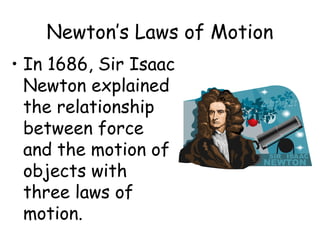
• In 1686, Sir Isaac
  Newton explained
  the relationship
  between force
  and the motion of
  objects with
  three laws of
  motion.
1st Law of Motion
• Newton’s 1st Law of Motion
  states that an object at rest
  remains at rest and an
  object in motion stays in
  motion until acted on by an
  unbalanced force.
• Two parts: Objects at rest
  and objects in motion.
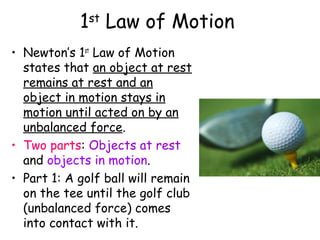
• Part 1: A golf ball will remain
  on the tee until the golf club
  (unbalanced force) comes
  into contact with it.
1st Law continued
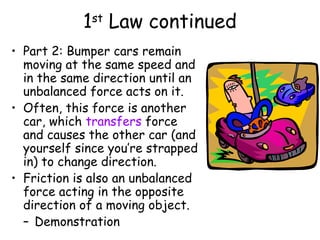
• Part 2: Bumper cars remain
  moving at the same speed and
  in the same direction until an
  unbalanced force acts on it.
• Often, this force is another
  car, which transfers force
  and causes the other car (and
  yourself since you’re strapped
  in) to change direction.
• Friction is also an unbalanced
  force acting in the opposite
  direction of a moving object.
  – Demonstration
Inertia
• Newton’s 1st Law is often called
  the law of inertia.
• Inertia is the tendency of all
  objects to resist any change in
  motion.
• All objects (resting or in motion)
  have inertia.
• Objects with a smaller mass have
  less inertia than one with a
  larger mass. It’s easier to start
  and stop a less massive object.
   – Mass is a measure of inertia.
QuickTime™ and a
         QuickTime™ and a
          decompressor
           decompressor
are needed to see this picture.
 are needed to see this picture.
Newton’s 2nd Law of Motion
• Newton’s 2nd law states that
  the acceleration of an object
  depends on the mass of the
  object and the amount of
  force applied.
• Part 1: Acceleration depends
  on mass.
  – An empty shopping cart
    accelerates faster than a full
    cart. Acceleration increases as
    mass decreases and acceleration
    decreases as mass increases.
    (inverse relationship)
Newton’s 2 Law continued
                        nd

• Part 2: Acceleration depends on force.
  – The same cart will move faster when a larger amount
    of force is used. Acceleration increases as force
    increases. (direct relationship)
• Mathematically, Newton’s 2nd law states:
  – a = F/m or F = ma
  – Acceleration equals the force applied divided by the
    object’s mass. When rearranged, force equals the
    object’s mass multiplied by acceleration.
• This law explains why objects fall to Earth at
  the same rate regardless of mass.
QuickTime™ and aa
         QuickTime™ and
           decompressor
           decompressor
are needed to see this picture.
 are needed to see this picture.
Newton’s 3rd Law of Motion
• Newton’s 3rd law states that whenever an
  object exerts a force on a second object,
  the second object exerts an equal and
  opposite force on the first object.
• The law states that forces act in pairs,
  but do not act on the same object.
• There are action and reaction forces
  (acting in pairs).
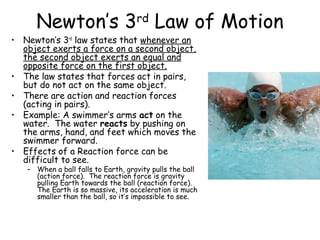
• Example: A swimmer’s arms act on the
  water. The water reacts by pushing on
  the arms, hand, and feet which moves the
  swimmer forward.
• Effects of a Reaction force can be
  difficult to see.
   – When a ball falls to Earth, gravity pulls the ball
     (action force). The reaction force is gravity
     pulling Earth towards the ball (reaction force).
     The Earth is so massive, its acceleration is much
     smaller than the ball, so it’s impossible to see.
3rd Law Continued

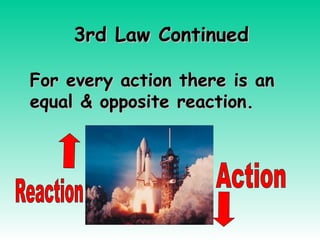
For every action there is an
equal & opposite reaction.
QuickTime™ and aa
         QuickTime™ and
           decompressor
          decompressor
are needed to see this picture.
 are needed to see this picture.
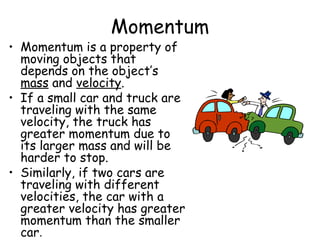
Momentum
• Momentum is a property of
  moving objects that
  depends on the object’s
  mass and velocity.
• If a small car and truck are
  traveling with the same
  velocity, the truck has
  greater momentum due to
  its larger mass and will be
  harder to stop.
• Similarly, if two cars are
  traveling with different
  velocities, the car with a
  greater velocity has greater
  momentum than the smaller
  car.
Conservation of Momentum
• When a moving object hits
  another object, some or all
  of the momentum from the
  first object is transferred
  to the other object.
• For example: Billiards and
  Bowling
• Law of Conservation of
  Momentum: Any time two or
  more objects interact, they
  may exchange momentum,
  but the total amount of
  momentum stays the same.

Newton's laws 2012 megan

  • 2.
    Newton’s Laws ofMotion • In 1686, Sir Isaac Newton explained the relationship between force and the motion of objects with three laws of motion.
  • 3.
    1st Law ofMotion • Newton’s 1st Law of Motion states that an object at rest remains at rest and an object in motion stays in motion until acted on by an unbalanced force. • Two parts: Objects at rest and objects in motion. • Part 1: A golf ball will remain on the tee until the golf club (unbalanced force) comes into contact with it.
  • 4.
    1st Law continued •Part 2: Bumper cars remain moving at the same speed and in the same direction until an unbalanced force acts on it. • Often, this force is another car, which transfers force and causes the other car (and yourself since you’re strapped in) to change direction. • Friction is also an unbalanced force acting in the opposite direction of a moving object. – Demonstration
  • 5.
    Inertia • Newton’s 1stLaw is often called the law of inertia. • Inertia is the tendency of all objects to resist any change in motion. • All objects (resting or in motion) have inertia. • Objects with a smaller mass have less inertia than one with a larger mass. It’s easier to start and stop a less massive object. – Mass is a measure of inertia.
  • 6.
    QuickTime™ and a QuickTime™ and a decompressor decompressor are needed to see this picture. are needed to see this picture.
  • 7.
    Newton’s 2nd Lawof Motion • Newton’s 2nd law states that the acceleration of an object depends on the mass of the object and the amount of force applied. • Part 1: Acceleration depends on mass. – An empty shopping cart accelerates faster than a full cart. Acceleration increases as mass decreases and acceleration decreases as mass increases. (inverse relationship)
  • 8.
    Newton’s 2 Lawcontinued nd • Part 2: Acceleration depends on force. – The same cart will move faster when a larger amount of force is used. Acceleration increases as force increases. (direct relationship) • Mathematically, Newton’s 2nd law states: – a = F/m or F = ma – Acceleration equals the force applied divided by the object’s mass. When rearranged, force equals the object’s mass multiplied by acceleration. • This law explains why objects fall to Earth at the same rate regardless of mass.
  • 9.
    QuickTime™ and aa QuickTime™ and decompressor decompressor are needed to see this picture. are needed to see this picture.
  • 10.
    Newton’s 3rd Lawof Motion • Newton’s 3rd law states that whenever an object exerts a force on a second object, the second object exerts an equal and opposite force on the first object. • The law states that forces act in pairs, but do not act on the same object. • There are action and reaction forces (acting in pairs). • Example: A swimmer’s arms act on the water. The water reacts by pushing on the arms, hand, and feet which moves the swimmer forward. • Effects of a Reaction force can be difficult to see. – When a ball falls to Earth, gravity pulls the ball (action force). The reaction force is gravity pulling Earth towards the ball (reaction force). The Earth is so massive, its acceleration is much smaller than the ball, so it’s impossible to see.
  • 11.
    3rd Law Continued Forevery action there is an equal & opposite reaction.
  • 12.
    QuickTime™ and aa QuickTime™ and decompressor decompressor are needed to see this picture. are needed to see this picture.
  • 13.
    Momentum • Momentum isa property of moving objects that depends on the object’s mass and velocity. • If a small car and truck are traveling with the same velocity, the truck has greater momentum due to its larger mass and will be harder to stop. • Similarly, if two cars are traveling with different velocities, the car with a greater velocity has greater momentum than the smaller car.
  • 14.
    Conservation of Momentum •When a moving object hits another object, some or all of the momentum from the first object is transferred to the other object. • For example: Billiards and Bowling • Law of Conservation of Momentum: Any time two or more objects interact, they may exchange momentum, but the total amount of momentum stays the same.