Learning Objectives
• Ican state Newton’s Laws of Motion.
• I can apply Newton’s Laws of Motion to real
life situations.
• I can describe momentum of different objects
and how it affects motion.
• I can explain the relationship between inertia
and mass.
Background
Sir Isaac Newton(1643-1727) an English scientist and
mathematician famous for his discovery of the law of
gravity also discovered the three laws of motion. He
published them in his book Philosophiae Naturalis
Principia Mathematica (mathematic principles of
natural philosophy) in 1687. Today these laws are
known as Newton’s Laws of Motion and describe the
motion of all objects on the scale we experience in our
everyday lives.
5.
Newton’s 3 Lawsof Motion
1. An object in motion tends to stay in motion
and an object at rest tends to stay at rest
unless acted upon by an unbalanced force.
2. Force equals mass times acceleration
(F = ma).
3.For every action there is an equal and
opposite reaction.
6.
Newton’s First Law
(lawof inertia)
An object at rest tends to stay at rest
and an object in motion tends to stay
in motion unless acted upon by an
unbalanced force.
7.
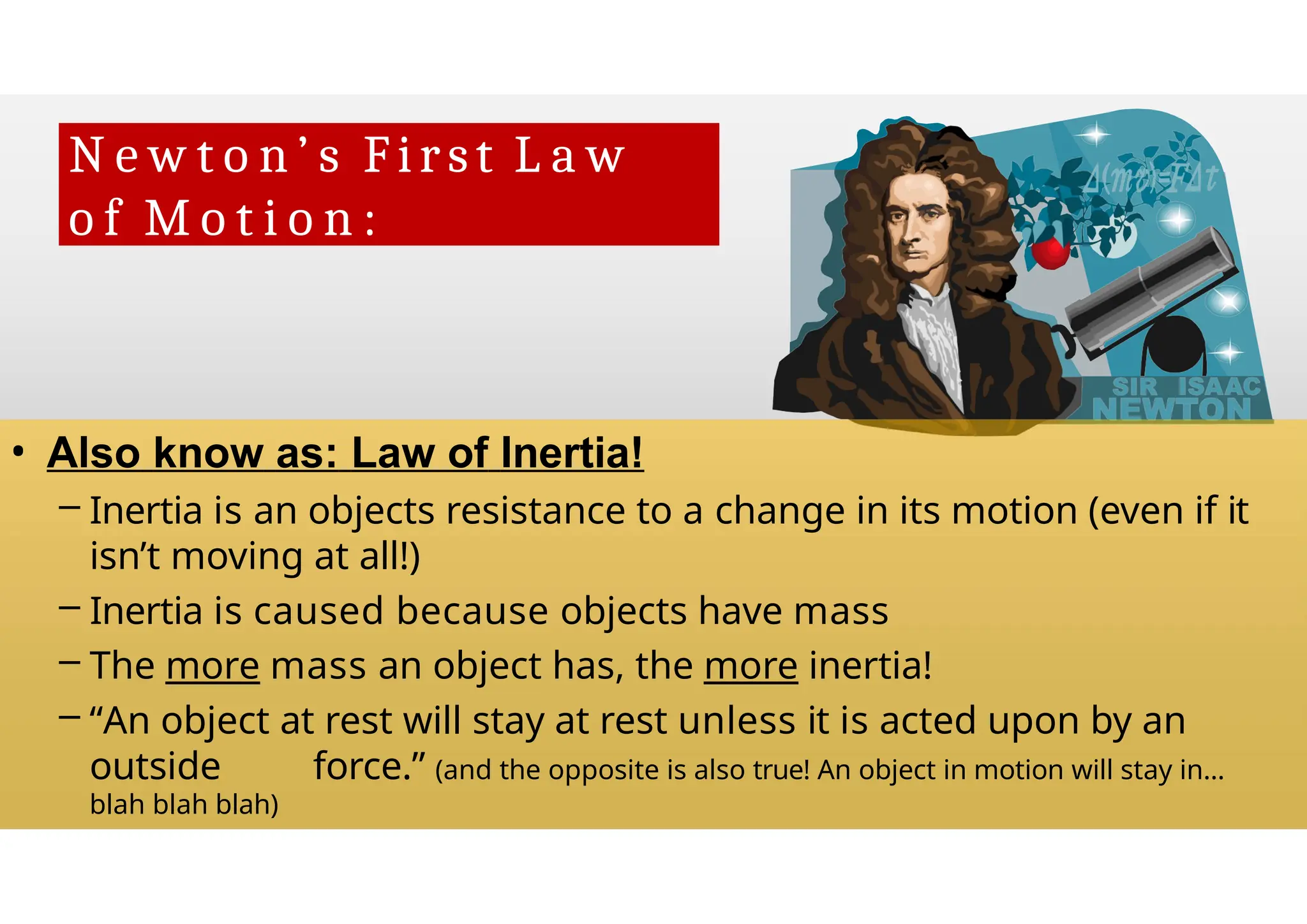
N e wt o n ’ s First L a w
o f M o t i o n :
• Also know as: Law of Inertia!
– Inertia is an objects resistance to a change in its motion (even if it
isn’t moving at all!)
– Inertia is caused because objects have mass
– The more mass an object has, the more inertia!
– “An object at rest will stay at rest unless it is acted upon by an
outside force.” (and the opposite is also true! An object in motion will stay in…
blah blah blah)
8.
Newton’s Second Law
(F= ma)
Force equals mass times acceleration.
F = ma
Acceleration: a measurement of how quickly
an object is changing speed.
9.
► More Force= more Acceleration
► More Mass = more Force
needed!
Newton’s Second Law of Motion
says:
“To move a mass, you need a force!”
Also known as F=ma
I am
so
smar
t
…
The greater the mass = greater inertia = more force needed!
10.
What do youthink happens to our acceleration
w/ different masses?
Distance
Time
Less Mass =
less force
needed
More Mass =
more force
needed
½ kg
1kg
2kg
With less mass, it doesn’t take as
much effort to get it moving;
therefore, I can move it farther in
less time (faster).
With more mass, it takes more
effort to get it moving; therefore,
it takes me more time to move it
farther (slower).
11.
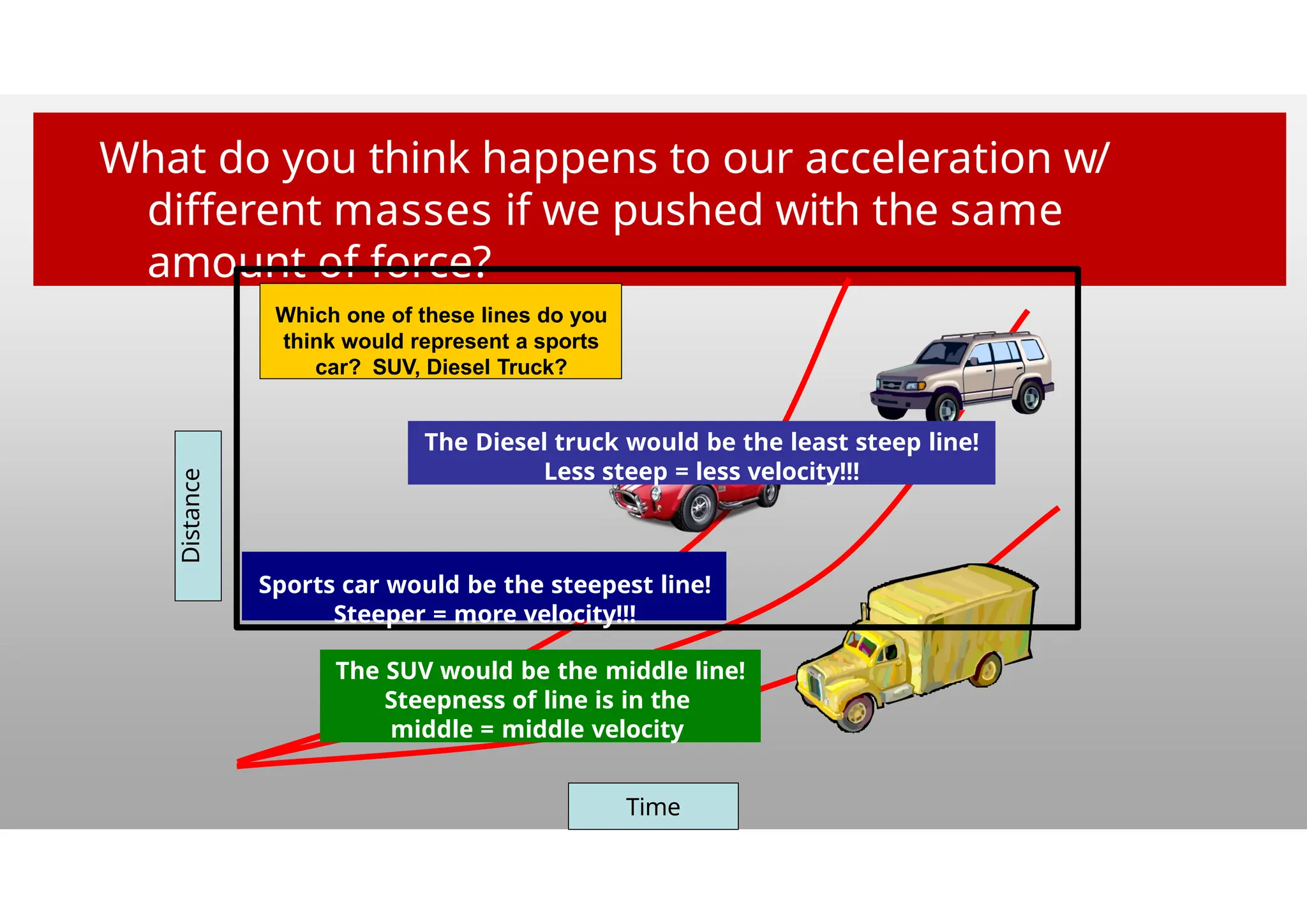
What do youthink happens to our acceleration w/
different masses if we pushed with the same
amount of force?
Distance
Time
Which one of these lines do you
think would represent a sports
car? SUV, Diesel Truck?
Sports car would be the steepest line!
Steeper = more velocity!!!
The Diesel truck would be the least steep line!
Less steep = less velocity!!!
The SUV would be the middle line!
Steepness of line is in the
middle = middle velocity
N e wt o n ’ s T h i r d L a w o f M o t i o n
• Also known as: Action-Reaction
• “For every action there is an
equal and opposite reaction.”
• Rockets take off because of a
force downwards from the
bottom makes them accelerate in
the opposite direction!
Downward
s force
Upward
s
reaction
14.
Vocabulary
Inertia: the tendencyof an object to resist changes in
its state of motion
Acceleration:
•a change in velocity
• a measurement of how quickly an
object is changing speed, direction or both
Velocity: The rate of change of a position along
a straight line with respect to time
Force: Push or pull (strength or energy