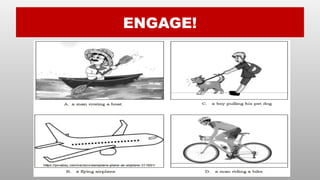
RECALL!
•What did you learn on the
last topic discussed to
the class?
ENGAGE!
•Have you ever experience
difficulties in stopping a
moving object? If yes, why
do you think so?
ENGAGE!
ENGAGE!
• VIDEO
Newtons Laws of
Motion
I. Law of Inertia
II. F = ma
III. Action-Reaction
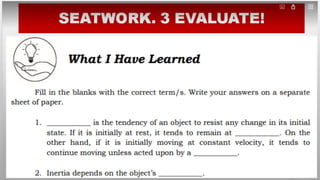
Learning Objectives
• Learners will be able to state the Newton’s Laws of
Motion.
• Learners can apply Newton’s Laws of Motion to
real life situations.
• Learners will be able to explain and demonstrate
the relationship between inertia and mass.
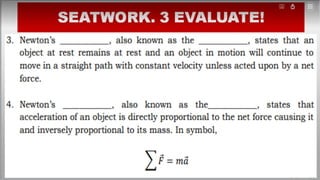
Newton’s Laws of Motion
Background
Sir Isaac Newton (1643-1727) an English scientist
and mathematician famous for his discovery of the
law of gravity also discovered the three laws of
motion. He published them in his book Philosophiae
Naturalis Principia Mathematica (mathematic
principles of natural philosophy) in 1687. Today
these laws are known as Newton’s Laws of Motion
and describe the motion of all objects on the scale
we experience in our everyday lives.
Newton’s 3 Laws of Motion
1. An object in motion tends to stay in motion
and an object at rest tends to stay at rest
unless acted upon by an unbalanced force.
2. Force equals mass times acceleration
(F = ma).
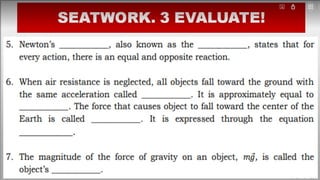
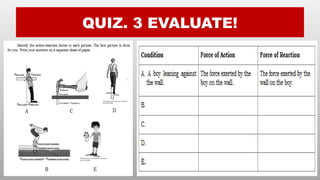
3. For every action there is an equal and
opposite reaction.
Newton’s First Law
(law of inertia)
An object at rest tends to stay at rest
and an object in motion tends to stay
in motion unless acted upon by an
unbalanced force.
Newton’s First Law
of Motion:
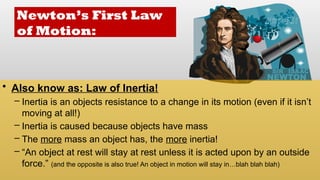
• Also know as: Law of Inertia!
– Inertia is an objects resistance to a change in its motion (even if it isn’t
moving at all!)
– Inertia is caused because objects have mass
– The more mass an object has, the more inertia!
– “An object at rest will stay at rest unless it is acted upon by an outside
force.” (and the opposite is also true! An object in motion will stay in…blah blah blah)
Newton’s First Law
of Motion:
• Basically, an object will “keep doing what it was
doing” in the same direction at the same speed
unless acted on by an unbalanced force.
• If the object was sitting still, it will remain
stationary. If it was moving at a constant velocity, it
will keep moving.
• It takes force to change the motion of an object.
Newton’s First Law
of Motion:
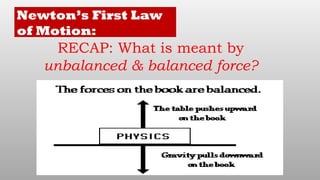
RECAP: What is meant by
unbalanced & balanced force?
Newton’s First Law
of Motion:
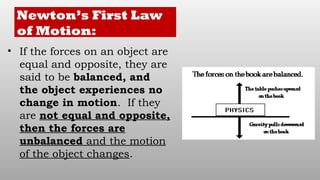
• If the forces on an object are
equal and opposite, they are
said to be balanced, and
the object experiences no
change in motion. If they
are not equal and opposite,
then the forces are
unbalanced and the motion
of the object changes.
Newton’s First Law
of Motion:
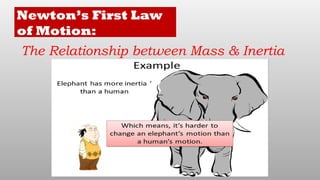
The Relationship between Mass & Inertia
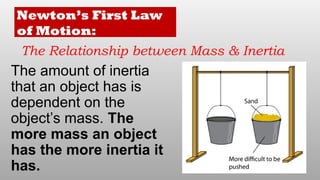
The amount of inertia
that an object has is
dependent on the
object’s mass. The
more mass an object
has the more inertia it
has.
Newton’s First Law
of Motion:
The Relationship between Mass & Inertia
ELABORATE!
Analyze the
picture given and
answer the
questions
provided.
ELABORATE!
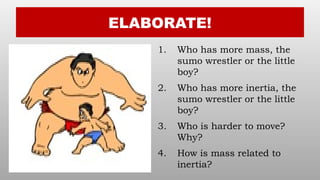
1. Who has more mass, the
sumo wrestler or the little
boy?
2. Who has more inertia, the
sumo wrestler or the little
boy?
3. Who is harder to move?
Why?
4. How is mass related to
inertia?
Newton’s First Law
of Motion:
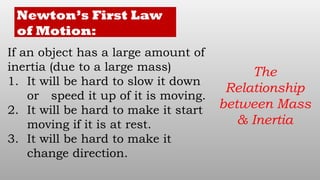
If an object has a large amount of
inertia (due to a large mass)
1. It will be hard to slow it down
or speed it up of it is moving.
2. It will be hard to make it start
moving if it is at rest.
3. It will be hard to make it
change direction.
The
Relationship
between Mass
& Inertia
ELABORATE!
COMPLETE THE SENTENCE.
I have learned that:
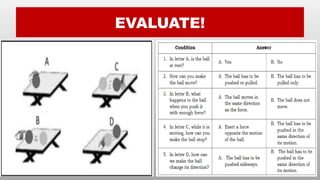
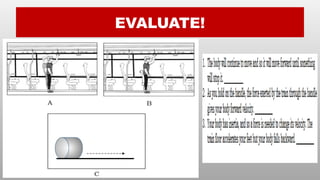
EVALUATE!
EVALUATE!
RECALL!
•What did you learn on the
last topic discussed to
the class?
ENGAGE!
•Volunteer:
–3 chairs,
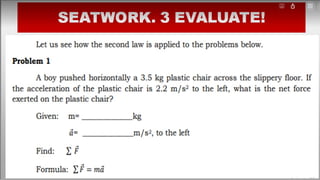
Newton’s Second Law
(law of acceleration)
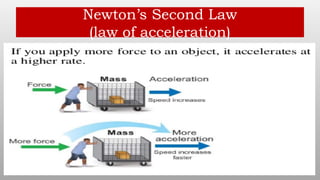
The acceleration of an object is directly
proportional to the net force acting on it
and is inversely proportional to the
object’s mass. The direction of the
acceleration is in the direction of the net
force acting on the object
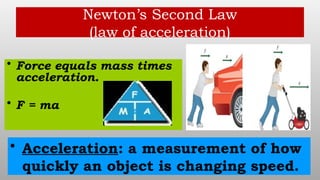
Newton’s Second Law
(law of acceleration)
• Force equals mass times
acceleration.
• F = ma
• Acceleration: a measurement of how
quickly an object is changing speed.
Newton’s Second Law
(law of acceleration)
Newton’s Second Law
(law of acceleration)
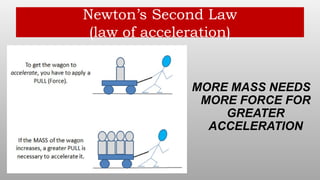
MORE MASS NEEDS
MORE FORCE FOR
GREATER
ACCELERATION
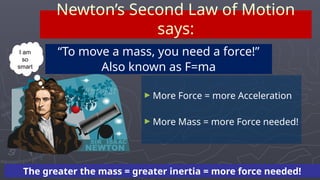
► More Force = more Acceleration
► More Mass = more Force needed!
Newton’s Second Law of Motion
says:
“To move a mass, you need a force!”
Also known as F=ma
I am
so
smart
…
The greater the mass = greater inertia = more force needed!
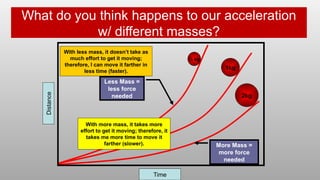
What do you think happens to our acceleration
w/ different masses?
Distance
Time
Less Mass =
less force
needed
More Mass =
more force
needed
½ kg
1kg
2kg
With less mass, it doesn’t take as
much effort to get it moving;
therefore, I can move it farther in
less time (faster).
With more mass, it takes more
effort to get it moving; therefore, it
takes me more time to move it
farther (slower).
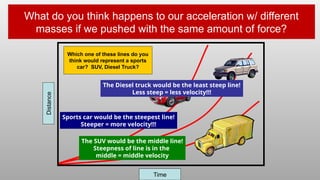
What do you think happens to our acceleration w/ different
masses if we pushed with the same amount of force?
Distance
Time
Which one of these lines do you
think would represent a sports
car? SUV, Diesel Truck?
Sports car would be the steepest line!
Steeper = more velocity!!!
The Diesel truck would be the least steep line!
Less steep = less velocity!!!
The SUV would be the middle line!
Steepness of line is in the
middle = middle velocity
Newton’s Second Law
(law of acceleration)
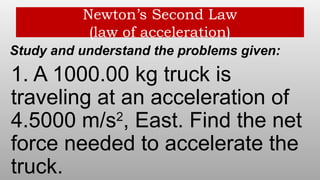
Study and understand the problems given:
1. A 1000.00 kg truck is
traveling at an acceleration of
4.5000 m/s2
, East. Find the net
force needed to accelerate the
truck.
Newton’s Second Law
(law of acceleration)
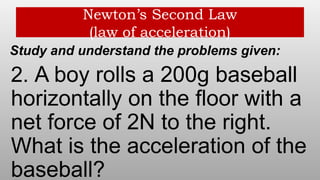
Study and understand the problems given:
2. A boy rolls a 200g baseball
horizontally on the floor with a
net force of 2N to the right.
What is the acceleration of the
baseball?
ELABORATE!
COMPLETE THE SENTENCE.
I have learned that:
QUIZ. 2 EVALUATE!
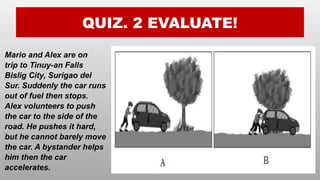
Mario and Alex are on
trip to Tinuy-an Falls
Bislig City, Surigao del
Sur. Suddenly the car runs
out of fuel then stops.
Alex volunteers to push
the car to the side of the
road. He pushes it hard,
but he cannot barely move
the car. A bystander helps
him then the car
accelerates.
QUIZ. 2 EVALUATE!
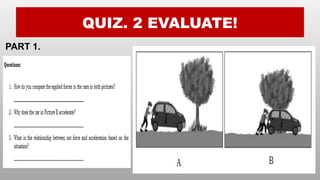
PART 1.
QUIZ. 2 EVALUATE!
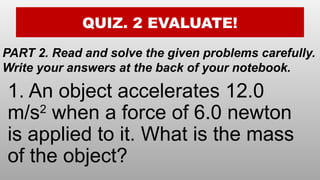
PART 2. Read and solve the given problems carefully.
Write your answers at the back of your notebook.
1. An object accelerates 12.0
m/s2
when a force of 6.0 newton
is applied to it. What is the mass
of the object?
QUIZ. 2 EVALUATE!
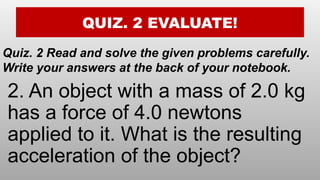
Quiz. 2 Read and solve the given problems carefully.
Write your answers at the back of your notebook.
2. An object with a mass of 2.0 kg
has a force of 4.0 newtons
applied to it. What is the resulting
acceleration of the object?
QUIZ. 2 EVALUATE!
Quiz. 2 Read and solve the given problems carefully.
Write your answers at the back of your notebook.
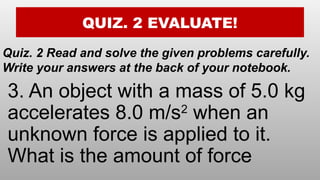
3. An object with a mass of 5.0 kg
accelerates 8.0 m/s2
when an
unknown force is applied to it.
What is the amount of force
QUIZ. 2 EVALUATE!
Quiz. 2 Read and solve the given problems carefully.
Write your answers at the back of your notebook.
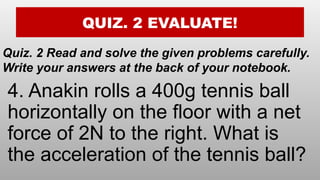
4. Anakin rolls a 400g tennis ball
horizontally on the floor with a net
force of 2N to the right. What is
the acceleration of the tennis ball?
RECALL!
•What did you learn on the
last topic discussed to
the class?
ENGAGE!
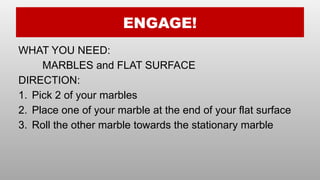
WHAT YOU NEED:
MARBLES and FLAT SURFACE
DIRECTION:
1. Pick 2 of your marbles
2. Place one of your marble at the end of your flat surface
3. Roll the other marble towards the stationary marble
SEATWORK 2. EVALUATE
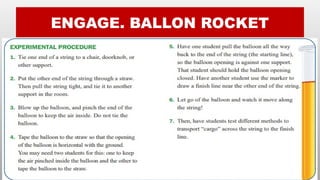
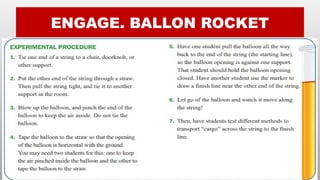
ENGAGE. BALLON ROCKET
Analyze and Conclude:
1.Once you have the balloon set, what happens when
you let go of it? What causes this to happen?
2.What do you think will make the balloon move
faster?
3.What happens when you add cargo to the balloon
rocket?
4.What forces act on the balloon?
5.What is the reaction force acting on the balloon?
6.What are the action-reaction pairs?
Newton’s Third Law
(Action-Reaction)
For every action there is an
equal and opposite reaction.
ENGAGE. MARBLE ROLLING
Analyze and Conclude:
1.What do you notice when the marbles
collide?
2.What forces act on the marbles?
3.What is reaction force acting on the
marble?
4. What are the action-reaction pairs?
Newton’s Third Law
(Action-Reaction)
“When one object exerts a
force on a second object, the
second one exerts a force on
the first that is equal in
magnitude and opposite in
direction.”
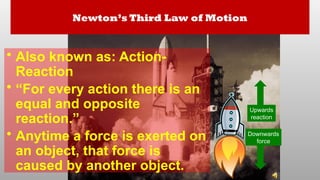
Newton’s Third Law of Motion
• Also known as: Action-
Reaction
• “For every action there is an
equal and opposite
reaction.”
• Anytime a force is exerted on
an object, that force is
caused by another object.
Downwards
force
Upwards
reaction
Newton’s Third Law of Motion
Downwards
force
Upwards
reaction
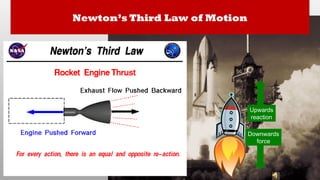
Newton’s Third Law of Motion
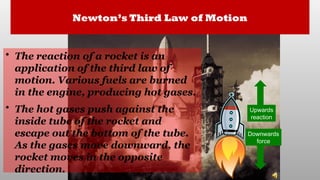
• The reaction of a rocket is an
application of the third law of
motion. Various fuels are burned
in the engine, producing hot gases.
• The hot gases push against the
inside tube of the rocket and
escape out the bottom of the tube.
As the gases move downward, the
rocket moves in the opposite
direction.
Downwards
force
Upwards
reaction
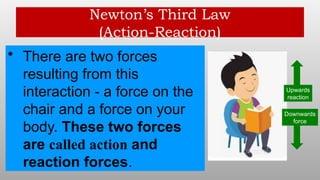
Newton’s Third Law
(Action-Reaction)
• There are two forces
resulting from this
interaction - a force on the
chair and a force on your
body. These two forces
are called action and
reaction forces.
Downwards
force
Upwards
reaction
Newton’s Third Law
(Action-Reaction)
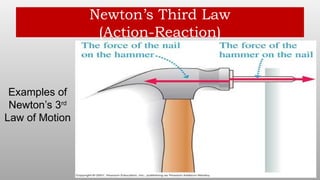
Examples of
Newton’s 3rd
Law of Motion
Newton’s Third Law
(Action-Reaction)
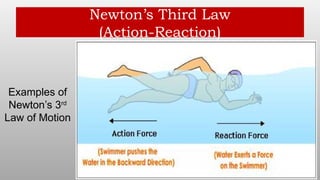
Examples of
Newton’s 3rd
Law of Motion
ELABORATE!
COMPLETE THE SENTENCE.
I have learned that:
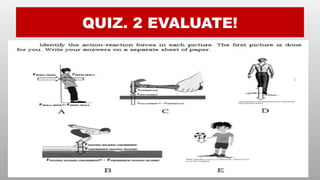
QUIZ. 2 EVALUATE!
QUIZ. 3 EVALUATE!
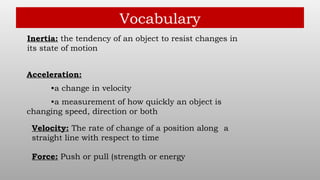
Vocabulary
Inertia: the tendency of an object to resist changes in
its state of motion
Acceleration:
•a change in velocity
•a measurement of how quickly an object is
changing speed, direction or both
Velocity: The rate of change of a position along a
straight line with respect to time
Force: Push or pull (strength or energy

threelawsofnewton_hs_science_gradeeight_

  • 1.
    RECALL! •What did youlearn on the last topic discussed to the class?
  • 2.
    ENGAGE! •Have you everexperience difficulties in stopping a moving object? If yes, why do you think so?
  • 3.
  • 4.
  • 5.
    Newtons Laws of Motion I.Law of Inertia II. F = ma III. Action-Reaction
  • 6.
    Learning Objectives • Learnerswill be able to state the Newton’s Laws of Motion. • Learners can apply Newton’s Laws of Motion to real life situations. • Learners will be able to explain and demonstrate the relationship between inertia and mass.
  • 7.
  • 8.
    Background Sir Isaac Newton(1643-1727) an English scientist and mathematician famous for his discovery of the law of gravity also discovered the three laws of motion. He published them in his book Philosophiae Naturalis Principia Mathematica (mathematic principles of natural philosophy) in 1687. Today these laws are known as Newton’s Laws of Motion and describe the motion of all objects on the scale we experience in our everyday lives.
  • 9.
    Newton’s 3 Lawsof Motion 1. An object in motion tends to stay in motion and an object at rest tends to stay at rest unless acted upon by an unbalanced force. 2. Force equals mass times acceleration (F = ma). 3. For every action there is an equal and opposite reaction.
  • 10.
    Newton’s First Law (lawof inertia) An object at rest tends to stay at rest and an object in motion tends to stay in motion unless acted upon by an unbalanced force.
  • 11.
    Newton’s First Law ofMotion: • Also know as: Law of Inertia! – Inertia is an objects resistance to a change in its motion (even if it isn’t moving at all!) – Inertia is caused because objects have mass – The more mass an object has, the more inertia! – “An object at rest will stay at rest unless it is acted upon by an outside force.” (and the opposite is also true! An object in motion will stay in…blah blah blah)
  • 12.
    Newton’s First Law ofMotion: • Basically, an object will “keep doing what it was doing” in the same direction at the same speed unless acted on by an unbalanced force. • If the object was sitting still, it will remain stationary. If it was moving at a constant velocity, it will keep moving. • It takes force to change the motion of an object.
  • 13.
    Newton’s First Law ofMotion: RECAP: What is meant by unbalanced & balanced force?
  • 14.
    Newton’s First Law ofMotion: • If the forces on an object are equal and opposite, they are said to be balanced, and the object experiences no change in motion. If they are not equal and opposite, then the forces are unbalanced and the motion of the object changes.
  • 15.
    Newton’s First Law ofMotion: The Relationship between Mass & Inertia The amount of inertia that an object has is dependent on the object’s mass. The more mass an object has the more inertia it has.
  • 16.
    Newton’s First Law ofMotion: The Relationship between Mass & Inertia
  • 17.
    ELABORATE! Analyze the picture givenand answer the questions provided.
  • 18.
    ELABORATE! 1. Who hasmore mass, the sumo wrestler or the little boy? 2. Who has more inertia, the sumo wrestler or the little boy? 3. Who is harder to move? Why? 4. How is mass related to inertia?
  • 19.
    Newton’s First Law ofMotion: If an object has a large amount of inertia (due to a large mass) 1. It will be hard to slow it down or speed it up of it is moving. 2. It will be hard to make it start moving if it is at rest. 3. It will be hard to make it change direction. The Relationship between Mass & Inertia
  • 20.
  • 21.
  • 22.
  • 23.
    RECALL! •What did youlearn on the last topic discussed to the class?
  • 24.
  • 25.
    Newton’s Second Law (lawof acceleration) The acceleration of an object is directly proportional to the net force acting on it and is inversely proportional to the object’s mass. The direction of the acceleration is in the direction of the net force acting on the object
  • 26.
    Newton’s Second Law (lawof acceleration) • Force equals mass times acceleration. • F = ma • Acceleration: a measurement of how quickly an object is changing speed.
  • 27.
  • 28.
    Newton’s Second Law (lawof acceleration) MORE MASS NEEDS MORE FORCE FOR GREATER ACCELERATION
  • 29.
    ► More Force= more Acceleration ► More Mass = more Force needed! Newton’s Second Law of Motion says: “To move a mass, you need a force!” Also known as F=ma I am so smart … The greater the mass = greater inertia = more force needed!
  • 30.
    What do youthink happens to our acceleration w/ different masses? Distance Time Less Mass = less force needed More Mass = more force needed ½ kg 1kg 2kg With less mass, it doesn’t take as much effort to get it moving; therefore, I can move it farther in less time (faster). With more mass, it takes more effort to get it moving; therefore, it takes me more time to move it farther (slower).
  • 31.
    What do youthink happens to our acceleration w/ different masses if we pushed with the same amount of force? Distance Time Which one of these lines do you think would represent a sports car? SUV, Diesel Truck? Sports car would be the steepest line! Steeper = more velocity!!! The Diesel truck would be the least steep line! Less steep = less velocity!!! The SUV would be the middle line! Steepness of line is in the middle = middle velocity
  • 32.
    Newton’s Second Law (lawof acceleration) Study and understand the problems given: 1. A 1000.00 kg truck is traveling at an acceleration of 4.5000 m/s2 , East. Find the net force needed to accelerate the truck.
  • 33.
    Newton’s Second Law (lawof acceleration) Study and understand the problems given: 2. A boy rolls a 200g baseball horizontally on the floor with a net force of 2N to the right. What is the acceleration of the baseball?
  • 34.
  • 35.
    QUIZ. 2 EVALUATE! Marioand Alex are on trip to Tinuy-an Falls Bislig City, Surigao del Sur. Suddenly the car runs out of fuel then stops. Alex volunteers to push the car to the side of the road. He pushes it hard, but he cannot barely move the car. A bystander helps him then the car accelerates.
  • 36.
  • 37.
    QUIZ. 2 EVALUATE! PART2. Read and solve the given problems carefully. Write your answers at the back of your notebook. 1. An object accelerates 12.0 m/s2 when a force of 6.0 newton is applied to it. What is the mass of the object?
  • 38.
    QUIZ. 2 EVALUATE! Quiz.2 Read and solve the given problems carefully. Write your answers at the back of your notebook. 2. An object with a mass of 2.0 kg has a force of 4.0 newtons applied to it. What is the resulting acceleration of the object?
  • 39.
    QUIZ. 2 EVALUATE! Quiz.2 Read and solve the given problems carefully. Write your answers at the back of your notebook. 3. An object with a mass of 5.0 kg accelerates 8.0 m/s2 when an unknown force is applied to it. What is the amount of force
  • 40.
    QUIZ. 2 EVALUATE! Quiz.2 Read and solve the given problems carefully. Write your answers at the back of your notebook. 4. Anakin rolls a 400g tennis ball horizontally on the floor with a net force of 2N to the right. What is the acceleration of the tennis ball?
  • 41.
    RECALL! •What did youlearn on the last topic discussed to the class?
  • 42.
    ENGAGE! WHAT YOU NEED: MARBLESand FLAT SURFACE DIRECTION: 1. Pick 2 of your marbles 2. Place one of your marble at the end of your flat surface 3. Roll the other marble towards the stationary marble
  • 43.
  • 44.
  • 45.
  • 46.
  • 47.
  • 48.
  • 49.
    ENGAGE. BALLON ROCKET Analyzeand Conclude: 1.Once you have the balloon set, what happens when you let go of it? What causes this to happen? 2.What do you think will make the balloon move faster? 3.What happens when you add cargo to the balloon rocket? 4.What forces act on the balloon? 5.What is the reaction force acting on the balloon? 6.What are the action-reaction pairs?
  • 50.
    Newton’s Third Law (Action-Reaction) Forevery action there is an equal and opposite reaction.
  • 51.
    ENGAGE. MARBLE ROLLING Analyzeand Conclude: 1.What do you notice when the marbles collide? 2.What forces act on the marbles? 3.What is reaction force acting on the marble? 4. What are the action-reaction pairs?
  • 52.
    Newton’s Third Law (Action-Reaction) “Whenone object exerts a force on a second object, the second one exerts a force on the first that is equal in magnitude and opposite in direction.”
  • 53.
    Newton’s Third Lawof Motion • Also known as: Action- Reaction • “For every action there is an equal and opposite reaction.” • Anytime a force is exerted on an object, that force is caused by another object. Downwards force Upwards reaction
  • 54.
    Newton’s Third Lawof Motion Downwards force Upwards reaction
  • 55.
    Newton’s Third Lawof Motion • The reaction of a rocket is an application of the third law of motion. Various fuels are burned in the engine, producing hot gases. • The hot gases push against the inside tube of the rocket and escape out the bottom of the tube. As the gases move downward, the rocket moves in the opposite direction. Downwards force Upwards reaction
  • 56.
    Newton’s Third Law (Action-Reaction) •There are two forces resulting from this interaction - a force on the chair and a force on your body. These two forces are called action and reaction forces. Downwards force Upwards reaction
  • 57.
    Newton’s Third Law (Action-Reaction) Examplesof Newton’s 3rd Law of Motion
  • 58.
    Newton’s Third Law (Action-Reaction) Examplesof Newton’s 3rd Law of Motion
  • 59.
  • 60.
  • 61.
  • 62.
    Vocabulary Inertia: the tendencyof an object to resist changes in its state of motion Acceleration: •a change in velocity •a measurement of how quickly an object is changing speed, direction or both Velocity: The rate of change of a position along a straight line with respect to time Force: Push or pull (strength or energy