NEWSPAPER ARTICLES
Newspaper headlines are often incomplete sentences (i.e.  Difficult Times Ahead ).  Here is a guide to the most common exceptions found in newspaper headlines.
NOUN PHRASES Headlines often contain a noun phrase with no verb. Here are some examples of noun phrase headlines:  Under Pressure from Boss Unexpected Visit Overwhelming Response of Voters
In the case of long noun phrases, it's helpful to try to connect the ideas by reading backward. For example:  Mustang Referral Customer Complaint
Mustang Referral Customer Complaint   By reading backwards, I can guess that: There is a  complaint  made by a  customer  about a  referral  program for  Mustang  cars. Of course, you need to use your imagine for this!
VARIOUS VERB CHANGES   There are a number of verb changes made to headlines.   Simple tenses  used instead of continuous or perfect forms.  For example:  Forgotten Brother Appears  = A forgotten brother has appeared (after a long period of time). The  infinitive  form refers to the future.  For example:  James Wood to Visit Portland  = (Famous actor) James Wood is going to visit Portland soon.  Auxiliary verbs  are dropped in the passive form.  For example:  Man Killed in Accident  = A Man has been killed in an accident.
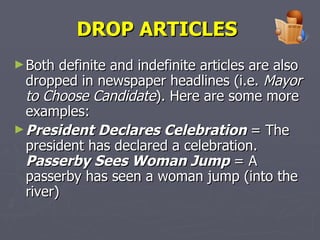
DROP ARTICLES   Both definite and indefinite articles are also dropped in newspaper headlines (i.e.  Mayor to Choose Candidate ). Here are some more examples:  President Declares Celebration  = The president has declared a celebration. Passerby Sees Woman Jump  = A passerby has seen a woman jump (into the river)
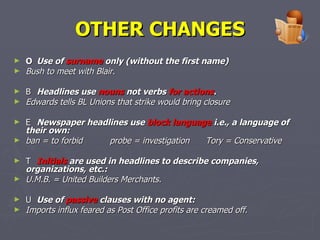
OTHER CHANGES 􀂃   Use of  surname  only (without the first name)  Bush to meet with Blair. 􀂃   Headlines use  nouns  not verbs  for actions . Edwards tells BL Unions that strike would bring closure 􀂃   Newspaper headlines use  block language  i.e., a language of their own: ban = to forbid probe = investigation Tory = Conservative 􀂃   Initials  are used in headlines to describe companies, organizations, etc.: U.M.B. = United Builders Merchants. 􀂃   Use of  passive  clauses with no agent: Imports influx feared as Post Office profits are creamed off.
News items and stories in newspapers have headlines above them.  A headline usually has only four or five words.  The idea of a headline is to  attract the interest of the readers  by telling them in an interesting and short way what the story is about.
AFTER THE HEADING The following questions must be answered: WHERE? WHEN? WHO? WHAT? WHY? HOW? HOW DO THEY FEEL?
THE END

Newspapersections

  • 1.
  • 2.
    Newspaper headlines areoften incomplete sentences (i.e. Difficult Times Ahead ). Here is a guide to the most common exceptions found in newspaper headlines.
  • 3.
    NOUN PHRASES Headlinesoften contain a noun phrase with no verb. Here are some examples of noun phrase headlines: Under Pressure from Boss Unexpected Visit Overwhelming Response of Voters
  • 4.
    In the caseof long noun phrases, it's helpful to try to connect the ideas by reading backward. For example: Mustang Referral Customer Complaint
  • 5.
    Mustang Referral CustomerComplaint By reading backwards, I can guess that: There is a complaint made by a customer about a referral program for Mustang cars. Of course, you need to use your imagine for this!
  • 6.
    VARIOUS VERB CHANGES There are a number of verb changes made to headlines. Simple tenses used instead of continuous or perfect forms. For example: Forgotten Brother Appears = A forgotten brother has appeared (after a long period of time). The infinitive form refers to the future. For example: James Wood to Visit Portland = (Famous actor) James Wood is going to visit Portland soon. Auxiliary verbs are dropped in the passive form. For example: Man Killed in Accident = A Man has been killed in an accident.
  • 7.
    DROP ARTICLES Both definite and indefinite articles are also dropped in newspaper headlines (i.e. Mayor to Choose Candidate ). Here are some more examples: President Declares Celebration = The president has declared a celebration. Passerby Sees Woman Jump = A passerby has seen a woman jump (into the river)
  • 8.
    OTHER CHANGES 􀂃 Use of surname only (without the first name) Bush to meet with Blair. 􀂃 Headlines use nouns not verbs for actions . Edwards tells BL Unions that strike would bring closure 􀂃 Newspaper headlines use block language i.e., a language of their own: ban = to forbid probe = investigation Tory = Conservative 􀂃 Initials are used in headlines to describe companies, organizations, etc.: U.M.B. = United Builders Merchants. 􀂃 Use of passive clauses with no agent: Imports influx feared as Post Office profits are creamed off.
  • 9.
    News items andstories in newspapers have headlines above them.  A headline usually has only four or five words.  The idea of a headline is to attract the interest of the readers by telling them in an interesting and short way what the story is about.
  • 10.
    AFTER THE HEADINGThe following questions must be answered: WHERE? WHEN? WHO? WHAT? WHY? HOW? HOW DO THEY FEEL?
  • 11.