The  headline  is the text at the top of a newspaper article, indicating the nature of the article below it. Headlines
A headline is the first thing a reader notices, so you  want to make a good impression. Headlines are a major  point of entry  for readers. You want a headline that will effectively introduce the reader to the story. When you consider accuracy, clarity, conciseness and tone, then you can see why headlines are perhaps the most important and often the most difficult portion of the editing process.  The first impression
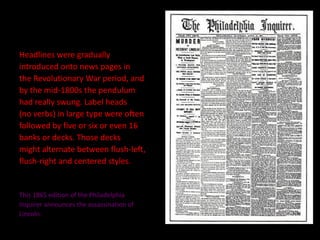
Headlines were gradually  introduced onto news pages in  the Revolutionary War period, and  by the mid-1800s the pendulum  had really swung. Label heads  (no verbs) in large type were often  followed by five or six or even 16  banks or decks. Those decks  might alternate between flush-left,  flush-right and centered styles.  This 1865 edition of the Philadelphia  Inquirer announces the assassination of  Lincoln.
Attract the reader's attention sells the story. As a point of entry, it is second to only the main photo/graphic element  Summarizes the story – that’s why a clear nut graph is so important Helps the reader index the contents of the page point sizes connote relative importance of story  Helps set the tone of the paper.  Provides typographic relief for the reader's eye. Serves as a design element that provides contrast with point size, typeface and type style (ital, bold etc.) Functions of headlines
Remember: The headline writer represents the reader.   Headlines are not complete sentences; instead, they are a  form of pidgin English; the textbook calls it a skeletonized  language. The articles a, an and the are cast aside for the  most part, and so is the verb is.  What makes a good headline?
1 Precise . Accurately reflects what the story is about. Being precise means the head fits the tone of the story (but serious stories can benefit from wordplay also). Being precise means moving the story forward. When a news event occurs early in the news cycle, the headline writer avoids a news peg that might be 12 hours old by the time the reader sees it..
2.  Clear . Isn’t overly subtle or worse, unintelligible. You don't say "huh?" after you read it. Don't use unfamiliar names, phrases, abbreviations, headlinese etc. Anyone know what the TCEQ is?  “Martinez hits homer” – which Martinez?  3.  Passes ethical / legal smell tests . Is balanced and fair, legally sound, tasteful in regard to subject matter. Don't use phrases like "arrested for" or "indicted for" or "charged for" -- only use the "for" word if someone is convicted. "Arrested for" is considered libelous, and lawsuits have been filed over that usage.
4.  Written with strong active verbs . Active voice is preferred to passive voice, but passive still can be OK. Gerunds (verbs ending with "ing") are OK but generally not preferred. Headlines without verbs can sometimes work, too; those are called  label heads. 5.  Fits the space requirement .  You don’t worry about hed space on the Internet, but you do in print and broadcast graphics. Many of the best headlines ever written were deep-sixed because they didn't fit. But AVOID PADDING just to fill out a line.  "U.S. Army medical doctor returns home"   is accurate   -- but   "Army doctor returns to Houston from Iraq"  has more information and is not redundant.
Critical elements : It’s easy to start with the subject / verb / object form (Police arrest man…). Then add the other key words as needed to add clarity and substance. Some of the key elements: Subject   –  the main “who” in the story, the protagonist, the central character.  Verb  –  whatever the primary action is. There may be more than one, as in “ Astros lose to Reds, fall 5 games back in wild-card race .” Which clause is more significant? Object  –  the secondary character/characters, perhaps the recipient of the action. This is where news judgment comes in.  d.  Location  –  Localize whenever possible. Proximity is a key factor in newsworthiness. Location can add clarity or serve as a memory trigger as well. e.  Time element   –  helpful when something happened years before, as in a cold case. It may be necessary for clarity.   f.  Attribution  –  Sometimes who says it adds weight to the subject. Use attribution to avoid being  accusatory or defamatory.   How to write a headline: Key steps
Rules for headlines 1. Spell everything right!  (Home of the Whopper) 2. Avoid ending a line of a hed with a preposition ( 4 killed in  /  I-45 pileup ), conjunction, part of a verb ( example:  FBI vows to crack /  down on drug dealers ) or modifiers  3. Don't editorialize -- except on editorial page.  County OKs  lousy budget . However, if "lousy" had been in somebody's quote  ( County OKs ‘lousy’ budget ), that head would be OK.  4. Don't  parrot  the lede. Don't steal that great verb or adjective  by the writer -- come up with your own. If you want to make  enemies among reporters, just steal their thunder in your  headlines. Incidentally, I've often seen heads that were much  more interesting than the story. 5. Include a subject and a verb. Avoid or limit use of label heads  such as "Montrose murder," but who can’t appreciate the 9/11  headline that said simply  Bastards!
Headline rules 11. Don't break compound nouns between lines.  Pilot tells Air Force to buzz off 12. Avoid unfamiliar names and places. How many Smiths are there in the vast, wide world of sports? Houston is bounded by several counties with towns of the same name -- Brazoria, Liberty, Montgomery, Waller. So a headline that said  Brazoria official indicted  could be confusing – is it a county official or city official who is in trouble?  13. Hed punctuation -- You can use certain punctuation in place of words. A colon can replace "says" or a comma can replace "and". Use single quotes in heads. Numerals are preferred also.  Smith: Cowboys will win  UH, Rice set schedules  Plan criticized as ‘disastrous’  3 senators miss vote but avoid  3 11-story buildings destroyed 14. Know first day heads vs. second day heads (folo stories) 15. Limit use of question heads.
Head orders Head orders have three parts: Width . The number of columns, or sticks of type, wide a story is Point size . 72 point is 1 inch tall, etc. Depth.  The number of lines Thus, a  2-36-2  head order means the headline  should be  two  columns wide, use  36 point   type and be  two  lines deep.

Headlines presentation improved 3

  • 1.
    The headline is the text at the top of a newspaper article, indicating the nature of the article below it. Headlines
  • 2.
    A headline isthe first thing a reader notices, so you want to make a good impression. Headlines are a major point of entry for readers. You want a headline that will effectively introduce the reader to the story. When you consider accuracy, clarity, conciseness and tone, then you can see why headlines are perhaps the most important and often the most difficult portion of the editing process. The first impression
  • 3.
    Headlines were gradually introduced onto news pages in the Revolutionary War period, and by the mid-1800s the pendulum had really swung. Label heads (no verbs) in large type were often followed by five or six or even 16 banks or decks. Those decks might alternate between flush-left, flush-right and centered styles. This 1865 edition of the Philadelphia Inquirer announces the assassination of Lincoln.
  • 4.
    Attract the reader'sattention sells the story. As a point of entry, it is second to only the main photo/graphic element Summarizes the story – that’s why a clear nut graph is so important Helps the reader index the contents of the page point sizes connote relative importance of story Helps set the tone of the paper. Provides typographic relief for the reader's eye. Serves as a design element that provides contrast with point size, typeface and type style (ital, bold etc.) Functions of headlines
  • 5.
    Remember: The headlinewriter represents the reader. Headlines are not complete sentences; instead, they are a form of pidgin English; the textbook calls it a skeletonized language. The articles a, an and the are cast aside for the most part, and so is the verb is. What makes a good headline?
  • 6.
    1 Precise .Accurately reflects what the story is about. Being precise means the head fits the tone of the story (but serious stories can benefit from wordplay also). Being precise means moving the story forward. When a news event occurs early in the news cycle, the headline writer avoids a news peg that might be 12 hours old by the time the reader sees it..
  • 7.
    2. Clear. Isn’t overly subtle or worse, unintelligible. You don't say "huh?" after you read it. Don't use unfamiliar names, phrases, abbreviations, headlinese etc. Anyone know what the TCEQ is? “Martinez hits homer” – which Martinez? 3. Passes ethical / legal smell tests . Is balanced and fair, legally sound, tasteful in regard to subject matter. Don't use phrases like "arrested for" or "indicted for" or "charged for" -- only use the "for" word if someone is convicted. "Arrested for" is considered libelous, and lawsuits have been filed over that usage.
  • 8.
    4. Writtenwith strong active verbs . Active voice is preferred to passive voice, but passive still can be OK. Gerunds (verbs ending with "ing") are OK but generally not preferred. Headlines without verbs can sometimes work, too; those are called label heads. 5. Fits the space requirement . You don’t worry about hed space on the Internet, but you do in print and broadcast graphics. Many of the best headlines ever written were deep-sixed because they didn't fit. But AVOID PADDING just to fill out a line. "U.S. Army medical doctor returns home" is accurate -- but "Army doctor returns to Houston from Iraq" has more information and is not redundant.
  • 9.
    Critical elements :It’s easy to start with the subject / verb / object form (Police arrest man…). Then add the other key words as needed to add clarity and substance. Some of the key elements: Subject – the main “who” in the story, the protagonist, the central character. Verb – whatever the primary action is. There may be more than one, as in “ Astros lose to Reds, fall 5 games back in wild-card race .” Which clause is more significant? Object – the secondary character/characters, perhaps the recipient of the action. This is where news judgment comes in. d. Location – Localize whenever possible. Proximity is a key factor in newsworthiness. Location can add clarity or serve as a memory trigger as well. e. Time element – helpful when something happened years before, as in a cold case. It may be necessary for clarity. f. Attribution – Sometimes who says it adds weight to the subject. Use attribution to avoid being accusatory or defamatory. How to write a headline: Key steps
  • 10.
    Rules for headlines1. Spell everything right! (Home of the Whopper) 2. Avoid ending a line of a hed with a preposition ( 4 killed in / I-45 pileup ), conjunction, part of a verb ( example: FBI vows to crack / down on drug dealers ) or modifiers 3. Don't editorialize -- except on editorial page. County OKs lousy budget . However, if "lousy" had been in somebody's quote ( County OKs ‘lousy’ budget ), that head would be OK. 4. Don't parrot the lede. Don't steal that great verb or adjective by the writer -- come up with your own. If you want to make enemies among reporters, just steal their thunder in your headlines. Incidentally, I've often seen heads that were much more interesting than the story. 5. Include a subject and a verb. Avoid or limit use of label heads such as "Montrose murder," but who can’t appreciate the 9/11 headline that said simply Bastards!
  • 11.
    Headline rules 11.Don't break compound nouns between lines. Pilot tells Air Force to buzz off 12. Avoid unfamiliar names and places. How many Smiths are there in the vast, wide world of sports? Houston is bounded by several counties with towns of the same name -- Brazoria, Liberty, Montgomery, Waller. So a headline that said Brazoria official indicted could be confusing – is it a county official or city official who is in trouble? 13. Hed punctuation -- You can use certain punctuation in place of words. A colon can replace "says" or a comma can replace "and". Use single quotes in heads. Numerals are preferred also. Smith: Cowboys will win UH, Rice set schedules Plan criticized as ‘disastrous’ 3 senators miss vote but avoid 3 11-story buildings destroyed 14. Know first day heads vs. second day heads (folo stories) 15. Limit use of question heads.
  • 12.
    Head orders Headorders have three parts: Width . The number of columns, or sticks of type, wide a story is Point size . 72 point is 1 inch tall, etc. Depth. The number of lines Thus, a 2-36-2 head order means the headline should be two columns wide, use 36 point type and be two lines deep.