Modal Forms
Modal verbs can be used in a variety of different forms. Study the examples below.
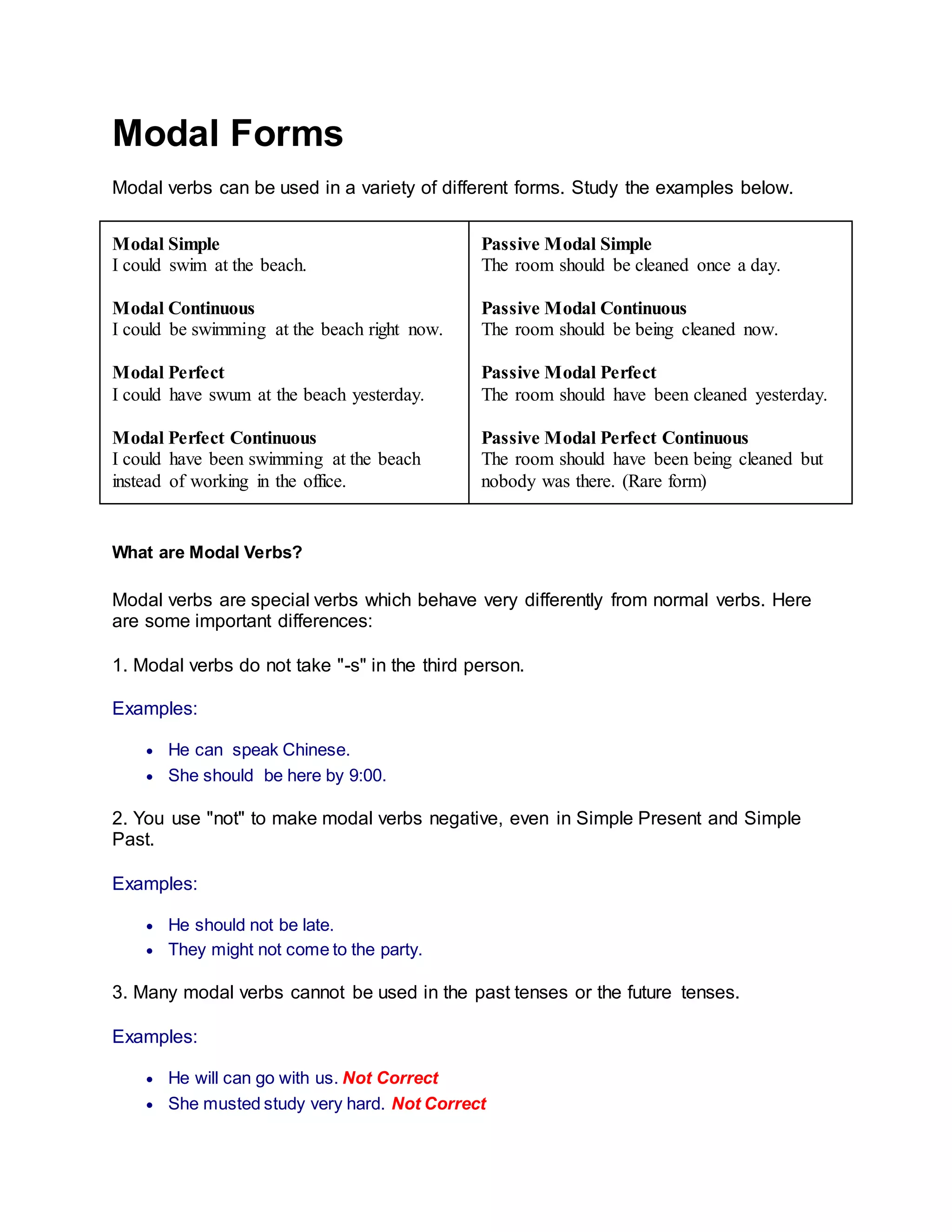
Modal Simple
I could swim at the beach.
Modal Continuous
I could be swimming at the beach right now.
Modal Perfect
I could have swum at the beach yesterday.
Modal Perfect Continuous
I could have been swimming at the beach
instead of working in the office.
Passive Modal Simple
The room should be cleaned once a day.
Passive Modal Continuous
The room should be being cleaned now.
Passive Modal Perfect
The room should have been cleaned yesterday.
Passive Modal Perfect Continuous
The room should have been being cleaned but
nobody was there. (Rare form)
What are Modal Verbs?
Modal verbs are special verbs which behave very differently from normal verbs. Here
are some important differences:
1. Modal verbs do not take "-s" in the third person.
Examples:
 He can speak Chinese.
 She should be here by 9:00.
2. You use "not" to make modal verbs negative, even in Simple Present and Simple
Past.
Examples:
 He should not be late.
 They might not come to the party.
3. Many modal verbs cannot be used in the past tenses or the future tenses.
Examples:
 He will can go with us. Not Correct
 She musted study very hard. Not Correct
Common Modal Verbs
Can
Could
May
Might
Must
Oughtto
Shall
Should
Will
Would
Modal verb
From Wikipedia
A modal verb (also modal, modal auxiliary verb, modal auxiliary) is a type of auxiliary verb that is used to
indicate modality. The use of auxiliary verbs to express modality is a characteristic of Germanic languages.
Contents
[hide]
 1 Function
 2 List
 3 Morphologyand syntax
 4 See also
 5 Bibliography
 6 References
 7 External links
[edit]Function
Modal auxiliary verbs give more information about the function of the main verb that follows it. Although having
a great variety of communicative functions, these functions can all be related to a scale ranging from possibility
("can") to necessity ("must"). Within this scale there are two functional divisions:
 one concerned with possibility and necessity in termsof freedom to act (including ability, permission
and duty),
 and the other ("shall" not included) concerns itself with the theoretical possibility of propositions being
true or not true, including likelihood and certainty.
Most modal auxiliary verbs have two distinct interpretations, epistemic (expressing how certain the factual
status of the embedded proposition is) and deontic(involving notions of permission and obligation). The
following sentences illustrate the two uses of must:
 epistemic: You must be starving. (= "It is necessarily the case that you are starving.")
 deontic: You must leave now. (= "You are required to leave now.")
 ambiguous: You must speak Spanish.
 epistemic = "It is surely the case that you speak Spanish (e.g., after having lived in Spain for ten
years)."
 deontic = "It is a requirement that you speak Spanish (e.g., if you want to get a job in Spain)."
Epistemic modals can be analyzed as raising verbs, while deontic modals can be analyzed as control verbs.
Another form of modal auxiliary is the verb indicating ability: "can" in English, "können" in German, and
"possum" in Latin. For example, "I can say that in English," "Ich kann das auf Deutsch sagen," and "Illud Latine
dicere possum."
Sometimes, the use of the modal auxiliary verbs varies in positive and negative statements. For example, in
English, we have the sentence pair, "You may do that," and "You may not do that." However, in German, these
ideas are expressed as "Sie dürfen das tun," but "Sie müssen das nicht tun." The latter looks as if it would
translate into English as "You must not do that," but it is more typically translated as "You may not do that."
[edit]List
This table lists some modal verbs with common roots in English, German and Dutch. English modal auxiliary
verb provides an exhaustive list of modal verbs in English.
Words in the same row share the same etymological root. Because of semantic drift, however, words in the
same row may no longer be proper translations of each other. In addition, the English and German
verbs will are completely different in meaning, and the German one has nothing to do with constructing the
future tense. These words are false friends.
In English, the plural and singular forms are identical. For German and Dutch, both the plural and singular form
of the verb are shown.
Note that the wordsin thislist are not translationsof each other. (See above.)
English German Dutch
can können, kann kunnen, kan
shall sollen,soll zullen,zal
will wollen, will willen,wil
must müssen, muss moeten, moet
may mögen, mag mogen, mag
tharf[1] dürfen, darf durven, durf
The English could is the past tense of can; should is the past tense of shall; and might is the past tense of may.
(This is ignoring the use of "may" as a vestige of the subjunctive mood in English.) These verbs have acquired
an independent, present tense meaning. The German verb möchten is sometimes taught as a vocabulary word
and included in the list of modal verbs, but it is actually the past subjunctive form of mögen. An example of the
subjective use of "may" in English is in the sentence "That may be, or may not be," meaning "That could be
true, but maybe it is not."
The English verbs dare and need have both a modal use (he dare not do it), and a non-modal use (he doesn't
dare to do it). The Dutch verb durven is not considered a modal (but it is there, nevertheless) because its modal
use has disappeared, but it has a non-modal use analogous with the English dare. Other English modal verbs
include want, wish, hope, and like. All of these differ from the main modals in English (i.e. most of those in the
table above) in that they take the particle to in the infinitive, like all other English verbs (may; to want), and are
followed by to when they are used as a modal (may go; want to go). Some may be more than one word, such
as "had better" and "would rather."[2]
[edit]Morphology and syntax
Germanic modal verbs are preterite-present verbs, which means that their present tense has the form of a
vocalic preterite. This is the source of the vowel alternation between singular and plural in German and Dutch.
Because of their preterite origins, modal verbs also lack the suffix (-s in modern English, -t in German and
Dutch) that would normally mark the third person singular form:
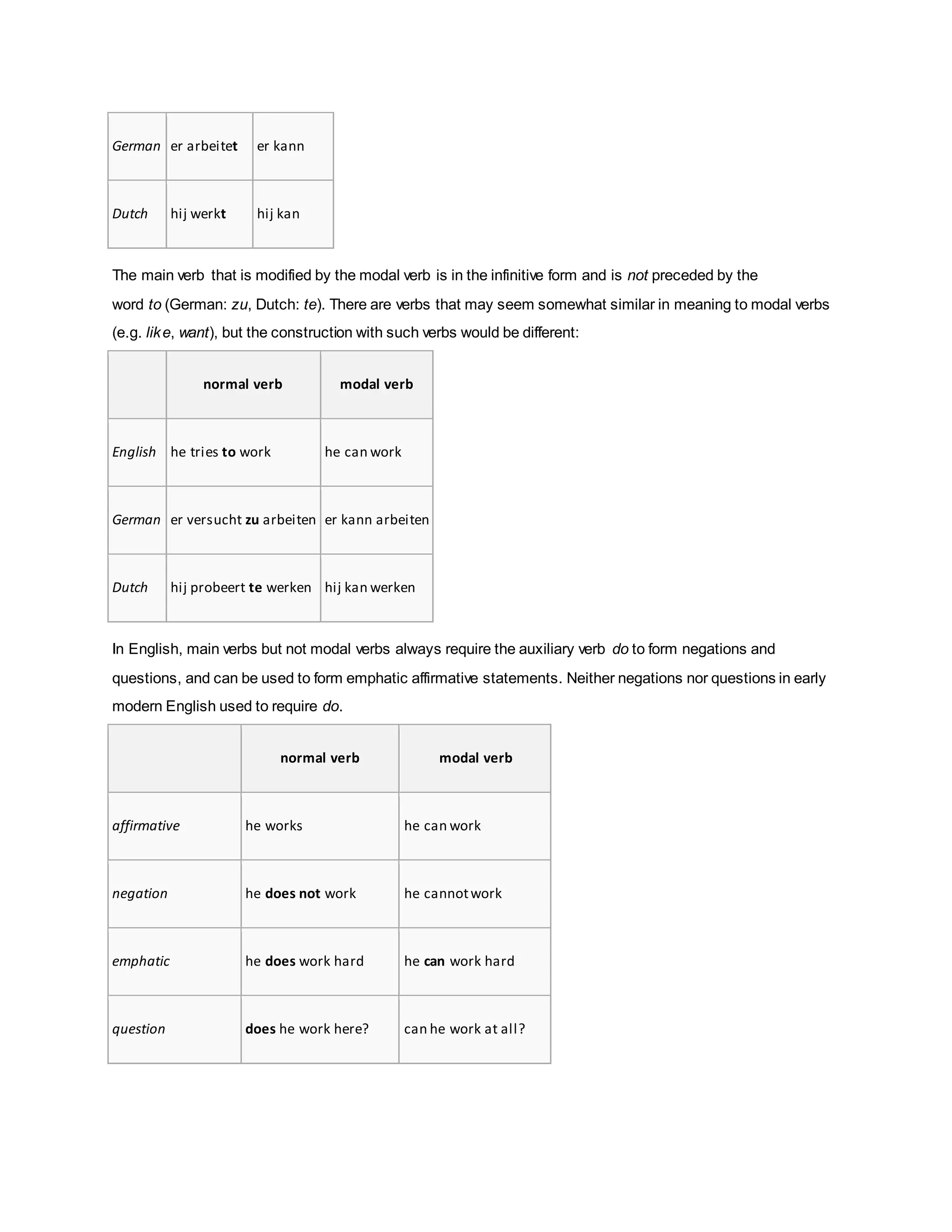
normal verb modal verb
English he works he can
German er arbeitet er kann
Dutch hij werkt hij kan
The main verb that is modified by the modal verb is in the infinitive form and is not preceded by the
word to (German: zu, Dutch: te). There are verbs that may seem somewhat similar in meaning to modal verbs
(e.g. like, want), but the construction with such verbs would be different:
normal verb modal verb
English he tries to work he can work
German er versucht zu arbeiten er kann arbeiten
Dutch hij probeert te werken hij kan werken
In English, main verbs but not modal verbs always require the auxiliary verb do to form negations and
questions, and can be used to form emphatic affirmative statements. Neither negations nor questions in early
modern English used to require do.
normal verb modal verb
affirmative he works he can work
negation he does not work he cannotwork
emphatic he does work hard he can work hard
question does he work here? can he work at all?
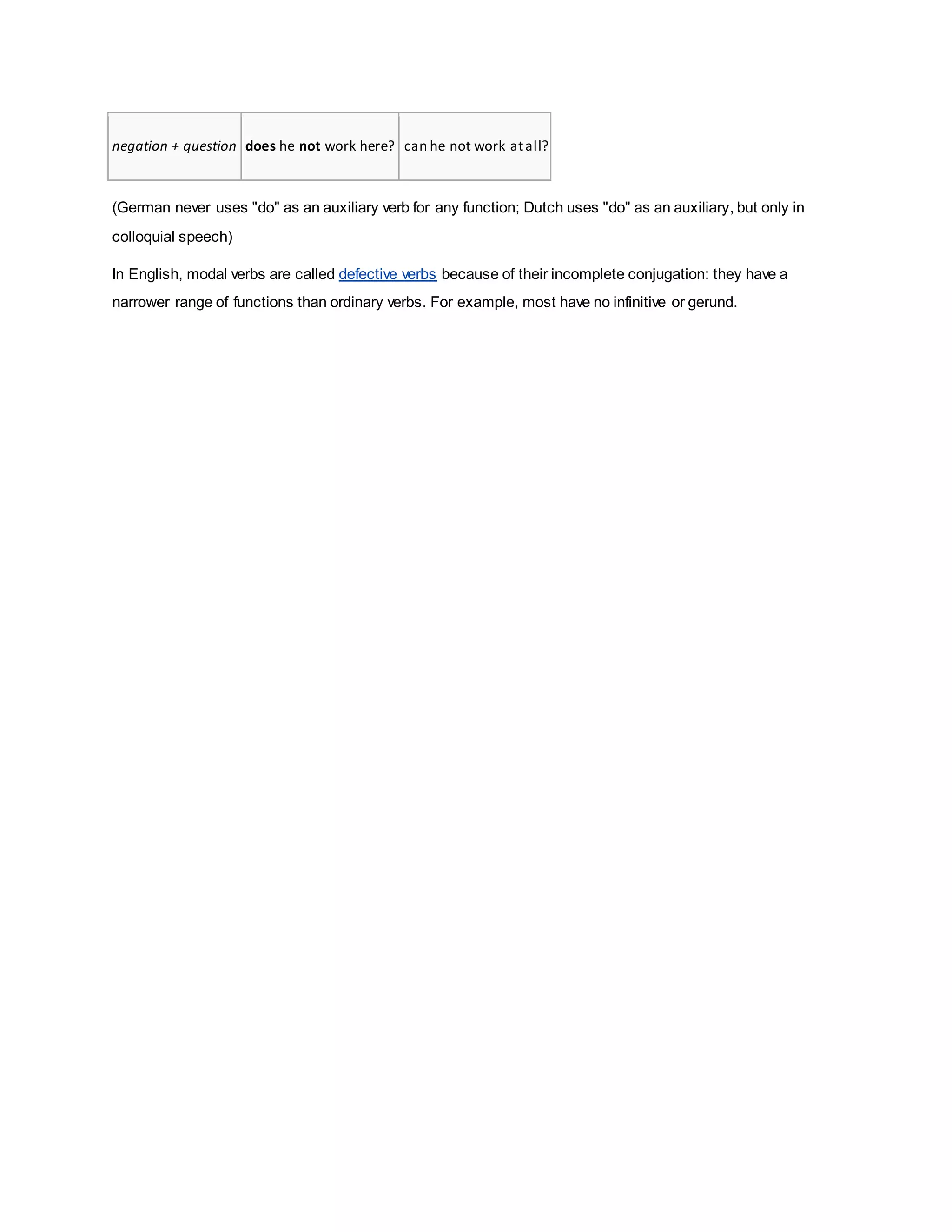
negation + question does he not work here? can he not work atall?
(German never uses "do" as an auxiliary verb for any function; Dutch uses "do" as an auxiliary, but only in
colloquial speech)
In English, modal verbs are called defective verbs because of their incomplete conjugation: they have a
narrower range of functions than ordinary verbs. For example, most have no infinitive or gerund.

Modals

  • 1.
    Modal Forms Modal verbscan be used in a variety of different forms. Study the examples below. Modal Simple I could swim at the beach. Modal Continuous I could be swimming at the beach right now. Modal Perfect I could have swum at the beach yesterday. Modal Perfect Continuous I could have been swimming at the beach instead of working in the office. Passive Modal Simple The room should be cleaned once a day. Passive Modal Continuous The room should be being cleaned now. Passive Modal Perfect The room should have been cleaned yesterday. Passive Modal Perfect Continuous The room should have been being cleaned but nobody was there. (Rare form) What are Modal Verbs? Modal verbs are special verbs which behave very differently from normal verbs. Here are some important differences: 1. Modal verbs do not take "-s" in the third person. Examples:  He can speak Chinese.  She should be here by 9:00. 2. You use "not" to make modal verbs negative, even in Simple Present and Simple Past. Examples:  He should not be late.  They might not come to the party. 3. Many modal verbs cannot be used in the past tenses or the future tenses. Examples:  He will can go with us. Not Correct  She musted study very hard. Not Correct
  • 2.
    Common Modal Verbs Can Could May Might Must Oughtto Shall Should Will Would Modalverb From Wikipedia A modal verb (also modal, modal auxiliary verb, modal auxiliary) is a type of auxiliary verb that is used to indicate modality. The use of auxiliary verbs to express modality is a characteristic of Germanic languages. Contents [hide]  1 Function  2 List  3 Morphologyand syntax  4 See also  5 Bibliography  6 References  7 External links [edit]Function Modal auxiliary verbs give more information about the function of the main verb that follows it. Although having a great variety of communicative functions, these functions can all be related to a scale ranging from possibility ("can") to necessity ("must"). Within this scale there are two functional divisions:  one concerned with possibility and necessity in termsof freedom to act (including ability, permission and duty),  and the other ("shall" not included) concerns itself with the theoretical possibility of propositions being true or not true, including likelihood and certainty. Most modal auxiliary verbs have two distinct interpretations, epistemic (expressing how certain the factual status of the embedded proposition is) and deontic(involving notions of permission and obligation). The following sentences illustrate the two uses of must:
  • 3.
     epistemic: Youmust be starving. (= "It is necessarily the case that you are starving.")  deontic: You must leave now. (= "You are required to leave now.")  ambiguous: You must speak Spanish.  epistemic = "It is surely the case that you speak Spanish (e.g., after having lived in Spain for ten years)."  deontic = "It is a requirement that you speak Spanish (e.g., if you want to get a job in Spain)." Epistemic modals can be analyzed as raising verbs, while deontic modals can be analyzed as control verbs. Another form of modal auxiliary is the verb indicating ability: "can" in English, "können" in German, and "possum" in Latin. For example, "I can say that in English," "Ich kann das auf Deutsch sagen," and "Illud Latine dicere possum." Sometimes, the use of the modal auxiliary verbs varies in positive and negative statements. For example, in English, we have the sentence pair, "You may do that," and "You may not do that." However, in German, these ideas are expressed as "Sie dürfen das tun," but "Sie müssen das nicht tun." The latter looks as if it would translate into English as "You must not do that," but it is more typically translated as "You may not do that." [edit]List This table lists some modal verbs with common roots in English, German and Dutch. English modal auxiliary verb provides an exhaustive list of modal verbs in English. Words in the same row share the same etymological root. Because of semantic drift, however, words in the same row may no longer be proper translations of each other. In addition, the English and German verbs will are completely different in meaning, and the German one has nothing to do with constructing the future tense. These words are false friends. In English, the plural and singular forms are identical. For German and Dutch, both the plural and singular form of the verb are shown. Note that the wordsin thislist are not translationsof each other. (See above.) English German Dutch can können, kann kunnen, kan shall sollen,soll zullen,zal
  • 4.
    will wollen, willwillen,wil must müssen, muss moeten, moet may mögen, mag mogen, mag tharf[1] dürfen, darf durven, durf The English could is the past tense of can; should is the past tense of shall; and might is the past tense of may. (This is ignoring the use of "may" as a vestige of the subjunctive mood in English.) These verbs have acquired an independent, present tense meaning. The German verb möchten is sometimes taught as a vocabulary word and included in the list of modal verbs, but it is actually the past subjunctive form of mögen. An example of the subjective use of "may" in English is in the sentence "That may be, or may not be," meaning "That could be true, but maybe it is not." The English verbs dare and need have both a modal use (he dare not do it), and a non-modal use (he doesn't dare to do it). The Dutch verb durven is not considered a modal (but it is there, nevertheless) because its modal use has disappeared, but it has a non-modal use analogous with the English dare. Other English modal verbs include want, wish, hope, and like. All of these differ from the main modals in English (i.e. most of those in the table above) in that they take the particle to in the infinitive, like all other English verbs (may; to want), and are followed by to when they are used as a modal (may go; want to go). Some may be more than one word, such as "had better" and "would rather."[2] [edit]Morphology and syntax Germanic modal verbs are preterite-present verbs, which means that their present tense has the form of a vocalic preterite. This is the source of the vowel alternation between singular and plural in German and Dutch. Because of their preterite origins, modal verbs also lack the suffix (-s in modern English, -t in German and Dutch) that would normally mark the third person singular form: normal verb modal verb English he works he can
  • 5.
    German er arbeiteter kann Dutch hij werkt hij kan The main verb that is modified by the modal verb is in the infinitive form and is not preceded by the word to (German: zu, Dutch: te). There are verbs that may seem somewhat similar in meaning to modal verbs (e.g. like, want), but the construction with such verbs would be different: normal verb modal verb English he tries to work he can work German er versucht zu arbeiten er kann arbeiten Dutch hij probeert te werken hij kan werken In English, main verbs but not modal verbs always require the auxiliary verb do to form negations and questions, and can be used to form emphatic affirmative statements. Neither negations nor questions in early modern English used to require do. normal verb modal verb affirmative he works he can work negation he does not work he cannotwork emphatic he does work hard he can work hard question does he work here? can he work at all?
  • 6.
    negation + questiondoes he not work here? can he not work atall? (German never uses "do" as an auxiliary verb for any function; Dutch uses "do" as an auxiliary, but only in colloquial speech) In English, modal verbs are called defective verbs because of their incomplete conjugation: they have a narrower range of functions than ordinary verbs. For example, most have no infinitive or gerund.