The
Ultimate Guide
to Creating an
Editorial Calendar
© 2013 NewsCred NewsCred.com l (212) 989-4100 l sales@newscred.com
© 2013 NewsCred 2
Great content doesn’t
happen by accident.
Even the most viral, seemingly one-off campaigns involve
a long-term strategy for monitoring brand activity and have
the right tools in place to create compelling content when an
opportunity presents itself. Marketers are challenged with
producing enough content to address customer concerns,
maintaining or building a brand, as well as staying current
with trending news and information– all the while positioning
your content for consumption across social media, email, print,
display, and other outbound methods. Planning and executing
your content strategy is a daunting task.
To tackle this challenge, the modern marketer relies heavily on
the editorial calendar – a tool to manage the process of creating,
publishing, and planning a comprehensive content strategy.
An organized editorial calendar is the foundation for a
successful content marketing strategy. Without one, your
brand loses a valuable opportunity to deliver consistent
messaging, align campaigns, and reduce marketing spend. Maintaining Your Calendar
Selecting Your Editorial Calendar
Getting Started
Table of Contents
In this guide, you’ll learn how to:
» Create an effective editorial calendar
» Align content with business goals
» Develop the best content strategy for your business
» Reduce the cost of content creation with curation best
practices
01
02
03
© 2013 NewsCred 3
01 Getting Started
Before you begin to plan, create or license,
and publish content, it’s critical to develop a
deep understanding of your audience and their
needs and interests. Buyer personas - factual
representations of your target customers that
are based on quantitative and qualitative
data such as demographics, online behavior,
buying history, and business goals - will
determine what forms of content are worth
your investment. Data aside, your buyers are
individuals, just like you.
It’s worrisome that only a mere 40% of
marketers believe their existing mix of
promotional strategies meet the needs of
their sales pipeline. Mapping your content
to the buying cycle is the surest way to
efficiently drive inbound leads. To align your
editorial calendar with the sales process, work
closely with your sales team to get a better
understanding of customer and prospect pain
points and learn at which stages content can
help influence purchase decisions.
Consider these questions
while developing personas:
» What business concerns keep
your audience up at night?
» What are they passionate about?
What inspires them to share content?
» What does your audience gain from
your content?
» Where and when do they currently
consume content?
» What do you want your audience
to do after reading your content?
Getting Started.
© 2013 NewsCred 4
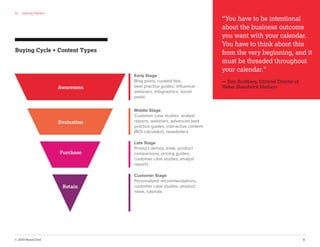
Buying Cycle + Content Types
01 Getting Started
“You have to be intentional
about the business outcome
you want with your calendar.
You have to think about this
from the very beginning, and it
must be threaded throughout
your calendar.”
— Erin Scottberg, Editorial Director of
Weber Shandwick Mediaco
Buying Cycle + Content Types
Early Stage
Blog posts, curated lists,
best practice guides, influencer
webinars, infographics, social
posts
Middle Stage
Customer case studies, analyst
reports, webinars, advanced best
practice guides, interactive content
(ROI calculator), newsletters
Late Stage
Product demos, trials, product
comparisons, pricing guides,
customer case studies, analyst
reports
Customer Stage
Personalized recommendations,
customer case studies, product
news, tutorials
Awareness
Evaluation
Purchase
Retain
© 2013 NewsCred 5
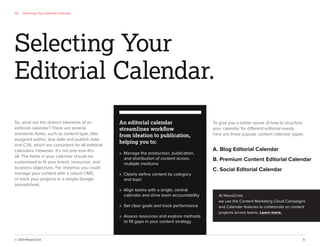
So, what are the distinct elements of an
editorial calendar? There are several
standards fields, such as content type, title,
assigned author, due date and publish date,
and CTA, which are consistent for all editorial
calendars. However, it’s not one-size-fits-
all. The fields in your calendar should be
customized to fit your brand, resources, and
business objectives. For instance, you could
manage your content with a robust CMS,
or track your projects in a simple Google
spreadsheet.
An editorial calendar
from ideation to publication,
helping you to:
» Manage the production, publication,
and distribution of content across
multiple mediums
» Clearly define content by category
and topic
» Align teams with a single, central
calendar and drive team accountability
» Set clear goals and track performance
» Assess resources and explore methods
to fill gaps in your content strategy
At NewsCred,
we use the Content Marketing Cloud Campaigns
and Calendar features to collaborate on content
projects across teams. Learn more.
Selecting Your
Editorial Calendar.
To give you a better sense of how to structure
your calendar for different editorial needs,
here are three popular content calendar types:
A. Blog Editorial Calendar
B. Premium Content Editorial Calendar
C. Social Editorial Calendar
02 Selecting Your Editorial Calendar
© 2013 NewsCred 6
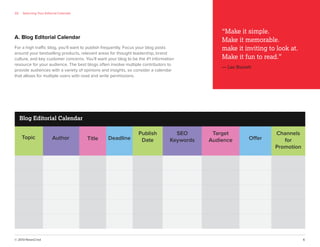
A. Blog Editorial Calendar
Blog Editorial Calendar
Deadline
Publish
Date
SEO
Keywords
Target
Audience Offer
Channels
for
Promotion
TitleTopic Author
02 Selecting Your Editorial Calendar
For a high traffic blog, you’ll want to publish frequently. Focus your blog posts
around your bestselling products, relevant areas for thought leadership, brand
culture, and key customer concerns. You’ll want your blog to be the #1 information
resource for your audience. The best blogs often involve multiple contributors to
provide audiences with a variety of opinions and insights, so consider a calendar
that allows for multiple users with read and write permissions.
“Make it simple.
Make it memorable.
make it inviting to look at.
Make it fun to read.”
— Leo Burnett
© 2013 NewsCred 7
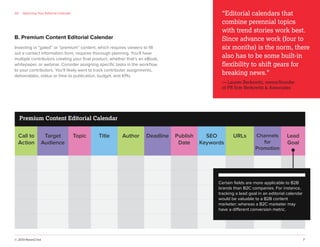
B. Premium Content Editorial Calendar
Premium Content Editorial Calendar
Title Author Deadline Publish
Date
SEO
Keywords
URLs Channels
for
Promotion
Lead
Goal
TopicCall to
Action
Target
Audience
02 Selecting Your Editorial Calendar
Investing in “gated” or “premium” content, which requires viewers to fill
out a contact information form, requires thorough planning. You’ll have
multiple contributors creating your final product, whether that’s an eBook,
whitepaper, or webinar. Consider assigning specific tasks in the workflow
to your contributors. You’ll likely want to track contributor assignments,
deliverables, status or time to publication, budget, and KPIs.
“Editorial calendars that
combine perennial topics
with trend stories work best.
Since advance work (four to
six months) is the norm, there
also has to be some built-in
breaking news.”
— Lauren Berkowitz, owner/founder
“Editorial calendars that
combine perennial topics
with trend stories work best.
Since advance work (four to
six months) is the norm, there
also has to be some built-in
breaking news.”
— Lauren Berkowitz, owner/founder
Certain fields are more applicable to B2B
brands than B2C companies. For instance,
tracking a lead goal in an editorial calendar
would be valuable to a B2B content
marketer; whereas a B2C marketer may
have a different conversion metric.
© 2013 NewsCred 8
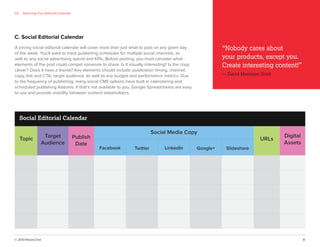
C. Social Editorial Calendar
Social Editorial Calendar
Facebook
Social Media Copy
Twitter LinkedIn Google+ Slideshare
URLs
Digital
Assets
Publish
Date
Topic Target
Audience
02 Selecting Your Editorial Calendar
A strong social editorial calendar will cover more than just what to post on any given day
of the week. You’ll want to track publishing schedules for multiple social channels, as
well as any social advertising spend and KPIs. Before posting, you must consider what
elements of the post could compel someone to share. Is it visually interesting? Is the copy
clever? Does it have a theme? Key elements should include: publication timing, channel,
copy, link and CTA, target audience, as well as any budget and performance metrics. Due
to the frequency of publishing, many social CMS options have built in calendaring and
scheduled publishing features. If that’s not available to you, Google Spreadsheets are easy
to use and provide visibility between content stakeholders.
“Nobody cares about
your products, except you.
Create interesting content!”
— David Meerman Scott
© 2013 NewsCred 9
01 Perform a content audit
What is your ideal ratio of licensed and
original content? The “Rule of Thirds,” first
coined by Betsy Morgan, former CEO of the
Huffington Post, is one route. The Rule of
Thirds means that one-third of all content
distributed should be original, one-third
should be user-generated or crowdsourced,
and the remaining third should be licensed
from other sources.
While it’s a great place to start, there’s no
magic trick to determine the perfect content
ratio for your audience. In order to grow traffic
and garner leads, track how each type of
content performs so that you can adjust to
your audience’s response. Altimeter Group
Analyst Rebecca Lieb identified successful
content campaigns as “an amalgam of licensed
content, curated content, third-party content,
and original content.” The ideal mix, she said,
will depend on the goals, resources, and
budget of the marketer.
Maintaining
Your Calendar.
02 Make room for SEO
Duane Forrester, senior product manager of
Bing, said, “SEO is a marketing function for
sure, but it needs to be baked into a product,
not slapped on like icing after the cake is
baked.” He’s right.
To create a sustainable content strategy, you
need to track SEO keywords and phrases on
your calendar. After you determine keywords
and phrases, list them on the calendar itself
to keep your whole team focused on usage.
Other than the obvious terms associated
with your brand pillars, Ubersuggest, Google
AdWords Keyword Planner, and Bing Keyword
Research Tool will generate keywords.
03 Plan ahead, but prepare
to be reactive
Milestones, holidays, and company events
provide seasonal (and fun!) content
opportunities. Map content to events that
are relevant to your brand and its audience.
Cynthia Manolo of Time Content Solutions
said, “a little bit of seasonality is good. We
build on what we know is coming our way,
and then populate key events, themes, and
holidays throughout the rest of the year.”
Having weekly themes can work well for
brands. For instance, running promotions
consistently on Mondays will train your
audience to look for your content, whereas
“Fun Friday” could create an opportunity
to engage with your audience on a casual,
personal level.
While it’s never a good idea to fly blind, the
onslaught of commentary and breaking
news from business, politics, pop culture is
24-7. While some events can be planned,
marketers need to be agile and reactive to
breaking stories. Just as in journalism, being
the first to break a story will result in more
views and improved credibility.
INSIDER’S TIP As they are well-versed in the
questions from your customers, your sales
team can be a great resource for suggesting
powerful SEO keywords and phrases.
03 Maintaining Your Calendar
© 2013 NewsCred 10
04 Building your content team
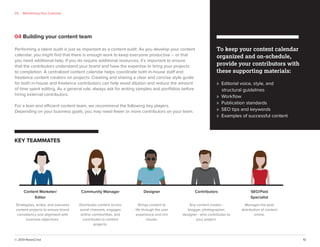
KEY TEAMMATES
To keep your content calendar
organized and on-schedule,
provide your contributors with
these supporting materials:
» Editorial voice, style, and
structural guidelines
» Workflow
» Publication standards
» SEO tips and keywords
» Examples of successful content
03 Maintaining Your Calendar
Content Marketer/
Editor
Strategizes, writes, and oversees
content projects to ensure brand
consistency and alignment with
business objectives.
Community Manager
Distributes content across
social channels, engages
online communities, and
contributes to content
projects.
Designer
Brings content to
life through the user
experience and rich
visuals.
Contributors
Any content creator -
blogger, photographer,
designer - who contributes to
your project.
SEO/Paid
Specialist
Manages the paid
distribution of content
online.
Performing a talent audit is just as important as a content audit. As you develop your content
calendar, you might find that there is enough work to keep everyone productive -- or that
you need additional help. If you do require additional resources, it’s important to ensure
that the contributors understand your brand and have the expertise to bring your projects
to completion. A centralized content calendar helps coordinate both in-house staff and
freelance content creators on projects. Creating and sharing a clear and concise style guide
for both in-house and freelance contributors can help avoid dilution and reduce the amount
of time spent editing. As a general rule, always ask for writing samples and portfolios before
hiring external contributors.
For a lean and efficient content team, we recommend the following key players.
Depending on your business goals, you may need fewer or more contributors on your team.
© 2013 NewsCred 11
It’s not just a calendar. When used correctly,
it can transform your content marketing strategy.
You can delight and inform your audience while
also generating leads.
It’ll make your job a breeze too.
Conclusion.
“Great content is the
best sales tool in the
world.”
© 2013 NewsCred NewsCred.com l (212) 989-4100 l sales@newscred.com

Ultimate Guide to Creating an Editorial Calendars

  • 1.
    The Ultimate Guide to Creatingan Editorial Calendar © 2013 NewsCred NewsCred.com l (212) 989-4100 l sales@newscred.com
  • 2.
    © 2013 NewsCred2 Great content doesn’t happen by accident. Even the most viral, seemingly one-off campaigns involve a long-term strategy for monitoring brand activity and have the right tools in place to create compelling content when an opportunity presents itself. Marketers are challenged with producing enough content to address customer concerns, maintaining or building a brand, as well as staying current with trending news and information– all the while positioning your content for consumption across social media, email, print, display, and other outbound methods. Planning and executing your content strategy is a daunting task. To tackle this challenge, the modern marketer relies heavily on the editorial calendar – a tool to manage the process of creating, publishing, and planning a comprehensive content strategy. An organized editorial calendar is the foundation for a successful content marketing strategy. Without one, your brand loses a valuable opportunity to deliver consistent messaging, align campaigns, and reduce marketing spend. Maintaining Your Calendar Selecting Your Editorial Calendar Getting Started Table of Contents In this guide, you’ll learn how to: » Create an effective editorial calendar » Align content with business goals » Develop the best content strategy for your business » Reduce the cost of content creation with curation best practices 01 02 03
  • 3.
    © 2013 NewsCred3 01 Getting Started Before you begin to plan, create or license, and publish content, it’s critical to develop a deep understanding of your audience and their needs and interests. Buyer personas - factual representations of your target customers that are based on quantitative and qualitative data such as demographics, online behavior, buying history, and business goals - will determine what forms of content are worth your investment. Data aside, your buyers are individuals, just like you. It’s worrisome that only a mere 40% of marketers believe their existing mix of promotional strategies meet the needs of their sales pipeline. Mapping your content to the buying cycle is the surest way to efficiently drive inbound leads. To align your editorial calendar with the sales process, work closely with your sales team to get a better understanding of customer and prospect pain points and learn at which stages content can help influence purchase decisions. Consider these questions while developing personas: » What business concerns keep your audience up at night? » What are they passionate about? What inspires them to share content? » What does your audience gain from your content? » Where and when do they currently consume content? » What do you want your audience to do after reading your content? Getting Started.
  • 4.
    © 2013 NewsCred4 Buying Cycle + Content Types 01 Getting Started “You have to be intentional about the business outcome you want with your calendar. You have to think about this from the very beginning, and it must be threaded throughout your calendar.” — Erin Scottberg, Editorial Director of Weber Shandwick Mediaco Buying Cycle + Content Types Early Stage Blog posts, curated lists, best practice guides, influencer webinars, infographics, social posts Middle Stage Customer case studies, analyst reports, webinars, advanced best practice guides, interactive content (ROI calculator), newsletters Late Stage Product demos, trials, product comparisons, pricing guides, customer case studies, analyst reports Customer Stage Personalized recommendations, customer case studies, product news, tutorials Awareness Evaluation Purchase Retain
  • 5.
    © 2013 NewsCred5 So, what are the distinct elements of an editorial calendar? There are several standards fields, such as content type, title, assigned author, due date and publish date, and CTA, which are consistent for all editorial calendars. However, it’s not one-size-fits- all. The fields in your calendar should be customized to fit your brand, resources, and business objectives. For instance, you could manage your content with a robust CMS, or track your projects in a simple Google spreadsheet. An editorial calendar from ideation to publication, helping you to: » Manage the production, publication, and distribution of content across multiple mediums » Clearly define content by category and topic » Align teams with a single, central calendar and drive team accountability » Set clear goals and track performance » Assess resources and explore methods to fill gaps in your content strategy At NewsCred, we use the Content Marketing Cloud Campaigns and Calendar features to collaborate on content projects across teams. Learn more. Selecting Your Editorial Calendar. To give you a better sense of how to structure your calendar for different editorial needs, here are three popular content calendar types: A. Blog Editorial Calendar B. Premium Content Editorial Calendar C. Social Editorial Calendar 02 Selecting Your Editorial Calendar
  • 6.
    © 2013 NewsCred6 A. Blog Editorial Calendar Blog Editorial Calendar Deadline Publish Date SEO Keywords Target Audience Offer Channels for Promotion TitleTopic Author 02 Selecting Your Editorial Calendar For a high traffic blog, you’ll want to publish frequently. Focus your blog posts around your bestselling products, relevant areas for thought leadership, brand culture, and key customer concerns. You’ll want your blog to be the #1 information resource for your audience. The best blogs often involve multiple contributors to provide audiences with a variety of opinions and insights, so consider a calendar that allows for multiple users with read and write permissions. “Make it simple. Make it memorable. make it inviting to look at. Make it fun to read.” — Leo Burnett
  • 7.
    © 2013 NewsCred7 B. Premium Content Editorial Calendar Premium Content Editorial Calendar Title Author Deadline Publish Date SEO Keywords URLs Channels for Promotion Lead Goal TopicCall to Action Target Audience 02 Selecting Your Editorial Calendar Investing in “gated” or “premium” content, which requires viewers to fill out a contact information form, requires thorough planning. You’ll have multiple contributors creating your final product, whether that’s an eBook, whitepaper, or webinar. Consider assigning specific tasks in the workflow to your contributors. You’ll likely want to track contributor assignments, deliverables, status or time to publication, budget, and KPIs. “Editorial calendars that combine perennial topics with trend stories work best. Since advance work (four to six months) is the norm, there also has to be some built-in breaking news.” — Lauren Berkowitz, owner/founder “Editorial calendars that combine perennial topics with trend stories work best. Since advance work (four to six months) is the norm, there also has to be some built-in breaking news.” — Lauren Berkowitz, owner/founder Certain fields are more applicable to B2B brands than B2C companies. For instance, tracking a lead goal in an editorial calendar would be valuable to a B2B content marketer; whereas a B2C marketer may have a different conversion metric.
  • 8.
    © 2013 NewsCred8 C. Social Editorial Calendar Social Editorial Calendar Facebook Social Media Copy Twitter LinkedIn Google+ Slideshare URLs Digital Assets Publish Date Topic Target Audience 02 Selecting Your Editorial Calendar A strong social editorial calendar will cover more than just what to post on any given day of the week. You’ll want to track publishing schedules for multiple social channels, as well as any social advertising spend and KPIs. Before posting, you must consider what elements of the post could compel someone to share. Is it visually interesting? Is the copy clever? Does it have a theme? Key elements should include: publication timing, channel, copy, link and CTA, target audience, as well as any budget and performance metrics. Due to the frequency of publishing, many social CMS options have built in calendaring and scheduled publishing features. If that’s not available to you, Google Spreadsheets are easy to use and provide visibility between content stakeholders. “Nobody cares about your products, except you. Create interesting content!” — David Meerman Scott
  • 9.
    © 2013 NewsCred9 01 Perform a content audit What is your ideal ratio of licensed and original content? The “Rule of Thirds,” first coined by Betsy Morgan, former CEO of the Huffington Post, is one route. The Rule of Thirds means that one-third of all content distributed should be original, one-third should be user-generated or crowdsourced, and the remaining third should be licensed from other sources. While it’s a great place to start, there’s no magic trick to determine the perfect content ratio for your audience. In order to grow traffic and garner leads, track how each type of content performs so that you can adjust to your audience’s response. Altimeter Group Analyst Rebecca Lieb identified successful content campaigns as “an amalgam of licensed content, curated content, third-party content, and original content.” The ideal mix, she said, will depend on the goals, resources, and budget of the marketer. Maintaining Your Calendar. 02 Make room for SEO Duane Forrester, senior product manager of Bing, said, “SEO is a marketing function for sure, but it needs to be baked into a product, not slapped on like icing after the cake is baked.” He’s right. To create a sustainable content strategy, you need to track SEO keywords and phrases on your calendar. After you determine keywords and phrases, list them on the calendar itself to keep your whole team focused on usage. Other than the obvious terms associated with your brand pillars, Ubersuggest, Google AdWords Keyword Planner, and Bing Keyword Research Tool will generate keywords. 03 Plan ahead, but prepare to be reactive Milestones, holidays, and company events provide seasonal (and fun!) content opportunities. Map content to events that are relevant to your brand and its audience. Cynthia Manolo of Time Content Solutions said, “a little bit of seasonality is good. We build on what we know is coming our way, and then populate key events, themes, and holidays throughout the rest of the year.” Having weekly themes can work well for brands. For instance, running promotions consistently on Mondays will train your audience to look for your content, whereas “Fun Friday” could create an opportunity to engage with your audience on a casual, personal level. While it’s never a good idea to fly blind, the onslaught of commentary and breaking news from business, politics, pop culture is 24-7. While some events can be planned, marketers need to be agile and reactive to breaking stories. Just as in journalism, being the first to break a story will result in more views and improved credibility. INSIDER’S TIP As they are well-versed in the questions from your customers, your sales team can be a great resource for suggesting powerful SEO keywords and phrases. 03 Maintaining Your Calendar
  • 10.
    © 2013 NewsCred10 04 Building your content team KEY TEAMMATES To keep your content calendar organized and on-schedule, provide your contributors with these supporting materials: » Editorial voice, style, and structural guidelines » Workflow » Publication standards » SEO tips and keywords » Examples of successful content 03 Maintaining Your Calendar Content Marketer/ Editor Strategizes, writes, and oversees content projects to ensure brand consistency and alignment with business objectives. Community Manager Distributes content across social channels, engages online communities, and contributes to content projects. Designer Brings content to life through the user experience and rich visuals. Contributors Any content creator - blogger, photographer, designer - who contributes to your project. SEO/Paid Specialist Manages the paid distribution of content online. Performing a talent audit is just as important as a content audit. As you develop your content calendar, you might find that there is enough work to keep everyone productive -- or that you need additional help. If you do require additional resources, it’s important to ensure that the contributors understand your brand and have the expertise to bring your projects to completion. A centralized content calendar helps coordinate both in-house staff and freelance content creators on projects. Creating and sharing a clear and concise style guide for both in-house and freelance contributors can help avoid dilution and reduce the amount of time spent editing. As a general rule, always ask for writing samples and portfolios before hiring external contributors. For a lean and efficient content team, we recommend the following key players. Depending on your business goals, you may need fewer or more contributors on your team.
  • 11.
    © 2013 NewsCred11 It’s not just a calendar. When used correctly, it can transform your content marketing strategy. You can delight and inform your audience while also generating leads. It’ll make your job a breeze too. Conclusion. “Great content is the best sales tool in the world.”
  • 12.
    © 2013 NewsCredNewsCred.com l (212) 989-4100 l sales@newscred.com