A Comprehensive Guide to Create

an Effective Content Calendar
BLOG | ADVANCED DIGITAL MEDIA SERVICES
https://advdms.com/
Even with a team of talented writers and social
media specialists, creating new content can be
overwhelming. Companies that handle digital
marketing and content creation internally can
sometimes find it difficult to create all the content
they want. Many businesses are motivated to
create and share more content, but time
constraints and lack of human resources often
impede their efforts.
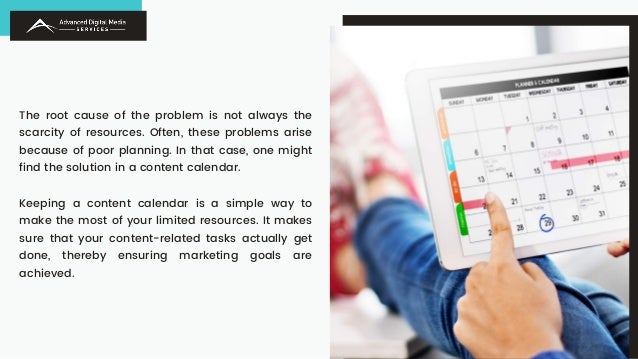
The root cause of the problem is not always the
scarcity of resources. Often, these problems arise

because of poor planning. In that case, one might
find the solution in a content calendar.
Keeping a content calendar is a simple way to
make the most of your limited resources. It makes
sure that your content-related tasks actually get
done, thereby ensuring marketing goals are
achieved.
What is a Content Calendar
A content calendar is essentially a schedule of all
things related to your digital marketing strategy.
Also known as an “editorial schedule,” it is where
you plot out topics, dates, and plans—practically
an overview of how you will present your brand or
business on your website.
Why Keep a Content Calendar
Now that we have an idea of what is a content
calendar, it’s time to dive deeper into how you
can set yourself up for a stellar marketing year.
As the digital marketing space becomes more
competitive, advertisers, marketers, and content
creators aim to be on top of the game. Content
planning is critical to the success of your
marketing strategy, and having a good mix of
solid planning and competitive content writing
sets you up for success. Lining up your activities
on a content calendar is an excellent place to
start.
Here’s how a content calendar can help you
meet your marketing goals:
1. Stay organized and on track with your goals.
A content calendar organizes all of your content
and marketing teams’ activities for the entire
year. It gives you a clear view of what’s coming
for your team and a comprehensive, up-to-date
view of planned content, when to publish them,
who’s working on them, and what needs to be
done next. It helps you standardize your
workflow and keep track of your campaigns,
ensuring that every operation will run smoothly.
With a content calendar, team members are able
to manage their tasks and see which to
accomplish first. This helps in making sure no
posting date or important event is missed,
keeping you on time and on track with your
marketing goals.
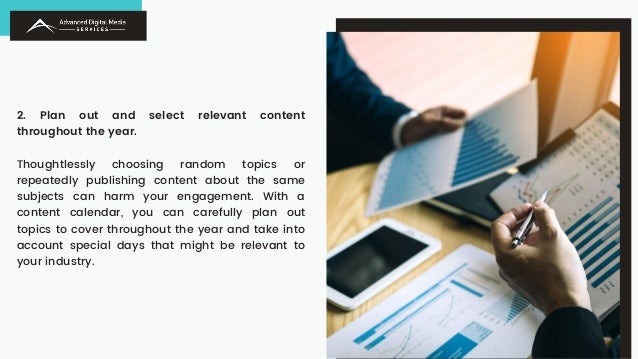
2. Plan out and select relevant content
throughout the year.
Thoughtlessly choosing random topics or
repeatedly publishing content about the same
subjects can harm your engagement. With a
content calendar, you can carefully plan out
topics to cover throughout the year and take into
account special days that might be relevant to
your industry.
Additionally, a content calendar is a great way to
incorporate A/B testing into your digital
marketing strategy. It enables you to experiment
with content writing styles and posting times and
see which works best for your website.
3. Encourage brainstorming.
Fresh ideas often come from long brainstorming
sessions. Keep your team engaged in creating
strategies, and it will usher in a surge of creative
ideas and content. With clearly defined goals and
a bird’s eye view of the marketing year, team
members can easily pitch ideas on what to do for
the coming months. Ideas that may be better
implemented in another season won’t be lost and
may be taken into consideration.
4. Maintain consistency.
Consistency is the key if you want your brand
or business to receive website traffic.
Scheduling will help any brand or business
prevent major mistakes and allow leeway to
create more ambitious strategies. It can help
track the business journey, see backlogs, and
identify areas that need improvement.
5. Save time.
With a content calendar, you won’t have to spend
hours and hours conducting meetings. You
already have an outline of what content to put
out for the year, so there’s no need to call for
unnecessarily long meetings on a regular basis.
You can save on money, energy, and effort in the
long run, and you can spend these on other
important matters that can benefit your digital
marketing campaign.
How to Create a Content Calendar
Content calendars are not one-size-fits-all. It will
have different components, depending on your
team’s needs. Here are some of the common
elements found in a content calendar:
Campaign
Every piece of content you publish should have a
purpose, which should be stated on your content
calendar. For instance, some can be used to
increase brand awareness, and some can be
used to showcase new products or services.
Geo-Targeting
If you publish content for a sizable audience, you
can state the target location on your content
calendar. Doing so will help your team in looking
for information that is relevant to your target
audience.
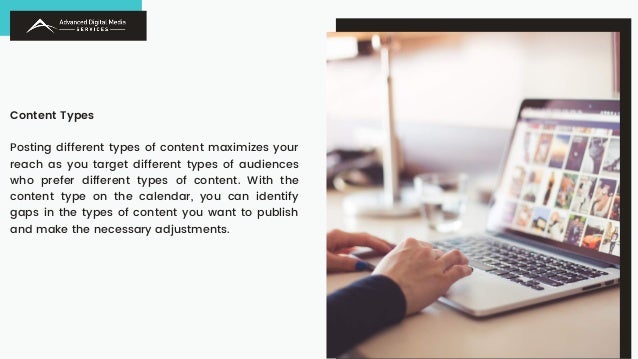
Content Types
Posting different types of content maximizes your
reach as you target different types of audiences
who prefer different types of content. With the
content type on the calendar, you can identify
gaps in the types of content you want to publish
and make the necessary adjustments.
Title
Of course, you need to include the title of each
piece of content you plan to put out. These could
just be ideas or working titles, but at the very
least, you need to have the seed of an idea so
that you know what content to create.
Writer or Author
If you have many writers on the team, it’s
essential to include the name of the assigned
writer beside every piece of content you plan to
put out. In that way, they can prepare for the
tasks assigned to them.
It also helps to do the same for the other tasks
involved in your content marketing strategy, such
as proofreading and posting. With the names of
members assigned to accomplish the task
recorded on your content calendar, it’s easier to
monitor who to contact when issues occur.
Edit Date
When creating a content calendar, you also have
to set important dates, such as edit dates. It lets
your proofreaders or editors know when they
should start working on the content assigned to
them.
Setting edit dates also lets your editors know
when they need to finish the content they’re
working on. It gives enough time for checking and
making sure that all the content you put out is of
high quality.
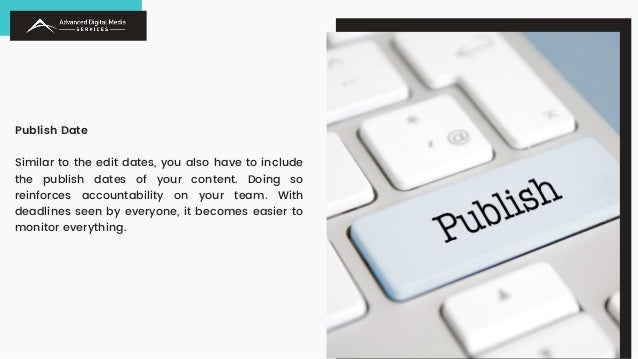
Publish Date
Similar to the edit dates, you also have to include
the publish dates of your content. Doing so
reinforces accountability on your team. With
deadlines seen by everyone, it becomes easier to
monitor everything.
Production Progress
A schedule isn’t complete without a status
tracker. For that reason, you need to consider
putting a section for monitoring the production
progress. This eliminates the need for contacting
people to ask for updates. By looking at the
calendar, you’ll easily see the progress of the
content as well as some potential bottlenecks in
the production process.
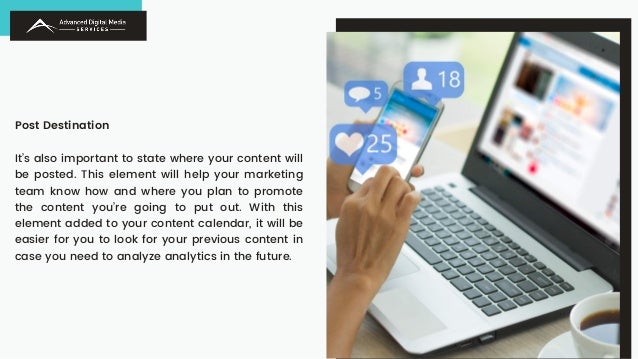
Post Destination
It’s also important to state where your content will
be posted. This element will help your marketing
team know how and where you plan to promote
the content you’re going to put out. With this
element added to your content calendar, it will be
easier for you to look for your previous content in
case you need to analyze analytics in the future.
Supporting Media
Some pieces of content need supporting media,
such as videos, images, or audio files. Allocating a
section for supporting media on your content
calendar streamlines the publishing process.
Document Link
One of the most important elements of a content
calendar is the section for document links. This
element comes in handy in cases where edits
need to be done. It makes it easier for the editor
to look for the original copy of the content.
Future Content Planning Ideas
Having a content calendar doesn’t mean that you
have to follow everything written on it. You can
still implement changes to some of the not-so-
urgent ones, especially when you find better
ideas.
To make sure you don’t forget or misplace ideas,
create a section for them on your content
calendar. Take note that you don’t have to delete
the ones you originally planned on putting out.
You can still use them in the future.
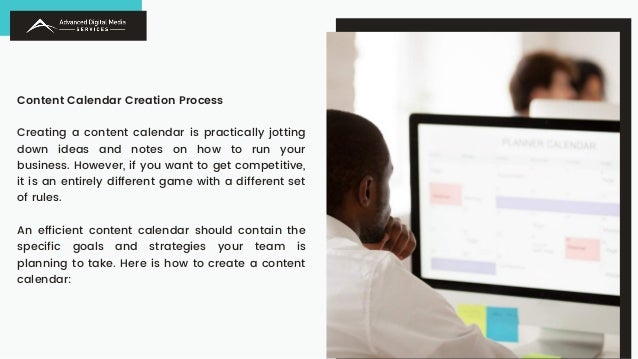
Content Calendar Creation Process
Creating a content calendar is practically jotting
down ideas and notes on how to run your
business. However, if you want to get competitive,
it is an entirely different game with a different set
of rules.
An efficient content calendar should contain the
specific goals and strategies your team is
planning to take. Here is how to create a content
calendar:
1. Perform a content audit.
You can begin by running a content audit. A
content audit lets you see which of your blog
posts or other types of content from the previous
years have performed well. You can then get an
idea of what works in terms of audience
engagement and brand reputation.
2. Conduct competitive research.
This step involves analyzing your competitors’
content, their topics, and the keywords they rank
for. You can get significant data and insights by
analyzing the competition, which you can use to
come up with an effective marketing strategy.
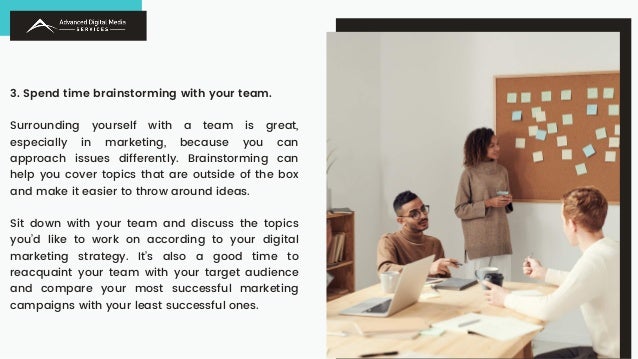
3. Spend time brainstorming with your team.
Surrounding yourself with a team is great,
especially in marketing, because you can
approach issues differently. Brainstorming can
help you cover topics that are outside of the box
and make it easier to throw around ideas.
Sit down with your team and discuss the topics
you’d like to work on according to your digital
marketing strategy. It’s also a good time to
reacquaint your team with your target audience
and compare your most successful marketing
campaigns with your least successful ones.
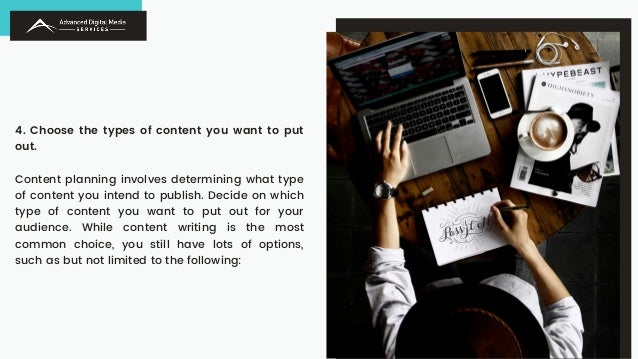
4. Choose the types of content you want to put
out.
Content planning involves determining what type
of content you intend to publish. Decide on which
type of content you want to put out for your
audience. While content writing is the most
common choice, you still have lots of options,
such as but not limited to the following:
Blogs
Case Studies
Opinion Pieces
Infographics
Newsletters
E-Books
Videos
Podcasts
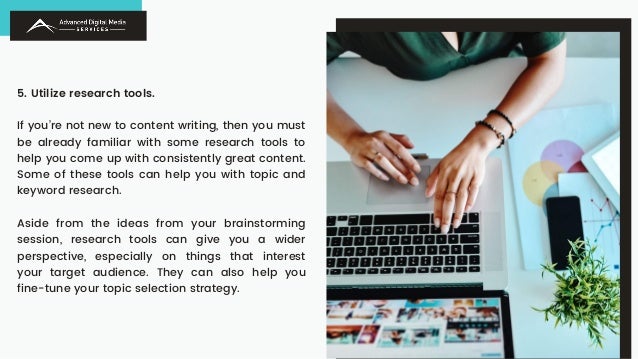
5. Utilize research tools.
If you’re not new to content writing, then you must
be already familiar with some research tools to
help you come up with consistently great content.
Some of these tools can help you with topic and
keyword research.
Aside from the ideas from your brainstorming
session, research tools can give you a wider
perspective, especially on things that interest
your target audience. They can also help you
fine-tune your topic selection strategy.
6. Decide on the publish dates.
When putting out content, you need to analyze
the best time for publishing. Consider how often
you can publish new content. It is important that
you choose a publishing schedule that is
convenient for your team.
You can use your content calendar to help
identify the busiest times for your team. By
planning ahead, the team can prepare for busy
months. This will ensure that projects are
completed and started well in advance of the
publication date.
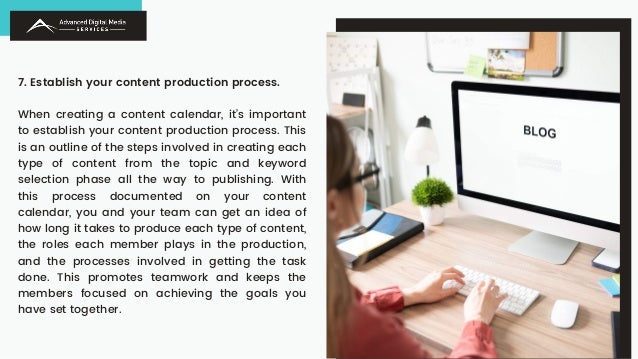
7. Establish your content production process.
When creating a content calendar, it’s important
to establish your content production process. This
is an outline of the steps involved in creating each
type of content from the topic and keyword
selection phase all the way to publishing. With
this process documented on your content
calendar, you and your team can get an idea of
how long it takes to produce each type of content,
the roles each member plays in the production,
and the processes involved in getting the task
done. This promotes teamwork and keeps the
members focused on achieving the goals you
have set together.
Tips to Put Together an Effective Content
Calendar
Many factors need consideration to create an
influential marketing campaign, and all of it starts
with a solid content calendar. Here are some tips
to put together an effective content calendar:
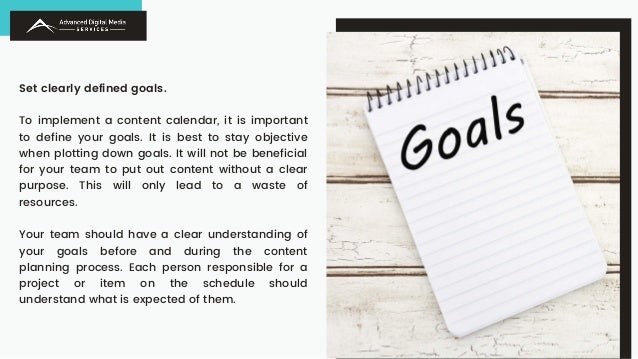
Set clearly defined goals.
To implement a content calendar, it is important
to define your goals. It is best to stay objective
when plotting down goals. It will not be beneficial
for your team to put out content without a clear
purpose. This will only lead to a waste of
resources.
Your team should have a clear understanding of
your goals before and during the content
planning process. Each person responsible for a
project or item on the schedule should
understand what is expected of them.
Create a content library.
If you’re planning to put out tons of content this
year, it helps to have a content library on your
content calendar. Your content library can be
helpful in locating old content that can be reused
or repurposed.
Have evergreen content ready.
You can save time and money by preparing
evergreen content. This type of content is always
useful, so it will likely get clicks and visits long
after it’s published. It isn’t bound to a specific
time, so it can be written and published anytime.
Having evergreen content prepared can be
handy, particularly when other tasks need to be
prioritized.
Utilize old content.
You don’t always have to create new content. You
can reuse old blog posts and convert them into
videos. Potential customers search for information
on different platforms, so presenting similar ideas
in different formats would be a good idea.
You should also ensure that your website’s
content is current. You will look professional and
trustworthy by reviewing and updating your
content regularly.
Measure results by monitoring your
engagement.
Proper result measurement is paramount to
having a long-lasting successful marketing
strategy. Check the awareness and engagement
of each post. These elements will directly give you
an idea of how successful your campaigns are.
Pay attention to the trends.
If you want to stay ahead of the competition, you
have to stay on top of marketing trends. Keeping
yourself updated on the digital marketing trends
can help you develop a marketing strategy that
will increase your brand awareness.
If you want to spearhead your digital marketing
campaign this year with the help of experts, look
no further than Advanced Digital Media Services.
We are experts in the field of online marketing.
We have a team of SEO experts and digital
marketers to help you come up with an
exceptional content calendar and provide you
with top-notch content writing services. With our
help, you’ll easily find your way to the top of the
online search ladder.
Don’t hesitate to reach out to us if you have any
inquiries regarding our content creation services.
We’ll gladly answer each one of them as soon as
possible. Call us today!
E-MAIL ADDRESS
info@advdms.com
PHONE NUMBER
(877)237-6969
CLICK BELOW TO VISIT OUR BLOG
https://advdms.com/blog
CONTACT
DETAILS
FOLLOW US ON:
https://facebook.com/AdvancedDigitalMediaServices
https://linkedin.com/company/advanceddigitalmedia
https://twitter.com/advdms_com
https://instagram.com/advanceddigitalmediaservices

A Comprehensive Guide to Create an Effective Content Calendar

  • 1.
    A Comprehensive Guideto Create an Effective Content Calendar BLOG | ADVANCED DIGITAL MEDIA SERVICES https://advdms.com/
  • 2.
    Even with ateam of talented writers and social media specialists, creating new content can be overwhelming. Companies that handle digital marketing and content creation internally can sometimes find it difficult to create all the content they want. Many businesses are motivated to create and share more content, but time constraints and lack of human resources often impede their efforts.
  • 3.
    The root causeof the problem is not always the scarcity of resources. Often, these problems arise because of poor planning. In that case, one might find the solution in a content calendar. Keeping a content calendar is a simple way to make the most of your limited resources. It makes sure that your content-related tasks actually get done, thereby ensuring marketing goals are achieved.
  • 4.
    What is aContent Calendar A content calendar is essentially a schedule of all things related to your digital marketing strategy. Also known as an “editorial schedule,” it is where you plot out topics, dates, and plans—practically an overview of how you will present your brand or business on your website.
  • 5.
    Why Keep aContent Calendar Now that we have an idea of what is a content calendar, it’s time to dive deeper into how you can set yourself up for a stellar marketing year.
  • 6.
    As the digitalmarketing space becomes more competitive, advertisers, marketers, and content creators aim to be on top of the game. Content planning is critical to the success of your marketing strategy, and having a good mix of solid planning and competitive content writing sets you up for success. Lining up your activities on a content calendar is an excellent place to start. Here’s how a content calendar can help you meet your marketing goals:
  • 7.
    1. Stay organizedand on track with your goals. A content calendar organizes all of your content and marketing teams’ activities for the entire year. It gives you a clear view of what’s coming for your team and a comprehensive, up-to-date view of planned content, when to publish them, who’s working on them, and what needs to be done next. It helps you standardize your workflow and keep track of your campaigns, ensuring that every operation will run smoothly.
  • 8.
    With a contentcalendar, team members are able to manage their tasks and see which to accomplish first. This helps in making sure no posting date or important event is missed, keeping you on time and on track with your marketing goals.
  • 9.
    2. Plan outand select relevant content throughout the year. Thoughtlessly choosing random topics or repeatedly publishing content about the same subjects can harm your engagement. With a content calendar, you can carefully plan out topics to cover throughout the year and take into account special days that might be relevant to your industry.
  • 10.
    Additionally, a contentcalendar is a great way to incorporate A/B testing into your digital marketing strategy. It enables you to experiment with content writing styles and posting times and see which works best for your website.
  • 11.
    3. Encourage brainstorming. Freshideas often come from long brainstorming sessions. Keep your team engaged in creating strategies, and it will usher in a surge of creative ideas and content. With clearly defined goals and a bird’s eye view of the marketing year, team members can easily pitch ideas on what to do for the coming months. Ideas that may be better implemented in another season won’t be lost and may be taken into consideration.
  • 12.
    4. Maintain consistency. Consistencyis the key if you want your brand or business to receive website traffic. Scheduling will help any brand or business prevent major mistakes and allow leeway to create more ambitious strategies. It can help track the business journey, see backlogs, and identify areas that need improvement.
  • 13.
    5. Save time. Witha content calendar, you won’t have to spend hours and hours conducting meetings. You already have an outline of what content to put out for the year, so there’s no need to call for unnecessarily long meetings on a regular basis. You can save on money, energy, and effort in the long run, and you can spend these on other important matters that can benefit your digital marketing campaign.
  • 14.
    How to Createa Content Calendar Content calendars are not one-size-fits-all. It will have different components, depending on your team’s needs. Here are some of the common elements found in a content calendar:
  • 15.
    Campaign Every piece ofcontent you publish should have a purpose, which should be stated on your content calendar. For instance, some can be used to increase brand awareness, and some can be used to showcase new products or services.
  • 16.
    Geo-Targeting If you publishcontent for a sizable audience, you can state the target location on your content calendar. Doing so will help your team in looking for information that is relevant to your target audience.
  • 17.
    Content Types Posting differenttypes of content maximizes your reach as you target different types of audiences who prefer different types of content. With the content type on the calendar, you can identify gaps in the types of content you want to publish and make the necessary adjustments.
  • 18.
    Title Of course, youneed to include the title of each piece of content you plan to put out. These could just be ideas or working titles, but at the very least, you need to have the seed of an idea so that you know what content to create.
  • 19.
    Writer or Author Ifyou have many writers on the team, it’s essential to include the name of the assigned writer beside every piece of content you plan to put out. In that way, they can prepare for the tasks assigned to them. It also helps to do the same for the other tasks involved in your content marketing strategy, such as proofreading and posting. With the names of members assigned to accomplish the task recorded on your content calendar, it’s easier to monitor who to contact when issues occur.
  • 20.
    Edit Date When creatinga content calendar, you also have to set important dates, such as edit dates. It lets your proofreaders or editors know when they should start working on the content assigned to them. Setting edit dates also lets your editors know when they need to finish the content they’re working on. It gives enough time for checking and making sure that all the content you put out is of high quality.
  • 21.
    Publish Date Similar tothe edit dates, you also have to include the publish dates of your content. Doing so reinforces accountability on your team. With deadlines seen by everyone, it becomes easier to monitor everything.
  • 22.
    Production Progress A scheduleisn’t complete without a status tracker. For that reason, you need to consider putting a section for monitoring the production progress. This eliminates the need for contacting people to ask for updates. By looking at the calendar, you’ll easily see the progress of the content as well as some potential bottlenecks in the production process.
  • 23.
    Post Destination It’s alsoimportant to state where your content will be posted. This element will help your marketing team know how and where you plan to promote the content you’re going to put out. With this element added to your content calendar, it will be easier for you to look for your previous content in case you need to analyze analytics in the future.
  • 24.
    Supporting Media Some piecesof content need supporting media, such as videos, images, or audio files. Allocating a section for supporting media on your content calendar streamlines the publishing process.
  • 25.
    Document Link One ofthe most important elements of a content calendar is the section for document links. This element comes in handy in cases where edits need to be done. It makes it easier for the editor to look for the original copy of the content.
  • 26.
    Future Content PlanningIdeas Having a content calendar doesn’t mean that you have to follow everything written on it. You can still implement changes to some of the not-so- urgent ones, especially when you find better ideas. To make sure you don’t forget or misplace ideas, create a section for them on your content calendar. Take note that you don’t have to delete the ones you originally planned on putting out. You can still use them in the future.
  • 27.
    Content Calendar CreationProcess Creating a content calendar is practically jotting down ideas and notes on how to run your business. However, if you want to get competitive, it is an entirely different game with a different set of rules. An efficient content calendar should contain the specific goals and strategies your team is planning to take. Here is how to create a content calendar:
  • 28.
    1. Perform acontent audit. You can begin by running a content audit. A content audit lets you see which of your blog posts or other types of content from the previous years have performed well. You can then get an idea of what works in terms of audience engagement and brand reputation.
  • 29.
    2. Conduct competitiveresearch. This step involves analyzing your competitors’ content, their topics, and the keywords they rank for. You can get significant data and insights by analyzing the competition, which you can use to come up with an effective marketing strategy.
  • 30.
    3. Spend timebrainstorming with your team. Surrounding yourself with a team is great, especially in marketing, because you can approach issues differently. Brainstorming can help you cover topics that are outside of the box and make it easier to throw around ideas. Sit down with your team and discuss the topics you’d like to work on according to your digital marketing strategy. It’s also a good time to reacquaint your team with your target audience and compare your most successful marketing campaigns with your least successful ones.
  • 31.
    4. Choose thetypes of content you want to put out. Content planning involves determining what type of content you intend to publish. Decide on which type of content you want to put out for your audience. While content writing is the most common choice, you still have lots of options, such as but not limited to the following:
  • 32.
  • 33.
    5. Utilize researchtools. If you’re not new to content writing, then you must be already familiar with some research tools to help you come up with consistently great content. Some of these tools can help you with topic and keyword research. Aside from the ideas from your brainstorming session, research tools can give you a wider perspective, especially on things that interest your target audience. They can also help you fine-tune your topic selection strategy.
  • 34.
    6. Decide onthe publish dates. When putting out content, you need to analyze the best time for publishing. Consider how often you can publish new content. It is important that you choose a publishing schedule that is convenient for your team. You can use your content calendar to help identify the busiest times for your team. By planning ahead, the team can prepare for busy months. This will ensure that projects are completed and started well in advance of the publication date.
  • 35.
    7. Establish yourcontent production process. When creating a content calendar, it’s important to establish your content production process. This is an outline of the steps involved in creating each type of content from the topic and keyword selection phase all the way to publishing. With this process documented on your content calendar, you and your team can get an idea of how long it takes to produce each type of content, the roles each member plays in the production, and the processes involved in getting the task done. This promotes teamwork and keeps the members focused on achieving the goals you have set together.
  • 36.
    Tips to PutTogether an Effective Content Calendar Many factors need consideration to create an influential marketing campaign, and all of it starts with a solid content calendar. Here are some tips to put together an effective content calendar:
  • 37.
    Set clearly definedgoals. To implement a content calendar, it is important to define your goals. It is best to stay objective when plotting down goals. It will not be beneficial for your team to put out content without a clear purpose. This will only lead to a waste of resources. Your team should have a clear understanding of your goals before and during the content planning process. Each person responsible for a project or item on the schedule should understand what is expected of them.
  • 38.
    Create a contentlibrary. If you’re planning to put out tons of content this year, it helps to have a content library on your content calendar. Your content library can be helpful in locating old content that can be reused or repurposed.
  • 39.
    Have evergreen contentready. You can save time and money by preparing evergreen content. This type of content is always useful, so it will likely get clicks and visits long after it’s published. It isn’t bound to a specific time, so it can be written and published anytime. Having evergreen content prepared can be handy, particularly when other tasks need to be prioritized.
  • 40.
    Utilize old content. Youdon’t always have to create new content. You can reuse old blog posts and convert them into videos. Potential customers search for information on different platforms, so presenting similar ideas in different formats would be a good idea. You should also ensure that your website’s content is current. You will look professional and trustworthy by reviewing and updating your content regularly.
  • 41.
    Measure results bymonitoring your engagement. Proper result measurement is paramount to having a long-lasting successful marketing strategy. Check the awareness and engagement of each post. These elements will directly give you an idea of how successful your campaigns are.
  • 42.
    Pay attention tothe trends. If you want to stay ahead of the competition, you have to stay on top of marketing trends. Keeping yourself updated on the digital marketing trends can help you develop a marketing strategy that will increase your brand awareness.
  • 43.
    If you wantto spearhead your digital marketing campaign this year with the help of experts, look no further than Advanced Digital Media Services. We are experts in the field of online marketing.
  • 44.
    We have ateam of SEO experts and digital marketers to help you come up with an exceptional content calendar and provide you with top-notch content writing services. With our help, you’ll easily find your way to the top of the online search ladder. Don’t hesitate to reach out to us if you have any inquiries regarding our content creation services. We’ll gladly answer each one of them as soon as possible. Call us today!
  • 45.
    E-MAIL ADDRESS info@advdms.com PHONE NUMBER (877)237-6969 CLICKBELOW TO VISIT OUR BLOG https://advdms.com/blog CONTACT DETAILS FOLLOW US ON: https://facebook.com/AdvancedDigitalMediaServices https://linkedin.com/company/advanceddigitalmedia https://twitter.com/advdms_com https://instagram.com/advanceddigitalmediaservices