CONTENT LABS
CONTENT STRATEGY FRAMEWORKS
2
OVERVIEW
The frameworks in this document are probably most helpful for those who are
already familiar with or practice content strategy.
They also represent the ones we particularly like and use the most here at KBS.
We hope you find them useful.
Paul Potenzone
Executive Director of Content & Social Strategy
ppotenzone@kbsp.com
Jonah Bloom
Co-CSO, Co-President NY
ppotenzone@kbsp.com
3
LOYALTY LOOP
ACTIVE
CONSIDERATION
POST-PURCHASE
INITIAL
CONSIDERATION
SET
MOMENT
OF
PURCHASE
TRIGGER
ACTIVE ENGAGEMENT
Tailored member content
DRIVE INTO
FUNNEL
CREATE FUNNEL
VELOCITY
HIGH-IMPACT
AWARENESS
CONVERT
OPPORTUNITY ASSESSMENT
QUESTIONS ANSWERED BY THIS FRAMEWORK:
• How can content help your business?
• What is the ratio of relative effort put against each part of
the journey?
• Where can current content efforts be mapped and where
are the gaps?
USING THE FRAMEWORK:
The blue boxes represent the potential content solution for
that part of the journey.
HIGH-IMPACT AWARENESS: High-profile paid & social content
programming
DRIVE INTO FUNNEL: Link to deeper content & optimize search
CREATE FUNNEL VELOCITY: Answer their questions & create
CRM stream
CONVERT: Purchase now / when the time is right
ACTIVE ENGAGEMENT: Tailored member content
4
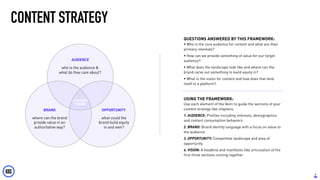
CONTENT STRATEGY
AUDIENCE
who is the audience &
what do they care about?
BRAND
where can the brand
provide value in an
authoritative way?
OPPORTUNITY
what could the
brand build equity
in and own?
CONTENT
VISION
QUESTIONS ANSWERED BY THIS FRAMEWORK:
• Who is the core audience for content and what are their
primary interests?
• How can we provide something of value for our target
audience?
• What does the landscape look like and where can the
brand carve out something to build equity in?
• What is the vision for content and how does that lend
itself to a platform?
USING THE FRAMEWORK:
Use each element of the Venn to guide the sections of your
content strategy like chapters:
1. AUDIENCE: Profiles including interests, demographics
and content consumption behaviors
2. BRAND: Brand identity language with a focus on value to
the audience
3. OPPORTUNITY: Competitive landscape and area of
opportunity
4. VISION: A headline and manifesto-like articulation of the
first three sections coming together
5
AUDIENCE PROFILES
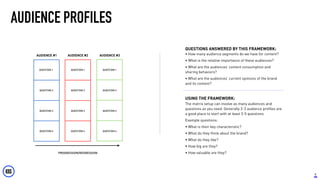
USING THE FRAMEWORK:
The matrix setup can involve as many audiences and
questions as you need. Generally 2-3 audience profiles are
a good place to start with at least 3-5 questions.
Example questions:
• What is their key characteristic?
• What do they think about the brand?
• What do they like?
• How big are they?
• How valuable are they?
QUESTIONS ANSWERED BY THIS FRAMEWORK:
• How many audience segments do we have for content?
• What is the relative importance of these audiences?
• What are the audiences’ content consumption and
sharing behaviors?
• What are the audiences’ current opinions of the brand
and its content?
AUDIENCE #1 AUDIENCE #2 AUDIENCE #3
QUESTION 1 QUESTION 1 QUESTION 1
QUESTION 2 QUESTION 2 QUESTION 2
QUESTION 3 QUESTION 3 QUESTION 3
QUESTION 4 QUESTION 4 QUESTION 4
PROGRESSION/REGRESSION
6
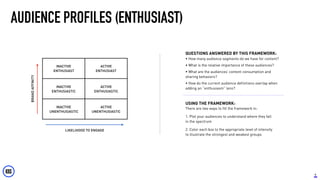
AUDIENCE PROFILES (ENTHUSIAST)
QUESTIONS ANSWERED BY THIS FRAMEWORK:
• How many audience segments do we have for content?
• What is the relative importance of these audiences?
• What are the audiences’ content consumption and
sharing behaviors?
• How do the current audience definitions overlap when
adding an “enthusiasm” lens?
USING THE FRAMEWORK:
There are two ways to fill the framework in:
1. Plot your audiences to understand where they fall
in the spectrum
2. Color each box to the appropriate level of intensity
to illustrate the strongest and weakest groups
LIKELIHOOD TO ENGAGE
BRANDAFFINITY
ACTIVE
ENTHUSIAST
ACTIVE
ENTHUSIASTIC
INACTIVE
ENTHUSIASTIC
INACTIVE
ENTHUSIAST
ACTIVE
UNENTHUSIASTIC
INACTIVE
UNENTHUSIASTIC
7
CONTENT ROADMAP
QUESTIONS ANSWERED BY THIS FRAMEWORK:
• Where is content coming from?
• Where does content live?
• Where does content get promoted?
USING THE FRAMEWORK:
Prior to building a full go-to-market ecosystem, this linear
framework helps organize content into the appropriate
channels - OWNED/SHARED/PAID/EARNED.
Populate each box with logos and a 1-2 word description
to fill in the framework.
SOURCE PUBLISH PROMOTE
OWNED OWNED OWNED
SHARED SHARED SHARED
PAID PAID PAID
EARNED EARNED EARNED
8
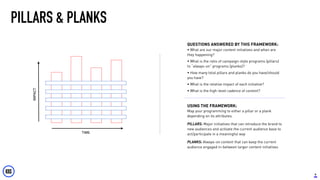
PILLARS & PLANKS
QUESTIONS ANSWERED BY THIS FRAMEWORK:
• What are our major content initiatives and when are
they happening?
• What is the ratio of campaign-style programs (pillars)
to “always-on” programs (planks)?
• How many total pillars and planks do you have/should
you have?
• What is the relative impact of each initiative?
• What is the high-level cadence of content?
USING THE FRAMEWORK:
Map your programming to either a pillar or a plank
depending on its attributes.
PILLARS: Major initiatives that can introduce the brand to
new audiences and activate the current audience base to
act/participate in a meaningful way
PLANKS: Always-on content that can keep the current
audience engaged in-between larger content initiatives
TIME
IMPACT
9
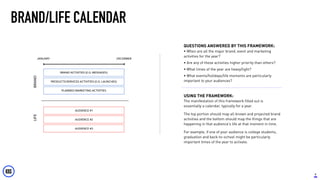
BRAND/LIFE CALENDAR
QUESTIONS ANSWERED BY THIS FRAMEWORK:
• When are all the major brand, event and marketing
activities for the year?
• Are any of these activities higher priority than others?
• What times of the year are heavy/light?
• What events/holidays/life moments are particularly
important to your audiences?
USING THE FRAMEWORK:
The manifestation of this framework filled out is
essentially a calendar, typically for a year.
The top portion should map all known and projected brand
activities and the bottom should map the things that are
happening in that audience’s life at that moment in time.
For example, if one of your audience is college students,
graduation and back-to-school might be particularly
important times of the year to activate.
BRAND ACTIVITIES (E.G. MESSAGES)
PRODUCTS/SERVICES ACTIVITIES (E.G. LAUNCHES)
AUDIENCE #2
AUDIENCE #3
JANUARY DECEMBER
AUDIENCE #1
PLANNED MARKETING ACTIVITIES
BRANDLIFE
FIN

Content Strategy Frameworks (from KBS)

  • 1.
  • 2.
    2 OVERVIEW The frameworks inthis document are probably most helpful for those who are already familiar with or practice content strategy. They also represent the ones we particularly like and use the most here at KBS. We hope you find them useful. Paul Potenzone Executive Director of Content & Social Strategy ppotenzone@kbsp.com Jonah Bloom Co-CSO, Co-President NY ppotenzone@kbsp.com
  • 3.
    3 LOYALTY LOOP ACTIVE CONSIDERATION POST-PURCHASE INITIAL CONSIDERATION SET MOMENT OF PURCHASE TRIGGER ACTIVE ENGAGEMENT Tailoredmember content DRIVE INTO FUNNEL CREATE FUNNEL VELOCITY HIGH-IMPACT AWARENESS CONVERT OPPORTUNITY ASSESSMENT QUESTIONS ANSWERED BY THIS FRAMEWORK: • How can content help your business? • What is the ratio of relative effort put against each part of the journey? • Where can current content efforts be mapped and where are the gaps? USING THE FRAMEWORK: The blue boxes represent the potential content solution for that part of the journey. HIGH-IMPACT AWARENESS: High-profile paid & social content programming DRIVE INTO FUNNEL: Link to deeper content & optimize search CREATE FUNNEL VELOCITY: Answer their questions & create CRM stream CONVERT: Purchase now / when the time is right ACTIVE ENGAGEMENT: Tailored member content
  • 4.
    4 CONTENT STRATEGY AUDIENCE who isthe audience & what do they care about? BRAND where can the brand provide value in an authoritative way? OPPORTUNITY what could the brand build equity in and own? CONTENT VISION QUESTIONS ANSWERED BY THIS FRAMEWORK: • Who is the core audience for content and what are their primary interests? • How can we provide something of value for our target audience? • What does the landscape look like and where can the brand carve out something to build equity in? • What is the vision for content and how does that lend itself to a platform? USING THE FRAMEWORK: Use each element of the Venn to guide the sections of your content strategy like chapters: 1. AUDIENCE: Profiles including interests, demographics and content consumption behaviors 2. BRAND: Brand identity language with a focus on value to the audience 3. OPPORTUNITY: Competitive landscape and area of opportunity 4. VISION: A headline and manifesto-like articulation of the first three sections coming together
  • 5.
    5 AUDIENCE PROFILES USING THEFRAMEWORK: The matrix setup can involve as many audiences and questions as you need. Generally 2-3 audience profiles are a good place to start with at least 3-5 questions. Example questions: • What is their key characteristic? • What do they think about the brand? • What do they like? • How big are they? • How valuable are they? QUESTIONS ANSWERED BY THIS FRAMEWORK: • How many audience segments do we have for content? • What is the relative importance of these audiences? • What are the audiences’ content consumption and sharing behaviors? • What are the audiences’ current opinions of the brand and its content? AUDIENCE #1 AUDIENCE #2 AUDIENCE #3 QUESTION 1 QUESTION 1 QUESTION 1 QUESTION 2 QUESTION 2 QUESTION 2 QUESTION 3 QUESTION 3 QUESTION 3 QUESTION 4 QUESTION 4 QUESTION 4 PROGRESSION/REGRESSION
  • 6.
    6 AUDIENCE PROFILES (ENTHUSIAST) QUESTIONSANSWERED BY THIS FRAMEWORK: • How many audience segments do we have for content? • What is the relative importance of these audiences? • What are the audiences’ content consumption and sharing behaviors? • How do the current audience definitions overlap when adding an “enthusiasm” lens? USING THE FRAMEWORK: There are two ways to fill the framework in: 1. Plot your audiences to understand where they fall in the spectrum 2. Color each box to the appropriate level of intensity to illustrate the strongest and weakest groups LIKELIHOOD TO ENGAGE BRANDAFFINITY ACTIVE ENTHUSIAST ACTIVE ENTHUSIASTIC INACTIVE ENTHUSIASTIC INACTIVE ENTHUSIAST ACTIVE UNENTHUSIASTIC INACTIVE UNENTHUSIASTIC
  • 7.
    7 CONTENT ROADMAP QUESTIONS ANSWEREDBY THIS FRAMEWORK: • Where is content coming from? • Where does content live? • Where does content get promoted? USING THE FRAMEWORK: Prior to building a full go-to-market ecosystem, this linear framework helps organize content into the appropriate channels - OWNED/SHARED/PAID/EARNED. Populate each box with logos and a 1-2 word description to fill in the framework. SOURCE PUBLISH PROMOTE OWNED OWNED OWNED SHARED SHARED SHARED PAID PAID PAID EARNED EARNED EARNED
  • 8.
    8 PILLARS & PLANKS QUESTIONSANSWERED BY THIS FRAMEWORK: • What are our major content initiatives and when are they happening? • What is the ratio of campaign-style programs (pillars) to “always-on” programs (planks)? • How many total pillars and planks do you have/should you have? • What is the relative impact of each initiative? • What is the high-level cadence of content? USING THE FRAMEWORK: Map your programming to either a pillar or a plank depending on its attributes. PILLARS: Major initiatives that can introduce the brand to new audiences and activate the current audience base to act/participate in a meaningful way PLANKS: Always-on content that can keep the current audience engaged in-between larger content initiatives TIME IMPACT
  • 9.
    9 BRAND/LIFE CALENDAR QUESTIONS ANSWEREDBY THIS FRAMEWORK: • When are all the major brand, event and marketing activities for the year? • Are any of these activities higher priority than others? • What times of the year are heavy/light? • What events/holidays/life moments are particularly important to your audiences? USING THE FRAMEWORK: The manifestation of this framework filled out is essentially a calendar, typically for a year. The top portion should map all known and projected brand activities and the bottom should map the things that are happening in that audience’s life at that moment in time. For example, if one of your audience is college students, graduation and back-to-school might be particularly important times of the year to activate. BRAND ACTIVITIES (E.G. MESSAGES) PRODUCTS/SERVICES ACTIVITIES (E.G. LAUNCHES) AUDIENCE #2 AUDIENCE #3 JANUARY DECEMBER AUDIENCE #1 PLANNED MARKETING ACTIVITIES BRANDLIFE
  • 10.