





Data-Driven
Content Marketing
How To Create & Optimize A Content Strategy With Data At Its Core
By Hana Abaza
TABLE OF CONTENTS
CH 1 Introduction
CH 2 Creating Content Strategy with
Data at the Core
CH 3 Content Ideation
CH 4 Content Distribution
CH 5 Content Experience
CH 6 Content Performance
CH 7 Conclusion
Editing
Writing & Research
Graphic Design
Braveen Kumar
Hana Abaza
Jenny Choi
Introduction
From Mad Men to Modern Marketing, we’ve seen
some major shifts in the marketing industry over
the years. The biggest shift is one of accountability.
Marketers, just like our counterparts in sales, have to
show value - show our contribution to the bottom line.
For many, this means embracing a new marketing
reality.
At the heart of this is the fact that marketing has to
be informed by data, and content marketing is no
different. Taking a data-driven approach for content
marketing requires three things:
CH 1
A fundamental shift in process. This is especially
important if your organization doesn’t currently prioritize
and encourage an analytical mindset. This includes laying
the foundation to track and measure ideas before they go
into the wild, and establishing a process for analyzing and
reporting results.
Open communication. Data comes in many forms, and
making informed decisions requires you to consider
quantitative and qualitative data, some of which you
have access to and some of which may be sitting in other
departments or teams.
The power to make make changes- to iterate. All of the
data in the world is essentially useless you have the power
to act on it. Unfortunately, one of the biggest bottlenecks
for marketers is the IT department. The content experience
(front end) must be owned by your marketing team so they
can optimize it based on the results. Either you need a
technical person on your marketing team or a software that
allows any marketer to take the reins.
If you can put a checkmark beside each of the above (or can work
towards that), then you’re part of the way there.
In this eBook, we’re going to focus on concepts, tools and tactics
to implement throughout each stage of the content marketing
process in order to understand what’s working and make better
decisions.
1.
2.
3.
Creating a Content
Strategy with Data
at the Core
Like anything else in business, you first need to establish clear goals
and a strategy (one that you can adapt as you gain more insight into
how it’s working). Developing buyer personas, defining the buyer
journey and mapping the right content to the right persona at each
stage of the buyer journey will provide a foundation for that strategy.
I’m going to assume that you have started this process, but if not, here
are some great resources that can point you in the right direction:
The Essentials of a Documented Content
Marketing Strategy
Blogging in the Age of Modern Marketing
1.
2.
CH 2
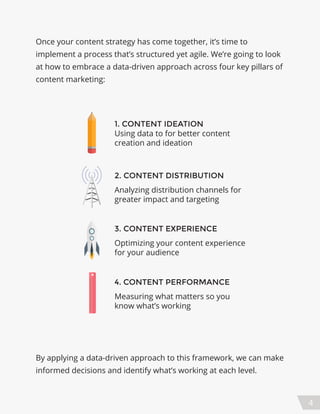
1. CONTENT IDEATION
2. CONTENT DISTRIBUTION
3. CONTENT EXPERIENCE
4. CONTENT PERFORMANCE
Using data to for better content
creation and ideation
Once your content strategy has come together, it’s time to
implement a process that’s structured yet agile. We’re going to look
at how to embrace a data-driven approach across four key pillars of
content marketing:
By applying a data-driven approach to this framework, we can make
informed decisions and identify what’s working at each level.
Analyzing distribution channels for
greater impact and targeting
Optimizing your content experience
for your audience
Measuring what matters so you
know what’s working
4
CONTENT IDEATION
While all of us, at some point, have managed to pull a
compelling content idea from thin air, the reality is that
ideation can be (and should be) driven by data. To create
content that resonates with your audience and your industry,
it’s essential to understand what’s already working.
Luckily, there are several tools that can help identify the
trends within your industry and the type of content that’s
hitting home with your audience. Here are a few that our
content team at Uberflip uses regularly:
CH 3
BuzzSumo
BuzzSumo analyzes what content performs best for specific topics or
websites. After typing in a topic or domain, you’ll get a results page with
the top ranked content for your search.
This includes a breakdown of how well the content performed across all
major social channels, giving you insight into where your audience lives.
BuzzSumo also lets you filter the results by date and by type (e.g. articles,
videos, infographics, etc.) so you have a better understanding of which
type of content is performing best.
You can do the same search for a competitor’s domain
and topics to see how you’re ranking in comparison.
PRO TIP!
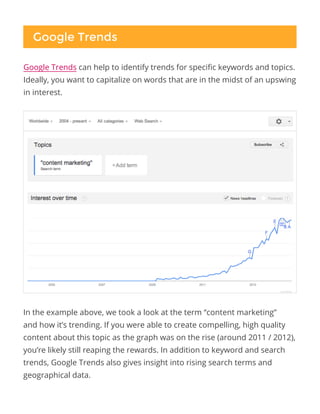
Google Trends
In the example above, we took a look at the term “content marketing”
and how it’s trending. If you were able to create compelling, high quality
content about this topic as the graph was on the rise (around 2011 / 2012),
you’re likely still reaping the rewards. In addition to keyword and search
trends, Google Trends also gives insight into rising search terms and
geographical data.
Google Trends can help to identify trends for specific keywords and topics.
Ideally, you want to capitalize on words that are in the midst of an upswing
in interest.
Mine Your Own Team For Data
In many companies, the content team works in a silo, separated from
demand generation, sales and customer support. This can be a huge
disadvantage. These are people with behind the scenes knowledge of what
your audience wants to know. They’re interacting with customers and
prospects on a regular basis and will be able to tell you their biggest pain
points.
Whether it’s for top of the funnel, educational content or customer-centric
content to help reduce churn, talk to your counterparts in other teams and
capitalize on what they’ve learned on the front lines.
For example, here are a couple of questions I like to ask our sales team:
What non-product related questions do you hear on a
regular basis?
This helps with “top of the funnel” content. If we can answer
these questions using content, we’ll not only help our sales
team by providing them with content they can send to their
prospects, but we’ll also answer the question for everyone
else.
What are the biggest pain points you hear about?
This speaks directly to a deeper understanding of our buyer
persona and is a great way to get ideas for more “bottom of
the funnel” content.
Don’t just tweet or email your customers - actually talk to them. Seems
like a strange concept, but there’s no substitution for a real conversation.
Email and social media often lack the nuances that you pick up on when
speaking to another human being.
Why does this matter? Ann Handley writes that, in order for your content
to be compelling and effective, it needs to be “useful, inspired, and
pathologically empathetic to the needs of the people you are trying to
reach.”
The amount of information you can glean from a couple of simple
conversations can have a major impact on how you position your
company, what to create and, as we we move to the next section, where to
distribute your content.
Talk To Your Customers
CONTENT DISTRIBUTION
Distributing your content is just as important as creating high
quality content. A data-driven approach is essential to refine
your distribution strategy.
CH 4
The first step is to set a baseline by analyzing the metrics associated with
your distribution channels - this can be eye opening! Tools like Google
Analytics, KISSmetrics (or even Buffer and BuzzSumo, if you’re primarily
focused on social media distribution) will help determine where the
majority of your traffic is coming from. Is it social? Search? Or is your
content getting picked up by other bloggers?
Once you understand where your existing traffic is coming from, you
might be able to gain some valuable insight into where you should focus
your distribution efforts. For example, if you discover that people coming
from LinkedIn are very engaged, it might be worth putting some paid
distribution behind this channel. Alternatively, you can also look into
other channels that LinkedIn users also frequent, such as forums or other
networks.
Staying in tune with your distribution metrics can also help identify viable
channels you may have been unaware of, such as other blogs that accept
guest posts.
Benchmark Current Distribution Channels
Further Reading: If you’re new to segmentation, here are
22 ways you can segment your contacts to get you started.
Segmenting Your Audience For More
Distribution
Once you understand where people are coming from, take the time to
segment your audience. Look at the metrics from each source, like time
on site, bounce rate and social shares. Are people coming from social
media more engaged than people coming from a Google search? Of those
visitors, who is ultimately converting to a lead and then a customer?
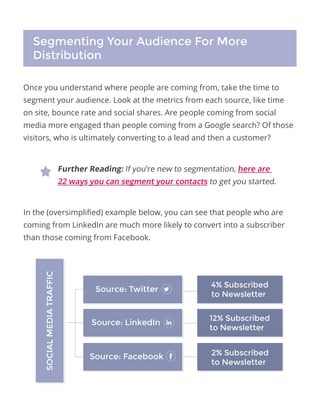
In the (oversimplified) example below, you can see that people who are
coming from LinkedIn are much more likely to convert into a subscriber
than those coming from Facebook.
SOCIALMEDIATRAFFIC
Source: Twitter
4% Subscribed
to Newsletter
12% Subscribed
to Newsletter
2% Subscribed
to Newsletter
Source: LinkedIn
Source: Facebook
Distribution Channels
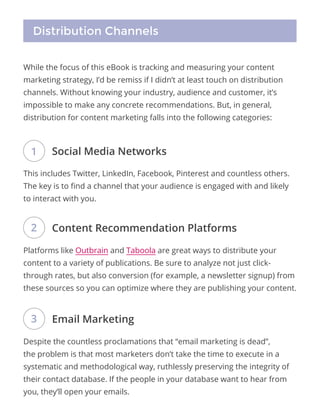
While the focus of this eBook is tracking and measuring your content
marketing strategy, I’d be remiss if I didn’t at least touch on distribution
channels. Without knowing your industry, audience and customer, it’s
impossible to make any concrete recommendations. But, in general,
distribution for content marketing falls into the following categories:
This includes Twitter, LinkedIn, Facebook, Pinterest and countless others.
The key is to find a channel that your audience is engaged with and likely
to interact with you.
Platforms like Outbrain and Taboola are great ways to distribute your
content to a variety of publications. Be sure to analyze not just click-
through rates, but also conversion (for example, a newsletter signup) from
these sources so you can optimize where they are publishing your content.
Despite the countless proclamations that “email marketing is dead”,
the problem is that most marketers don’t take the time to execute in a
systematic and methodological way, ruthlessly preserving the integrity of
their contact database. If the people in your database want to hear from
you, they’ll open your emails.
Social Media Networks
Content Recommendation Platforms
Email Marketing
1
2
3
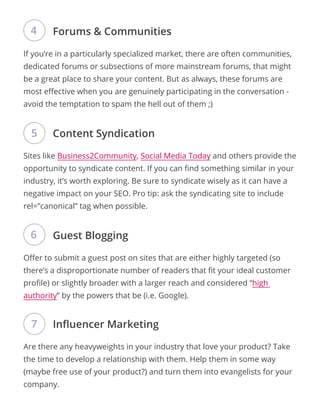
If you’re in a particularly specialized market, there are often communities,
dedicated forums or subsections of more mainstream forums, that might
be a great place to share your content. But as always, these forums are
most effective when you are genuinely participating in the conversation -
avoid the temptation to spam the hell out of them ;)
Sites like Business2Community, Social Media Today and others provide the
opportunity to syndicate content. If you can find something similar in your
industry, it’s worth exploring. Be sure to syndicate wisely as it can have a
negative impact on your SEO. Pro tip: ask the syndicating site to include
rel=”canonical” tag when possible.
Offer to submit a guest post on sites that are either highly targeted (so
there’s a disproportionate number of readers that fit your ideal customer
profile) or slightly broader with a larger reach and considered “high
authority” by the powers that be (i.e. Google).
Are there any heavyweights in your industry that love your product? Take
the time to develop a relationship with them. Help them in some way
(maybe free use of your product?) and turn them into evangelists for your
company.
Forums & Communities
Content Syndication
Guest Blogging
Influencer Marketing
4
5
6
7
Industry influencers aren’t the only ones who can act as evangelists on
your behalf. Your customers are also the perfect people to spread your
message. Using an advocate marketing platform like Influitive is the
perfect way to turn customers into advocates, encouraging them to share
your content with their own networks.
Like email marketing, SEO isn’t dead but it has evolved. As expected,
Google is increasingly emphasizing semantic search. In order to have an
impact on your content’s SEO performance, you have to consider both
keywords and the actual language people (your customers) are using.
Understanding whether or not there is a viable channel in any of the
above categories takes time, data and experimentation. The key is to lay
the foundation to properly track results, prior to experimentation, so you
can benchmark and track progress.
Advocate Marketing
SEO
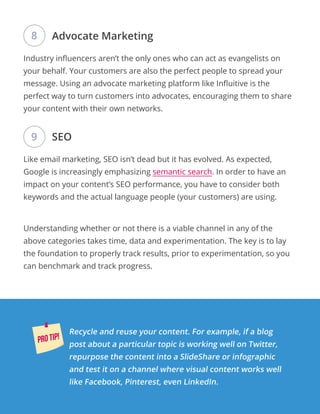
Recycle and reuse your content. For example, if a blog
post about a particular topic is working well on Twitter,
repurpose the content into a SlideShare or infographic
and test it on a channel where visual content works well
like Facebook, Pinterest, even LinkedIn.
PRO TIP!
8
9
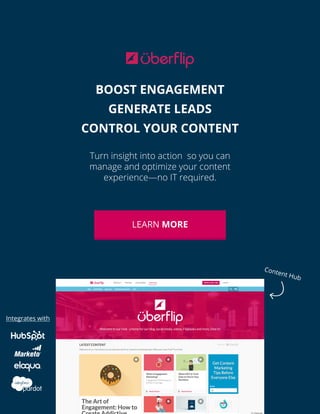
BOOST ENGAGEMENT
GENERATE LEADS
CONTROL YOUR CONTENT
Turn insight into action so you can
manage and optimize your content
experience—no IT required.
Content Hub
Integrates with
LEARN MORE
CONTENT EXPERIENCE
Creating a killer content experience goes a long way towards
increasing the engagement and distribution of your content.
But your content experience must also be designed and
optimized for lead generation. Unfortunately, user experience
is too often ignored due to a lack of knowledge or a lack of
control.
CH 5
Here are three questions you need to answer when
focusing on optimizing the experience.
Is it social shares, newsletter signups, lead generation?
Understand the primary goal to optimize in the right
direction.
Do you have the infrastructure in place to measure
success? If you’re after newsletter subscribers, are
you able to measure your subscriber conversion rate?
Tools that can help you do this include marketing
automation platforms like Marketo or HubSpot or
content marketing software like Uberflip.
Do you have the control to change the content
experience? Whether this is you as a marketer, or
working in conjunction with the development team,
being able to quickly change and add call-to-actions
or create targeted content streams can have a huge
impact on your overall performance.
What are you optimizing for?
Can you measure it?
Can you change it?
1.
2.
3.
We’ll do a deep dive into specific metrics in the next
section, but the general concept behind optimizing
your content marketing is the same as optimizing
a landing page, a sales site, an ecommerce site or
anything else.
Given full control over the content experience (without
involving IT or developers in the process), marketers
can further optimize the content experience to tailor
to specific buyer personas. You can tighten the
message for more personalized call-to-actions, usually
resulting in higher engagement and conversion rates.
Generate more leads by optimizing the
content experience for conversions
TRY UBERFLIP FREE
CONTENT PERFORMANCE
Content effectiveness and ROI often gets the least attention
because it is the hardest to measure, but it’s the most
important aspect of taking a data-driven approach to content
marketing.
Content ROI comes down to understanding the goal of
your content. However, while I’m the first to advocate for
the importance of knowing your Content ROI, if your only
objective is brand awareness then attaching a dollar figure
to your ROI is more difficult. As much as I want you to be
metrics-minded, it’s important to remember that there can
also be intangible benefits to content marketing.
CH 6
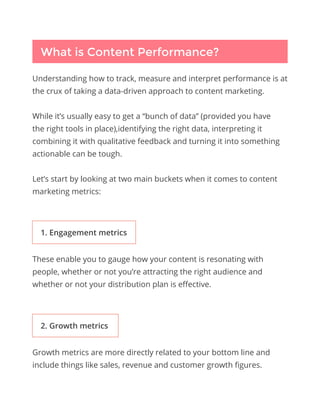
What is Content Performance?
Understanding how to track, measure and interpret performance is at
the crux of taking a data-driven approach to content marketing.
While it’s usually easy to get a “bunch of data” (provided you have
the right tools in place),identifying the right data, interpreting it
combining it with qualitative feedback and turning it into something
actionable can be tough.
Let’s start by looking at two main buckets when it comes to content
marketing metrics:
These enable you to gauge how your content is resonating with
people, whether or not you’re attracting the right audience and
whether or not your distribution plan is effective.
Growth metrics are more directly related to your bottom line and
include things like sales, revenue and customer growth figures.
1. Engagement metrics
2. Growth metrics
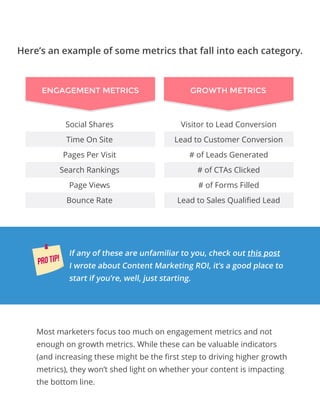
Social Shares
Time On Site
Pages Per Visit
Search Rankings
Page Views
Bounce Rate
Visitor to Lead Conversion
Lead to Customer Conversion
# of Leads Generated
# of CTAs Clicked
# of Forms Filled
Lead to Sales Qualified Lead
Most marketers focus too much on engagement metrics and not
enough on growth metrics. While these can be valuable indicators
(and increasing these might be the first step to driving higher growth
metrics), they won’t shed light on whether your content is impacting
the bottom line.
Here’s an example of some metrics that fall into each category.
If any of these are unfamiliar to you, check out this post
I wrote about Content Marketing ROI, it’s a good place to
start if you’re, well, just starting.
PRO TIP!
ENGAGEMENT METRICS GROWTH METRICS
Once again, the metrics you choose to focus on should align with
your overall goals. Once you know what those are, you can begin to
put together a funnel that will shed some light on what’s working and
what needs work.
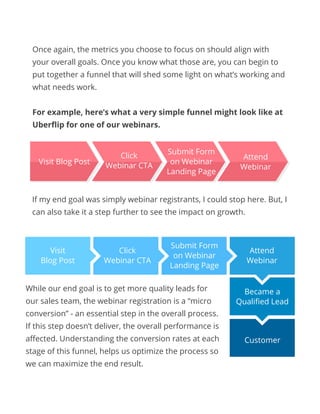
For example, here’s what a very simple funnel might look like at
Uberflip for one of our webinars.
If my end goal was simply webinar registrants, I could stop here. But, I
can also take it a step further to see the impact on growth.
While our end goal is to get more quality leads for
our sales team, the webinar registration is a “micro
conversion” - an essential step in the overall process.
If this step doesn’t deliver, the overall performance is
affected. Understanding the conversion rates at each
stage of this funnel, helps us optimize the process so
we can maximize the end result.
Visit Blog Post
Click
Webinar CTA
Submit Form
on Webinar
Landing Page
Attend
Webinar
Attend
Webinar
Visit
Blog Post
Click
Webinar CTA
Submit Form
on Webinar
Landing Page
Became a
Qualified Lead
Customer
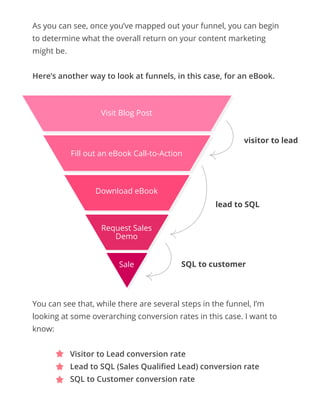
As you can see, once you’ve mapped out your funnel, you can begin
to determine what the overall return on your content marketing
might be.
Here’s another way to look at funnels, in this case, for an eBook.
You can see that, while there are several steps in the funnel, I’m
looking at some overarching conversion rates in this case. I want to
know:
	 	 Visitor to Lead conversion rate
		Lead to SQL (Sales Qualified Lead) conversion rate
	 	 SQL to Customer conversion rate
visitor to lead
lead to SQL
SQL to customer
Visit Blog Post
Fill out an eBook Call-to-Action
Download eBook
Request Sales
Demo
Sale
Unfortunately, most content marketers don’t have visibility into these
metrics. If you can’t answer the question “is it worth it?” and back up
your response with compelling data (e.g. number of leads generated)
then you’re wasting your time.
While there’s no shortage of tools to help you measure performance,
there are a few that can get you most of the way there.
Tools to Measure Performance
Google Analytics is a great way to analyze where your traffic is coming
from, engagement metrics like pageviews and sessions (used to be
called “visits”). Beyond that, you can also analyze behavior flow to
see where people go next. And, if you want to go a step further, you
can also set up events or goals so you can measure things like click
throughs, conversions, etc.
Two reports that are particularly valuable in GA are the channel and
landing page reports. The first lets you drill down into specific traffic
sources so you can see what’s driving the most traffic. This is a great
way to discover different referral sources that you might be able to
further exploit. Here’s what it looks like:
Google Analytics
Channel Reports
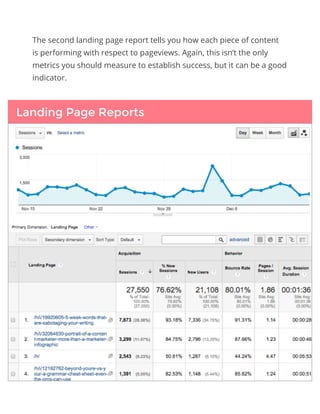
The second landing page report tells you how each piece of content
is performing with respect to pageviews. Again, this isn’t the only
metrics you should measure to establish success, but it can be a good
indicator.
Landing Page Reports
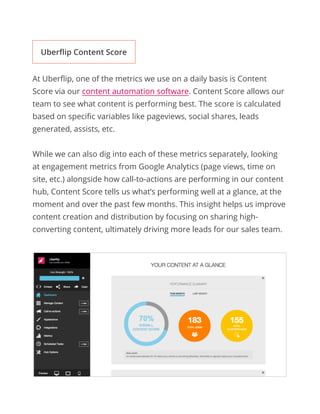
At Uberflip, one of the metrics we use on a daily basis is Content
Score via our content automation software. Content Score allows our
team to see what content is performing best. The score is calculated
based on specific variables like pageviews, social shares, leads
generated, assists, etc.
While we can also dig into each of these metrics separately, looking
at engagement metrics from Google Analytics (page views, time on
site, etc.) alongside how call-to-actions are performing in our content
hub, Content Score tells us what’s performing well at a glance, at the
moment and over the past few months. This insight helps us improve
content creation and distribution by focusing on sharing high-
converting content, ultimately driving more leads for our sales team.
Uberflip Content Score
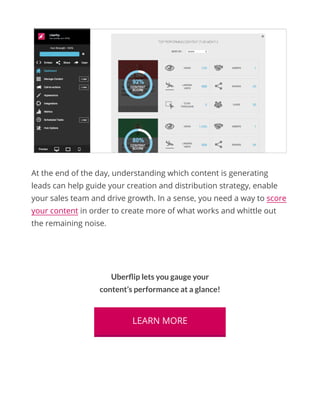
At the end of the day, understanding which content is generating
leads can help guide your creation and distribution strategy, enable
your sales team and drive growth. In a sense, you need a way to score
your content in order to create more of what works and whittle out
the remaining noise.
Uberflip lets you gauge your
content’s performance at a glance!
LEARN MORE
Conclusion
Effective content marketing isn’t a “hit or miss” practice; you can
significantly improve your success rate by taking the time to analyze
your performance.
A data-driven approach to content marketing will help you step out of
the dark and truly understand what is (and isn’t) working. Digging into
your metrics to extrapolate relevant information can help guide your
overall content strategy and decision making process.
So take a deep breath, dive into your metrics and embrace all the data
that’s at your fingertips!
CH 7
tips & tricks?
WANT MORE
CONTENT MARKETING
Get your own Uberflip Hub!
Start your free trial now.
Subscribe to our HUB

Data-Driven Content Marketing

  • 1.
    Data-Driven Content Marketing How ToCreate & Optimize A Content Strategy With Data At Its Core By Hana Abaza
  • 2.
    TABLE OF CONTENTS CH1 Introduction CH 2 Creating Content Strategy with Data at the Core CH 3 Content Ideation CH 4 Content Distribution CH 5 Content Experience CH 6 Content Performance CH 7 Conclusion
  • 3.
    Editing Writing & Research GraphicDesign Braveen Kumar Hana Abaza Jenny Choi
  • 4.
    Introduction From Mad Mento Modern Marketing, we’ve seen some major shifts in the marketing industry over the years. The biggest shift is one of accountability. Marketers, just like our counterparts in sales, have to show value - show our contribution to the bottom line. For many, this means embracing a new marketing reality. At the heart of this is the fact that marketing has to be informed by data, and content marketing is no different. Taking a data-driven approach for content marketing requires three things: CH 1
  • 5.
    A fundamental shiftin process. This is especially important if your organization doesn’t currently prioritize and encourage an analytical mindset. This includes laying the foundation to track and measure ideas before they go into the wild, and establishing a process for analyzing and reporting results. Open communication. Data comes in many forms, and making informed decisions requires you to consider quantitative and qualitative data, some of which you have access to and some of which may be sitting in other departments or teams. The power to make make changes- to iterate. All of the data in the world is essentially useless you have the power to act on it. Unfortunately, one of the biggest bottlenecks for marketers is the IT department. The content experience (front end) must be owned by your marketing team so they can optimize it based on the results. Either you need a technical person on your marketing team or a software that allows any marketer to take the reins. If you can put a checkmark beside each of the above (or can work towards that), then you’re part of the way there. In this eBook, we’re going to focus on concepts, tools and tactics to implement throughout each stage of the content marketing process in order to understand what’s working and make better decisions. 1. 2. 3.
  • 6.
    Creating a Content Strategywith Data at the Core Like anything else in business, you first need to establish clear goals and a strategy (one that you can adapt as you gain more insight into how it’s working). Developing buyer personas, defining the buyer journey and mapping the right content to the right persona at each stage of the buyer journey will provide a foundation for that strategy. I’m going to assume that you have started this process, but if not, here are some great resources that can point you in the right direction: The Essentials of a Documented Content Marketing Strategy Blogging in the Age of Modern Marketing 1. 2. CH 2
  • 7.
    1. CONTENT IDEATION 2.CONTENT DISTRIBUTION 3. CONTENT EXPERIENCE 4. CONTENT PERFORMANCE Using data to for better content creation and ideation Once your content strategy has come together, it’s time to implement a process that’s structured yet agile. We’re going to look at how to embrace a data-driven approach across four key pillars of content marketing: By applying a data-driven approach to this framework, we can make informed decisions and identify what’s working at each level. Analyzing distribution channels for greater impact and targeting Optimizing your content experience for your audience Measuring what matters so you know what’s working 4
  • 8.
    CONTENT IDEATION While allof us, at some point, have managed to pull a compelling content idea from thin air, the reality is that ideation can be (and should be) driven by data. To create content that resonates with your audience and your industry, it’s essential to understand what’s already working. Luckily, there are several tools that can help identify the trends within your industry and the type of content that’s hitting home with your audience. Here are a few that our content team at Uberflip uses regularly: CH 3
  • 9.
    BuzzSumo BuzzSumo analyzes whatcontent performs best for specific topics or websites. After typing in a topic or domain, you’ll get a results page with the top ranked content for your search. This includes a breakdown of how well the content performed across all major social channels, giving you insight into where your audience lives. BuzzSumo also lets you filter the results by date and by type (e.g. articles, videos, infographics, etc.) so you have a better understanding of which type of content is performing best. You can do the same search for a competitor’s domain and topics to see how you’re ranking in comparison. PRO TIP!
  • 10.
    Google Trends In theexample above, we took a look at the term “content marketing” and how it’s trending. If you were able to create compelling, high quality content about this topic as the graph was on the rise (around 2011 / 2012), you’re likely still reaping the rewards. In addition to keyword and search trends, Google Trends also gives insight into rising search terms and geographical data. Google Trends can help to identify trends for specific keywords and topics. Ideally, you want to capitalize on words that are in the midst of an upswing in interest.
  • 11.
    Mine Your OwnTeam For Data In many companies, the content team works in a silo, separated from demand generation, sales and customer support. This can be a huge disadvantage. These are people with behind the scenes knowledge of what your audience wants to know. They’re interacting with customers and prospects on a regular basis and will be able to tell you their biggest pain points. Whether it’s for top of the funnel, educational content or customer-centric content to help reduce churn, talk to your counterparts in other teams and capitalize on what they’ve learned on the front lines. For example, here are a couple of questions I like to ask our sales team: What non-product related questions do you hear on a regular basis? This helps with “top of the funnel” content. If we can answer these questions using content, we’ll not only help our sales team by providing them with content they can send to their prospects, but we’ll also answer the question for everyone else. What are the biggest pain points you hear about? This speaks directly to a deeper understanding of our buyer persona and is a great way to get ideas for more “bottom of the funnel” content.
  • 12.
    Don’t just tweetor email your customers - actually talk to them. Seems like a strange concept, but there’s no substitution for a real conversation. Email and social media often lack the nuances that you pick up on when speaking to another human being. Why does this matter? Ann Handley writes that, in order for your content to be compelling and effective, it needs to be “useful, inspired, and pathologically empathetic to the needs of the people you are trying to reach.” The amount of information you can glean from a couple of simple conversations can have a major impact on how you position your company, what to create and, as we we move to the next section, where to distribute your content. Talk To Your Customers
  • 13.
    CONTENT DISTRIBUTION Distributing yourcontent is just as important as creating high quality content. A data-driven approach is essential to refine your distribution strategy. CH 4
  • 14.
    The first stepis to set a baseline by analyzing the metrics associated with your distribution channels - this can be eye opening! Tools like Google Analytics, KISSmetrics (or even Buffer and BuzzSumo, if you’re primarily focused on social media distribution) will help determine where the majority of your traffic is coming from. Is it social? Search? Or is your content getting picked up by other bloggers? Once you understand where your existing traffic is coming from, you might be able to gain some valuable insight into where you should focus your distribution efforts. For example, if you discover that people coming from LinkedIn are very engaged, it might be worth putting some paid distribution behind this channel. Alternatively, you can also look into other channels that LinkedIn users also frequent, such as forums or other networks. Staying in tune with your distribution metrics can also help identify viable channels you may have been unaware of, such as other blogs that accept guest posts. Benchmark Current Distribution Channels
  • 15.
    Further Reading: Ifyou’re new to segmentation, here are 22 ways you can segment your contacts to get you started. Segmenting Your Audience For More Distribution Once you understand where people are coming from, take the time to segment your audience. Look at the metrics from each source, like time on site, bounce rate and social shares. Are people coming from social media more engaged than people coming from a Google search? Of those visitors, who is ultimately converting to a lead and then a customer? In the (oversimplified) example below, you can see that people who are coming from LinkedIn are much more likely to convert into a subscriber than those coming from Facebook. SOCIALMEDIATRAFFIC Source: Twitter 4% Subscribed to Newsletter 12% Subscribed to Newsletter 2% Subscribed to Newsletter Source: LinkedIn Source: Facebook
  • 16.
    Distribution Channels While thefocus of this eBook is tracking and measuring your content marketing strategy, I’d be remiss if I didn’t at least touch on distribution channels. Without knowing your industry, audience and customer, it’s impossible to make any concrete recommendations. But, in general, distribution for content marketing falls into the following categories: This includes Twitter, LinkedIn, Facebook, Pinterest and countless others. The key is to find a channel that your audience is engaged with and likely to interact with you. Platforms like Outbrain and Taboola are great ways to distribute your content to a variety of publications. Be sure to analyze not just click- through rates, but also conversion (for example, a newsletter signup) from these sources so you can optimize where they are publishing your content. Despite the countless proclamations that “email marketing is dead”, the problem is that most marketers don’t take the time to execute in a systematic and methodological way, ruthlessly preserving the integrity of their contact database. If the people in your database want to hear from you, they’ll open your emails. Social Media Networks Content Recommendation Platforms Email Marketing 1 2 3
  • 17.
    If you’re ina particularly specialized market, there are often communities, dedicated forums or subsections of more mainstream forums, that might be a great place to share your content. But as always, these forums are most effective when you are genuinely participating in the conversation - avoid the temptation to spam the hell out of them ;) Sites like Business2Community, Social Media Today and others provide the opportunity to syndicate content. If you can find something similar in your industry, it’s worth exploring. Be sure to syndicate wisely as it can have a negative impact on your SEO. Pro tip: ask the syndicating site to include rel=”canonical” tag when possible. Offer to submit a guest post on sites that are either highly targeted (so there’s a disproportionate number of readers that fit your ideal customer profile) or slightly broader with a larger reach and considered “high authority” by the powers that be (i.e. Google). Are there any heavyweights in your industry that love your product? Take the time to develop a relationship with them. Help them in some way (maybe free use of your product?) and turn them into evangelists for your company. Forums & Communities Content Syndication Guest Blogging Influencer Marketing 4 5 6 7
  • 18.
    Industry influencers aren’tthe only ones who can act as evangelists on your behalf. Your customers are also the perfect people to spread your message. Using an advocate marketing platform like Influitive is the perfect way to turn customers into advocates, encouraging them to share your content with their own networks. Like email marketing, SEO isn’t dead but it has evolved. As expected, Google is increasingly emphasizing semantic search. In order to have an impact on your content’s SEO performance, you have to consider both keywords and the actual language people (your customers) are using. Understanding whether or not there is a viable channel in any of the above categories takes time, data and experimentation. The key is to lay the foundation to properly track results, prior to experimentation, so you can benchmark and track progress. Advocate Marketing SEO Recycle and reuse your content. For example, if a blog post about a particular topic is working well on Twitter, repurpose the content into a SlideShare or infographic and test it on a channel where visual content works well like Facebook, Pinterest, even LinkedIn. PRO TIP! 8 9
  • 19.
    BOOST ENGAGEMENT GENERATE LEADS CONTROLYOUR CONTENT Turn insight into action so you can manage and optimize your content experience—no IT required. Content Hub Integrates with LEARN MORE
  • 20.
    CONTENT EXPERIENCE Creating akiller content experience goes a long way towards increasing the engagement and distribution of your content. But your content experience must also be designed and optimized for lead generation. Unfortunately, user experience is too often ignored due to a lack of knowledge or a lack of control. CH 5
  • 21.
    Here are threequestions you need to answer when focusing on optimizing the experience. Is it social shares, newsletter signups, lead generation? Understand the primary goal to optimize in the right direction. Do you have the infrastructure in place to measure success? If you’re after newsletter subscribers, are you able to measure your subscriber conversion rate? Tools that can help you do this include marketing automation platforms like Marketo or HubSpot or content marketing software like Uberflip. Do you have the control to change the content experience? Whether this is you as a marketer, or working in conjunction with the development team, being able to quickly change and add call-to-actions or create targeted content streams can have a huge impact on your overall performance. What are you optimizing for? Can you measure it? Can you change it? 1. 2. 3.
  • 22.
    We’ll do adeep dive into specific metrics in the next section, but the general concept behind optimizing your content marketing is the same as optimizing a landing page, a sales site, an ecommerce site or anything else. Given full control over the content experience (without involving IT or developers in the process), marketers can further optimize the content experience to tailor to specific buyer personas. You can tighten the message for more personalized call-to-actions, usually resulting in higher engagement and conversion rates. Generate more leads by optimizing the content experience for conversions TRY UBERFLIP FREE
  • 23.
    CONTENT PERFORMANCE Content effectivenessand ROI often gets the least attention because it is the hardest to measure, but it’s the most important aspect of taking a data-driven approach to content marketing. Content ROI comes down to understanding the goal of your content. However, while I’m the first to advocate for the importance of knowing your Content ROI, if your only objective is brand awareness then attaching a dollar figure to your ROI is more difficult. As much as I want you to be metrics-minded, it’s important to remember that there can also be intangible benefits to content marketing. CH 6
  • 24.
    What is ContentPerformance? Understanding how to track, measure and interpret performance is at the crux of taking a data-driven approach to content marketing. While it’s usually easy to get a “bunch of data” (provided you have the right tools in place),identifying the right data, interpreting it combining it with qualitative feedback and turning it into something actionable can be tough. Let’s start by looking at two main buckets when it comes to content marketing metrics: These enable you to gauge how your content is resonating with people, whether or not you’re attracting the right audience and whether or not your distribution plan is effective. Growth metrics are more directly related to your bottom line and include things like sales, revenue and customer growth figures. 1. Engagement metrics 2. Growth metrics
  • 25.
    Social Shares Time OnSite Pages Per Visit Search Rankings Page Views Bounce Rate Visitor to Lead Conversion Lead to Customer Conversion # of Leads Generated # of CTAs Clicked # of Forms Filled Lead to Sales Qualified Lead Most marketers focus too much on engagement metrics and not enough on growth metrics. While these can be valuable indicators (and increasing these might be the first step to driving higher growth metrics), they won’t shed light on whether your content is impacting the bottom line. Here’s an example of some metrics that fall into each category. If any of these are unfamiliar to you, check out this post I wrote about Content Marketing ROI, it’s a good place to start if you’re, well, just starting. PRO TIP! ENGAGEMENT METRICS GROWTH METRICS
  • 26.
    Once again, themetrics you choose to focus on should align with your overall goals. Once you know what those are, you can begin to put together a funnel that will shed some light on what’s working and what needs work. For example, here’s what a very simple funnel might look like at Uberflip for one of our webinars. If my end goal was simply webinar registrants, I could stop here. But, I can also take it a step further to see the impact on growth. While our end goal is to get more quality leads for our sales team, the webinar registration is a “micro conversion” - an essential step in the overall process. If this step doesn’t deliver, the overall performance is affected. Understanding the conversion rates at each stage of this funnel, helps us optimize the process so we can maximize the end result. Visit Blog Post Click Webinar CTA Submit Form on Webinar Landing Page Attend Webinar Attend Webinar Visit Blog Post Click Webinar CTA Submit Form on Webinar Landing Page Became a Qualified Lead Customer
  • 27.
    As you cansee, once you’ve mapped out your funnel, you can begin to determine what the overall return on your content marketing might be. Here’s another way to look at funnels, in this case, for an eBook. You can see that, while there are several steps in the funnel, I’m looking at some overarching conversion rates in this case. I want to know: Visitor to Lead conversion rate Lead to SQL (Sales Qualified Lead) conversion rate SQL to Customer conversion rate visitor to lead lead to SQL SQL to customer Visit Blog Post Fill out an eBook Call-to-Action Download eBook Request Sales Demo Sale
  • 28.
    Unfortunately, most contentmarketers don’t have visibility into these metrics. If you can’t answer the question “is it worth it?” and back up your response with compelling data (e.g. number of leads generated) then you’re wasting your time. While there’s no shortage of tools to help you measure performance, there are a few that can get you most of the way there. Tools to Measure Performance Google Analytics is a great way to analyze where your traffic is coming from, engagement metrics like pageviews and sessions (used to be called “visits”). Beyond that, you can also analyze behavior flow to see where people go next. And, if you want to go a step further, you can also set up events or goals so you can measure things like click throughs, conversions, etc. Two reports that are particularly valuable in GA are the channel and landing page reports. The first lets you drill down into specific traffic sources so you can see what’s driving the most traffic. This is a great way to discover different referral sources that you might be able to further exploit. Here’s what it looks like: Google Analytics
  • 29.
  • 30.
    The second landingpage report tells you how each piece of content is performing with respect to pageviews. Again, this isn’t the only metrics you should measure to establish success, but it can be a good indicator. Landing Page Reports
  • 31.
    At Uberflip, oneof the metrics we use on a daily basis is Content Score via our content automation software. Content Score allows our team to see what content is performing best. The score is calculated based on specific variables like pageviews, social shares, leads generated, assists, etc. While we can also dig into each of these metrics separately, looking at engagement metrics from Google Analytics (page views, time on site, etc.) alongside how call-to-actions are performing in our content hub, Content Score tells us what’s performing well at a glance, at the moment and over the past few months. This insight helps us improve content creation and distribution by focusing on sharing high- converting content, ultimately driving more leads for our sales team. Uberflip Content Score
  • 32.
    At the endof the day, understanding which content is generating leads can help guide your creation and distribution strategy, enable your sales team and drive growth. In a sense, you need a way to score your content in order to create more of what works and whittle out the remaining noise. Uberflip lets you gauge your content’s performance at a glance! LEARN MORE
  • 33.
    Conclusion Effective content marketingisn’t a “hit or miss” practice; you can significantly improve your success rate by taking the time to analyze your performance. A data-driven approach to content marketing will help you step out of the dark and truly understand what is (and isn’t) working. Digging into your metrics to extrapolate relevant information can help guide your overall content strategy and decision making process. So take a deep breath, dive into your metrics and embrace all the data that’s at your fingertips! CH 7
  • 34.
    tips & tricks? WANTMORE CONTENT MARKETING Get your own Uberflip Hub! Start your free trial now. Subscribe to our HUB