The Millennial Mind:
How Content Drives Brand Loyalty
A quantitative research study conducted by NewsCred in 2014
Methodology
In Fall 2014, NewsCred, the world’s leading content marketing
platform, conducted a study to understand how millennials view
content today – including the good, the bad, and the ugly.
The study surveyed 501 US millennials and was conducted by MBC
Research. The results reveal that 62% of those surveyed feel that
online content drives their loyalty to a brand - yet the content they’re
receiving is turning them off by not helping them navigate their
everyday problems, being too long, sales-driven, or not tailoring
messaging to individual cultural interests.
The following insights are from the NewsCred study, with additional
color from Yahoo and eMarketer.
NewsCred Millennial Survey 2014
Millennial is the word on every
brand’s mind.
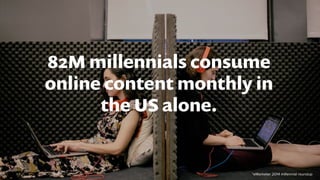
82M millennials consume
online content monthly in
the US alone.
*eMarketer 2014 millennial roundup
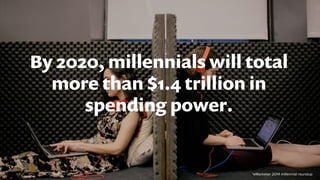
By 2020, millennials will total
more than $1.4 trillion in
spending power.
*eMarketer 2014 millennial roundup
Introduction
We are all familiar with the word millennial. If you aren’t, odds
are you’re not in marketing, or have just returned to your
computer after living under a rock.
To be fair, the definition of a “millennial” can vary widely.
According to Wikipedia, a millennial, loosely, describes anyone
born between the early 1980s and 2000. That means anyone
from the age of 15 – 30+. That is a lot of people. Yet, typically
when people refer to millennials, they are referring to 18-25
year-olds. The biggest opportunity for brands is building long-
term relationships with tomorrow’s leaders, influencers, and big
spenders.
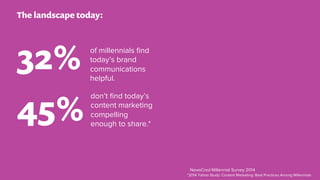
of millennials find
today’s brand
communications
helpful.
don’t find today’s
content marketing
compelling
enough to share.*
32%
45%
The landscape today:
*2014 Yahoo Study: Content Marketing: Best Practices Among Millennials
NewsCred Millennial Survey 2014
While content presents an amazing opportunity, brands
have their work cut out for them. Millennials can call B.S.
faster than any other audience. They consume copious
amounts of content, but lose interest in under 10 seconds.
They are identity obsessed. They like to laugh. They are
“independent” (or at least they want you to think they are).
They crave cultural relevance. They want to read your
brand’s content, but unfortunately, they’re not really
feeling it right now.
The sad truth: millennials are not impressed
with your content marketing
Why isn’t your content
winning the hearts of
millennials everywhere?
1. Why your content is failing with millennials (and how to fix it)
Hyper-relevance / Helpful + useful / Thought-provoking / Emotion / Format
2. Four brands that get it right
Netflix / Verizon / Denny’s / VICE
3. Appendix and stats
How and why they share / Behavior
Table of Contents
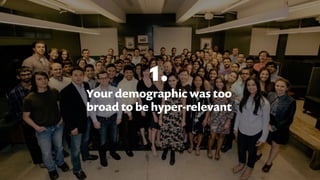
1.
Your demographic was too
broad to be hyper-relevant
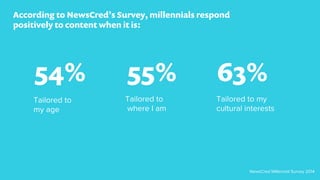
54%
According to NewsCred’s Survey, millennials respond
positively to content when it is:
Tailored to
my age
Tailored to
where I am
Tailored to my
cultural interests
55% 63%
NewsCred Millennial Survey 2014
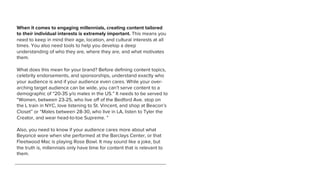
When it comes to engaging millennials, creating content tailored
to their individual interests is extremely important. This means you
need to keep in mind their age, location, and cultural interests at all
times. You also need tools to help you develop a deep
understanding of who they are, where they are, and what motivates
them.
What does this mean for your brand? Before defining content topics,
celebrity endorsements, and sponsorships, understand exactly who
your audience is and if your audience even cares. While your over-
arching target audience can be wide, you can’t serve content to a
demographic of “20-35 y/o males in the US.” It needs to be served to
“Women, between 23-25, who live off of the Bedford Ave. stop on
the L train in NYC, love listening to St. Vincent, and shop at Beacon’s
Closet” or “Males between 28-30, who live in LA, listen to Tyler the
Creator, and wear head-to-toe Supreme. ”
Also, you need to know if your audience cares more about what
Beyoncé wore when she performed at the Barclays Center, or that
Fleetwood Mac is playing Rose Bowl. It may sound like a joke, but
the truth is, millennials only have time for content that is relevant to
them.
2.
You decided you didn’t want to be useful or helpful
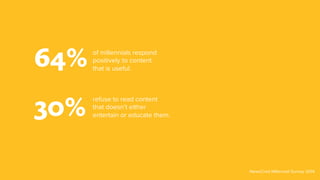
64% of millennials respond
positively to content
that is useful.
refuse to read content
that doesn’t either
entertain or educate them.30%
NewsCred Millennial Survey 2014
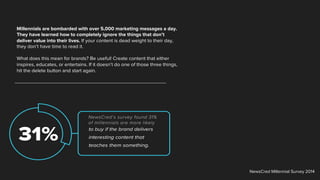
Millennials are bombarded with over 5,000 marketing messages a day.
They have learned how to completely ignore the things that don’t
deliver value into their lives. If your content is dead weight to their day,
they don’t have time to read it.
What does this mean for brands? Be useful! Create content that either
inspires, educates, or entertains. If it doesn’t do one of those three things,
hit the delete button and start again.
even say they are more likely
to buy if the brand delivers
interesting content that
teaches them something.
NewsCred Millennial Survey 2014
NewsCred’s survey found 31%
of millennials are more likely
3.
Your content was boring and stupid.
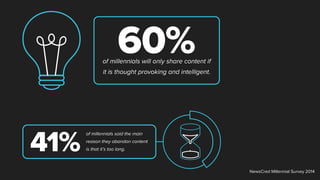
of millennials will only share content if
it is thought provoking and intelligent.
of millennials said the main
reason they abandon content
is that it’s too long.41%
NewsCred Millennial Survey 2014
NewsCred’s survey found that 60% of millennials only share
content when it is “thought provoking and intelligent.” So what is
the opposite of that? Boring and stupid. Those two words are
probably not the ones you want associated with your brand.
Aside from your content inspiring, educating, or entertaining
your audience, it also needs to be a positive reflection of your
brand’s perspective. It should elicit thought and sharing. It
should feel smart. In 2014, our average attention span is less
than that of a goldfish*. Does that mean every article should be a
listicle? No. The days of long-form content are not over. This
just means that content should not feel like an empty marketing
ploy.
What does this mean for your brand? Form a perspective and a
point-of-view. Take a step back from the content you create and
question whether or not it will contribute to an interesting
discourse. If your content is thought provoking and intelligent,
millennials will share it.
*Statistic Brain
NewsCred Millennial Survey 2014
4.
You didn’t want them to get all emotional on you
0% 10% 20% 30% 40% 50% 60% 70% 80%
It's funny
It's thought provoking
It's a cause I believe in
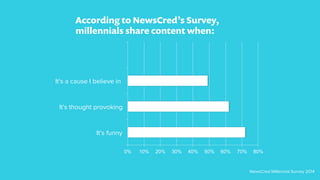
According to NewsCred’s Survey,
millennials share content when:
NewsCred Millennial Survey 2014
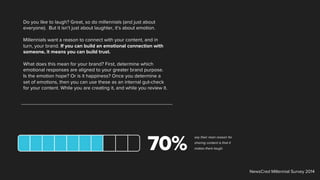
Do you like to laugh? Great, so do millennials (and just about
everyone). But it isn’t just about laughter, it’s about emotion.
Millennials want a reason to connect with your content, and in
turn, your brand. If you can build an emotional connection with
someone, it means you can build trust.
What does this mean for your brand? First, determine which
emotional responses are aligned to your greater brand purpose.
Is the emotion hope? Or is it happiness? Once you determine a
set of emotions, then you can use these as an internal gut-check
for your content. While you are creating it, and while you review it.
say their main reason for
sharing content is that it
makes them laugh.
NewsCred Millennial Survey 2014
5.
You texted a link to your Myspace
profile.*
*that’s not a real thing
0% 10% 20% 30% 40% 50% 60% 70% 80%
Searching on Google
Facebook
Instagram
Twitter
Pinterest
LinkedIn
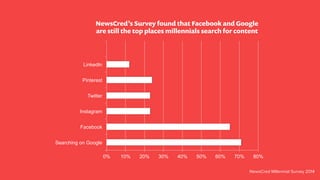
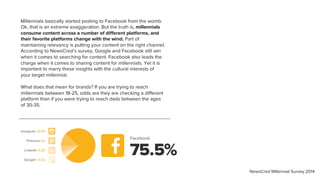
NewsCred’s Survey found that Facebook and Google
are still the top places millennials search for content
NewsCred Millennial Survey 2014
Millennials basically started posting to Facebook from the womb.
Ok, that is an extreme exaggeration. But the truth is, millennials
consume content across a number of different platforms, and
their favorite platforms change with the wind. Part of
maintaining relevancy is putting your content on the right channel.
According to NewsCred’s survey, Google and Facebook still win
when it comes to searching for content. Facebook also leads the
charge when it comes to sharing content for millennials. Yet it is
important to marry these insights with the cultural interests of
your target millennial.
What does that mean for brands? If you are trying to reach
millennials between 18-25, odds are they are checking a different
platform than if you were trying to reach dads between the ages
of 30-35.
Facebook
Instagram 12.5%
Pinterest 5%
LinkedIn 3.5%
Google+ 3.5%
75.5%
NewsCred Millennial Survey 2014
4 brands that are
doing it right
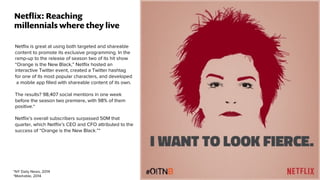
Netflix is great at using both targeted and shareable
content to promote its exclusive programming. In the
ramp-up to the release of season two of its hit show
“Orange is the New Black,” Netflix hosted an
interactive Twitter event, created a Twitter hashtag
for one of its most popular characters, and developed
a mobile app filled with shareable content of its own.
The results? 98,407 social mentions in one week
before the season two premiere, with 98% of them
positive.*
Netflix’s overall subscribers surpassed 50M that
quarter, which Netflix’s CEO and CFO attributed to the
success of “Orange is the New Black.”*
Netflix: Reaching
millennials where they live
*NY Daily News, 2014
*Mashable, 2014
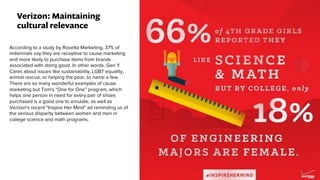
According to a study by Rosetta Marketing, 37% of
millennials say they are receptive to cause marketing
and more likely to purchase items from brands
associated with doing good. In other words, Gen Y
Cares about issues like sustainability, LGBT equality,
animal rescue, or helping the poor, to name a few.
There are so many wonderful examples of cause
marketing but Tom's “One for One” program, which
helps one person in need for every pair of shoes
purchased is a good one to emulate, as well as
Verizon's recent "Inspire Her Mind" ad reminding us of
the serious disparity between women and men in
college science and math programs.
Verizon: Maintaining
cultural relevance
Denny’s: Combining authenticity
with the right format
Format is extremely important when it comes to reaching
millennials. An October 2013 survey by The New York Times found
that 34% of millennials watch mostly online video and no broadcast
television. But in order to create content with authenticity,
sometimes you need to tap into the creativity and credibility of a
third party source.
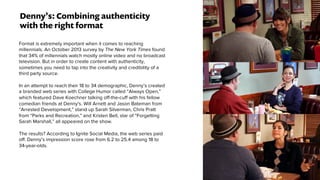
In an attempt to reach their 18 to 34 demographic, Denny’s created
a branded web series with College Humor called “Always Open,”
which featured Dave Koechner talking off-the-cuff with his fellow
comedian friends at Denny's. Will Arnett and Jason Bateman from
“Arrested Development,” stand up Sarah Silverman, Chris Pratt
from “Parks and Recreation,” and Kristen Bell, star of “Forgetting
Sarah Marshall,” all appeared on the show.
The results? According to Ignite Social Media, the web series paid
off. Denny’s impression score rose from 6.2 to 25.4 among 18 to
34-year-olds.
In order to make content young people will trust, accept, and
like, you need to know about the decade that formed them and
shaped their consciousness, said VICE’s Chief Content Officer
Eddie Moretti. “In the decade of the 2000s, it was the march of
two opposing forces – a crisis of information and the liberation of
information.”
The biggest casualty of the decade, however, was a loss of
trust. “Millennials lost trust in politicians and experts and systems
[social security, etc.],” said Moretti. They also lost trust in the
media.
As far as the “liberation of information” - that came with the rapid
advancements in computing, connectivity, and social media.
Basically the rise of digital and mobile access.
Though millennials have the reputation of being self-indulgent
selfie-takers, VICE found through direct conversations with their
fans that they do care deeply about the world they live in, and
they were looking for a non-traditional source to keep them
informed.
VICE: Creating the content
of the future
Appendix
The information is endless when it comes to the
complex millennial demographic. Aside from the
insights and stats that we shared, the following charts
from NewsCred’s survey will give you a general look
at some useful information that helped shape these
takeaways.
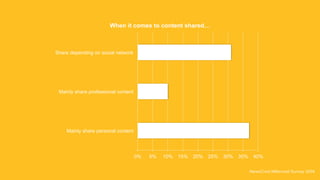
Content sharing amongst millennials
0% 5% 10% 15% 20% 25% 30% 35% 40%
Mainly share personal content
Mainly share professional content
Share depending on social network
When it comes to content shared…
NewsCred Millennial Survey 2014
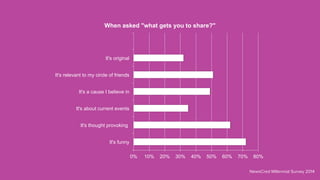
0% 10% 20% 30% 40% 50% 60% 70% 80%
It's funny
It's thought provoking
It's about current events
It's a cause I believe in
It's relevant to my circle of friends
It's original
When asked "what gets you to share?"
NewsCred Millennial Survey 2014
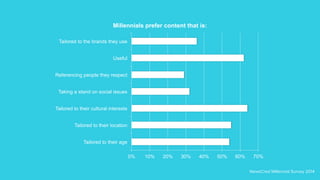
0% 10% 20% 30% 40% 50% 60% 70%
Tailored to their age
Tailored to their location
Tailored to their cultural interests
Taking a stand on social issues
Referencing people they respect
Useful
Tailored to the brands they use
Millennials prefer content that is:
NewsCred Millennial Survey 2014
Millennials and brands
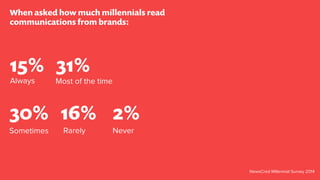
15% 31%
30% 16% 2%
When asked how much millennials read
communications from brands:
Always Most of the time
Sometimes Rarely Never
NewsCred Millennial Survey 2014
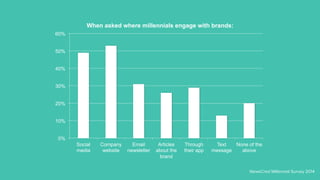
0%
10%
20%
30%
40%
50%
60%
Social
media
Company
website
Email
newsletter
Articles
about the
brand
Through
their app
Text
message
None of the
above
When asked where millennials engage with brands:
NewsCred Millennial Survey 2014
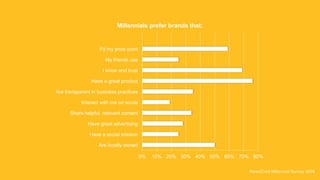
0% 10% 20% 30% 40% 50% 60% 70% 80%
Are locally owned
Have a social mission
Have great advertising
Share helpful, relevant content
Interact with me on social
Are transparent in business practices
Have a great product
I know and trust
My friends use
Fit my price point
Millennials prefer brands that:
NewsCred Millennial Survey 2014
Full disclosure:
This report was created by a bunch of
millennials at NewsCred.
About
NewsCred
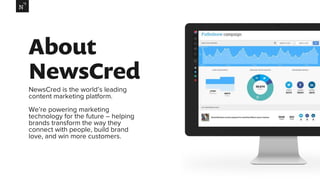
NewsCred is the world’s leading
content marketing platform.
We’re powering marketing
technology for the future – helping
brands transform the way they
connect with people, build brand
love, and win more customers.
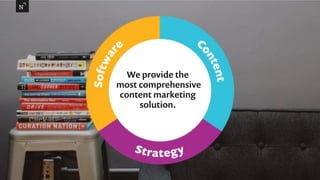
We provide the
most comprehensive
content marketing
solution.
Get in touch!
press@newscred.com | 212-989-4100
Thanks!

Millennial Mind - How Content Drives Brand Loyalty

  • 1.
    The Millennial Mind: HowContent Drives Brand Loyalty A quantitative research study conducted by NewsCred in 2014
  • 2.
    Methodology In Fall 2014,NewsCred, the world’s leading content marketing platform, conducted a study to understand how millennials view content today – including the good, the bad, and the ugly. The study surveyed 501 US millennials and was conducted by MBC Research. The results reveal that 62% of those surveyed feel that online content drives their loyalty to a brand - yet the content they’re receiving is turning them off by not helping them navigate their everyday problems, being too long, sales-driven, or not tailoring messaging to individual cultural interests. The following insights are from the NewsCred study, with additional color from Yahoo and eMarketer. NewsCred Millennial Survey 2014
  • 3.
    Millennial is theword on every brand’s mind.
  • 4.
    82M millennials consume onlinecontent monthly in the US alone. *eMarketer 2014 millennial roundup
  • 5.
    By 2020, millennialswill total more than $1.4 trillion in spending power. *eMarketer 2014 millennial roundup
  • 6.
    Introduction We are allfamiliar with the word millennial. If you aren’t, odds are you’re not in marketing, or have just returned to your computer after living under a rock. To be fair, the definition of a “millennial” can vary widely. According to Wikipedia, a millennial, loosely, describes anyone born between the early 1980s and 2000. That means anyone from the age of 15 – 30+. That is a lot of people. Yet, typically when people refer to millennials, they are referring to 18-25 year-olds. The biggest opportunity for brands is building long- term relationships with tomorrow’s leaders, influencers, and big spenders.
  • 7.
    of millennials find today’sbrand communications helpful. don’t find today’s content marketing compelling enough to share.* 32% 45% The landscape today: *2014 Yahoo Study: Content Marketing: Best Practices Among Millennials NewsCred Millennial Survey 2014
  • 8.
    While content presentsan amazing opportunity, brands have their work cut out for them. Millennials can call B.S. faster than any other audience. They consume copious amounts of content, but lose interest in under 10 seconds. They are identity obsessed. They like to laugh. They are “independent” (or at least they want you to think they are). They crave cultural relevance. They want to read your brand’s content, but unfortunately, they’re not really feeling it right now. The sad truth: millennials are not impressed with your content marketing
  • 9.
    Why isn’t yourcontent winning the hearts of millennials everywhere?
  • 10.
    1. Why yourcontent is failing with millennials (and how to fix it) Hyper-relevance / Helpful + useful / Thought-provoking / Emotion / Format 2. Four brands that get it right Netflix / Verizon / Denny’s / VICE 3. Appendix and stats How and why they share / Behavior Table of Contents
  • 11.
    1. Your demographic wastoo broad to be hyper-relevant
  • 12.
    54% According to NewsCred’sSurvey, millennials respond positively to content when it is: Tailored to my age Tailored to where I am Tailored to my cultural interests 55% 63% NewsCred Millennial Survey 2014
  • 13.
    When it comesto engaging millennials, creating content tailored to their individual interests is extremely important. This means you need to keep in mind their age, location, and cultural interests at all times. You also need tools to help you develop a deep understanding of who they are, where they are, and what motivates them. What does this mean for your brand? Before defining content topics, celebrity endorsements, and sponsorships, understand exactly who your audience is and if your audience even cares. While your over- arching target audience can be wide, you can’t serve content to a demographic of “20-35 y/o males in the US.” It needs to be served to “Women, between 23-25, who live off of the Bedford Ave. stop on the L train in NYC, love listening to St. Vincent, and shop at Beacon’s Closet” or “Males between 28-30, who live in LA, listen to Tyler the Creator, and wear head-to-toe Supreme. ” Also, you need to know if your audience cares more about what Beyoncé wore when she performed at the Barclays Center, or that Fleetwood Mac is playing Rose Bowl. It may sound like a joke, but the truth is, millennials only have time for content that is relevant to them.
  • 14.
    2. You decided youdidn’t want to be useful or helpful
  • 15.
    64% of millennialsrespond positively to content that is useful. refuse to read content that doesn’t either entertain or educate them.30% NewsCred Millennial Survey 2014
  • 16.
    Millennials are bombardedwith over 5,000 marketing messages a day. They have learned how to completely ignore the things that don’t deliver value into their lives. If your content is dead weight to their day, they don’t have time to read it. What does this mean for brands? Be useful! Create content that either inspires, educates, or entertains. If it doesn’t do one of those three things, hit the delete button and start again. even say they are more likely to buy if the brand delivers interesting content that teaches them something. NewsCred Millennial Survey 2014 NewsCred’s survey found 31% of millennials are more likely
  • 17.
    3. Your content wasboring and stupid.
  • 18.
    of millennials willonly share content if it is thought provoking and intelligent. of millennials said the main reason they abandon content is that it’s too long.41% NewsCred Millennial Survey 2014
  • 19.
    NewsCred’s survey foundthat 60% of millennials only share content when it is “thought provoking and intelligent.” So what is the opposite of that? Boring and stupid. Those two words are probably not the ones you want associated with your brand. Aside from your content inspiring, educating, or entertaining your audience, it also needs to be a positive reflection of your brand’s perspective. It should elicit thought and sharing. It should feel smart. In 2014, our average attention span is less than that of a goldfish*. Does that mean every article should be a listicle? No. The days of long-form content are not over. This just means that content should not feel like an empty marketing ploy. What does this mean for your brand? Form a perspective and a point-of-view. Take a step back from the content you create and question whether or not it will contribute to an interesting discourse. If your content is thought provoking and intelligent, millennials will share it. *Statistic Brain NewsCred Millennial Survey 2014
  • 20.
    4. You didn’t wantthem to get all emotional on you
  • 21.
    0% 10% 20%30% 40% 50% 60% 70% 80% It's funny It's thought provoking It's a cause I believe in According to NewsCred’s Survey, millennials share content when: NewsCred Millennial Survey 2014
  • 22.
    Do you liketo laugh? Great, so do millennials (and just about everyone). But it isn’t just about laughter, it’s about emotion. Millennials want a reason to connect with your content, and in turn, your brand. If you can build an emotional connection with someone, it means you can build trust. What does this mean for your brand? First, determine which emotional responses are aligned to your greater brand purpose. Is the emotion hope? Or is it happiness? Once you determine a set of emotions, then you can use these as an internal gut-check for your content. While you are creating it, and while you review it. say their main reason for sharing content is that it makes them laugh. NewsCred Millennial Survey 2014
  • 23.
    5. You texted alink to your Myspace profile.* *that’s not a real thing
  • 24.
    0% 10% 20%30% 40% 50% 60% 70% 80% Searching on Google Facebook Instagram Twitter Pinterest LinkedIn NewsCred’s Survey found that Facebook and Google are still the top places millennials search for content NewsCred Millennial Survey 2014
  • 25.
    Millennials basically startedposting to Facebook from the womb. Ok, that is an extreme exaggeration. But the truth is, millennials consume content across a number of different platforms, and their favorite platforms change with the wind. Part of maintaining relevancy is putting your content on the right channel. According to NewsCred’s survey, Google and Facebook still win when it comes to searching for content. Facebook also leads the charge when it comes to sharing content for millennials. Yet it is important to marry these insights with the cultural interests of your target millennial. What does that mean for brands? If you are trying to reach millennials between 18-25, odds are they are checking a different platform than if you were trying to reach dads between the ages of 30-35. Facebook Instagram 12.5% Pinterest 5% LinkedIn 3.5% Google+ 3.5% 75.5% NewsCred Millennial Survey 2014
  • 26.
    4 brands thatare doing it right
  • 27.
    Netflix is greatat using both targeted and shareable content to promote its exclusive programming. In the ramp-up to the release of season two of its hit show “Orange is the New Black,” Netflix hosted an interactive Twitter event, created a Twitter hashtag for one of its most popular characters, and developed a mobile app filled with shareable content of its own. The results? 98,407 social mentions in one week before the season two premiere, with 98% of them positive.* Netflix’s overall subscribers surpassed 50M that quarter, which Netflix’s CEO and CFO attributed to the success of “Orange is the New Black.”* Netflix: Reaching millennials where they live *NY Daily News, 2014 *Mashable, 2014
  • 28.
    According to astudy by Rosetta Marketing, 37% of millennials say they are receptive to cause marketing and more likely to purchase items from brands associated with doing good. In other words, Gen Y Cares about issues like sustainability, LGBT equality, animal rescue, or helping the poor, to name a few. There are so many wonderful examples of cause marketing but Tom's “One for One” program, which helps one person in need for every pair of shoes purchased is a good one to emulate, as well as Verizon's recent "Inspire Her Mind" ad reminding us of the serious disparity between women and men in college science and math programs. Verizon: Maintaining cultural relevance
  • 29.
    Denny’s: Combining authenticity withthe right format Format is extremely important when it comes to reaching millennials. An October 2013 survey by The New York Times found that 34% of millennials watch mostly online video and no broadcast television. But in order to create content with authenticity, sometimes you need to tap into the creativity and credibility of a third party source. In an attempt to reach their 18 to 34 demographic, Denny’s created a branded web series with College Humor called “Always Open,” which featured Dave Koechner talking off-the-cuff with his fellow comedian friends at Denny's. Will Arnett and Jason Bateman from “Arrested Development,” stand up Sarah Silverman, Chris Pratt from “Parks and Recreation,” and Kristen Bell, star of “Forgetting Sarah Marshall,” all appeared on the show. The results? According to Ignite Social Media, the web series paid off. Denny’s impression score rose from 6.2 to 25.4 among 18 to 34-year-olds.
  • 30.
    In order tomake content young people will trust, accept, and like, you need to know about the decade that formed them and shaped their consciousness, said VICE’s Chief Content Officer Eddie Moretti. “In the decade of the 2000s, it was the march of two opposing forces – a crisis of information and the liberation of information.” The biggest casualty of the decade, however, was a loss of trust. “Millennials lost trust in politicians and experts and systems [social security, etc.],” said Moretti. They also lost trust in the media. As far as the “liberation of information” - that came with the rapid advancements in computing, connectivity, and social media. Basically the rise of digital and mobile access. Though millennials have the reputation of being self-indulgent selfie-takers, VICE found through direct conversations with their fans that they do care deeply about the world they live in, and they were looking for a non-traditional source to keep them informed. VICE: Creating the content of the future
  • 31.
  • 32.
    The information isendless when it comes to the complex millennial demographic. Aside from the insights and stats that we shared, the following charts from NewsCred’s survey will give you a general look at some useful information that helped shape these takeaways.
  • 33.
  • 34.
    0% 5% 10%15% 20% 25% 30% 35% 40% Mainly share personal content Mainly share professional content Share depending on social network When it comes to content shared… NewsCred Millennial Survey 2014
  • 35.
    0% 10% 20%30% 40% 50% 60% 70% 80% It's funny It's thought provoking It's about current events It's a cause I believe in It's relevant to my circle of friends It's original When asked "what gets you to share?" NewsCred Millennial Survey 2014
  • 36.
    0% 10% 20%30% 40% 50% 60% 70% Tailored to their age Tailored to their location Tailored to their cultural interests Taking a stand on social issues Referencing people they respect Useful Tailored to the brands they use Millennials prefer content that is: NewsCred Millennial Survey 2014
  • 37.
  • 38.
    15% 31% 30% 16%2% When asked how much millennials read communications from brands: Always Most of the time Sometimes Rarely Never NewsCred Millennial Survey 2014
  • 39.
    0% 10% 20% 30% 40% 50% 60% Social media Company website Email newsletter Articles about the brand Through their app Text message Noneof the above When asked where millennials engage with brands: NewsCred Millennial Survey 2014
  • 40.
    0% 10% 20%30% 40% 50% 60% 70% 80% Are locally owned Have a social mission Have great advertising Share helpful, relevant content Interact with me on social Are transparent in business practices Have a great product I know and trust My friends use Fit my price point Millennials prefer brands that: NewsCred Millennial Survey 2014
  • 41.
    Full disclosure: This reportwas created by a bunch of millennials at NewsCred.
  • 42.
    About NewsCred NewsCred is theworld’s leading content marketing platform. We’re powering marketing technology for the future – helping brands transform the way they connect with people, build brand love, and win more customers.
  • 43.
    We provide the mostcomprehensive content marketing solution.
  • 44.
  • 45.