PETER NEWMARK &
COMMUNICATIVE
TRANSLATION THEORY
ayeah 2023.10.5
文
A
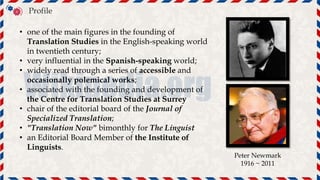
Peter Newmark
1916 ~ 2011
• one of the main figures in the founding of
Translation Studies in the English-speaking world
in twentieth century;
• very influential in the Spanish-speaking world;
• widely read through a series of accessible and
occasionally polemical works;
• associated with the founding and development of
the Centre for Translation Studies at Surrey
• chair of the editorial board of the Journal of
Specialized Translation;
• "Translation Now" bimonthly for The Linguist
• an Editorial Board Member of the Institute of
Linguists.
Profile
文
A
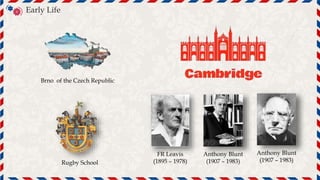
Brno of the Czech Republic
Early Life
FR Leavis
(1895 – 1978)
Anthony Blunt
(1907 – 1983)
Rugby School
文
A
Anthony Blunt
(1907 – 1983)
Career
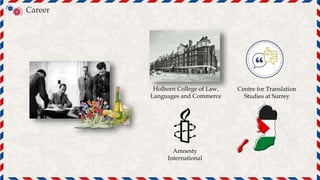
Holborn College of Law,
Languages and Commerce
文
A
Centre for Translation
Studies at Surrey
Amnesty
International
Major Works
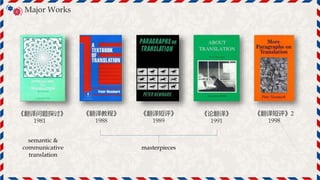
《翻译教程》
1988
《翻译短评》
1989
《论翻译》
1991
《翻译短评》2
1998
文
A
《翻译问题探讨》
1981
semantic &
communicative
translation
masterpieces
What is Translation?
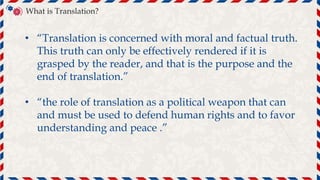
Translation is a craft consisting in the attempt to replace a
written message and/or statement in one language by the
same message and/or statement in another language.
翻译就是把一个文本的意义按作者所想的方式移译入另一种
文字(语言)。
Science Skill Art Taste
文
A
• “Translation is concerned with moral and factual truth.
This truth can only be effectively rendered if it is
grasped by the reader, and that is the purpose and the
end of translation.”
• “the role of translation as a political weapon that can
and must be used to defend human rights and to favor
understanding and peace .”
文
A
What is Translation?
文
A
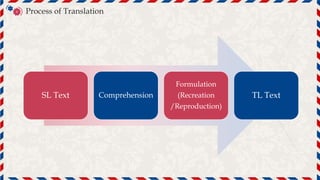
SL Text Comprehension
Formulation
(Recreation
/Reproduction)
TL Text
Process of Translation
Three Types of Texts
文
A
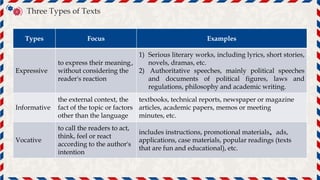
Types Focus Examples
Expressive
to express their meaning,
without considering the
reader's reaction
1) Serious literary works, including lyrics, short stories,
novels, dramas, etc.
2) Authoritative speeches, mainly political speeches
and documents of political figures, laws and
regulations, philosophy and academic writing.
Informative
the external context, the
fact of the topic or factors
other than the language
textbooks, technical reports, newspaper or magazine
articles, academic papers, memos or meeting
minutes, etc.
Vocative
to call the readers to act,
think, feel or react
according to the author's
intention
includes instructions, promotional materials。ads,
applications, case materials, popular readings (texts
that are fun and educational), etc.
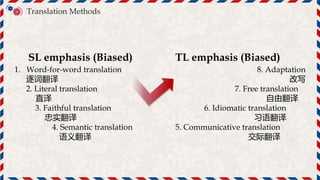
SL emphasis (Biased) TL emphasis (Biased)
1. Word-for-word translation
逐词翻译
8. Adaptation
改写
2. Literal translation
直译
7. Free translation
自由翻译
3. Faithful translation
忠实翻译
6. Idiomatic translation
习语翻译
4. Semantic translation
语义翻译
5. Communicative translation
交际翻译
Translation Methods
文
A
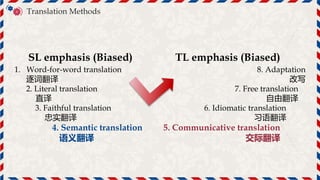
SL emphasis (Biased) TL emphasis (Biased)
1. Word-for-word translation
逐词翻译
8. Adaptation
改写
2. Literal translation
直译
7. Free translation
自由翻译
3. Faithful translation
忠实翻译
6. Idiomatic translation
习语翻译
4. Semantic translation
语义翻译
5. Communicative translation
交际翻译
Translation Methods
文
A
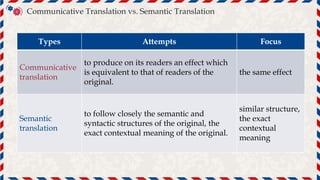
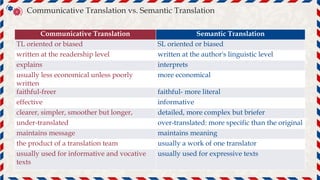
Communicative Translation vs. Semantic Translation
文
A
Types Attempts Focus
Communicative
translation
to produce on its readers an effect which
is equivalent to that of readers of the
original.
the same effect
Semantic
translation
to follow closely the semantic and
syntactic structures of the original, the
exact contextual meaning of the original.
similar structure,
the exact
contextual
meaning
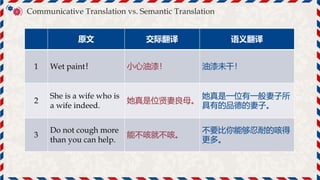
Communicative Translation vs. Semantic Translation
文
A
原文 交际翻译 语义翻译
1 Wet paint! 小心油漆! 油漆未干!
2
She is a wife who is
a wife indeed.
她真是位贤妻良母。
她真是一位有一般妻子所
具有的品德的妻子。
3
Do not cough more
than you can help.
能不咳就不咳。
不要比你能够忍耐的咳得
更多。
Communicative Translation Semantic Translation
TL oriented or biased SL oriented or biased
written at the readership level written at the author's linguistic level
explains interprets
usually less economical unless poorly
written
more economical
faithful-freer faithful- more literal
effective informative
clearer, simpler, smoother but longer, detailed, more complex but briefer
under-translated over-translated: more specific than the original
maintains message maintains meaning
the product of a translation team usually a work of one translator
usually used for informative and vocative
texts
usually used for expressive texts
Communicative Translation vs. Semantic Translation
文
A
Thank you for your attention!
ayeah 2023.10
文
A
References
文
A
• https://www.theguardian.com/education/2011/sep/28/peter-
newmark-obituary
• https://www.slideshare.net/nurulhusna76055/peter-newmark-
250421359
• https://www.slideshare.net/zee_albasyouni/newmarks-theory-2
• https://en.wikipedia.org/wiki/Peter_Newmark
• https://www.bilibili.com/video/BV1cs4y1U72u/?spm_id_from=33
3.788&vd_source=91e65125272e48d2a93639cf14a58a7b

Newmark & His Communicative Translation Theory

  • 1.
    PETER NEWMARK & COMMUNICATIVE TRANSLATIONTHEORY ayeah 2023.10.5 文 A
  • 2.
    Peter Newmark 1916 ~2011 • one of the main figures in the founding of Translation Studies in the English-speaking world in twentieth century; • very influential in the Spanish-speaking world; • widely read through a series of accessible and occasionally polemical works; • associated with the founding and development of the Centre for Translation Studies at Surrey • chair of the editorial board of the Journal of Specialized Translation; • "Translation Now" bimonthly for The Linguist • an Editorial Board Member of the Institute of Linguists. Profile 文 A
  • 3.
    Brno of theCzech Republic Early Life FR Leavis (1895 – 1978) Anthony Blunt (1907 – 1983) Rugby School 文 A Anthony Blunt (1907 – 1983)
  • 4.
    Career Holborn College ofLaw, Languages and Commerce 文 A Centre for Translation Studies at Surrey Amnesty International
  • 5.
  • 6.
    What is Translation? Translationis a craft consisting in the attempt to replace a written message and/or statement in one language by the same message and/or statement in another language. 翻译就是把一个文本的意义按作者所想的方式移译入另一种 文字(语言)。 Science Skill Art Taste 文 A
  • 7.
    • “Translation isconcerned with moral and factual truth. This truth can only be effectively rendered if it is grasped by the reader, and that is the purpose and the end of translation.” • “the role of translation as a political weapon that can and must be used to defend human rights and to favor understanding and peace .” 文 A What is Translation?
  • 8.
  • 9.
    Three Types ofTexts 文 A Types Focus Examples Expressive to express their meaning, without considering the reader's reaction 1) Serious literary works, including lyrics, short stories, novels, dramas, etc. 2) Authoritative speeches, mainly political speeches and documents of political figures, laws and regulations, philosophy and academic writing. Informative the external context, the fact of the topic or factors other than the language textbooks, technical reports, newspaper or magazine articles, academic papers, memos or meeting minutes, etc. Vocative to call the readers to act, think, feel or react according to the author's intention includes instructions, promotional materials。ads, applications, case materials, popular readings (texts that are fun and educational), etc.
  • 10.
    SL emphasis (Biased)TL emphasis (Biased) 1. Word-for-word translation 逐词翻译 8. Adaptation 改写 2. Literal translation 直译 7. Free translation 自由翻译 3. Faithful translation 忠实翻译 6. Idiomatic translation 习语翻译 4. Semantic translation 语义翻译 5. Communicative translation 交际翻译 Translation Methods 文 A
  • 11.
    SL emphasis (Biased)TL emphasis (Biased) 1. Word-for-word translation 逐词翻译 8. Adaptation 改写 2. Literal translation 直译 7. Free translation 自由翻译 3. Faithful translation 忠实翻译 6. Idiomatic translation 习语翻译 4. Semantic translation 语义翻译 5. Communicative translation 交际翻译 Translation Methods 文 A
  • 12.
    Communicative Translation vs.Semantic Translation 文 A Types Attempts Focus Communicative translation to produce on its readers an effect which is equivalent to that of readers of the original. the same effect Semantic translation to follow closely the semantic and syntactic structures of the original, the exact contextual meaning of the original. similar structure, the exact contextual meaning
  • 13.
    Communicative Translation vs.Semantic Translation 文 A 原文 交际翻译 语义翻译 1 Wet paint! 小心油漆! 油漆未干! 2 She is a wife who is a wife indeed. 她真是位贤妻良母。 她真是一位有一般妻子所 具有的品德的妻子。 3 Do not cough more than you can help. 能不咳就不咳。 不要比你能够忍耐的咳得 更多。
  • 14.
    Communicative Translation SemanticTranslation TL oriented or biased SL oriented or biased written at the readership level written at the author's linguistic level explains interprets usually less economical unless poorly written more economical faithful-freer faithful- more literal effective informative clearer, simpler, smoother but longer, detailed, more complex but briefer under-translated over-translated: more specific than the original maintains message maintains meaning the product of a translation team usually a work of one translator usually used for informative and vocative texts usually used for expressive texts Communicative Translation vs. Semantic Translation 文 A
  • 15.
    Thank you foryour attention! ayeah 2023.10 文 A
  • 16.
    References 文 A • https://www.theguardian.com/education/2011/sep/28/peter- newmark-obituary • https://www.slideshare.net/nurulhusna76055/peter-newmark- 250421359 •https://www.slideshare.net/zee_albasyouni/newmarks-theory-2 • https://en.wikipedia.org/wiki/Peter_Newmark • https://www.bilibili.com/video/BV1cs4y1U72u/?spm_id_from=33 3.788&vd_source=91e65125272e48d2a93639cf14a58a7b

Editor's Notes

  • #3 我在网上看到他青年和老年时期同样45度角的两张照片,觉得很有意思。 维基百科上对他的生平介绍是这样的: 二十世纪英语翻译研究的主要奠基人之一。 在西班牙语世界也很有影响力。 由于一系列通俗易懂、偶尔也会引起争议的作品闻名于世。 参与了萨里大学翻译研究中心的创建和发展。 他是《专业翻译》杂志的编辑委员会主席。 他还为《语言学家》的双月刊《今日翻译》撰稿 担任语言学家学会编委。 虽然偶有争议,但总的来说,彼得·纽马克在翻译和翻译研究领域是一位鼓舞人心的人物。 他是一位不屈不挠的语言学习斗士,主张政府给予翻译事业更多的认可、资源和承诺。
  • #4 彼特·纽马克出生于捷克,他出生那会儿叫奥匈帝国,的布尔诺市,父亲是英国人,经营着一家成功的纺织企业。父亲希望他长大能成为一位英国绅士,所以从小就给他请了一位英国的家庭教师教他,五岁时更是迁居英国,之后就在英国接受传统的学院教育。纽马克曾就读于著名的拉格比公学,后就读于剑桥大学的三一学院(Trinity College),学习语言,期间他学习并精通了法语和德语,且英国文学成绩优异。与在拉格比公学压抑的氛围相比,剑桥的学习开放而自由。其中有三位老师对纽马克影响较大:他的英语老师文学学者法兰克·雷蒙德·利维斯、法语老师艺术史学家安东尼·布兰特以及爱尔兰剧作家尚·奥凯西Sean O‘Casey。这些人看待艺术与文学的方法深深影响了纽马克的翻译技巧和方法,纽马克尤其对于利维斯和奥凯西看重文学德育和美育的重要性甚是认同,这些观点在他之后的文章中都有反映。纽马克一直把翻译当做一种严肃的活动,这也是受到了他们的影响。纽马克曾短暂信仰共产主义,直到2002年,他一直是工党的支持者,当时政府决定取消14岁后学校课程中教授外语的要求。 拉格比学校是英国沃里克郡拉格比的一所公立学校(13-18岁学生的英语收费寄宿学校)。它成立于1567年,是一所面向当地男孩的免费文法学校,是英国最古老的独立学校之一。直到1667年,这所学校仍然相对默默无闻。1828年至1841年,托马斯·阿诺德在担任校长期间重建了这所学校,被视为维多利亚公立学校的先驱。它是1864年克拉伦登委员会调查的九所著名学校之一,后来被列为1868年《公立学校法》中的七所学校之一。最初是一所男子学校,1992年完全实行男女同校。该校的校友——或“老鲁格人”——包括一位英国首相、几位主教、著名诗人、科学家、作家和士兵。橄榄球学校是橄榄球运动的发源地。
  • #5 关于纽马克的翻译生涯,网上广为流传的是他在第二次世界大战期间的一个小故事。当时他在意大利第八军团担任情报员。他被派去为德国在博尔扎诺的投降仪式做翻译,在一座别墅里与德国军官共度了一个晚上,谈论德国浪漫主义诗人。第二天早上,投降书正式签署。纽马克为翻译长额外订购了三瓶香槟,令他惊讶的是,这些香槟很快就送到了。 战后他开始从事语言教学,在20世纪60年代成为霍尔本法律、语言和商业学院的现代语言系主任。该学院后与伦敦中央理工学院合并成为现在的威斯敏斯特大学,1981年他从该学院语言系主任任上退休。 退休之后纽马克仍然坚持写作和教学。直到去世之前,他还是萨里大学的客座教授,经常在国外演讲。他喜欢古典音乐、戏剧以及各种文学和诗歌。作为大赦国际的忠实支持者,他也对巴勒斯坦事业充满热情。 國際特赦組織,是一個國際非政府組織,總部位於英國倫敦,致力於推動全球人權事業的發展,在全球擁有大約七百萬成員及支持者。該組織的工作方針是對人權狀況進行調研,採取相應行動,尋求終結各種侵犯人權的行為,並且為那些遭受迫害的人們伸張正義。
  • #6 上个世纪60年代末,翻译这项语言活动开始引起广泛的关注。特别是语言学的相关理论介入后,翻译研究取得了很大成果。1974年,纽马克升任教授,开设翻译理论课。从这时起,纽马克开始写一些专门论述翻译问题的文章。在大量的翻译实践和教学实践的指引下,纽马克的翻译思想开始初具形态。正如纽马克自己所言他的大多数想法都是来自课堂。1981年,纽马克的第一部著作《翻译问题探讨》Approaches to Translation出版,立刻引起广泛赞誉。正是在这本书中,他提出了“语义翻译”和“交际翻译”的概念。 之后,纽马克放弃全职教师,担任客座教授,全心投入翻译学的研究。1988年,出版《翻译教程》(A Textbook of Translation),该书获1988年英国应用语言学协会奖。1991年,出版《论翻译》(About Translation)一书,提出全新概念“翻译关联法”。此后,分别于1993年和1995年,又出版了《翻译短评》(Paragraphs on Translation)和《翻译短评(第二集)》(More paragraphs on Translation)。其中前两本书被翻译成多种语言,且多次版印,影响深远,奠定了纽马克在英国翻译界的地位。现在,纽马克虽然人已经百岁高龄,仍然笔耕不辍,为英国的《语言学家》杂志的“今日翻译”(Translation Now)专栏撰稿,并继续为学生上课。
  • #7 那么在纽马克心中,翻译是什么呢? Translation is a craft consisting in the attempt to replace a written message and/or statement in one language by the same message and/or statement in another language. 翻译就是把一个文本的意义按作者所想的方式移译入另一种文字(语言)。 这里的名词craft不仅仅意味着操作行为,事实上,它还有内涵,正如纽马克在他的《翻译教程》中所说——译者的“工作分为四个层次:翻译首先是一门科学,它需要以知识为前提,是可以识别的;其次,它是一种技能,它需要恰当的语言和合规的用法;第三,它是艺术,它区分了作品的优秀和平庸,是具有创造性、依赖直觉,有时还是启发性的;最后一个层次,它事关品味。
  • #8 纽马克认为,无论是作为科学还是艺术, 翻译活动都强调参和求真: “翻译传递的是道德及事实真相。只有读者领会了,这个真相才算被有效地呈现出来,这就是翻译的目的和终点。” 因此,译者是一个负有道德责任的代理人,纽马克强调“翻译作为一种政治武器,可以而且必须被用来捍卫人权,促进理解与和平。” 纽马克一直都不是生活在象牙塔里的老学究,而是学以致用的的行动派。
  • #9 纽马克认为要完成从源语言文本到目标语言文本的转变,译者需要翻越两座大山,那就是理解原文和重构译文。理解和重构不仅仅是字词句的理解重构,还需要揣测文本的意图、思考译者的意图、分析文本的类型、考虑读者的需求和译文的使用环境、研究文本的内涵与外延,根据源语文本的类型采用不同的翻译方法。
  • #10 要根据不同的文本采用不同的翻译方法,首先就需要对文本进行分类。纽马克主张把要翻译的对象看成文本,根据语言的功能对文本进行相应的分类。 在《翻译探索》中,纽马克提出了语言的 expressive function表情功能informative function信息功能,vocative function号召功能; (语言功能三分法),后来又在《翻译教程》增加了三种功能:美学功能aesthetic function,寒暄功能phatic function ,元语言功能 metalingual functions,不过在探讨不同文本的翻译方法时还是以表情、信息和号召类型为主。 表达型文本Expressive texts 包括严肃的文学作品、歌词、小说、戏剧、权威演讲、法律法规、哲学和学术论文等,这些文本旨在输出作者情感或观点,不考虑读者反应。 信息型文本Informative texts包括各种教科书、技术报告、新闻、杂志文章、学术文章、备忘录等; 通常关注外部语境,即话题相关的事实或语言以外的因素。信息型文本通常用现代语言写成,有标准的形式,没有个人风格特色,强调“真实性”; 呼吁型文本vocative texts根据作者意图,旨在唤起读者去行动感受、思考,说明书、宣传材料、广告、求职信、案例材料和通俗读物等。
  • #11 分析完了文本分类,那么对应的翻译方法呢?我们来看看。纽马克归纳了八种翻译方法,并把它们分成了两组,左边的四种翻译忠于源语言,右边的四种则忠于目标语,不难看出,译者在运用这些翻译方法的时候所享有的自由度是沿着V形箭头的方向递增的,而纽马克着重研究的语义翻译和交际翻译,在这个体系中处于一个相对中庸的位置。 强调(偏向)源语 1.逐字翻译 2.直译 3.忠实翻译 4.语义翻译 强调(偏向)目的语 5.改写 6.自由翻译 7.习语翻译 8.交际翻译
  • #12 分析完了文本分类,那么对应的翻译方法呢?我们来看看。纽马克归纳了八种翻译方法,并把它们分成了两组,左边的四种翻译忠于源语言,右边的四种则忠于目标语,不难看出,译者在运用这些翻译方法的时候所享有的自由度是沿着V形箭头的方向递增的,而纽马克着重研究的语义翻译和交际翻译,在这个体系中处于一个相对中庸的位置。 强调(偏向)源语 1.逐字翻译 2.直译 3.忠实翻译 4.语义翻译 强调(偏向)目的语 5.改写 6.自由翻译 7.习语翻译 8.交际翻译
  • #13 交际翻译力图为译作读者创造尽可能接近原作读者所获得的效果。 语义翻译力图在译作语言的语义结构和句法结构允许的情况下,译出原作在上下文中的准确意思。
  • #14 举几个例子就很直观了。
  • #15 最后,我们来总结以下语义翻译和交际翻译的特点: Communicative Translation TL oriented or biased Written at the readership level explains Usually less economical unless a text was poorly written Faithful-freer effective Clearer, simpler, smoother but longer Under-translated Maintains message The product of a translation team Usually used for informative and vocative texts Semantic Translation SL oriented or biased Written at the author's linguistic level interprets More economical Faithful- more literal informative Detailed, more complex but briefer Over-translated: more specific than the original Maintains meaning Usually a work of one translator usually used for expressive texts 交际翻译 目标语导向或偏重目标语 在读者层面上写的 解释 除非写得不好,否则通常不太经济 忠实的自由主义者 有效的 更清晰、更简单、更平滑但更长, 过度翻译:比原文更具体 维护消息 翻译团队的产品 通常用于提供信息的和有号召力的文本 源语导向或侧重源语 以作者的语言水平写作 解释 更经济 忠实-更字面 提供有用信息的 详细、更复杂但更简短 翻译不足 保持意义 通常是一个翻译人员的作品 通常用于表达性文本 Newmark认为,语义翻译总是不如原文,因为它涉及意义的损失,而交际翻译却可以获得在语义内容中损失的力量和清晰度,允许译者用自己的语言写得比原文好一点。