Resuscitation of new born-
helping baby breath
Dr.RAIYA ALI
SUPERVISER: PRO KARIM MANJI
HBB is an evidence-based educational
program to teach neonatal resuscitation
techniques in resource-limited areas
• The placenta, which until this point has been
the provider of food and oxygen and the
remover of fetal waste products, is clamped
off and the neonate must immediately adapt
to take responsibility for these functions.
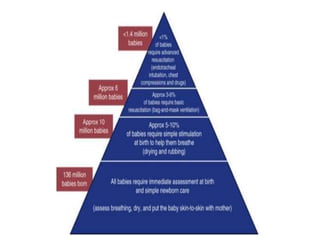
• The purpose of resuscitation is to intervene
when these natural processes are disturbed
pathologically.
• American Academy of Pediatrics developed a
program HBB which is based on the what so
called Golden min (the first 60 seconds of a
newborn baby’s life).
INTRODUCTION
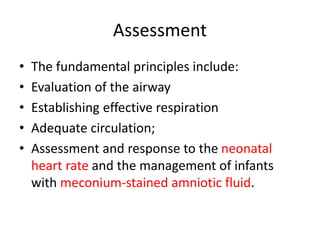
Assessment
• The fundamental principles include:
• Evaluation of the airway
• Establishing effective respiration
• Adequate circulation;
• Assessment and response to the neonatal
heart rate and the management of infants
with meconium-stained amniotic fluid.
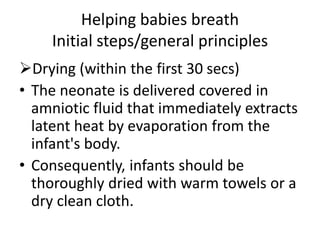
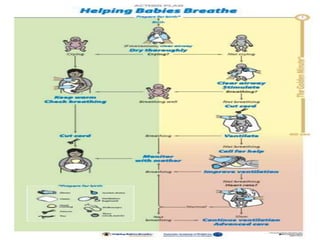
Helping babies breath
Initial steps/general principles
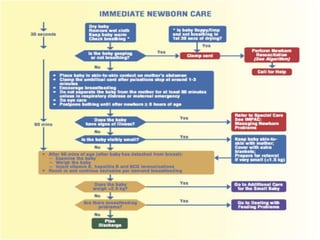
Drying (within the first 30 secs)
• The neonate is delivered covered in
amniotic fluid that immediately extracts
latent heat by evaporation from the
infant's body.
• Consequently, infants should be
thoroughly dried with warm towels or a
dry clean cloth.
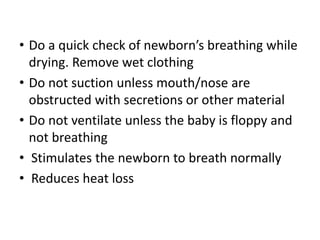
• Do a quick check of newborn’s breathing while
drying. Remove wet clothing
• Do not suction unless mouth/nose are
obstructed with secretions or other material
• Do not ventilate unless the baby is floppy and
not breathing
• Stimulates the newborn to breath normally
• Reduces heat loss
If after 30 secs baby is breathing or
crying:
Temperature control:
• Heat loss should be minimized by early drying,
warm clothing, freedom from drafts, and
ensuring that incubators are double-walled with
warm gas between the walls. Placing the baby
skin-to-skin with the mother and covering both
with a blanket.
• Physical examination, weighing, and bathing of
the infant should always be carried out in a warm
environment
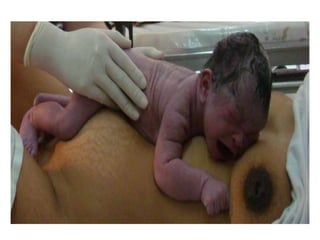
Skin -to-skin (STS) contact
• Place the newborn prone on the mother’s
abdomen or chest skin-to-skin.
• Cover newborn’s back with a blanket and head
with a hat .
• Place identification band on ankle
Provides warmth
Improves bonding
Provides protection from infection
Contributes to the overall success of
breastfeeding
If after 30 secs of drying, newborn is
NOT breathing or is gasping:
Re-position, suction and ventilate
• Clamp and cut the cord immediately
• Call for HELP
• Transfer to a warm firm surface
• Inform the mother
• Start resuscitation protocol
Cord clamping
• The cord should be clamped 1 or 2 cm from
the umbilicus using a disposable clamp, and
cut with sterile scissors distal to the clamp.
• Leave the stump uncovered, do not apply
anything
• The cord clamp can be safely removed during
the second day of life, at which time the cord
should be inspected to insure that there is no
residual hemorrhage.
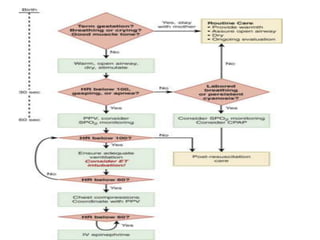
Resuscitation protocol
• If the infant is apneic, gasping, has decreased
muscle tone, or is cyanotic, immediate
resuscitation is needed.
• Place the infant under a radiant warmer;
• quickly towel dry the baby;
• open the airway by laying the infant in the
sniffing position;
• suction the mouth and the nose;
• provide tactile stimulation (by gently slapping
or flicking the soles of the feet or by gently
rubbing the back);
• and, if necessary, give oxygen.
Ventilation
• If the infant does not start breathing
adequately or has a heart rate of less than 100
beats per minute, positive pressure ventilation
(PPV) should be instituted immediately. The
entire process up to this point should not take
more than 20 to 30 seconds.
• Initial PPV can be provided by either a flow-
inflating bag (also called an anesthesia bag) or
a self-inflating bag.
Chest compressions
• Chest compressions are infrequently needed
during neonatal resuscitation.
• Infants who have a heart rate of less than 60
bpm, despite 30 seconds of effective PPV, need
immediate chest compressions.
• Chest compressions can be provided by either the
thumb technique or the two-finger technique,
the thumb technique being preferred.
• Rate of 90 per minute with an accompanying
breath rate of 30 per minute (chest-
compressions-to-ventilation ratio = 3:1).
Endotracheal intubation
• Indications for endotracheal intubation include
(a) to suction meconium;
(b) to improve ventilation when bag-and-mask
ventilation is ineffective;
(c) to coordinate ventilation and chest
compressions;
(d) to administer medications such as epinephrine;
(e) when prolonged ventilation is needed, for
example, extreme prematurity;
(f) to administer surfactant
Medications
• Only a small fraction of infants require
medications during resuscitation.
• All medications needed for resuscitation can be
administered via the ET or via an umbilical
venous or an arterial catheter.
• EPINEPHRINE is usually the first drug
administered during resuscitation.
• It is indicated when the heart rate remains less
than 60 bpm after 30 seconds of adequate PPV
and another 30 seconds of chest compressions
and PPV.
• It is administered either via an ET or umbilical
vein
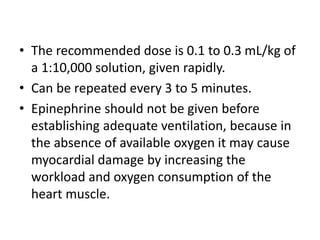
• The recommended dose is 0.1 to 0.3 mL/kg of
a 1:10,000 solution, given rapidly.
• Can be repeated every 3 to 5 minutes.
• Epinephrine should not be given before
establishing adequate ventilation, because in
the absence of available oxygen it may cause
myocardial damage by increasing the
workload and oxygen consumption of the
heart muscle.
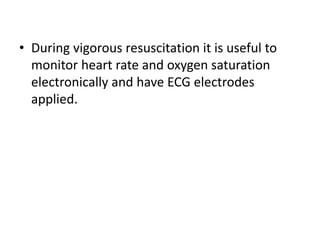
• During vigorous resuscitation it is useful to
monitor heart rate and oxygen saturation
electronically and have ECG electrodes
applied.
REFERENCES
• http://pediatrics.aappublications.org/content/
126/5/e1400.full (American Academy of
Pediatrics)
• Avery’s Neonatology, 6th edition
• Nelson’s textbook of Pediatrics, 19th edition

NEWBORN RESUSCITATION.pptx

  • 1.
    Resuscitation of newborn- helping baby breath Dr.RAIYA ALI SUPERVISER: PRO KARIM MANJI
  • 2.
    HBB is anevidence-based educational program to teach neonatal resuscitation techniques in resource-limited areas
  • 3.
    • The placenta,which until this point has been the provider of food and oxygen and the remover of fetal waste products, is clamped off and the neonate must immediately adapt to take responsibility for these functions.
  • 4.
    • The purposeof resuscitation is to intervene when these natural processes are disturbed pathologically. • American Academy of Pediatrics developed a program HBB which is based on the what so called Golden min (the first 60 seconds of a newborn baby’s life).
  • 5.
  • 6.
    Assessment • The fundamentalprinciples include: • Evaluation of the airway • Establishing effective respiration • Adequate circulation; • Assessment and response to the neonatal heart rate and the management of infants with meconium-stained amniotic fluid.
  • 7.
    Helping babies breath Initialsteps/general principles Drying (within the first 30 secs) • The neonate is delivered covered in amniotic fluid that immediately extracts latent heat by evaporation from the infant's body. • Consequently, infants should be thoroughly dried with warm towels or a dry clean cloth.
  • 8.
    • Do aquick check of newborn’s breathing while drying. Remove wet clothing • Do not suction unless mouth/nose are obstructed with secretions or other material • Do not ventilate unless the baby is floppy and not breathing • Stimulates the newborn to breath normally • Reduces heat loss
  • 9.
    If after 30secs baby is breathing or crying: Temperature control: • Heat loss should be minimized by early drying, warm clothing, freedom from drafts, and ensuring that incubators are double-walled with warm gas between the walls. Placing the baby skin-to-skin with the mother and covering both with a blanket. • Physical examination, weighing, and bathing of the infant should always be carried out in a warm environment
  • 10.
    Skin -to-skin (STS)contact • Place the newborn prone on the mother’s abdomen or chest skin-to-skin. • Cover newborn’s back with a blanket and head with a hat . • Place identification band on ankle Provides warmth Improves bonding Provides protection from infection Contributes to the overall success of breastfeeding
  • 12.
    If after 30secs of drying, newborn is NOT breathing or is gasping: Re-position, suction and ventilate • Clamp and cut the cord immediately • Call for HELP • Transfer to a warm firm surface • Inform the mother • Start resuscitation protocol
  • 13.
    Cord clamping • Thecord should be clamped 1 or 2 cm from the umbilicus using a disposable clamp, and cut with sterile scissors distal to the clamp. • Leave the stump uncovered, do not apply anything • The cord clamp can be safely removed during the second day of life, at which time the cord should be inspected to insure that there is no residual hemorrhage.
  • 15.
    Resuscitation protocol • Ifthe infant is apneic, gasping, has decreased muscle tone, or is cyanotic, immediate resuscitation is needed. • Place the infant under a radiant warmer; • quickly towel dry the baby; • open the airway by laying the infant in the sniffing position;
  • 16.
    • suction themouth and the nose; • provide tactile stimulation (by gently slapping or flicking the soles of the feet or by gently rubbing the back); • and, if necessary, give oxygen.
  • 17.
    Ventilation • If theinfant does not start breathing adequately or has a heart rate of less than 100 beats per minute, positive pressure ventilation (PPV) should be instituted immediately. The entire process up to this point should not take more than 20 to 30 seconds. • Initial PPV can be provided by either a flow- inflating bag (also called an anesthesia bag) or a self-inflating bag.
  • 18.
    Chest compressions • Chestcompressions are infrequently needed during neonatal resuscitation. • Infants who have a heart rate of less than 60 bpm, despite 30 seconds of effective PPV, need immediate chest compressions. • Chest compressions can be provided by either the thumb technique or the two-finger technique, the thumb technique being preferred. • Rate of 90 per minute with an accompanying breath rate of 30 per minute (chest- compressions-to-ventilation ratio = 3:1).
  • 19.
    Endotracheal intubation • Indicationsfor endotracheal intubation include (a) to suction meconium; (b) to improve ventilation when bag-and-mask ventilation is ineffective; (c) to coordinate ventilation and chest compressions; (d) to administer medications such as epinephrine; (e) when prolonged ventilation is needed, for example, extreme prematurity; (f) to administer surfactant
  • 20.
    Medications • Only asmall fraction of infants require medications during resuscitation. • All medications needed for resuscitation can be administered via the ET or via an umbilical venous or an arterial catheter. • EPINEPHRINE is usually the first drug administered during resuscitation. • It is indicated when the heart rate remains less than 60 bpm after 30 seconds of adequate PPV and another 30 seconds of chest compressions and PPV. • It is administered either via an ET or umbilical vein
  • 21.
    • The recommendeddose is 0.1 to 0.3 mL/kg of a 1:10,000 solution, given rapidly. • Can be repeated every 3 to 5 minutes. • Epinephrine should not be given before establishing adequate ventilation, because in the absence of available oxygen it may cause myocardial damage by increasing the workload and oxygen consumption of the heart muscle.
  • 22.
    • During vigorousresuscitation it is useful to monitor heart rate and oxygen saturation electronically and have ECG electrodes applied.
  • 25.
    REFERENCES • http://pediatrics.aappublications.org/content/ 126/5/e1400.full (AmericanAcademy of Pediatrics) • Avery’s Neonatology, 6th edition • Nelson’s textbook of Pediatrics, 19th edition