Job Instruction
What is Job Instruction?
Job Instruction is a systematic method
assuring that the employee can perform
the job tasks correctly, safely, and
consistently. They can both perform
the job motions and understand why doing
them that way is important.
Objective of JI
Develop a well-trained workforce
resulting in
Less mistakes and errors
Fewer accidents
Less equipment damage
Less customer complaints
Advantages & Disadvantages
1. It promotes higher levels of employee
safety.
2. It creates higher levels of productivity.
3. It maintains best practices.
4. It is cheaper than other training
methods.
5. It is a simple method of learning.
6. It reduces outside influences.
1. It still carries a training cost.
2. It is only as good as the trainer.
3. It creates a time requirement which
must be met.
4. It does not prevent all accidents.
5. It can reduce team productivity levels.
6. It may create a disturbance in the
workplace.
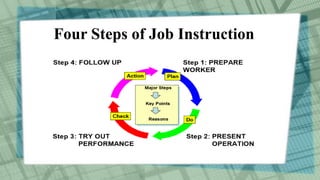
Four Steps of Job Instruction
Job Instruction Motto
“if the worker hasn’t learned the
instructor hasn’t taught”
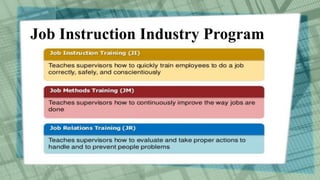
Job Instruction Industry Program
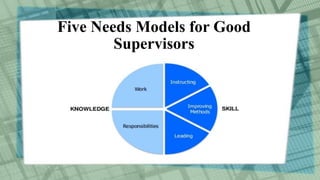
Five Needs Models for Good
Supervisors
Training is a necessity for both the trainer and the trainee.
The trainer (the company) would want to make its staff more efficient in
this highly competitive world.
It would want its employees to know the latest trends and technologies
and use them according to the company’s principles and objectives.
So, it’s more of mutual necessity and agreement between the companies
and their respective employees when it comes to training and
development.
Conclusion
Job Instruction
Lokesh Gaur
160BBAGEN049
BBA-6th Sem. (2016-19)

Job instruction

  • 1.
  • 2.
    What is JobInstruction? Job Instruction is a systematic method assuring that the employee can perform the job tasks correctly, safely, and consistently. They can both perform the job motions and understand why doing them that way is important.
  • 3.
    Objective of JI Developa well-trained workforce resulting in Less mistakes and errors Fewer accidents Less equipment damage Less customer complaints
  • 4.
    Advantages & Disadvantages 1.It promotes higher levels of employee safety. 2. It creates higher levels of productivity. 3. It maintains best practices. 4. It is cheaper than other training methods. 5. It is a simple method of learning. 6. It reduces outside influences. 1. It still carries a training cost. 2. It is only as good as the trainer. 3. It creates a time requirement which must be met. 4. It does not prevent all accidents. 5. It can reduce team productivity levels. 6. It may create a disturbance in the workplace.
  • 5.
    Four Steps ofJob Instruction
  • 6.
    Job Instruction Motto “ifthe worker hasn’t learned the instructor hasn’t taught”
  • 7.
  • 8.
    Five Needs Modelsfor Good Supervisors
  • 9.
    Training is anecessity for both the trainer and the trainee. The trainer (the company) would want to make its staff more efficient in this highly competitive world. It would want its employees to know the latest trends and technologies and use them according to the company’s principles and objectives. So, it’s more of mutual necessity and agreement between the companies and their respective employees when it comes to training and development. Conclusion
  • 10.