Name: - Md Sahil Ali
Registration no.: -12212350
Course code: - PBA523
Topic: - Minnow brook Perspective in
Public Administration.
Submitted to: -Dr. Manvendra Singh
Introduction
Old Public Administration
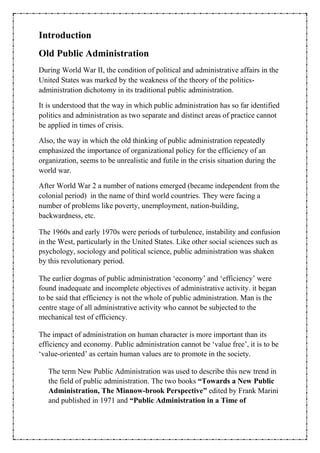
During World War II, the condition of political and administrative affairs in the
United States was marked by the weakness of the theory of the politics-
administration dichotomy in its traditional public administration.
It is understood that the way in which public administration has so far identified
politics and administration as two separate and distinct areas of practice cannot
be applied in times of crisis.
Also, the way in which the old thinking of public administration repeatedly
emphasized the importance of organizational policy for the efficiency of an
organization, seems to be unrealistic and futile in the crisis situation during the
world war.
After World War 2 a number of nations emerged (became independent from the
colonial period) in the name of third world countries. They were facing a
number of problems like poverty, unemployment, nation-building,
backwardness, etc.
The 1960s and early 1970s were periods of turbulence, instability and confusion
in the West, particularly in the United States. Like other social sciences such as
psychology, sociology and political science, public administration was shaken
by this revolutionary period.
The earlier dogmas of public administration ‘economy’ and ‘efficiency’ were
found inadequate and incomplete objectives of administrative activity. it began
to be said that efficiency is not the whole of public administration. Man is the
centre stage of all administrative activity who cannot be subjected to the
mechanical test of efficiency.
The impact of administration on human character is more important than its
efficiency and economy. Public administration cannot be ‘value free’, it is to be
‘value-oriented’ as certain human values are to promote in the society.
The term New Public Administration was used to describe this new trend in
the field of public administration. The two books “Towards a New Public
Administration, The Minnow-brook Perspective” edited by Frank Marini
and published in 1971 and “Public Administration in a Time of
Turbulence” edited by Dwight Waldo and published simultaneously gave
currency to the concept of New Public Administration.
These two books edited the ideas of an academic get together of younger
age-group on public administration called the Minnow-brook Conference
held in 1968. This conference expressed dissatisfaction with the state of the
discipline of public administration and sought to give it a new image by
discarding traditional concepts and making it alive to the problems presented
by the “turbulent times”
We have already concerned that in the sixties, there was a kind of frustration
among the younger generation about various government activities in the United
States. On the one hand, the Vietnam War, on the other hand, the racist riots,
various social evils caused a kind of frustration in the minds of the people about
all kinds of administration and institutions.
Some young theorists then met with their new thoughts in 1968 at the
Minnowbrook Conference Center at Syracuse University in the United States
under the patronage of Dwight Waldo. This Minnowbrook conference was
marked as the beginning of the new public administration discussion.
The main purpose of this conference was to discuss the new theories of public
administration and to identify how to give more importance to the ‘Public’ part
of public administration.
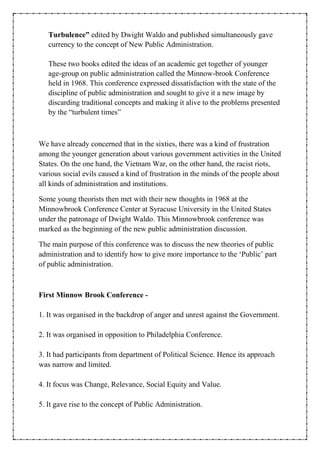
First Minnow Brook Conference -
1. It was organised in the backdrop of anger and unrest against the Government.
2. It was organised in opposition to Philadelphia Conference.
3. It had participants from department of Political Science. Hence its approach
was narrow and limited.
4. It focus was Change, Relevance, Social Equity and Value.
5. It gave rise to the concept of Public Administration.
6. New Public Administration failed in practise.
7. Its theme, tenure, tone and temperament was more radical and anti
Government.
8. Its proceeding were combined in a report by Frank Marini in 1971 named
"Toward a New Public Administration:The Minnow Brook Perspective".
9. It was held under the chairmanship of Dwight Waldo.
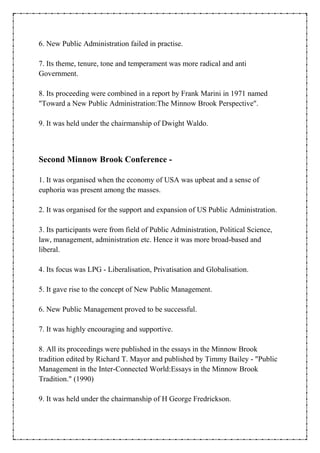
Second Minnow Brook Conference -
1. It was organised when the economy of USA was upbeat and a sense of
euphoria was present among the masses.
2. It was organised for the support and expansion of US Public Administration.
3. Its participants were from field of Public Administration, Political Science,
law, management, administration etc. Hence it was more broad-based and
liberal.
4. Its focus was LPG - Liberalisation, Privatisation and Globalisation.
5. It gave rise to the concept of New Public Management.
6. New Public Management proved to be successful.
7. It was highly encouraging and supportive.
8. All its proceedings were published in the essays in the Minnow Brook
tradition edited by Richard T. Mayor and published by Timmy Bailey - "Public
Management in the Inter-Connected World:Essays in the Minnow Brook
Tradition." (1990)
9. It was held under the chairmanship of H George Fredrickson.
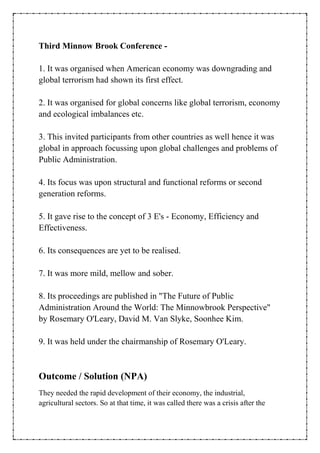
Third Minnow Brook Conference -
1. It was organised when American economy was downgrading and
global terrorism had shown its first effect.
2. It was organised for global concerns like global terrorism, economy
and ecological imbalances etc.
3. This invited participants from other countries as well hence it was
global in approach focussing upon global challenges and problems of
Public Administration.
4. Its focus was upon structural and functional reforms or second
generation reforms.
5. It gave rise to the concept of 3 E's - Economy, Efficiency and
Effectiveness.
6. Its consequences are yet to be realised.
7. It was more mild, mellow and sober.
8. Its proceedings are published in "The Future of Public
Administration Around the World: The Minnowbrook Perspective"
by Rosemary O'Leary, David M. Van Slyke, Soonhee Kim.
9. It was held under the chairmanship of Rosemary O'Leary.
Outcome / Solution (NPA)
They needed the rapid development of their economy, the industrial,
agricultural sectors. So at that time, it was called there was a crisis after the
second world war in third world countries. So the questions arose about how to
develop these nations.
The western model (traditional managerial administration) of public
administration failed to overcome these crises in the third world nations.
It was a period of the 1960s. This was known as the period of crisis and turmoil
in the socio-economic aspect of the United states. There was huge
unemployment and traditional public administration almost gave up to resolve
those problems.
So as a result in order to respond to these problems, a new approach of public
administration evolves. The approach was called the New Public
Administration.
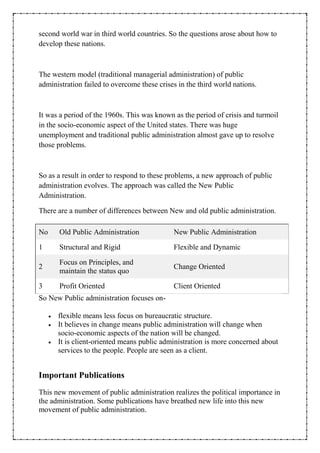
There are a number of differences between New and old public administration.
No Old Public Administration New Public Administration
1 Structural and Rigid Flexible and Dynamic
2
Focus on Principles, and
maintain the status quo
Change Oriented
3 Profit Oriented Client Oriented
So New Public administration focuses on-
 flexible means less focus on bureaucratic structure.
 It believes in change means public administration will change when
socio-economic aspects of the nation will be changed.
 It is client-oriented means public administration is more concerned about
services to the people. People are seen as a client.
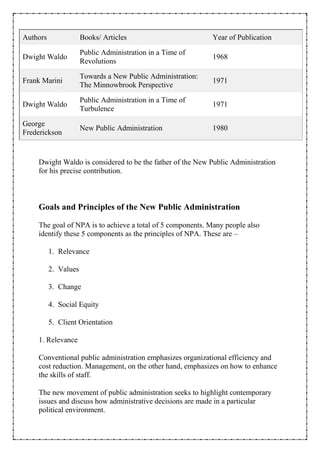
Important Publications
This new movement of public administration realizes the political importance in
the administration. Some publications have breathed new life into this new
movement of public administration.
Authors Books/ Articles Year of Publication
Dwight Waldo
Public Administration in a Time of
Revolutions
1968
Frank Marini
Towards a New Public Administration:
The Minnowbrook Perspective
1971
Dwight Waldo
Public Administration in a Time of
Turbulence
1971
George
Frederickson
New Public Administration 1980
Dwight Waldo is considered to be the father of the New Public Administration
for his precise contribution.
Goals and Principles of the New Public Administration
The goal of NPA is to achieve a total of 5 components. Many people also
identify these 5 components as the principles of NPA. These are –
1. Relevance
2. Values
3. Change
4. Social Equity
5. Client Orientation
1. Relevance
Conventional public administration emphasizes organizational efficiency and
cost reduction. Management, on the other hand, emphasizes on how to enhance
the skills of staff.
The new movement of public administration seeks to highlight contemporary
issues and discuss how administrative decisions are made in a particular
political environment.
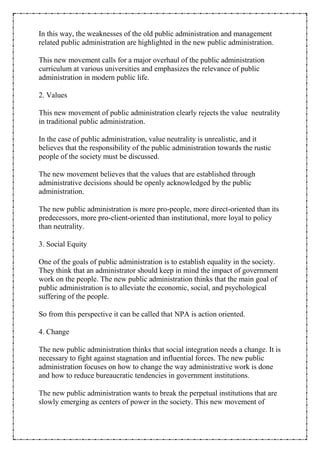
In this way, the weaknesses of the old public administration and management
related public administration are highlighted in the new public administration.
This new movement calls for a major overhaul of the public administration
curriculum at various universities and emphasizes the relevance of public
administration in modern public life.
2. Values
This new movement of public administration clearly rejects the value neutrality
in traditional public administration.
In the case of public administration, value neutrality is unrealistic, and it
believes that the responsibility of the public administration towards the rustic
people of the society must be discussed.
The new movement believes that the values that are established through
administrative decisions should be openly acknowledged by the public
administration.
The new public administration is more pro-people, more direct-oriented than its
predecessors, more pro-client-oriented than institutional, more loyal to policy
than neutrality.
3. Social Equity
One of the goals of public administration is to establish equality in the society.
They think that an administrator should keep in mind the impact of government
work on the people. The new public administration thinks that the main goal of
public administration is to alleviate the economic, social, and psychological
suffering of the people.
So from this perspective it can be called that NPA is action oriented.
4. Change
The new public administration thinks that social integration needs a change. It is
necessary to fight against stagnation and influential forces. The new public
administration focuses on how to change the way administrative work is done
and how to reduce bureaucratic tendencies in government institutions.
The new public administration wants to break the perpetual institutions that are
slowly emerging as centers of power in the society. This new movement of
public administration is trying to find out how to fight against institutionalism
and bureaucracy in the society.
5. Client Orientation
Client refers to the citizen. The prime goal of NPA is to provide satisfactory
service to the citizens.
Features of New Public Administration
In the light of the above discussion, some features of the New Public
Administration (NPA) can be identified. These are –
1. It is more prescriptive rather than descriptive.
2. It is a value-based concept. Value is inevitable in public administration.
3. It is more oriented towards changing reality.
4. NPA is more flexible and dynamic.
5. It is more ready to influence policies that can improve the quality of
working life, as well as more competent to implement such policies.
6. It is also more oriented towards clients. Here clients refer to the citizen.
7. It assures the people participation in the decision making process of
public administration.
Conclusion of New Public Administration
From the above discussion on New Public Administration, it can be concluded
that The New Public Administration was able to bring about a great change in
the old way of thinking about public administration. This movement
transformed public administration into a socially conscious discipline.
This movement had a special contribution, especially in developing countries.
This new administration had a special significance in bringing about a
qualitative change by freeing the administration from the shackles of
bureaucratic red tape.
It can be clearly said that this new movement of public administration seeks to
change the quality of public life, believes in a certain ideology and seeks to
alleviate the sufferings of the neglected people of the society to some extent.
To the proponents of this movement the structure of an organization, the
process of action is relatively secondary; Social problems make them think a lot
more. Ethics, values, new thinking, variability, social problems, these are
relevant and important to the new public administration.
References
https://schoolofpoliticalscience.com/new-public-administration/
https://www.ifioque.com/career-
workshop/management/3rd_Minnowbrook_Conference
https://www.padmad.org/2014/02/1st-2nd-3rd-minnow-brook-conferences.html
https://unacademy.com/content/upsc/study-material/public-administration/new-
public-administration/

ALI 523.pdf

  • 1.
    Name: - MdSahil Ali Registration no.: -12212350 Course code: - PBA523 Topic: - Minnow brook Perspective in Public Administration. Submitted to: -Dr. Manvendra Singh
  • 2.
    Introduction Old Public Administration DuringWorld War II, the condition of political and administrative affairs in the United States was marked by the weakness of the theory of the politics- administration dichotomy in its traditional public administration. It is understood that the way in which public administration has so far identified politics and administration as two separate and distinct areas of practice cannot be applied in times of crisis. Also, the way in which the old thinking of public administration repeatedly emphasized the importance of organizational policy for the efficiency of an organization, seems to be unrealistic and futile in the crisis situation during the world war. After World War 2 a number of nations emerged (became independent from the colonial period) in the name of third world countries. They were facing a number of problems like poverty, unemployment, nation-building, backwardness, etc. The 1960s and early 1970s were periods of turbulence, instability and confusion in the West, particularly in the United States. Like other social sciences such as psychology, sociology and political science, public administration was shaken by this revolutionary period. The earlier dogmas of public administration ‘economy’ and ‘efficiency’ were found inadequate and incomplete objectives of administrative activity. it began to be said that efficiency is not the whole of public administration. Man is the centre stage of all administrative activity who cannot be subjected to the mechanical test of efficiency. The impact of administration on human character is more important than its efficiency and economy. Public administration cannot be ‘value free’, it is to be ‘value-oriented’ as certain human values are to promote in the society. The term New Public Administration was used to describe this new trend in the field of public administration. The two books “Towards a New Public Administration, The Minnow-brook Perspective” edited by Frank Marini and published in 1971 and “Public Administration in a Time of
  • 3.
    Turbulence” edited byDwight Waldo and published simultaneously gave currency to the concept of New Public Administration. These two books edited the ideas of an academic get together of younger age-group on public administration called the Minnow-brook Conference held in 1968. This conference expressed dissatisfaction with the state of the discipline of public administration and sought to give it a new image by discarding traditional concepts and making it alive to the problems presented by the “turbulent times” We have already concerned that in the sixties, there was a kind of frustration among the younger generation about various government activities in the United States. On the one hand, the Vietnam War, on the other hand, the racist riots, various social evils caused a kind of frustration in the minds of the people about all kinds of administration and institutions. Some young theorists then met with their new thoughts in 1968 at the Minnowbrook Conference Center at Syracuse University in the United States under the patronage of Dwight Waldo. This Minnowbrook conference was marked as the beginning of the new public administration discussion. The main purpose of this conference was to discuss the new theories of public administration and to identify how to give more importance to the ‘Public’ part of public administration. First Minnow Brook Conference - 1. It was organised in the backdrop of anger and unrest against the Government. 2. It was organised in opposition to Philadelphia Conference. 3. It had participants from department of Political Science. Hence its approach was narrow and limited. 4. It focus was Change, Relevance, Social Equity and Value. 5. It gave rise to the concept of Public Administration.
  • 4.
    6. New PublicAdministration failed in practise. 7. Its theme, tenure, tone and temperament was more radical and anti Government. 8. Its proceeding were combined in a report by Frank Marini in 1971 named "Toward a New Public Administration:The Minnow Brook Perspective". 9. It was held under the chairmanship of Dwight Waldo. Second Minnow Brook Conference - 1. It was organised when the economy of USA was upbeat and a sense of euphoria was present among the masses. 2. It was organised for the support and expansion of US Public Administration. 3. Its participants were from field of Public Administration, Political Science, law, management, administration etc. Hence it was more broad-based and liberal. 4. Its focus was LPG - Liberalisation, Privatisation and Globalisation. 5. It gave rise to the concept of New Public Management. 6. New Public Management proved to be successful. 7. It was highly encouraging and supportive. 8. All its proceedings were published in the essays in the Minnow Brook tradition edited by Richard T. Mayor and published by Timmy Bailey - "Public Management in the Inter-Connected World:Essays in the Minnow Brook Tradition." (1990) 9. It was held under the chairmanship of H George Fredrickson.
  • 5.
    Third Minnow BrookConference - 1. It was organised when American economy was downgrading and global terrorism had shown its first effect. 2. It was organised for global concerns like global terrorism, economy and ecological imbalances etc. 3. This invited participants from other countries as well hence it was global in approach focussing upon global challenges and problems of Public Administration. 4. Its focus was upon structural and functional reforms or second generation reforms. 5. It gave rise to the concept of 3 E's - Economy, Efficiency and Effectiveness. 6. Its consequences are yet to be realised. 7. It was more mild, mellow and sober. 8. Its proceedings are published in "The Future of Public Administration Around the World: The Minnowbrook Perspective" by Rosemary O'Leary, David M. Van Slyke, Soonhee Kim. 9. It was held under the chairmanship of Rosemary O'Leary. Outcome / Solution (NPA) They needed the rapid development of their economy, the industrial, agricultural sectors. So at that time, it was called there was a crisis after the
  • 6.
    second world warin third world countries. So the questions arose about how to develop these nations. The western model (traditional managerial administration) of public administration failed to overcome these crises in the third world nations. It was a period of the 1960s. This was known as the period of crisis and turmoil in the socio-economic aspect of the United states. There was huge unemployment and traditional public administration almost gave up to resolve those problems. So as a result in order to respond to these problems, a new approach of public administration evolves. The approach was called the New Public Administration. There are a number of differences between New and old public administration. No Old Public Administration New Public Administration 1 Structural and Rigid Flexible and Dynamic 2 Focus on Principles, and maintain the status quo Change Oriented 3 Profit Oriented Client Oriented So New Public administration focuses on-  flexible means less focus on bureaucratic structure.  It believes in change means public administration will change when socio-economic aspects of the nation will be changed.  It is client-oriented means public administration is more concerned about services to the people. People are seen as a client. Important Publications This new movement of public administration realizes the political importance in the administration. Some publications have breathed new life into this new movement of public administration.
  • 7.
    Authors Books/ ArticlesYear of Publication Dwight Waldo Public Administration in a Time of Revolutions 1968 Frank Marini Towards a New Public Administration: The Minnowbrook Perspective 1971 Dwight Waldo Public Administration in a Time of Turbulence 1971 George Frederickson New Public Administration 1980 Dwight Waldo is considered to be the father of the New Public Administration for his precise contribution. Goals and Principles of the New Public Administration The goal of NPA is to achieve a total of 5 components. Many people also identify these 5 components as the principles of NPA. These are – 1. Relevance 2. Values 3. Change 4. Social Equity 5. Client Orientation 1. Relevance Conventional public administration emphasizes organizational efficiency and cost reduction. Management, on the other hand, emphasizes on how to enhance the skills of staff. The new movement of public administration seeks to highlight contemporary issues and discuss how administrative decisions are made in a particular political environment.
  • 8.
    In this way,the weaknesses of the old public administration and management related public administration are highlighted in the new public administration. This new movement calls for a major overhaul of the public administration curriculum at various universities and emphasizes the relevance of public administration in modern public life. 2. Values This new movement of public administration clearly rejects the value neutrality in traditional public administration. In the case of public administration, value neutrality is unrealistic, and it believes that the responsibility of the public administration towards the rustic people of the society must be discussed. The new movement believes that the values that are established through administrative decisions should be openly acknowledged by the public administration. The new public administration is more pro-people, more direct-oriented than its predecessors, more pro-client-oriented than institutional, more loyal to policy than neutrality. 3. Social Equity One of the goals of public administration is to establish equality in the society. They think that an administrator should keep in mind the impact of government work on the people. The new public administration thinks that the main goal of public administration is to alleviate the economic, social, and psychological suffering of the people. So from this perspective it can be called that NPA is action oriented. 4. Change The new public administration thinks that social integration needs a change. It is necessary to fight against stagnation and influential forces. The new public administration focuses on how to change the way administrative work is done and how to reduce bureaucratic tendencies in government institutions. The new public administration wants to break the perpetual institutions that are slowly emerging as centers of power in the society. This new movement of
  • 9.
    public administration istrying to find out how to fight against institutionalism and bureaucracy in the society. 5. Client Orientation Client refers to the citizen. The prime goal of NPA is to provide satisfactory service to the citizens. Features of New Public Administration In the light of the above discussion, some features of the New Public Administration (NPA) can be identified. These are – 1. It is more prescriptive rather than descriptive. 2. It is a value-based concept. Value is inevitable in public administration. 3. It is more oriented towards changing reality. 4. NPA is more flexible and dynamic. 5. It is more ready to influence policies that can improve the quality of working life, as well as more competent to implement such policies. 6. It is also more oriented towards clients. Here clients refer to the citizen. 7. It assures the people participation in the decision making process of public administration. Conclusion of New Public Administration From the above discussion on New Public Administration, it can be concluded that The New Public Administration was able to bring about a great change in the old way of thinking about public administration. This movement transformed public administration into a socially conscious discipline. This movement had a special contribution, especially in developing countries. This new administration had a special significance in bringing about a qualitative change by freeing the administration from the shackles of bureaucratic red tape.
  • 10.
    It can beclearly said that this new movement of public administration seeks to change the quality of public life, believes in a certain ideology and seeks to alleviate the sufferings of the neglected people of the society to some extent. To the proponents of this movement the structure of an organization, the process of action is relatively secondary; Social problems make them think a lot more. Ethics, values, new thinking, variability, social problems, these are relevant and important to the new public administration. References https://schoolofpoliticalscience.com/new-public-administration/ https://www.ifioque.com/career- workshop/management/3rd_Minnowbrook_Conference https://www.padmad.org/2014/02/1st-2nd-3rd-minnow-brook-conferences.html https://unacademy.com/content/upsc/study-material/public-administration/new- public-administration/