9-19-1
Chapter
9
New Product Development
and
Product Life-Cycle Strategies
PRINCIPLES OF MARKETING
9-29-2
Causes of New Product Failures
• Overestimation of Market Size
• Product Design Problems
• Product Incorrectly Positioned, Priced or
Advertised
• Costs of Product Development
• Competitive Actions
• To create successful new products, the
company must:
– understand it’s customers, markets and
competitors
– develop products that deliver superior value to
customers.
9-39-3
New Product Development
Process
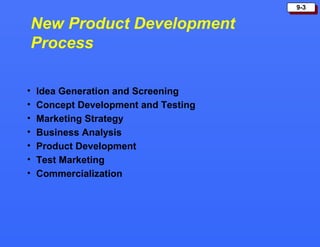
• Idea Generation and Screening
• Concept Development and Testing
• Marketing Strategy
• Business Analysis
• Product Development
• Test Marketing
• Commercialization
9-49-4
New Product Development Process
Step 1. Idea Generation
New Product Development Process
Step 1. Idea Generation
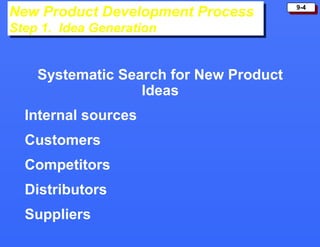
Systematic Search for New Product
Ideas
Internal sources
Customers
Competitors
Distributors
Suppliers
9-59-5
• Process to spot good ideas and drop
poor ones
• Criteria
– Market Size
– Product Price
– Development Time & Costs
– Manufacturing Costs
– Rate of Return
New Product Development Process
Step 2. Idea Screening
New Product Development Process
Step 2. Idea Screening
9-69-6
New Product Development Process
Step 3. Concept Development & Testing
New Product Development Process
Step 3. Concept Development & Testing
1. Develop Product Ideas into
Alternative
Product Concepts
1. Develop Product Ideas into
Alternative
Product Concepts
2. Concept Testing - Test the
Product Concepts with Groups
of Target Customers
2. Concept Testing - Test the
Product Concepts with Groups
of Target Customers
3. Choose the Best One3. Choose the Best One
9-79-7
New Product Development Process
Step 4. Marketing Strategy Development
New Product Development Process
Step 4. Marketing Strategy Development
Part Two - Short-Term:
Product’s Planned Price
Distribution
Marketing Budget
Part Two - Short-Term:
Product’s Planned Price
Distribution
Marketing Budget
Part Three - Long-Term:
Sales & Profit Goals
Marketing Mix Strategy
Part Three - Long-Term:
Sales & Profit Goals
Marketing Mix Strategy
Marketing Strategy Statement Formulation
Part One - Overall:
Target Market
Planned Product Positioning
Sales & Profit Goals
Market Share
Part One - Overall:
Target Market
Planned Product Positioning
Sales & Profit Goals
Market Share
9-89-8
New Product Development Process
Step 5. Business Analysis
Step 6. Product Development
New Product Development Process
Step 5. Business Analysis
Step 6. Product Development
Business Analysis
Review of Product Sales, Costs,
and Profits Projections to See if
They Meet Company Objectives
Business Analysis
Review of Product Sales, Costs,
and Profits Projections to See if
They Meet Company Objectives
If Yes, Move to
Product Development
If Yes, Move to
Product Development
If No, Eliminate
Product Concept
If No, Eliminate
Product Concept
9-99-9
New Product Development Process
Step 7. Test Marketing
New Product Development Process
Step 7. Test Marketing
Standard
Test Market
Full marketing campaign
in a small number of
representative cities.
Standard
Test Market
Full marketing campaign
in a small number of
representative cities.
Simulated
Test Market
Test in a simulated
shopping environment
to a sample of
consumers.
Simulated
Test Market
Test in a simulated
shopping environment
to a sample of
consumers.
Controlled
Test Market
A few stores that have
agreed to carry new
products for a fee.
Controlled
Test Market
A few stores that have
agreed to carry new
products for a fee.
9-109-10
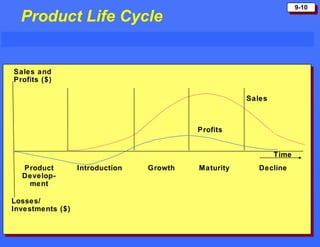
Product Life Cycle
Time
Product
Develop-
ment
Introduction
Profits
Sales
Growth Maturity Decline
Losses/
Investments ($)
Sales and
Profits ($)
9-119-11
Introduction Stage of the
PLC
SalesSales
CostsCosts
ProfitsProfits
Marketing ObjectivesMarketing Objectives
ProductProduct
PricePrice
Low salesLow sales
High cost per customerHigh cost per customer
NegativeNegative
Create product awareness
and trial
Create product awareness
and trial
Offer a basic productOffer a basic product
Use cost-plusUse cost-plus
DistributionDistribution Build selective distributionBuild selective distribution
AdvertisingAdvertising Build product awareness among
early adopters and dealers
Build product awareness among
early adopters and dealers
9-129-12
Growth Stage of the PLC
SalesSales
CostsCosts
ProfitsProfits
Marketing ObjectivesMarketing Objectives
ProductProduct
PricePrice
Rapidly rising salesRapidly rising sales
Average cost per customerAverage cost per customer
Rising profitsRising profits
Maximize market shareMaximize market share
Offer product extensions,
service, warranty
Offer product extensions,
service, warranty
Price to penetrate marketPrice to penetrate market
DistributionDistribution Build intensive distributionBuild intensive distribution
AdvertisingAdvertising Build awareness and interest in
the mass market
Build awareness and interest in
the mass market
9-139-13
Maturity Stage of the PLC
SalesSales
CostsCosts
ProfitsProfits
Marketing ObjectivesMarketing Objectives
ProductProduct
PricePrice
Peak salesPeak sales
Low cost per customerLow cost per customer
High profitsHigh profits
Maximize profit while defending
market share
Maximize profit while defending
market share
Diversify brand and modelsDiversify brand and models
Price to match or best
competitors
Price to match or best
competitors
DistributionDistribution Build more intensive distributionBuild more intensive distribution
AdvertisingAdvertising Stress brand differences and
benefits
Stress brand differences and
benefits
9-149-14
Decline Stage of the PLC
SalesSales
CostsCosts
ProfitsProfits
Marketing ObjectivesMarketing Objectives
ProductProduct
PricePrice
Declining salesDeclining sales
Low cost per customerLow cost per customer
Declining profitsDeclining profits
Reduce expenditure and milk the
brand
Reduce expenditure and milk the
brand
Phase out weak itemsPhase out weak items
Cut priceCut price
DistributionDistribution Go selective: phase out
unprofitable outlets
Go selective: phase out
unprofitable outlets
AdvertisingAdvertising Reduce to level needed to retain
hard-core loyal customers
Reduce to level needed to retain
hard-core loyal customers

product life cycle

  • 1.
    9-19-1 Chapter 9 New Product Development and ProductLife-Cycle Strategies PRINCIPLES OF MARKETING
  • 2.
    9-29-2 Causes of NewProduct Failures • Overestimation of Market Size • Product Design Problems • Product Incorrectly Positioned, Priced or Advertised • Costs of Product Development • Competitive Actions • To create successful new products, the company must: – understand it’s customers, markets and competitors – develop products that deliver superior value to customers.
  • 3.
    9-39-3 New Product Development Process •Idea Generation and Screening • Concept Development and Testing • Marketing Strategy • Business Analysis • Product Development • Test Marketing • Commercialization
  • 4.
    9-49-4 New Product DevelopmentProcess Step 1. Idea Generation New Product Development Process Step 1. Idea Generation Systematic Search for New Product Ideas Internal sources Customers Competitors Distributors Suppliers
  • 5.
    9-59-5 • Process tospot good ideas and drop poor ones • Criteria – Market Size – Product Price – Development Time & Costs – Manufacturing Costs – Rate of Return New Product Development Process Step 2. Idea Screening New Product Development Process Step 2. Idea Screening
  • 6.
    9-69-6 New Product DevelopmentProcess Step 3. Concept Development & Testing New Product Development Process Step 3. Concept Development & Testing 1. Develop Product Ideas into Alternative Product Concepts 1. Develop Product Ideas into Alternative Product Concepts 2. Concept Testing - Test the Product Concepts with Groups of Target Customers 2. Concept Testing - Test the Product Concepts with Groups of Target Customers 3. Choose the Best One3. Choose the Best One
  • 7.
    9-79-7 New Product DevelopmentProcess Step 4. Marketing Strategy Development New Product Development Process Step 4. Marketing Strategy Development Part Two - Short-Term: Product’s Planned Price Distribution Marketing Budget Part Two - Short-Term: Product’s Planned Price Distribution Marketing Budget Part Three - Long-Term: Sales & Profit Goals Marketing Mix Strategy Part Three - Long-Term: Sales & Profit Goals Marketing Mix Strategy Marketing Strategy Statement Formulation Part One - Overall: Target Market Planned Product Positioning Sales & Profit Goals Market Share Part One - Overall: Target Market Planned Product Positioning Sales & Profit Goals Market Share
  • 8.
    9-89-8 New Product DevelopmentProcess Step 5. Business Analysis Step 6. Product Development New Product Development Process Step 5. Business Analysis Step 6. Product Development Business Analysis Review of Product Sales, Costs, and Profits Projections to See if They Meet Company Objectives Business Analysis Review of Product Sales, Costs, and Profits Projections to See if They Meet Company Objectives If Yes, Move to Product Development If Yes, Move to Product Development If No, Eliminate Product Concept If No, Eliminate Product Concept
  • 9.
    9-99-9 New Product DevelopmentProcess Step 7. Test Marketing New Product Development Process Step 7. Test Marketing Standard Test Market Full marketing campaign in a small number of representative cities. Standard Test Market Full marketing campaign in a small number of representative cities. Simulated Test Market Test in a simulated shopping environment to a sample of consumers. Simulated Test Market Test in a simulated shopping environment to a sample of consumers. Controlled Test Market A few stores that have agreed to carry new products for a fee. Controlled Test Market A few stores that have agreed to carry new products for a fee.
  • 10.
    9-109-10 Product Life Cycle Time Product Develop- ment Introduction Profits Sales GrowthMaturity Decline Losses/ Investments ($) Sales and Profits ($)
  • 11.
    9-119-11 Introduction Stage ofthe PLC SalesSales CostsCosts ProfitsProfits Marketing ObjectivesMarketing Objectives ProductProduct PricePrice Low salesLow sales High cost per customerHigh cost per customer NegativeNegative Create product awareness and trial Create product awareness and trial Offer a basic productOffer a basic product Use cost-plusUse cost-plus DistributionDistribution Build selective distributionBuild selective distribution AdvertisingAdvertising Build product awareness among early adopters and dealers Build product awareness among early adopters and dealers
  • 12.
    9-129-12 Growth Stage ofthe PLC SalesSales CostsCosts ProfitsProfits Marketing ObjectivesMarketing Objectives ProductProduct PricePrice Rapidly rising salesRapidly rising sales Average cost per customerAverage cost per customer Rising profitsRising profits Maximize market shareMaximize market share Offer product extensions, service, warranty Offer product extensions, service, warranty Price to penetrate marketPrice to penetrate market DistributionDistribution Build intensive distributionBuild intensive distribution AdvertisingAdvertising Build awareness and interest in the mass market Build awareness and interest in the mass market
  • 13.
    9-139-13 Maturity Stage ofthe PLC SalesSales CostsCosts ProfitsProfits Marketing ObjectivesMarketing Objectives ProductProduct PricePrice Peak salesPeak sales Low cost per customerLow cost per customer High profitsHigh profits Maximize profit while defending market share Maximize profit while defending market share Diversify brand and modelsDiversify brand and models Price to match or best competitors Price to match or best competitors DistributionDistribution Build more intensive distributionBuild more intensive distribution AdvertisingAdvertising Stress brand differences and benefits Stress brand differences and benefits
  • 14.
    9-149-14 Decline Stage ofthe PLC SalesSales CostsCosts ProfitsProfits Marketing ObjectivesMarketing Objectives ProductProduct PricePrice Declining salesDeclining sales Low cost per customerLow cost per customer Declining profitsDeclining profits Reduce expenditure and milk the brand Reduce expenditure and milk the brand Phase out weak itemsPhase out weak items Cut priceCut price DistributionDistribution Go selective: phase out unprofitable outlets Go selective: phase out unprofitable outlets AdvertisingAdvertising Reduce to level needed to retain hard-core loyal customers Reduce to level needed to retain hard-core loyal customers