Organization, Follow Up, Efficiency and
Perception
Heather Griffin
What We Will Cover
“Nothing is good or bad but thinking it makes it so.”


1      •Business Priciples

2      •Organization

3      •Follow Up

4      •Perception
The 2 MOST Important Facts of Business
It’s easy to forget in day to day business the true reasons we are
here. So, why do we come to work?

1.   To feel good about ourselves
2.   To make money

The truth is that it is more important to us to feel good about
ourselves than make money. Money makes us feel good about
ourselves!
How We Feel About Ourselves
The sole reason we do anything is life is how it makes us feel
about ourselves. People are inherently selfish.

Think about your spouse, your best friend, your favorite co-
worker. How do they make you feel about yourself?

Understanding that you can learn how to motivate, cultivate
relationships and most importantly feel good about yourself
Leadership and Self Deception
•   All employees should function for the sole purpose
    of bettering the business. Instead we self justify
    reasons to behave in non-productive ways
•   Employees determine like or dislike on employees
    based on how they feel about themselves
•   Employees view eachother as “things” that can
    either help or hinder their self image
•   Employees rationalize their behavior by breaking
    down other people
•    We should not worry about changing others (or
     even ourselves!) we should instead recognize that
     the problem lies within ourselves and go from
     there
Leadership and Self Deception
At night a husband and wife are sleeping. The husband wakes up when the
baby in the other room starts to cry. The husband’s first thought is to get up
and get the child before his wife wakes up; after all, she works so hard all
day and needs all the sleep she can get. The husband’s next thought though
is that he too works hard all day and needs to get up early for a meeting.
“Why should I get up? My responsibility in this family is to go to work and
earn money so we can live. I need all the sleep I can get so I can function at
my job – I have a big project to complete tomorrow. [Baby continues to
cry+. Why doesn’t my wife get up and get that baby? Doesn’t she realize I
need to get sleep? Okay, I know she’s awake now. Why doesn’t she get up?
Now she’s just being lazy. *And so on+.

Maybe the situation is at work where you had a thought that you should do
something but then didn’t do it. When it created a problem you were able
to rationalize your behavior and blame someone else (“I would have done X
had Susan done her job” or “I was just too busy with other things to get X
done.”). Basically, self-betrayal results from not being true to what you
[hopefully] know is the right thing to do.
Leadership and Self Deception

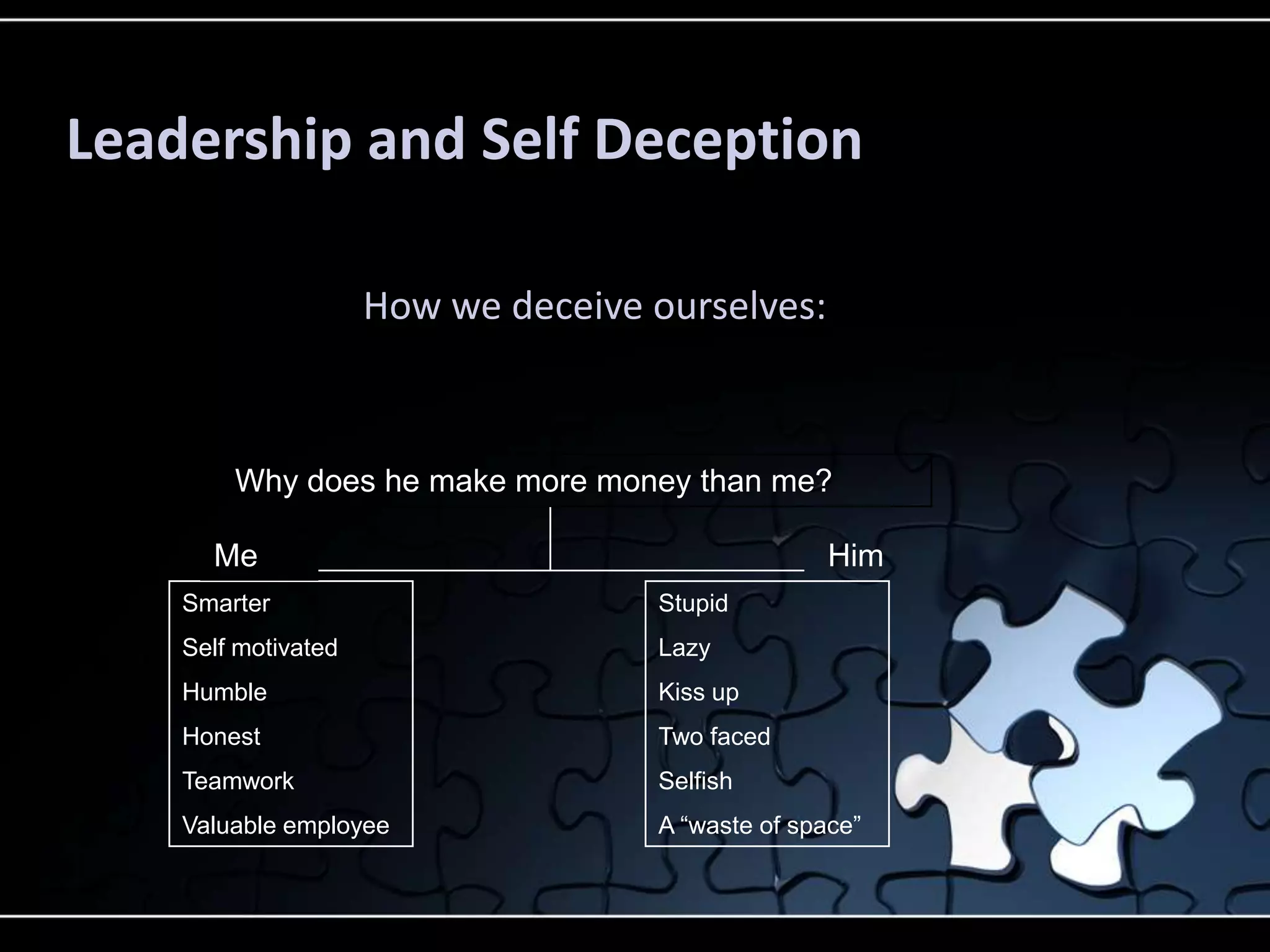
                     How we deceive ourselves:


        Why does he make more money than me?

      Me                                           Him
    Smarter                         Stupid
    Self motivated                  Lazy
    Humble                          Kiss up
    Honest                          Two faced
    Teamwork                        Selfish
    Valuable employee               A “waste of space”
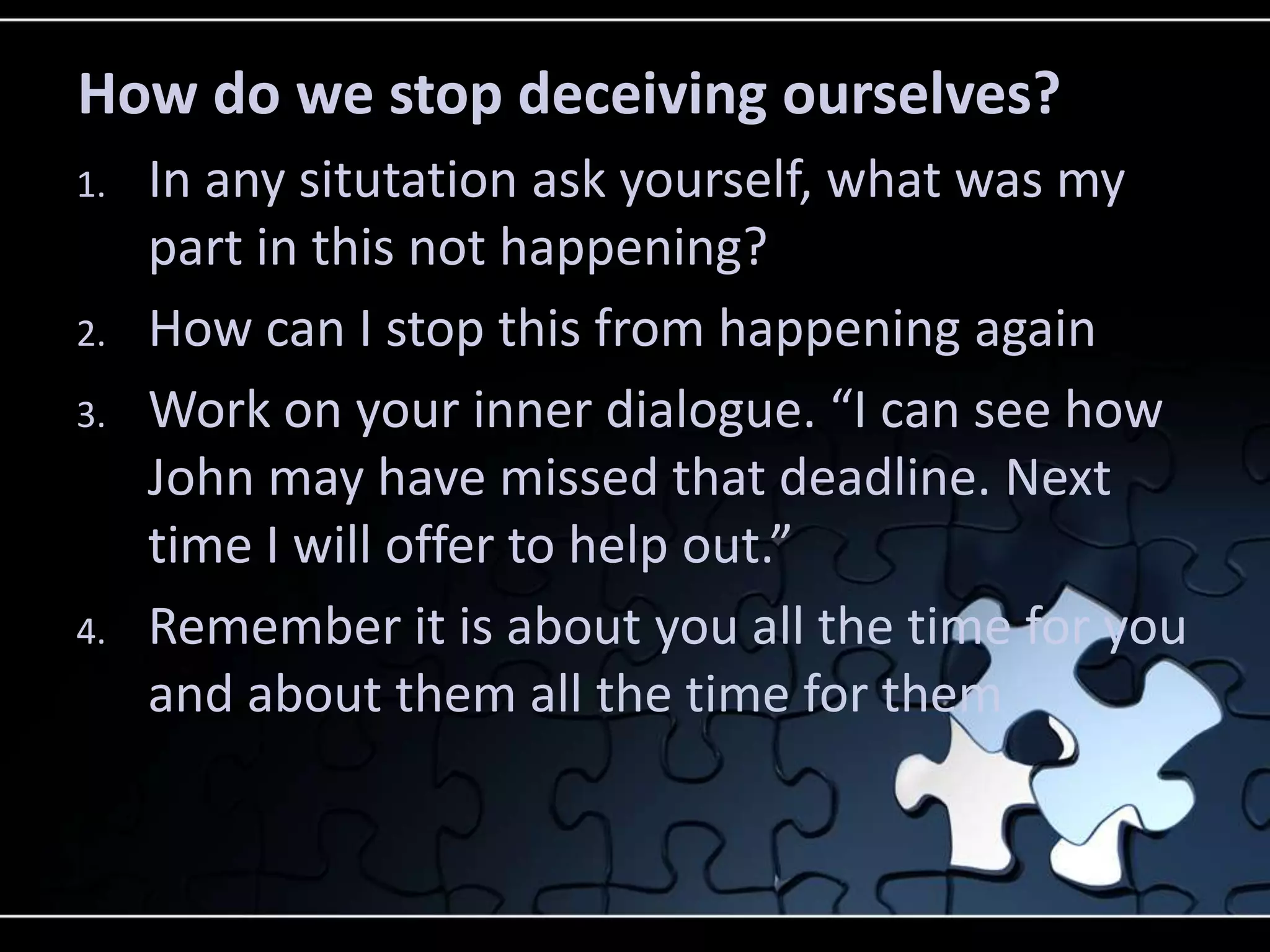
How do we stop deceiving ourselves?
1.   In any situtation ask yourself, what was my
     part in this not happening?
2.   How can I stop this from happening again
3.   Work on your inner dialogue. “I can see how
     John may have missed that deadline. Next
     time I will offer to help out.”
4.   Remember it is about you all the time for you
     and about them all the time for them
But I’m smarter than you.
IQ vs. EQ
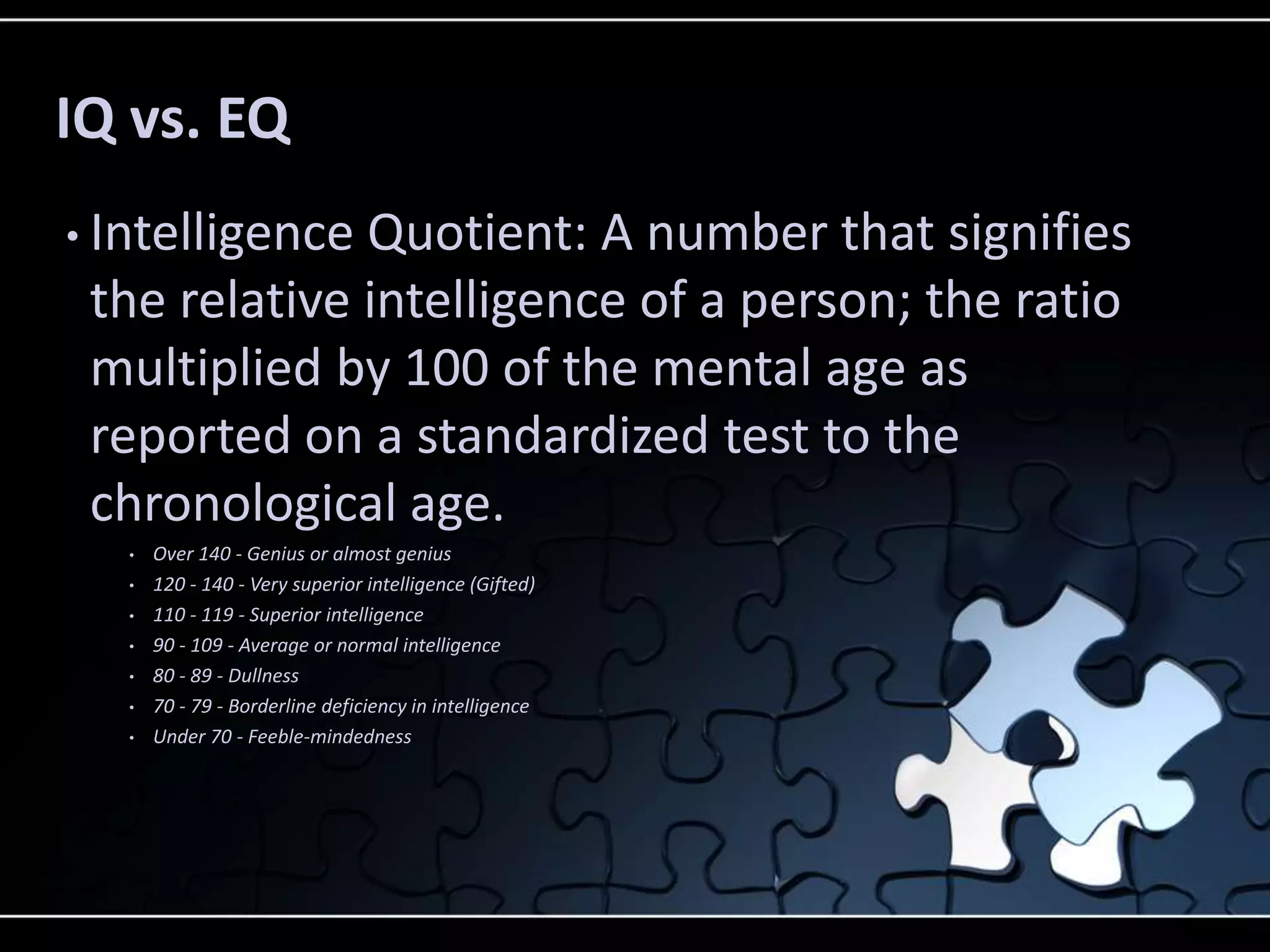
IQ vs. EQ
• IntelligenceQuotient: A number that signifies
 the relative intelligence of a person; the ratio
 multiplied by 100 of the mental age as
 reported on a standardized test to the
 chronological age.
   •   Over 140 - Genius or almost genius
   •   120 - 140 - Very superior intelligence (Gifted)
   •   110 - 119 - Superior intelligence
   •   90 - 109 - Average or normal intelligence
   •   80 - 89 - Dullness
   •   70 - 79 - Borderline deficiency in intelligence
   •   Under 70 - Feeble-mindedness
IQ vs. EQ
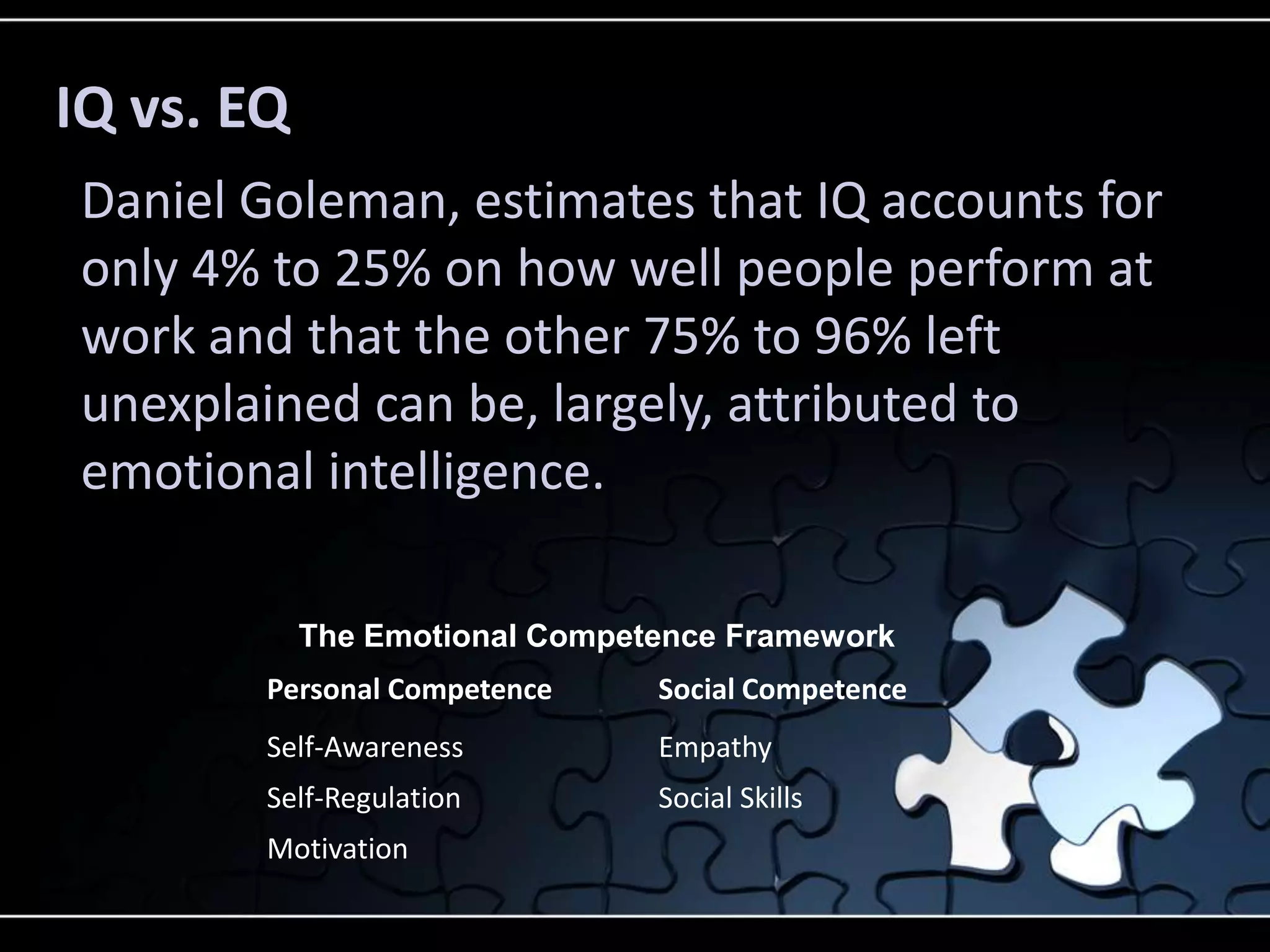
Emotitional Quotient: A measure of one's
emotional intelligence, as defined by the ability
to use both emotional and cognitive thought.
Emotional intelligence skills include but are not
limited to empathy, intuition, creativity,
flexibility, resilience, stress management,
leadership, integrity, authenticity, intrapersonal
skills and interpersonal skills.
IQ vs. EQ
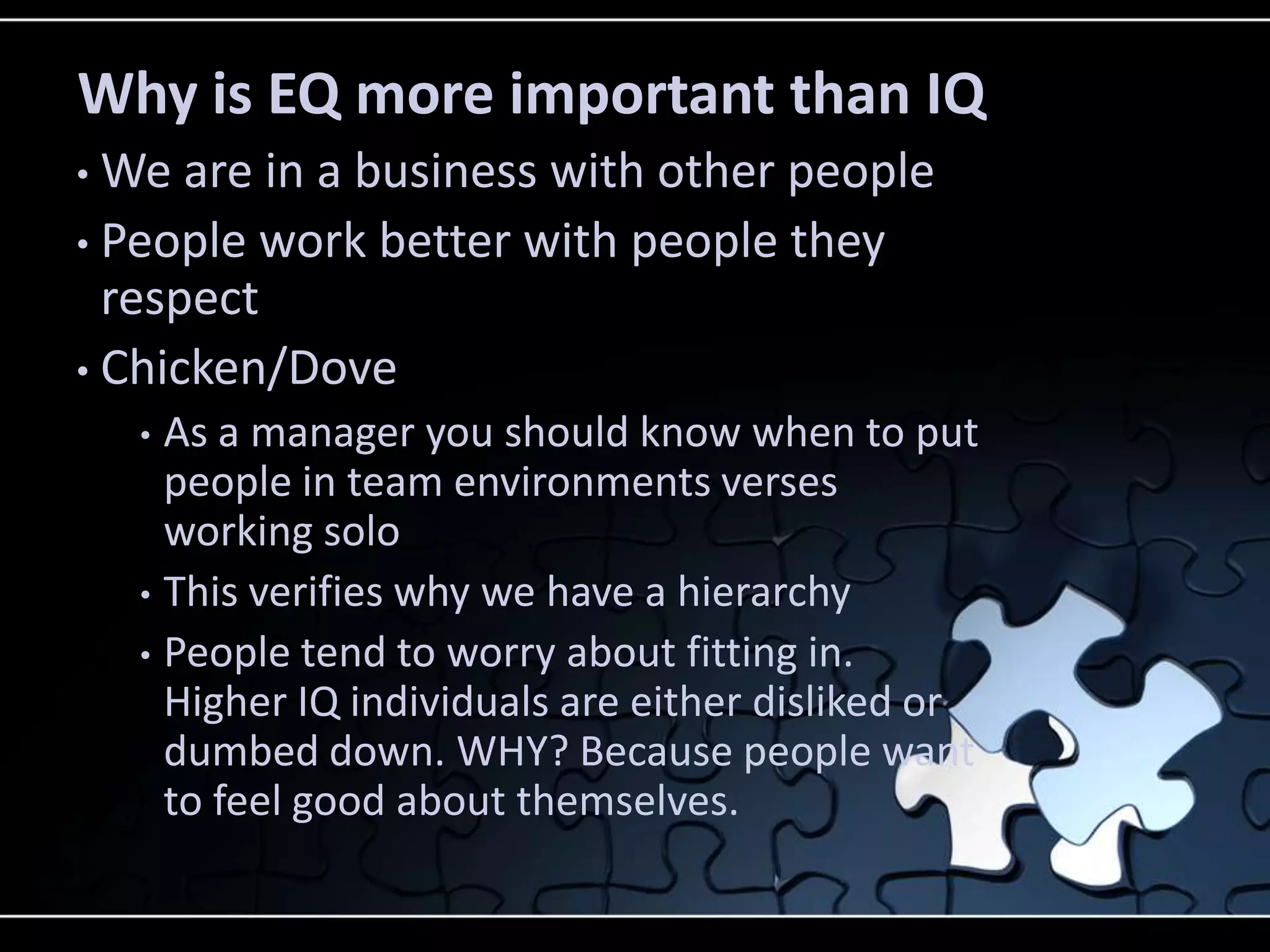
Daniel Goleman, estimates that IQ accounts for
only 4% to 25% on how well people perform at
work and that the other 75% to 96% left
unexplained can be, largely, attributed to
emotional intelligence.

            The Emotional Competence Framework
        Personal Competence     Social Competence
        Self-Awareness          Empathy
        Self-Regulation         Social Skills
        Motivation
Why is EQ more important than IQ
• We are in a business with other people
• People work better with people they
  respect
• Chicken/Dove
    • As a manager you should know when to put
      people in team environments verses
      working solo
    • This verifies why we have a hierarchy
    • People tend to worry about fitting in.
      Higher IQ individuals are either disliked or
      dumbed down. WHY? Because people want
      to feel good about themselves.
EQ By Job Title
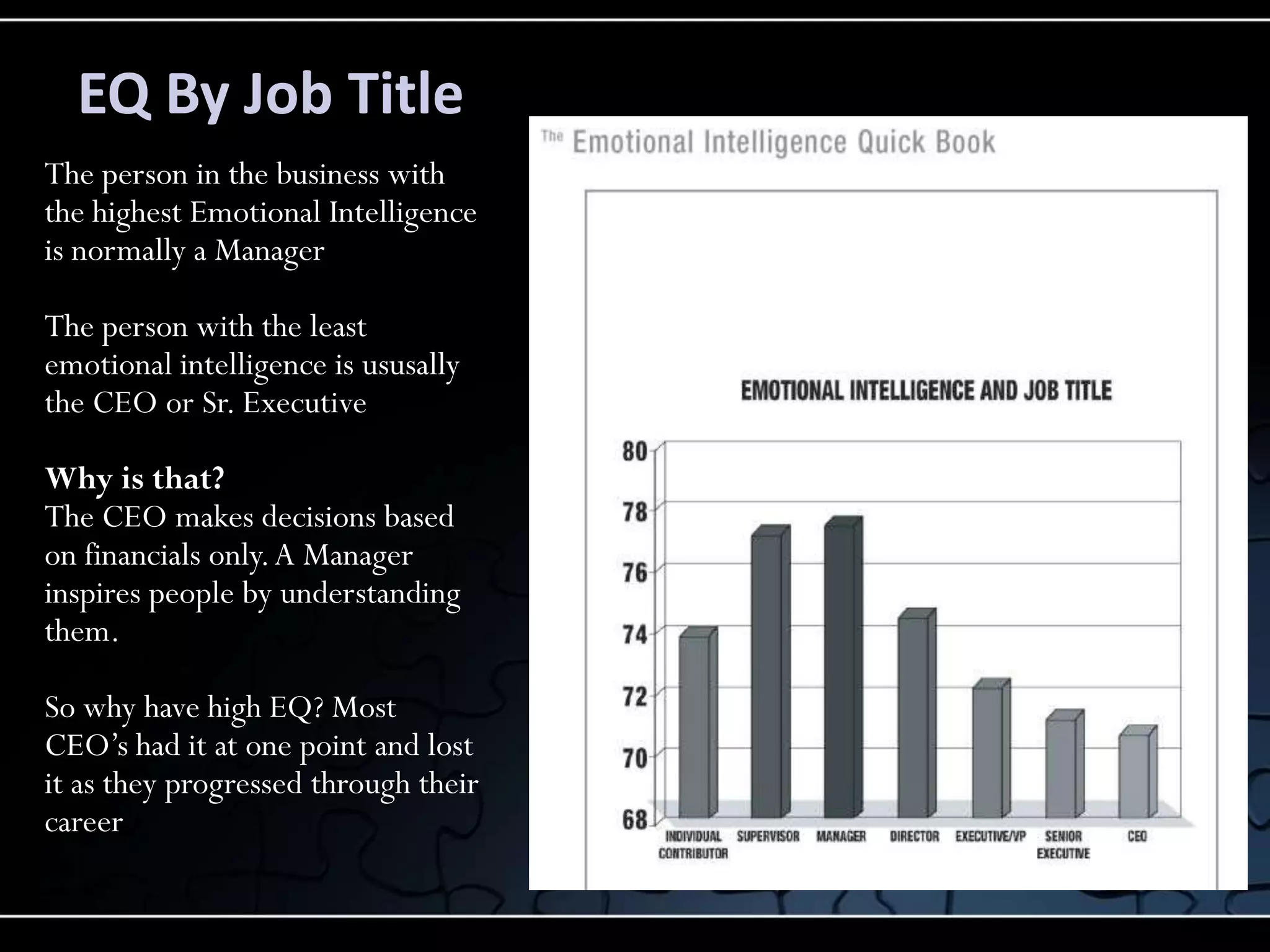
The person in the business with
the highest Emotional Intelligence
is normally a Manager

The person with the least
emotional intelligence is ususally
the CEO or Sr. Executive

Why is that?
The CEO makes decisions based
on financials only. A Manager
inspires people by understanding
them.

So why have high EQ? Most
CEO’s had it at one point and lost
it as they progressed through their
career
Recap
• People   want to feel good about themselves. It
  is their number 1 motivation in life
• People with high EQ have high social
  competence and can read people and respond
  appropriately to other people’s emotions
  (making the other people feel good about
  themselves)
Let’s Get Organized!
Organizational Skills
Why does this make us feel good about ourselves?

Organizational Skills are the foundation of forming a
positive perception and more importantly efficiently
working. Here are some of the benefits of being
organized:
1.  You save time looking for things you need
2.  You can see patterns you might otherwise miss
3.  It keeps you prepared for anything at anytime
4.  Perception. Organized people appear more
    competent and intelligent.
5.  Research shows that clutter can cause depression,
    anxiety and decreased performance
How to Get Organized
1. Organize your desk, your documents on your
   computer and your drawers. It may not
   seem like it but it’s virtually impossible to be
   organized and efficient if your surrounded in
   clutter. Also, the perception of a messy desk
   is that you a) are slacking off b) don’t take
   your job seriously and/or c) you are lazy.
***Being organized helps you both feel good
about yourself and make money!
1. Focus on what is important: set daily and
   monthly goals. Keep a picture of your family
   on your desk to remind you what matters
2. Make lists: all day, especially during
   meetings make lists. Here is how I do mine:
To Do List:
Bullet Point: an informational point I may need for
an action item
Triangle: an action item, something that needs to
get done
Asterisk: an idea that I can work on with extra time
Star: someone else’s task that I want to remember
was assigned

I update these in Microsoft Office tasks if they aren’t
able to complete in one day.

I don’t leave for the day without completing all
action items or assigning them to me for a future
date
How to Get Organized
•   3) Manage Your Time: do your most challenging
    work in the beginning of the day or right after
    lunch when your mind is sharpest.
•   4) Delegate Tasks: if there is something you can
    delegate then do it! It’s hard to let control
    sometimes but remember what you are paid for.
    IE If your are a Sr. member of management you
    shouldn’t spend time stapling packets
•   5) Use Your Resources: Microsoft Office tasks
    allows you to assign tasks, schedule tasks and
    manage them. You can also schedule yourself
    reminders. Microsoft Office Calendar allows you
    to schedule your work day. Block out chunks of
    time of the calendar to work on projects or tasks
    you seem to never have the time for
FOLLOW UP
Follow Up
Why is Follow Up Important?
1)   It makes you appear organized
2)   It builds confidence with your co-workers and manager that
     you won’t ever drop the ball
3)   It is your BIGGEST perception building tool. An opportunity to
     show yourself as an organized go getter without appearing to
     be campaigning for yourself

How to follow up:
1. Document meetings and conversation
2. Send follow emails for every verbal completion
3. ALWAYS ask for additional feedback
Example Follow Up Letter
Potential Client
Hi John,

Thank you for meeting with us today. I just wanted to do a quick recap
of the action items from our meeting:
1. I will email you pricing
2. Your VP will sign the contract
3. We will meet back up on Tuesday to make sure we are on track


Please let me know if there is anything I missed!
Looking forward to speaking with you on Tuesday at 2
Example of Follow Up Email
Manager
Hi Sarah,
I just wanted to update you on the status of each of my current
assigned tasks so you know where I am:
1.   Budget Forecasting: completed and turned in for review
2.   New Hire Training: First draft completed waiting for approval
3.   Credit Card P&P: on hold until John comes back
4.   Expense Reporting: in accounting’s hands


Because John is out I don’t believe we are going to hit our original
target date of 1/2/12. I wanted to let you know ahead of schedule so
you can tell me how you would like me to proceed.


Please let me know if I forgot anything. I am looking forward to a
wonderful 2012!
THE MOST IMPORTANT QUESTION YOU
CAN ASK WHEN ASSIGNED A TASK?

WHEN IS THIS DUE?
•   You can’t make a deadline if you don’t know when the
    expectation of completion is
•   The person assigning you a task always knows when they expect
    it done. SO ASK!!!!
EFFICIENCY AND PRIORITIZATION
Efficiency
The Keys to be Efficient
1.   Be organized
2.   Know how to delegate
3.   Learn to be an expert in your day to day office tools
4.   Practice things you struggle with
5.   Know how to ask for help
6.   OVERCOMMUNICATE
7.   Prioritize
8.   Be Proactive
How to Prioritize
Efficiency
 •   Know your objective: at the beginning of your day
     know what tasks you want to have done
       •   Hold yourself accountable: set a goal and reach it.
       •   Reach for the stars: add more than you think you can
           accomplish. Don’t let quality slip to get it but make sure
           you feel the pressure to hit your goals
 •   Use your resources: Task list, Assistants, technology
 •   Prioritize based on cost, value and risk.
 •   Rank your tasks for the day (MAKE SURE YOUR
     TASKS ARE YOUR MANAGERS) send a follow up
     email to confirm
Priortization

What if you are organized, and have all your tasks set up by
deadline but it’s just too much work?

1.   Bring your list to your manager
2.   Here’s what you say: “Hi John, do you have a quick minute? I
     want to make sure I hit every deadline you have assigned me
     and believe I can do it with some assistance prioratizong my
     list of responsiblities. Can you tell me of these projects which
     you need completed first?”
Perception
Remember you are your biggest advocate. Whether or not it is
reality being organized shows that you value your job. It shows
that you are serious about meeting and exceeding expectations.
It shows how you feel about yourself and the company.

Following up is your opportunity to brag without bragging! Here
is what I did. I heard what you said and did it. Too many great
employees go unnoticed because no one knows what they are
doing!
Perception

How do you show your coworkers and boss that you are a great
employee?

Let’s describe how you want to be viewed:
• Intelligent
• Competent
• Ambitious
• A Go Getter
• Valuable
• Team Player
Perception
How do you show that you are a good employee?

Urgency. Time is money and well, it’s your bosses money. No boss is
ever happy to see his employees moving slowly. Even if you are
methodiacal and detail oriented you have to show that you GET IT.
Move with speed and show that his deadlines are yours. If something
bad happens have a normal appropriate reactions:
        •   The server goes down and no one can work
        •   A large client is contemplating cancelling


Ambition: asking the right questions at the right time is the way to
show you have the drive.

Organization: being organized makes you look on top of it. That makes
your boss believe you are competent
Perception
How do you show your boss you are a good employee?
•   Efficiency: show that you can get work done faster then
    expected with excellent execution
•   Communication: perception is reality. Even if you did
    everything you were asked to do
•   Focus on Revenue: any chance you get to show that your focus
    is on making the company money, take it. Be proactive about it.
    Be creative. (cheaper paper, lower phone bill, new client, etc)
•   Humility: No one likes an arrogant person. You have to be the
    best and believeable not know it
Real Life Ways to Make an Impression
• Take notes through out the day and recap
  in email any sticking points
• Learn Microsoft Office and be able to
  make everything you create professional
• Ask for monthly one on one’s if you aren’t
  getting them. In them, ask the questions:
  1.     What can I do better?
  2.     What skills can I learn on my down time to make me seem
         more desirable
  3.     On our last one one one we discussed me improving on
         ______ how would you say I progressed?
Real Life Ways to Make an Impression
• Dress for the job you want
• Always offer to do overtime, to come in early
  and/or to stay late
• Be proactive. If you see a problem come up with a
  solution and then “pitch it” to leadership
• Do your research, know your competitors, your
  company history, your management’s experience
  and anything and everything else you can
• Always have a sense of urgency for sales, projects
  and performance
“Management is doing things right;
leadership is doing the right things”

Organization, follow up, efficiency and perception

  • 1.
    Organization, Follow Up,Efficiency and Perception Heather Griffin
  • 2.
    What We WillCover “Nothing is good or bad but thinking it makes it so.” 1 •Business Priciples 2 •Organization 3 •Follow Up 4 •Perception
  • 3.
    The 2 MOSTImportant Facts of Business It’s easy to forget in day to day business the true reasons we are here. So, why do we come to work? 1. To feel good about ourselves 2. To make money The truth is that it is more important to us to feel good about ourselves than make money. Money makes us feel good about ourselves!
  • 4.
    How We FeelAbout Ourselves The sole reason we do anything is life is how it makes us feel about ourselves. People are inherently selfish. Think about your spouse, your best friend, your favorite co- worker. How do they make you feel about yourself? Understanding that you can learn how to motivate, cultivate relationships and most importantly feel good about yourself
  • 5.
    Leadership and SelfDeception • All employees should function for the sole purpose of bettering the business. Instead we self justify reasons to behave in non-productive ways • Employees determine like or dislike on employees based on how they feel about themselves • Employees view eachother as “things” that can either help or hinder their self image • Employees rationalize their behavior by breaking down other people • We should not worry about changing others (or even ourselves!) we should instead recognize that the problem lies within ourselves and go from there
  • 6.
    Leadership and SelfDeception At night a husband and wife are sleeping. The husband wakes up when the baby in the other room starts to cry. The husband’s first thought is to get up and get the child before his wife wakes up; after all, she works so hard all day and needs all the sleep she can get. The husband’s next thought though is that he too works hard all day and needs to get up early for a meeting. “Why should I get up? My responsibility in this family is to go to work and earn money so we can live. I need all the sleep I can get so I can function at my job – I have a big project to complete tomorrow. [Baby continues to cry+. Why doesn’t my wife get up and get that baby? Doesn’t she realize I need to get sleep? Okay, I know she’s awake now. Why doesn’t she get up? Now she’s just being lazy. *And so on+. Maybe the situation is at work where you had a thought that you should do something but then didn’t do it. When it created a problem you were able to rationalize your behavior and blame someone else (“I would have done X had Susan done her job” or “I was just too busy with other things to get X done.”). Basically, self-betrayal results from not being true to what you [hopefully] know is the right thing to do.
  • 7.
    Leadership and SelfDeception How we deceive ourselves: Why does he make more money than me? Me Him Smarter Stupid Self motivated Lazy Humble Kiss up Honest Two faced Teamwork Selfish Valuable employee A “waste of space”
  • 8.
    How do westop deceiving ourselves? 1. In any situtation ask yourself, what was my part in this not happening? 2. How can I stop this from happening again 3. Work on your inner dialogue. “I can see how John may have missed that deadline. Next time I will offer to help out.” 4. Remember it is about you all the time for you and about them all the time for them
  • 9.
    But I’m smarterthan you. IQ vs. EQ
  • 10.
    IQ vs. EQ •IntelligenceQuotient: A number that signifies the relative intelligence of a person; the ratio multiplied by 100 of the mental age as reported on a standardized test to the chronological age. • Over 140 - Genius or almost genius • 120 - 140 - Very superior intelligence (Gifted) • 110 - 119 - Superior intelligence • 90 - 109 - Average or normal intelligence • 80 - 89 - Dullness • 70 - 79 - Borderline deficiency in intelligence • Under 70 - Feeble-mindedness
  • 11.
    IQ vs. EQ EmotitionalQuotient: A measure of one's emotional intelligence, as defined by the ability to use both emotional and cognitive thought. Emotional intelligence skills include but are not limited to empathy, intuition, creativity, flexibility, resilience, stress management, leadership, integrity, authenticity, intrapersonal skills and interpersonal skills.
  • 12.
    IQ vs. EQ DanielGoleman, estimates that IQ accounts for only 4% to 25% on how well people perform at work and that the other 75% to 96% left unexplained can be, largely, attributed to emotional intelligence. The Emotional Competence Framework Personal Competence Social Competence Self-Awareness Empathy Self-Regulation Social Skills Motivation
  • 13.
    Why is EQmore important than IQ • We are in a business with other people • People work better with people they respect • Chicken/Dove • As a manager you should know when to put people in team environments verses working solo • This verifies why we have a hierarchy • People tend to worry about fitting in. Higher IQ individuals are either disliked or dumbed down. WHY? Because people want to feel good about themselves.
  • 14.
    EQ By JobTitle The person in the business with the highest Emotional Intelligence is normally a Manager The person with the least emotional intelligence is ususally the CEO or Sr. Executive Why is that? The CEO makes decisions based on financials only. A Manager inspires people by understanding them. So why have high EQ? Most CEO’s had it at one point and lost it as they progressed through their career
  • 15.
    Recap • People want to feel good about themselves. It is their number 1 motivation in life • People with high EQ have high social competence and can read people and respond appropriately to other people’s emotions (making the other people feel good about themselves)
  • 16.
  • 17.
    Organizational Skills Why doesthis make us feel good about ourselves? Organizational Skills are the foundation of forming a positive perception and more importantly efficiently working. Here are some of the benefits of being organized: 1. You save time looking for things you need 2. You can see patterns you might otherwise miss 3. It keeps you prepared for anything at anytime 4. Perception. Organized people appear more competent and intelligent. 5. Research shows that clutter can cause depression, anxiety and decreased performance
  • 18.
    How to GetOrganized 1. Organize your desk, your documents on your computer and your drawers. It may not seem like it but it’s virtually impossible to be organized and efficient if your surrounded in clutter. Also, the perception of a messy desk is that you a) are slacking off b) don’t take your job seriously and/or c) you are lazy. ***Being organized helps you both feel good about yourself and make money! 1. Focus on what is important: set daily and monthly goals. Keep a picture of your family on your desk to remind you what matters 2. Make lists: all day, especially during meetings make lists. Here is how I do mine:
  • 19.
    To Do List: BulletPoint: an informational point I may need for an action item Triangle: an action item, something that needs to get done Asterisk: an idea that I can work on with extra time Star: someone else’s task that I want to remember was assigned I update these in Microsoft Office tasks if they aren’t able to complete in one day. I don’t leave for the day without completing all action items or assigning them to me for a future date
  • 20.
    How to GetOrganized • 3) Manage Your Time: do your most challenging work in the beginning of the day or right after lunch when your mind is sharpest. • 4) Delegate Tasks: if there is something you can delegate then do it! It’s hard to let control sometimes but remember what you are paid for. IE If your are a Sr. member of management you shouldn’t spend time stapling packets • 5) Use Your Resources: Microsoft Office tasks allows you to assign tasks, schedule tasks and manage them. You can also schedule yourself reminders. Microsoft Office Calendar allows you to schedule your work day. Block out chunks of time of the calendar to work on projects or tasks you seem to never have the time for
  • 21.
  • 22.
    Follow Up Why isFollow Up Important? 1) It makes you appear organized 2) It builds confidence with your co-workers and manager that you won’t ever drop the ball 3) It is your BIGGEST perception building tool. An opportunity to show yourself as an organized go getter without appearing to be campaigning for yourself How to follow up: 1. Document meetings and conversation 2. Send follow emails for every verbal completion 3. ALWAYS ask for additional feedback
  • 23.
    Example Follow UpLetter Potential Client Hi John, Thank you for meeting with us today. I just wanted to do a quick recap of the action items from our meeting: 1. I will email you pricing 2. Your VP will sign the contract 3. We will meet back up on Tuesday to make sure we are on track Please let me know if there is anything I missed! Looking forward to speaking with you on Tuesday at 2
  • 24.
    Example of FollowUp Email Manager Hi Sarah, I just wanted to update you on the status of each of my current assigned tasks so you know where I am: 1. Budget Forecasting: completed and turned in for review 2. New Hire Training: First draft completed waiting for approval 3. Credit Card P&P: on hold until John comes back 4. Expense Reporting: in accounting’s hands Because John is out I don’t believe we are going to hit our original target date of 1/2/12. I wanted to let you know ahead of schedule so you can tell me how you would like me to proceed. Please let me know if I forgot anything. I am looking forward to a wonderful 2012!
  • 25.
    THE MOST IMPORTANTQUESTION YOU CAN ASK WHEN ASSIGNED A TASK? WHEN IS THIS DUE? • You can’t make a deadline if you don’t know when the expectation of completion is • The person assigning you a task always knows when they expect it done. SO ASK!!!!
  • 26.
  • 27.
    Efficiency The Keys tobe Efficient 1. Be organized 2. Know how to delegate 3. Learn to be an expert in your day to day office tools 4. Practice things you struggle with 5. Know how to ask for help 6. OVERCOMMUNICATE 7. Prioritize 8. Be Proactive
  • 28.
    How to Prioritize Efficiency • Know your objective: at the beginning of your day know what tasks you want to have done • Hold yourself accountable: set a goal and reach it. • Reach for the stars: add more than you think you can accomplish. Don’t let quality slip to get it but make sure you feel the pressure to hit your goals • Use your resources: Task list, Assistants, technology • Prioritize based on cost, value and risk. • Rank your tasks for the day (MAKE SURE YOUR TASKS ARE YOUR MANAGERS) send a follow up email to confirm
  • 29.
    Priortization What if youare organized, and have all your tasks set up by deadline but it’s just too much work? 1. Bring your list to your manager 2. Here’s what you say: “Hi John, do you have a quick minute? I want to make sure I hit every deadline you have assigned me and believe I can do it with some assistance prioratizong my list of responsiblities. Can you tell me of these projects which you need completed first?”
  • 30.
    Perception Remember you areyour biggest advocate. Whether or not it is reality being organized shows that you value your job. It shows that you are serious about meeting and exceeding expectations. It shows how you feel about yourself and the company. Following up is your opportunity to brag without bragging! Here is what I did. I heard what you said and did it. Too many great employees go unnoticed because no one knows what they are doing!
  • 31.
    Perception How do youshow your coworkers and boss that you are a great employee? Let’s describe how you want to be viewed: • Intelligent • Competent • Ambitious • A Go Getter • Valuable • Team Player
  • 32.
    Perception How do youshow that you are a good employee? Urgency. Time is money and well, it’s your bosses money. No boss is ever happy to see his employees moving slowly. Even if you are methodiacal and detail oriented you have to show that you GET IT. Move with speed and show that his deadlines are yours. If something bad happens have a normal appropriate reactions: • The server goes down and no one can work • A large client is contemplating cancelling Ambition: asking the right questions at the right time is the way to show you have the drive. Organization: being organized makes you look on top of it. That makes your boss believe you are competent
  • 33.
    Perception How do youshow your boss you are a good employee? • Efficiency: show that you can get work done faster then expected with excellent execution • Communication: perception is reality. Even if you did everything you were asked to do • Focus on Revenue: any chance you get to show that your focus is on making the company money, take it. Be proactive about it. Be creative. (cheaper paper, lower phone bill, new client, etc) • Humility: No one likes an arrogant person. You have to be the best and believeable not know it
  • 34.
    Real Life Waysto Make an Impression • Take notes through out the day and recap in email any sticking points • Learn Microsoft Office and be able to make everything you create professional • Ask for monthly one on one’s if you aren’t getting them. In them, ask the questions: 1. What can I do better? 2. What skills can I learn on my down time to make me seem more desirable 3. On our last one one one we discussed me improving on ______ how would you say I progressed?
  • 35.
    Real Life Waysto Make an Impression • Dress for the job you want • Always offer to do overtime, to come in early and/or to stay late • Be proactive. If you see a problem come up with a solution and then “pitch it” to leadership • Do your research, know your competitors, your company history, your management’s experience and anything and everything else you can • Always have a sense of urgency for sales, projects and performance
  • 36.
    “Management is doingthings right; leadership is doing the right things”