Learning Outcomes
2
1. Identifythe grade descriptors used in
public and private schools
2. Compare and contrast public school grading
policy with that of the private school
implementing contextualized grading system.
3.
Learning Objectives
3
a. Understandhow grades are computed at the
end of school year for both public and private
school.
b. Acknowledge the Computation of Students’
Grades following DepEd Order No. 31 s. 2020.
c. Show the steps on how grading system are
computed.
4.
“ Education isnot
preparation for life;
education is life itself.
-John Dewey
4
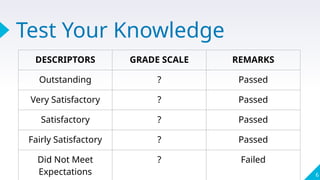
Test Your Knowledge
6
DESCRIPTORSGRADE SCALE REMARKS
Outstanding ? Passed
Very Satisfactory ? Passed
Satisfactory ? Passed
Fairly Satisfactory ? Passed
Did Not Meet
Expectations
? Failed
7.
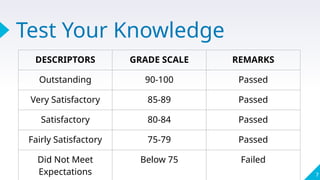
Test Your Knowledge
7
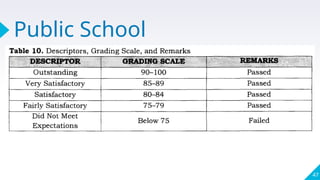
DESCRIPTORSGRADE SCALE REMARKS
Outstanding 90-100 Passed
Very Satisfactory 85-89 Passed
Satisfactory 80-84 Passed
Fairly Satisfactory 75-79 Passed
Did Not Meet
Expectations
Below 75 Failed
8.
What is thegrading
system?
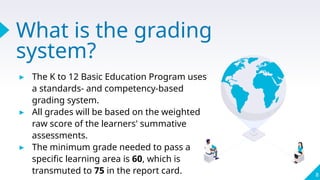
▸ The K to 12 Basic Education Program uses
a standards- and competency-based
grading system.
▸ All grades will be based on the weighted
raw score of the learners' summative
assessments.
▸ The minimum grade needed to pass a
specific learning area is 60, which is
transmuted to 75 in the report card. 8
9.
Grading
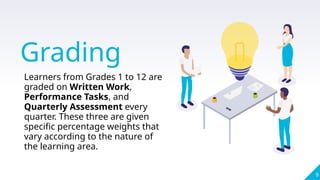
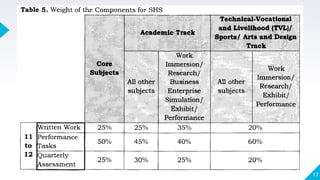
Learners from Grades1 to 12 are
graded on Written Work,
Performance Tasks, and
Quarterly Assessment every
quarter. These three are given
specific percentage weights that
vary according to the nature of
the learning area.
9
11
For Kindergarten
Guidelines specificto
the assessment of
Kindergarten learners
will be issued in a
different memorandum
or order.
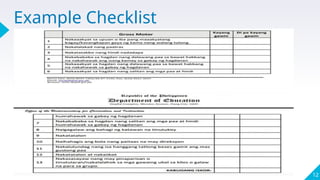
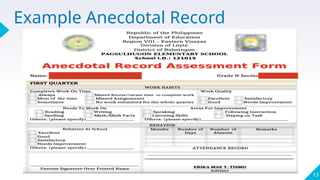
However, for
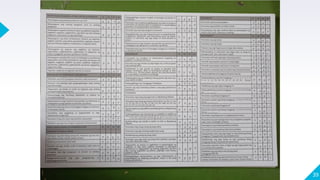
Kindergarten, checklists
and anecdotal records
are used instead of
numerical grades.
For Kindergarten
14
These arebased on
learning standards
found in the
Kindergarten
curriculum guide.
It is important for
teachers to keep a
portfolio, which is a
record or compilation
of the learner's output,
such as writing
samples,
accomplished activity
sheets, and artwork.
The portfolio can
provide concrete
evidence of how much
or how well the learner
is able to accomplish
the skills and
competencies.
15.
15
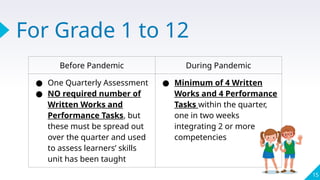
For Grade 1to 12
Before Pandemic During Pandemic
● One Quarterly Assessment
● NO required number of
Written Works and
Performance Tasks, but
these must be spread out
over the quarter and used
to assess learners’ skills
unit has been taught
● Minimum of 4 Written
Works and 4 Performance
Tasks within the quarter,
one in two weeks
integrating 2 or more
competencies
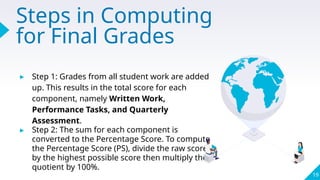
Steps in Computing
forFinal Grades
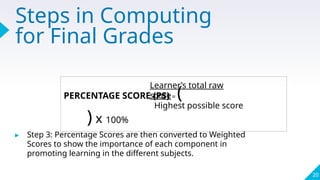
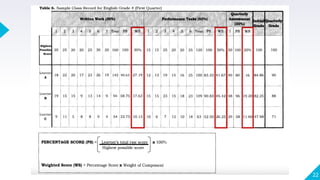
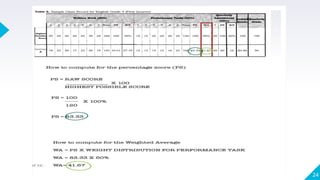
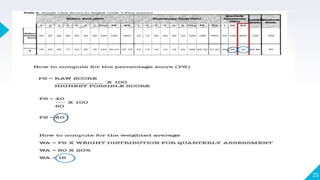
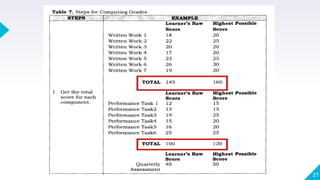
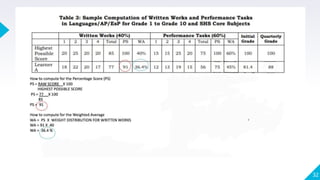
▸ Step 1: Grades from all student work are added
up. This results in the total score for each
component, namely Written Work,
Performance Tasks, and Quarterly
Assessment.
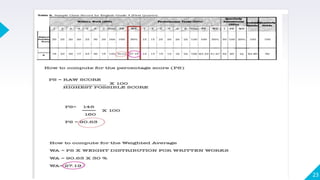
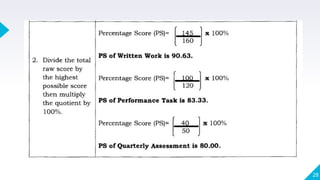
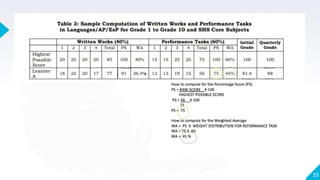
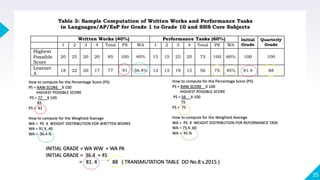
▸ Step 2: The sum for each component is
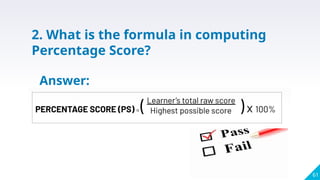
converted to the Percentage Score. To compute
the Percentage Score (PS), divide the raw score
by the highest possible score then multiply the
quotient by 100%.
19
20.
Steps in Computing
forFinal Grades
20
PERCENTAGE SCORE (PS) = (
) x 100%
Learner’s total raw
score
Highest possible score
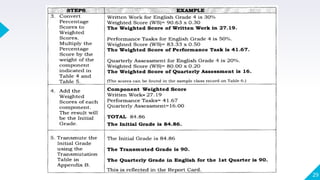
▸ Step 3: Percentage Scores are then converted to Weighted
Scores to show the importance of each component in
promoting learning in the different subjects.
21.
21
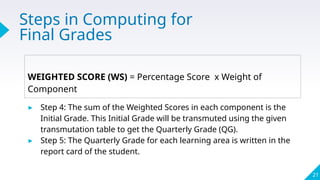
WEIGHTED SCORE (WS)= Percentage Score x Weight of
Component
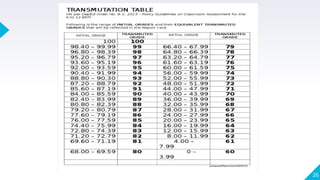
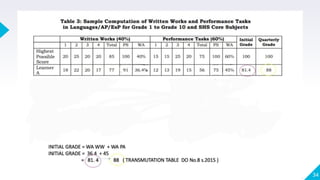
▸ Step 4: The sum of the Weighted Scores in each component is the
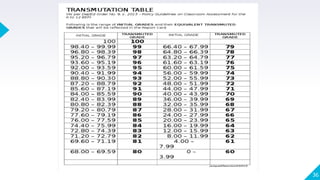
Initial Grade. This Initial Grade will be transmuted using the given
transmutation table to get the Quarterly Grade (QG).
▸ Step 5: The Quarterly Grade for each learning area is written in the
report card of the student.
Steps in Computing for
Final Grades
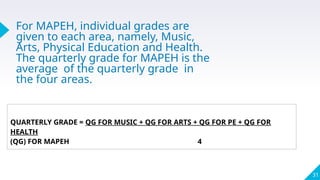
For MAPEH, individualgrades are
given to each area, namely, Music,
Arts, Physical Education and Health.
The quarterly grade for MAPEH is the
average of the quarterly grade in
the four areas.
31
QUARTERLY GRADE = QG FOR MUSIC + QG FOR ARTS + QG FOR PE + QG FOR
HEALTH
(QG) FOR MAPEH 4
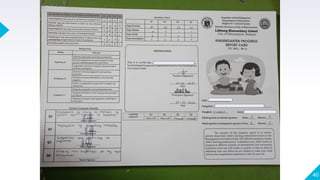
For Kindergarten
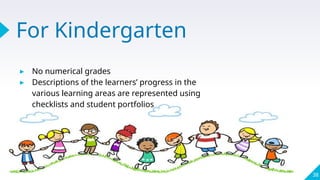
▸ Nonumerical grades
▸ Descriptions of the learners’ progress in the
various learning areas are represented using
checklists and student portfolios
38
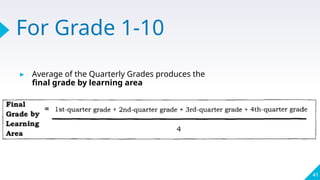
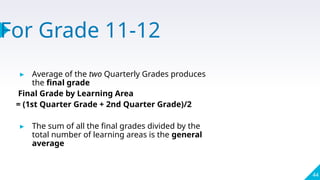
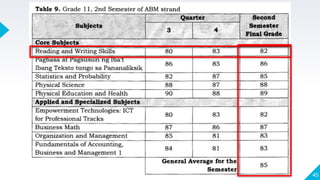
For Grade 11-12
▸Average of the two Quarterly Grades produces
the final grade
Final Grade by Learning Area
= (1st Quarter Grade + 2nd Quarter Grade)/2
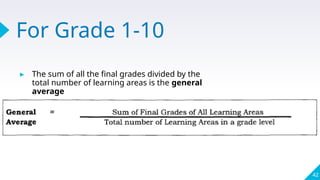
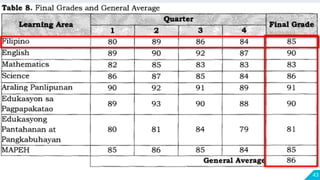
▸ The sum of all the final grades divided by the
total number of learning areas is the general
average
44
50
DO No. 8,s. 2015 DO No. 31, s. 2020
Effective School Year (SY) 2015-2016,
the Policy Guidelines on Classroom
Assessment for the K to 12 Basic
Education Program shall be
implemented in public schools and
secondary schools nationwide.
DepEd issues the Interim
Policy Guidelines for
Assessment and Grading in
Light of Basic Education
Learning Continuity Plan to
provide guidance on the
assessment of student learning
and on the grading scheme to
be adopted this school year.
Public Schools
51.
51
DO No. 08,s. 2015 DO No. 31 s. 2020
Non-DepEd schools are urged to
implement these policy guidelines
as well. Non-DepEd schools are
permitted to modify the policy
guidelines according to their
school’s Philosophy, Vision and
Mission with the approval of the
appropriate DepEd regional
office.
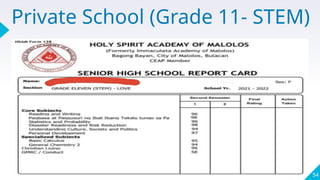
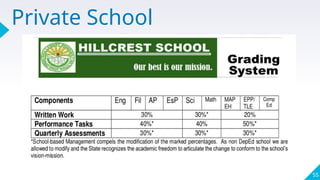
Private schools, technical and
vocational institutions and higher
education, including State and
local universities and colleges
offering K to 12 Basic Education
Program are encouraged to
implement these interim policy
guidelines as well. Private schools
and institutions are permitted to
modify these policy guidelines
according to their Philosophy,
Vision and Mission, with the
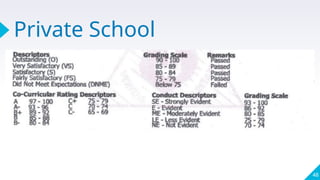
Private Schools
56
SUMMARY
● Grading isthe way of reporting assessment data by assigning a
value to the result as a record of students’ ability, achievement
or progress.
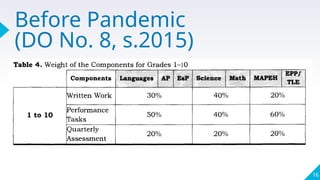
● Before the pandemic or DO no.8 2015, learners from Grade 1 to
12 are graded on Written Works, Performance Tasks and
Quarterly Assessment every quarter. These three are given
specific percentage weights that vary according to the nature of
the learning area.
57.
57
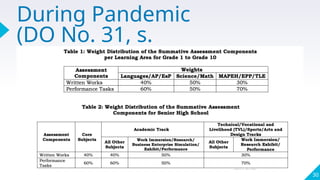
● During thepandemic or DO no.31, s.2020, public school strictly
follow the two component such as Written Works and
Performance Tasks. Quarterly Assessment were given a weight
of 20%, will be distributed into written works and performance
task allotting additional 10% of each component.
● Private school, technical and vocational institution, and higher
education offering K -12 Basic Education program are encouraged
to implement these interim policy guidelines as well. They are
permitted to modify these policy guidelines according to their
Philosophy, Vision and Mission, with the approval of their
respective DepEd regional office.
58.
58
Assessment
1. What isthe minimum grade needed to
pass a specific learning area, which is
transmuted to 75 in the report card?
59.
59
Assessment
1. What isthe minimum grade needed to
pass a specific learning area, which is
transmuted to 75 in the report card?
Answer: 60
60.
60
2. What isthe formula in computing
Percentage Score?
61.
61
2. What isthe formula in computing
Percentage Score?
Answer:
62.
62
3. It isa record or compilation of the
learner's output, such as writing samples,
accomplished activity sheets, and artwork.
63.
63
3. It isa record or compilation of the
learner's output, such as writing samples,
accomplished activity sheets, and artwork.
Answer:
PORTFOLIO
64.
64
4. What isthe grading scale for
descriptor outstanding with a remarks
of passed?
65.
65
4. What isthe grading scale for
descriptor outstanding,with a remark
of passed?
Answer: 90-100
66.
66
5. What DepEdorder implemented in all
public schools nationwide?
67.
67
5. What isthe DepEd order no.
implemented in all public schools
nationwide?
Answer: DO No. 31, s.
2020