SUNSUN J. CARNAZO
INSTRUCTOR 1
I. RIGHT TO ADMISSION WITHOUT
UNDUE DISCRIMINATION
No student shall be denied admission
to any school on account of his/her
physical handicap, socio-economic
status, political and religious beliefs,
sexual orientation or membership of
student organizations, nor shall
pregnant students certified reformed
drug abusers and those suffering from
immune deficiency syndrome be
discriminated against
Failure of or refusal of student to sign
waiver documents prepared by the
school administration shall not
constitute a ground for his/her non-
admission.
Students shall have the right freely to
choose his/her fields of study subject
to existing curricula and to continue
his/her course up to graduation except
in case of academic deficiency or
violation of disciplinary regulations
that do not infringe upon the exercise
of student’s rights and welfare.
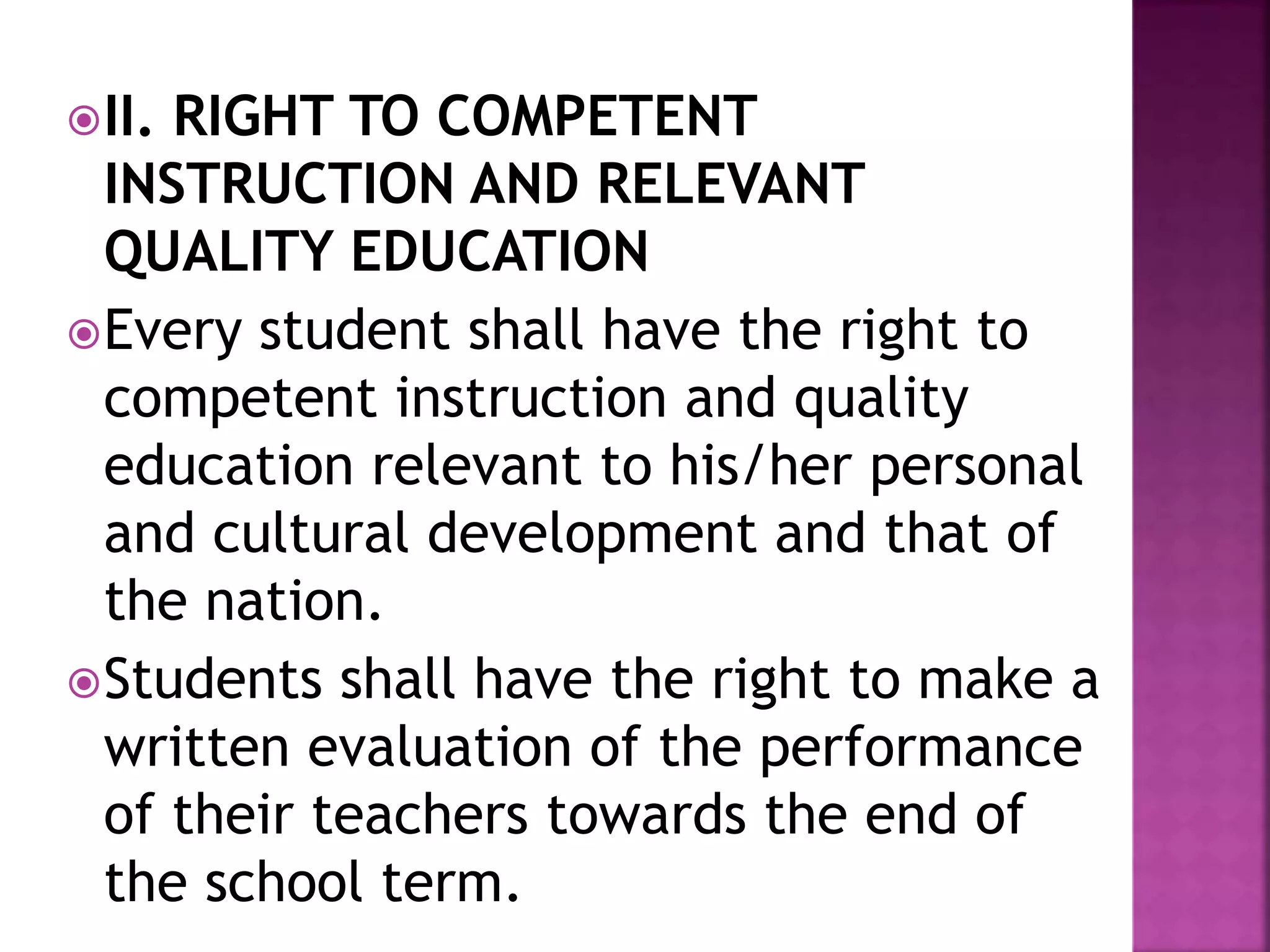
II. RIGHT TO COMPETENT
INSTRUCTION AND RELEVANT
QUALITY EDUCATION
Every student shall have the right to
competent instruction and quality
education relevant to his/her personal
and cultural development and that of
the nation.
Students shall have the right to make a
written evaluation of the performance
of their teachers towards the end of
the school term.
III. RIGHT TO ADEQUATE WELFARE
SERVICES AND ACADEMIC
FACILITIES
It shall be the responsibility of the
school administration to provide
the students with adequate
welfare services and academic
facilities relative to the financial
capacity of the school.
The school shall endeavor to provide
free annual physical check-up to the
students. It shall be the responsibility
of the school authorities to provide
students with adequate laboratory,
library, research, recreation and
physical education facilities.
It shall be the responsibility of the
school administration to promptly
notify student concerned of letters and
other communications it receives in
behalf of the students.
IV. RIGHT TO ORGANIZE
STUDENT ORGANIZATIONS
Unity and collective effort
being fundamental in
realization of common goals
and the promotion and
protection of common interest,
the State recognizes the rights
of the students to organize
among themselves.
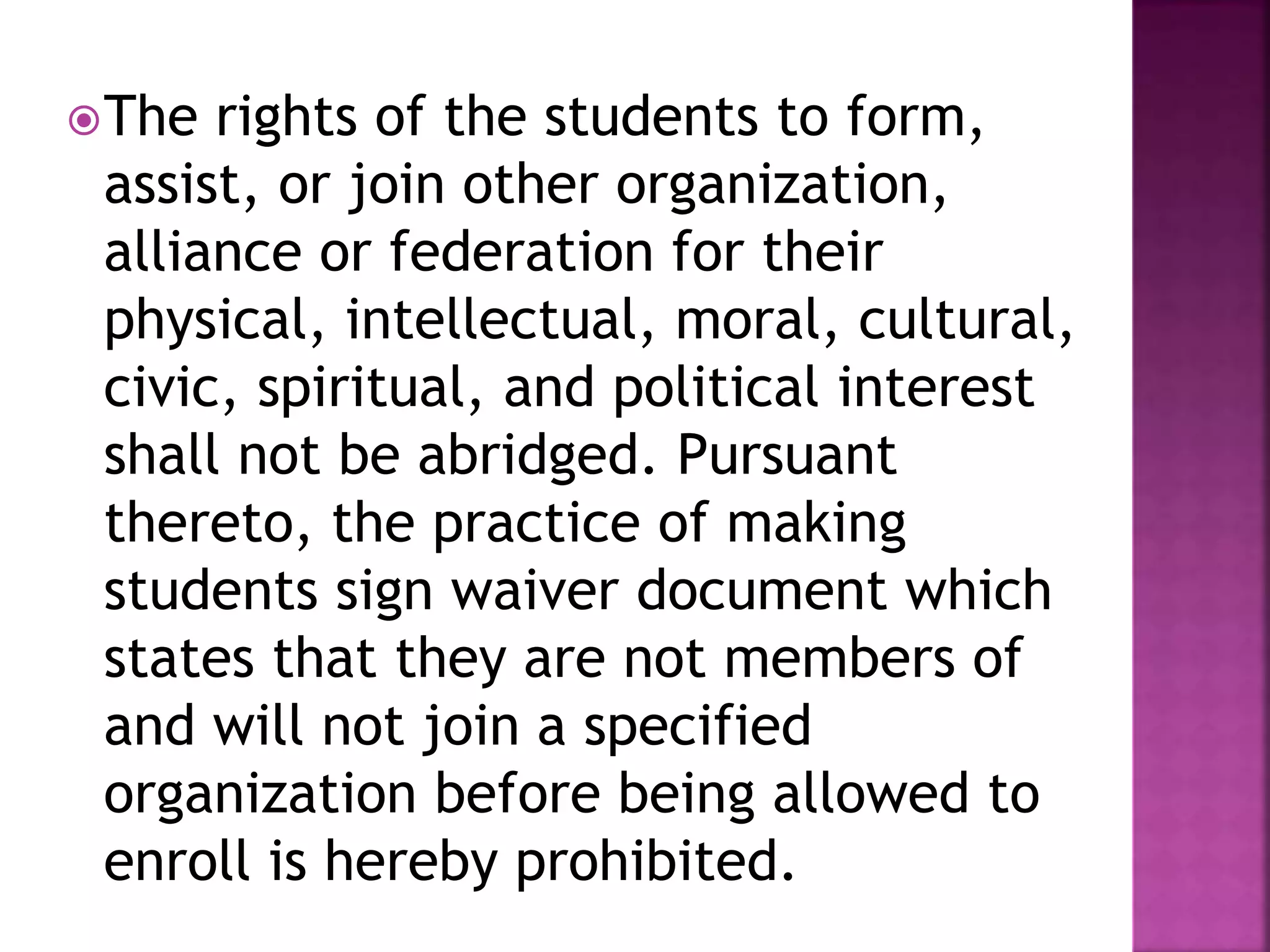
The rights of the students to form,
assist, or join other organization,
alliance or federation for their
physical, intellectual, moral, cultural,
civic, spiritual, and political interest
shall not be abridged. Pursuant
thereto, the practice of making
students sign waiver document which
states that they are not members of
and will not join a specified
organization before being allowed to
enroll is hereby prohibited.
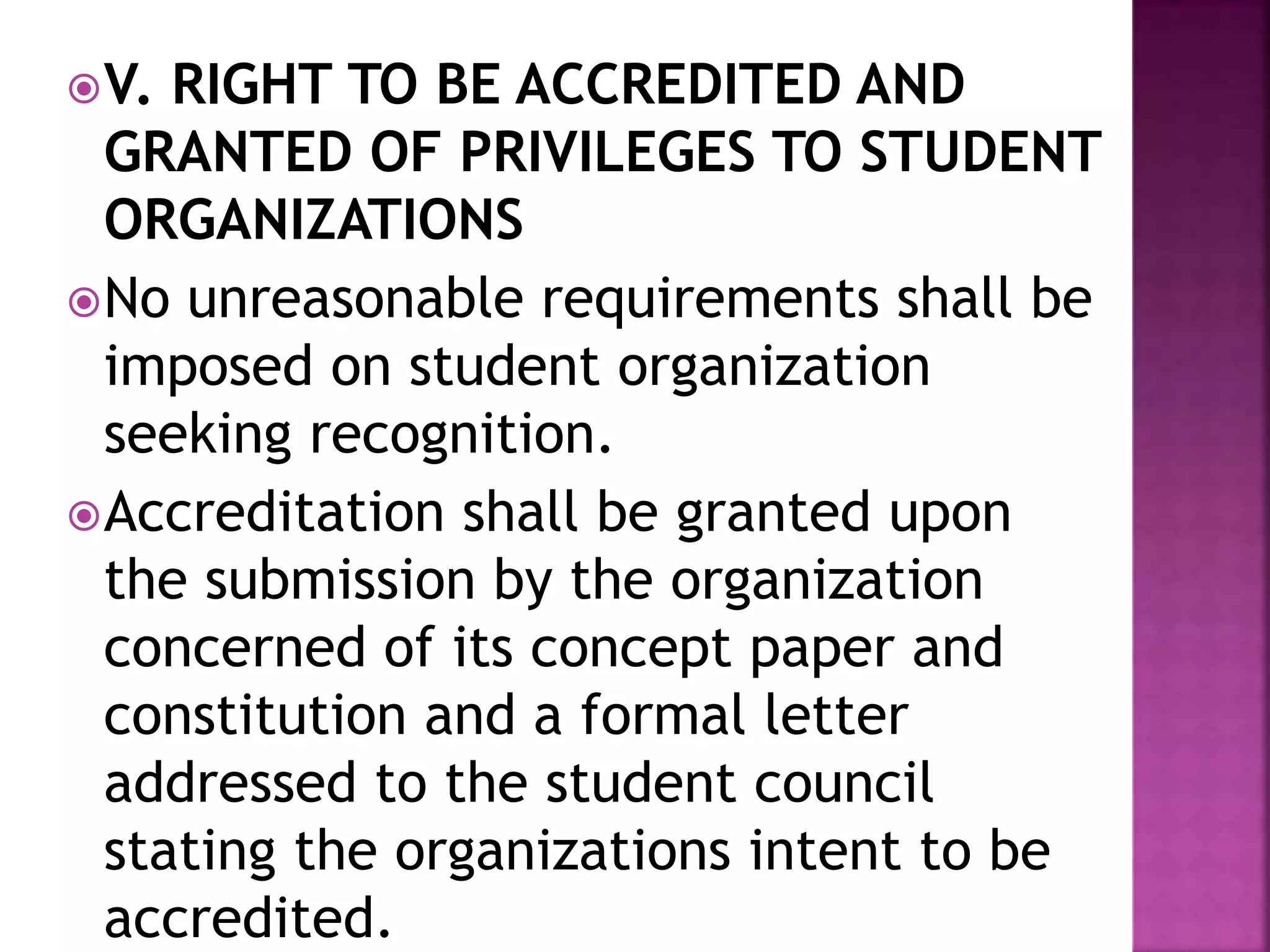
V. RIGHT TO BE ACCREDITED AND
GRANTED OF PRIVILEGES TO STUDENT
ORGANIZATIONS
No unreasonable requirements shall be
imposed on student organization
seeking recognition.
Accreditation shall be granted upon
the submission by the organization
concerned of its concept paper and
constitution and a formal letter
addressed to the student council
stating the organizations intent to be
accredited.
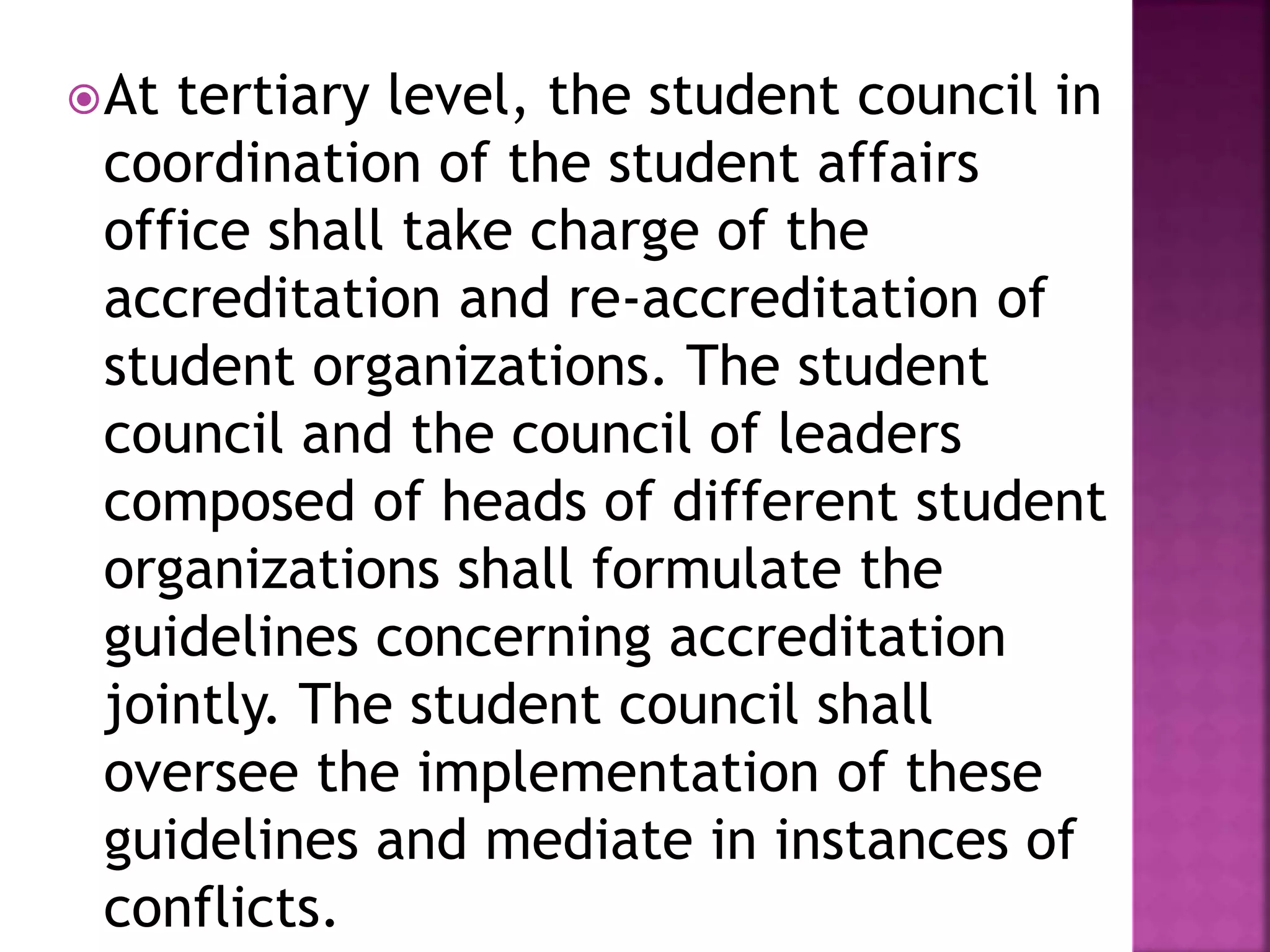
At tertiary level, the student council in
coordination of the student affairs
office shall take charge of the
accreditation and re-accreditation of
student organizations. The student
council and the council of leaders
composed of heads of different student
organizations shall formulate the
guidelines concerning accreditation
jointly. The student council shall
oversee the implementation of these
guidelines and mediate in instances of
conflicts.
There shall be no discrimination
in the assignment of school
facilities and granting of other
privileges to student
organizations. The school
administration shall endeavor to
provide, free of charge, a hall of
or building to house the offices
of the different student
organizations within the
premises of the school.
Excessive charges for the use of
school facilities shall be
prohibited. Whenever possible, the
school administration shall allow
student organizations to use school
facilities free of charge.
All on and off campus activities of
student organizations shall be
coordinated by the student
council/government.
VI. RIGHT TO ORGANIZE A STUDENT
COUNCIL/GOVERNMENT
The State shall ensure the existence
of democratic autonomous student
councils/governments. Pursuant
thereto, there shall be one
university student
council/government for each school
campus that shall be given
recognition by the schools, colleges
and universities concerned.
It shall have its own set of officers
elected in annual popular
elections. Every student
council/government shall have the
right to determine its policies and
programs on student activities
subject to its duly ratified charter
or constitution and to school rules
and regulations provided the same
do not infringe on the basic human
rights.
VII. STUDENT
COUNCIL/GOVERNMENT CHARTER
OR CONSTITUTIONS
The Student Council/Government
Charter or Constitution shall be
formed by the representatives of
all student organizations in a
school and shall be ratified by the
student body.
VIII. FORMATION OF THE STUDENT
COMMISSION ON ELECTIONS
There is hereby created a Commission
on Elections (COMELEC) that shall
conduct and oversee the election of
officers of the student
council/government. The Student
Affairs Office shall choose the
members of the Commission from
among the list of the nominees
recommended by the student
council/government.
Once constituted, the
COMELEC shall be independent
and autonomous from any
sector of the school and shall
ensure the conduct of clean,
honest and peaceful elections.
The school must provide the
COMELEC sufficient funds to
ensure the success of its goals
and objectives.
IX. PROHIBITION IN THE USE
OF FORCE AND EXACTION OF
EXCESSIVE FEES
All campus organizations shall
be prohibited using force in the
initiation of and exacting
excessive fees from their
members as well as their other
student activities.
X. REPRESENTATION IN
POLICY – MAKING BODY
As far as practicable and
consistent with school rule’s
and regulations, there shall be
a student representative in the
policy-formulating body of the
school.
The duly elected student
representative from the selection
process of the Student
Council/Government shall
represent the student body to the
policy-making body. He shall have
the same rights as that of the
regular member, but his privileges
shall be limited to reimbursement
for actual expenses in attending
meetings.
XI. RIGHT TO BE INFORMED
The rights of the students to
information on matters directly or
indirectly affecting their welfare shall
be recognized. Access to official
records and other pertinent documents
and papers pertaining to official act,
transactions or decisions shall be
afforded by the students subject only
to reasonable regulations that maybe
imposed such as time for examining
the documents and other papers to
prevent loss or damage of the same.
XII. FREEDOM OF EXPRESSION
Subject to existing laws, students shall
have the right to freely express their
views and opinions. They shall have the
right to peaceably assemble and
petition the government and school
authorities for the redress of their
grievances. Pursuant thereto, no
school regulation shall be imposed
violating or abridging the student’s
right to assembly.
Student shall have access to print and
broadcast media in their information
activities. They shall also have the
right to print, circulate and/or mount
leaflets, newsletters, posters, wall
news, petitions and such other
materials. Pursuant thereto, the school
authorities shall ensure the provision
of facilities such as bulletin boards for
the mounting of the aforementioned
materials.
School authorities may
designate a certain area
on every campus as a
freedom park where
students, can freely
discuss issues directly and
indirectly affecting them.
XIII. STUDENT PUBLICATION
Students shall have the right to publish
student newspaper and other similar
publications, print in their pages
materials that they deem in pursuance
of their academic freedom and
freedom of expression in accordance
with Republic Act NO. 7079, otherwise
known as the “Campus Journalism Act
of 1991.”
Pursuant thereto, no
individual who is not a staff
member of the publication
shall determine its content.
The role of the faculty
adviser in the student
newspaper shall be limited
to technical guidance.
The selection of the student editor-in-
chief and his/her staff shall be made
by annual fair and competitive
examinations to be administered by an
impartial Board of Judges.
The editorial staff shall observe the
ethics of professional journalism. It
shall be the responsibility of the
editorial staff to ensure that the
student paper is not used for purposes
contrary to law.
The editor/editorial staff
shall, unless sooner removed
for cause and with due
process, be assured of
security of tenure for the
duration of his/her its
prescribed term.
XIV. ACADEMIC FREEDOM
Students’ academic freedom
shall consist of, but not limited
to, the following rights:
To conduct researches in
connection with academic
work, and to freely discuss and
publish their findings and
recommendations;
To conduct inquiry within the
campus in curricular and extra-
curricular activities;
To choose a field of study and to
pursue the quest for truth; to
express their opinion on any
subject or public or general
concern which directly or
indirectly affects the students of
the educational system;
To invite off-campus speakers or
resource persons to student-sponsored
assemblies, fora, symposia, and other
similar activities;
To express contrary interpretations or
dissenting opinions inside and outside
the classroom;
To participate in the drafting of a new
curriculum and in the review or
revision of the old;
To participate in the drafting
and/or revising of the student
handbook which shall include the
school rules and regulations, a
copy of which shall be furnished
the students upon admission to the
school; and
To be free from any form of
indoctrination leading to imposed
ideological hegemony.
XV. RIGHT TO DUE PROCESS
A student subject to
disciplinary proceedings
shall have the right to
defend himself, to be heard
and to present evidence on
his/her behalf before an
impartial body.
There shall be a Student Disciplinary
Board to be composed of one (1)
representative from the school
administration, two (2) faculty
members and two (2) students to
conduct investigations into and decide
on cases of student violations of
disciplinary standards. Both the faculty
and the student representatives shall
be endorsed by the student
council/government.
The blacklisting, expulsion,
suspension and other such
disciplinary sanctions that maybe
taken against a student shall not
be valid unless the following rights
have been observed and accorded
the student:
The right to be informed in writing
of the nature and cause of the
accusation against him/her;
The right to confront witness
against him/her and to full access
to the evidence in the case;
The right to defend
himself/herself and to be
defended by a representative or
counsel of his/her choice,
adequate time being given to
him/her for the preparation of
his/her defense;
The right to a hearing before
the Student Disciplinary Board;
The right against self-
incrimination; and
The right to appeal adverse
decision of the Student
Disciplinary Board to the
governing board and ultimately
to the appropriate education
agencies.
The decision in any disciplinary
proceeding must be rendered on the
basis of relevant and substantial
evidence presented at the hearing, or
at the least contained in the record
and disclosed to the student affected.
The deciding body should, in all
controversial questions, render its
decision in such a manner that the
issues involved, and the reasons for
any decision rendered are made clear
to the student.
Disciplinary sanction shall
be corrective rather than
punitive or penal in nature.
The gravity of disciplinary
sanctions must be
proportionate to the
seriousness of the violation
committed.
The Office of the Guidance Counselor
of the respective schools in
consultation with the Student
Disciplinary Board shall publish on a
periodic basis acts that are deemed
violative of the school rules and
regulations and the corresponding
disciplinary sanctions. Provided, that
such rules and regulations do not
violate the rights guaranteed herein
and under the Constitution.
XVI. RIGHT AGAINST UNREASONABLE
SEARCHES AND SEIZURES
Every student shall be free from any
form of unreasonable search and
seizure. Except for the following
instances no search or seizure of a
student shall be deemed valid:
Searches made at the point of ingress
and egress by authorized personnel of
the school;
Searches and seizure of illegal articles or
articles falling in the plain view of dully
authorized personnel;
Searches and seizures of articles that are
illegal, discovered inadvertently by duly
authorized personnel;
Searches made when the student is about
to commit, is committing or has just
committed a crime or a serious infraction
of the school’s rules and regulations;
Searches made with a valid search
warrant.
Articles seized in violation
of the hereinabove provided
rights shall not be used as
evidence against the
student in any disciplinary
action that may be brought
against him/her.
XVII. ACCESS TO SCHOOL RECORDS
AND ISSUANCE OF OFFICIALS
CERTIFICATES
 Subject to the provision of the following
section, every student shall have access to
his/her own school records, the
confidentiality of which the school shall
maintain. He/She shall have the right to be
issued official certificates, diplomas,
transcripts of records, grades, transfer
credentials and other similar documents
within thirty (30) gays from the filing of
request and accomplishment of all pertinent
requirements.
XVIII. SECURITY OF TENURE
It shall be the right of students to
finish their entire courses of study in a
given school, except in cases of
academic deficiency or violation of
disciplinary regulations.
In cases wherein the school authorities
refuse to allow a student to enroll for
the subsequent semester or year due
to the causes hereinabove stated, the
student may appeal such ruling to the
appropriate education agency
XIX. PROHIBITION AGAINST
INVOLUNTARY
CONTRIBUTIONS
Except those approved by
their own student
organizations, all-
involuntary contributions
shall be prohibited.
XX. COLLECTION OF STUDENT
PAPER AND STUDENT COUNCIL
FEES
The school administration shall
assist the student paper staff and
the student council/government,
in their financial needs through
the collection of student paper
and student council fees from the
students.
The student paper fees shall
be held in trust for their
unhampered use in the
publication of student paper.
The full amount of student
council fees shall be turned
over to the student council
within fifteen (15) days from
the assumption of office of the
Student Council Officers.
XXI. PRIVACY OF COMMUNICATION
The privacy of communication and
correspondence among students shall
remain inviolable.
XXII. SCHOLARSHIP GRANTS AND
PRIVILEGES
Opposition to school policies inimical
to students’ interest shall not be a
ground for denying or withdrawing
scholarships grants and privileges to
deserving students.
XXIII. RIGHT TO ADEQUATE
AND SAFE
HOUSING/DORMITORY
FACILITIES
The state and the respective
school authorities shall
endeavor to provide the
students adequate, safe and
clean housing facilities.
XXIV. PROHIBITION AGAINST
MILITARIZATION OF THE SCHOOL
CAMPUS
The pursuit of academic excellence
and exercise of academic freedom can
be attained only in an atmosphere free
from fear and unreasonable restraint.
Pursuant thereto, no military
detachment shall be installed on the
school campus.
Military elements and/or policeman in
uniform or in plain clothes and school
security forces shall not interfere with
student activities, particularly
peaceful mass actions, inside the
school campus.
XXV. FIREARMS BAN
Students shall not be allowed to carry
firearms inside the school campus.
They shall be required to deposit such
firearms with the school security force
prior to their entry to the school
premises.
Bill includes:
Monitoring mechanisms
Sanctions
end

Magna Carta of Students

  • 1.
  • 2.
    I. RIGHT TOADMISSION WITHOUT UNDUE DISCRIMINATION No student shall be denied admission to any school on account of his/her physical handicap, socio-economic status, political and religious beliefs, sexual orientation or membership of student organizations, nor shall pregnant students certified reformed drug abusers and those suffering from immune deficiency syndrome be discriminated against
  • 3.
    Failure of orrefusal of student to sign waiver documents prepared by the school administration shall not constitute a ground for his/her non- admission. Students shall have the right freely to choose his/her fields of study subject to existing curricula and to continue his/her course up to graduation except in case of academic deficiency or violation of disciplinary regulations that do not infringe upon the exercise of student’s rights and welfare.
  • 4.
    II. RIGHT TOCOMPETENT INSTRUCTION AND RELEVANT QUALITY EDUCATION Every student shall have the right to competent instruction and quality education relevant to his/her personal and cultural development and that of the nation. Students shall have the right to make a written evaluation of the performance of their teachers towards the end of the school term.
  • 5.
    III. RIGHT TOADEQUATE WELFARE SERVICES AND ACADEMIC FACILITIES It shall be the responsibility of the school administration to provide the students with adequate welfare services and academic facilities relative to the financial capacity of the school.
  • 6.
    The school shallendeavor to provide free annual physical check-up to the students. It shall be the responsibility of the school authorities to provide students with adequate laboratory, library, research, recreation and physical education facilities. It shall be the responsibility of the school administration to promptly notify student concerned of letters and other communications it receives in behalf of the students.
  • 7.
    IV. RIGHT TOORGANIZE STUDENT ORGANIZATIONS Unity and collective effort being fundamental in realization of common goals and the promotion and protection of common interest, the State recognizes the rights of the students to organize among themselves.
  • 8.
    The rights ofthe students to form, assist, or join other organization, alliance or federation for their physical, intellectual, moral, cultural, civic, spiritual, and political interest shall not be abridged. Pursuant thereto, the practice of making students sign waiver document which states that they are not members of and will not join a specified organization before being allowed to enroll is hereby prohibited.
  • 9.
    V. RIGHT TOBE ACCREDITED AND GRANTED OF PRIVILEGES TO STUDENT ORGANIZATIONS No unreasonable requirements shall be imposed on student organization seeking recognition. Accreditation shall be granted upon the submission by the organization concerned of its concept paper and constitution and a formal letter addressed to the student council stating the organizations intent to be accredited.
  • 10.
    At tertiary level,the student council in coordination of the student affairs office shall take charge of the accreditation and re-accreditation of student organizations. The student council and the council of leaders composed of heads of different student organizations shall formulate the guidelines concerning accreditation jointly. The student council shall oversee the implementation of these guidelines and mediate in instances of conflicts.
  • 11.
    There shall beno discrimination in the assignment of school facilities and granting of other privileges to student organizations. The school administration shall endeavor to provide, free of charge, a hall of or building to house the offices of the different student organizations within the premises of the school.
  • 12.
    Excessive charges forthe use of school facilities shall be prohibited. Whenever possible, the school administration shall allow student organizations to use school facilities free of charge. All on and off campus activities of student organizations shall be coordinated by the student council/government.
  • 13.
    VI. RIGHT TOORGANIZE A STUDENT COUNCIL/GOVERNMENT The State shall ensure the existence of democratic autonomous student councils/governments. Pursuant thereto, there shall be one university student council/government for each school campus that shall be given recognition by the schools, colleges and universities concerned.
  • 14.
    It shall haveits own set of officers elected in annual popular elections. Every student council/government shall have the right to determine its policies and programs on student activities subject to its duly ratified charter or constitution and to school rules and regulations provided the same do not infringe on the basic human rights.
  • 15.
    VII. STUDENT COUNCIL/GOVERNMENT CHARTER ORCONSTITUTIONS The Student Council/Government Charter or Constitution shall be formed by the representatives of all student organizations in a school and shall be ratified by the student body.
  • 16.
    VIII. FORMATION OFTHE STUDENT COMMISSION ON ELECTIONS There is hereby created a Commission on Elections (COMELEC) that shall conduct and oversee the election of officers of the student council/government. The Student Affairs Office shall choose the members of the Commission from among the list of the nominees recommended by the student council/government.
  • 17.
    Once constituted, the COMELECshall be independent and autonomous from any sector of the school and shall ensure the conduct of clean, honest and peaceful elections. The school must provide the COMELEC sufficient funds to ensure the success of its goals and objectives.
  • 18.
    IX. PROHIBITION INTHE USE OF FORCE AND EXACTION OF EXCESSIVE FEES All campus organizations shall be prohibited using force in the initiation of and exacting excessive fees from their members as well as their other student activities.
  • 19.
    X. REPRESENTATION IN POLICY– MAKING BODY As far as practicable and consistent with school rule’s and regulations, there shall be a student representative in the policy-formulating body of the school.
  • 20.
    The duly electedstudent representative from the selection process of the Student Council/Government shall represent the student body to the policy-making body. He shall have the same rights as that of the regular member, but his privileges shall be limited to reimbursement for actual expenses in attending meetings.
  • 21.
    XI. RIGHT TOBE INFORMED The rights of the students to information on matters directly or indirectly affecting their welfare shall be recognized. Access to official records and other pertinent documents and papers pertaining to official act, transactions or decisions shall be afforded by the students subject only to reasonable regulations that maybe imposed such as time for examining the documents and other papers to prevent loss or damage of the same.
  • 22.
    XII. FREEDOM OFEXPRESSION Subject to existing laws, students shall have the right to freely express their views and opinions. They shall have the right to peaceably assemble and petition the government and school authorities for the redress of their grievances. Pursuant thereto, no school regulation shall be imposed violating or abridging the student’s right to assembly.
  • 23.
    Student shall haveaccess to print and broadcast media in their information activities. They shall also have the right to print, circulate and/or mount leaflets, newsletters, posters, wall news, petitions and such other materials. Pursuant thereto, the school authorities shall ensure the provision of facilities such as bulletin boards for the mounting of the aforementioned materials.
  • 24.
    School authorities may designatea certain area on every campus as a freedom park where students, can freely discuss issues directly and indirectly affecting them.
  • 25.
    XIII. STUDENT PUBLICATION Studentsshall have the right to publish student newspaper and other similar publications, print in their pages materials that they deem in pursuance of their academic freedom and freedom of expression in accordance with Republic Act NO. 7079, otherwise known as the “Campus Journalism Act of 1991.”
  • 26.
    Pursuant thereto, no individualwho is not a staff member of the publication shall determine its content. The role of the faculty adviser in the student newspaper shall be limited to technical guidance.
  • 27.
    The selection ofthe student editor-in- chief and his/her staff shall be made by annual fair and competitive examinations to be administered by an impartial Board of Judges. The editorial staff shall observe the ethics of professional journalism. It shall be the responsibility of the editorial staff to ensure that the student paper is not used for purposes contrary to law.
  • 28.
    The editor/editorial staff shall,unless sooner removed for cause and with due process, be assured of security of tenure for the duration of his/her its prescribed term.
  • 29.
    XIV. ACADEMIC FREEDOM Students’academic freedom shall consist of, but not limited to, the following rights: To conduct researches in connection with academic work, and to freely discuss and publish their findings and recommendations;
  • 30.
    To conduct inquirywithin the campus in curricular and extra- curricular activities; To choose a field of study and to pursue the quest for truth; to express their opinion on any subject or public or general concern which directly or indirectly affects the students of the educational system;
  • 31.
    To invite off-campusspeakers or resource persons to student-sponsored assemblies, fora, symposia, and other similar activities; To express contrary interpretations or dissenting opinions inside and outside the classroom; To participate in the drafting of a new curriculum and in the review or revision of the old;
  • 32.
    To participate inthe drafting and/or revising of the student handbook which shall include the school rules and regulations, a copy of which shall be furnished the students upon admission to the school; and To be free from any form of indoctrination leading to imposed ideological hegemony.
  • 33.
    XV. RIGHT TODUE PROCESS A student subject to disciplinary proceedings shall have the right to defend himself, to be heard and to present evidence on his/her behalf before an impartial body.
  • 34.
    There shall bea Student Disciplinary Board to be composed of one (1) representative from the school administration, two (2) faculty members and two (2) students to conduct investigations into and decide on cases of student violations of disciplinary standards. Both the faculty and the student representatives shall be endorsed by the student council/government.
  • 35.
    The blacklisting, expulsion, suspensionand other such disciplinary sanctions that maybe taken against a student shall not be valid unless the following rights have been observed and accorded the student: The right to be informed in writing of the nature and cause of the accusation against him/her;
  • 36.
    The right toconfront witness against him/her and to full access to the evidence in the case; The right to defend himself/herself and to be defended by a representative or counsel of his/her choice, adequate time being given to him/her for the preparation of his/her defense;
  • 37.
    The right toa hearing before the Student Disciplinary Board; The right against self- incrimination; and The right to appeal adverse decision of the Student Disciplinary Board to the governing board and ultimately to the appropriate education agencies.
  • 38.
    The decision inany disciplinary proceeding must be rendered on the basis of relevant and substantial evidence presented at the hearing, or at the least contained in the record and disclosed to the student affected. The deciding body should, in all controversial questions, render its decision in such a manner that the issues involved, and the reasons for any decision rendered are made clear to the student.
  • 39.
    Disciplinary sanction shall becorrective rather than punitive or penal in nature. The gravity of disciplinary sanctions must be proportionate to the seriousness of the violation committed.
  • 40.
    The Office ofthe Guidance Counselor of the respective schools in consultation with the Student Disciplinary Board shall publish on a periodic basis acts that are deemed violative of the school rules and regulations and the corresponding disciplinary sanctions. Provided, that such rules and regulations do not violate the rights guaranteed herein and under the Constitution.
  • 41.
    XVI. RIGHT AGAINSTUNREASONABLE SEARCHES AND SEIZURES Every student shall be free from any form of unreasonable search and seizure. Except for the following instances no search or seizure of a student shall be deemed valid: Searches made at the point of ingress and egress by authorized personnel of the school;
  • 42.
    Searches and seizureof illegal articles or articles falling in the plain view of dully authorized personnel; Searches and seizures of articles that are illegal, discovered inadvertently by duly authorized personnel; Searches made when the student is about to commit, is committing or has just committed a crime or a serious infraction of the school’s rules and regulations; Searches made with a valid search warrant.
  • 43.
    Articles seized inviolation of the hereinabove provided rights shall not be used as evidence against the student in any disciplinary action that may be brought against him/her.
  • 44.
    XVII. ACCESS TOSCHOOL RECORDS AND ISSUANCE OF OFFICIALS CERTIFICATES  Subject to the provision of the following section, every student shall have access to his/her own school records, the confidentiality of which the school shall maintain. He/She shall have the right to be issued official certificates, diplomas, transcripts of records, grades, transfer credentials and other similar documents within thirty (30) gays from the filing of request and accomplishment of all pertinent requirements.
  • 45.
    XVIII. SECURITY OFTENURE It shall be the right of students to finish their entire courses of study in a given school, except in cases of academic deficiency or violation of disciplinary regulations. In cases wherein the school authorities refuse to allow a student to enroll for the subsequent semester or year due to the causes hereinabove stated, the student may appeal such ruling to the appropriate education agency
  • 46.
    XIX. PROHIBITION AGAINST INVOLUNTARY CONTRIBUTIONS Exceptthose approved by their own student organizations, all- involuntary contributions shall be prohibited.
  • 47.
    XX. COLLECTION OFSTUDENT PAPER AND STUDENT COUNCIL FEES The school administration shall assist the student paper staff and the student council/government, in their financial needs through the collection of student paper and student council fees from the students.
  • 48.
    The student paperfees shall be held in trust for their unhampered use in the publication of student paper. The full amount of student council fees shall be turned over to the student council within fifteen (15) days from the assumption of office of the Student Council Officers.
  • 49.
    XXI. PRIVACY OFCOMMUNICATION The privacy of communication and correspondence among students shall remain inviolable. XXII. SCHOLARSHIP GRANTS AND PRIVILEGES Opposition to school policies inimical to students’ interest shall not be a ground for denying or withdrawing scholarships grants and privileges to deserving students.
  • 50.
    XXIII. RIGHT TOADEQUATE AND SAFE HOUSING/DORMITORY FACILITIES The state and the respective school authorities shall endeavor to provide the students adequate, safe and clean housing facilities.
  • 51.
    XXIV. PROHIBITION AGAINST MILITARIZATIONOF THE SCHOOL CAMPUS The pursuit of academic excellence and exercise of academic freedom can be attained only in an atmosphere free from fear and unreasonable restraint. Pursuant thereto, no military detachment shall be installed on the school campus.
  • 52.
    Military elements and/orpoliceman in uniform or in plain clothes and school security forces shall not interfere with student activities, particularly peaceful mass actions, inside the school campus. XXV. FIREARMS BAN Students shall not be allowed to carry firearms inside the school campus. They shall be required to deposit such firearms with the school security force prior to their entry to the school premises.
  • 53.
  • 54.