ACCOUNTING O.L
Templates for the
Preparation of Financial Statements
Prepared By:
Maryam A. Ghazy
2
International standards – terminology
The list below is to help Centres become familiar with international
terminology which Cambridge uses in accounting syllabuses. Well-known
standards, which are relevant to the level of study, will be included in
question papers, mark schemes and associated documents.
It is recommended that Centres use this terminology in their teaching and
learning materials, however, candidates will not lose marks for using
different terms.
International usage Previous Cambridge/UK usage
Statement of
financial position
Balance sheet
Bank (and other) loans
Interest bearing loans and
borrowing
Loans repayable after 12 months
Bank overdrafts and loans
Interest bearing loans and
borrowing
Loans repayable within 12 months
Capital or equity/shareholders’
equity
Capital
Cash (and cash equivalents) Bank and cash
Cost of sales Cost of goods sold
Current assets Current assets
Current liabilities Current liabilities
Creditors: amounts due within 12 months
Finance costs Interest payable
Finance income/investment
revenues
Interest receivable
Financial statements Final accounts
Gross profit Gross profit
Income statement Trading and profit & loss account
Intangible assets Goodwill, etc.
Inventory/inventories
(of raw materials and finished
goods)
Stock
Investment property Investments
Non-current assets Fixed assets
3
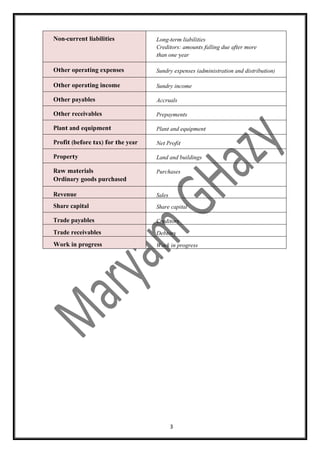
Non-current liabilities Long-term liabilities
Creditors: amounts falling due after more
than one year
Other operating expenses Sundry expenses (administration and distribution)
Other operating income Sundry income
Other payables Accruals
Other receivables Prepayments
Plant and equipment Plant and equipment
Profit (before tax) for the year Net Profit
Property Land and buildings
Raw materials
Ordinary goods purchased
Purchases
Revenue Sales
Share capital Share capital
Trade payables Creditors
Trade receivables Debtors
Work in progress Work in progress
4
Sole Trader
Income Statement for the year ended ……………
$ $ $
Revenue
Less Sales returns
Less Cost of Goods Sold
Opening Inventory
Purchases
Less Purchases returns
Less Goods for Own use
Carriage inwards
Less Closing Inventory
Gross Profit
Add Other Income
Discount received
Rent received
Commission received
*Profit on disposal of non-current (fixed) assets
* Reduction in provision for doubtful debts
Bad debts recovered
Less Expenses
Salaries/wages
Rent
Utilities
Stationary Equipment
Other operating expenses
Interest on loans
Depreciation
* Loss on disposal of non – current assets
* provision for doubtful debts
Profit for the year
XXX
(XXX)
XXX
(XXX)
XXX
XXX
XXX
XXX
XXX
(XXX)
XXX
XXX
XXX
XXX
XXX
XXX
XXX
XXX
XXX
XXX
(XXX)
XXX
XXX
XXX
XXX
XXX
XXX
XXX
XXX
XXX
XXX
(XXX)
XXX
5
Sole Trader
Statement of Financial Position at …...................
$ $ $
Assets
Non-current assets
Cost Depreciation to
date
Book Value
Land and buildings XXX XXX XXX
Fixtures and fitting XXX XXX XXX
Office equipment XXX XXX XXX
Motor vehicles XXX XXX XXX
XXX XXX XXX
Current assets
Inventory XXX
Trade receivables XXX
Less Provision for doubtful debts (XXX) XXX
Other receivables XXX
Other receivables (accrued income) XXX
Bank XXX
Cash XXX
Total Assets XXXX
Capital and liabilities
Capital
Opening balance XXX
**Plus Profit for the year XXX
XXX
Less Drawings (XXX)
XXX
Non-current liabilities
Loan XXX
Current liabilities
Trade payables XXX
Other payables XXX
Prepaid income XXX
*Bank overdraft XXX
XXX
Total Liabilities XXXX
6
Financial Statements of a Sole Trader – Service business
Sole Trader (Name)
Income Statement for the year ended
………………………….
$
Fees received
Commission received
Rent received
Discount received
*Profit on disposal of non-current (fixed) assets
**Reduction in provision for doubtful debts
Less Expenses
Wages and salaries
Office expenses
Rent and rates
Insurance
Office expenses
Motor vehicle expenses
Selling expenses
Loan interest
Bad debts
*Loss on disposal of fixed assets
**Provision for doubtful debts
Depreciation of fixtures and
fittings Depreciation of office
equipment Depreciation of motor
vehicles
***Profit for the year (Net profit)
$ $
xxxx
xxxx
xxxx
xxxx
xxxx
xxxx
xxxx
xxx
xxx
xxx
xxx
xxx
xxx
xxx
xxx
xxx
xxx
xxx
xxx
xxx
xxx
xxx xxxx
xxxx
* If only one asset was sold during the year only one of these items will appear
** If the provision reduces the surplus amount is added to the gross profit: if the provision
increases the amount required is included in the expenses
*** If the expenses exceed the gross profit plus other income the resulting figure is
described as a loss for the year (net loss)
The Statement of Financial Position of a sole trader in the service sector is presented in
the same format as the Statement of Financial Position of a sole trader involved in a
trading business.
7
Financial Statements of a partnership business
The Income statement of a partnership business follows the same format as that
of a sole trader. The only difference is that interest on a loan from a partner may
be included in the expenses of the profit and loss section.
It is necessary to prepare an appropriation account to show the distribution of
the profit for the year (net profit) between the partners.
Partnership (Name)
Profit and Loss Appropriation Account for the year ended ……………………….
$ $ $
Profit for the year xxxx
Add Interest on drawings – Partner A xxxx
Partner B xxxx xxxx
xxxx
Less Interest on capital - Partner A xxxx
Partner B xxxx xxxx
Partner’s salary - Partner A xxxx xxxx
xxxx
*Profit shares - Partner A xxxx
Partner B xxxx xxxx
* Residual profit is shared in the ratio stated in the partnership agreement
The first section of the Statement of Financial Position of a partnership is similar to a
sole trader. The second section shows the capital and current account of each partner.
Where the full details of the partners’ current accounts are not required the “Financed
by” section of a partnership Statement of Financial Position could be presented as
follows.
Partnership (Name)
Extract from Statement of Financial Position at ………………….
Financed by
Capital accounts
*Current accounts
$
Partner A
xxx
xxx
xxx
$ $
Partner B Total
Xxxx xxxx
xxxx xxxx
xxxx xxxx
* Where a balance is a debit balance it is shown in brackets and deducted rather than added.
8
Where full details of the current accounts are required the “Financed by” section of a
partnership Statement of Financial Position could be presented as follows.
Partnership (Name)
Extract from Statement of Financial Position at …………………..
Capital account
Current accounts
*Opening balance
Interest on
capital Partner’s
salary
**Profit shares
Less Drawings
$
Partner A
xxxx
xxx
xxx
xxx
xxx
xxx
xxx
xxx
$ $
Partner B Total
xxxx xxxx
xxx
xxx
xxx
xxx
xxx
xxx
xxx xxxx
xxxx
* Where a balance is a debit balance it is shown in brackets and deducted rather than
added
** Where there is a loss to share out it is shown in brackets and deducted rather than
added
9
Financial Statements of a manufacturing business
A business which manufactures goods must prepare a manufacturing account to
show the calculation of the cost of manufacture, whatever the ownership of the
business. The manufacturing business could be a sole trader or a partnership.
Name of manufacturing business Manufacturing
Account for the year ended ………………………..
$ $ $
Cost of material consumed
Opening inventory (stock) of raw material xxxx
Purchases of raw material xxxx
Carriage on raw material xxxx
xxxx
Less Closing inventory (stock) of raw material xxxx xxxx
Direct wages xxxx
Direct expenses xxxx
Prime Cost xxxx
Add Factory overheads
Indirect wages xxxx
Factory rent and rates xxxx
Factory insurance xxxx
Factory fuel and power xxxx
Factory general expenses xxxx
Depreciation of factory machinery xxxx xxxx
xxxx
Add Opening inventory (stock) of work in progress xxxx
xxxx
Less Closing inventory (stock) of work in progress xxxx
Production cost of goods completed xxxx
The income statement of a manufacturing business follows the same format as that of any
other form of business, except that the trading account section includes the production cost
of goods completed. The profit and loss section includes only office, selling and financial
expenses
Name of manufacturing business
Income Statement (Trading Account) for the year ended ………………………..
$ $ $
Revenue xxxx
Less Cost of sales
Opening inventory (stock) of finished goods xxxx
Production cost of goods completed xxxx
Purchases of finished goods xxxx
xxxx
Less Closing inventory (stock) of finished goods xxxx xxxx
Gross profit xxxx
The Statement of Financial Position of a manufacturing business follows the same
format as that of any other business; however there may be three stocks rather than
one.
10
Financial Statements of a non-trading organization
A summary of the cash book, known as a receipts and payments account, is
prepared by the treasurer of a non trading organization. All money received is shown
on the debit side and all money paid out on the credit side. It is balanced in the same
way as a cash account. A trading account may be prepared if a shop or café etc is
operated by the organization.
Non-trading Organization (Name)
Shop Trading Account for the year ended …………………………
Revenue
Less Cost of sales
Opening inventory
Purchases
Less Closing inventory (stock)
Cost of goods sold
Add Shop expenses
Wages of shop assistant Shop
rent and rates Depreciation of
shop fittings
Profit on shop
$ $ $
xxxx
xxxx
xxxx
xxxx
xxxx
xxxx
xxxx
xxxx
xxxx xxxx xxxx
xxxx
An income and expenditure account is also prepared - the equivalent of the profit
and loss account of a business. The expenses of the organization are deducted from
the revenue and the resulting figure is a surplus or deficit, rather than a profit or loss.
Non-trading Organisation (Name)
Income and Expenditure Account for the year ended ……………
$
Income
Subscriptions
Profit on shop
Competition – entrance fees less
expenses
Interest received
*Profit on disposal of non-current (fixed) assets
Expenditure General
expenses Rates and
insurance
Repairs and maintenance
Loan interest
*Loss on disposal of non-current (fixed) assets
Depreciation of equipment
**Surplus for the year
$ $
xxxx
xxxx
xxxx xxxx
xxxx
xxxx
xxxx
xxxx
xxxx
xxxx
xxxx
xxxx
xxxx xxxx
xxxx
* If only one asset was sold during the year only one of these items will appear
** If the expenditure exceeds the income the resulting figure is described as a deficit
11
The first section of the Statement of Financial Position of a non-trading
organization follows the same format as that of a sole trader. The second section of the
Statement of Financial Position has to be modified so that it shows the accumulated
fund and the surplus or deficit.
Non-trading Organisation (Name)
Extract from Statement of Financial Position at …………………………..
$ $ $
Accumulated fund
Opening balance xxxx
*Plus surplus for the year xxxx
xxxx
* If there is a deficit this will be deducted from the accumulated fund
12
Financial Statements of a limited company
Many private limited companies are moving over to the IAS format used by a Plc
(public limited company which is traded on the stock exchange). However the
traditional format of an income statement of a limited company is given below as
this format is likely to continue to appear in textbooks and in the accounts of private
limited companies.
The income statement of a private limited company (for a company which is not
traded on the stock exchange) follows the same format as for a sole trader, although
interest on debentures and directors’ remuneration may be included in the expenses
in the profit and loss section.
It is necessary to prepare an appropriation account to show the distribution of the net profit.
Limited Company (Name)
Profit and Loss Appropriation Account for the year ended ……………………….
$ $ $
Profit for the year (Net profit) xxxx
Less Transfer to general reserve xxxx
Dividends – Preference paid xxxx
proposed xxxx xxxx
Ordinary paid xxxx
xxxx
Retained profit for the year xxxx
Add Retained profit brought forward xxxx
Retained profit carried forward xxxx
The first section of the Statement of Financial Position of a limited company is
similar to that of a sole trader. The second section of the Statement of Financial
Position needs to show the share capital and reserves.
Limited Company (Name)
Extract from Statement of Financial Position at …………………………..
$
Share Capital
x% Preference shares of $x each
Ordinary shares of $x each
Reserves
General reserve
Retained profit carried forward
Shareholders’ funds
$ $
Authorised Issued
xxxx xxxx
xxxx xxxx
xxxx xxxx
xxx
xxxx
xxxx
13
Limited Company
Statement of Financial Position at …...................
$ $ $
Assets
Non-current assets
Cost Depreciation to
date
Book Value
Land and buildings XXX XXX XXX
Fixtures and fitting XXX XXX XXX
Office equipment XXX XXX XXX
Motor vehicles XXX XXX XXX
Intangible asets XXX
XXX XXX XXX
Current assets
Inventory XXX
Trade receivables XXX
Less Provision for doubtful debts (XXX) XXX
Other receivables XXX
Other receivables (accrued income) XXX
Bank XXX
Cash XXX
Total Assets XXXX
Shareholder’s equity and liabilities Authorized Issued
Equity $ $
Share capital
%, Preference share of ..$ each
Ordinary shares of …$ each
XXX
XXX
XXX
XXX
XXX XXX
Reserves
General reserves ( beg. Bal. + Amount transferred) XXX
Shareholders’ funds XXX
XXX
Non-current liabilities
% debenture XXX
Current liabilities
Trade payables XXX
Other payables XXX
Preference dividends proposed ( only) XXX
Interest on Debenture ( accrued) XXX
Prepaid income XXX
*Bank overdraft XXX
XXX
Total Liabilities XXXX

New Format

  • 1.
    ACCOUNTING O.L Templates forthe Preparation of Financial Statements Prepared By: Maryam A. Ghazy
  • 2.
    2 International standards –terminology The list below is to help Centres become familiar with international terminology which Cambridge uses in accounting syllabuses. Well-known standards, which are relevant to the level of study, will be included in question papers, mark schemes and associated documents. It is recommended that Centres use this terminology in their teaching and learning materials, however, candidates will not lose marks for using different terms. International usage Previous Cambridge/UK usage Statement of financial position Balance sheet Bank (and other) loans Interest bearing loans and borrowing Loans repayable after 12 months Bank overdrafts and loans Interest bearing loans and borrowing Loans repayable within 12 months Capital or equity/shareholders’ equity Capital Cash (and cash equivalents) Bank and cash Cost of sales Cost of goods sold Current assets Current assets Current liabilities Current liabilities Creditors: amounts due within 12 months Finance costs Interest payable Finance income/investment revenues Interest receivable Financial statements Final accounts Gross profit Gross profit Income statement Trading and profit & loss account Intangible assets Goodwill, etc. Inventory/inventories (of raw materials and finished goods) Stock Investment property Investments Non-current assets Fixed assets
  • 3.
    3 Non-current liabilities Long-termliabilities Creditors: amounts falling due after more than one year Other operating expenses Sundry expenses (administration and distribution) Other operating income Sundry income Other payables Accruals Other receivables Prepayments Plant and equipment Plant and equipment Profit (before tax) for the year Net Profit Property Land and buildings Raw materials Ordinary goods purchased Purchases Revenue Sales Share capital Share capital Trade payables Creditors Trade receivables Debtors Work in progress Work in progress
  • 4.
    4 Sole Trader Income Statementfor the year ended …………… $ $ $ Revenue Less Sales returns Less Cost of Goods Sold Opening Inventory Purchases Less Purchases returns Less Goods for Own use Carriage inwards Less Closing Inventory Gross Profit Add Other Income Discount received Rent received Commission received *Profit on disposal of non-current (fixed) assets * Reduction in provision for doubtful debts Bad debts recovered Less Expenses Salaries/wages Rent Utilities Stationary Equipment Other operating expenses Interest on loans Depreciation * Loss on disposal of non – current assets * provision for doubtful debts Profit for the year XXX (XXX) XXX (XXX) XXX XXX XXX XXX XXX (XXX) XXX XXX XXX XXX XXX XXX XXX XXX XXX XXX (XXX) XXX XXX XXX XXX XXX XXX XXX XXX XXX XXX (XXX) XXX
  • 5.
    5 Sole Trader Statement ofFinancial Position at …................... $ $ $ Assets Non-current assets Cost Depreciation to date Book Value Land and buildings XXX XXX XXX Fixtures and fitting XXX XXX XXX Office equipment XXX XXX XXX Motor vehicles XXX XXX XXX XXX XXX XXX Current assets Inventory XXX Trade receivables XXX Less Provision for doubtful debts (XXX) XXX Other receivables XXX Other receivables (accrued income) XXX Bank XXX Cash XXX Total Assets XXXX Capital and liabilities Capital Opening balance XXX **Plus Profit for the year XXX XXX Less Drawings (XXX) XXX Non-current liabilities Loan XXX Current liabilities Trade payables XXX Other payables XXX Prepaid income XXX *Bank overdraft XXX XXX Total Liabilities XXXX
  • 6.
    6 Financial Statements ofa Sole Trader – Service business Sole Trader (Name) Income Statement for the year ended …………………………. $ Fees received Commission received Rent received Discount received *Profit on disposal of non-current (fixed) assets **Reduction in provision for doubtful debts Less Expenses Wages and salaries Office expenses Rent and rates Insurance Office expenses Motor vehicle expenses Selling expenses Loan interest Bad debts *Loss on disposal of fixed assets **Provision for doubtful debts Depreciation of fixtures and fittings Depreciation of office equipment Depreciation of motor vehicles ***Profit for the year (Net profit) $ $ xxxx xxxx xxxx xxxx xxxx xxxx xxxx xxx xxx xxx xxx xxx xxx xxx xxx xxx xxx xxx xxx xxx xxx xxx xxxx xxxx * If only one asset was sold during the year only one of these items will appear ** If the provision reduces the surplus amount is added to the gross profit: if the provision increases the amount required is included in the expenses *** If the expenses exceed the gross profit plus other income the resulting figure is described as a loss for the year (net loss) The Statement of Financial Position of a sole trader in the service sector is presented in the same format as the Statement of Financial Position of a sole trader involved in a trading business.
  • 7.
    7 Financial Statements ofa partnership business The Income statement of a partnership business follows the same format as that of a sole trader. The only difference is that interest on a loan from a partner may be included in the expenses of the profit and loss section. It is necessary to prepare an appropriation account to show the distribution of the profit for the year (net profit) between the partners. Partnership (Name) Profit and Loss Appropriation Account for the year ended ………………………. $ $ $ Profit for the year xxxx Add Interest on drawings – Partner A xxxx Partner B xxxx xxxx xxxx Less Interest on capital - Partner A xxxx Partner B xxxx xxxx Partner’s salary - Partner A xxxx xxxx xxxx *Profit shares - Partner A xxxx Partner B xxxx xxxx * Residual profit is shared in the ratio stated in the partnership agreement The first section of the Statement of Financial Position of a partnership is similar to a sole trader. The second section shows the capital and current account of each partner. Where the full details of the partners’ current accounts are not required the “Financed by” section of a partnership Statement of Financial Position could be presented as follows. Partnership (Name) Extract from Statement of Financial Position at …………………. Financed by Capital accounts *Current accounts $ Partner A xxx xxx xxx $ $ Partner B Total Xxxx xxxx xxxx xxxx xxxx xxxx * Where a balance is a debit balance it is shown in brackets and deducted rather than added.
  • 8.
    8 Where full detailsof the current accounts are required the “Financed by” section of a partnership Statement of Financial Position could be presented as follows. Partnership (Name) Extract from Statement of Financial Position at ………………….. Capital account Current accounts *Opening balance Interest on capital Partner’s salary **Profit shares Less Drawings $ Partner A xxxx xxx xxx xxx xxx xxx xxx xxx $ $ Partner B Total xxxx xxxx xxx xxx xxx xxx xxx xxx xxx xxxx xxxx * Where a balance is a debit balance it is shown in brackets and deducted rather than added ** Where there is a loss to share out it is shown in brackets and deducted rather than added
  • 9.
    9 Financial Statements ofa manufacturing business A business which manufactures goods must prepare a manufacturing account to show the calculation of the cost of manufacture, whatever the ownership of the business. The manufacturing business could be a sole trader or a partnership. Name of manufacturing business Manufacturing Account for the year ended ……………………….. $ $ $ Cost of material consumed Opening inventory (stock) of raw material xxxx Purchases of raw material xxxx Carriage on raw material xxxx xxxx Less Closing inventory (stock) of raw material xxxx xxxx Direct wages xxxx Direct expenses xxxx Prime Cost xxxx Add Factory overheads Indirect wages xxxx Factory rent and rates xxxx Factory insurance xxxx Factory fuel and power xxxx Factory general expenses xxxx Depreciation of factory machinery xxxx xxxx xxxx Add Opening inventory (stock) of work in progress xxxx xxxx Less Closing inventory (stock) of work in progress xxxx Production cost of goods completed xxxx The income statement of a manufacturing business follows the same format as that of any other form of business, except that the trading account section includes the production cost of goods completed. The profit and loss section includes only office, selling and financial expenses Name of manufacturing business Income Statement (Trading Account) for the year ended ……………………….. $ $ $ Revenue xxxx Less Cost of sales Opening inventory (stock) of finished goods xxxx Production cost of goods completed xxxx Purchases of finished goods xxxx xxxx Less Closing inventory (stock) of finished goods xxxx xxxx Gross profit xxxx The Statement of Financial Position of a manufacturing business follows the same format as that of any other business; however there may be three stocks rather than one.
  • 10.
    10 Financial Statements ofa non-trading organization A summary of the cash book, known as a receipts and payments account, is prepared by the treasurer of a non trading organization. All money received is shown on the debit side and all money paid out on the credit side. It is balanced in the same way as a cash account. A trading account may be prepared if a shop or café etc is operated by the organization. Non-trading Organization (Name) Shop Trading Account for the year ended ………………………… Revenue Less Cost of sales Opening inventory Purchases Less Closing inventory (stock) Cost of goods sold Add Shop expenses Wages of shop assistant Shop rent and rates Depreciation of shop fittings Profit on shop $ $ $ xxxx xxxx xxxx xxxx xxxx xxxx xxxx xxxx xxxx xxxx xxxx xxxx An income and expenditure account is also prepared - the equivalent of the profit and loss account of a business. The expenses of the organization are deducted from the revenue and the resulting figure is a surplus or deficit, rather than a profit or loss. Non-trading Organisation (Name) Income and Expenditure Account for the year ended …………… $ Income Subscriptions Profit on shop Competition – entrance fees less expenses Interest received *Profit on disposal of non-current (fixed) assets Expenditure General expenses Rates and insurance Repairs and maintenance Loan interest *Loss on disposal of non-current (fixed) assets Depreciation of equipment **Surplus for the year $ $ xxxx xxxx xxxx xxxx xxxx xxxx xxxx xxxx xxxx xxxx xxxx xxxx xxxx xxxx xxxx * If only one asset was sold during the year only one of these items will appear ** If the expenditure exceeds the income the resulting figure is described as a deficit
  • 11.
    11 The first sectionof the Statement of Financial Position of a non-trading organization follows the same format as that of a sole trader. The second section of the Statement of Financial Position has to be modified so that it shows the accumulated fund and the surplus or deficit. Non-trading Organisation (Name) Extract from Statement of Financial Position at ………………………….. $ $ $ Accumulated fund Opening balance xxxx *Plus surplus for the year xxxx xxxx * If there is a deficit this will be deducted from the accumulated fund
  • 12.
    12 Financial Statements ofa limited company Many private limited companies are moving over to the IAS format used by a Plc (public limited company which is traded on the stock exchange). However the traditional format of an income statement of a limited company is given below as this format is likely to continue to appear in textbooks and in the accounts of private limited companies. The income statement of a private limited company (for a company which is not traded on the stock exchange) follows the same format as for a sole trader, although interest on debentures and directors’ remuneration may be included in the expenses in the profit and loss section. It is necessary to prepare an appropriation account to show the distribution of the net profit. Limited Company (Name) Profit and Loss Appropriation Account for the year ended ………………………. $ $ $ Profit for the year (Net profit) xxxx Less Transfer to general reserve xxxx Dividends – Preference paid xxxx proposed xxxx xxxx Ordinary paid xxxx xxxx Retained profit for the year xxxx Add Retained profit brought forward xxxx Retained profit carried forward xxxx The first section of the Statement of Financial Position of a limited company is similar to that of a sole trader. The second section of the Statement of Financial Position needs to show the share capital and reserves. Limited Company (Name) Extract from Statement of Financial Position at ………………………….. $ Share Capital x% Preference shares of $x each Ordinary shares of $x each Reserves General reserve Retained profit carried forward Shareholders’ funds $ $ Authorised Issued xxxx xxxx xxxx xxxx xxxx xxxx xxx xxxx xxxx
  • 13.
    13 Limited Company Statement ofFinancial Position at …................... $ $ $ Assets Non-current assets Cost Depreciation to date Book Value Land and buildings XXX XXX XXX Fixtures and fitting XXX XXX XXX Office equipment XXX XXX XXX Motor vehicles XXX XXX XXX Intangible asets XXX XXX XXX XXX Current assets Inventory XXX Trade receivables XXX Less Provision for doubtful debts (XXX) XXX Other receivables XXX Other receivables (accrued income) XXX Bank XXX Cash XXX Total Assets XXXX Shareholder’s equity and liabilities Authorized Issued Equity $ $ Share capital %, Preference share of ..$ each Ordinary shares of …$ each XXX XXX XXX XXX XXX XXX Reserves General reserves ( beg. Bal. + Amount transferred) XXX Shareholders’ funds XXX XXX Non-current liabilities % debenture XXX Current liabilities Trade payables XXX Other payables XXX Preference dividends proposed ( only) XXX Interest on Debenture ( accrued) XXX Prepaid income XXX *Bank overdraft XXX XXX Total Liabilities XXXX