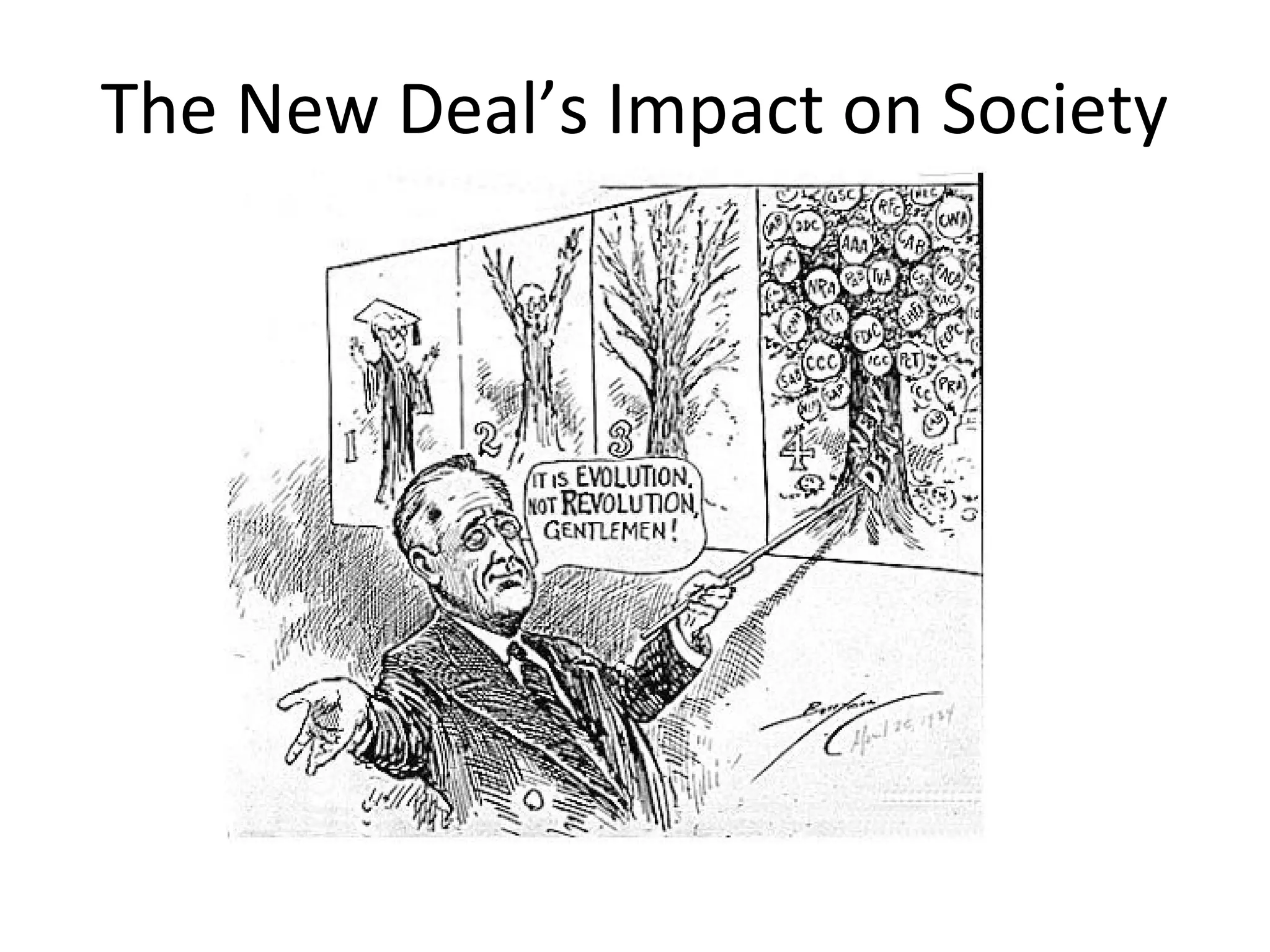
The New Deal’s Impact on Society
New Deal Constituencies
& the Broker State
• Civilian gov’t employees increased by 80%
• # of gov’t employees in Washington, DC doubled
in 10 years
• Power of federal gov’t increased drastically
• Acted as a broker state
– Gov’t acted as mediator in national marketplace
– Elevated & strengthened new interests
• Organized labor, women, African Americans, & other groups
joined the coalition the Democrats started to build
Organized Labor
• Huge arena for federal intervention
• Factors that led to growth of labor movement
– Inadequacy of welfare capitalism
– New Deal legislation; example=Wagner Act
– Rise of the Congress of Industrial Organizations
(CIO); est. 1936
• Growing militancy of rank & file workers
• By 1940, unionized workers=9 million
– 23% of the non-farm workforce
Organized Labor
• CIO promoted all workers, skilled & unskilled,
into one union
– Accepted women, blacks, & Mexican Americans
– John L. Lewis, once leader of United Mine
Workers, helped form CIO
– Competed w/ AFL; more militant
– Allied w/ Democratic Party
• Scored a victory with United Auto Workers &
GM (1936-1937)
– GM & other auto producers recognized the UAW
Organized Labor
• Steel workers struggled in battle for
unionization
• Memorial Day Massacre (1937), South Chicago
• Marching peacefully, fired upon, 10 killed &
90 wounded
• Strike failed
• 1937—4,720 strikes & 80% favored unions
Women & the New Deal
• Gains in government:
– Frances Perkins, 1st
female in cabinet
– Molly Dawson, head of Women’s Division of the DNC
– Nellie, Tayloe Ross, 1st
female director of the mint
– Eleanor Roosevelt, one of the 1st
prominent First Ladies
• The “conscience of the New Deal”
• Setbacks:
– Low wages
– Low levels of employment
– CCC did not hire women
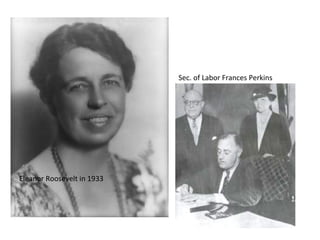
Eleanor Roosevelt in 1933
Sec. of Labor Frances Perkins
Blacks & the New Deal
• New Deal did little to battle racial
discrimination
• CCC segregated blacks & whites
• NRA codes did not protect black workers
• FDR repeatedly refused to ban lynching
– Said it would antagonize southern members of
Congress
• Their support was needed for New Deal measures
Blacks & the New Deal
• 18% of WPA recipients were black
• Resettlement Administration was set up to help small farmers
buy land
• Mary McLeod Bethune hired to run Office of Minority Affairs
• Eleanor Roosevelt was a champion of equal rights
• The belief that the White House was concerned for African
Americans shifted voting
– Republican Party had been party of blacks since time of
Lincoln
Politicization of Mexican
Americans
• Benefited from labor policies
– But agencies paid at different rates based on race
– Tension & conflict between whites & Hispanics in
CCC camps
• Increasingly identified with US rather than
Mexico
• Democrats made it clear that they welcomed
Mexican Americans
Indian Reorganization Act
• Native Americans continued to be among the nation’s
most disadvantaged minorities
• Average annual income in 1934=$48!
• IRA reversed Dawes Act of 1887 by promoting
extensive self-government; tribal councils &
constitutions
• Tribal lands & agricultural profits both increased
greatly
• New Deal helped preserve Native languages, arts,
traditions
• However, problems were so severe that more change
was needed
The New Deal & the Land
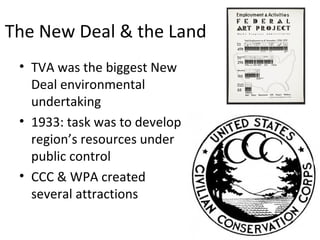
• TVA was the biggest New
Deal environmental
undertaking
• 1933: task was to develop
region’s resources under
public control
• CCC & WPA created
several attractions
New Deal & the Arts
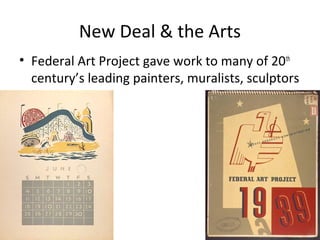
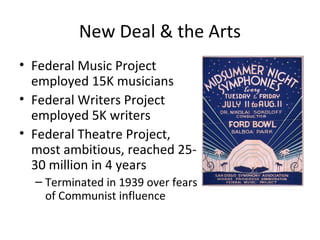
• Federal Art Project gave work to many of 20th
century’s leading painters, muralists, sculptors
New Deal & the Arts
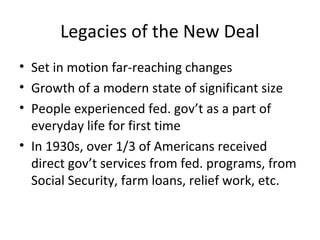
• Federal Music Project
employed 15K musicians
• Federal Writers Project
employed 5K writers
• Federal Theatre Project,
most ambitious, reached 25-
30 million in 4 years
– Terminated in 1939 over fears
of Communist influence
Legacies of the New Deal
• Set in motion far-reaching changes
• Growth of a modern state of significant size
• People experienced fed. gov’t as a part of
everyday life for first time
• In 1930s, over 1/3 of Americans received
direct gov’t services from fed. programs, from
Social Security, farm loans, relief work, etc.
Legacy of the New Deal
• Gov’t made a commitment to intervene in
economy when private sector could not
guarantee stability
• Stock market regulation, Fed. Reserve
reformed
• Accelerated pattern begun by Progressive of
using regulation to bring order to economic
life
Problems with the New Deal
• Social Security Act did not include national
health care
• Welfare system did not reach a majority of
American workers, including domestics & farm
workers
• Discriminated against women in terms of jobs
& wages
• Did not end Depression, only short-term fixes
Problems with the New Deal
• Forced FDR to be unable to challenge
marginalization of blacks in the South
• Needed white southern vote
• Court-packing scheme, recession of 1937,
Republican success in 1938 elections, &
inevitability of WWII—combined to bring end
to the New Deal
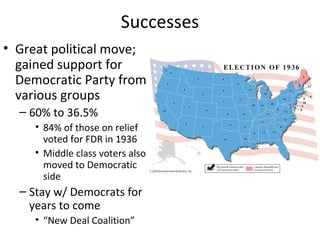
Successes
• Great political move;
gained support for
Democratic Party from
various groups
– 60% to 36.5%
• 84% of those on relief
voted for FDR in 1936
• Middle class voters also
moved to Democratic
side
– Stay w/ Democrats for
years to come
• “New Deal Coalition”

New Deal Impact

  • 1.
    The New Deal’sImpact on Society
  • 3.
    New Deal Constituencies &the Broker State • Civilian gov’t employees increased by 80% • # of gov’t employees in Washington, DC doubled in 10 years • Power of federal gov’t increased drastically • Acted as a broker state – Gov’t acted as mediator in national marketplace – Elevated & strengthened new interests • Organized labor, women, African Americans, & other groups joined the coalition the Democrats started to build
  • 4.
    Organized Labor • Hugearena for federal intervention • Factors that led to growth of labor movement – Inadequacy of welfare capitalism – New Deal legislation; example=Wagner Act – Rise of the Congress of Industrial Organizations (CIO); est. 1936 • Growing militancy of rank & file workers • By 1940, unionized workers=9 million – 23% of the non-farm workforce
  • 5.
    Organized Labor • CIOpromoted all workers, skilled & unskilled, into one union – Accepted women, blacks, & Mexican Americans – John L. Lewis, once leader of United Mine Workers, helped form CIO – Competed w/ AFL; more militant – Allied w/ Democratic Party • Scored a victory with United Auto Workers & GM (1936-1937) – GM & other auto producers recognized the UAW
  • 6.
    Organized Labor • Steelworkers struggled in battle for unionization • Memorial Day Massacre (1937), South Chicago • Marching peacefully, fired upon, 10 killed & 90 wounded • Strike failed • 1937—4,720 strikes & 80% favored unions
  • 7.
    Women & theNew Deal • Gains in government: – Frances Perkins, 1st female in cabinet – Molly Dawson, head of Women’s Division of the DNC – Nellie, Tayloe Ross, 1st female director of the mint – Eleanor Roosevelt, one of the 1st prominent First Ladies • The “conscience of the New Deal” • Setbacks: – Low wages – Low levels of employment – CCC did not hire women
  • 8.
    Eleanor Roosevelt in1933 Sec. of Labor Frances Perkins
  • 9.
    Blacks & theNew Deal • New Deal did little to battle racial discrimination • CCC segregated blacks & whites • NRA codes did not protect black workers • FDR repeatedly refused to ban lynching – Said it would antagonize southern members of Congress • Their support was needed for New Deal measures
  • 10.
    Blacks & theNew Deal • 18% of WPA recipients were black • Resettlement Administration was set up to help small farmers buy land • Mary McLeod Bethune hired to run Office of Minority Affairs • Eleanor Roosevelt was a champion of equal rights • The belief that the White House was concerned for African Americans shifted voting – Republican Party had been party of blacks since time of Lincoln
  • 11.
    Politicization of Mexican Americans •Benefited from labor policies – But agencies paid at different rates based on race – Tension & conflict between whites & Hispanics in CCC camps • Increasingly identified with US rather than Mexico • Democrats made it clear that they welcomed Mexican Americans
  • 12.
    Indian Reorganization Act •Native Americans continued to be among the nation’s most disadvantaged minorities • Average annual income in 1934=$48! • IRA reversed Dawes Act of 1887 by promoting extensive self-government; tribal councils & constitutions • Tribal lands & agricultural profits both increased greatly • New Deal helped preserve Native languages, arts, traditions • However, problems were so severe that more change was needed
  • 13.
    The New Deal& the Land • TVA was the biggest New Deal environmental undertaking • 1933: task was to develop region’s resources under public control • CCC & WPA created several attractions
  • 14.
    New Deal &the Arts • Federal Art Project gave work to many of 20th century’s leading painters, muralists, sculptors
  • 15.
    New Deal &the Arts • Federal Music Project employed 15K musicians • Federal Writers Project employed 5K writers • Federal Theatre Project, most ambitious, reached 25- 30 million in 4 years – Terminated in 1939 over fears of Communist influence
  • 16.
    Legacies of theNew Deal • Set in motion far-reaching changes • Growth of a modern state of significant size • People experienced fed. gov’t as a part of everyday life for first time • In 1930s, over 1/3 of Americans received direct gov’t services from fed. programs, from Social Security, farm loans, relief work, etc.
  • 17.
    Legacy of theNew Deal • Gov’t made a commitment to intervene in economy when private sector could not guarantee stability • Stock market regulation, Fed. Reserve reformed • Accelerated pattern begun by Progressive of using regulation to bring order to economic life
  • 18.
    Problems with theNew Deal • Social Security Act did not include national health care • Welfare system did not reach a majority of American workers, including domestics & farm workers • Discriminated against women in terms of jobs & wages • Did not end Depression, only short-term fixes
  • 19.
    Problems with theNew Deal • Forced FDR to be unable to challenge marginalization of blacks in the South • Needed white southern vote • Court-packing scheme, recession of 1937, Republican success in 1938 elections, & inevitability of WWII—combined to bring end to the New Deal
  • 20.
    Successes • Great politicalmove; gained support for Democratic Party from various groups – 60% to 36.5% • 84% of those on relief voted for FDR in 1936 • Middle class voters also moved to Democratic side – Stay w/ Democrats for years to come • “New Deal Coalition”