the montessori learning
Larry Page and Sergey Brin 
have experienced in Montessori Learning 
Founder of Google
Method of Education 
by: 
Aulia – Iline – Nia -Sagita
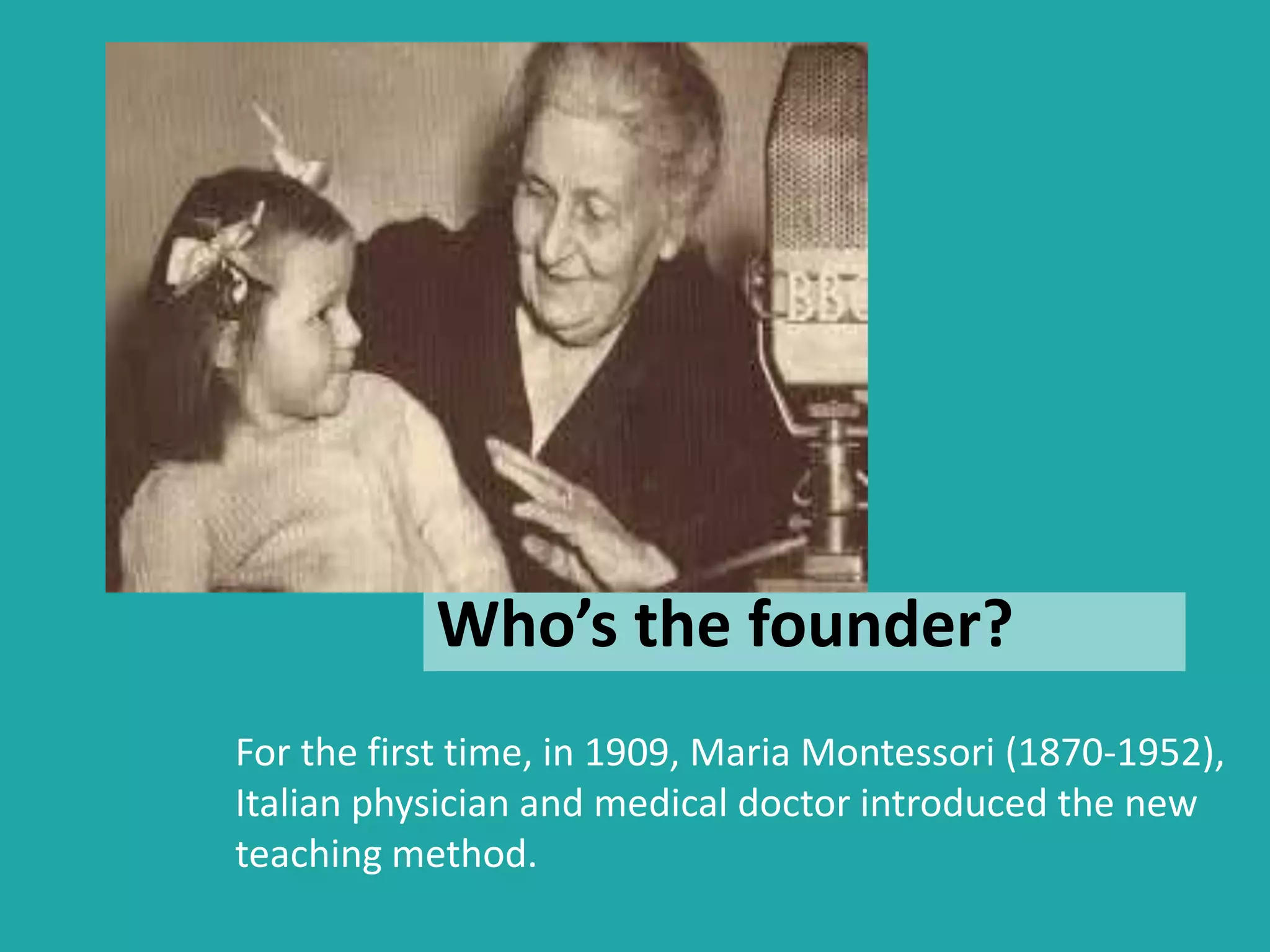
Who’s the founder? 
For the first time, in 1909, Maria Montessori (1870-1952), 
Italian physician and medical doctor introduced the new 
teaching method.
What is Montessori ?
Montessori is an approach to the education of 
children. It is a way of looking at, and 
understanding, children. It is a view of how 
children develop and learn which has been 
translated into a systematic method of 
education based upon careful scientific study.
Montessori belief that many of the problem children 
she was working with were educational rather than 
medical. 
In examining children, she felt 
that children were not achieving 
their potential, because 
education was not based upon 
science.
What is the idea behind the 
Montessori approach to the 
education of children?
Montessori is an approach to education based upon 
the principle that schooling should work with the 
nature of the child instead of against it. 
Therefore, education should be based upon scientific 
study of the child and a resulting understanding of 
the processes of development and learning.
What is the Montessori understanding of 
the nature of the child? 
 Children like to work as well as play. 
 Children have a natural drive to work in order to 
develop. 
 The child’s great task is to create an adult. 
 Children are not content unless they have an 
opportunity to develop and learn.
How does Montessori’s understanding of 
the child influence her view of education? 
Montessori schools are based upon the 
principle that the child, not the teacher, is the 
construction of man, and so of society. 
Teacher can only help the great work that is 
being done. 
The teacher’s job is to provide the materials 
and environment which will aid development 
and to be ready to respond when help is 
needed.
What is Dr. Montessori’s view of 
education? 
Education should no longer consist only of 
imparting knowledge, it must release human 
potentialities. 
If education is to be an aid to civilization, it 
cannot be carried out by emptying the schools 
of knowledge, of character, of discipline, of 
social harmony, and above all of freedom.
How is a Montessori program different 
from other programs? 
1. Teaching to individuals instead of to groups 
2. Children learn through practicing tasks 
3. The Montessori curriculum is much broader than many 
other programs 
4. Montessori programs emphasize on self-discipline 
5. The materials in a Montessori classroom are carefully 
designed 
6. Montessori teachers are trained to respect and positive 
values 
7. The Montessori method is done in positive manner 
8. The routine of the Montessori program is well-arranged and 
based on the principle of freedom
How does a Montessori education benefit 
children?
• Competence: Children in Montessori schools are often several years 
above grade level in their basic skills. Also, since the Montessori 
education is comprehensive, children are often exceptionally 
knowledgeable in a number of other areas as well. 
• Self Discipline: Montessori schools are well known for children’s 
development of self-discipline. Children choose to work long and 
hard. They treat materials and others with respect. They display 
patience and resistance to temptation and the 
ability to attend for long periods. 
• Social Adjustment: Montessori school children usually strike a 
visitor as friendly, empathetic, and cooperative. The class- room is a 
cheerful social community where children happily help each other. 
It is not uncommon to see a child offer to help another child. Also, 
learning social grace and courtesy are a part of the Montessori 
curriculum. 
• Happiness: Most parents of children in a Montessori school 
comment on how much their children love school.
Program Options 
• Infant and tooddler 
program (0-3) 
• Pre-school and 
kindergarten (3-6) 
• Elementary school (6-12) 
• Middle and high school 
(12-18)
GREAT FIGURES 
those who experienced in Montessori learning 
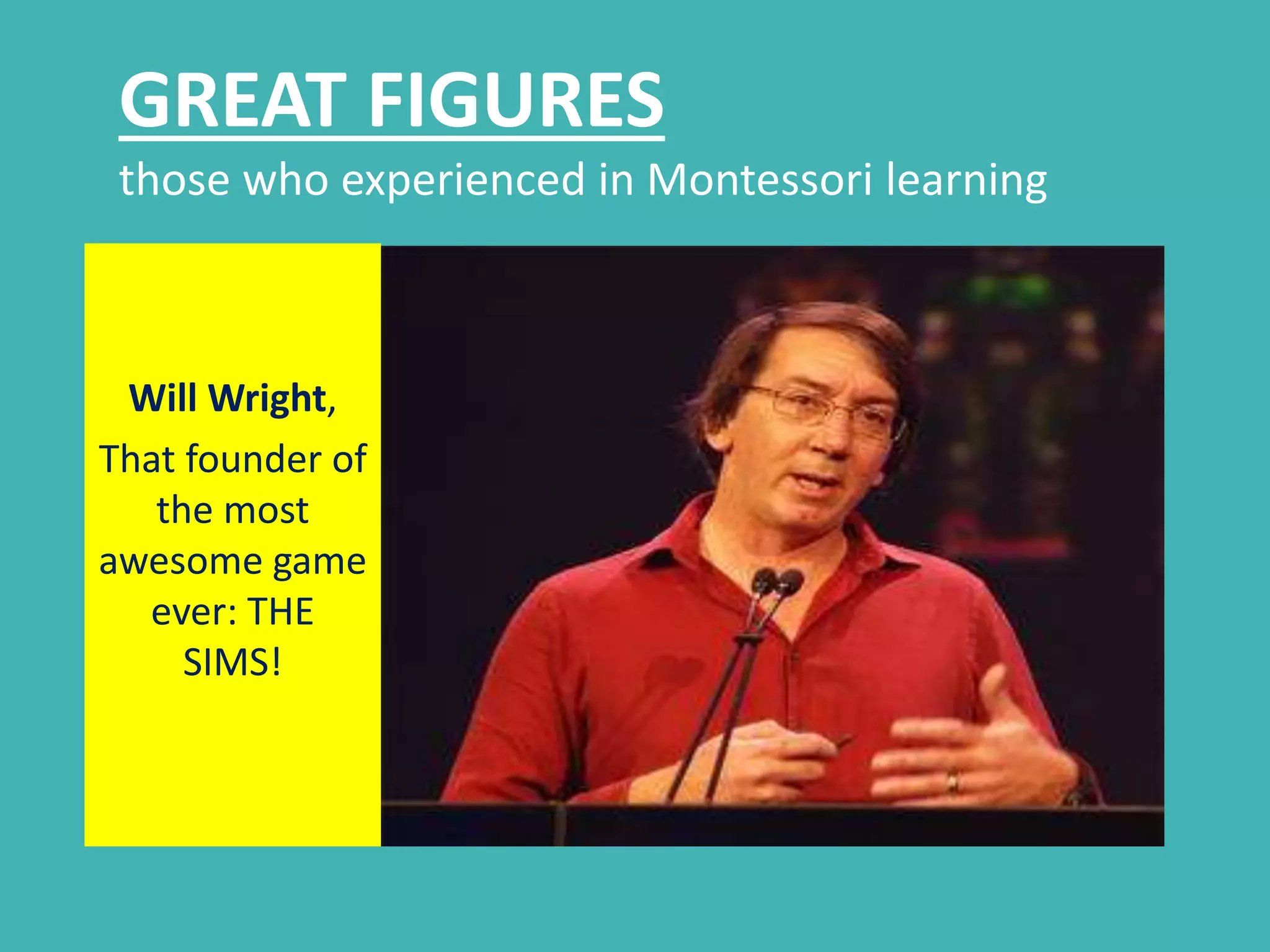
Will Wright, 
That founder of 
the most 
awesome game 
ever: THE 
SIMS!
Legendary chef, 
Julia Child, 
Child actress 
Dakota 
Fanning, 
Rapper P. 
Diddy 
Multi talented 
singer/song 
writer, Taylor 
Swift
Jimmy Wales, 
Founder of 
Wikipedia.com
SOURCES: 
 http://www.leesburgmontessori.com/Met 
hodsofEducation.pdf 
 http://www.absorbentminds.co.uk/acatalo 
g/What_is_Montessori_.html 
www.dailymontessori.com/montessori-theory/ 
Our conclusion 
Montessori teaching method 
appreciates the uniqueness of 
every child. It benefits the 
natures of children which are 
playing and working on the 
matter that they are interested 
in. 
By considering the strength of 
children, this method is 
successful to develop a child’s 
potential maximally without 
any pressure but support 
process-

Montessori method of education

  • 1.
  • 2.
    Larry Page andSergey Brin have experienced in Montessori Learning Founder of Google
  • 3.
    Method of Education by: Aulia – Iline – Nia -Sagita
  • 4.
    Who’s the founder? For the first time, in 1909, Maria Montessori (1870-1952), Italian physician and medical doctor introduced the new teaching method.
  • 5.
  • 6.
    Montessori is anapproach to the education of children. It is a way of looking at, and understanding, children. It is a view of how children develop and learn which has been translated into a systematic method of education based upon careful scientific study.
  • 7.
    Montessori belief thatmany of the problem children she was working with were educational rather than medical. In examining children, she felt that children were not achieving their potential, because education was not based upon science.
  • 8.
    What is theidea behind the Montessori approach to the education of children?
  • 9.
    Montessori is anapproach to education based upon the principle that schooling should work with the nature of the child instead of against it. Therefore, education should be based upon scientific study of the child and a resulting understanding of the processes of development and learning.
  • 10.
    What is theMontessori understanding of the nature of the child?  Children like to work as well as play.  Children have a natural drive to work in order to develop.  The child’s great task is to create an adult.  Children are not content unless they have an opportunity to develop and learn.
  • 11.
    How does Montessori’sunderstanding of the child influence her view of education? Montessori schools are based upon the principle that the child, not the teacher, is the construction of man, and so of society. Teacher can only help the great work that is being done. The teacher’s job is to provide the materials and environment which will aid development and to be ready to respond when help is needed.
  • 12.
    What is Dr.Montessori’s view of education? Education should no longer consist only of imparting knowledge, it must release human potentialities. If education is to be an aid to civilization, it cannot be carried out by emptying the schools of knowledge, of character, of discipline, of social harmony, and above all of freedom.
  • 13.
    How is aMontessori program different from other programs? 1. Teaching to individuals instead of to groups 2. Children learn through practicing tasks 3. The Montessori curriculum is much broader than many other programs 4. Montessori programs emphasize on self-discipline 5. The materials in a Montessori classroom are carefully designed 6. Montessori teachers are trained to respect and positive values 7. The Montessori method is done in positive manner 8. The routine of the Montessori program is well-arranged and based on the principle of freedom
  • 14.
    How does aMontessori education benefit children?
  • 15.
    • Competence: Childrenin Montessori schools are often several years above grade level in their basic skills. Also, since the Montessori education is comprehensive, children are often exceptionally knowledgeable in a number of other areas as well. • Self Discipline: Montessori schools are well known for children’s development of self-discipline. Children choose to work long and hard. They treat materials and others with respect. They display patience and resistance to temptation and the ability to attend for long periods. • Social Adjustment: Montessori school children usually strike a visitor as friendly, empathetic, and cooperative. The class- room is a cheerful social community where children happily help each other. It is not uncommon to see a child offer to help another child. Also, learning social grace and courtesy are a part of the Montessori curriculum. • Happiness: Most parents of children in a Montessori school comment on how much their children love school.
  • 16.
    Program Options •Infant and tooddler program (0-3) • Pre-school and kindergarten (3-6) • Elementary school (6-12) • Middle and high school (12-18)
  • 17.
    GREAT FIGURES thosewho experienced in Montessori learning Will Wright, That founder of the most awesome game ever: THE SIMS!
  • 18.
    Legendary chef, JuliaChild, Child actress Dakota Fanning, Rapper P. Diddy Multi talented singer/song writer, Taylor Swift
  • 19.
    Jimmy Wales, Founderof Wikipedia.com
  • 20.
    SOURCES:  http://www.leesburgmontessori.com/Met hodsofEducation.pdf  http://www.absorbentminds.co.uk/acatalo g/What_is_Montessori_.html www.dailymontessori.com/montessori-theory/ Our conclusion Montessori teaching method appreciates the uniqueness of every child. It benefits the natures of children which are playing and working on the matter that they are interested in. By considering the strength of children, this method is successful to develop a child’s potential maximally without any pressure but support process-