Brain Plasticity:  How to Reprogram Your Mind   We are what we repeatedly do.  Excellence, then, is not an act, but a habit. – Aristotle Kristopher L. Walton, MSW, LCSW [email_address] 208-403-3597 Navigating Your Mind:  Achieving a Life of Peace, Joy and Happiness Anticipated Publish Date:  Fall 2010
Solidified Brain No free will or choice
No chance of change
4 Points to Remember What Is Neuroplasticity? Why Does It Matter? Changing My Habits! Creating My Successful Life!
Neuroplasticity Brains Ability to Restructure Itself
Neuro-net
Law of Associative Memory
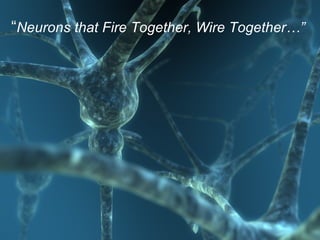
“ Neurons that Fire Together, Wire Together…”
“ Neurons that Fire Apart Wire Apart.”
Or Loose It
4 Points to Remember What Is Neuroplasticity? Why Does It Matter? Changing My Habits! Creating My Successful Life!
Addicted to Emotions Anger Anxiety Depression Victimization
HYPOTHALMUS
Frontal Lobe Changing our minds Imagination Free will Creativity Opportunity
Stop Living in the Past
“ CHATTERBOX”
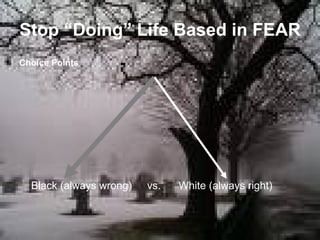
Stop “Doing” Life Based in FEAR Choice Points Black (always wrong)  vs.  White (always right)
“ Create” Your Life in New Opportunity and Adventure Choice Points Option A vs. Option B Options C, D, E… vs. Options F, G, H…
4 Points to Remember What Is Neuroplasticity? Why Does It Matter? Changing My Habits! Creating My Successful Life!
Persistence and Determination
Freedom to imagine…
MINDFULNESS
RE-LABLING
Mental Rehearsal
Turn Around Statements 1.  Thoughts and events from my past cause how I feel.  I will always be bad. My past does not cause how I feel.  It is what it is and I let it go. 2.  He/she is supposed to like or love me all the time. It’s okay! I can’t be liked or loved by every all the time. 3.  I must be achieving in all important respects in order to be worthwhile. I cannot be everything to everyone all of the time. 4.  I should be everything to everyone all of the time. It’s okay not to be everything, for everyone, all the time. 5.  It’s awful and terrible when things are not the way I want them to be.   Life’s an adventure and I can stand it.
Vision Specific and Crystal Clear
Goals
Beliefs
Daily Tasks
Procrastination Habit Killer
Thoughts
Feelings
Actions
15 Minute Rule Mindful Activity
Active and Directive Thoughts Create Habits
Success Comes From   Tracking Your Habits
Neuro-linking Habit Formulation Link New Habit with Environment or Situations you Enjoy
4 Points to Remember What Is Neuroplasticity? Why Does It Matter? Changing My Habits! Creating My Successful Life!
DREAM BIG
Memory and Dreams  vs.  Environment
Power/Vision Board
Audio Recordings
Outcomes
Assaraf, J, M. Smith.  The Answer. Grow Any Business, Achieve Financial Freedom, and Live and Extraordinary Life (2008). Canfield, J. with Switzer, J.  The Success Principles.  How to Get from Where You Are to Where You Want to Be (2005). Cooper, Robert K.  The Other 90%.  Three Rivers Press (2001). Ellis, A. Institute, Bernard, M. W. and Wolfe, J.L. Editors.  The Rational Emotive Behavioral Therapy Resource Book for Practitioners (2000). Fullan, Michael.  Leading in a Culture of Change. Jossey Bass (2003). Maxwell, John C.  Developing the Leader Within You. Nelson Business (2005). Schwartz, J.M., S. Begley.  The Mind & The Brain. Neuroplasticity and the Power of Mental Force (2002).  References
Kristopher L. Walton, MSW, LCSW 2775 Channing Way Idaho Falls, Idaho  83404 (208) 403-3597 Workshops, Coaching, Training, Keynote Speaking, Adolescent/Adult Therapy Author:  Navigating Your Mind:  Achieving a Life of Peace, Joy and Happiness   (anticipated publish date autumn 2010)
Appendix I I don’t like it, that’s okay.  I can stand it anyway.  It is what it is. He/she is supposed to like or love me all the time. It’s okay! I can’t be liked or loved by every all the time. I must be achieving in all important respects in order to be worthwhile. I cannot be everything to everyone all of the time. I should be everything to everyone all of the time. It’s okay not to be everything, for everyone, all the time. Life should be fair and the way I want it to be. It’s okay.  Life is not fair.  I can stand it. It’s awful and terrible when things are not the way I want them to be.  Life’s an adventure and I can stand it.  What happens to me causes how I feel. The past is not a predictor of the future.  I can stand this! I should look good to all people in order to be worthwhile. I love myself for who I am and for where I am at.  I am great! Reverse Paranoia  (Jack Canfield) This bad event is happening to prepare me for future events that are great.

Brain plasticity

  • 1.
    Brain Plasticity: How to Reprogram Your Mind We are what we repeatedly do.  Excellence, then, is not an act, but a habit. – Aristotle Kristopher L. Walton, MSW, LCSW [email_address] 208-403-3597 Navigating Your Mind: Achieving a Life of Peace, Joy and Happiness Anticipated Publish Date: Fall 2010
  • 2.
    Solidified Brain Nofree will or choice
  • 3.
  • 4.
    4 Points toRemember What Is Neuroplasticity? Why Does It Matter? Changing My Habits! Creating My Successful Life!
  • 5.
    Neuroplasticity Brains Abilityto Restructure Itself
  • 6.
  • 7.
  • 8.
    “ Neurons thatFire Together, Wire Together…”
  • 9.
    “ Neurons thatFire Apart Wire Apart.”
  • 10.
  • 11.
    4 Points toRemember What Is Neuroplasticity? Why Does It Matter? Changing My Habits! Creating My Successful Life!
  • 12.
    Addicted to EmotionsAnger Anxiety Depression Victimization
  • 13.
  • 14.
    Frontal Lobe Changingour minds Imagination Free will Creativity Opportunity
  • 15.
  • 16.
  • 17.
    Stop “Doing” LifeBased in FEAR Choice Points Black (always wrong) vs. White (always right)
  • 18.
    “ Create” YourLife in New Opportunity and Adventure Choice Points Option A vs. Option B Options C, D, E… vs. Options F, G, H…
  • 19.
    4 Points toRemember What Is Neuroplasticity? Why Does It Matter? Changing My Habits! Creating My Successful Life!
  • 20.
  • 21.
  • 22.
  • 23.
  • 24.
  • 25.
    Turn Around Statements1. Thoughts and events from my past cause how I feel. I will always be bad. My past does not cause how I feel. It is what it is and I let it go. 2. He/she is supposed to like or love me all the time. It’s okay! I can’t be liked or loved by every all the time. 3. I must be achieving in all important respects in order to be worthwhile. I cannot be everything to everyone all of the time. 4. I should be everything to everyone all of the time. It’s okay not to be everything, for everyone, all the time. 5. It’s awful and terrible when things are not the way I want them to be. Life’s an adventure and I can stand it.
  • 26.
    Vision Specific andCrystal Clear
  • 27.
  • 28.
  • 29.
  • 30.
  • 31.
  • 32.
  • 33.
  • 34.
    15 Minute RuleMindful Activity
  • 35.
    Active and DirectiveThoughts Create Habits
  • 36.
    Success Comes From Tracking Your Habits
  • 37.
    Neuro-linking Habit FormulationLink New Habit with Environment or Situations you Enjoy
  • 38.
    4 Points toRemember What Is Neuroplasticity? Why Does It Matter? Changing My Habits! Creating My Successful Life!
  • 39.
  • 40.
    Memory and Dreams vs. Environment
  • 41.
  • 42.
  • 43.
  • 44.
    Assaraf, J, M.Smith. The Answer. Grow Any Business, Achieve Financial Freedom, and Live and Extraordinary Life (2008). Canfield, J. with Switzer, J. The Success Principles. How to Get from Where You Are to Where You Want to Be (2005). Cooper, Robert K. The Other 90%. Three Rivers Press (2001). Ellis, A. Institute, Bernard, M. W. and Wolfe, J.L. Editors. The Rational Emotive Behavioral Therapy Resource Book for Practitioners (2000). Fullan, Michael. Leading in a Culture of Change. Jossey Bass (2003). Maxwell, John C. Developing the Leader Within You. Nelson Business (2005). Schwartz, J.M., S. Begley. The Mind & The Brain. Neuroplasticity and the Power of Mental Force (2002). References
  • 45.
    Kristopher L. Walton,MSW, LCSW 2775 Channing Way Idaho Falls, Idaho 83404 (208) 403-3597 Workshops, Coaching, Training, Keynote Speaking, Adolescent/Adult Therapy Author: Navigating Your Mind: Achieving a Life of Peace, Joy and Happiness (anticipated publish date autumn 2010)
  • 46.
    Appendix I Idon’t like it, that’s okay. I can stand it anyway. It is what it is. He/she is supposed to like or love me all the time. It’s okay! I can’t be liked or loved by every all the time. I must be achieving in all important respects in order to be worthwhile. I cannot be everything to everyone all of the time. I should be everything to everyone all of the time. It’s okay not to be everything, for everyone, all the time. Life should be fair and the way I want it to be. It’s okay. Life is not fair. I can stand it. It’s awful and terrible when things are not the way I want them to be. Life’s an adventure and I can stand it. What happens to me causes how I feel. The past is not a predictor of the future. I can stand this! I should look good to all people in order to be worthwhile. I love myself for who I am and for where I am at. I am great! Reverse Paranoia (Jack Canfield) This bad event is happening to prepare me for future events that are great.

Editor's Notes

  • #3 Graduated from College – Brains were looked upon as “fixed” by the age of 18. Childhood experiences matter most
  • #4 Homer Simpson Through the 1980’s and 1990’s Theory brain was fully developed by age 18. No will or choice about life What happened to me causes how I feel, do and my successes
  • #6 Neuro-plasticity refers to the brain’s ability to restructure itself after training or practice.  Neuroplasticity is what makes personal growth and development possible . It’s possible It’s proven Now it’s up to you to create your life to be what you want it to be.
  • #7 The brain is made up of 100 billion tiny nerve cells called neurons Tiny branches that reach out to other neurons that form a Neuro-net Connections are integrated into a THOUGHTS OR MEMORIES Brain builds up it’s concepts by the Law of Associative Memory Thoughts, feelings and memories are caught up in this Neuro-net and it creates our PERCEPTIONS of our lives.
  • #8 Associate Memory can be HELPFUL WITH KEEPING OLD MEMORIES AVAILABLE FOR RECALL PIANO, SCHOOL RELATIONSHIPS ETC. HELPFUL OR NOT SO HELPFUL WITH PROBLEMS FROM OUR PAST ANTICIPATE TO OCCUR IN THE FUTURE SUCH AS The concept of Love is an ideal that we are “suppose” to enjoy However, if love has been associated to disappointment, pain or fear, we anticipate love will be painful or scary. So, we stay away from love because we anticipate hurt and sadness with any type of love. Believe FAILURE Embarrassed Give up Stay stuck
  • #9 Neuroplasticity : “neurons that fire together wire together… and neurons that fire apart wire apart.”.   The more practice you accumulate, the more ingrained or grooved the pathways become .  When neurons activate at the same time as a response to an event, the neurons become associated with one another and the connections become stronger If you practice something over and over those nerve cells have a long-term relationship. If you get angry, frustrated, suffer or be a VICTIM on a daily basis; you are creating a neuro-network that is creating your idenity around these feelings, thoughts and beliefs.
  • #10 Nerve cells that don’t fire together don’t wire together. Every time we interrupt the thought process, it produces a change to our neuro-chemical responses in our brain. When we interrupt these thoughts, it breaks up the neuro-network relationships that creates new beliefs, thoughts, feelings, actions, habits, and outcomes.
  • #11 Use it or lose it! When neurons don’t activate together they disengage and wire in a new direction
  • #13 Our additions to how we feel on any given day determines who we perceives ourselves to be. We are addicted to feeling good, avoidant, misery, fear, anger, food, CONTROL, distraction, VICTIMIZATION ADDICTION MEANS: SOMETHING YOU CANNOT STOP. IF YOU CANNOT CONTROL YOUR EMOTIONAL STATE, YOU MUST BE ADDICTED TO IT.
  • #14 Mini chemical factory that produces chemicals that matches emotions that we experience. Those chemicals are called peptides. About 20-small chain amino acid sequences. These are called neuro-peptides or neuro-hormones that match emotional experiences that we have on a daily basis. Chemicals for anger, sadness, hurt, lust, VICTIMIZATION Chemicals for trust, safe, love, hope, faith Peptides go to the Pituitary and then to the blood stream. It then goes to cells of the body (stomach, chest and throat) looking for the receptors to accept the peptide to create the feeling.
  • #15 Humans have large frontal lobes compared to the rest of the brain. Firm intention Decision making Regulating behavior Inspiration Make decisions and choices that are different from decisions we have made in the past. A large frontal lobe allows us opportunity to change our minds and the direction of our lives.
  • #16 Most of us are living in our pasts. Memories of what was suppose to be. WE CAN CHANGE Speculate the possibilities of WHAT IF GREAT…
  • #17 Control the Chatterbox inside of our minds with active/directive thoughts, Disputing Irrational Belief’s Change your thinking = Creating your life to be what you want not what is expected of you from the out side environment CHANGE MEANS MODIFYING OUR BEHAVIOR ENOUGH SO IT IS PERMANENT. STOP, STOP, STOP OUTLOUD
  • #18 Stop doing your life based in fear Only leaves 2 choices of being black or white
  • #19 Being mindful to the opportunities of life. Listen to first instinct of what to do with any new direction in life.
  • #21 Calvin Coolige “ Nothing in the world can take the place of persistence. Talent will not; nothing is more common that unsuccessful men and women with talent. Genius will not; unrewarded genius is almost a proverb. Education will not, the world is full of educated derelicts. Persistence and determination alone are omnipotent. The slogan “press on” has solved and always will solve the problems of the human race.” Calvin Coolige (30th President of the United States 1923–1929).
  • #22 When we can overcome our fear, we are free to imagine the greatest of all directions…our passions and purpose. We become enlivened with the possibilities of “what if” FUN, ADVENTURE, EXCITEMENT, OPPORTUNITY, GREATNESS… BECOMING A DIFFERENT PERSON CHANGE OF PERCEPTION OF OUR WORLD
  • #23 What we say to ourselves creates ourselves Awareness of what you are telling yourself Question “What Am I Thinking” FROM AN OBJECTIVE / 3 RD PARTY PERSPECTIVE brain can change based purely on mental training
  • #24 When you feel anxiety, anger, depression RE-LABLE what you are saying to yourself.
  • #25 If we practice mental rehersal of what we want, our neuro-network will change and what we practice will be easier to do. If we accept that idea, the thought rehearsal will allow us to repeat it over and over to be a new neuro-network of possibilities. Making our thoughts as real as possible, hold the thought for an extended time, which makes the thought real, Thus, the possibilities of “what if” greatness and stop what if “bad.”
  • #26 SLOW DOWN AND EXPLAIN THIS SLIDE TURN AROUND STATEMENTS 1. Thoughts and events from my past cause how I feel. I will always be bad. My past does not cause how I feel. It is what it is and I let it go. 2. He/she is supposed to like or love me all the time. It’s okay! I can’t be liked or loved by every all the time. 3. I must be achieving in all important respects in order to be worthwhile. I cannot be everything to everyone all of the time. 4. I should be everything to everyone all of the time. It’s okay not to be everything, for everyone, all the time. 5. It’s awful and terrible when things are not the way I want them to be. Life’s an adventure and I can stand it. AT FIRST IT WILL FEEL LIKE YOU ARE LYING TO YOURSELF…BUT IF THE STATEMENT MAKES RATIONAL AND LOGICAL SENSE THEN KEEP AT IT AND IT WILL BECOME YOUR NEW BELIEF THIS WILL CREATE YOU TO FEEL CALM, COMFORTABLE AND OKAY…MAYBE MILD ANNOYANCE, BUT THAT’S BETTER
  • #27 Brain doesn’t know the difference between reality and imagination/dreams If you can dream it you can achieve it specific and crystal clear. When you have down time, think about your vision When you cannot sleep at night, think of your vision What does it taste, touch, look, smell, and sound like?
  • #28 What is your personal vision and “ultimate goal”. Milestones to fulfilling your vision Targets Base actions.  Habits are the small steps you take every single day that bring you ever closer to your goals.  Your goals and your vision aren’t possible until you form the right habits. Goals Written Time Deadlines Specific Daily Reminders
  • #29 Active Directive Focus on what you want Turn around statments
  • #30 Track your tasks everyday that projects you toward your goals of your vision. Journal Planner Spouse Calendar Write it down Plan the night before Look at it before falling asleep
  • #31  One day “off” can easily snowball into 5 days or 5 weeks.  It’s always easier to convince yourself that slacking off with a specific daily habit isn’t going to make a difference than it is to just do it.  It’s amazing how powerful our internal motivation for slacking can actually be! Never, Ever Quit or Give Up Change Your Irrational Thoughts and stay focused Tell a friend/spouse what you are doing to keep you motivated and directed toward your ultimate vision and goals. Do something everyday directed toward your goal. Do what others are not willing to do 4 hours prospecting for what you want
  • #32 Practice turn around statements, Dream your Vision, Daily reading of your goals Follow your daily tasks changes your thoughts… Difficulty falling/staying asleep Active/directive Imagination of the fun aspects of your vision Write down new ideas or thoughts of inspiration and follow them.
  • #33 These will create New Feelings Perpetuate upon itself Pull in the positive emotions of the experiences of your vision, goals, beliefs etc.
  • #34 New Actions Change up your daily actions to be focused toward your goals. 21 days of focus and actions will create plasticity
  • #35 Mindful Adaptive Activities for 15 minutes. Not just distracting, but engaged in goal oriented thinking, feeling and memory Wait for the procrastination feeling to go away and stay focused on your goals. 15 more minutes in thinking, writing, acting, or focusing on your vision or goals. Don’t give up
  • #36 Brushing your teeth ritual. You grab that toothbrush, squeeze some toothpaste onto it, and go about your violent brushing. Same quadrants of your mouth each night because it’s probably not something you think about anymore.  You just do it, and you’ll probably always do it that way unless you make a conscious change. Do something enough times and it becomes a part of you – perhaps to a fault – and from that point on, it can be harder not to do something at all than to do it.  In truth, most of our lives consist of habitual action each day.  Have you ever been driving along and realized (too late) that you’ve gone in the completely wrong direction, because you habitually started driving to work even though you were originally planning to go to a friend’s house?  Your conscious mind shut-off the second you got into that car and was on auto-pilot until you realized you were heading in the wrong direction. 
  • #37 Habits form the basis for everything you do or will achieve.  Without forming new habits and replacing destructive behavior with positive habits, your goals will always remain distant WITHOUT Consistent goal achievement, your vision might as well not exist. Your habits “accumulate up” to your goals – there can’t be real triumph without small wins along the way Each time you repeat a behavior, the context in which it occurs is linked in your mind to the activity itself.  The time of day, MUSIC CAR CHAIR THINK OF IT BEING FUN, ENTERTAINING AND ADVENTOUROUS
  • #38 Surround the habit you’d like to form with corresponding positive context, forever linking your new habit with an environment or situation you enjoy. In order to get into the habit of writing, I combine classical music and a comfortable chair – now whenever I hear the music no matter where I am, I’m immediately ready to pour my heart out with a keyboard.  Getting into the habit of going to the gym early in the morning years ago required a daily ritual of Rocky music as soon as I got out of bed.  To this day every time I hear Burning Heart from Rocky IV I’m ready to exercise.  combine something you already enjoy with a developing habit that isn’t yet second-nature .  The association between the two can be enough to ingrain that habit a little more quickly
  • #41 The brain doesn’t know the difference between what it remembers and what it see’s in the environment The same neuro-nets are firing
  • #42 What you see is where you go. Reminders of your goals. When we don’t do this we loose track of what we want. Otherwise the white-noise of our lives will take us off track.
  • #43 Using a digital voice recorder, tell yourself the affirmations and goals that you have. How you need to behave for the most success. Keep a success journal and read it often.
  • #44 Outcomes…