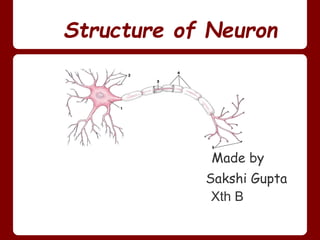
Structure of Neuron


             Made by
            Sakshi Gupta
             Xth B
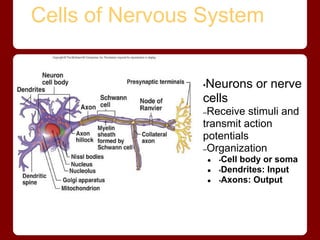
Cells of Nervous System


                Neurons or nerve
                •
                cells
                –Receive stimuli and
                transmit action
                potentials
                –Organization
                    ●   •Cell body or soma
                    ●   •Dendrites: Input
                    ●   •Axons: Output
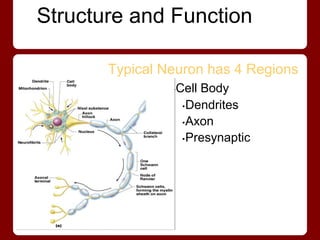
Structure and Function

            Typical Neuron has 4 Regions
                     Cell Body
                     •

                      • Dendrites

                      • Axon

                      • Presynaptic
Terminals
Functional Classification of Neurons

·Sensory (afferent) neurons
·Carry impulses from the sensory receptors
·Cutaneous sense organs
·Proprioceptors – detect stretch or tension
·Motor (efferent) neurons
·Carry impulses from the central nervous
system
Neuron Classification
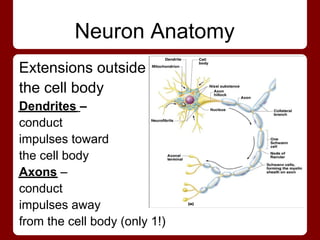
Neuron Anatomy
Extensions outside
the cell body
Dendrites –
conduct
impulses toward
the cell body
Axons –
conduct
impulses away
from the cell body (only 1!)
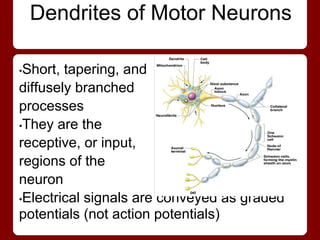
Dendrites of Motor Neurons

•Short, tapering, and
diffusely branched
processes
•They are the

receptive, or input,
regions of the
neuron
•Electrical signals are conveyed as graded
potentials (not action potentials)
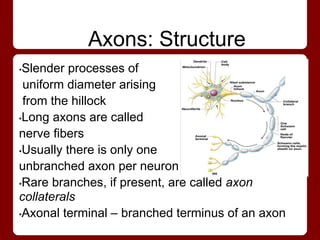
Axons: Structure
•Slender processes of
 uniform diameter arising
 from the hillock
•Long axons are called

nerve fibers
•Usually there is only one

unbranched axon per neuron
•Rare branches, if present, are called axon
collaterals
•Axonal terminal – branched terminus of an axon
Myelin Sheath

•Whitish, fatty
 (protein-lipid),
 segmented sheath
around most long
axons
•It functions in:
–Protection of the axon
–Electrically insulating fibers from one another

–Increasing the speed of nerve impulse
transmission
NEURON

NEURON

  • 1.
    Structure of Neuron Made by Sakshi Gupta Xth B
  • 2.
    Cells of NervousSystem Neurons or nerve • cells –Receive stimuli and transmit action potentials –Organization ● •Cell body or soma ● •Dendrites: Input ● •Axons: Output
  • 3.
    Structure and Function Typical Neuron has 4 Regions Cell Body • • Dendrites • Axon • Presynaptic Terminals
  • 4.
    Functional Classification ofNeurons ·Sensory (afferent) neurons ·Carry impulses from the sensory receptors ·Cutaneous sense organs ·Proprioceptors – detect stretch or tension ·Motor (efferent) neurons ·Carry impulses from the central nervous system
  • 5.
  • 6.
    Neuron Anatomy Extensions outside thecell body Dendrites – conduct impulses toward the cell body Axons – conduct impulses away from the cell body (only 1!)
  • 7.
    Dendrites of MotorNeurons •Short, tapering, and diffusely branched processes •They are the receptive, or input, regions of the neuron •Electrical signals are conveyed as graded potentials (not action potentials)
  • 8.
    Axons: Structure •Slender processesof uniform diameter arising from the hillock •Long axons are called nerve fibers •Usually there is only one unbranched axon per neuron •Rare branches, if present, are called axon collaterals •Axonal terminal – branched terminus of an axon
  • 9.
    Myelin Sheath •Whitish, fatty (protein-lipid), segmented sheath around most long axons •It functions in: –Protection of the axon –Electrically insulating fibers from one another –Increasing the speed of nerve impulse transmission