NEURON
Prepared By :
Sukhpreet Kaur
PPT-2
HISTOLOGY OF NERVOUS
TISSUE
• Nervous tissue consists of two types of cells:
neurons and neuroglia. Neurons provide most
of the unique functions of the nervous system,
such as sensing, thinking, remembering,
controlling muscle activity, and regulating
glandular secretions. Neuroglia support,
nourish, protect the neurons and maintain
homeostasis.
NEURONS
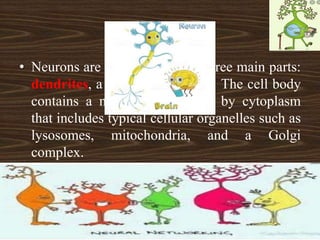
• Neurons are composed of the three main parts:
dendrites, a cell body, an axon. The cell body
contains a nucleus surrounded by cytoplasm
that includes typical cellular organelles such as
lysosomes, mitochondria, and a Golgi
complex.
NEURONS
• Neuronal cell bodies also contain free ribosomes
and prominent clusters of endoplasmic
reticulum, termed Nissl bodies.
• The ribosomes are the sites of protein synthesis.
• Newly synthesized proteins produced by nissal
bodies are used to replace cellular components
as material for growth of neurons and to
regenerate damaged axons in the PNS.
NEURONS
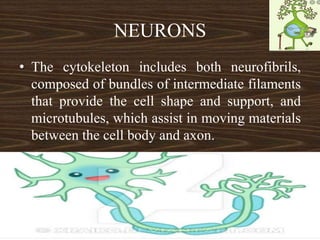
• The cytokeleton includes both neurofibrils,
composed of bundles of intermediate filaments
that provide the cell shape and support, and
microtubules, which assist in moving materials
between the cell body and axon.
NEURONS
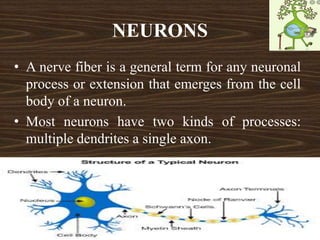
• A nerve fiber is a general term for any neuronal
process or extension that emerges from the cell
body of a neuron.
• Most neurons have two kinds of processes:
multiple dendrites a single axon.
NEURONS
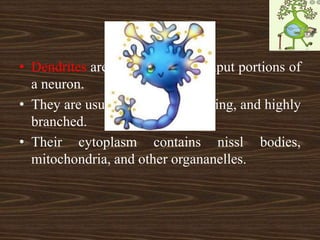
• Dendrites are the receiving or input portions of
a neuron.
• They are usually are short, tapering, and highly
branched.
• Their cytoplasm contains nissl bodies,
mitochondria, and other organanelles.
NEURONS
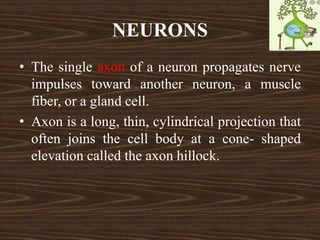
• The single axon of a neuron propagates nerve
impulses toward another neuron, a muscle
fiber, or a gland cell.
• Axon is a long, thin, cylindrical projection that
often joins the cell body at a cone- shaped
elevation called the axon hillock.
NEURONS
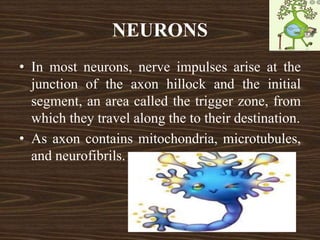
• In most neurons, nerve impulses arise at the
junction of the axon hillock and the initial
segment, an area called the trigger zone, from
which they travel along the to their destination.
• As axon contains mitochondria, microtubules,
and neurofibrils.
NEURONS
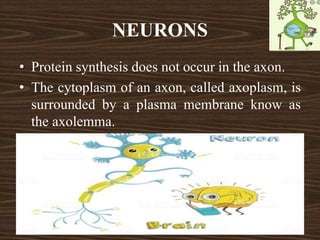
• Protein synthesis does not occur in the axon.
• The cytoplasm of an axon, called axoplasm, is
surrounded by a plasma membrane know as
the axolemma.
NEURONS
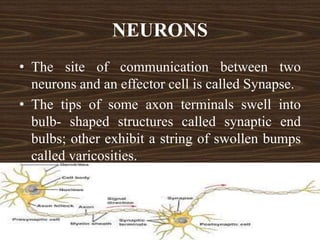
• The site of communication between two
neurons and an effector cell is called Synapse.
• The tips of some axon terminals swell into
bulb- shaped structures called synaptic end
bulbs; other exhibit a string of swollen bumps
called varicosities.
To be continue …
Thank you
•

Neuron ppt

  • 1.
  • 2.
    HISTOLOGY OF NERVOUS TISSUE •Nervous tissue consists of two types of cells: neurons and neuroglia. Neurons provide most of the unique functions of the nervous system, such as sensing, thinking, remembering, controlling muscle activity, and regulating glandular secretions. Neuroglia support, nourish, protect the neurons and maintain homeostasis.
  • 3.
    NEURONS • Neurons arecomposed of the three main parts: dendrites, a cell body, an axon. The cell body contains a nucleus surrounded by cytoplasm that includes typical cellular organelles such as lysosomes, mitochondria, and a Golgi complex.
  • 4.
    NEURONS • Neuronal cellbodies also contain free ribosomes and prominent clusters of endoplasmic reticulum, termed Nissl bodies. • The ribosomes are the sites of protein synthesis. • Newly synthesized proteins produced by nissal bodies are used to replace cellular components as material for growth of neurons and to regenerate damaged axons in the PNS.
  • 5.
    NEURONS • The cytokeletonincludes both neurofibrils, composed of bundles of intermediate filaments that provide the cell shape and support, and microtubules, which assist in moving materials between the cell body and axon.
  • 6.
    NEURONS • A nervefiber is a general term for any neuronal process or extension that emerges from the cell body of a neuron. • Most neurons have two kinds of processes: multiple dendrites a single axon.
  • 7.
    NEURONS • Dendrites arethe receiving or input portions of a neuron. • They are usually are short, tapering, and highly branched. • Their cytoplasm contains nissl bodies, mitochondria, and other organanelles.
  • 8.
    NEURONS • The singleaxon of a neuron propagates nerve impulses toward another neuron, a muscle fiber, or a gland cell. • Axon is a long, thin, cylindrical projection that often joins the cell body at a cone- shaped elevation called the axon hillock.
  • 9.
    NEURONS • In mostneurons, nerve impulses arise at the junction of the axon hillock and the initial segment, an area called the trigger zone, from which they travel along the to their destination. • As axon contains mitochondria, microtubules, and neurofibrils.
  • 10.
    NEURONS • Protein synthesisdoes not occur in the axon. • The cytoplasm of an axon, called axoplasm, is surrounded by a plasma membrane know as the axolemma.
  • 11.
    NEURONS • The siteof communication between two neurons and an effector cell is called Synapse. • The tips of some axon terminals swell into bulb- shaped structures called synaptic end bulbs; other exhibit a string of swollen bumps called varicosities.
  • 12.
    To be continue… Thank you •