GUIDED MEDIA
GUIDED MEDIA AND ITS TYPE
• Guided Media:
It is also referred to as Wired or Bounded transmission media. Signals
being transmitted are directed and confined in a narrow pathway by using
physical links.
• Types of Guided media
 Twisted cable
 Coaxil Cable
 Fiber Optical Cable
TWISTED PAIR CABLE
• Twisted Pair Cable –
It consists of 2 separately insulated conductor wires wound about each
other. Generally, several such pairs are bundled together in a protective sheath. They
are the most widely used Transmission Media.
• Twisted Pair is of two types:
Unshielded Twisted Pair (UTP):
Shielded Twisted Pair (STP
Twisted Pair is of two types:
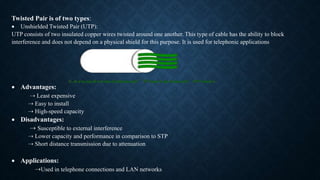
 Unshielded Twisted Pair (UTP):
UTP consists of two insulated copper wires twisted around one another. This type of cable has the ability to block
interference and does not depend on a physical shield for this purpose. It is used for telephonic applications
 Advantages:
⇢ Least expensive
⇢ Easy to install
⇢ High-speed capacity
 Disadvantages:
⇢ Susceptible to external interference
⇢ Lower capacity and performance in comparison to STP
⇢ Short distance transmission due to attenuation
 Applications:
⇢Used in telephone connections and LAN networks
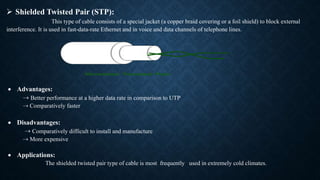
 Shielded Twisted Pair (STP):
This type of cable consists of a special jacket (a copper braid covering or a foil shield) to block external
interference. It is used in fast-data-rate Ethernet and in voice and data channels of telephone lines.
 Advantages:
⇢ Better performance at a higher data rate in comparison to UTP
⇢ Comparatively faster
 Disadvantages:
⇢ Comparatively difficult to install and manufacture
⇢ More expensive
 Applications:
The shielded twisted pair type of cable is most frequently used in extremely cold climates.
(ii) Coaxial Cable –
It has an outer plastic covering containing an insulation layer made of PVC or Teflon and 2 parallel conductors
each having a separate insulated protection cover. The coaxial cable transmits information in two modes: Baseband
mode(dedicated cable bandwidth) and Broadband mode(cable bandwidth is split into separate ranges). Cable TVs and analog
television networks widely use Coaxial cables.
 Advantages:
⇢ Better noise Immunity
⇢ Easy to install and expand
 Disadvantages:
⇢ Single cable failure can disrupt the entire network Applications:
 Applications:
⇢Radio frequency signals are sent over coaxial wire. It can be used for cable television signal distribution, digital audio
(S/PDIF), computer network connections (like Ethernet), and feedlines that connect radio transmitters and receivers to their
antennas.
(iii) Optical Fiber Cable –
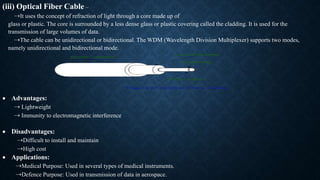
⇢It uses the concept of refraction of light through a core made up of
glass or plastic. The core is surrounded by a less dense glass or plastic covering called the cladding. It is used for the
transmission of large volumes of data.
⇢The cable can be unidirectional or bidirectional. The WDM (Wavelength Division Multiplexer) supports two modes,
namely unidirectional and bidirectional mode.
 Advantages:
⇢ Lightweight
⇢ Immunity to electromagnetic interference
 Disadvantages:
⇢Difficult to install and maintain
⇢High cost
 Applications:
⇢Medical Purpose: Used in several types of medical instruments.
⇢Defence Purpose: Used in transmission of data in aerospace.
Guided Media.pptx

Guided Media.pptx

  • 1.
  • 2.
    GUIDED MEDIA ANDITS TYPE • Guided Media: It is also referred to as Wired or Bounded transmission media. Signals being transmitted are directed and confined in a narrow pathway by using physical links. • Types of Guided media  Twisted cable  Coaxil Cable  Fiber Optical Cable
  • 3.
    TWISTED PAIR CABLE •Twisted Pair Cable – It consists of 2 separately insulated conductor wires wound about each other. Generally, several such pairs are bundled together in a protective sheath. They are the most widely used Transmission Media. • Twisted Pair is of two types: Unshielded Twisted Pair (UTP): Shielded Twisted Pair (STP
  • 4.
    Twisted Pair isof two types:  Unshielded Twisted Pair (UTP): UTP consists of two insulated copper wires twisted around one another. This type of cable has the ability to block interference and does not depend on a physical shield for this purpose. It is used for telephonic applications  Advantages: ⇢ Least expensive ⇢ Easy to install ⇢ High-speed capacity  Disadvantages: ⇢ Susceptible to external interference ⇢ Lower capacity and performance in comparison to STP ⇢ Short distance transmission due to attenuation  Applications: ⇢Used in telephone connections and LAN networks
  • 5.
     Shielded TwistedPair (STP): This type of cable consists of a special jacket (a copper braid covering or a foil shield) to block external interference. It is used in fast-data-rate Ethernet and in voice and data channels of telephone lines.  Advantages: ⇢ Better performance at a higher data rate in comparison to UTP ⇢ Comparatively faster  Disadvantages: ⇢ Comparatively difficult to install and manufacture ⇢ More expensive  Applications: The shielded twisted pair type of cable is most frequently used in extremely cold climates.
  • 6.
    (ii) Coaxial Cable– It has an outer plastic covering containing an insulation layer made of PVC or Teflon and 2 parallel conductors each having a separate insulated protection cover. The coaxial cable transmits information in two modes: Baseband mode(dedicated cable bandwidth) and Broadband mode(cable bandwidth is split into separate ranges). Cable TVs and analog television networks widely use Coaxial cables.  Advantages: ⇢ Better noise Immunity ⇢ Easy to install and expand  Disadvantages: ⇢ Single cable failure can disrupt the entire network Applications:  Applications: ⇢Radio frequency signals are sent over coaxial wire. It can be used for cable television signal distribution, digital audio (S/PDIF), computer network connections (like Ethernet), and feedlines that connect radio transmitters and receivers to their antennas.
  • 7.
    (iii) Optical FiberCable – ⇢It uses the concept of refraction of light through a core made up of glass or plastic. The core is surrounded by a less dense glass or plastic covering called the cladding. It is used for the transmission of large volumes of data. ⇢The cable can be unidirectional or bidirectional. The WDM (Wavelength Division Multiplexer) supports two modes, namely unidirectional and bidirectional mode.  Advantages: ⇢ Lightweight ⇢ Immunity to electromagnetic interference  Disadvantages: ⇢Difficult to install and maintain ⇢High cost  Applications: ⇢Medical Purpose: Used in several types of medical instruments. ⇢Defence Purpose: Used in transmission of data in aerospace.