
Topic: Pervasive Security
Mechanism
Salman Memon
2k12/IT/109
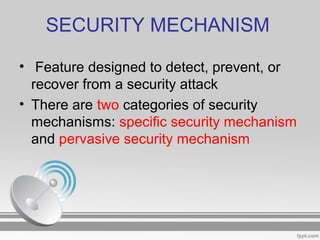
SECURITY MECHANISM
• Feature designed to detect, prevent, or
recover from a security attack
• There are two categories of security
mechanisms: specific security mechanism
and pervasive security mechanism
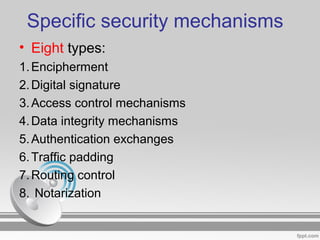
Specific security mechanisms
• Eight types:
1.Encipherment
2.Digital signature
3.Access control mechanisms
4.Data integrity mechanisms
5.Authentication exchanges
6.Traffic padding
7.Routing control
8. Notarization
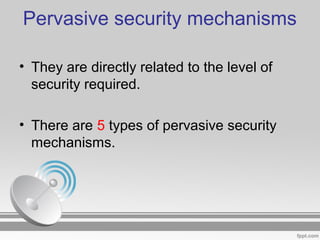
Pervasive security mechanisms
• They are directly related to the level of
security required.
• There are 5 types of pervasive security
mechanisms.
1- Trusted Functionality
• Any functionality providing or accessing security
mechanisms should be trustworthy
2- Security Label
• Any resource (e.g. stored data, processing
power, communications bandwidth) may have
security label associated with it to indicate
security sensitivity
3- Event Detection
• It is used to detect apparent violations of
security.
• It may be Single bit or Multi bit error
4- Security Audit Trials
• Log of past security-related events
• Permits detection and investigation of past
security breaches
5- Security Recovery
• A process that takes recovery actions on the
basis of requests from mechanisms
• Recover the system as soon as possible
ThAnK YoUThAnK YoU

Networking

  • 1.
  • 2.
    SECURITY MECHANISM • Featuredesigned to detect, prevent, or recover from a security attack • There are two categories of security mechanisms: specific security mechanism and pervasive security mechanism
  • 3.
    Specific security mechanisms •Eight types: 1.Encipherment 2.Digital signature 3.Access control mechanisms 4.Data integrity mechanisms 5.Authentication exchanges 6.Traffic padding 7.Routing control 8. Notarization
  • 4.
    Pervasive security mechanisms •They are directly related to the level of security required. • There are 5 types of pervasive security mechanisms.
  • 5.
    1- Trusted Functionality •Any functionality providing or accessing security mechanisms should be trustworthy
  • 6.
    2- Security Label •Any resource (e.g. stored data, processing power, communications bandwidth) may have security label associated with it to indicate security sensitivity
  • 7.
    3- Event Detection •It is used to detect apparent violations of security. • It may be Single bit or Multi bit error
  • 8.
    4- Security AuditTrials • Log of past security-related events • Permits detection and investigation of past security breaches
  • 9.
    5- Security Recovery •A process that takes recovery actions on the basis of requests from mechanisms • Recover the system as soon as possible
  • 10.