Network Intrusion
Detection Using
Machine Learning
Ensuring the security and integrity of computer networks is crucial in
today's digital landscape. This presentation explores the power of
machine learning in bolstering network intrusion detection systems
(NIDS) to combat evolving cyber threats.
Importance of Network Security
1 Protecting Sensitive Data
Robust network security measures are
crucial for safeguarding an
organization's valuable and
confidential data, including customer
information, financial records, and
intellectual property, from
unauthorized access, theft, and
exploitation by malicious actors.
2 Ensuring Operational
Continuity
Effective network intrusion detection
systems (NIDS) help prevent disruptive
cyber attacks, such as distributed
denial-of-service (DDoS) incidents, that
can cripple an organization's
operations and cause significant
downtime, financial losses, and
reputational damage.
3 Maintaining Compliance
Robust network security solutions, including advanced NIDS, are essential for meeting
the stringent compliance requirements set by industry regulators and standards bodies,
failure of which can result in hefty fines and legal consequences for the organization.
The Need for Advanced Network Intrusion
Detection
Evolving Cyber Threats
Malicious actors are constantly
developing new and increasingly
sophisticated techniques to
infiltrate computer networks. This
rapid evolution of cyber threats
demands more advanced network
intrusion detection capabilities that
can keep pace with the dynamic
nature of modern attack methods.
Limitations of Traditional
NIDS
Signature-based and rule-based
network intrusion detection systems
(NIDS) often struggle to effectively
identify and mitigate the latest
cyber threats. These traditional
approaches rely on predefined
patterns and rules, making them
inherently limited in their ability to
adapt and respond to novel attack
vectors that emerge over time.
Adaptive, AI-Powered
Solutions
To address the shortcomings of
traditional NIDS, there is a growing
need for more advanced, adaptive
solutions that leverage the power of
machine learning and artificial
intelligence. These AI-powered NIDS
can learn and evolve, enabling them
to detect and prevent a wider range
of sophisticated cyber attacks,
including those that do not match
known signatures or predefined
rules.
Literature Survey
G. Aceto, D. Ciuonzo, A. Montieri, V. Persico, and A. Pescape, "AI-powered Internet Traffic Classification: Past,
Present, and Future," IEEE Communications Surveys & Tutorials, vol. 21, no. 3, pp. 2386-2431, third quarter 2019.
N. Capuano, G. Fenza, V. Loia, and C. Stanzione, "Explainable Artificial Intelligence in CyberSecurity: A Survey,"
IEEE Access, vol. 8, pp. 145916-145935, 2020.
A. Halbouni, T. S. Gunawan, M. H. Habaebi, M. Halbouni, M. Kartiwi, and R. Ahmad, "Machine Learning and Deep
Learning Approaches for CyberSecurity: A Review," IEEE Access, vol. 9, pp. 19483-19501, 2021.
M. Usama, J. Qadir, A. Raza, H. Arif, K.-L. A. Yau, Y. Elkhateb, A. Hussain, and A. Al-Fuqaha, "Unsupervised Machine
Learning for Networking: Techniques, Applications and Research Challenges," IEEE Access, vol. 7, pp. 65579-
65615, 2019.
This section provides a comprehensive literature survey on the application of machine learning and AI-powered
techniques in network intrusion detection and cybersecurity. The cited works cover a range of topics, including traffic
classification, explainable AI, and unsupervised machine learning approaches for network security.
Key Objectives
1 Develop Advanced ML Models
Our primary goal is to leverage the comprehensive UNSW-NB15 dataset to
design and train innovative machine learning models capable of accurately
detecting a wide range of network intrusions and cyber threats.
2 Rigorously Evaluate Model Performance
We will thoroughly assess the accuracy, precision, recall, and F1-score of the
developed machine learning models to identify the most effective and robust
approaches for network intrusion detection.
3 Optimize for Real-Time Deployment
The final step will be to optimize the selected models for efficient real-time
implementation and integration within operational network intrusion
detection systems (NIDS), ensuring seamless and effective cybersecurity
protection.
Methodology
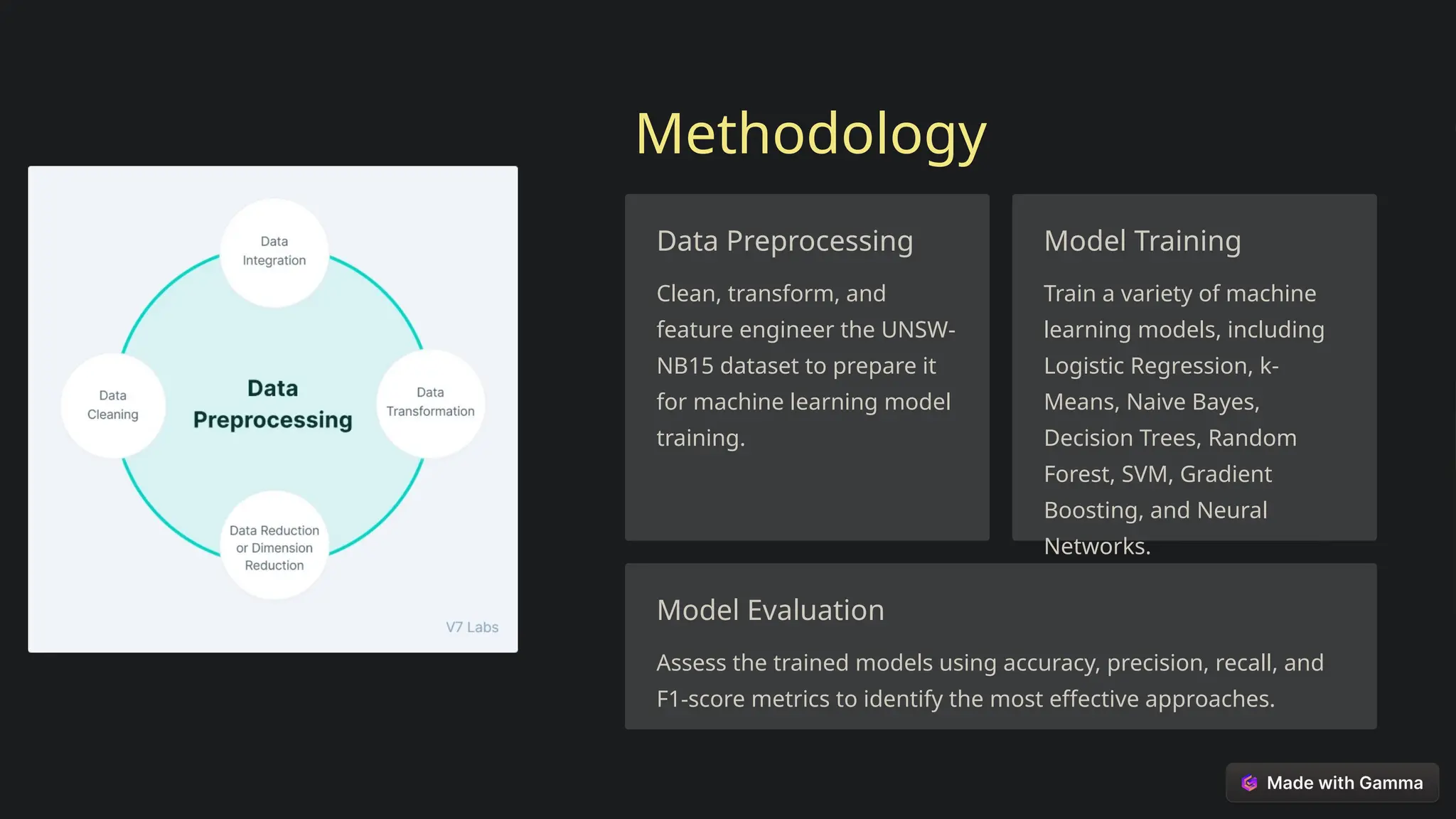
Data Preprocessing
Clean, transform, and
feature engineer the UNSW-
NB15 dataset to prepare it
for machine learning model
training.
Model Training
Train a variety of machine
learning models, including
Logistic Regression, k-
Means, Naive Bayes,
Decision Trees, Random
Forest, SVM, Gradient
Boosting, and Neural
Networks.
Model Evaluation
Assess the trained models using accuracy, precision, recall, and
F1-score metrics to identify the most effective approaches.
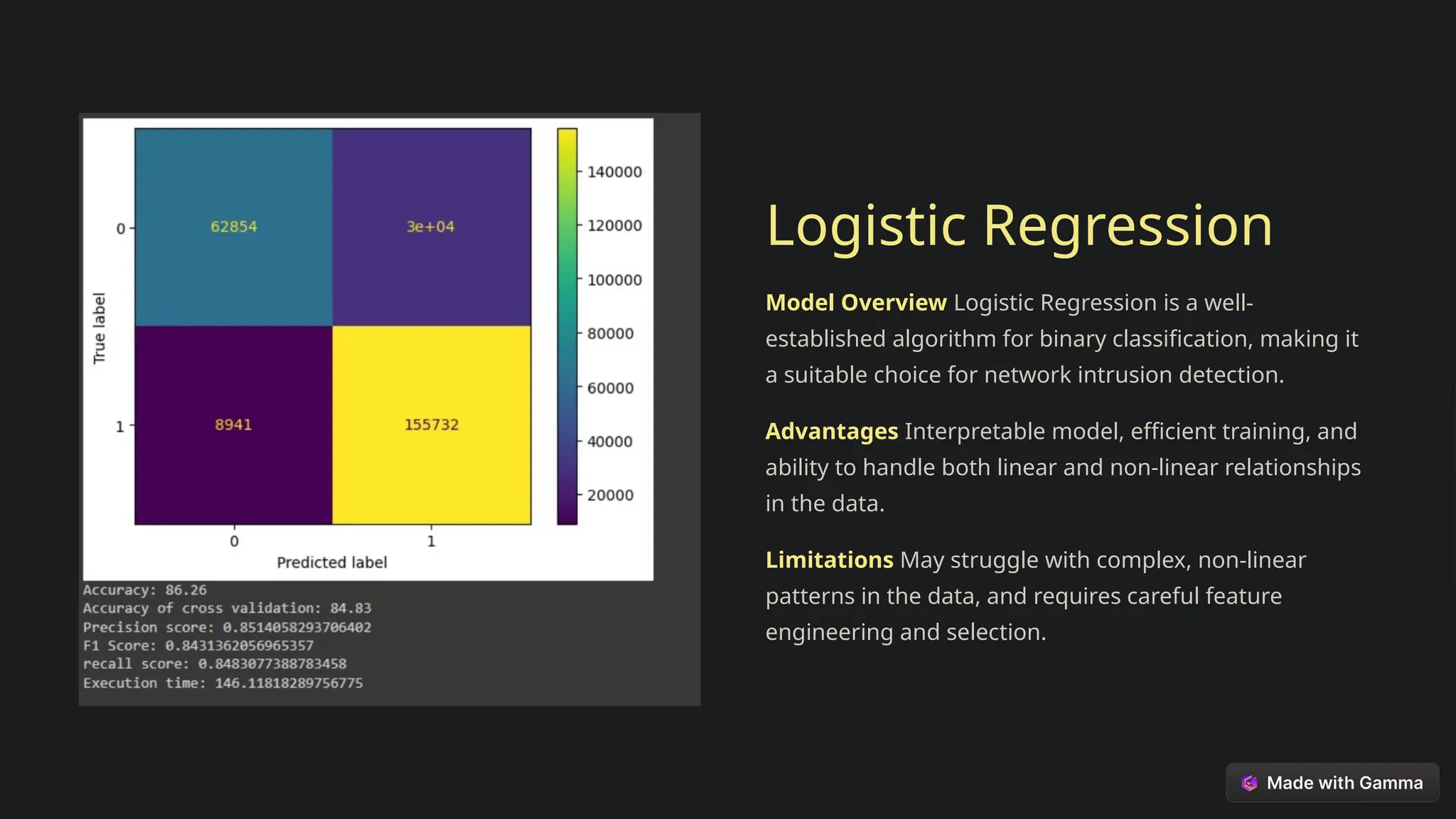
Logistic Regression
Model Overview Logistic Regression is a well-
established algorithm for binary classification, making it
a suitable choice for network intrusion detection.
Advantages Interpretable model, efficient training, and
ability to handle both linear and non-linear relationships
in the data.
Limitations May struggle with complex, non-linear
patterns in the data, and requires careful feature
engineering and selection.
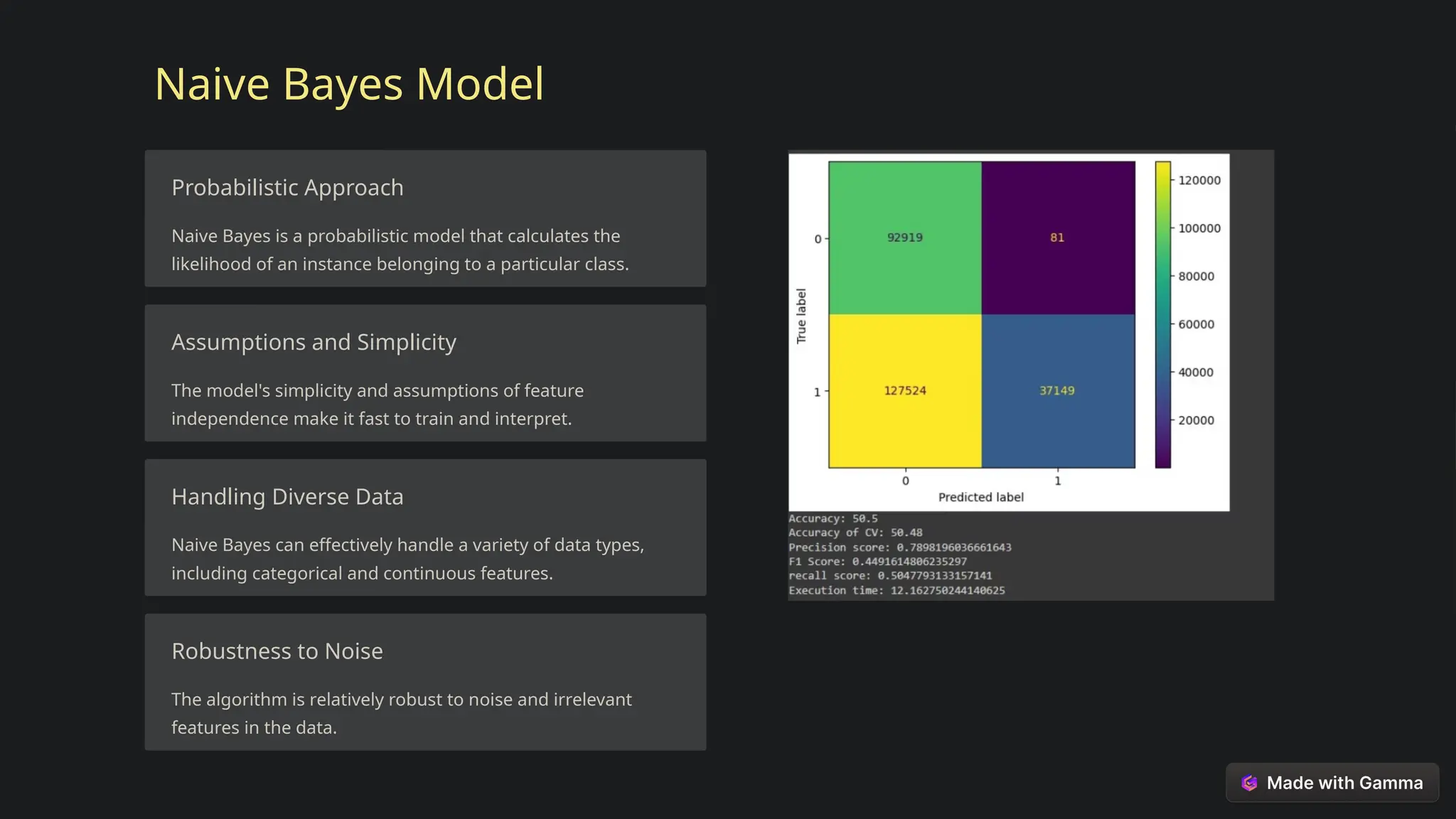
Naive Bayes Model
Probabilistic Approach
Naive Bayes is a probabilistic model that calculates the
likelihood of an instance belonging to a particular class.
Assumptions and Simplicity
The model's simplicity and assumptions of feature
independence make it fast to train and interpret.
Handling Diverse Data
Naive Bayes can effectively handle a variety of data types,
including categorical and continuous features.
Robustness to Noise
The algorithm is relatively robust to noise and irrelevant
features in the data.
Decision Tree Model
Data Interpretability
Decision trees provide a highly
interpretable model, making it
easy to understand the decision-
making process.
Feature Importance
The model can identify the most
important features, which is
valuable for feature engineering
and selection.
Flexibility
Decision trees can handle both
numerical and categorical data,
making them versatile for
network intrusion detection.
Overfitting Potential
Decision trees may be prone to
overfitting, especially on
complex datasets, requiring
careful hyperparameter tuning.
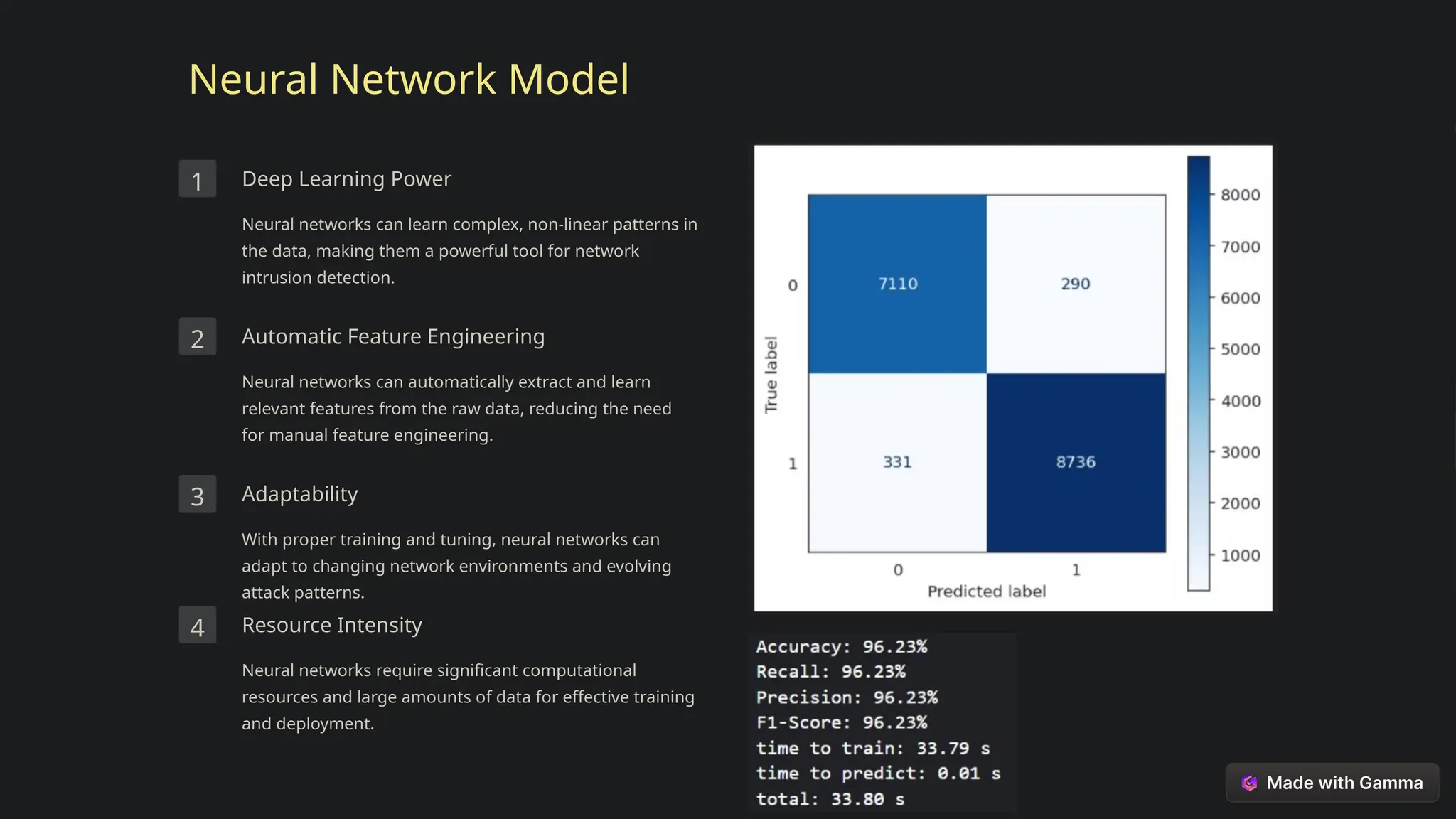
Neural Network Model
1 Deep Learning Power
Neural networks can learn complex, non-linear patterns in
the data, making them a powerful tool for network
intrusion detection.
2 Automatic Feature Engineering
Neural networks can automatically extract and learn
relevant features from the raw data, reducing the need
for manual feature engineering.
3 Adaptability
With proper training and tuning, neural networks can
adapt to changing network environments and evolving
attack patterns.
4 Resource Intensity
Neural networks require significant computational
resources and large amounts of data for effective training
and deployment.
Gradient Boosting Model
Ensemble
Learning
Gradient Boosting
combines multiple
weak learners,
such as decision
trees, to create a
strong, accurate
model.
Iterative
Optimization
The model
iteratively
improves by
focusing on the
mistakes made by
the previous
learners, leading
to enhanced
performance.
Handling
Complexity
Gradient Boosting
can effectively
capture complex,
non-linear
patterns in the
network intrusion
detection data.
Support Vector Machine (SVM)
Model
Strength Ability to handle high-dimensional
data and complex, non-linear
relationships
Weakness Sensitivity to feature scaling and the
selection of appropriate kernel
functions
Use Case SVM can be particularly effective for
binary classification tasks, such as
distinguishing between normal and
anomalous network traffic
Optimization Careful tuning of hyperparameters,
such as the regularization parameter
and kernel type, is crucial for optimal
performance
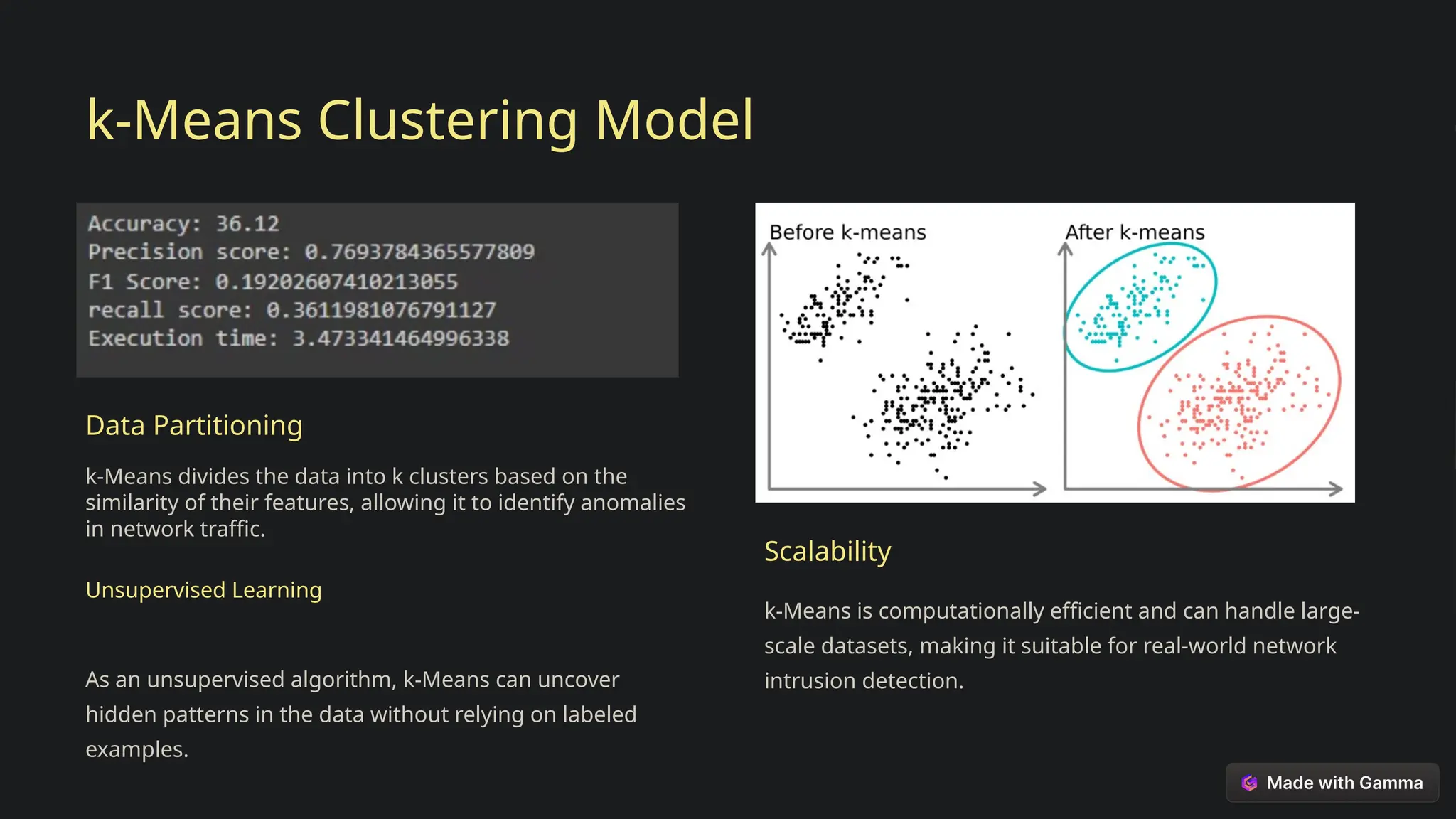
k-Means Clustering Model
Data Partitioning
k-Means divides the data into k clusters based on the
similarity of their features, allowing it to identify anomalies
in network traffic.
Unsupervised Learning
As an unsupervised algorithm, k-Means can uncover
hidden patterns in the data without relying on labeled
examples.
Scalability
k-Means is computationally efficient and can handle large-
scale datasets, making it suitable for real-world network
intrusion detection.
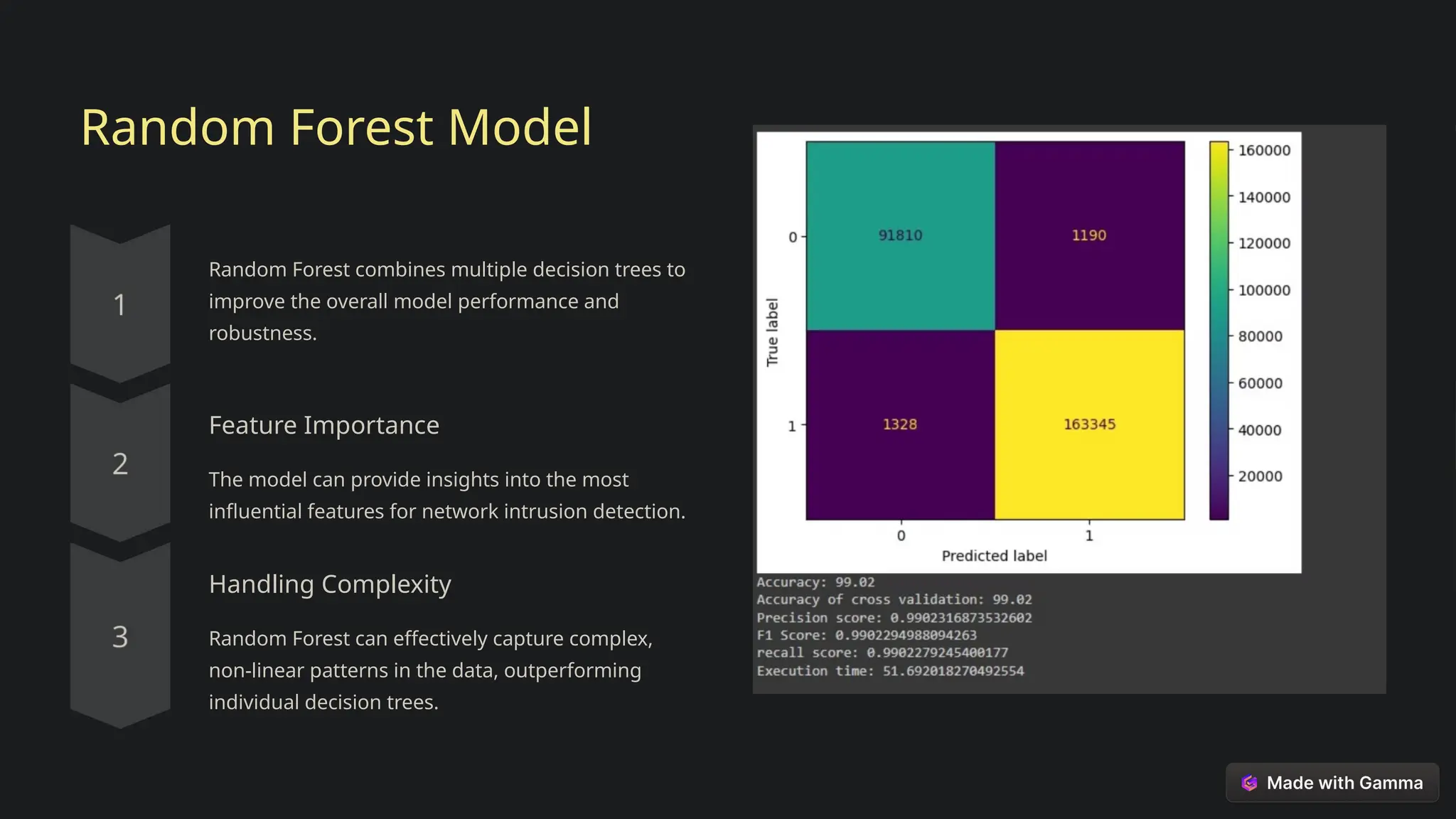
Random Forest Model
Random Forest combines multiple decision trees to
improve the overall model performance and
robustness.
Feature Importance
The model can provide insights into the most
influential features for network intrusion detection.
Handling Complexity
Random Forest can effectively capture complex,
non-linear patterns in the data, outperforming
individual decision trees.
Evaluation Metrics
1 Accuracy
The overall correctness of the model in correctly identifying both
normal and intrusive network traffic.
2 Precision
The model's ability to correctly identify true positive instances
among all positive predictions.
3 Recall
The model's ability to correctly identify all true positive instances
among all actual positive instances.
4 F1-Score
The harmonic mean of precision and recall, providing a balanced
measure of the model's performance.
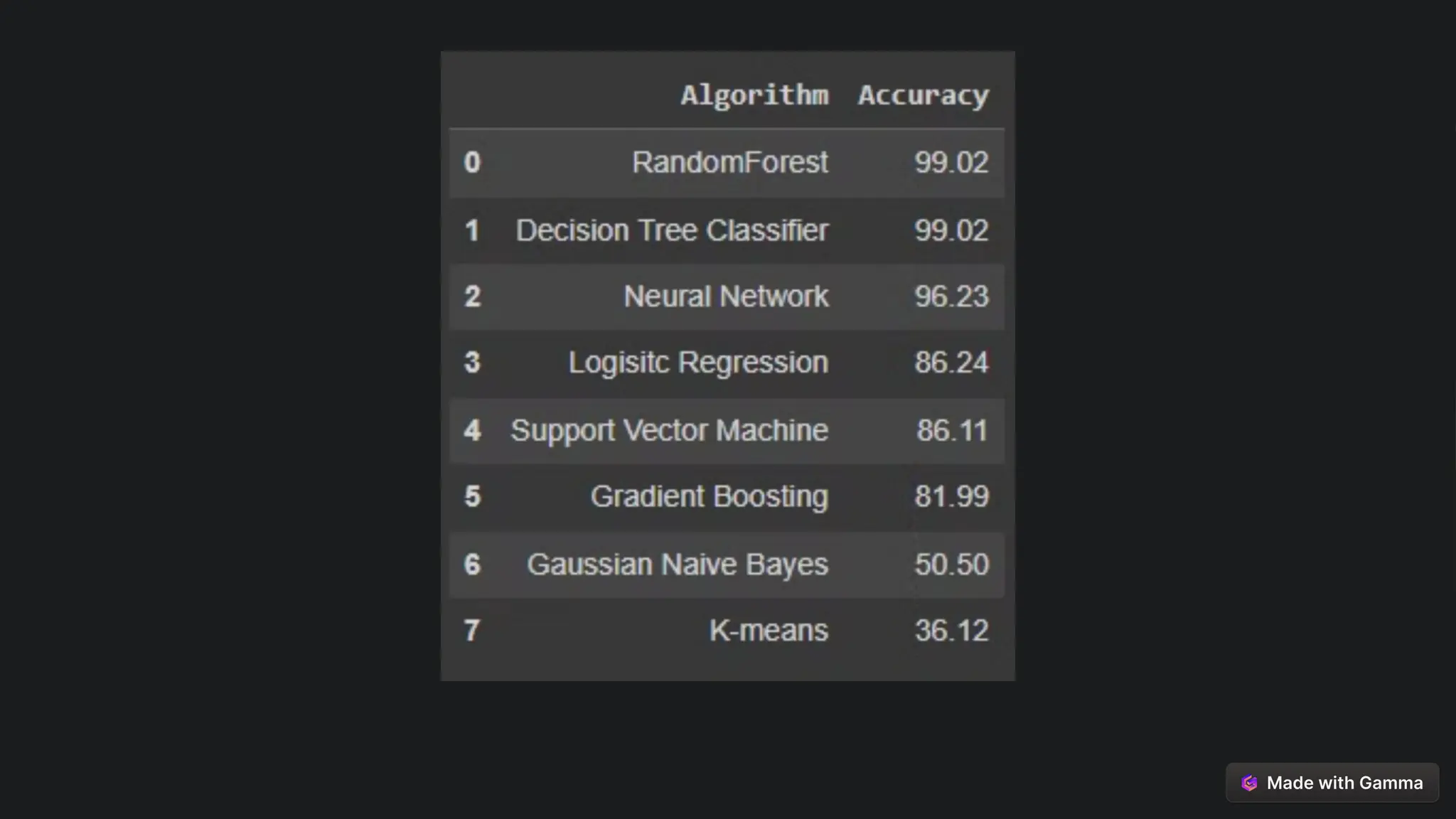
Comparision Charts
Challenges and Limitations
1 Data Availability
The availability of
comprehensive and up-
to-date network traffic
datasets is crucial for
effective model
development and
evaluation.
2 Computational
Efficiency
Ensuring the real-time
performance of NIDS
requires optimizing the
machine learning models
for efficient deployment.
3 Adaptability
Continuously evolving cyber threats demand that NIDS have
the ability to adapt and learn from new data and attack
patterns.
Future Work and Recommendations
Ongoing Research
Explore advanced machine learning techniques, such as transfer learning and federated
learning, to further enhance NIDS capabilities.
Collaborative Efforts
Encourage cross-industry and academic collaboration to share knowledge, datasets, and
best practices for network security.
Automation and Integration
Integrate NIDS with security orchestration and automated response (SOAR) platforms to
enable swift and coordinated actions.
Conclusion
This research has demonstrated the immense potential of network
intrusion detection systems (NIDS) powered by machine learning to
combat evolving cyber threats and safeguard critical networks. By
leveraging advanced algorithms and techniques, we have unlocked
new capabilities in identifying complex attack patterns and
protecting valuable assets. The insights gained from this work can
serve as a strong foundation for future advancements in network
security, empowering organizations to stay ahead of the ever-
changing landscape of cyber threats.

Network-Intrusion-Detection-Using-Machine-Learning-1.pptx

  • 1.
    Network Intrusion Detection Using MachineLearning Ensuring the security and integrity of computer networks is crucial in today's digital landscape. This presentation explores the power of machine learning in bolstering network intrusion detection systems (NIDS) to combat evolving cyber threats.
  • 2.
    Importance of NetworkSecurity 1 Protecting Sensitive Data Robust network security measures are crucial for safeguarding an organization's valuable and confidential data, including customer information, financial records, and intellectual property, from unauthorized access, theft, and exploitation by malicious actors. 2 Ensuring Operational Continuity Effective network intrusion detection systems (NIDS) help prevent disruptive cyber attacks, such as distributed denial-of-service (DDoS) incidents, that can cripple an organization's operations and cause significant downtime, financial losses, and reputational damage. 3 Maintaining Compliance Robust network security solutions, including advanced NIDS, are essential for meeting the stringent compliance requirements set by industry regulators and standards bodies, failure of which can result in hefty fines and legal consequences for the organization.
  • 3.
    The Need forAdvanced Network Intrusion Detection Evolving Cyber Threats Malicious actors are constantly developing new and increasingly sophisticated techniques to infiltrate computer networks. This rapid evolution of cyber threats demands more advanced network intrusion detection capabilities that can keep pace with the dynamic nature of modern attack methods. Limitations of Traditional NIDS Signature-based and rule-based network intrusion detection systems (NIDS) often struggle to effectively identify and mitigate the latest cyber threats. These traditional approaches rely on predefined patterns and rules, making them inherently limited in their ability to adapt and respond to novel attack vectors that emerge over time. Adaptive, AI-Powered Solutions To address the shortcomings of traditional NIDS, there is a growing need for more advanced, adaptive solutions that leverage the power of machine learning and artificial intelligence. These AI-powered NIDS can learn and evolve, enabling them to detect and prevent a wider range of sophisticated cyber attacks, including those that do not match known signatures or predefined rules.
  • 4.
    Literature Survey G. Aceto,D. Ciuonzo, A. Montieri, V. Persico, and A. Pescape, "AI-powered Internet Traffic Classification: Past, Present, and Future," IEEE Communications Surveys & Tutorials, vol. 21, no. 3, pp. 2386-2431, third quarter 2019. N. Capuano, G. Fenza, V. Loia, and C. Stanzione, "Explainable Artificial Intelligence in CyberSecurity: A Survey," IEEE Access, vol. 8, pp. 145916-145935, 2020. A. Halbouni, T. S. Gunawan, M. H. Habaebi, M. Halbouni, M. Kartiwi, and R. Ahmad, "Machine Learning and Deep Learning Approaches for CyberSecurity: A Review," IEEE Access, vol. 9, pp. 19483-19501, 2021. M. Usama, J. Qadir, A. Raza, H. Arif, K.-L. A. Yau, Y. Elkhateb, A. Hussain, and A. Al-Fuqaha, "Unsupervised Machine Learning for Networking: Techniques, Applications and Research Challenges," IEEE Access, vol. 7, pp. 65579- 65615, 2019. This section provides a comprehensive literature survey on the application of machine learning and AI-powered techniques in network intrusion detection and cybersecurity. The cited works cover a range of topics, including traffic classification, explainable AI, and unsupervised machine learning approaches for network security.
  • 5.
    Key Objectives 1 DevelopAdvanced ML Models Our primary goal is to leverage the comprehensive UNSW-NB15 dataset to design and train innovative machine learning models capable of accurately detecting a wide range of network intrusions and cyber threats. 2 Rigorously Evaluate Model Performance We will thoroughly assess the accuracy, precision, recall, and F1-score of the developed machine learning models to identify the most effective and robust approaches for network intrusion detection. 3 Optimize for Real-Time Deployment The final step will be to optimize the selected models for efficient real-time implementation and integration within operational network intrusion detection systems (NIDS), ensuring seamless and effective cybersecurity protection.
  • 6.
    Methodology Data Preprocessing Clean, transform,and feature engineer the UNSW- NB15 dataset to prepare it for machine learning model training. Model Training Train a variety of machine learning models, including Logistic Regression, k- Means, Naive Bayes, Decision Trees, Random Forest, SVM, Gradient Boosting, and Neural Networks. Model Evaluation Assess the trained models using accuracy, precision, recall, and F1-score metrics to identify the most effective approaches.
  • 7.
    Logistic Regression Model OverviewLogistic Regression is a well- established algorithm for binary classification, making it a suitable choice for network intrusion detection. Advantages Interpretable model, efficient training, and ability to handle both linear and non-linear relationships in the data. Limitations May struggle with complex, non-linear patterns in the data, and requires careful feature engineering and selection.
  • 8.
    Naive Bayes Model ProbabilisticApproach Naive Bayes is a probabilistic model that calculates the likelihood of an instance belonging to a particular class. Assumptions and Simplicity The model's simplicity and assumptions of feature independence make it fast to train and interpret. Handling Diverse Data Naive Bayes can effectively handle a variety of data types, including categorical and continuous features. Robustness to Noise The algorithm is relatively robust to noise and irrelevant features in the data.
  • 9.
    Decision Tree Model DataInterpretability Decision trees provide a highly interpretable model, making it easy to understand the decision- making process. Feature Importance The model can identify the most important features, which is valuable for feature engineering and selection. Flexibility Decision trees can handle both numerical and categorical data, making them versatile for network intrusion detection. Overfitting Potential Decision trees may be prone to overfitting, especially on complex datasets, requiring careful hyperparameter tuning.
  • 10.
    Neural Network Model 1Deep Learning Power Neural networks can learn complex, non-linear patterns in the data, making them a powerful tool for network intrusion detection. 2 Automatic Feature Engineering Neural networks can automatically extract and learn relevant features from the raw data, reducing the need for manual feature engineering. 3 Adaptability With proper training and tuning, neural networks can adapt to changing network environments and evolving attack patterns. 4 Resource Intensity Neural networks require significant computational resources and large amounts of data for effective training and deployment.
  • 11.
    Gradient Boosting Model Ensemble Learning GradientBoosting combines multiple weak learners, such as decision trees, to create a strong, accurate model. Iterative Optimization The model iteratively improves by focusing on the mistakes made by the previous learners, leading to enhanced performance. Handling Complexity Gradient Boosting can effectively capture complex, non-linear patterns in the network intrusion detection data.
  • 12.
    Support Vector Machine(SVM) Model Strength Ability to handle high-dimensional data and complex, non-linear relationships Weakness Sensitivity to feature scaling and the selection of appropriate kernel functions Use Case SVM can be particularly effective for binary classification tasks, such as distinguishing between normal and anomalous network traffic Optimization Careful tuning of hyperparameters, such as the regularization parameter and kernel type, is crucial for optimal performance
  • 13.
    k-Means Clustering Model DataPartitioning k-Means divides the data into k clusters based on the similarity of their features, allowing it to identify anomalies in network traffic. Unsupervised Learning As an unsupervised algorithm, k-Means can uncover hidden patterns in the data without relying on labeled examples. Scalability k-Means is computationally efficient and can handle large- scale datasets, making it suitable for real-world network intrusion detection.
  • 14.
    Random Forest Model RandomForest combines multiple decision trees to improve the overall model performance and robustness. Feature Importance The model can provide insights into the most influential features for network intrusion detection. Handling Complexity Random Forest can effectively capture complex, non-linear patterns in the data, outperforming individual decision trees.
  • 15.
    Evaluation Metrics 1 Accuracy Theoverall correctness of the model in correctly identifying both normal and intrusive network traffic. 2 Precision The model's ability to correctly identify true positive instances among all positive predictions. 3 Recall The model's ability to correctly identify all true positive instances among all actual positive instances. 4 F1-Score The harmonic mean of precision and recall, providing a balanced measure of the model's performance.
  • 17.
  • 19.
    Challenges and Limitations 1Data Availability The availability of comprehensive and up- to-date network traffic datasets is crucial for effective model development and evaluation. 2 Computational Efficiency Ensuring the real-time performance of NIDS requires optimizing the machine learning models for efficient deployment. 3 Adaptability Continuously evolving cyber threats demand that NIDS have the ability to adapt and learn from new data and attack patterns.
  • 20.
    Future Work andRecommendations Ongoing Research Explore advanced machine learning techniques, such as transfer learning and federated learning, to further enhance NIDS capabilities. Collaborative Efforts Encourage cross-industry and academic collaboration to share knowledge, datasets, and best practices for network security. Automation and Integration Integrate NIDS with security orchestration and automated response (SOAR) platforms to enable swift and coordinated actions.
  • 21.
    Conclusion This research hasdemonstrated the immense potential of network intrusion detection systems (NIDS) powered by machine learning to combat evolving cyber threats and safeguard critical networks. By leveraging advanced algorithms and techniques, we have unlocked new capabilities in identifying complex attack patterns and protecting valuable assets. The insights gained from this work can serve as a strong foundation for future advancements in network security, empowering organizations to stay ahead of the ever- changing landscape of cyber threats.