This paper analyzes the performance of various machine learning algorithms for intrusion detection systems (IDS) using the KDD Cup-99 dataset, emphasizing the need to reduce false alarm rates to improve efficiency. It discusses different types of IDS, including those based on signatures and anomalies, and proposes a five-step generic model for IDS design to enhance detection capabilities while minimizing false positives. The research aims to assist future studies and improve intrusion detection technologies through rigorous evaluation of classification algorithms.
![Journal of Biomechanical Science and Engineering
Japan Society of Mechanical Engineers
ISSN: 1880-9863
Advances in Mechanical, Civil, Computer Engineering in respect Public Health and Safety
DOI 10.17605/OSF.IO/WX6CS
621 | April 2023
PERFORMANCE EVALUATION OF MACHINE LEARNING
ALGORITHMS FOR INTRUSION DETECTION SYSTEM
Sudhanshu Sekhar Tripathy 1 and Bichitrananda Behera 2
1, 2
Department of Computer Science and Engineering, C.V. Raman Global University Bhubaneswar, Odisha.
Email: 1
tripathysudhanshu6@gmail.com, 2
bbehera19@gmail.com
Abstract
The escalation of hazards to safety and hijacking of digital networks are among the strongest perilous difficulties
that must be addressed in the present day. Numerous safety procedures were set up to track and recognize any
illicit activity on the network's infrastructure. IDS are the best way to resist and recognize intrusions on internet
connections and digital technologies. To classify network traffic as normal or anomalous, Machine Learning (ML)
classifiers are increasingly utilized. An IDS with machine learning increases the accuracy with which security
attacks are detected. This paper focuses on intrusion detection systems (IDSs) analysis using ML techniques. IDSs
utilizing ML techniques are efficient and precise at identifying network assaults. In data with large dimensional
spaces, however, the efficacy of these systems degrades. Correspondingly, the case is essential to execute a
feasible feature removal technique capable of getting rid of characteristics that have little effect on the
classification process. In this paper, we analyze the KDD CUP-'99' intrusion detection dataset used for training
and validating ML models. Then, we implement ML classifiers such as “Logistic Regression, Decision Tree, K-
Nearest Neighbour, Naïve Bayes, Bernoulli Naïve Bayes, Multinomial Naïve Bayes, XG-Boost Classifier, Ada-
Boost, Random Forest, SVM, Rocchio classifier, Ridge, Passive-Aggressive classifier, ANN besides Perceptron
(PPN), the optimal classifiers are determined by comparing the results of Stochastic Gradient Descent and back-
propagation neural networks for IDS”, Conventional categorization indicators, such as "accuracy, precision,
recall, and the f1-measure", have been used to evaluate the performance of the ML classification algorithms.
Keywords: ML classifiers, Intrusion detection system (IDS), False alarm rate, KDD CUP-99 dataset
1. INTRODUCTION
In computer networks, the number of fraudulent operations, intrusions, and attacks has
increased dramatically in recent years. Owing to innovations in technology progress, more than
90 percent of practical-circumstances activities are currently accessible in cyberspace. Several
procedures involving financial services, buying something, examinations via the Internet,
online sales, and exchange of information are thoroughly employed. With the dynamic
development in the number of Internet-accessible services, Internet information security must
be regularly maintained and adequate protection against cyberattacks is required. Use of
traditional technology, such as a firewall, to repel attacks. Consequently, an IDS is typically
set up to enhance the network security of businesses and other organizations [1]. A firewall is
a passive system of manual protection, whereas an IDS system is an active system of automated
protection.
An IDS (Intrusion Detection System), is the technique for detecting and tracking intrusive
activities and reporting on any security breaches in an IT infrastructure or a network, along
with analyzing evidence of potential events, such as unpredictability or imminent threats of
breaching computer network security designs, acceptable implemented policies, or obsolete
safety provisions. The two primary types of intrusion detection systems IDS are based on both
signatures and abnormalities. The first method utilizes a repository that contains known
malicious activity signatures along with generating an alert if communication over the network
fits a specific signature, while the second one works with an approach for standardizing system](https://image.slidesharecdn.com/44th2apr23wx6cs-231104063226-fa46a1b6/85/PERFORMANCE-EVALUATION-OF-MACHINE-LEARNING-ALGORITHMS-FOR-INTRUSION-DETECTION-SYSTEM-1-320.jpg)
![Journal of Biomechanical Science and Engineering
Japan Society of Mechanical Engineers
ISSN: 1880-9863
Advances in Mechanical, Civil, Computer Engineering in respect Public Health and Safety
DOI 10.17605/OSF.IO/WX6CS
622 | April 2023
operations and raises alarms for evident abnormalities. Although IDS have demonstrated their
ability to identify multiple attacks on the network and have evolved into exhaustive protection
in a broad network, it is of extreme concern that it triggers an excessive amount of alarms,
almost all of which are false positives. This diminishes IDS's efficacy. Consequently, the
overwhelming extent of improperly categorized warnings is a key issue influencing the
operation of IDS [3]. False positive alerts are those that are triggered when an IDS erroneously
identifies a benign action as harmful.
In the past couple of years, the proportion of erroneous alerts has been utilized to measure the
effectiveness of Systems to identify intrusions; consequently, they play an essential part in
reducing the overall result of these detection systems. IDSs are the most common approach for
detecting such kind of behavior. IDSs include Intrusion Detection Using Signatures, Systems
for detecting intrusions based on anomalies, and hybrid model Systems. Figure 1. Illustrates
the various types of IDS.
Intrusion Detection Using Signatures employs algorithmic pattern-matching tactics to detect
intrusions and preserve the signatures of harmful actions in a knowledge base. In the interim,
AIDSs attempt to comprehend the typical conduct of the actions and designate comparable to
the suspect. This form of system exists, a signature database is not required, and the system is
capable of identifying Never-before-known zero-day vulnerabilities assaults observed before.
The combination of SIDS and AIDS is used to aggregate hybrid systems to increase the
prevalence of known malevolent actions while decreasing the percentage of erroneous positives
for zero-day vulnerability assaults. [2].
Even though Signature-based IDS generates fewer false positive alerts than Anomaly-based
IDS, false positives cannot be avoided. All of these explanations motivate researchers to
develop strategies that can proportionally reduce false positives. Specifically, numerous
technologies, encompassing machine learning algorithms as well as control visual content, and
an intelligent false alarm filter, have been considered.
There are numerous kinds of detection of breaches strategies, but their accuracy is still a
concern, accuracy is contingent on the frequency of detecting and erroneous alerts. To decrease
a lot of erroneous positives and increase the frequency of detection, it is necessary to address
the issue of precision. These research efforts were prompted by this concept. In the literature,
the most common ML/DNN classifiers [4] are “LR, DT, KNN, Naive Bayes, Multinomial
Naïve Bayes (MNB), Bernoulli Naïve Bayes (BNB), XG-Boost Classifier, Ada-Boost
Classifier, RF, SVM, RC, Ridge, Passive-Aggressive (PA) classifier, ANN besides Perceptron
(PPN), Back-propagation neural network (BPN) and stochastic-gradient descent (SGD)”.
This paper intends to investigate the most advantageous techniques for eliminating erroneous
alarms intrusion detection systems (IDSs) by analyzing the performance, of the majority
prevalent algorithms for machine learning found in the literature on intrusion detection
systems. In addition, matrices comparing the efficacy of the native classification algorithms
have to be assessed analytically through precisely defined parameters that include “accuracy,
precision, recall, and f-measure” on the openly accessible KDD Cup-99 dataset. The analysis
will aid future researchers in gathering information on all proposed methods from a theoretical
perspective and can serve as a fast reference for those unfamiliar with the topic.](https://image.slidesharecdn.com/44th2apr23wx6cs-231104063226-fa46a1b6/85/PERFORMANCE-EVALUATION-OF-MACHINE-LEARNING-ALGORITHMS-FOR-INTRUSION-DETECTION-SYSTEM-2-320.jpg)
![Journal of Biomechanical Science and Engineering
Japan Society of Mechanical Engineers
ISSN: 1880-9863
Advances in Mechanical, Civil, Computer Engineering in respect Public Health and Safety
DOI 10.17605/OSF.IO/WX6CS
626 | April 2023
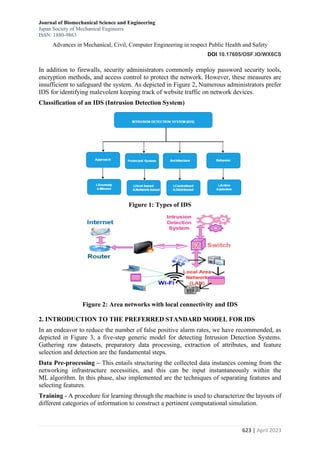
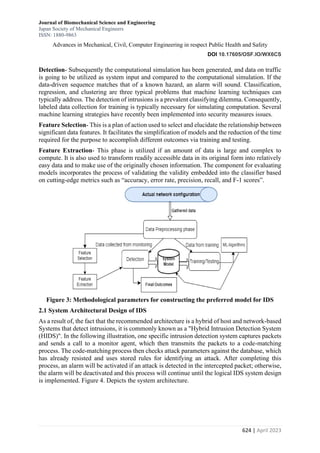
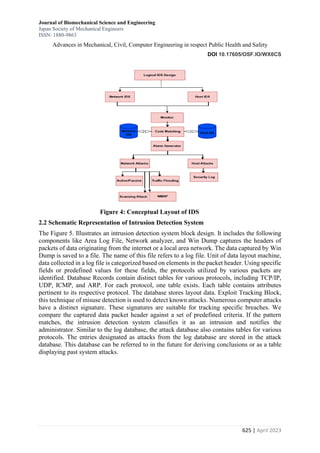
Figure 5: Schematic Representation of IDS
2.3 Literature Review
Different ML network-based detection systems known as Network Intrusion Systems (NIDSs)
are being built recently to defend in opposition to malevolent attacks, according to the authors
of [6]. This article recommends a literary work that is multiple stages optimized NIDS
according to ML structure which minimizes the amount of computation required without
compromising tracking efficacy, as well as the influence of excessive sampling approaches on
the training sample number of prototypes and the minimum training sample number is
examined and that is suitable. In addition, various ML hyper-factors optimization procedures
are investigated to enhance the efficacy of the NIDS. The two current IDS datasets, CICIDS
2017 and UNSW-NB 2015 are utilized for assessing the usefulness of the suggested framework
[6]. The findings of the experimental research demonstrate that the recommended paradigm
substantially decreases the essential dimensions of samples for training (74% fit) and feature
set size (50% fit). Furthermore, tuning parameter value optimization boosts the model's
efficiency by finding accuracy scores above 99% among the two datasets, surpassing recent by
1-2% of literature better accuracy and the degree of precision and 1-2% fewer false positives.
The authors of [7] state that scholars suggested several ways of discerning suspicious activity
to mitigate the impact of threats; moreover, up-to-date mechanisms frequently fail to adjust to
constant change designs, linked hazards, and zero-day exploits. This script plans to address the
flaws and drawbacks of existing datasets, their impact on Network Intrusion Detection System
(NIDS) construction, along with the expanding quantity of refined hazards. This article
concludes by employing a couple of essential facets of knowledge for researchers; an
investigation of prevalent datasets, considering their implementation and influence on the
advancement of the previous era's systems for recognizing Security breaches, and a
categorization of network hazards and the auxiliary equipment to combat such assaults. The
greatest aspect of the paper is merely the most recent IDS research comprises 33.3% of which
of our hazard classification. The latest datasets reveal a distinct absence of actual network
hazards, assault demonstration, along with a substantial proportion of criticized hazards, that
limits the detecting efficiency of contemporary machine learning IDS techniques. This
manuscript's novel integration of categorization and dataset investigation seeks to increase the
development of datasets and the gathering of data from the current research globe.
Using the repeated existence of network security actions, the authors of [8] state that the
Intrusion Detection System (IDS) is designed to produce records of alerts and logs when](https://image.slidesharecdn.com/44th2apr23wx6cs-231104063226-fa46a1b6/85/PERFORMANCE-EVALUATION-OF-MACHINE-LEARNING-ALGORITHMS-FOR-INTRUSION-DETECTION-SYSTEM-6-320.jpg)
![Journal of Biomechanical Science and Engineering
Japan Society of Mechanical Engineers
ISSN: 1880-9863
Advances in Mechanical, Civil, Computer Engineering in respect Public Health and Safety
DOI 10.17605/OSF.IO/WX6CS
627 | April 2023
observing a network environment where numerous trace and alert records are stored
unnecessarily, resulting in an unlimited burden on server storage and security workforces.
Researchers have always been motivated by the question of how to diminish superfluous
evidence of network detection of intrusion alerts. Using the whale optimization algorithm, the
authors of this paper propose a method for handling a vast number of superfluous alarms. Based
on the hierarchical clustering of alarms, they are incorporating the whale optimization
technique within the method of alert generation. The UNSW-NB15 dataset is examined to
validate the algorithm's probability; in comparison with earlier alarm clustering approaches, an
alarm clustering approach developed using the whale optimization technique can produce a
clustering of higher quality in less time. The outcomes indicate that the suggested technique
could effectively diminish superfluous alarms and decrease the workload of IDS and personnel.
The development of systems for intrusion detection employs deep learning features in light of
their technological advantages, including elevated correctness, computerization, and
scalability, which enhance actual network intrusion detection systems, according to the authors
of [9]. They proposed a Unique and adaptable resilient NIDS that employs a recurrent neural
network (RNN) featuring a multi-classifier to produce a real-time detection model. In the
outcomes of experiments, the system identifies network assaults with pinpoint accuracy and
real-time simulation enhancement at a high rate, while demonstrating robustness under attack.
According to the authors of [10], a combination of techniques provides improvements in
efficacy. They suggested a Double-Layer Hybrid Approach (DLHA) intended to deal with the
aforesaid issue. They evaluated performance by applying the NSL-KDD dataset. The outcomes
of the experiments indicate that DLHA surpasses extant IDS methods. By achieving detection
rates of 96.67 percent and one hundred percent from R2L and U2R, respectively, DLHA excels
at detecting rare attacks.
Table 1: Comparative Summary of Related Works
Reference Dataset Classifiers Used
Assessment
Matrix
Findings
S.Zwane,
P.Tarwireyi et al.
[11]
UNSW-
NB15
DT (J48), AdaBoost,
RF, Bootstrap
Aggregation. Multi-
Layer Perceptron,
Bayesian Network,
SVM
TPR, FPR,
ROC Curve,
Test-time, and
Build-time.
Collective Learning surpassed
individual Ensemble-based models are
typically sluggish in terms of model
construction and evaluation.
M. Injadat, A.
Moubayed et al.
[6]
CICIDS
2017 and
UNSW-NB
2015
Bayesian
Optimization
implementing the Tree
Parzen Estimator
(BO-TPE-RF) and
KNN
Precision,
Accuracy,
Recall/ TPR,
FAR/FPR
(false
alarm/positive
rate)
Concerning accuracy, Information
Acquisition Based Selection of Features
(IGBFS) outperformed correlation-
based feature selection.
H. Hindy et al. [7] KDD-99 k-means versus SVM
TP, TN, FP,
FN
It demonstrates that the latest IDS
analysis only encompasses
approximately 33.3% of the
vulnerabilities prevalent across the
taxonomies and that ML is utilized by
97.25 % of the analyzed IDS.](https://image.slidesharecdn.com/44th2apr23wx6cs-231104063226-fa46a1b6/85/PERFORMANCE-EVALUATION-OF-MACHINE-LEARNING-ALGORITHMS-FOR-INTRUSION-DETECTION-SYSTEM-7-320.jpg)
![Journal of Biomechanical Science and Engineering
Japan Society of Mechanical Engineers
ISSN: 1880-9863
Advances in Mechanical, Civil, Computer Engineering in respect Public Health and Safety
DOI 10.17605/OSF.IO/WX6CS
628 | April 2023
Wang,L.;Gu, L.;
Tang, Y. [8]
UNSW-
NB15
WOA (Whale
Optimization
Algorithm),
hierarchical alarm
clustering algorithm.
Accuracy
Precisions,
Recall
WOA has been used to address the issue
of numerous superfluous alarms caused
by an IDS to detect spurious alarms.
K. Yu, K. Nguyen
et al. [9]
NSL-KDD
99, UNSW-
NB15,Kyoto
2006,CIDDS
Multi-Classifiers like
LR, DT, KNN, RF,
Multilayer Perceptron,
Gaussian_NB, and
Gradient Boosting.
Based on the
ROC (Receiver
operating
characteristic)
curve, TPR,
FPR, and Area
under the curve
(AUC) are
utilized to
characterize
the
performance of
the proposed
system.
This system uses RNN in conjunction
with a multi-classifier and random
system parameters to create a NIDS that
is both adaptable and resilient.
T.
Wisanwanichthan
et.al. [10]
NSL-KDD Naïve Bayes, SVM
Accuracy,
F1_score,
Precision,
Detection rate
(Recall), and
FAR
The results of the experiments indicate
that DLHA outperforms existing IDS
methods. DLHA excels at detecting rare
incidents with detection rates of 96.67
percent and one hundred percent from
R2L and U2R, respectively.
R.Elhefnawy, H.
Abounaser, et al.
[12]
KDDCUP99,
and UNSW-
NB15
FLS (Fuzzy Logic
System)
CLASSIFIER, SVM
Accuracy,
Precision,
Recall, FAR,
F-Score
Hybrid Nested Genetic-Fuzzy
Algorithm (HNGFA) outperforms other
techniques for all types of assaults with
a significant degree of FAR in a variety
of dataset configurations.
Mahfouz, A. M.,
Venugopal, et al.
[15]
NSL-KDD
Naïve Bayes, LR,
Multilayer
Perceptron, SVM,
KNN, DT.
Accuracy,
TPR, FPR,
Precision,
Recall, F-
Measure, ROC
Area
J48 surpasses other classifiers in terms
of proficiency during the first phase,
whereas IBK (Instance-Based KNN)
executes faster throughout the second
phase.
G. Kocher and G.
Kumar, [16]
UNSW-
NB15
KNN, SGD,
DT,RF,LR, Naïve
Bayes
Accuracy,
Mean Squared
Error
Precision,
Recall, F1-
Score, TPR,
FPR.
RF classifier performs better than other
classifiers.
Pai, Vasudeva &
Bhat et al. [17]
NSL-KDD
RF, Naive Bayes,
SVM, J48, LR, and
DT
Accuracy,
Precision,
Recall, ROC,
F1-Score
RF classifier performs better than other
classifiers.
O. Almomani, M.
A. Almaiah et al.
[18]
UNSW-
NB15
LR, Multinomial
Naive Bayesian,
Gaussian Naive
Bayesian, Bernoulli
Naive Bayesian,
KNN, DT, Adaptive
Boosting, RF,
Multilayer Perceptron,
and Gradient Boosting
accuracy,
precision, F-
measure
Random Forest classifier boasts the
greatest Accuracy, Precision, and F-
measure for an IDS.
Othman et al.
[19]
KDDCUP99 SVM
AUROC (Area
Under Curve),
AUPR (Area
Under
The paper's findings demonstrate that
an automated FFNN (Feed Forward
Neural Network) surpasses all other
algorithms.](https://image.slidesharecdn.com/44th2apr23wx6cs-231104063226-fa46a1b6/85/PERFORMANCE-EVALUATION-OF-MACHINE-LEARNING-ALGORITHMS-FOR-INTRUSION-DETECTION-SYSTEM-8-320.jpg)
![Journal of Biomechanical Science and Engineering
Japan Society of Mechanical Engineers
ISSN: 1880-9863
Advances in Mechanical, Civil, Computer Engineering in respect Public Health and Safety
DOI 10.17605/OSF.IO/WX6CS
629 | April 2023
Precision-
Recall Curve )
Hasan, M., Islam
et al. [20]
Kaggle RF, ANN, LR, SVM.
Accuracy,
precision,
recall, f1 score,
ROC.
The test demonstrates that RF is an
effective approach for IDS with a
detection rate of 99.4% in IoT.
R. Kumar Singh
Gautam et al.
[21]
KDD-99
Naive Bayes, PART
(partial decision tree
algorithm), Adaptive
Boost, and ensemble
methods.
Precision,
Recall,
Accuracy.
The results of the study indicate that
the ensemble methodology employing
bootstrap approaches outperforms the
other classifier.
3. INTRUSION DETECTION SYSTEMS WITH ML CLASSIFIERS
3.1 Logistic Regression
In the approach of the logistic regression classification paradigm, the logistic regression
classifier is typically employed to anticipate a categorical response. It can address problems
related to both binary data and multiple classifications. One can estimate the likelihood of a
specific event occurring through data that fits the logistic function. The outcome range for this
feature is 0 to 1. The significance of 0.5 represents the boundary within classes 1 and 0. The
result is specified as category 1 exceeds 0.5, along with the outcome specified as class 0 which
falls below 0.5. Logistic regression is an algorithm for classifying observations into discrete
classes [14]. As opposed to logistic regression, which modifies the result using the logistic
sigmoid function to produce a value for the probability that can be applied to two or more
distinct classifications. F(x) = 1 / 1+e-x
describes the sigmoid function.
x represents the function's input parameter, while F(x) returns a value between 0 and 1; e is the
natural log base.
3.2 Naive Bayes Classifier
Naïve Bayes is a straightforward classification of possibility based on the theorem of Bayes in
which every attribute or parameter is taken to be unchanged from one another. Conditional
probability maintains the constraint with a distinct relationship among the features. There exist
both variants of the nave Bayes classifier; both the Multivariate Bernoulli model (B_NB) and
the Multinomial Bernoulli model (M_NB) are included. The multivariate Bernoulli naive
Bayes model operates exclusively with information in binary format. Thomas Bayes, who was
a British scientist, proposed Bayes' theorem as an approach for anticipating future possibilities
based on past data [22]. The Bayes theorem is represented by the following formula (1)
P (E|F) =
P(F|E).P(E)
P(F)
(1)
Where: F: The facts along with unclassified groups
E: The F facts statement belongs to a particular group
P (E|F): The likelihood of an assumption E is dependent on the presence of state F
P (E): Assumption likelihood E
P (F|E): F likelihood depending on states
P (F): F likelihood](https://image.slidesharecdn.com/44th2apr23wx6cs-231104063226-fa46a1b6/85/PERFORMANCE-EVALUATION-OF-MACHINE-LEARNING-ALGORITHMS-FOR-INTRUSION-DETECTION-SYSTEM-9-320.jpg)
![Journal of Biomechanical Science and Engineering
Japan Society of Mechanical Engineers
ISSN: 1880-9863
Advances in Mechanical, Civil, Computer Engineering in respect Public Health and Safety
DOI 10.17605/OSF.IO/WX6CS
630 | April 2023
3.3 K-Nearest Neighbor Classifier (KNN)
KNN classification technique was similar to cases that are also known as the "lazy learner" due
to the absence of a learning period. It only generates results when they are requested.
A classifier based on KNN is utilized for the classification of program behavior as typical or
invasive [23]. KNN is a supervised classifier that predicts the outcome of the intended
parameter via locating the k-nearest neighbors using distance by Euclidean measurement. It is
a non-parametric method of classification that does not make any inferences regarding the data
being classified [24].
KNN Algorithm:
Step-1: Input the training and testing datasets.
Step-2: Select k as the value of the neighbors
Step-3: In every instance of the data specimen, find out the difference between the specimen
and its neighbors.
• Save the interspaces and arrange them ascendingly.
• Acknowledge the initial k responses.
• Classify the most recent dataset according to the preponderance classes
included in the neighboring position.
Step 4: Document the final precision.
Step 5: Our prototype is all set
3.4 Decision Tree Classifier
The Decision tree algorithm is one of which is most widespread classification techniques. The
decision tree is an example of a tree-shaped graph. It assigns classification based on the
principles applied from the trunk to the leaves of the tree. The internal nodes are tests, the
branch corresponds to the test result, and the leaf nodes are classified.
Decision Tree algorithm
1. Select any attribute from the data set.
2. Calculate the importance of each attribute when dividing the data.
3. Separate the data based on the greatest attribute's value.
4. Again, return to step 1.
3.5 Extreme Gradient Boosting (XGBOOST) Classifier
Ensemble learning is based on the assumption that the error of one model's classifier can be
mitigated by other classifiers when the model involves multiple models, which provide superior
performance than a single model. Boosting is a technique that recurrently combines weak
classifiers (barely better than random) into a more accurate model. XGBoost is a form of
boosting technology that employs trees as base learners. It is a scalable tree-growing system.
XGBoost is developed upon a framework for gradient boosting. Gradient boosting is a machine
learning method used to solve classification, regression, and clustering issues. When making
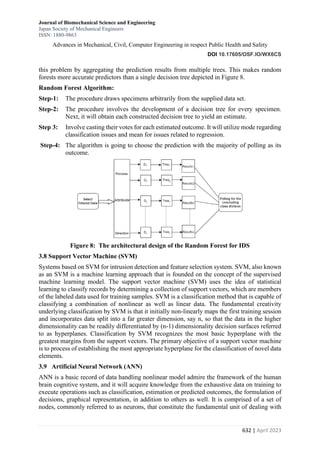
predictions, it optimizes the model as depicted in Figure 6.](https://image.slidesharecdn.com/44th2apr23wx6cs-231104063226-fa46a1b6/85/PERFORMANCE-EVALUATION-OF-MACHINE-LEARNING-ALGORITHMS-FOR-INTRUSION-DETECTION-SYSTEM-10-320.jpg)

![Journal of Biomechanical Science and Engineering
Japan Society of Mechanical Engineers
ISSN: 1880-9863
Advances in Mechanical, Civil, Computer Engineering in respect Public Health and Safety
DOI 10.17605/OSF.IO/WX6CS
633 | April 2023
information in ANN. About the dilemma assertion, these neurons are arranged into three
separate layers; the input layer, the output layer, and the hidden layer. In the framework of
classification of false positive threats, the number of threats determines the total number of
neuronal cells in the input or first layer, whereas the filter of network classification categories
influences the percentage that comprises neuronal cells as part of each output or final layer.
ANN will include at least a single input or first layer along with a single output or final layer
but will have several hidden layers based on the chosen disadvantage. Every connection
regarding the source of input to the result of the output layer with the help of layers that are
hidden is assigned weights that illustrate the degree of dependence between nodes. When
neurons obtain weighted data, an established activation function analyses the weighted sum.
To identify the appropriate neuron in the results of the output layer, the activation function's
output value is provided to every neuron through its input layer. Rectifier linear unit (ReLU)
features consist of Binary step, sigmoid function TanH, and Softmax. Are some commonly
utilized instances of activation functions by utilizing extra hidden layers, ANN might become
more adaptable and efficient. PPN, SGD, and BPN consist of all three predominant equipped
with neural networks that operate the algorithms that are widely utilized for reducing false
alarm rates.
4. RIDGE CLASSIFIER (RIDGE)
The Ridge method of classification relies on the domain postulation that instances of specific
categories reside on a portion of space that is linear and that the latest class can be administered
screening of the sample defined in the form of a continuous arrangement of sample training
evaluation for the pertinent category [27]. Ridge regression is an approach for analyzing
multicollinear data that has been used for algorithm-optimized performance. This approach
pulls out L2 regularization. When the issue of multicollinearity occurs, the least-squares are
random and variances are at large, leading to predicted values that are significantly lower than
the actual value L1 and L2 may decrease the complexity of the model and prevent overfitting
caused by simple linear regression.
4.1 Passive Aggressive (PA) Classifier
Classifiers who employ passive aggressions are parts of the huge-scalability method of learning
technique category [28]. It is one of them the few online-learning algorithms known. In online
machine learning algorithms, the input data arrives periodically and the machine learning
model gets modified continually, as opposed to sequential learning, which utilizes the whole
training set at once. The concept of operation of such a classification style is similar to the
perception network encoder; despite this, no learning rate is required. Still, it contains the
regularisation parameter C. Here C is the regularisation parameter, and it indicates the penalty
that the model will impose due to a wrong prediction.
4.2 Rocchio Classifier (RC)
The Rocchio algorithms for classification rely on the well-established response to relevance
theory in the area of data retrieval. It utilizes the characteristic's measure of midpoint and
proximity estimates between false alarm rates during the instruction and evaluation phases of
the prototype creation and application, accordingly. During the instruction phase, the Rocchio
classifier calculates the midpoint for every classification-related online web attack and
recognizes the centroid as the representative for each class. During the evaluation phase, the](https://image.slidesharecdn.com/44th2apr23wx6cs-231104063226-fa46a1b6/85/PERFORMANCE-EVALUATION-OF-MACHINE-LEARNING-ALGORITHMS-FOR-INTRUSION-DETECTION-SYSTEM-13-320.jpg)