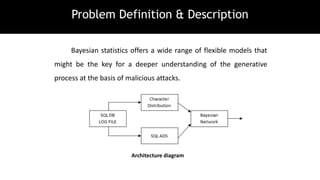
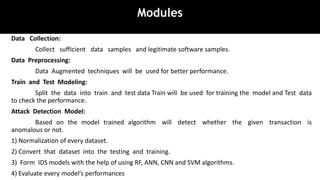
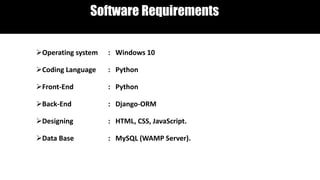
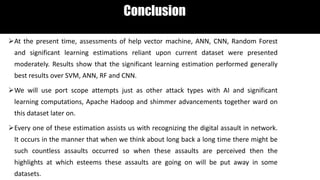
This document describes a proposed system for detecting cyber attacks using Bayesian inference. It begins with an introduction to the problem of credit/debit card theft and existing physical unclonable functions. It then discusses the disadvantages of existing cyber attack detection systems, such as performance issues and high false positive rates. The proposed system builds a directed acyclic graph to represent the probability distribution of variables related to cyber attacks. It will use modules for data collection, preprocessing, model training/testing, and attack detection. The system will be implemented in Python using frameworks like Django and evaluated using algorithms like random forest, artificial neural networks, and support vector machines.







![Getting Started with Apache Spark: Big Data Made Simple [Free Meetup]](https://cdn.slidesharecdn.com/ss_thumbnails/apachesparkgettingstarted-260203175547-8361bcc3-thumbnail.jpg?width=640&height=640&fit=bounds)


