1
David Amar, Tom Hait, and Ron Shamir
Blavatnik School of Computer Science
Tel Aviv University
2
Comparative genomics
 Standard expression experiments: cases vs. controls ->
differential genes -> interpretation
 Problems
 Small number of samples
 Non-specific signal
 Interpretation of a gene set/ gene ranking
 Goal: find specific changes for a tested disease
 E.g., an up-regulated pathway
 Crucial for clinical studies
3
Previous integrative classification studies
 Huang et al. 2010 PNAS (9,160 samples); Schmid et al.
PNAS 2012 (3,030); Lee et al. Bioinformatics 2013 (~14,000)
 Multilabel classification
 Global expression patterns
 Only 1-3 platforms
 Many datasets were removed from GEO
 No “healthy” class (Huang);No diseases (Lee)
 Pathprint (Altschuler et al. 2013)
 Use pathways
 Tissue classification (as in Lee et al.)
4
Integrating pathways and molecular
profiles
 Enrichment tests
 Improves interpretability
 GSEAGSA
 Ranked based
 Higher statistical power
 Classification
 Extract pathway features
 Example: given a pathway remove non-differential genes
 Not clear if prediction performance improves
compared to using genes (Staiger et al. 2013)
5
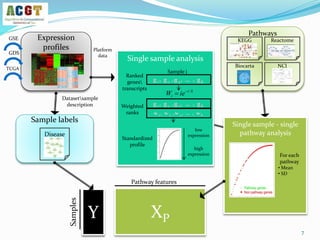
6
Pathways
KEGG Reactome
Biocarta NCI
Expression
profiles
GSE
GDS
TCGA
Sample labels
Disease
Datasetsample
description
Single sample - single
pathway analysis
For each
pathway
• Mean
• SD
Y
Samples
XP
Pathway features
Platform
data
Single sample analysis
Ranked
genes
transcripts
Sample j
Weighted
ranks
/i k
iW ie

Standardized
profile
low
expression
high
expression
7
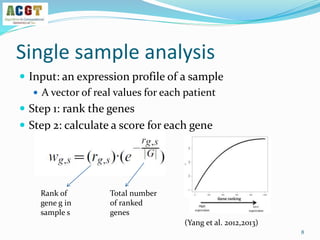
Single sample analysis
 Input: an expression profile of a sample
 A vector of real values for each patient
 Step 1: rank the genes
 Step 2: calculate a score for each gene
Rank of
gene g in
sample s
Total number
of ranked
genes
(Yang et al. 2012,2013)
8
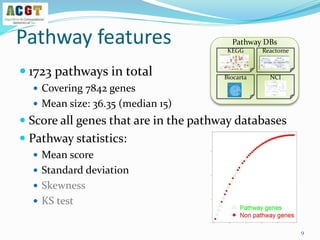
Pathway features
 1723 pathways in total
 Covering 7842 genes
 Mean size: 36.35 (median 15)
 Score all genes that are in the pathway databases
 Pathway statistics:
 Mean score
 Standard deviation
 Skewness
 KS test
Pathway DBs
KEGG Reactome
Biocarta NCI
9
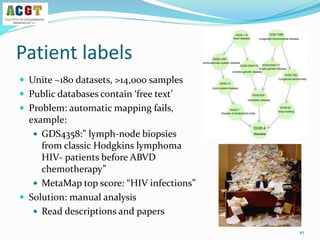
Patient labels
 Unite ~180 datasets, >14,000 samples
 Public databases contain ‘free text’
 Problem: automatic mapping fails,
example:
 GDS4358:” lymph-node biopsies
from classic Hodgkins lymphoma
HIV- patients before ABVD
chemotherapy”
 MetaMap top score: “HIV infections”
 Solution: manual analysis
 Read descriptions and papers
10
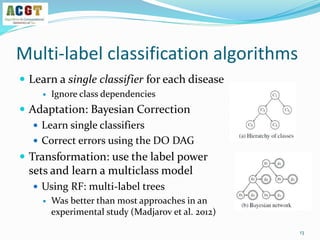
Current microarray data
 Data from GEO
 13,314 samples
 17 platforms
 Sample annotation
 Ignore terms with less than
 100 samples
 5 datasets
 48 disease terms
Disease terms
XP
Samples
Pathway features
Y
Disease terms {0,1}
Samples 11
12
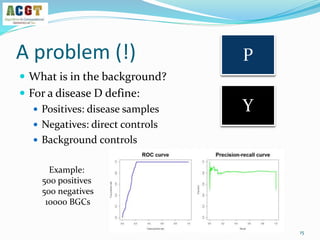
Multi-label classification algorithms
 Learn a single classifier for each disease
 Ignore class dependencies
 Adaptation: Bayesian Correction
 Learn single classifiers
 Correct errors using the DO DAG
 Transformation: use the label power
sets and learn a multiclass model
 Using RF: multi-label trees
 Was better than most approaches in an
experimental study (Madjarov et al. 2012)
13
How to validate an classifier?
 Use leave-dataset out cross-validation
 Global AUC scores: each prediction Pij vs the correct label Yij
 Disease based AUC scores: consider each column separately
14
Y
Disease terms {0,1}
Samples
P
Probabilities [0,1]
Samples
The output of a multi-label learner
Test set
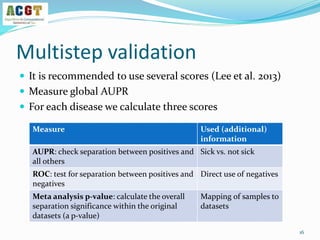
A problem (!)
 What is in the background?
 For a disease D define:
 Positives: disease samples
 Negatives: direct controls
 Background controls
15
Example:
500 positives
500 negatives
10000 BGCs
Y
P
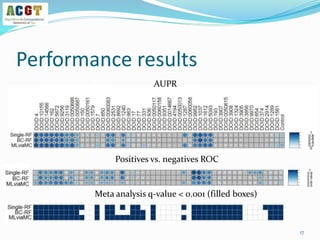
Multistep validation
16
 It is recommended to use several scores (Lee et al. 2013)
 Measure global AUPR
 For each disease we calculate three scores
Measure Used (additional)
information
AUPR: check separation between positives and
all others
Sick vs. not sick
ROC: test for separation between positives and
negatives
Direct use of negatives
Meta analysis p-value: calculate the overall
separation significance within the original
datasets (a p-value)
Mapping of samples to
datasets
Performance results
17
Meta analysis q-value < 0.001 (filled boxes)
Positives vs. negatives ROC
AUPR
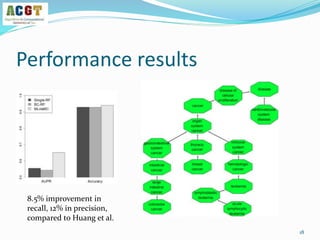
Performance results
18
8.5% improvement in
recall, 12% in precision,
compared to Huang et al.
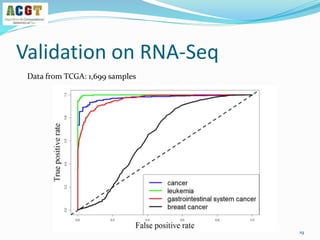
Validation on RNA-Seq
Data from TCGA: 1,699 samples
19
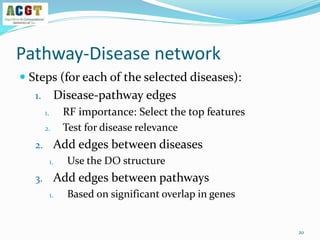
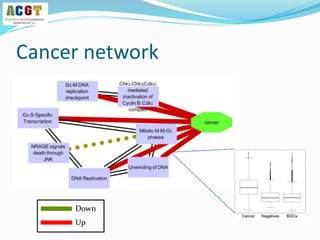
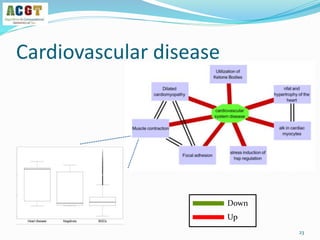
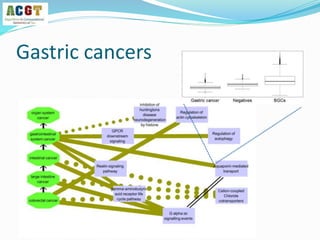
Pathway-Disease network
 Steps (for each of the selected diseases):
1. Disease-pathway edges
1. RF importance: Select the top features
2. Test for disease relevance
2. Add edges between diseases
1. Use the DO structure
3. Add edges between pathways
1. Based on significant overlap in genes
20
Cancer network
Down
Up
Cardiovascular disease
23
Down
Up
Gastric cancers
Summary
 Large scale integration
 Multi-label learning
 Careful validation
 Pathway based features as biomarkers
 Summary of the results in a network
 Currently
 Add genes: overcome missing values
 Shows improvement in validation
25
Acknowledgements
 Ron Shamir
 Tom Hait

NetBioSIG2014-Talk by David Amar

  • 1.
    1 David Amar, TomHait, and Ron Shamir Blavatnik School of Computer Science Tel Aviv University
  • 2.
  • 3.
    Comparative genomics  Standardexpression experiments: cases vs. controls -> differential genes -> interpretation  Problems  Small number of samples  Non-specific signal  Interpretation of a gene set/ gene ranking  Goal: find specific changes for a tested disease  E.g., an up-regulated pathway  Crucial for clinical studies 3
  • 4.
    Previous integrative classificationstudies  Huang et al. 2010 PNAS (9,160 samples); Schmid et al. PNAS 2012 (3,030); Lee et al. Bioinformatics 2013 (~14,000)  Multilabel classification  Global expression patterns  Only 1-3 platforms  Many datasets were removed from GEO  No “healthy” class (Huang);No diseases (Lee)  Pathprint (Altschuler et al. 2013)  Use pathways  Tissue classification (as in Lee et al.) 4
  • 5.
    Integrating pathways andmolecular profiles  Enrichment tests  Improves interpretability  GSEAGSA  Ranked based  Higher statistical power  Classification  Extract pathway features  Example: given a pathway remove non-differential genes  Not clear if prediction performance improves compared to using genes (Staiger et al. 2013) 5
  • 6.
  • 7.
    Pathways KEGG Reactome Biocarta NCI Expression profiles GSE GDS TCGA Samplelabels Disease Datasetsample description Single sample - single pathway analysis For each pathway • Mean • SD Y Samples XP Pathway features Platform data Single sample analysis Ranked genes transcripts Sample j Weighted ranks /i k iW ie  Standardized profile low expression high expression 7
  • 8.
    Single sample analysis Input: an expression profile of a sample  A vector of real values for each patient  Step 1: rank the genes  Step 2: calculate a score for each gene Rank of gene g in sample s Total number of ranked genes (Yang et al. 2012,2013) 8
  • 9.
    Pathway features  1723pathways in total  Covering 7842 genes  Mean size: 36.35 (median 15)  Score all genes that are in the pathway databases  Pathway statistics:  Mean score  Standard deviation  Skewness  KS test Pathway DBs KEGG Reactome Biocarta NCI 9
  • 10.
    Patient labels  Unite~180 datasets, >14,000 samples  Public databases contain ‘free text’  Problem: automatic mapping fails, example:  GDS4358:” lymph-node biopsies from classic Hodgkins lymphoma HIV- patients before ABVD chemotherapy”  MetaMap top score: “HIV infections”  Solution: manual analysis  Read descriptions and papers 10
  • 11.
    Current microarray data Data from GEO  13,314 samples  17 platforms  Sample annotation  Ignore terms with less than  100 samples  5 datasets  48 disease terms Disease terms XP Samples Pathway features Y Disease terms {0,1} Samples 11
  • 12.
  • 13.
    Multi-label classification algorithms Learn a single classifier for each disease  Ignore class dependencies  Adaptation: Bayesian Correction  Learn single classifiers  Correct errors using the DO DAG  Transformation: use the label power sets and learn a multiclass model  Using RF: multi-label trees  Was better than most approaches in an experimental study (Madjarov et al. 2012) 13
  • 14.
    How to validatean classifier?  Use leave-dataset out cross-validation  Global AUC scores: each prediction Pij vs the correct label Yij  Disease based AUC scores: consider each column separately 14 Y Disease terms {0,1} Samples P Probabilities [0,1] Samples The output of a multi-label learner Test set
  • 15.
    A problem (!) What is in the background?  For a disease D define:  Positives: disease samples  Negatives: direct controls  Background controls 15 Example: 500 positives 500 negatives 10000 BGCs Y P
  • 16.
    Multistep validation 16  Itis recommended to use several scores (Lee et al. 2013)  Measure global AUPR  For each disease we calculate three scores Measure Used (additional) information AUPR: check separation between positives and all others Sick vs. not sick ROC: test for separation between positives and negatives Direct use of negatives Meta analysis p-value: calculate the overall separation significance within the original datasets (a p-value) Mapping of samples to datasets
  • 17.
    Performance results 17 Meta analysisq-value < 0.001 (filled boxes) Positives vs. negatives ROC AUPR
  • 18.
    Performance results 18 8.5% improvementin recall, 12% in precision, compared to Huang et al.
  • 19.
    Validation on RNA-Seq Datafrom TCGA: 1,699 samples 19
  • 20.
    Pathway-Disease network  Steps(for each of the selected diseases): 1. Disease-pathway edges 1. RF importance: Select the top features 2. Test for disease relevance 2. Add edges between diseases 1. Use the DO structure 3. Add edges between pathways 1. Based on significant overlap in genes 20
  • 21.
  • 22.
  • 23.
  • 24.
    Summary  Large scaleintegration  Multi-label learning  Careful validation  Pathway based features as biomarkers  Summary of the results in a network  Currently  Add genes: overcome missing values  Shows improvement in validation 25
  • 25.