Joaquín Dopazo
Computational Genomics Department,
Centro de Investigación Príncipe Felipe (CIPF),
Functional Genomics Node, (INB),
Bioinformatics in Rare Diseases (BiER-CIBERER),
Valencia, Spain.
Multigenic (mechanistic) biomarkers
http://bioinfo.cipf.es
http://www.babelomics.org
@xdopazo
SEQC2, Advancing Precision Medicine and Cancer Genomics,
Bethesda, MD, September 13‐14, 2016
Modular nature of human genetic
diseases (and other relevant traits)
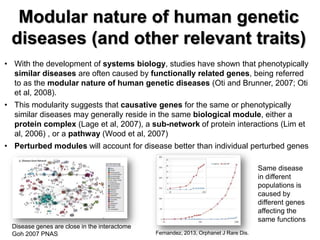
• With the development of systems biology, studies have shown that phenotypically
similar diseases are often caused by functionally related genes, being referred
to as the modular nature of human genetic diseases (Oti and Brunner, 2007; Oti
et al, 2008).
• This modularity suggests that causative genes for the same or phenotypically
similar diseases may generally reside in the same biological module, either a
protein complex (Lage et al, 2007), a sub-network of protein interactions (Lim et
al, 2006) , or a pathway (Wood et al, 2007)
• Perturbed modules will account for disease better than individual perturbed genes
Disease genes are close in the interactome
Goh 2007 PNAS
Same disease
in different
populations is
caused by
different genes
affecting the
same functions
Fernandez, 2013, Orphanet J Rare Dis.
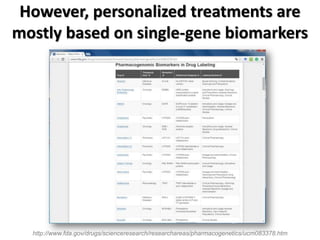
However, personalized treatments are
mostly based on single-gene biomarkers
http://www.fda.gov/drugs/scienceresearch/researchareas/pharmacogenetics/ucm083378.htm
With a few exceptions: MammaPrint, an
example of successful breast cancer decision
support test based on a multigenic biomarker
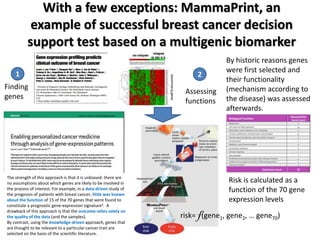
The strength of this approach is that it is unbiased: there are
no assumptions about which genes are likely to be involved in
the process of interest. For example, in a data-driven study of
the prognosis of patients with breast cancer, little was known
about the function of 15 of the 70 genes that were found to
constitute a prognostic gene-expression signature4. A
drawback of this approach is that the outcome relies solely on
the quality of the data (and the samples).
By contrast, using the knowledge-driven approach, genes that
are thought to be relevant to a particular cancer trait are
selected on the basis of the scientific literature.
Finding
genes
1 2
Assessing
functions
Risk is calculated as a
function of the 70 gene
expression levels
risk= f(gene1, gene2, … gene70)
By historic reasons genes
were first selected and
their functionality
(mechanism according to
the disease) was assessed
afterwards.
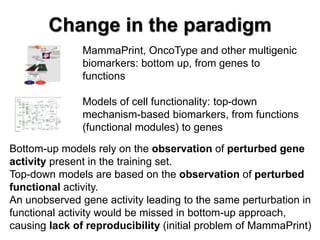
Change in the paradigm
MammaPrint, OncoType and other multigenic
biomarkers: bottom up, from genes to
functions
Models of cell functionality: top-down
mechanism-based biomarkers, from functions
(functional modules) to genes
Bottom-up models rely on the observation of perturbed gene
activity present in the training set.
Top-down models are based on the observation of perturbed
functional activity.
An unobserved gene activity leading to the same perturbation in
functional activity would be missed in bottom-up approach,
causing lack of reproducibility (initial problem of MammaPrint)
How realistic are models of
functional modules?
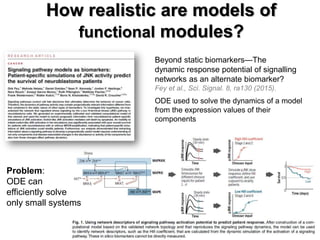
Beyond static biomarkers—The
dynamic response potential of signalling
networks as an alternate biomarker?
Fey et al., Sci. Signal. 8, ra130 (2015).
ODE used to solve the dynamics of a model
from the expression values of their
components
Problem:
ODE can
efficiently solve
only small systems
Two problems: defining
functional modules and
modeling their behavior
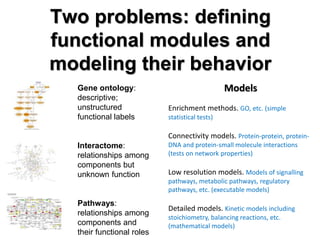
Gene ontology:
descriptive;
unstructured
functional labels
Interactome:
relationships among
components but
unknown function
Pathways:
relationships among
components and
their functional roles
Models
Enrichment methods. GO, etc. (simple
statistical tests)
Connectivity models. Protein-protein, protein-
DNA and protein-small molecule interactions
(tests on network properties)
Low resolution models. Models of signalling
pathways, metabolic pathways, regulatory
pathways, etc. (executable models)
Detailed models. Kinetic models including
stoichiometry, balancing reactions, etc.
(mathematical models)
How a functional module is defined?
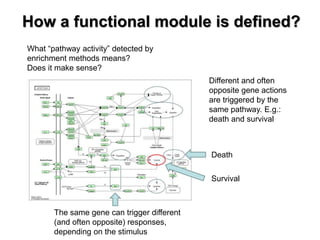
What “pathway activity” detected by
enrichment methods means?
Does it make sense?
Different and often
opposite gene actions
are triggered by the
same pathway. E.g.:
death and survival
The same gene can trigger different
(and often opposite) responses,
depending on the stimulus
Survival
Death
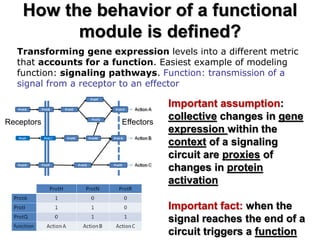
How the behavior of a functional
module is defined?
Transforming gene expression levels into a different metric
that accounts for a function. Easiest example of modeling
function: signaling pathways. Function: transmission of a
signal from a receptor to an effector
Receptors Effectors
Important assumption:
collective changes in gene
expression within the
context of a signaling
circuit are proxies of
changes in protein
activation
Important fact: when the
signal reaches the end of a
circuit triggers a function
A B D
E
F
HSignal
1 0.7
0.1 0.9
0.5
1 0.6
1
ASignal
1
0.7
0.07
0.5
0.6
0.7
0.7
0.7
0.063
0.483
0.516
0.36
0.65
0.825
0.65
0.325
0.65
0.175
0.500.50
C
C F
G
H Function
Function
E
DB
G
0.50
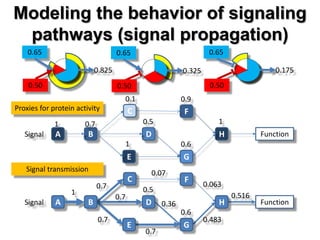
Modeling the behavior of signaling
pathways (signal propagation)
Proxies for protein activity
Signal transmission
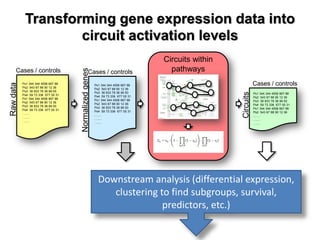
Transforming gene expression data into
circuit activation levels
Cases / controls
Normalizedgenes Ps1 344 344 4556 667 88
Ps2 543 67 88 90 12 36
Ps3 36 833 78 38 99 00
Ps4 59 73 336 677 00 31
Ps1 344 344 4556 667 88
Ps2 543 67 88 90 12 36
Ps3 36 833 78 38 99 00
Ps4 59 73 336 677 00 31
…….
…….
…….
Cases / controls
Circuits
Ps1 344 344 4556 667 88
Ps2 543 67 88 90 12 36
Ps3 36 833 78 38 99 00
Ps4 59 73 336 677 00 31
Ps1 344 344 4556 667 88
Ps2 543 67 88 90 12 36
…….
…….
…….
Circuits within
pathwaysCases / controls
Rawdata
Ps1 344 344 4556 667 88
Ps2 543 67 88 90 12 36
Ps3 36 833 78 38 99 00
Ps4 59 73 336 677 00 31
Ps1 344 344 4556 667 88
Ps2 543 67 88 90 12 36
Ps3 36 833 78 38 99 00
Ps4 59 73 336 677 00 31
…….
…….
…….
Downstream analysis (differential expression,
clustering to find subgroups, survival,
predictors, etc.)
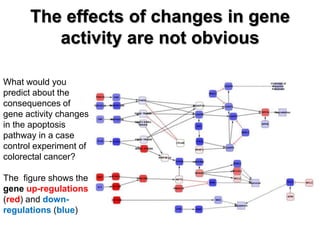
What would you
predict about the
consequences of
gene activity changes
in the apoptosis
pathway in a case
control experiment of
colorectal cancer?
The figure shows the
gene up-regulations
(red) and down-
regulations (blue)
The effects of changes in gene
activity are not obvious
Apoptosis
inhibition is
not obvious
from gene
expression
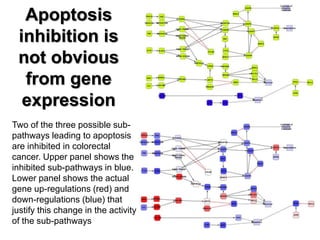
Two of the three possible sub-
pathways leading to apoptosis
are inhibited in colorectal
cancer. Upper panel shows the
inhibited sub-pathways in blue.
Lower panel shows the actual
gene up-regulations (red) and
down-regulations (blue) that
justify this change in the activity
of the sub-pathways
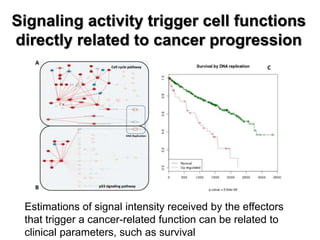
Signaling activity trigger cell functions
directly related to cancer progression
Estimations of signal intensity received by the effectors
that trigger a cancer-related function can be related to
clinical parameters, such as survival
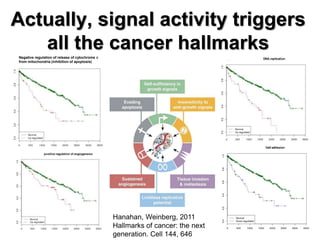
Actually, signal activity triggers
all the cancer hallmarks
Hanahan, Weinberg, 2011
Hallmarks of cancer: the next
generation. Cell 144, 646
Negative regulation of release of cytochrome c
from mitochondria (inhibition of apoptosis)
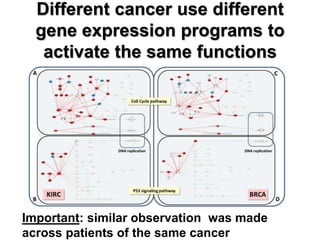
Different cancer use different
gene expression programs to
activate the same functions
Important: similar observation was made
across patients of the same cancer
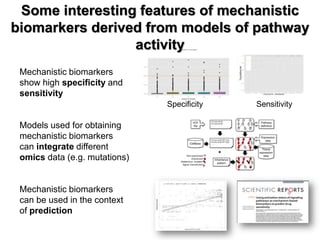
Mechanistic biomarkers
show high specificity and
sensitivity
Models used for obtaining
mechanistic biomarkers
can integrate different
omics data (e.g. mutations)
Mechanistic biomarkers
can be used in the context
of prediction
Specificity Sensitivity
Some interesting features of mechanistic
biomarkers derived from models of pathway
activity
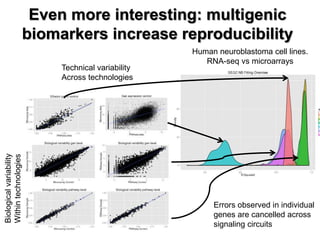
Biologicalvariability
Withintechnologies Even more interesting: multigenic
biomarkers increase reproducibility
Human neuroblastoma cell lines.
RNA-seq vs microarrays
Errors observed in individual
genes are cancelled across
signaling circuits
Technical variability
Across technologies
Future prospects:
Actionable models
The real advantage of models is that, the same way they can be used
to convert omics data into measurements of cell functionality that
provide information on disease mechanisms and drug MoA, they can
be used to test hypothesis such as “what if I suppress (or over-
express) this gen?” This lead to the concept of actionable models.
By simulating changes of gene expression/activity it is easy to:
• Direct study of the consequences of induced gene over-expressions
or KOs
• Reverse study of genes that need to be perturbed to change cell
functionalities, such as:
• Reverting the “normal” functional status of a cell
• Selectively kill diseased cells without affecting normal cells
• Enhancing or reducing cell functionalities (e.g., apoptosis or
proliferation, respectively, to fight cancer)
• Etc.
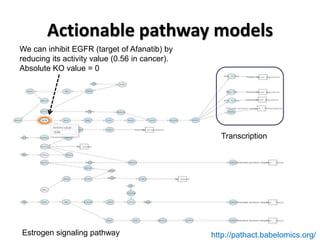
Actionable pathway models
Transcription
We can inhibit EGFR (target of Afanatib) by
reducing its activity value (0.56 in cancer).
Absolute KO value = 0
Estrogen signaling pathway http://pathact.babelomics.org/
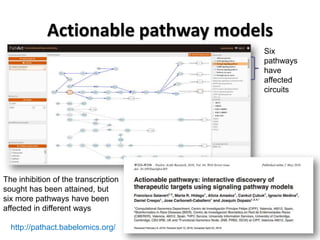
Actionable pathway models
http://pathact.babelomics.org/
The inhibition of the transcription
sought has been attained, but
six more pathways have been
affected in different ways
Six
pathways
have
affected
circuits
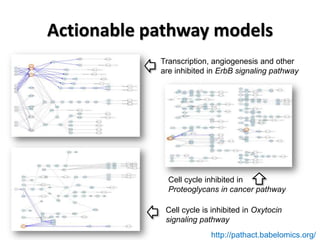
Actionable pathway models
Cell cycle inhibited in
Proteoglycans in cancer pathway
Transcription, angiogenesis and other
are inhibited in ErbB signaling pathway
Cell cycle is inhibited in Oxytocin
signaling pathway
http://pathact.babelomics.org/
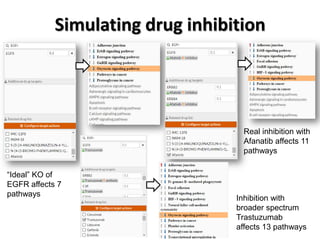
Simulating drug inhibition
“Ideal” KO of
EGFR affects 7
pathways
Real inhibition with
Afanatib affects 11
pathways
Inhibition with
broader spectrum
Trastuzumab
affects 13 pathways
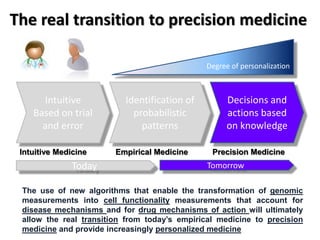
The use of new algorithms that enable the transformation of genomic
measurements into cell functionality measurements that account for
disease mechanisms and for drug mechanisms of action will ultimately
allow the real transition from today’s empirical medicine to precision
medicine and provide increasingly personalized medicine
The real transition to precision medicine
Intuitive
Based on trial
and error
Identification of
probabilistic
patterns
Decisions and
actions based
on knowledge
Intuitive Medicine Empirical Medicine Precision Medicine
Today Tomorrow
Degree of personalization
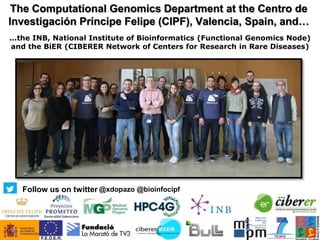
The Computational Genomics Department at the Centro de
Investigación Príncipe Felipe (CIPF), Valencia, Spain, and…
...the INB, National Institute of Bioinformatics (Functional Genomics Node)
and the BiER (CIBERER Network of Centers for Research in Rare Diseases)
@xdopazo @bioinfocipfFollow us on twitter

Multigenic (mechanistic) biomarkers

  • 1.
    Joaquín Dopazo Computational GenomicsDepartment, Centro de Investigación Príncipe Felipe (CIPF), Functional Genomics Node, (INB), Bioinformatics in Rare Diseases (BiER-CIBERER), Valencia, Spain. Multigenic (mechanistic) biomarkers http://bioinfo.cipf.es http://www.babelomics.org @xdopazo SEQC2, Advancing Precision Medicine and Cancer Genomics, Bethesda, MD, September 13‐14, 2016
  • 2.
    Modular nature ofhuman genetic diseases (and other relevant traits) • With the development of systems biology, studies have shown that phenotypically similar diseases are often caused by functionally related genes, being referred to as the modular nature of human genetic diseases (Oti and Brunner, 2007; Oti et al, 2008). • This modularity suggests that causative genes for the same or phenotypically similar diseases may generally reside in the same biological module, either a protein complex (Lage et al, 2007), a sub-network of protein interactions (Lim et al, 2006) , or a pathway (Wood et al, 2007) • Perturbed modules will account for disease better than individual perturbed genes Disease genes are close in the interactome Goh 2007 PNAS Same disease in different populations is caused by different genes affecting the same functions Fernandez, 2013, Orphanet J Rare Dis.
  • 3.
    However, personalized treatmentsare mostly based on single-gene biomarkers http://www.fda.gov/drugs/scienceresearch/researchareas/pharmacogenetics/ucm083378.htm
  • 4.
    With a fewexceptions: MammaPrint, an example of successful breast cancer decision support test based on a multigenic biomarker The strength of this approach is that it is unbiased: there are no assumptions about which genes are likely to be involved in the process of interest. For example, in a data-driven study of the prognosis of patients with breast cancer, little was known about the function of 15 of the 70 genes that were found to constitute a prognostic gene-expression signature4. A drawback of this approach is that the outcome relies solely on the quality of the data (and the samples). By contrast, using the knowledge-driven approach, genes that are thought to be relevant to a particular cancer trait are selected on the basis of the scientific literature. Finding genes 1 2 Assessing functions Risk is calculated as a function of the 70 gene expression levels risk= f(gene1, gene2, … gene70) By historic reasons genes were first selected and their functionality (mechanism according to the disease) was assessed afterwards.
  • 5.
    Change in theparadigm MammaPrint, OncoType and other multigenic biomarkers: bottom up, from genes to functions Models of cell functionality: top-down mechanism-based biomarkers, from functions (functional modules) to genes Bottom-up models rely on the observation of perturbed gene activity present in the training set. Top-down models are based on the observation of perturbed functional activity. An unobserved gene activity leading to the same perturbation in functional activity would be missed in bottom-up approach, causing lack of reproducibility (initial problem of MammaPrint)
  • 6.
    How realistic aremodels of functional modules? Beyond static biomarkers—The dynamic response potential of signalling networks as an alternate biomarker? Fey et al., Sci. Signal. 8, ra130 (2015). ODE used to solve the dynamics of a model from the expression values of their components Problem: ODE can efficiently solve only small systems
  • 7.
    Two problems: defining functionalmodules and modeling their behavior Gene ontology: descriptive; unstructured functional labels Interactome: relationships among components but unknown function Pathways: relationships among components and their functional roles Models Enrichment methods. GO, etc. (simple statistical tests) Connectivity models. Protein-protein, protein- DNA and protein-small molecule interactions (tests on network properties) Low resolution models. Models of signalling pathways, metabolic pathways, regulatory pathways, etc. (executable models) Detailed models. Kinetic models including stoichiometry, balancing reactions, etc. (mathematical models)
  • 8.
    How a functionalmodule is defined? What “pathway activity” detected by enrichment methods means? Does it make sense? Different and often opposite gene actions are triggered by the same pathway. E.g.: death and survival The same gene can trigger different (and often opposite) responses, depending on the stimulus Survival Death
  • 9.
    How the behaviorof a functional module is defined? Transforming gene expression levels into a different metric that accounts for a function. Easiest example of modeling function: signaling pathways. Function: transmission of a signal from a receptor to an effector Receptors Effectors Important assumption: collective changes in gene expression within the context of a signaling circuit are proxies of changes in protein activation Important fact: when the signal reaches the end of a circuit triggers a function
  • 10.
    A B D E F HSignal 10.7 0.1 0.9 0.5 1 0.6 1 ASignal 1 0.7 0.07 0.5 0.6 0.7 0.7 0.7 0.063 0.483 0.516 0.36 0.65 0.825 0.65 0.325 0.65 0.175 0.500.50 C C F G H Function Function E DB G 0.50 Modeling the behavior of signaling pathways (signal propagation) Proxies for protein activity Signal transmission
  • 11.
    Transforming gene expressiondata into circuit activation levels Cases / controls Normalizedgenes Ps1 344 344 4556 667 88 Ps2 543 67 88 90 12 36 Ps3 36 833 78 38 99 00 Ps4 59 73 336 677 00 31 Ps1 344 344 4556 667 88 Ps2 543 67 88 90 12 36 Ps3 36 833 78 38 99 00 Ps4 59 73 336 677 00 31 ……. ……. ……. Cases / controls Circuits Ps1 344 344 4556 667 88 Ps2 543 67 88 90 12 36 Ps3 36 833 78 38 99 00 Ps4 59 73 336 677 00 31 Ps1 344 344 4556 667 88 Ps2 543 67 88 90 12 36 ……. ……. ……. Circuits within pathwaysCases / controls Rawdata Ps1 344 344 4556 667 88 Ps2 543 67 88 90 12 36 Ps3 36 833 78 38 99 00 Ps4 59 73 336 677 00 31 Ps1 344 344 4556 667 88 Ps2 543 67 88 90 12 36 Ps3 36 833 78 38 99 00 Ps4 59 73 336 677 00 31 ……. ……. ……. Downstream analysis (differential expression, clustering to find subgroups, survival, predictors, etc.)
  • 12.
    What would you predictabout the consequences of gene activity changes in the apoptosis pathway in a case control experiment of colorectal cancer? The figure shows the gene up-regulations (red) and down- regulations (blue) The effects of changes in gene activity are not obvious
  • 13.
    Apoptosis inhibition is not obvious fromgene expression Two of the three possible sub- pathways leading to apoptosis are inhibited in colorectal cancer. Upper panel shows the inhibited sub-pathways in blue. Lower panel shows the actual gene up-regulations (red) and down-regulations (blue) that justify this change in the activity of the sub-pathways
  • 14.
    Signaling activity triggercell functions directly related to cancer progression Estimations of signal intensity received by the effectors that trigger a cancer-related function can be related to clinical parameters, such as survival
  • 15.
    Actually, signal activitytriggers all the cancer hallmarks Hanahan, Weinberg, 2011 Hallmarks of cancer: the next generation. Cell 144, 646 Negative regulation of release of cytochrome c from mitochondria (inhibition of apoptosis)
  • 16.
    Different cancer usedifferent gene expression programs to activate the same functions Important: similar observation was made across patients of the same cancer
  • 17.
    Mechanistic biomarkers show highspecificity and sensitivity Models used for obtaining mechanistic biomarkers can integrate different omics data (e.g. mutations) Mechanistic biomarkers can be used in the context of prediction Specificity Sensitivity Some interesting features of mechanistic biomarkers derived from models of pathway activity
  • 18.
    Biologicalvariability Withintechnologies Even moreinteresting: multigenic biomarkers increase reproducibility Human neuroblastoma cell lines. RNA-seq vs microarrays Errors observed in individual genes are cancelled across signaling circuits Technical variability Across technologies
  • 19.
    Future prospects: Actionable models Thereal advantage of models is that, the same way they can be used to convert omics data into measurements of cell functionality that provide information on disease mechanisms and drug MoA, they can be used to test hypothesis such as “what if I suppress (or over- express) this gen?” This lead to the concept of actionable models. By simulating changes of gene expression/activity it is easy to: • Direct study of the consequences of induced gene over-expressions or KOs • Reverse study of genes that need to be perturbed to change cell functionalities, such as: • Reverting the “normal” functional status of a cell • Selectively kill diseased cells without affecting normal cells • Enhancing or reducing cell functionalities (e.g., apoptosis or proliferation, respectively, to fight cancer) • Etc.
  • 20.
    Actionable pathway models Transcription Wecan inhibit EGFR (target of Afanatib) by reducing its activity value (0.56 in cancer). Absolute KO value = 0 Estrogen signaling pathway http://pathact.babelomics.org/
  • 21.
    Actionable pathway models http://pathact.babelomics.org/ Theinhibition of the transcription sought has been attained, but six more pathways have been affected in different ways Six pathways have affected circuits
  • 22.
    Actionable pathway models Cellcycle inhibited in Proteoglycans in cancer pathway Transcription, angiogenesis and other are inhibited in ErbB signaling pathway Cell cycle is inhibited in Oxytocin signaling pathway http://pathact.babelomics.org/
  • 23.
    Simulating drug inhibition “Ideal”KO of EGFR affects 7 pathways Real inhibition with Afanatib affects 11 pathways Inhibition with broader spectrum Trastuzumab affects 13 pathways
  • 24.
    The use ofnew algorithms that enable the transformation of genomic measurements into cell functionality measurements that account for disease mechanisms and for drug mechanisms of action will ultimately allow the real transition from today’s empirical medicine to precision medicine and provide increasingly personalized medicine The real transition to precision medicine Intuitive Based on trial and error Identification of probabilistic patterns Decisions and actions based on knowledge Intuitive Medicine Empirical Medicine Precision Medicine Today Tomorrow Degree of personalization
  • 25.
    The Computational GenomicsDepartment at the Centro de Investigación Príncipe Felipe (CIPF), Valencia, Spain, and… ...the INB, National Institute of Bioinformatics (Functional Genomics Node) and the BiER (CIBERER Network of Centers for Research in Rare Diseases) @xdopazo @bioinfocipfFollow us on twitter