Emissions slowdown:
Are we on the way to 2°C?
Glen Peters (CICERO)
School of Economics & Business, Norwegian University of Life Sciences, 11/10/2017
• Emission trends in the last decades
• Emission scenarios
• The trouble with negative emissions
– What are negative emissions?
• The trouble with carbon capture and storage
• Integrated Assessment Models
• Discussion
Overview
Key changes in emissions (1960-2016)
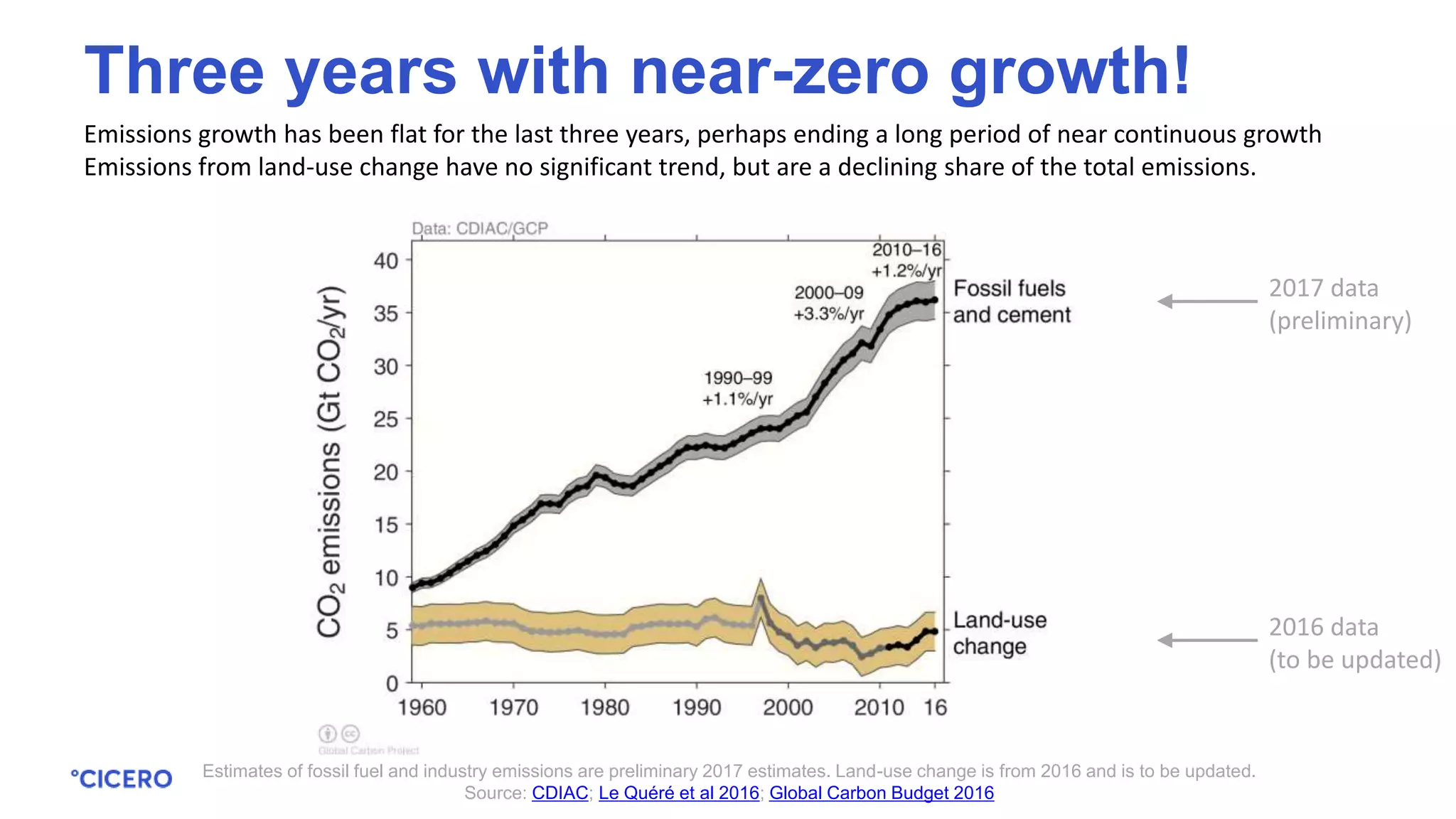
Emissions growth has been flat for the last three years, perhaps ending a long period of near continuous growth
Emissions from land-use change have no significant trend, but are a declining share of the total emissions.
Estimates of fossil fuel and industry emissions are preliminary 2017 estimates. Land-use change is from 2016 and is to be updated.
Source: CDIAC; Le Quéré et al 2016; Global Carbon Budget 2016
Three years with near-zero growth!
2017 data
(preliminary)
2016 data
(to be updated)
Key changes in emissions (2000-2020)
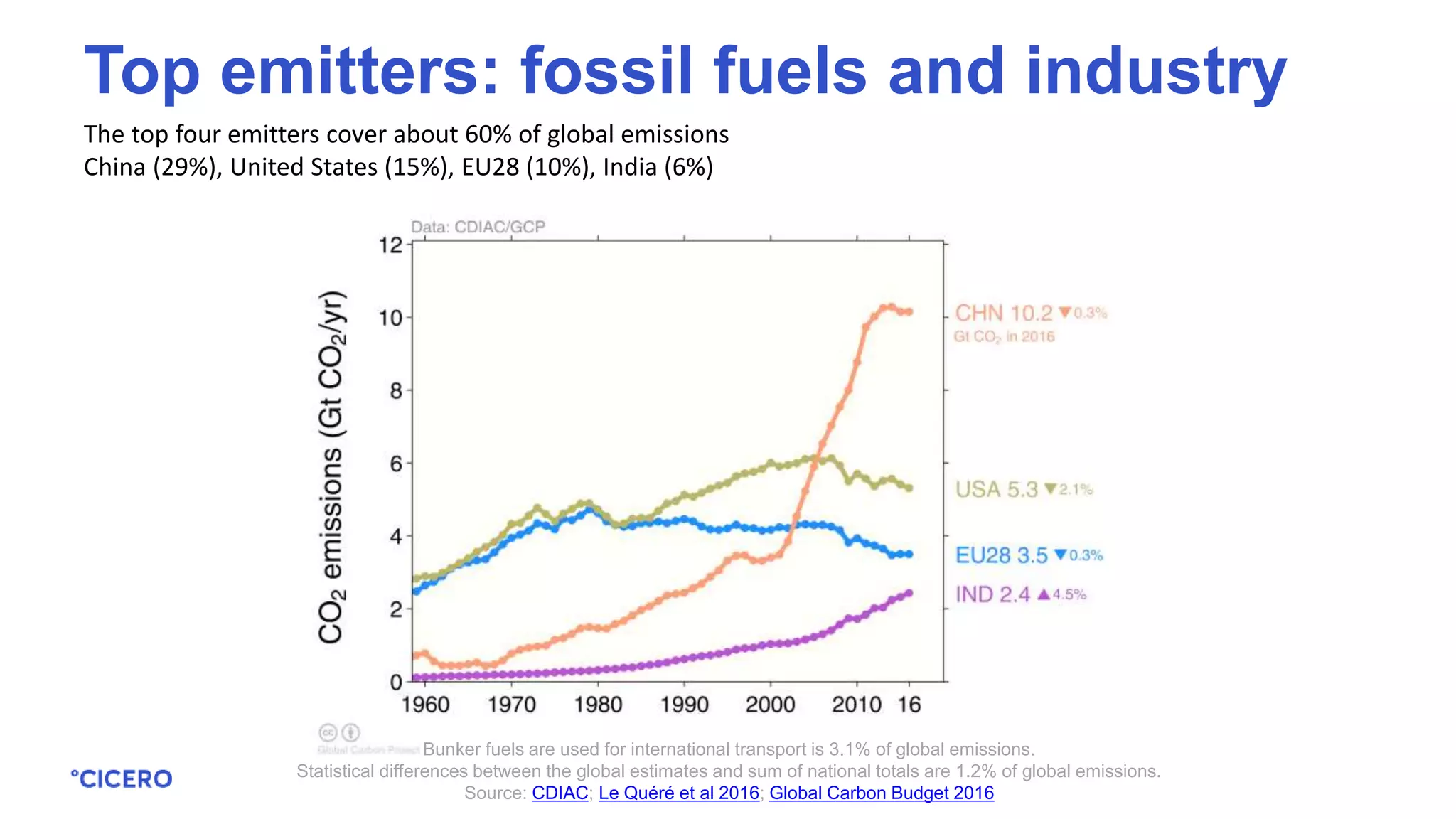
The top four emitters cover about 60% of global emissions
China (29%), United States (15%), EU28 (10%), India (6%)
Bunker fuels are used for international transport is 3.1% of global emissions.
Statistical differences between the global estimates and sum of national totals are 1.2% of global emissions.
Source: CDIAC; Le Quéré et al 2016; Global Carbon Budget 2016
Top emitters: fossil fuels and industry
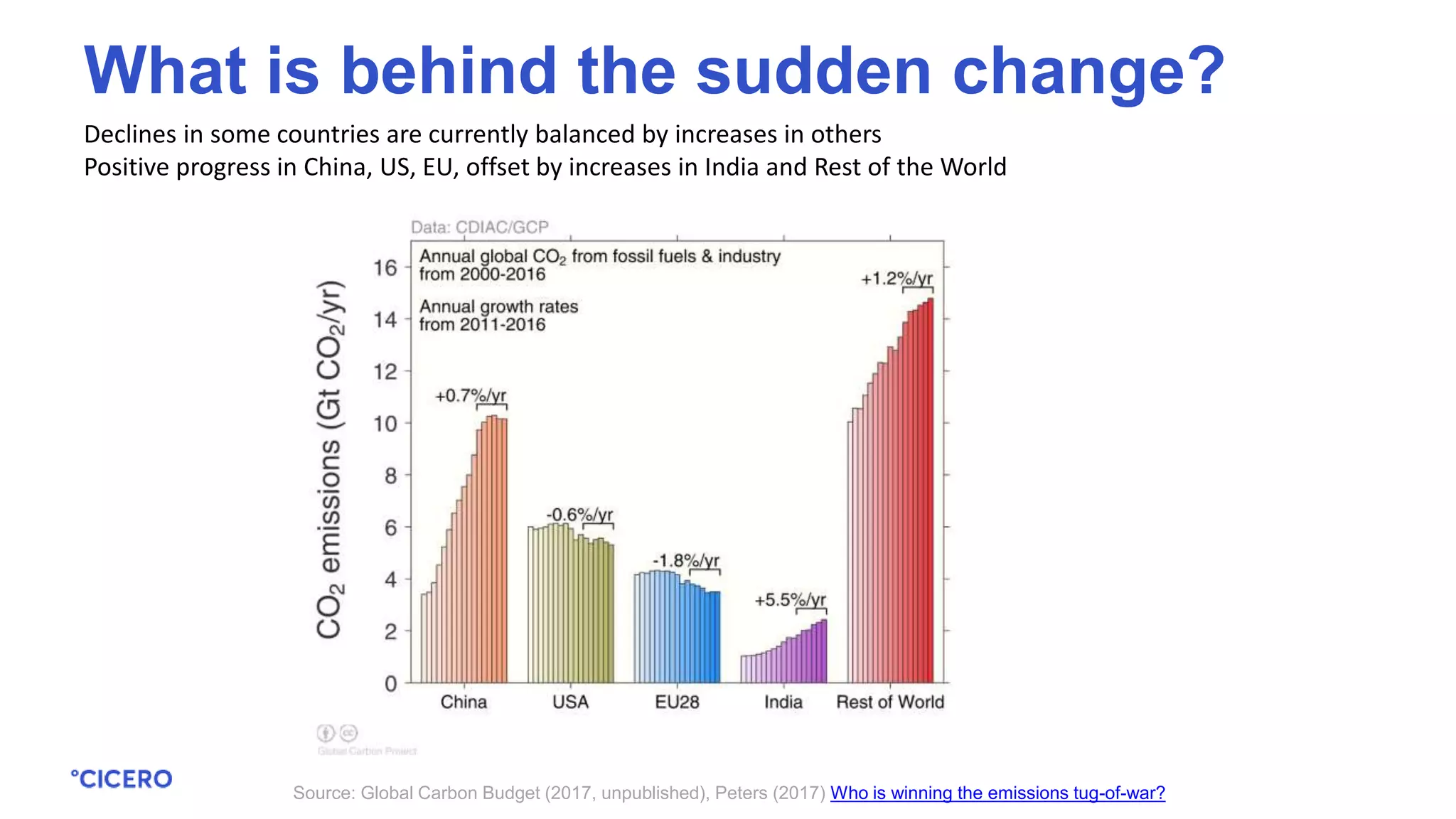
Declines in some countries are currently balanced by increases in others
Positive progress in China, US, EU, offset by increases in India and Rest of the World
Source: Global Carbon Budget (2017, unpublished), Peters (2017) Who is winning the emissions tug-of-war?
What is behind the sudden change?
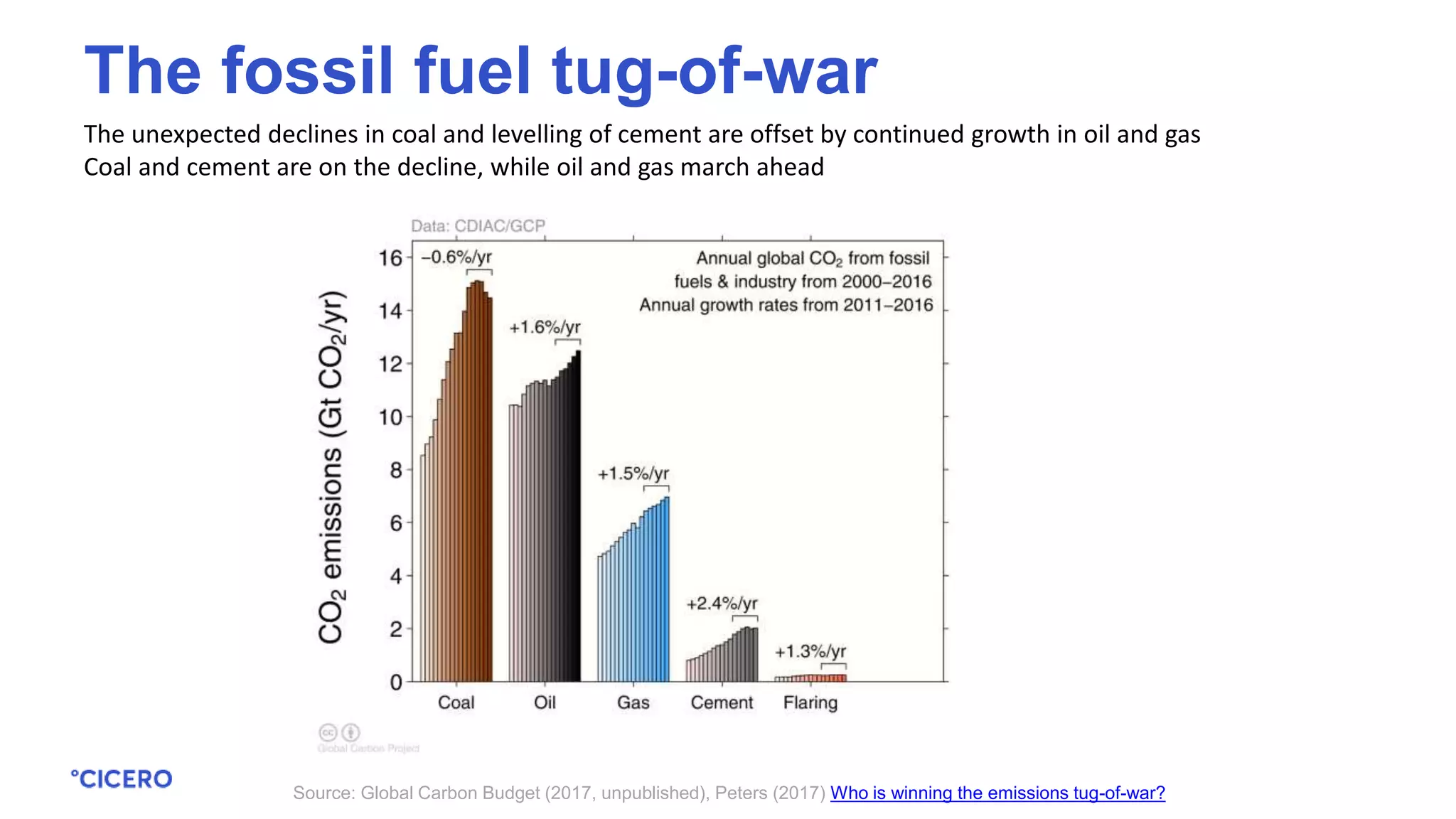
The unexpected declines in coal and levelling of cement are offset by continued growth in oil and gas
Coal and cement are on the decline, while oil and gas march ahead
Source: Global Carbon Budget (2017, unpublished), Peters (2017) Who is winning the emissions tug-of-war?
The fossil fuel tug-of-war
Rapid (relative) growth in solar and wind reaches the headlines, but offset by (relative) small changes in fossil fuels
Source: BP 2017; Jackson et al 2015; Global Carbon Budget 2016
Solar & wind are helping (a little)
What is causing emissions to change in each country?
Tracking Progress (2000-2020)
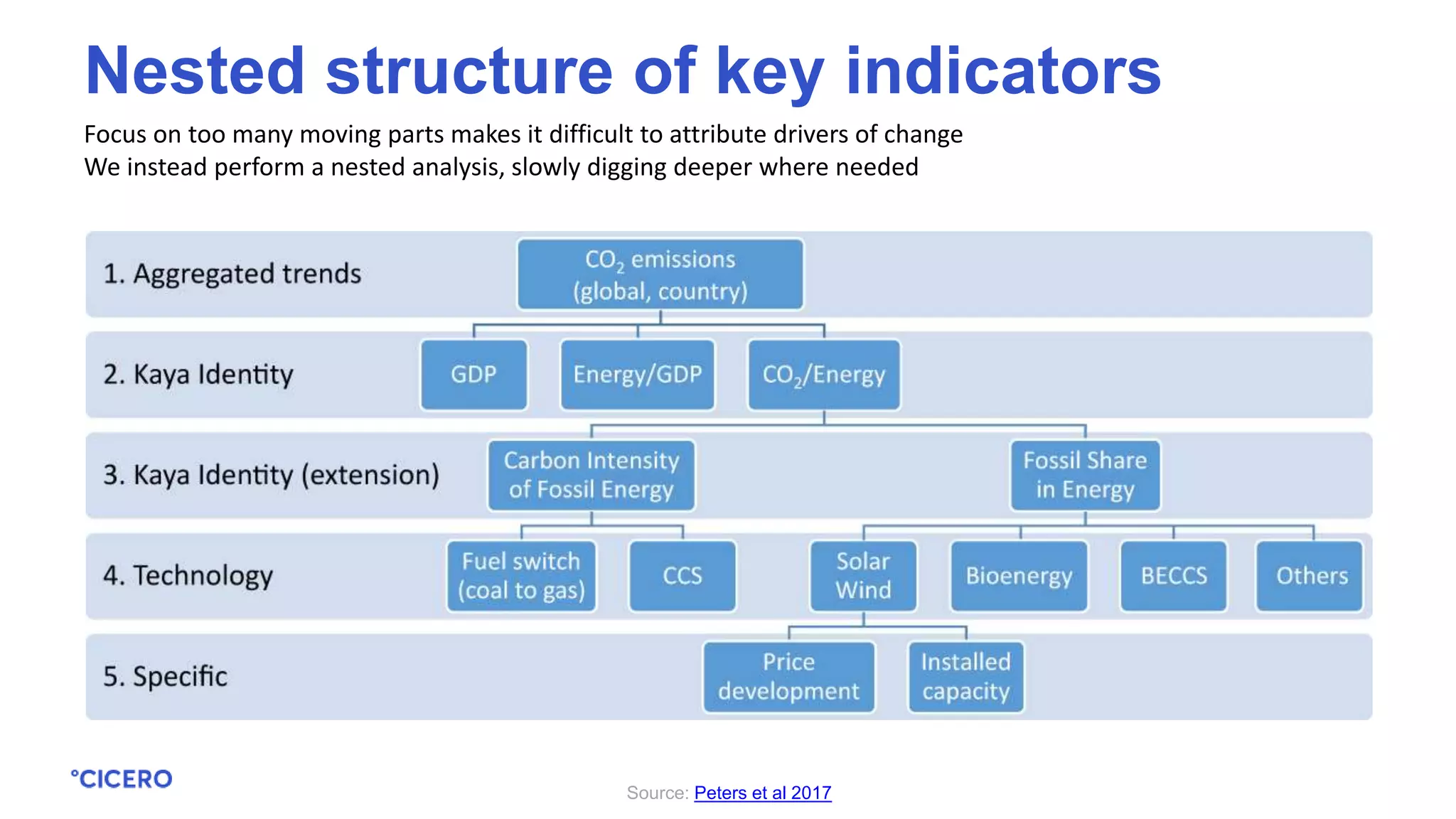
Focus on too many moving parts makes it difficult to attribute drivers of change
We instead perform a nested analysis, slowly digging deeper where needed
Source: Peters et al 2017
Nested structure of key indicators
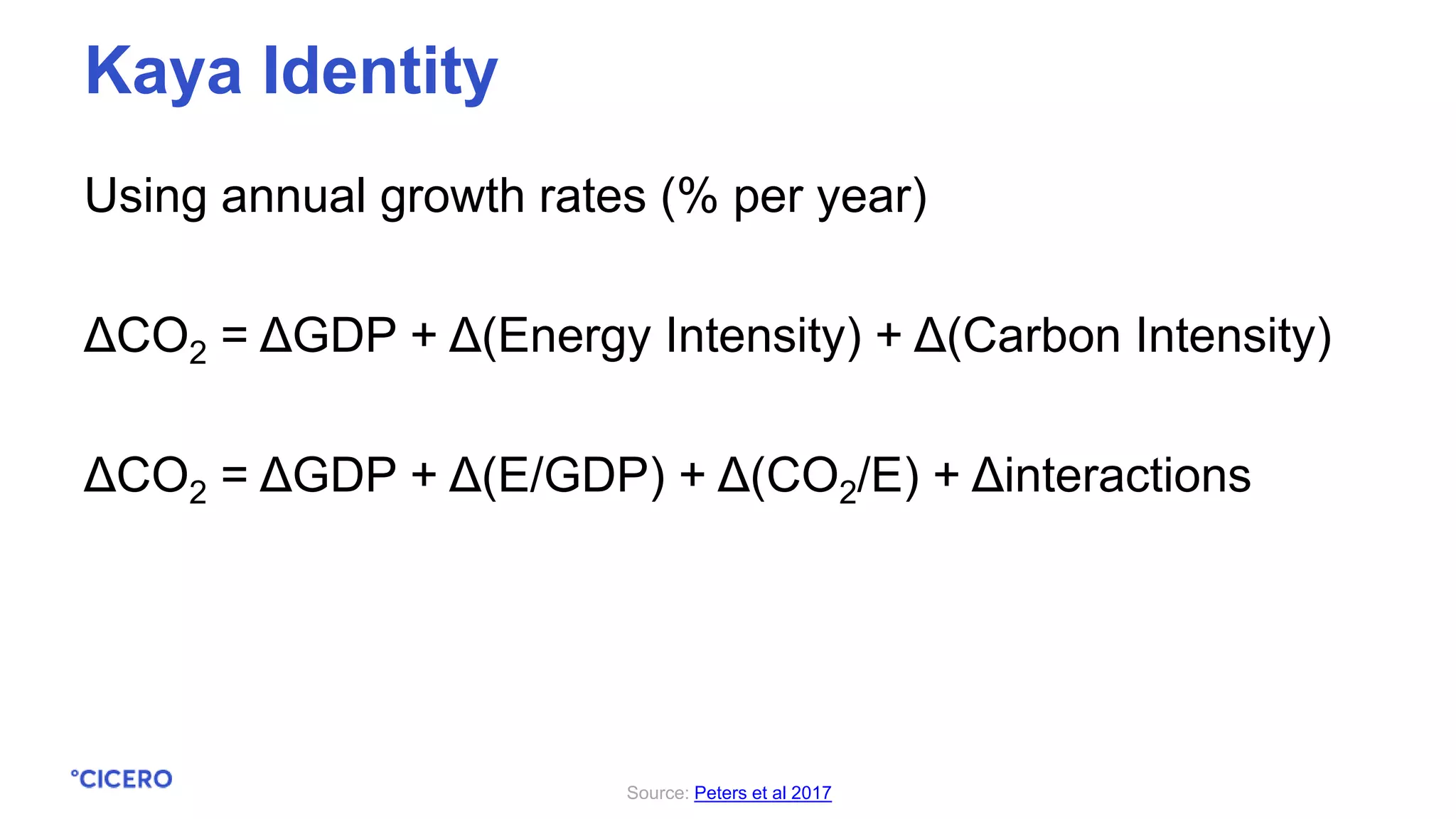
Using annual growth rates (% per year)
ΔCO2 = ΔGDP + Δ(Energy Intensity) + Δ(Carbon Intensity)
ΔCO2 = ΔGDP + Δ(E/GDP) + Δ(CO2/E) + Δinteractions
Kaya Identity
Source: Peters et al 2017
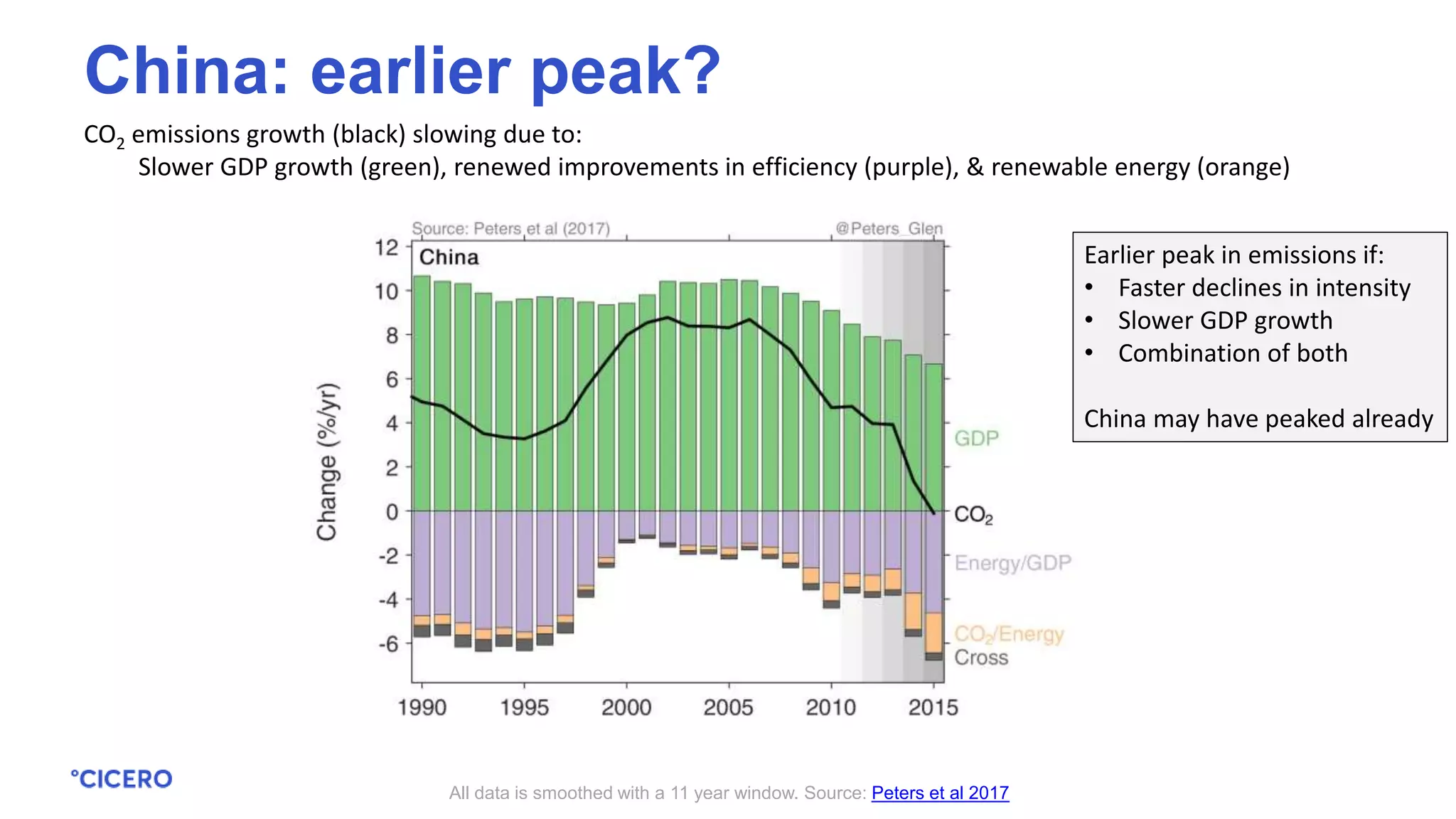
CO2 emissions growth (black) slowing due to:
Slower GDP growth (green), renewed improvements in efficiency (purple), & renewable energy (orange)
All data is smoothed with a 11 year window. Source: Peters et al 2017
China: earlier peak?
Earlier peak in emissions if:
• Faster declines in intensity
• Slower GDP growth
• Combination of both
China may have peaked already
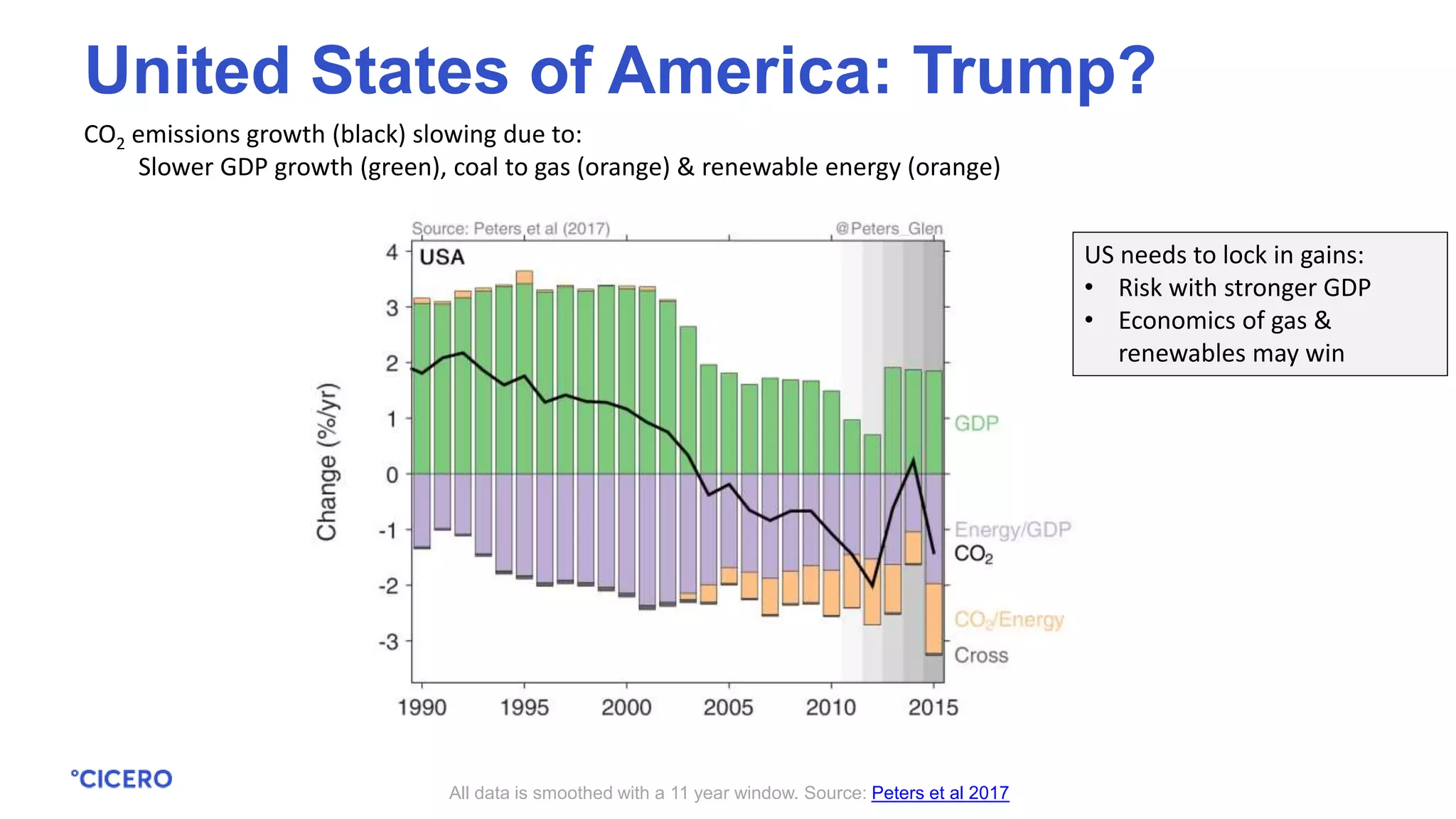
CO2 emissions growth (black) slowing due to:
Slower GDP growth (green), coal to gas (orange) & renewable energy (orange)
All data is smoothed with a 11 year window. Source: Peters et al 2017
United States of America: Trump?
US needs to lock in gains:
• Risk with stronger GDP
• Economics of gas &
renewables may win
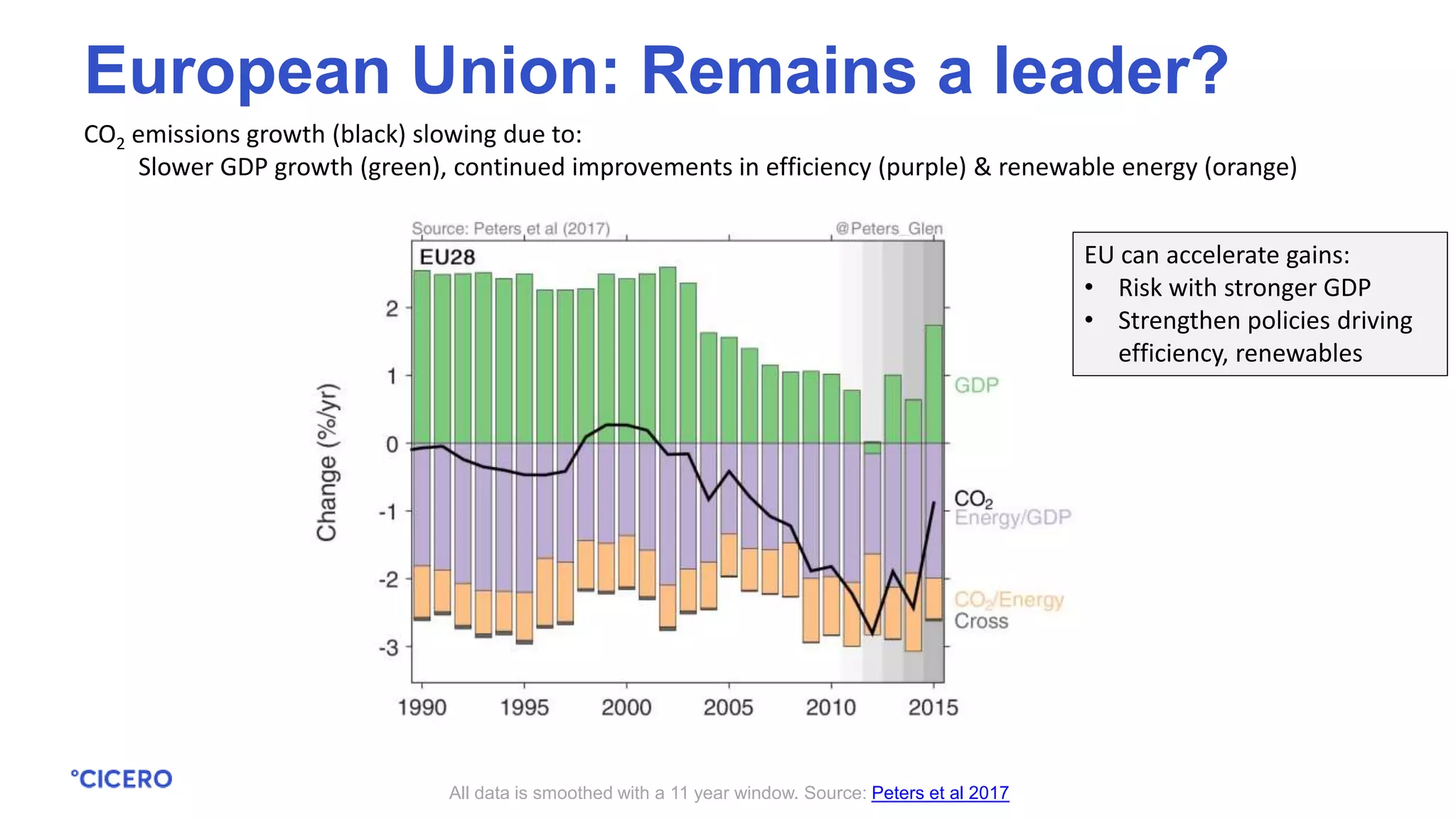
CO2 emissions growth (black) slowing due to:
Slower GDP growth (green), continued improvements in efficiency (purple) & renewable energy (orange)
All data is smoothed with a 11 year window. Source: Peters et al 2017
European Union: Remains a leader?
EU can accelerate gains:
• Risk with stronger GDP
• Strengthen policies driving
efficiency, renewables
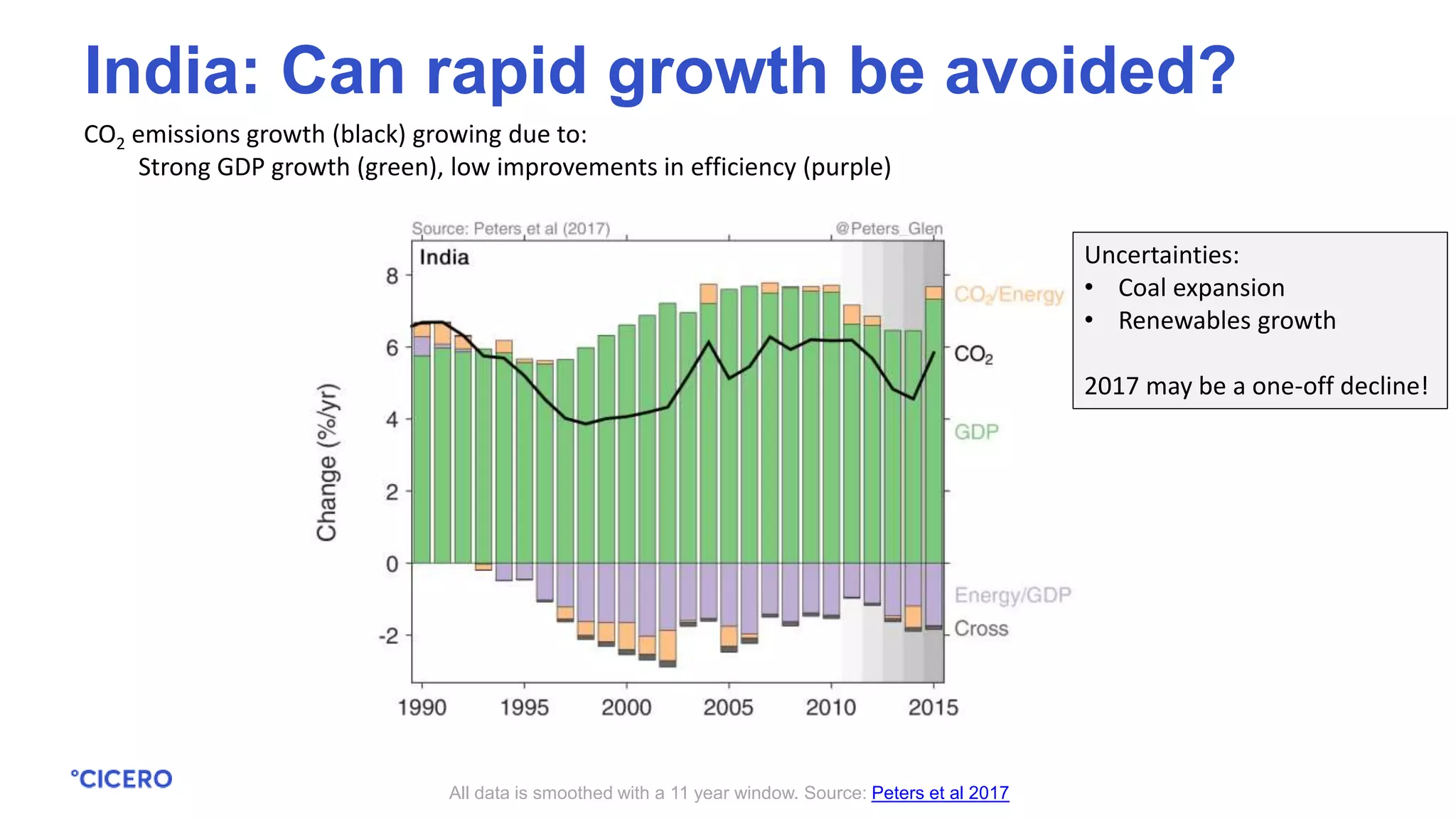
CO2 emissions growth (black) growing due to:
Strong GDP growth (green), low improvements in efficiency (purple)
All data is smoothed with a 11 year window. Source: Peters et al 2017
India: Can rapid growth be avoided?
Uncertainties:
• Coal expansion
• Renewables growth
2017 may be a one-off decline!
The future is uncertain, and we use scenarios to explore these future uncertainties
Emission scenarios
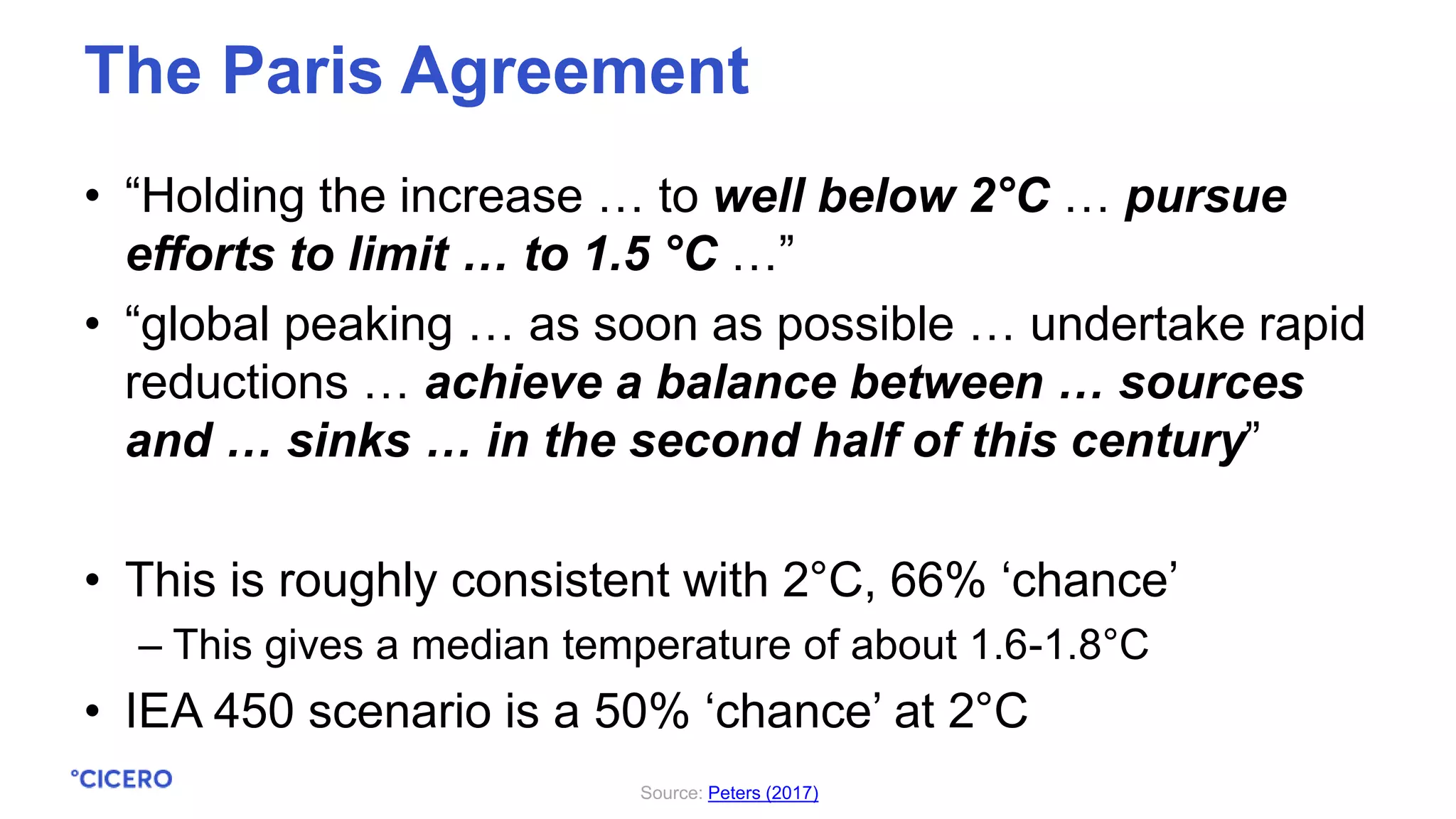
• “Holding the increase … to well below 2°C … pursue
efforts to limit … to 1.5 °C …”
• “global peaking … as soon as possible … undertake rapid
reductions … achieve a balance between … sources
and … sinks … in the second half of this century”
• This is roughly consistent with 2°C, 66% ‘chance’
– This gives a median temperature of about 1.6-1.8°C
• IEA 450 scenario is a 50% ‘chance’ at 2°C
The Paris Agreement
Source: Peters (2017)
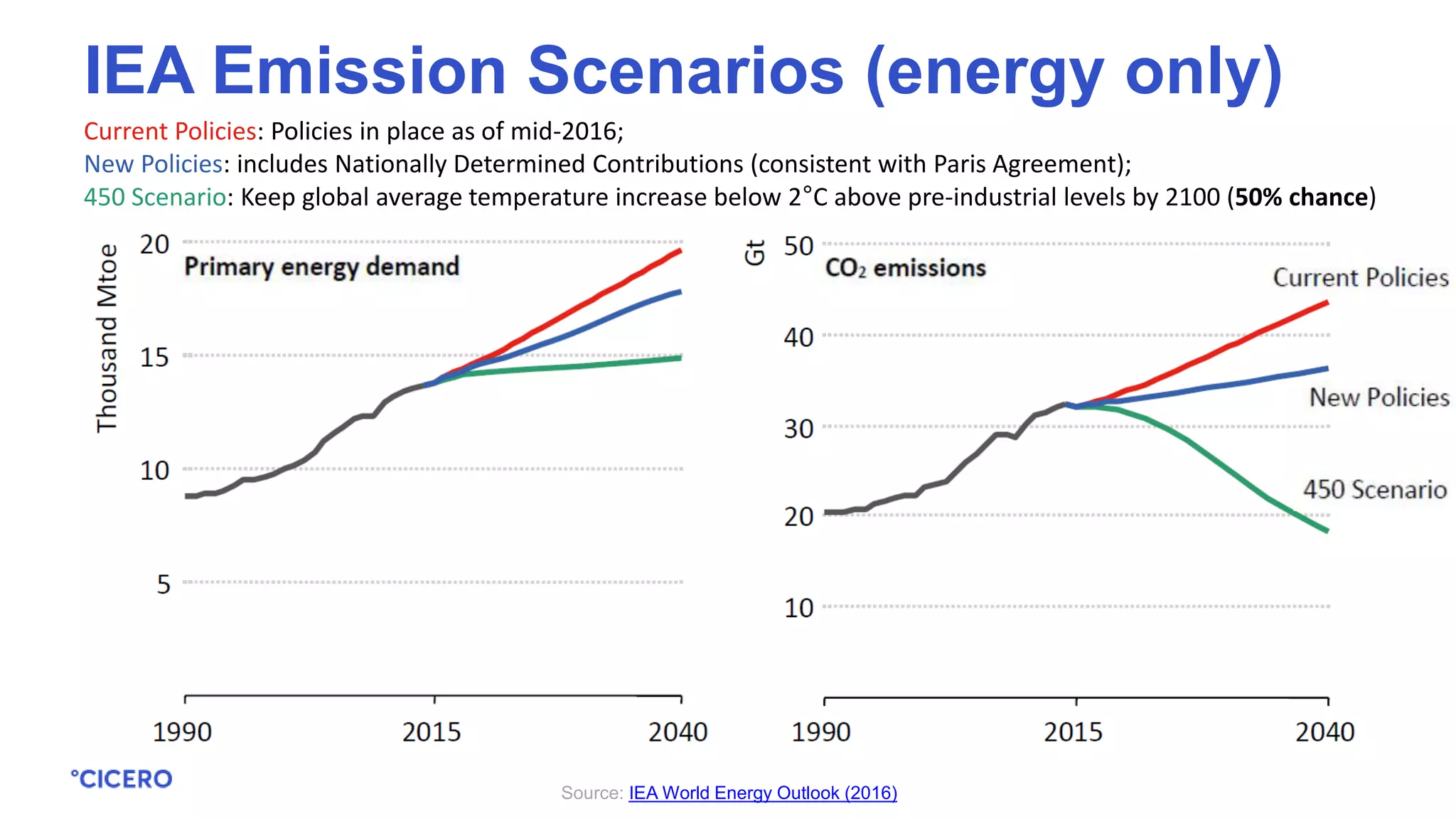
Source: IEA World Energy Outlook (2016)
IEA Emission Scenarios (energy only)
Current Policies: Policies in place as of mid-2016;
New Policies: includes Nationally Determined Contributions (consistent with Paris Agreement);
450 Scenario: Keep global average temperature increase below 2°C above pre-industrial levels by 2100 (50% chance)
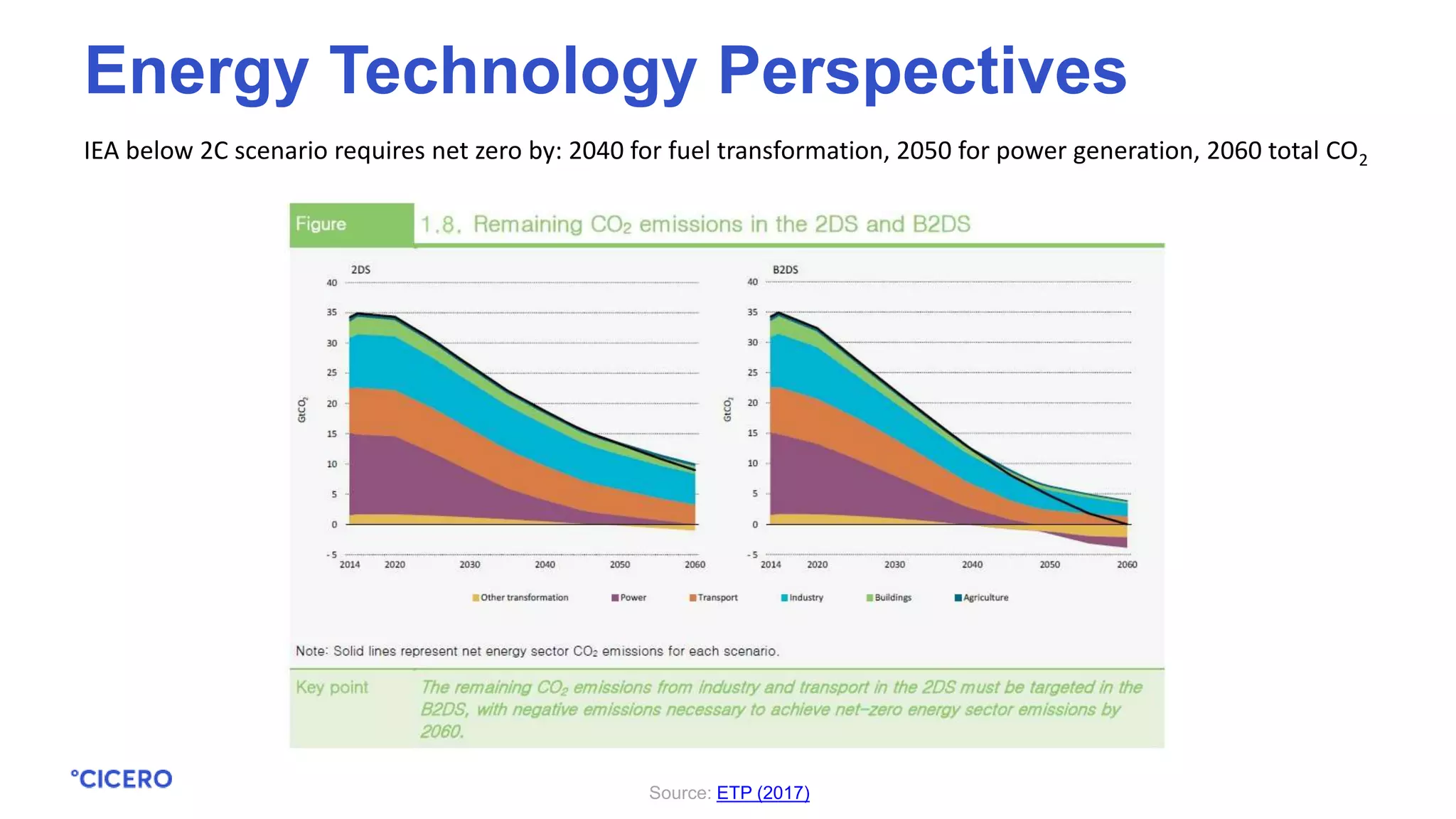
IEA below 2C scenario requires net zero by: 2040 for fuel transformation, 2050 for power generation, 2060 total CO2
Source: ETP (2017)
Energy Technology Perspectives
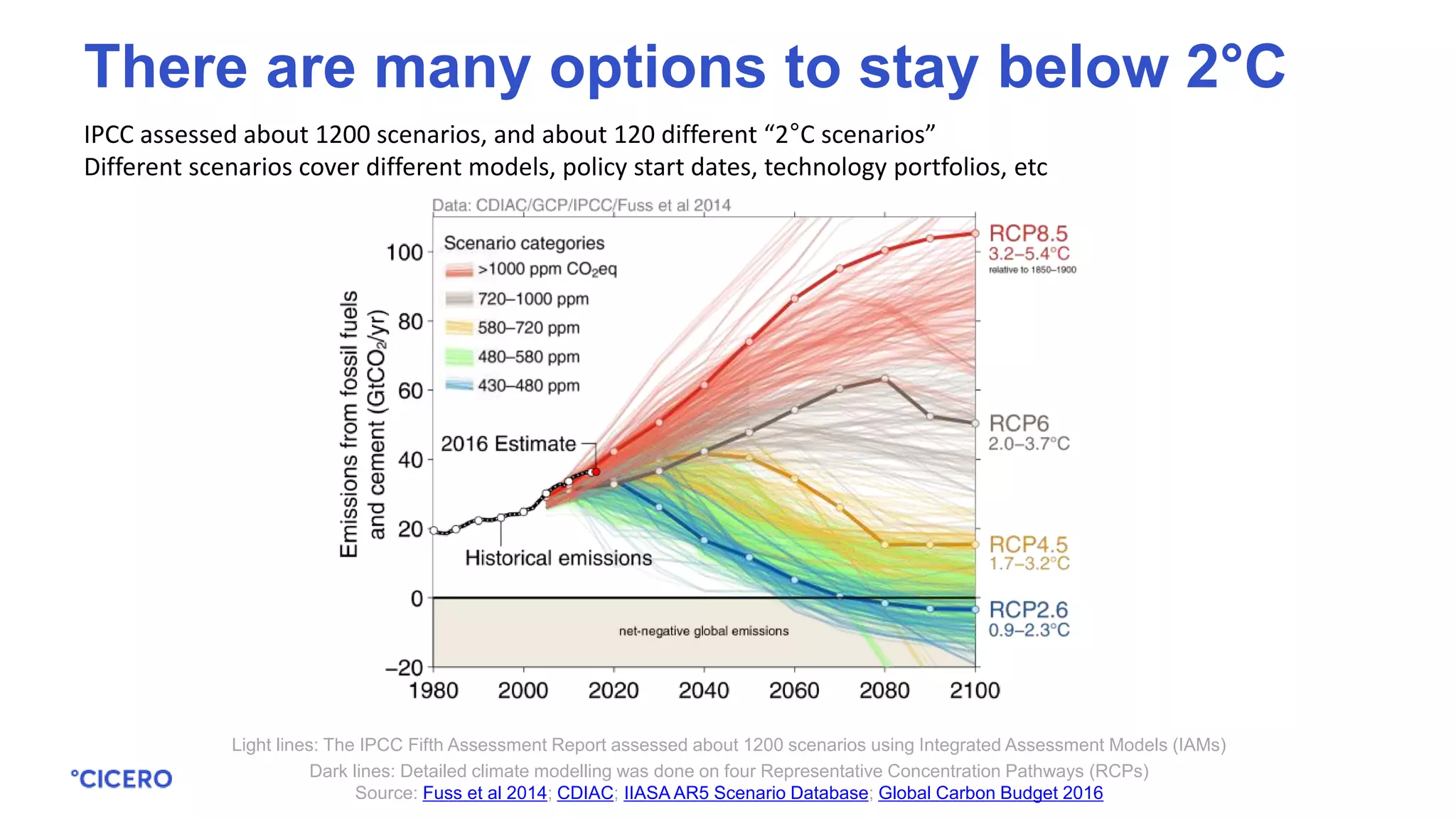
IPCC assessed about 1200 scenarios, and about 120 different “2°C scenarios”
Different scenarios cover different models, policy start dates, technology portfolios, etc
Light lines: The IPCC Fifth Assessment Report assessed about 1200 scenarios using Integrated Assessment Models (IAMs)
Dark lines: Detailed climate modelling was done on four Representative Concentration Pathways (RCPs)
Source: Fuss et al 2014; CDIAC; IIASA AR5 Scenario Database; Global Carbon Budget 2016
There are many options to stay below 2°C
IPCC assessed about 1200 scenarios, and about 120 different “2°C scenarios”
Different scenarios cover different models, policy start dates, technology portfolios, etc
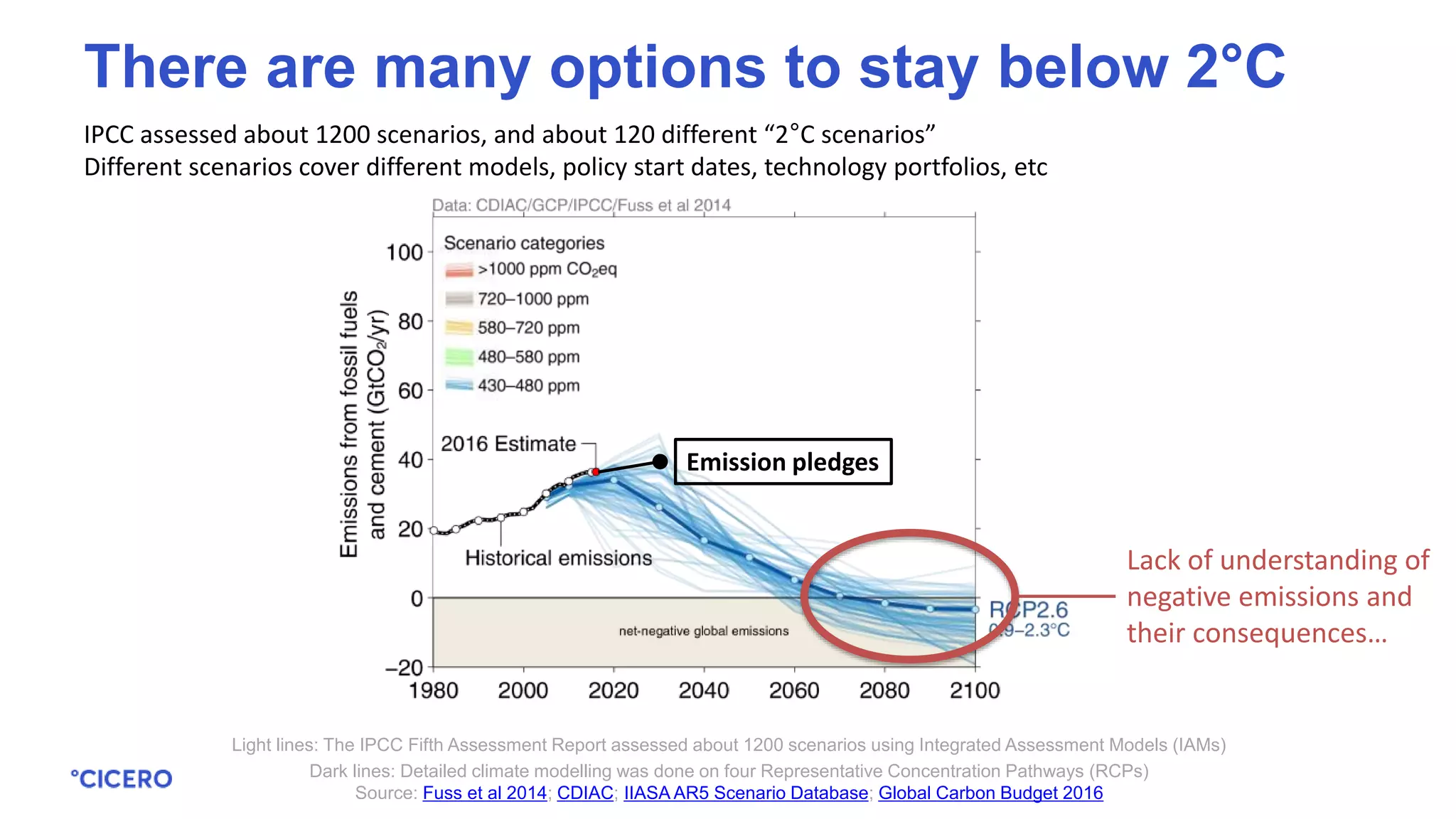
Light lines: The IPCC Fifth Assessment Report assessed about 1200 scenarios using Integrated Assessment Models (IAMs)
Dark lines: Detailed climate modelling was done on four Representative Concentration Pathways (RCPs)
Source: Fuss et al 2014; CDIAC; IIASA AR5 Scenario Database; Global Carbon Budget 2016
There are many options to stay below 2°C
Lack of understanding of
negative emissions and
their consequences…
Emission pledges
The trouble with negative emissions
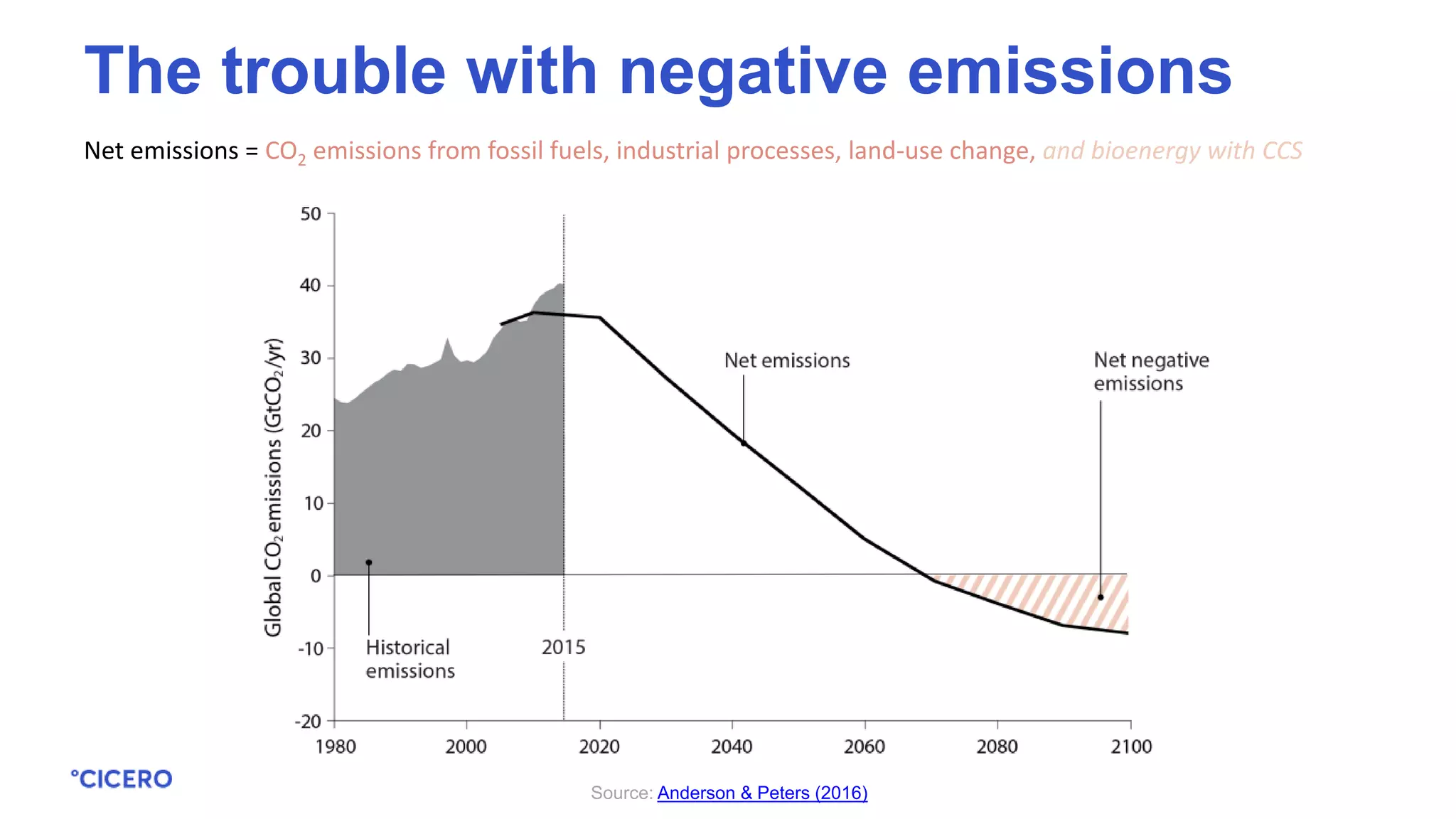
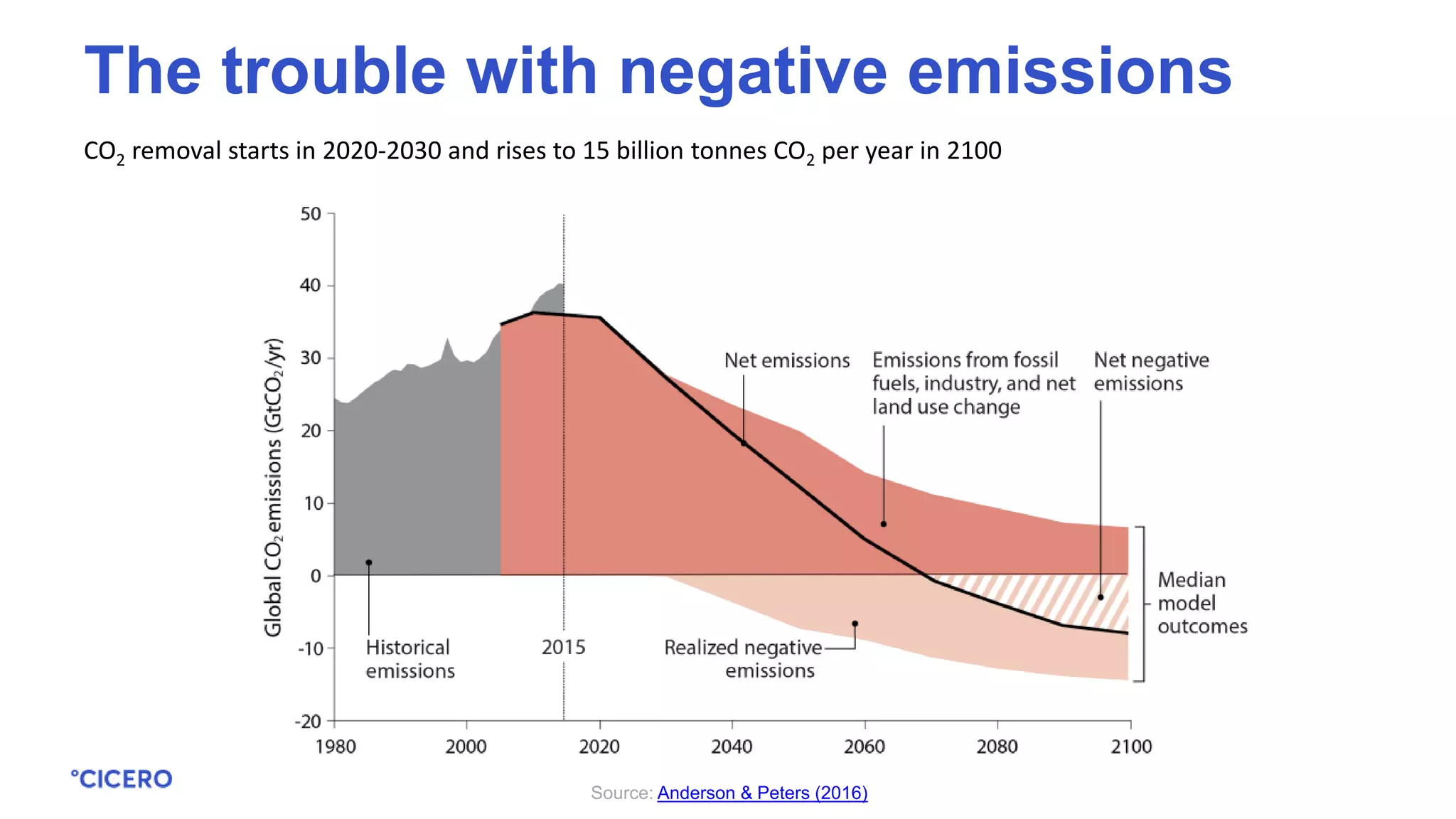
Net emissions = CO2 emissions from fossil fuels, industrial processes, land-use change, and bioenergy with CCS
Source: Anderson & Peters (2016)
The trouble with negative emissions
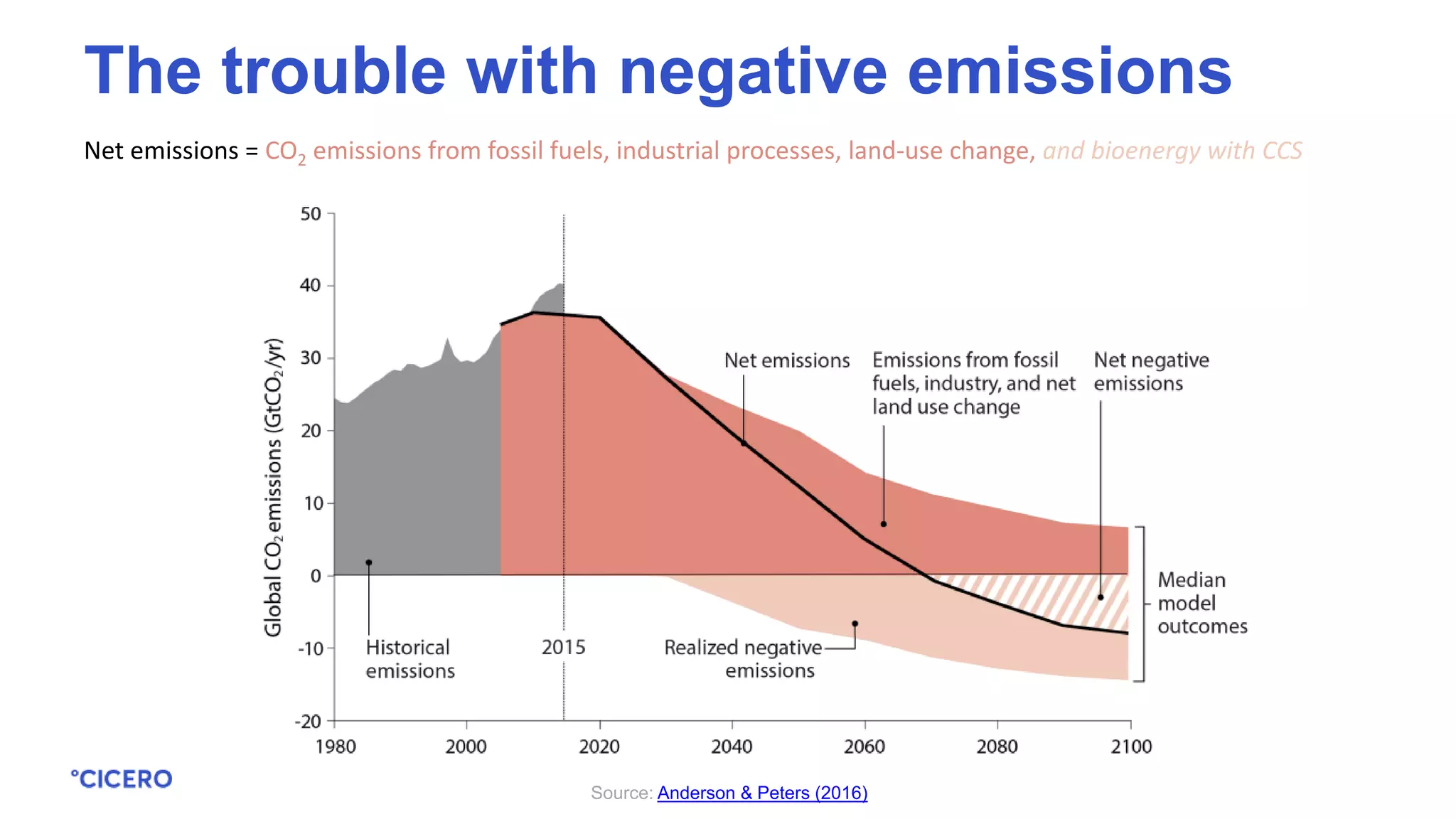
Net emissions = CO2 emissions from fossil fuels, industrial processes, land-use change, and bioenergy with CCS
Source: Anderson & Peters (2016)
The trouble with negative emissions
CO2 removal starts in 2020-2030 and rises to 15 billion tonnes CO2 per year in 2100
Source: Anderson & Peters (2016)
The trouble with negative emissions
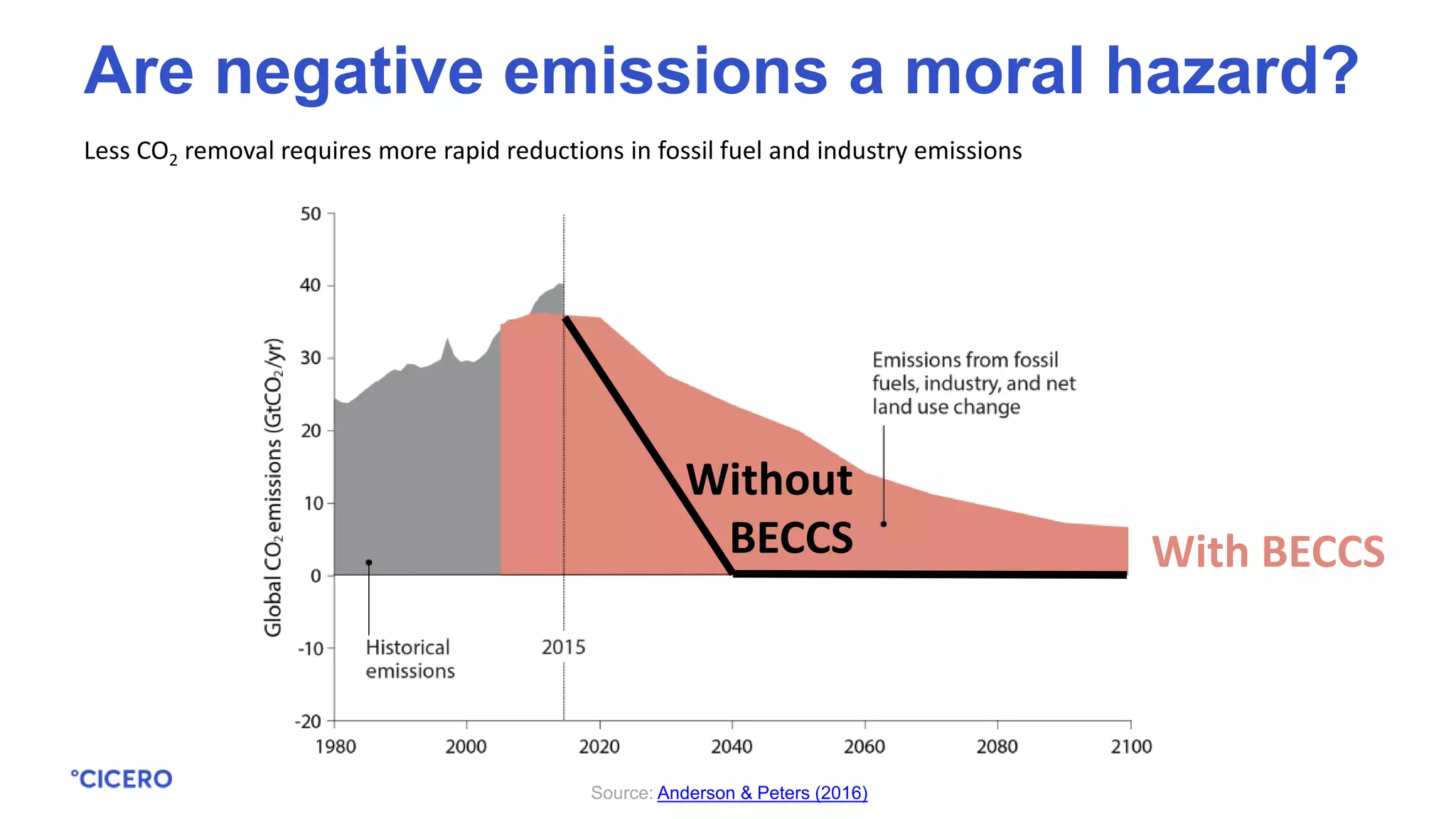
Less CO2 removal requires more rapid reductions in fossil fuel and industry emissions
Source: Anderson & Peters (2016)
Are negative emissions a moral hazard?
With BECCS
Without
BECCS
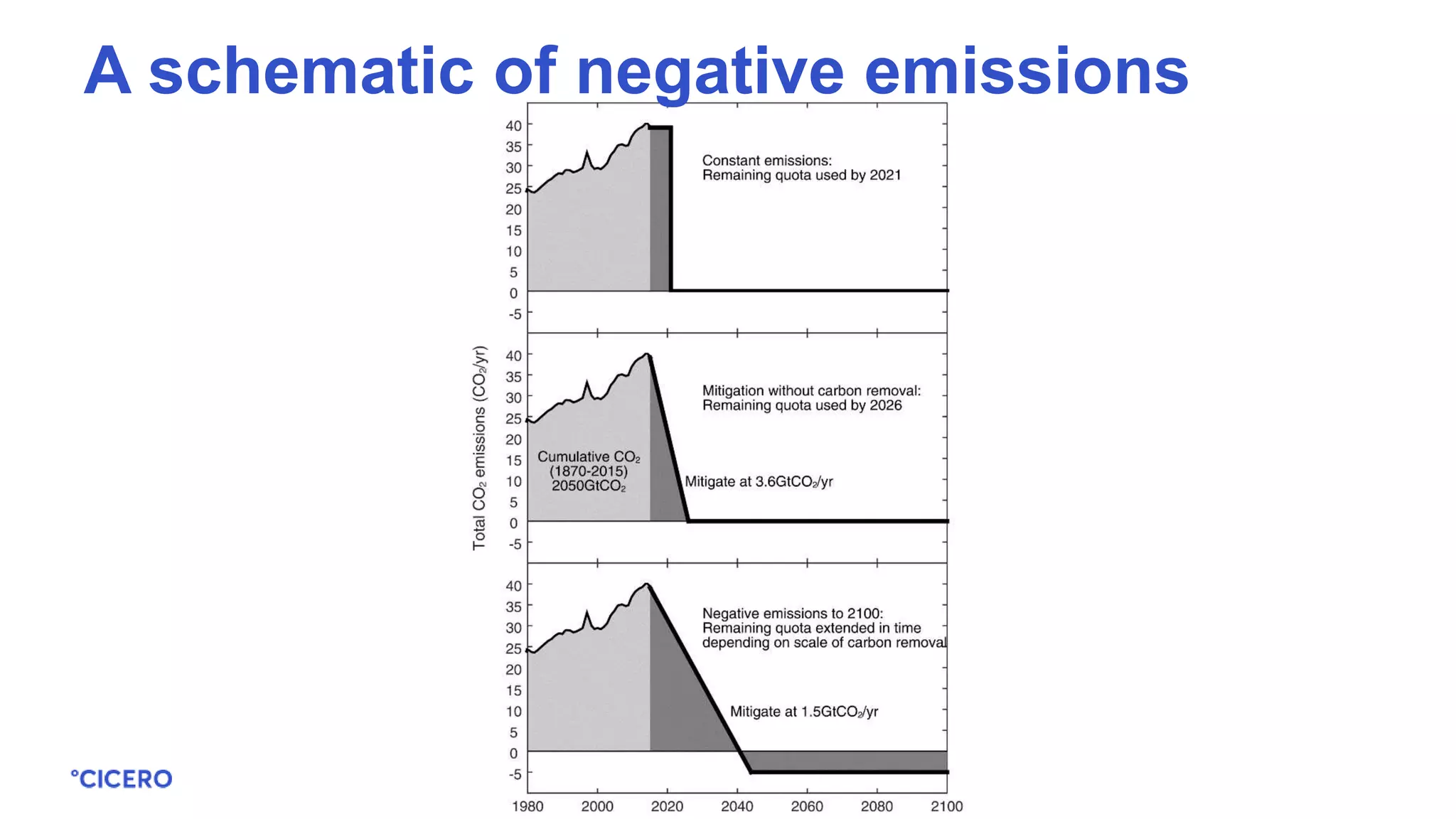
A schematic of negative emissions
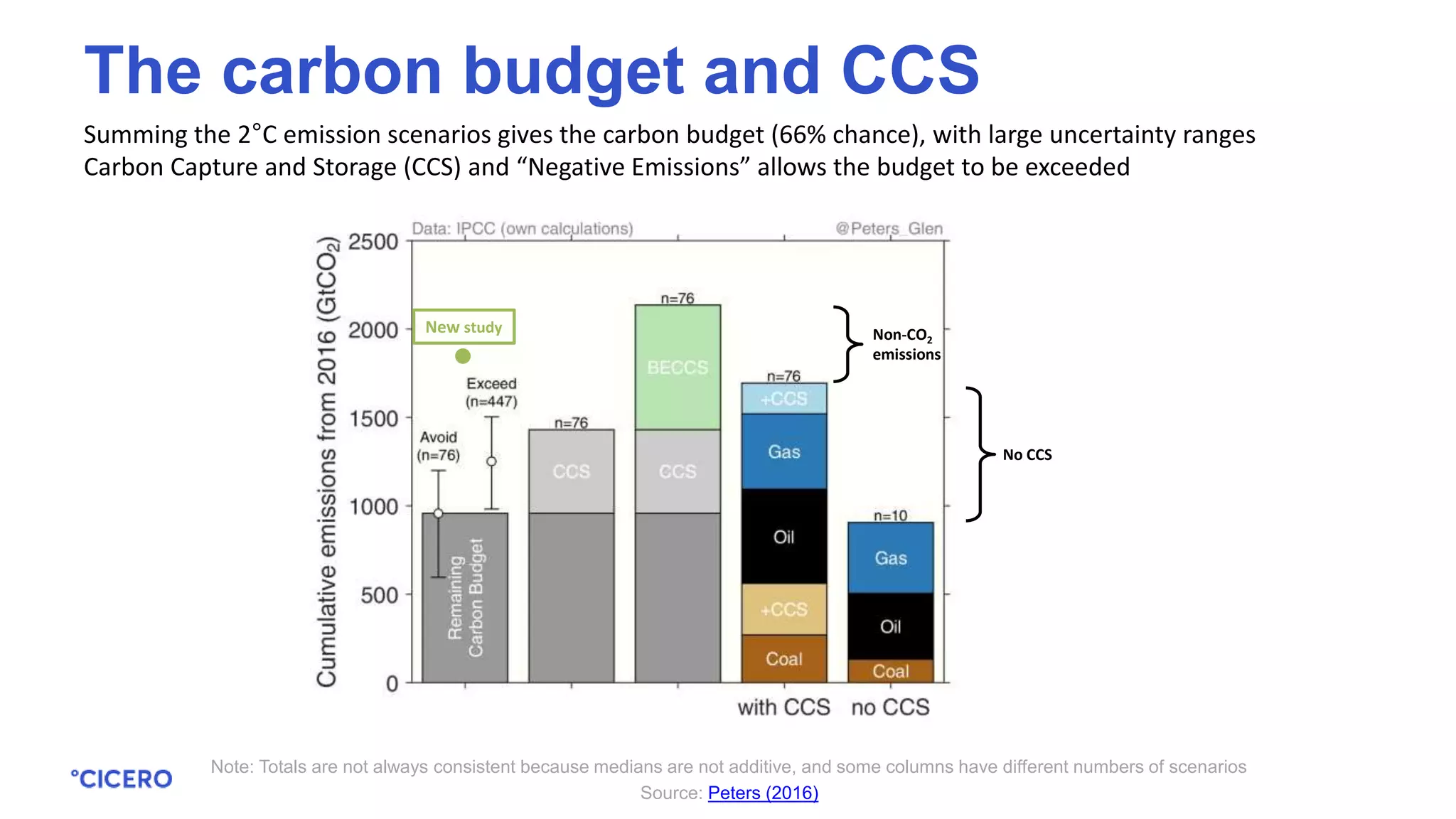
Summing the 2°C emission scenarios gives the carbon budget (66% chance), with large uncertainty ranges
Carbon Capture and Storage (CCS) and “Negative Emissions” allows the budget to be exceeded
Note: Totals are not always consistent because medians are not additive, and some columns have different numbers of scenarios
Source: Peters (2016)
The carbon budget and CCS
Non-CO2
emissions
No CCS
New study
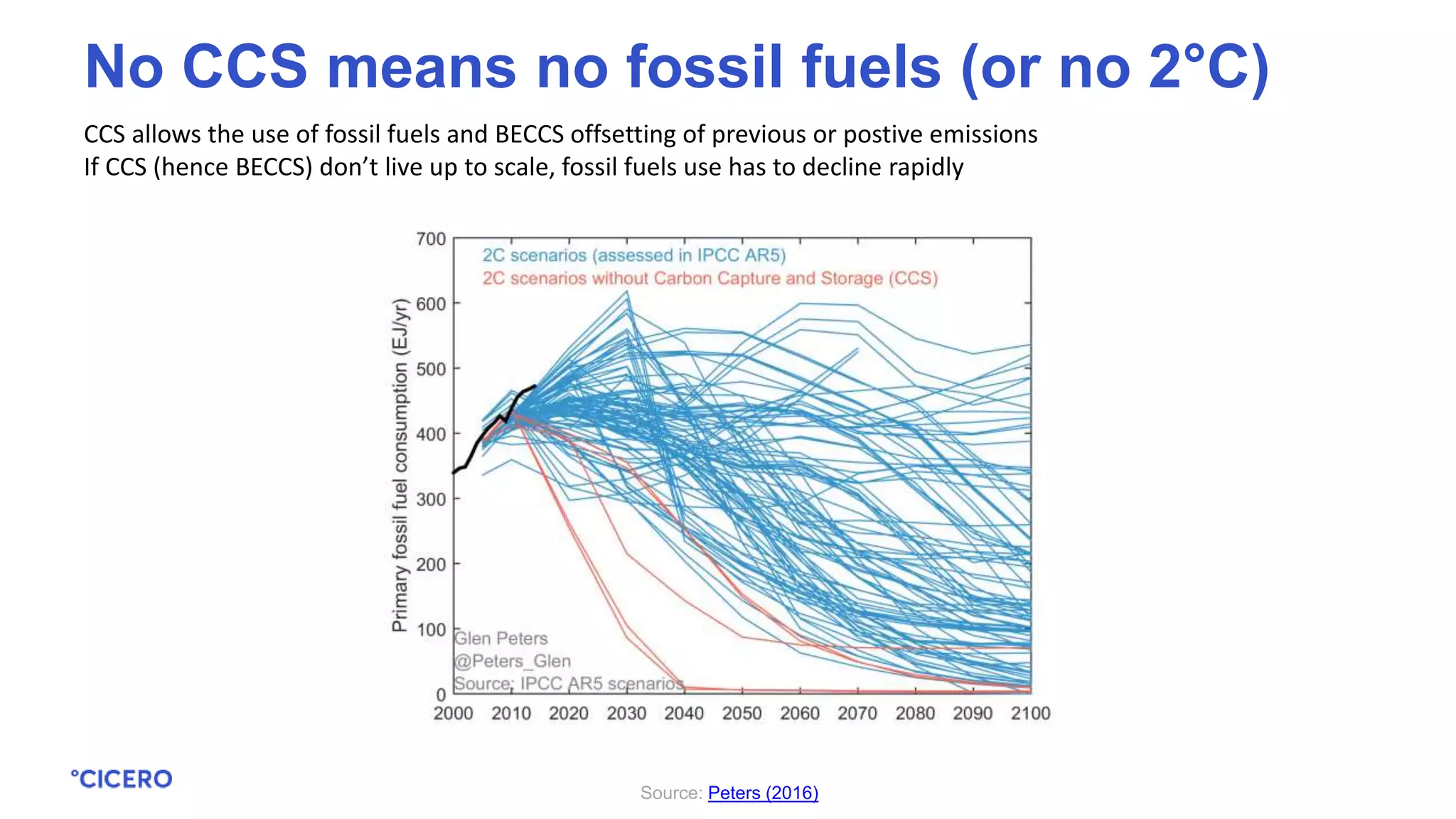
CCS allows the use of fossil fuels and BECCS offsetting of previous or postive emissions
If CCS (hence BECCS) don’t live up to scale, fossil fuels use has to decline rapidly
Source: Peters (2016)
No CCS means no fossil fuels (or no 2°C)
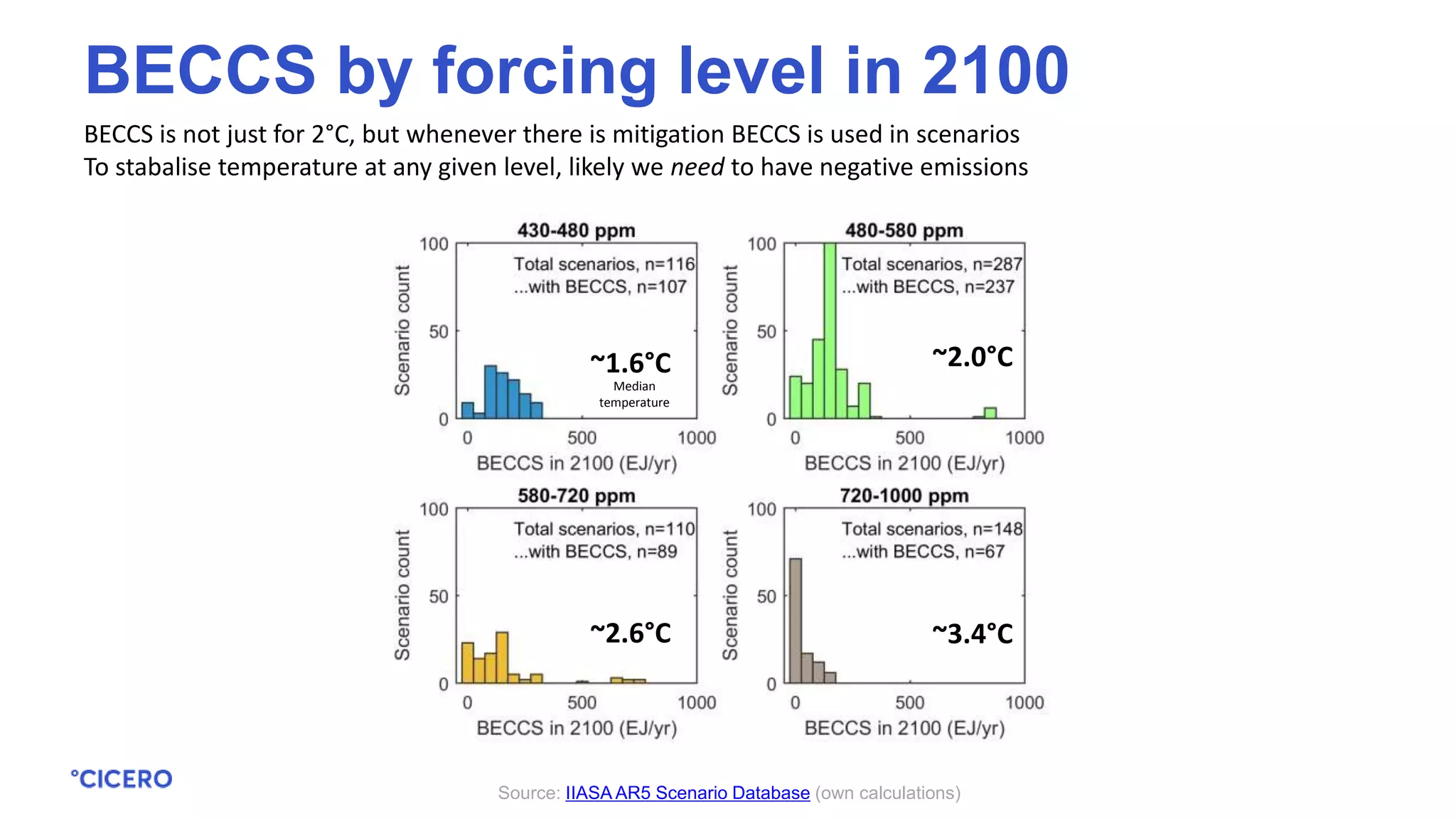
BECCS is not just for 2°C, but whenever there is mitigation BECCS is used in scenarios
To stabalise temperature at any given level, likely we need to have negative emissions
Source: IIASA AR5 Scenario Database (own calculations)
BECCS by forcing level in 2100
~1.6°C ~2.0°C
~2.6°C ~3.4°C
Median
temperature
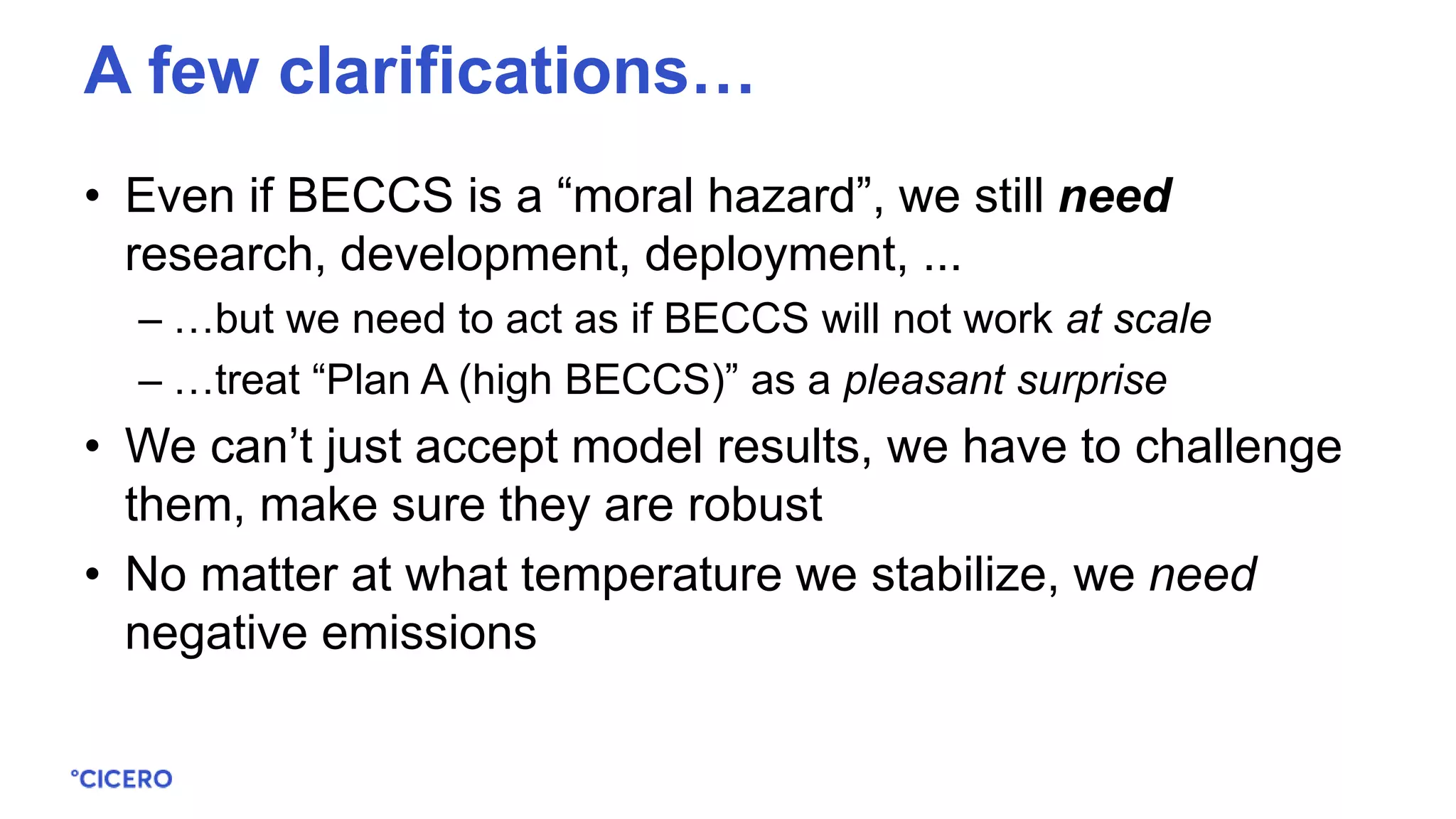
• Even if BECCS is a “moral hazard”, we still need
research, development, deployment, ...
– …but we need to act as if BECCS will not work at scale
– …treat “Plan A (high BECCS)” as a pleasant surprise
• We can’t just accept model results, we have to challenge
them, make sure they are robust
• No matter at what temperature we stabilize, we need
negative emissions
A few clarifications…
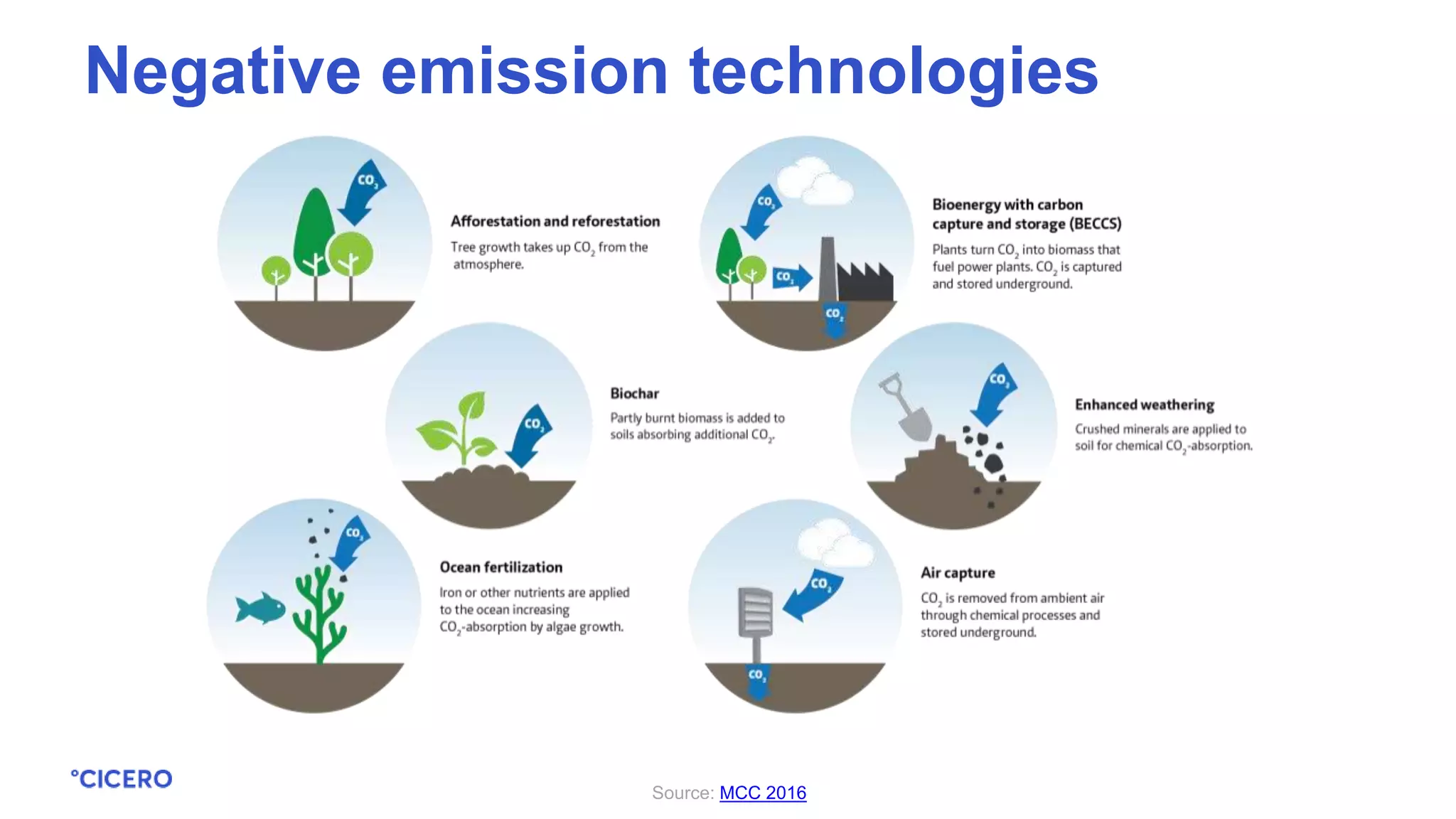
Negative emission technologies
Source: MCC 2016
Negative emission technologies
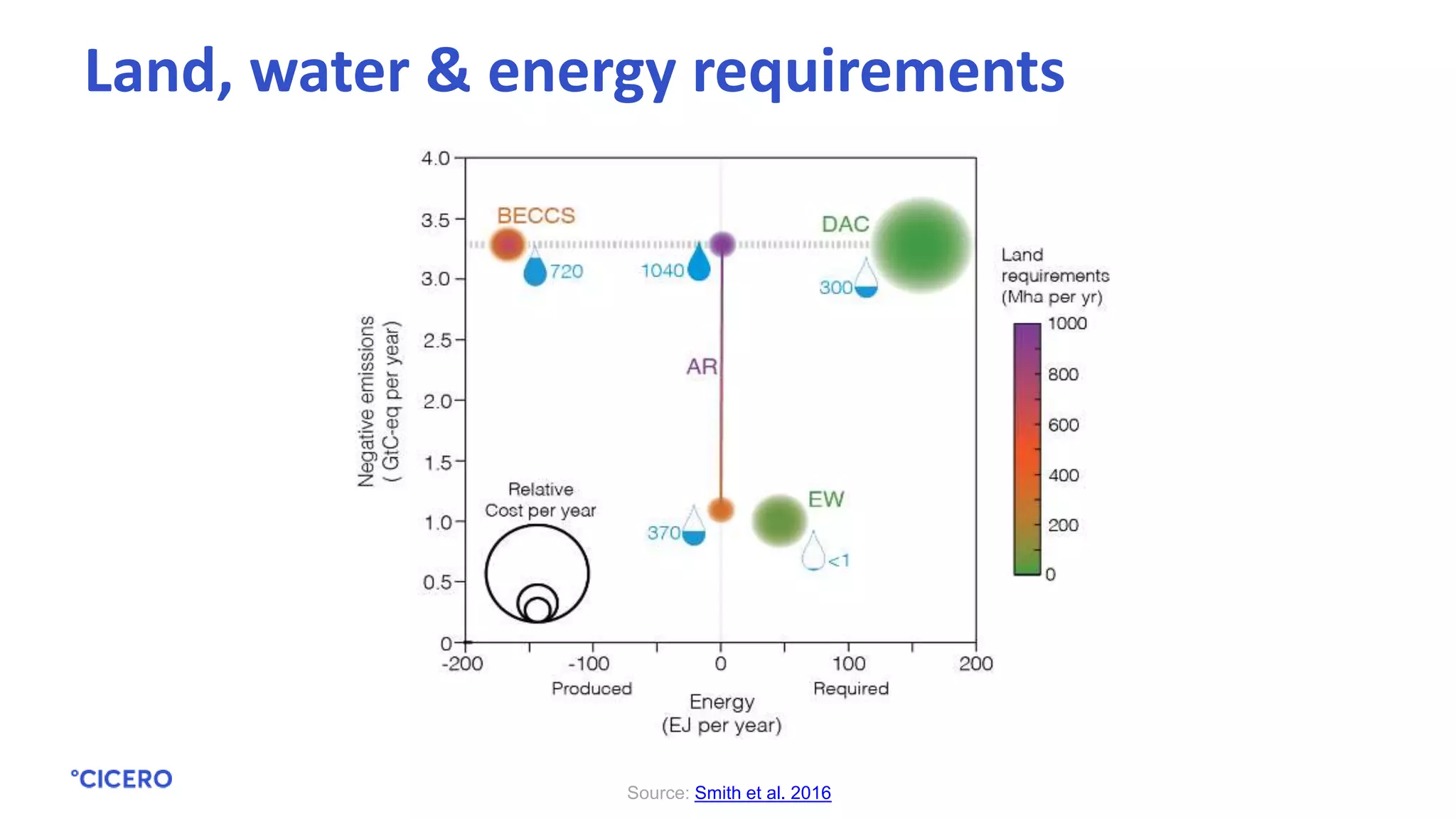
Source: Smith et al. 2016
Land, water & energy requirements
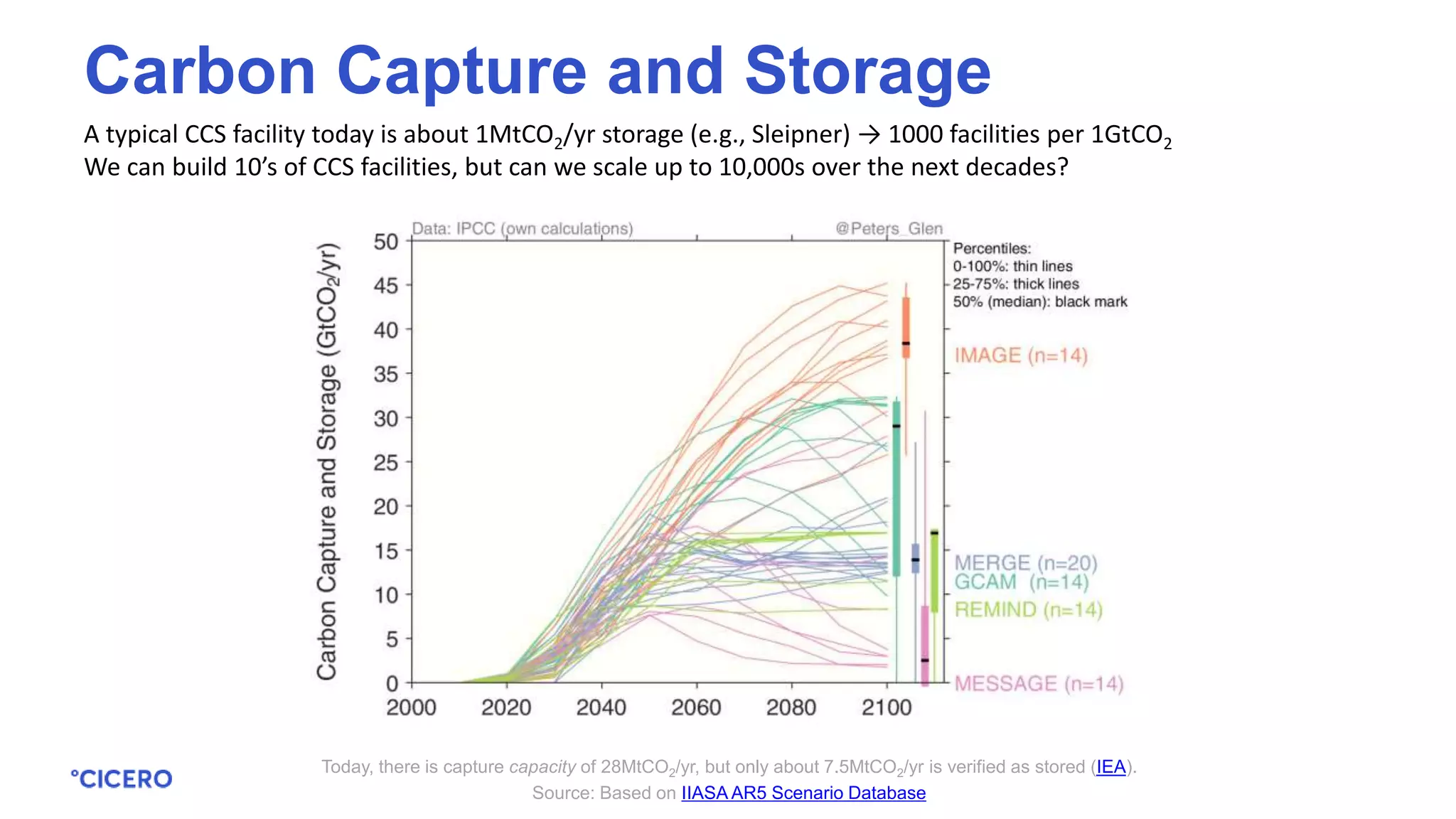
The trouble with carbon, capture & storage
A typical CCS facility today is about 1MtCO2/yr storage (e.g., Sleipner) → 1000 facilities per 1GtCO2
We can build 10’s of CCS facilities, but can we scale up to 10,000s over the next decades?
Today, there is capture capacity of 28MtCO2/yr, but only about 7.5MtCO2/yr is verified as stored (IEA).
Source: Based on IIASA AR5 Scenario Database
Carbon Capture and Storage
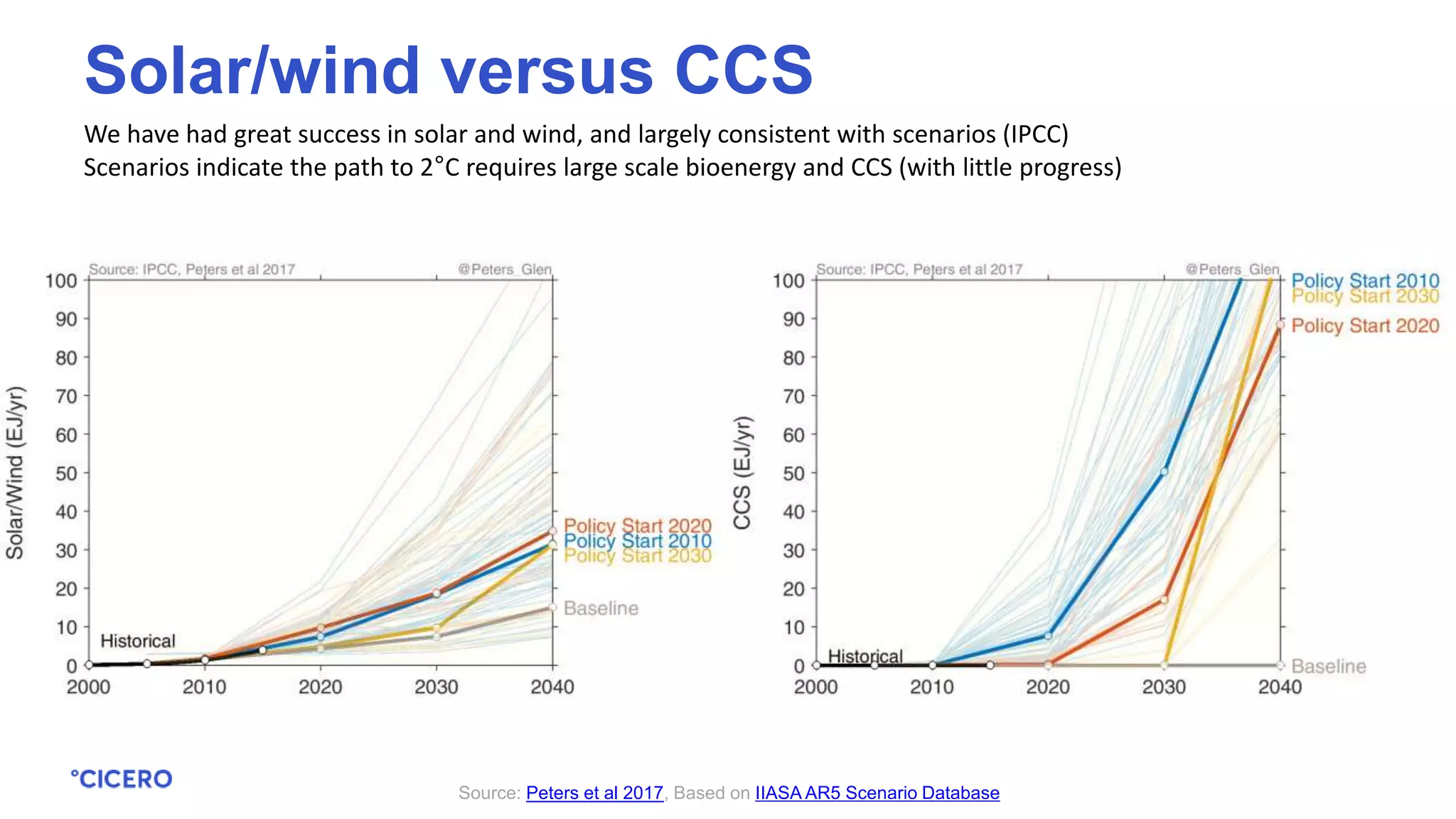
We have had great success in solar and wind, and largely consistent with scenarios (IPCC)
Scenarios indicate the path to 2°C requires large scale bioenergy and CCS (with little progress)
Source: Peters et al 2017, Based on IIASA AR5 Scenario Database
Solar/wind versus CCS
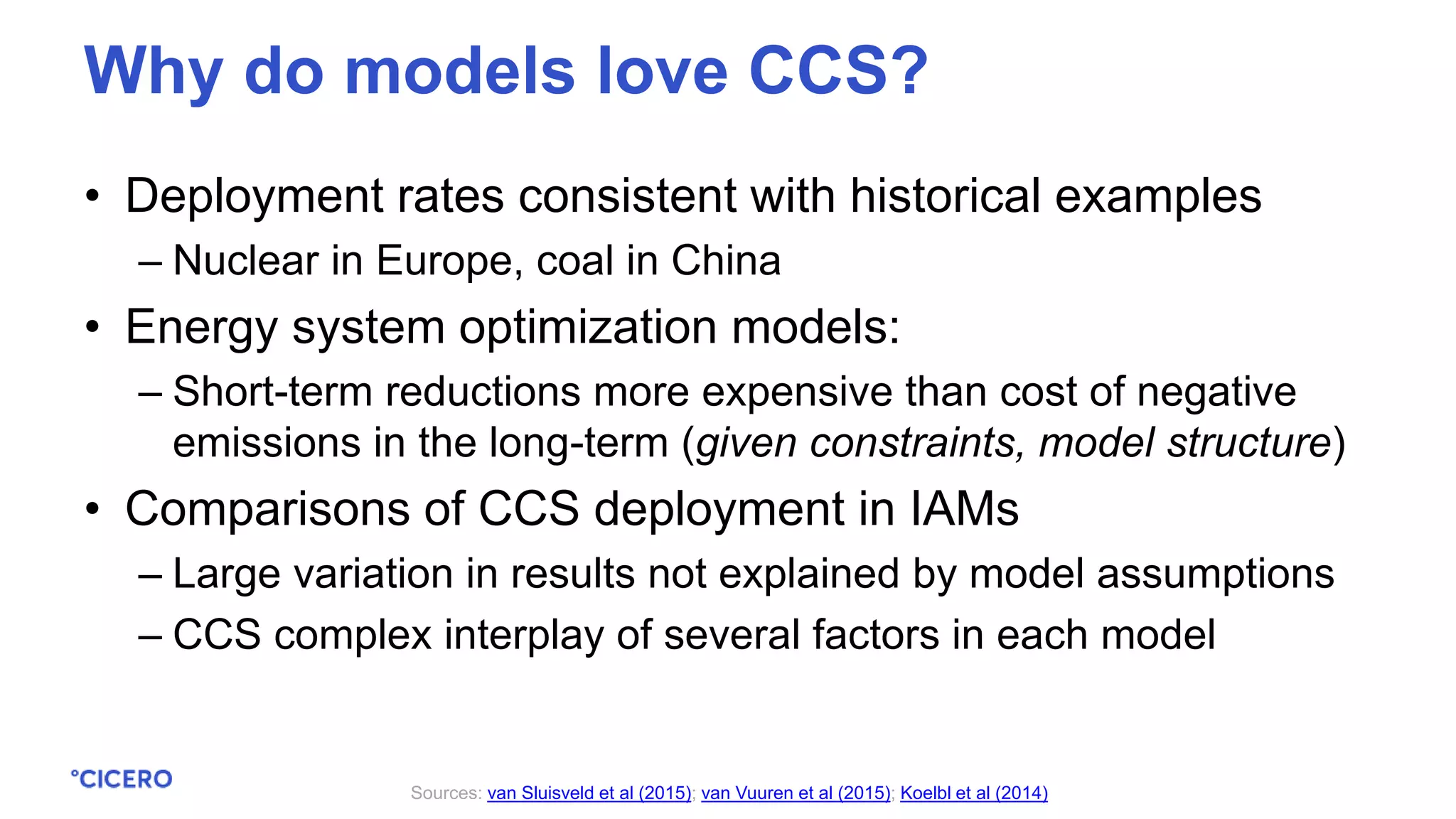
• Deployment rates consistent with historical examples
– Nuclear in Europe, coal in China
• Energy system optimization models:
– Short-term reductions more expensive than cost of negative
emissions in the long-term (given constraints, model structure)
• Comparisons of CCS deployment in IAMs
– Large variation in results not explained by model assumptions
– CCS complex interplay of several factors in each model
Sources: van Sluisveld et al (2015); van Vuuren et al (2015); Koelbl et al (2014)
Why do models love CCS?
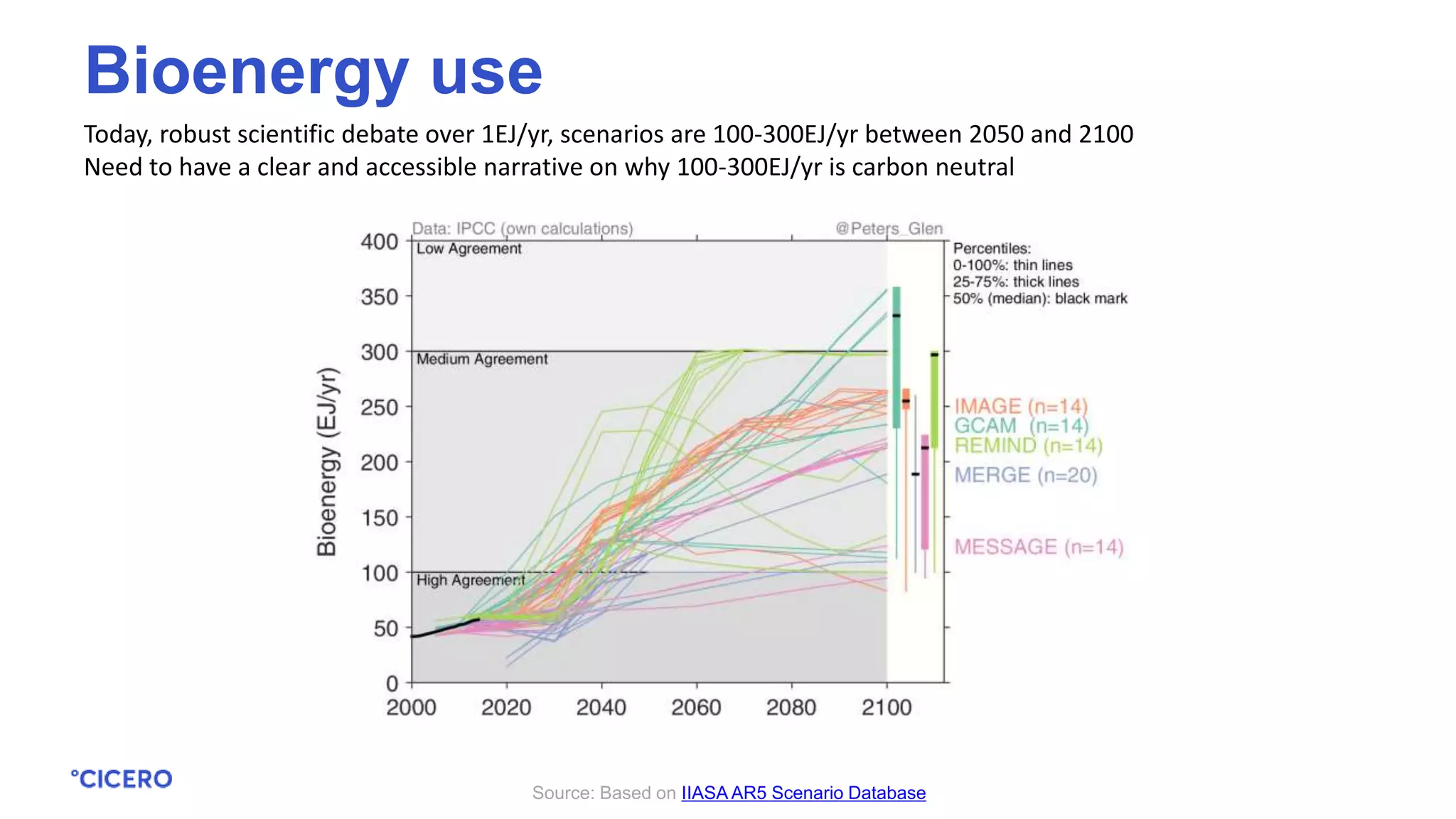
Today, robust scientific debate over 1EJ/yr, scenarios are 100-300EJ/yr between 2050 and 2100
Need to have a clear and accessible narrative on why 100-300EJ/yr is carbon neutral
Source: Based on IIASA AR5 Scenario Database
Bioenergy use
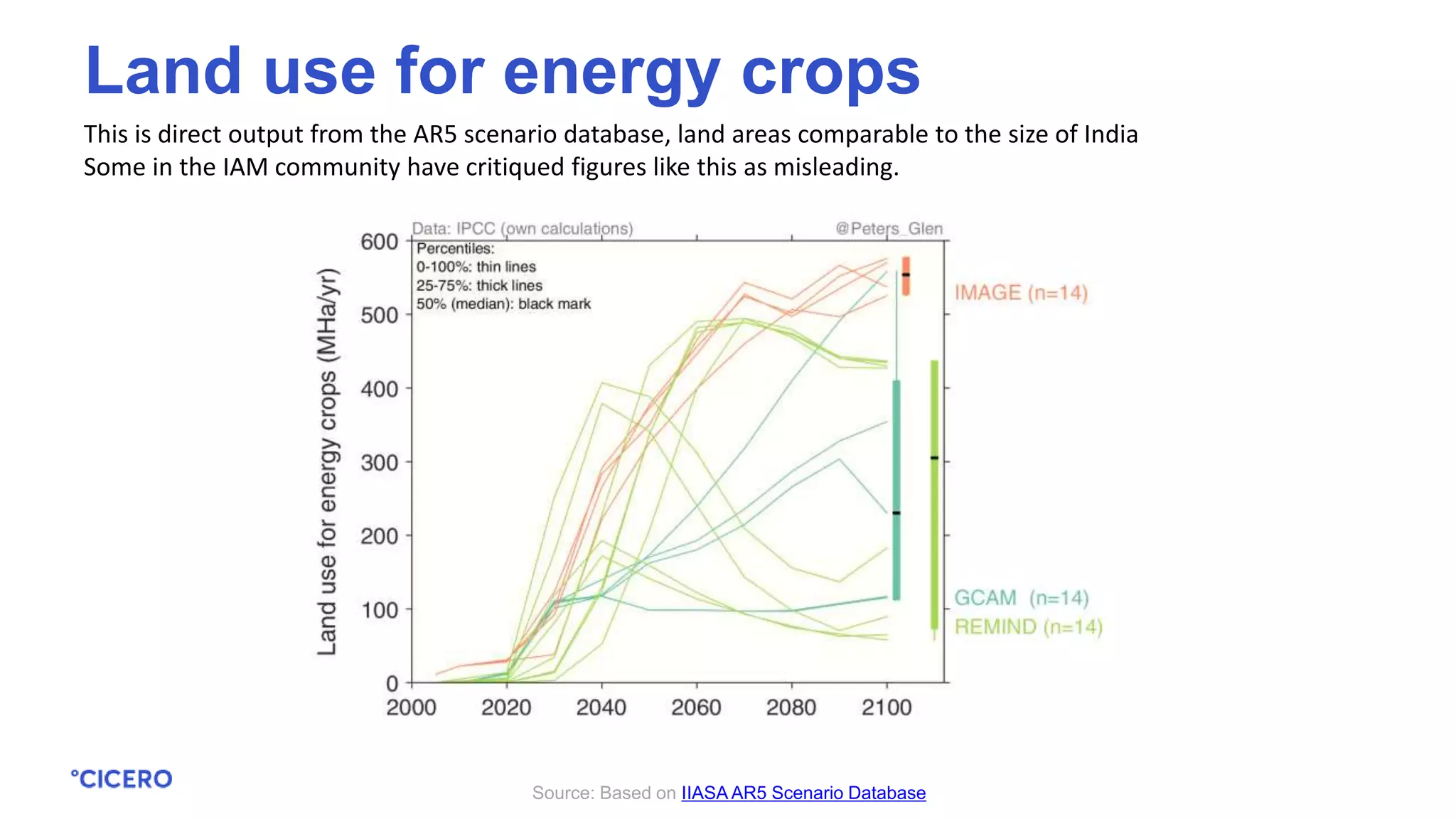
This is direct output from the AR5 scenario database, land areas comparable to the size of India
Some in the IAM community have critiqued figures like this as misleading.
Source: Based on IIASA AR5 Scenario Database
Land use for energy crops
• Bioenergy ranges are broad, generalizations are elusive
• Results determined by a combination of assumptions:
– Biomass feedstock supplies
– Bioenergy options and costs
– Other technology options and costs
– Integrated systems modeling
– Baselines
• Elucidating & assessing this requires a dedicated effort…
Why do models love bioenergy?
Source: Rose et al (2014)
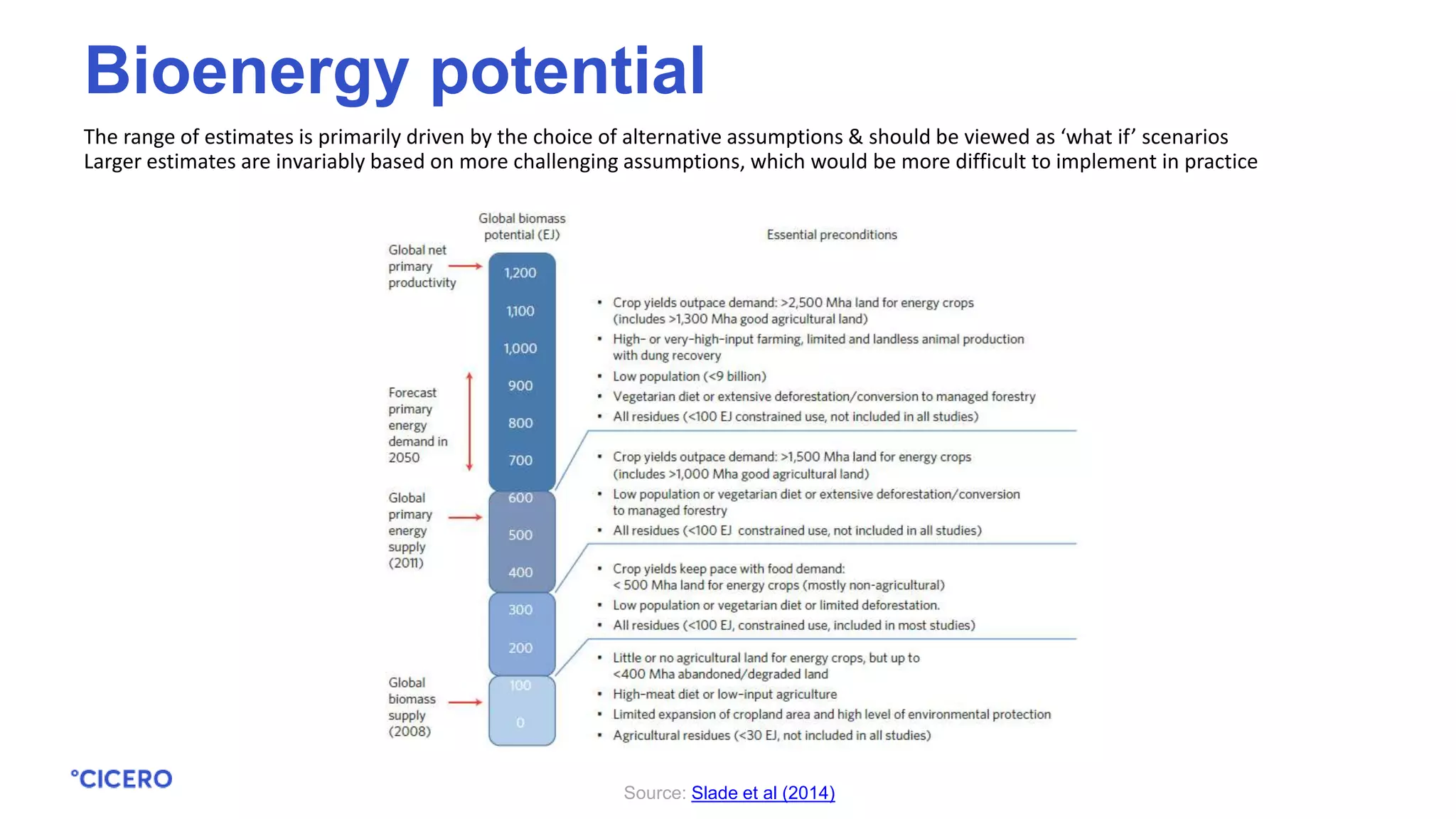
The range of estimates is primarily driven by the choice of alternative assumptions & should be viewed as ‘what if’ scenarios
Larger estimates are invariably based on more challenging assumptions, which would be more difficult to implement in practice
Source: Slade et al (2014)
Bioenergy potential
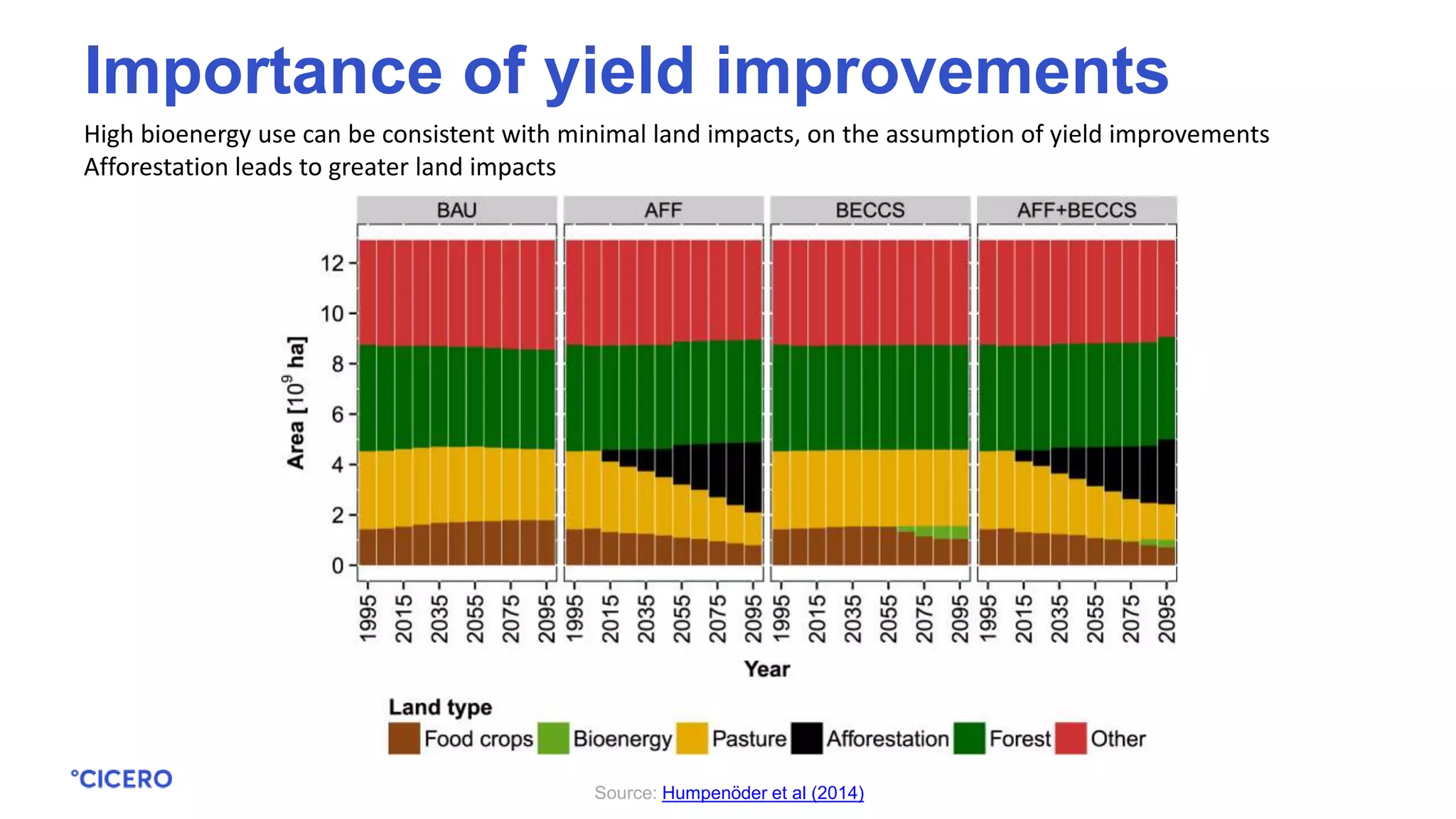
High bioenergy use can be consistent with minimal land impacts, on the assumption of yield improvements
Afforestation leads to greater land impacts
Source: Humpenöder et al (2014)
Importance of yield improvements
Energy optimization models
Integrated Assessment Models
• Energy system optimisation models (generally)
– Find “best available” from given alternatives
– Prone to corner solutions
• Structural and parametric uncertainties
• Model validation
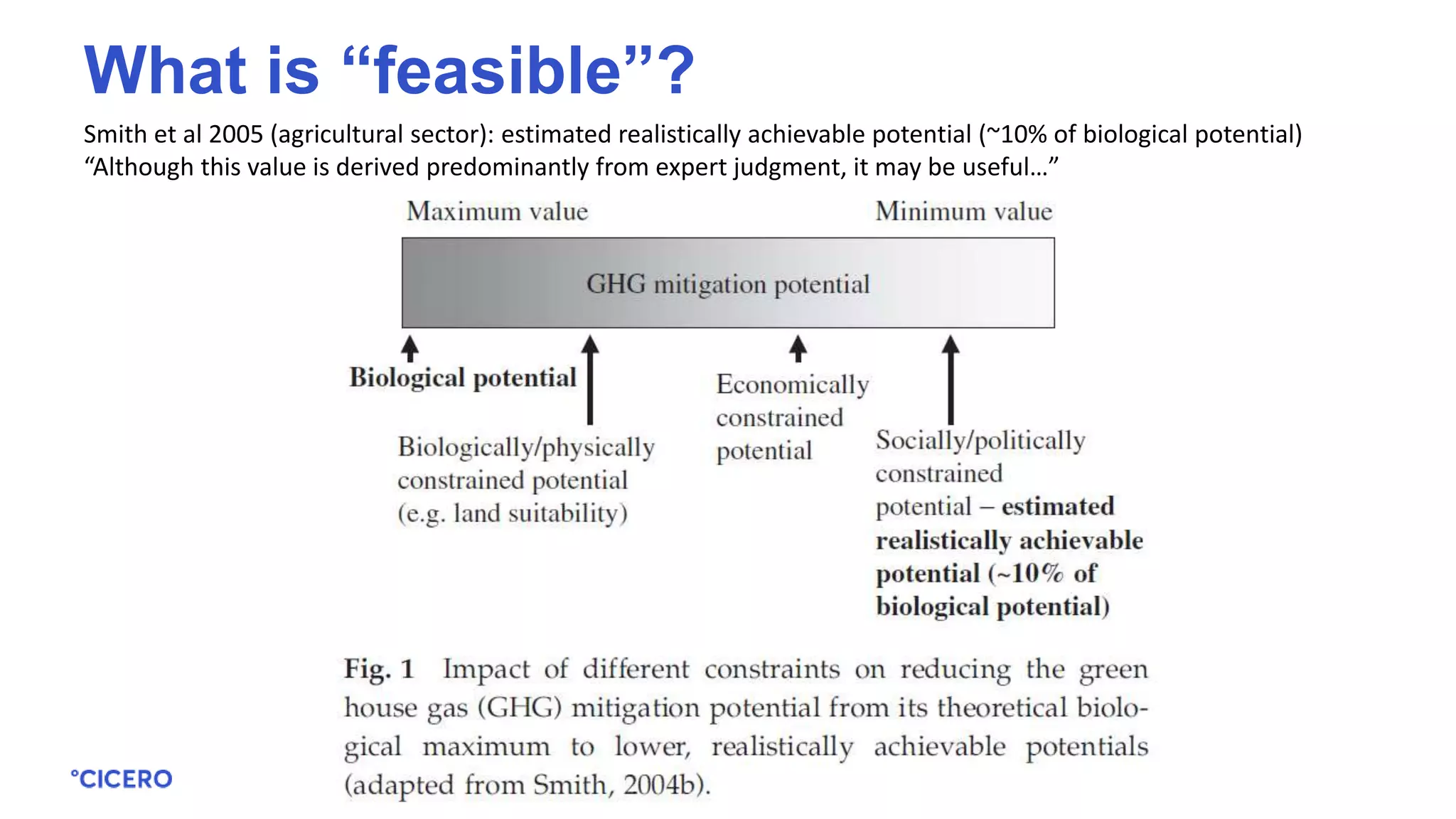
• What is feasible?
– Physical, technical, economic, social, political, …
(Global) energy system optimization
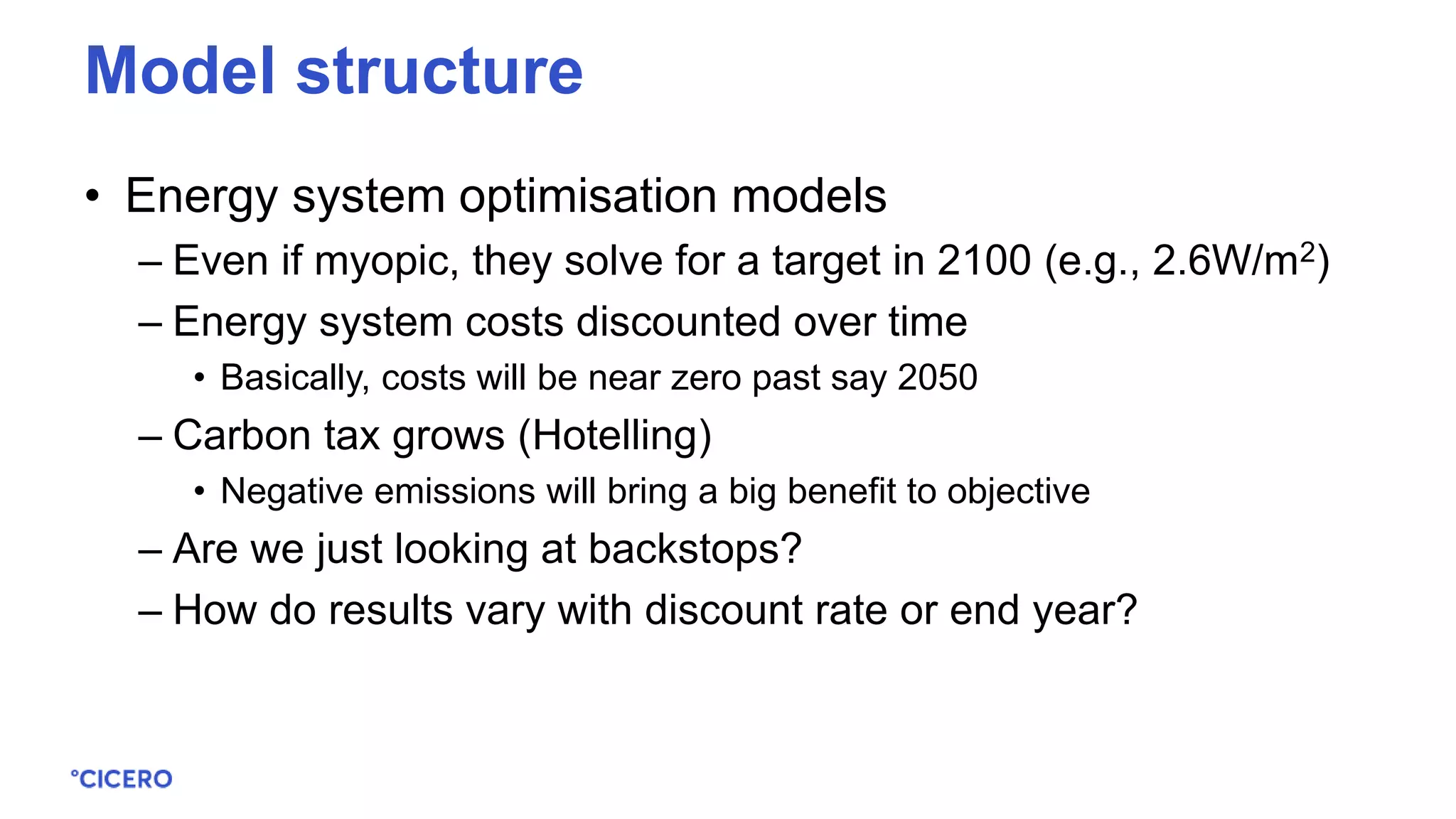
• Energy system optimisation models
– Even if myopic, they solve for a target in 2100 (e.g., 2.6W/m2)
– Energy system costs discounted over time
• Basically, costs will be near zero past say 2050
– Carbon tax grows (Hotelling)
• Negative emissions will bring a big benefit to objective
– Are we just looking at backstops?
– How do results vary with discount rate or end year?
Model structure
Smith et al 2005 (agricultural sector): estimated realistically achievable potential (~10% of biological potential)
“Although this value is derived predominantly from expert judgment, it may be useful…”
What is “feasible”?
Discussion
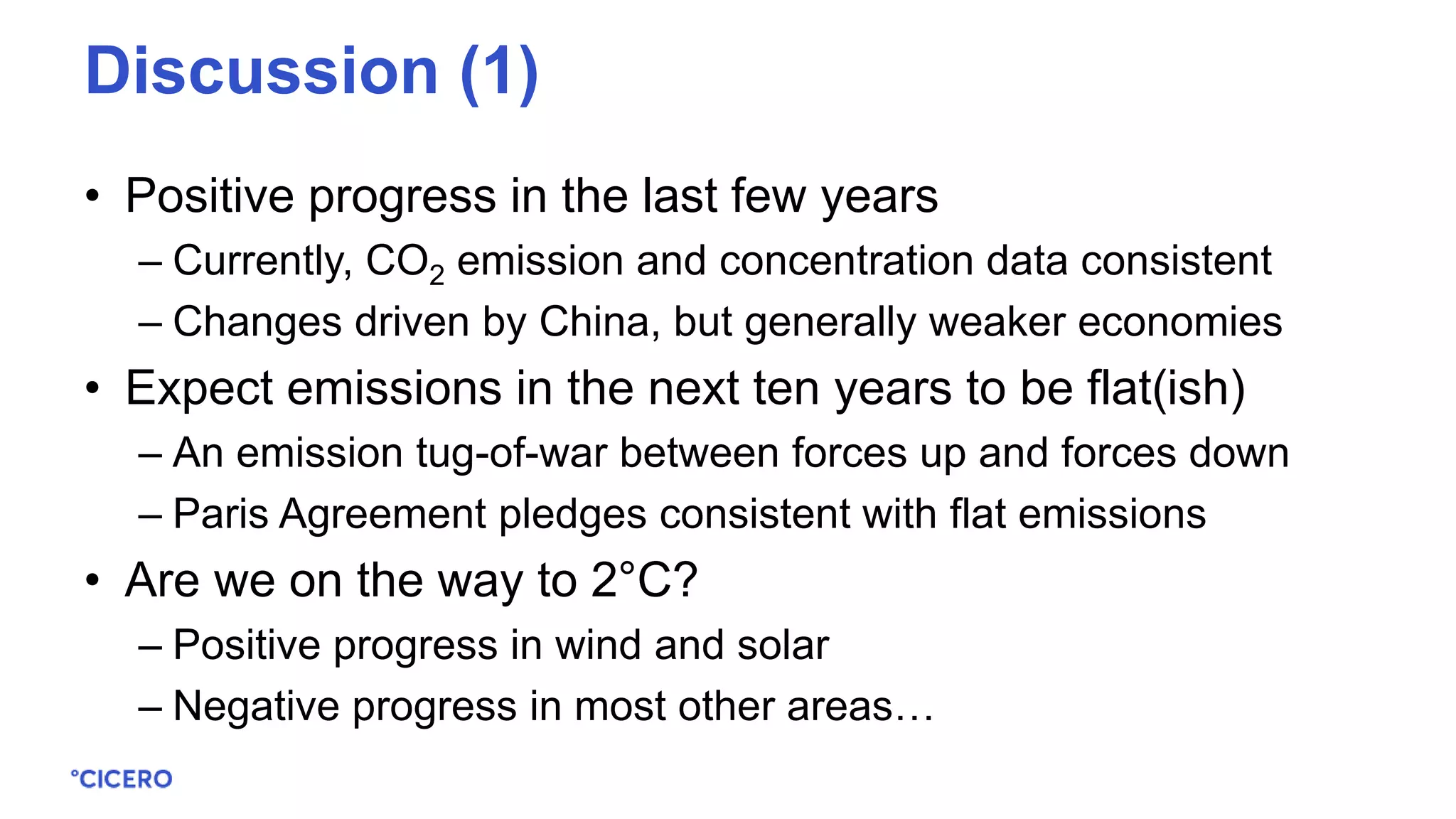
• Positive progress in the last few years
– Currently, CO2 emission and concentration data consistent
– Changes driven by China, but generally weaker economies
• Expect emissions in the next ten years to be flat(ish)
– An emission tug-of-war between forces up and forces down
– Paris Agreement pledges consistent with flat emissions
• Are we on the way to 2°C?
– Positive progress in wind and solar
– Negative progress in most other areas…
Discussion (1)
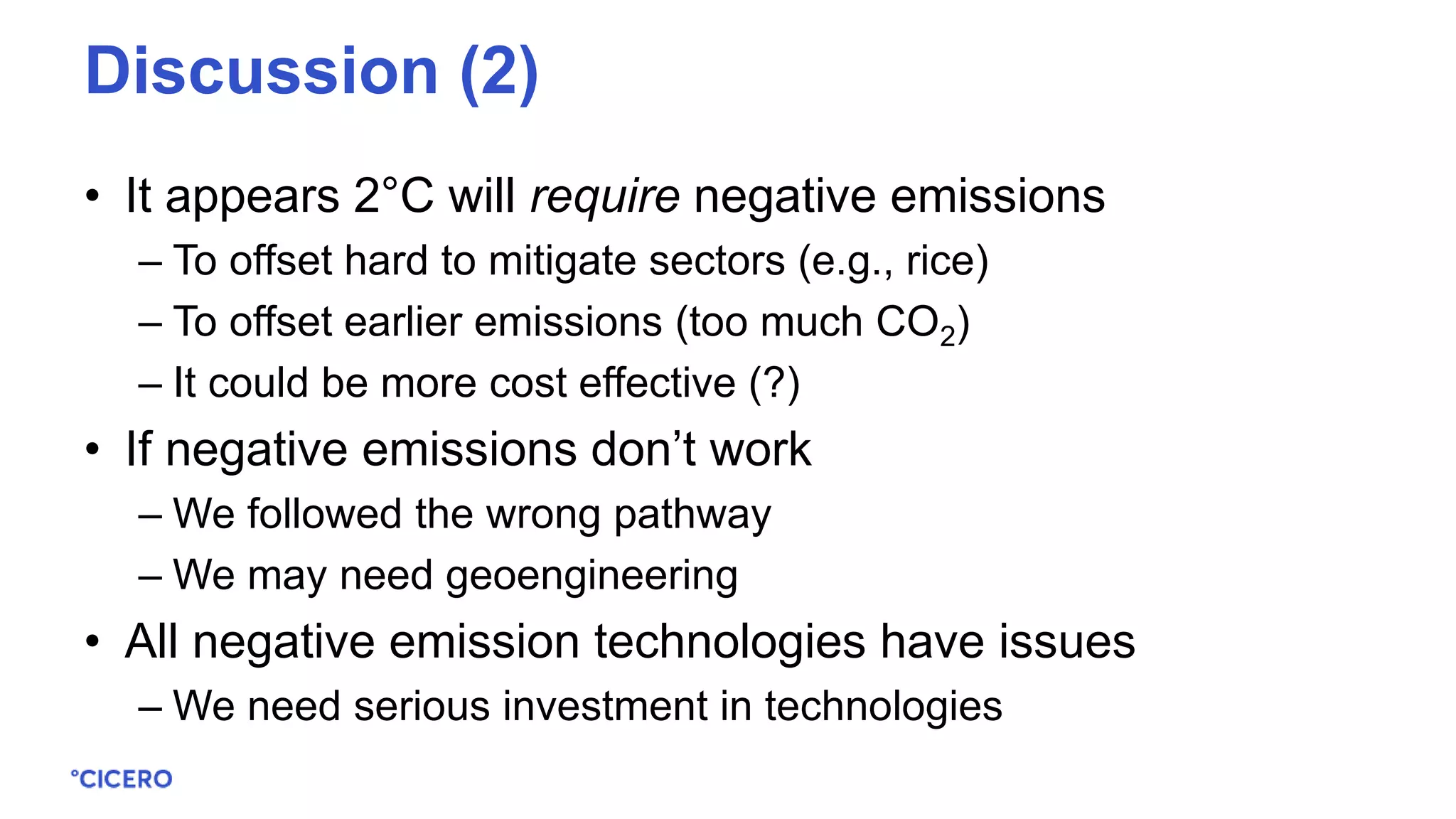
• It appears 2°C will require negative emissions
– To offset hard to mitigate sectors (e.g., rice)
– To offset earlier emissions (too much CO2)
– It could be more cost effective (?)
• If negative emissions don’t work
– We followed the wrong pathway
– We may need geoengineering
• All negative emission technologies have issues
– We need serious investment in technologies
Discussion (2)
Peters_Glen
cicero.oslo.no
cicerosenterforklimaforskning
glen.peters@cicero.oslo.no
Glen Peters

Emissions slowdown: Are we on the way to 2°C?

  • 1.
    Emissions slowdown: Are weon the way to 2°C? Glen Peters (CICERO) School of Economics & Business, Norwegian University of Life Sciences, 11/10/2017
  • 2.
    • Emission trendsin the last decades • Emission scenarios • The trouble with negative emissions – What are negative emissions? • The trouble with carbon capture and storage • Integrated Assessment Models • Discussion Overview
  • 3.
    Key changes inemissions (1960-2016)
  • 4.
    Emissions growth hasbeen flat for the last three years, perhaps ending a long period of near continuous growth Emissions from land-use change have no significant trend, but are a declining share of the total emissions. Estimates of fossil fuel and industry emissions are preliminary 2017 estimates. Land-use change is from 2016 and is to be updated. Source: CDIAC; Le Quéré et al 2016; Global Carbon Budget 2016 Three years with near-zero growth! 2017 data (preliminary) 2016 data (to be updated)
  • 5.
    Key changes inemissions (2000-2020)
  • 6.
    The top fouremitters cover about 60% of global emissions China (29%), United States (15%), EU28 (10%), India (6%) Bunker fuels are used for international transport is 3.1% of global emissions. Statistical differences between the global estimates and sum of national totals are 1.2% of global emissions. Source: CDIAC; Le Quéré et al 2016; Global Carbon Budget 2016 Top emitters: fossil fuels and industry
  • 7.
    Declines in somecountries are currently balanced by increases in others Positive progress in China, US, EU, offset by increases in India and Rest of the World Source: Global Carbon Budget (2017, unpublished), Peters (2017) Who is winning the emissions tug-of-war? What is behind the sudden change?
  • 8.
    The unexpected declinesin coal and levelling of cement are offset by continued growth in oil and gas Coal and cement are on the decline, while oil and gas march ahead Source: Global Carbon Budget (2017, unpublished), Peters (2017) Who is winning the emissions tug-of-war? The fossil fuel tug-of-war
  • 9.
    Rapid (relative) growthin solar and wind reaches the headlines, but offset by (relative) small changes in fossil fuels Source: BP 2017; Jackson et al 2015; Global Carbon Budget 2016 Solar & wind are helping (a little)
  • 10.
    What is causingemissions to change in each country? Tracking Progress (2000-2020)
  • 12.
    Focus on toomany moving parts makes it difficult to attribute drivers of change We instead perform a nested analysis, slowly digging deeper where needed Source: Peters et al 2017 Nested structure of key indicators
  • 13.
    Using annual growthrates (% per year) ΔCO2 = ΔGDP + Δ(Energy Intensity) + Δ(Carbon Intensity) ΔCO2 = ΔGDP + Δ(E/GDP) + Δ(CO2/E) + Δinteractions Kaya Identity Source: Peters et al 2017
  • 14.
    CO2 emissions growth(black) slowing due to: Slower GDP growth (green), renewed improvements in efficiency (purple), & renewable energy (orange) All data is smoothed with a 11 year window. Source: Peters et al 2017 China: earlier peak? Earlier peak in emissions if: • Faster declines in intensity • Slower GDP growth • Combination of both China may have peaked already
  • 15.
    CO2 emissions growth(black) slowing due to: Slower GDP growth (green), coal to gas (orange) & renewable energy (orange) All data is smoothed with a 11 year window. Source: Peters et al 2017 United States of America: Trump? US needs to lock in gains: • Risk with stronger GDP • Economics of gas & renewables may win
  • 16.
    CO2 emissions growth(black) slowing due to: Slower GDP growth (green), continued improvements in efficiency (purple) & renewable energy (orange) All data is smoothed with a 11 year window. Source: Peters et al 2017 European Union: Remains a leader? EU can accelerate gains: • Risk with stronger GDP • Strengthen policies driving efficiency, renewables
  • 17.
    CO2 emissions growth(black) growing due to: Strong GDP growth (green), low improvements in efficiency (purple) All data is smoothed with a 11 year window. Source: Peters et al 2017 India: Can rapid growth be avoided? Uncertainties: • Coal expansion • Renewables growth 2017 may be a one-off decline!
  • 18.
    The future isuncertain, and we use scenarios to explore these future uncertainties Emission scenarios
  • 19.
    • “Holding theincrease … to well below 2°C … pursue efforts to limit … to 1.5 °C …” • “global peaking … as soon as possible … undertake rapid reductions … achieve a balance between … sources and … sinks … in the second half of this century” • This is roughly consistent with 2°C, 66% ‘chance’ – This gives a median temperature of about 1.6-1.8°C • IEA 450 scenario is a 50% ‘chance’ at 2°C The Paris Agreement Source: Peters (2017)
  • 20.
    Source: IEA WorldEnergy Outlook (2016) IEA Emission Scenarios (energy only) Current Policies: Policies in place as of mid-2016; New Policies: includes Nationally Determined Contributions (consistent with Paris Agreement); 450 Scenario: Keep global average temperature increase below 2°C above pre-industrial levels by 2100 (50% chance)
  • 21.
    IEA below 2Cscenario requires net zero by: 2040 for fuel transformation, 2050 for power generation, 2060 total CO2 Source: ETP (2017) Energy Technology Perspectives
  • 22.
    IPCC assessed about1200 scenarios, and about 120 different “2°C scenarios” Different scenarios cover different models, policy start dates, technology portfolios, etc Light lines: The IPCC Fifth Assessment Report assessed about 1200 scenarios using Integrated Assessment Models (IAMs) Dark lines: Detailed climate modelling was done on four Representative Concentration Pathways (RCPs) Source: Fuss et al 2014; CDIAC; IIASA AR5 Scenario Database; Global Carbon Budget 2016 There are many options to stay below 2°C
  • 23.
    IPCC assessed about1200 scenarios, and about 120 different “2°C scenarios” Different scenarios cover different models, policy start dates, technology portfolios, etc Light lines: The IPCC Fifth Assessment Report assessed about 1200 scenarios using Integrated Assessment Models (IAMs) Dark lines: Detailed climate modelling was done on four Representative Concentration Pathways (RCPs) Source: Fuss et al 2014; CDIAC; IIASA AR5 Scenario Database; Global Carbon Budget 2016 There are many options to stay below 2°C Lack of understanding of negative emissions and their consequences… Emission pledges
  • 24.
    The trouble withnegative emissions
  • 25.
    Net emissions =CO2 emissions from fossil fuels, industrial processes, land-use change, and bioenergy with CCS Source: Anderson & Peters (2016) The trouble with negative emissions
  • 26.
    Net emissions =CO2 emissions from fossil fuels, industrial processes, land-use change, and bioenergy with CCS Source: Anderson & Peters (2016) The trouble with negative emissions
  • 27.
    CO2 removal startsin 2020-2030 and rises to 15 billion tonnes CO2 per year in 2100 Source: Anderson & Peters (2016) The trouble with negative emissions
  • 28.
    Less CO2 removalrequires more rapid reductions in fossil fuel and industry emissions Source: Anderson & Peters (2016) Are negative emissions a moral hazard? With BECCS Without BECCS
  • 29.
    A schematic ofnegative emissions
  • 30.
    Summing the 2°Cemission scenarios gives the carbon budget (66% chance), with large uncertainty ranges Carbon Capture and Storage (CCS) and “Negative Emissions” allows the budget to be exceeded Note: Totals are not always consistent because medians are not additive, and some columns have different numbers of scenarios Source: Peters (2016) The carbon budget and CCS Non-CO2 emissions No CCS New study
  • 31.
    CCS allows theuse of fossil fuels and BECCS offsetting of previous or postive emissions If CCS (hence BECCS) don’t live up to scale, fossil fuels use has to decline rapidly Source: Peters (2016) No CCS means no fossil fuels (or no 2°C)
  • 32.
    BECCS is notjust for 2°C, but whenever there is mitigation BECCS is used in scenarios To stabalise temperature at any given level, likely we need to have negative emissions Source: IIASA AR5 Scenario Database (own calculations) BECCS by forcing level in 2100 ~1.6°C ~2.0°C ~2.6°C ~3.4°C Median temperature
  • 33.
    • Even ifBECCS is a “moral hazard”, we still need research, development, deployment, ... – …but we need to act as if BECCS will not work at scale – …treat “Plan A (high BECCS)” as a pleasant surprise • We can’t just accept model results, we have to challenge them, make sure they are robust • No matter at what temperature we stabilize, we need negative emissions A few clarifications…
  • 35.
  • 36.
    Source: MCC 2016 Negativeemission technologies
  • 37.
    Source: Smith etal. 2016 Land, water & energy requirements
  • 38.
    The trouble withcarbon, capture & storage
  • 39.
    A typical CCSfacility today is about 1MtCO2/yr storage (e.g., Sleipner) → 1000 facilities per 1GtCO2 We can build 10’s of CCS facilities, but can we scale up to 10,000s over the next decades? Today, there is capture capacity of 28MtCO2/yr, but only about 7.5MtCO2/yr is verified as stored (IEA). Source: Based on IIASA AR5 Scenario Database Carbon Capture and Storage
  • 40.
    We have hadgreat success in solar and wind, and largely consistent with scenarios (IPCC) Scenarios indicate the path to 2°C requires large scale bioenergy and CCS (with little progress) Source: Peters et al 2017, Based on IIASA AR5 Scenario Database Solar/wind versus CCS
  • 41.
    • Deployment ratesconsistent with historical examples – Nuclear in Europe, coal in China • Energy system optimization models: – Short-term reductions more expensive than cost of negative emissions in the long-term (given constraints, model structure) • Comparisons of CCS deployment in IAMs – Large variation in results not explained by model assumptions – CCS complex interplay of several factors in each model Sources: van Sluisveld et al (2015); van Vuuren et al (2015); Koelbl et al (2014) Why do models love CCS?
  • 42.
    Today, robust scientificdebate over 1EJ/yr, scenarios are 100-300EJ/yr between 2050 and 2100 Need to have a clear and accessible narrative on why 100-300EJ/yr is carbon neutral Source: Based on IIASA AR5 Scenario Database Bioenergy use
  • 43.
    This is directoutput from the AR5 scenario database, land areas comparable to the size of India Some in the IAM community have critiqued figures like this as misleading. Source: Based on IIASA AR5 Scenario Database Land use for energy crops
  • 44.
    • Bioenergy rangesare broad, generalizations are elusive • Results determined by a combination of assumptions: – Biomass feedstock supplies – Bioenergy options and costs – Other technology options and costs – Integrated systems modeling – Baselines • Elucidating & assessing this requires a dedicated effort… Why do models love bioenergy? Source: Rose et al (2014)
  • 45.
    The range ofestimates is primarily driven by the choice of alternative assumptions & should be viewed as ‘what if’ scenarios Larger estimates are invariably based on more challenging assumptions, which would be more difficult to implement in practice Source: Slade et al (2014) Bioenergy potential
  • 46.
    High bioenergy usecan be consistent with minimal land impacts, on the assumption of yield improvements Afforestation leads to greater land impacts Source: Humpenöder et al (2014) Importance of yield improvements
  • 47.
  • 48.
    • Energy systemoptimisation models (generally) – Find “best available” from given alternatives – Prone to corner solutions • Structural and parametric uncertainties • Model validation • What is feasible? – Physical, technical, economic, social, political, … (Global) energy system optimization

  • 49.
    • Energy systemoptimisation models – Even if myopic, they solve for a target in 2100 (e.g., 2.6W/m2) – Energy system costs discounted over time • Basically, costs will be near zero past say 2050 – Carbon tax grows (Hotelling) • Negative emissions will bring a big benefit to objective – Are we just looking at backstops? – How do results vary with discount rate or end year? Model structure
  • 50.
    Smith et al2005 (agricultural sector): estimated realistically achievable potential (~10% of biological potential) “Although this value is derived predominantly from expert judgment, it may be useful…” What is “feasible”?
  • 51.
  • 52.
    • Positive progressin the last few years – Currently, CO2 emission and concentration data consistent – Changes driven by China, but generally weaker economies • Expect emissions in the next ten years to be flat(ish) – An emission tug-of-war between forces up and forces down – Paris Agreement pledges consistent with flat emissions • Are we on the way to 2°C? – Positive progress in wind and solar – Negative progress in most other areas… Discussion (1)
  • 53.
    • It appears2°C will require negative emissions – To offset hard to mitigate sectors (e.g., rice) – To offset earlier emissions (too much CO2) – It could be more cost effective (?) • If negative emissions don’t work – We followed the wrong pathway – We may need geoengineering • All negative emission technologies have issues – We need serious investment in technologies Discussion (2)
  • 54.