The opinions expressed in this publication do not necessarily reflect the official view of
the APO. For reproduction of the contents in part or in full, the APO’s prior permission
is required.
Dr. Anil Kumar Saxena, India, served as the author.
©Asian Productivity Organization, 2009
ISBN: 92-833-7086-4
– i –
CONTENTS
List of Tables .........................................................................................................ii
List of Figures.......................................................................................................iii
List of Annexes .....................................................................................................iv
Abbreviations and Acronyms .................................................................................v
Foreword… ..........................................................................................................vii
Acknowledgments ..............................................................................................viii
Chapter 1: Estimating And Reducing GHG Emissions ............................................ 1
Background ............................................................................................................................ 1
World Scenario on GHG Emissions............................................................................................ 2
Carbon Dioxide and the Global GHG Emissions Scenario............................................................. 2
Global GHG Emissions Flow by Sector and Activity..................................................................... 6
Key Drivers of Emissions from Energy Use ................................................................................ 7
CO2 Emissions from Selected Sectors........................................................................................ 8
Energy Supply Sector ............................................................................................................ 10
SMEs and GHG Emissions ...................................................................................................... 10
Kyoto Protocol and GHG Emissions Reduction.......................................................................... 11
Emissions Trading................................................................................................................. 11
Chapter 2: Estimating GHG Emissions..................................................................13
GHG Emissions Estimation and Inventory................................................................................ 13
GHG Inventory Concepts and Objectives................................................................................. 13
Preparation of National Inventory ........................................................................................... 14
Estimation of GHG Emissions from Industrial Processes and Product Use.................................. 19
GHG Estimation Methods ....................................................................................................... 23
GHG Calculators.................................................................................................................... 25
Embodied Energy and Emissions Factors................................................................................. 29
Uncertainties Over Inventory Estimates .................................................................................. 32
Chapter 3: GHG Emission Reduction Technologies...............................................34
Introduction.......................................................................................................................... 34
GHG Reduction Technologies.................................................................................................. 34
GHG Reduction Technologies for Industries ............................................................................. 39
Residential, Institutional, and Commercial Buildings (Infrastructure Sector) .............................. 48
GHG Reduction Technologies for the Transport Sector.............................................................. 55
Annex 1 to 13 ..............................................................................................61 – 79
GHG Glossary.......................................................................................................80
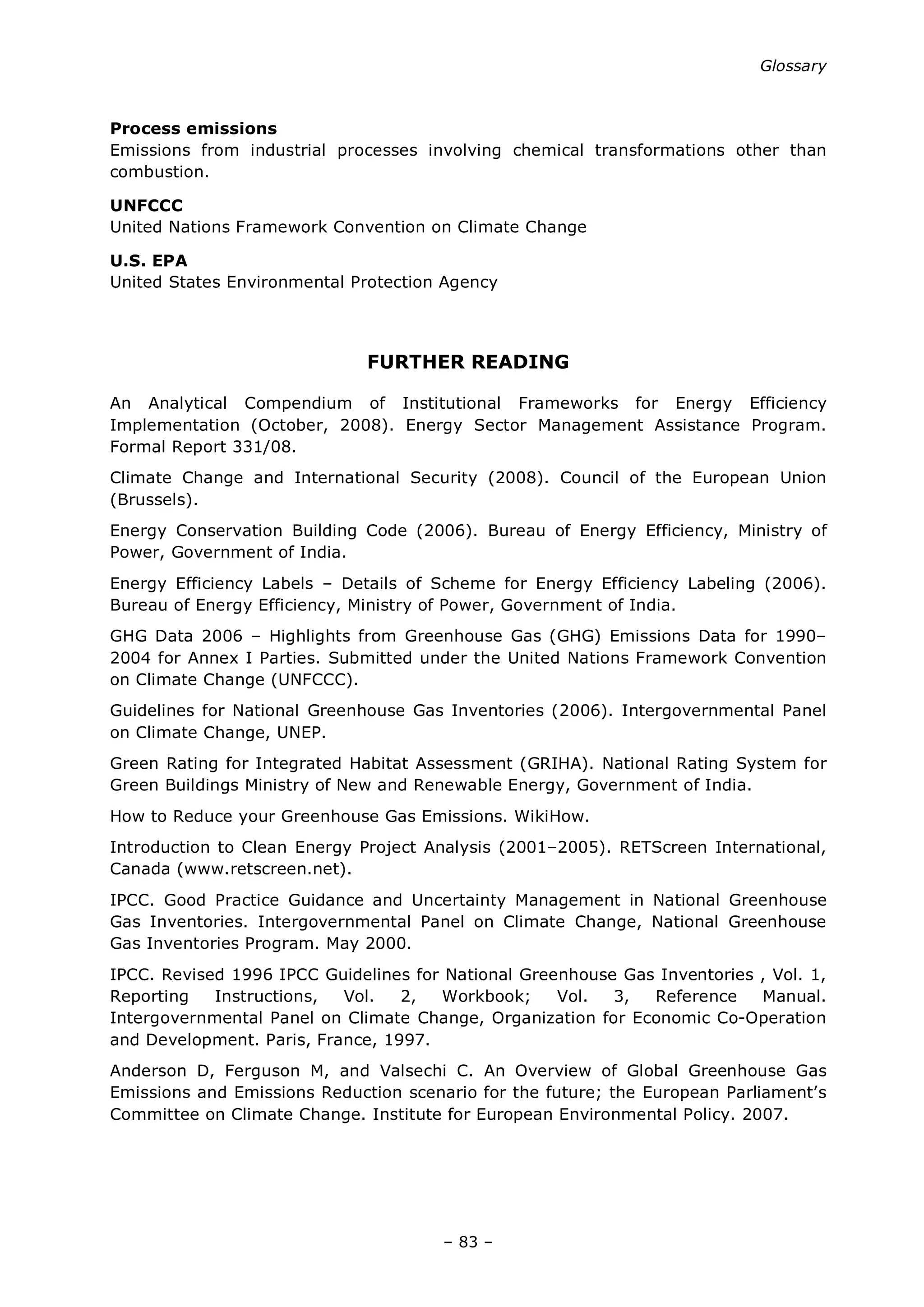
Further Reading .................................................................................................................... 83
Important Websites............................................................................................................... 84
– ii –
LIST OF TABLES
Chapter 1: Estimating and Reducing GHG Emissions
Table 1-1. Per capita greenhouse gas emissions and ranking of APO member countries
(year 2000) ...........................................................................................................4
Table 1-2. Trends and projections for CO2 emissions from various sectors of the economy ..........8
Chapter 2: Estimating GHG Emissions
Table 2-1. Global warming potential of major GHGs................................................................13
Table 2-2. Industrial processes and product use categories and their possible emissions ...........21
Table 2-3. GHG emission calculator developed by A1 Future Technologies (India).....................25
Table 2-4. Spreadsheet for calculating GHG emissions based on UNEP GHG calculator ..............26
Table 2-5. Calculator for estimating GHG emissions released by households.............................27
Table 2-6. GHG-Energy Calc 4, showing emissions for a typical Australian family of three .........29
Table 2-7. Emission factors for GHG calculation developed by the Australian
Greenhouse Office................................................................................................31
Table 2-8. Methane yield from selected landfill solid waste components ...................................32
Table 2-9. Uncertainties due to emission factors and activity data ...........................................33
Chapter 3: GHG Emission Reduction Technologies
Table 3-1. Opportunities for EE improvements by consuming sector .....................................38
Table 3-2. Case studies of GHG reduction through energy efficiency in Indian industries ..........43
Table 3-3. Roof assembly U-factor and wall insulation R-factor requirements ...........................50
Table 3-4. CO2 emissions according to fuel type .....................................................................55
Table 3-5. Measures and their impacts in reducing fuel consumption .......................................56
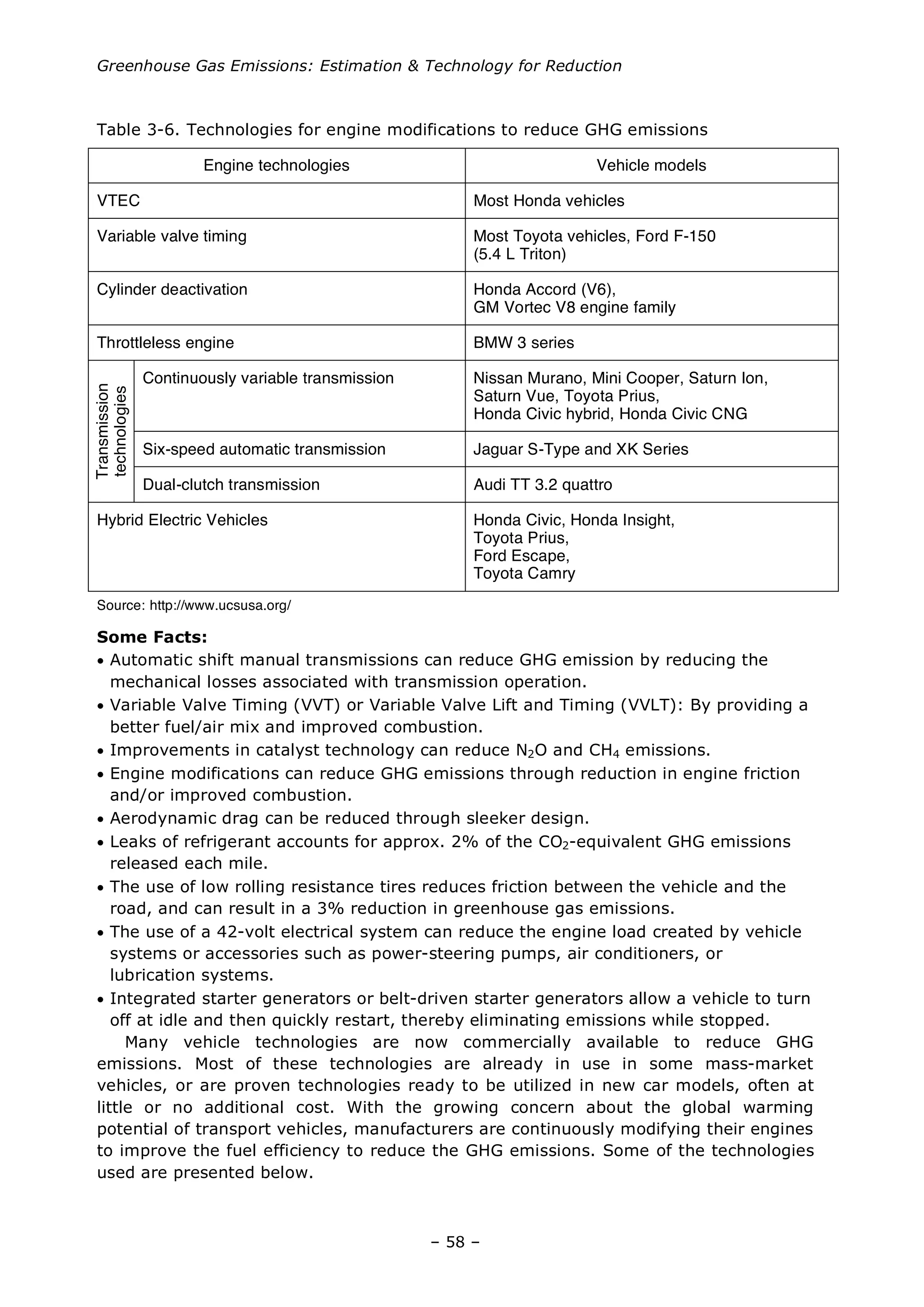
Table 3-6. Technologies for engine modifications to reduce GHG emissions ..............................58
– iii –
LIST OF FIGURES
Chapter 1: Estimating and Reducing GHG Emissions
Figure 1-1. Per capita greenhouse gas emissions in 2000 (tons of CO2e) .................................... 3
Figure 1-2. Greenhouse gas emissions in APO member countries in 2000 (per capita) ................. 5
Figure 1-3. World emissions flowchart of fossil fuel use (World Resources Institute) .................... 6
Figure 1-4. Emissions projections — simple model representing key factors driving
CO2 emissions from energy use (Pew Center, 2004)................................................. 8
Figure 1-5. Sector-wise global CO2 emissions in 2004 ............................................................... 9
Chapter 2: Estimating GHG Emissions
Figure 2-1. Decision tree for preparation of GHG emission inventory ........................................ 15
Figure 2-2. Methodology for GHG inventorization .................................................................... 16
Figure 2-3. Six-step methodology for greenhouse gas (GHG) inventorization ............................ 17
Figure 2-4. Generalized decision tree for estimating emissions from fuel combustion ............. 18
Chapter 3: GHG Emission Reduction Technologies
Figure 3-1. GHG reduction potential of various technologies .................................................... 35
Figure 3-2. GHG emissions reductions through 2050, by consuming sector ............................ 37
Figure 3-3. Showing relationship between economy & lifestyle for energy use........................... 39
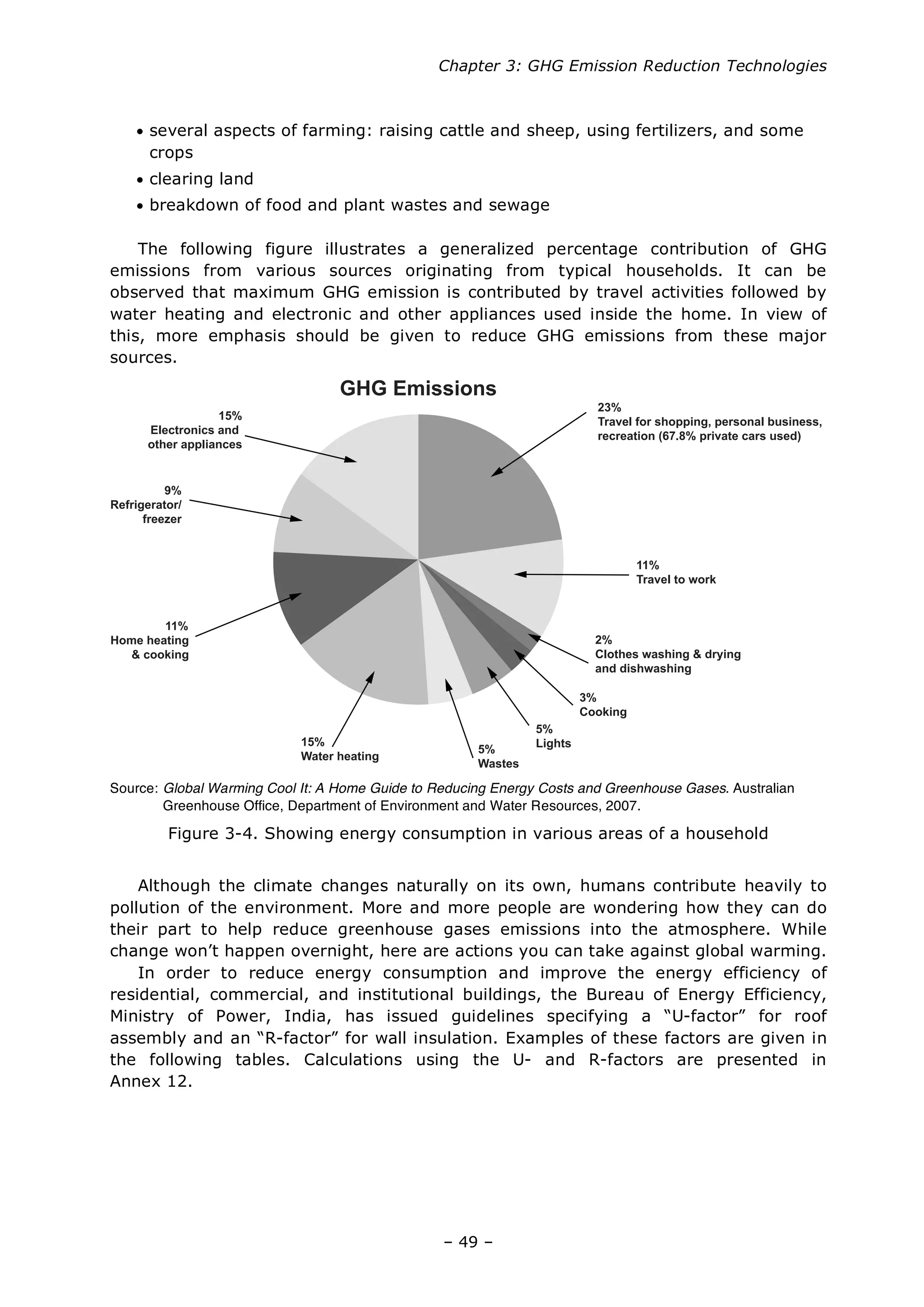
Figure 3-4. Showing energy consumption in various areas of household ................................... 49
Figure 3-5. Greenhouse gas emissions from electric hot water system
(140 liters usage daily) ........................................................................................ 50
Figure 3-6. Energy label developed in India............................................................................ 52
– iv –
LIST OF ANNEXES
Annex 1. Conversion Tables ............................................................................ 61
Annex 2. Country-Specific Energy Factors....................................................... 62
Annex 3. Fuel-Specific Emission Factors.......................................................... 63
Emission Factors for Transport Vehicles ........................................... 63
Annex 4. Embodied Energy and Emissions of Goods........................................ 64
Per Capita Emission Factors of Aircraft and Trains ........................... 64
Annex 5. Some Facts and Figures on Fuel, Its Consumption Pattern, and
GHG Emissions.................................................................................. 65
Table A5-1. Data on GHG emissions according to economic status (with world average)............65
Table A5-2. World primary energy consumption and GHG emissions (by fuel type) ...................65
Table A5-3. Absolute emissions in this sector in 2000 were 5,743 mt CO2 share by fuel type.....66
Table A5-4. Carbon content of fossil fuels ..............................................................................66
Table A5-5. Selected data on fossil fuels................................................................................66
Table A5-6. Fossil fuel consumption by sector, 2002...............................................................66
Table A5-7. Electricity and heat (share by fuel type)...............................................................67
Table A5-8. Transport sector – 14% of total global GHG .........................................................67
Table A5-9. Building use, 15% of total global of GHG emissions ..............................................67
Table A5-10. Industrial sector, 21% of total global of GHG emissions ........................................67
Table A5-11. GHG emissions from industrial sector according to process....................................68
Annex 6. Global Warming Potential (GWP) Factors ......................................... 69
Annex 7. Conversion Factors ........................................................................... 70
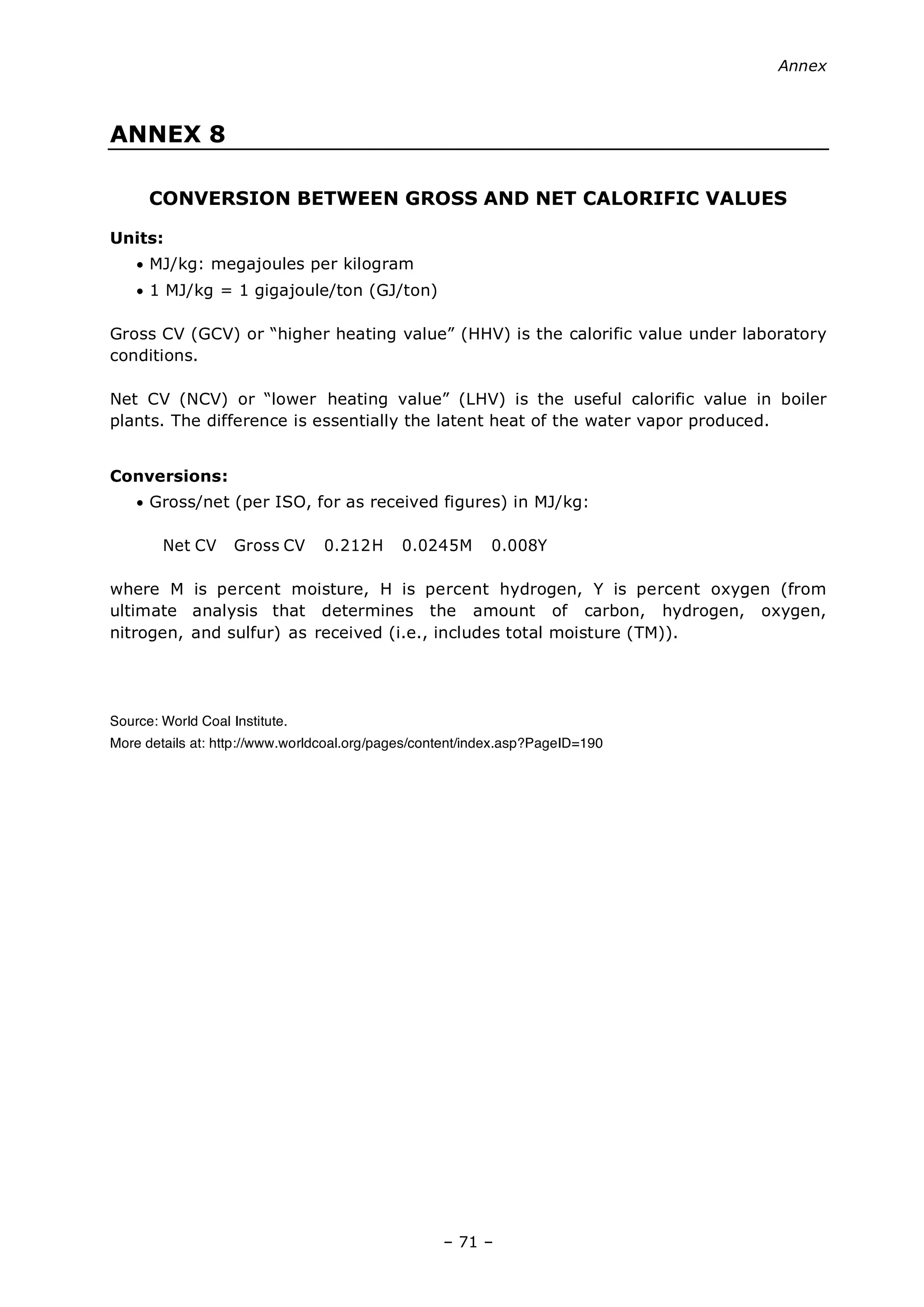
Annex 8. Conversion Between Gross and Net Calorific Values......................... 71
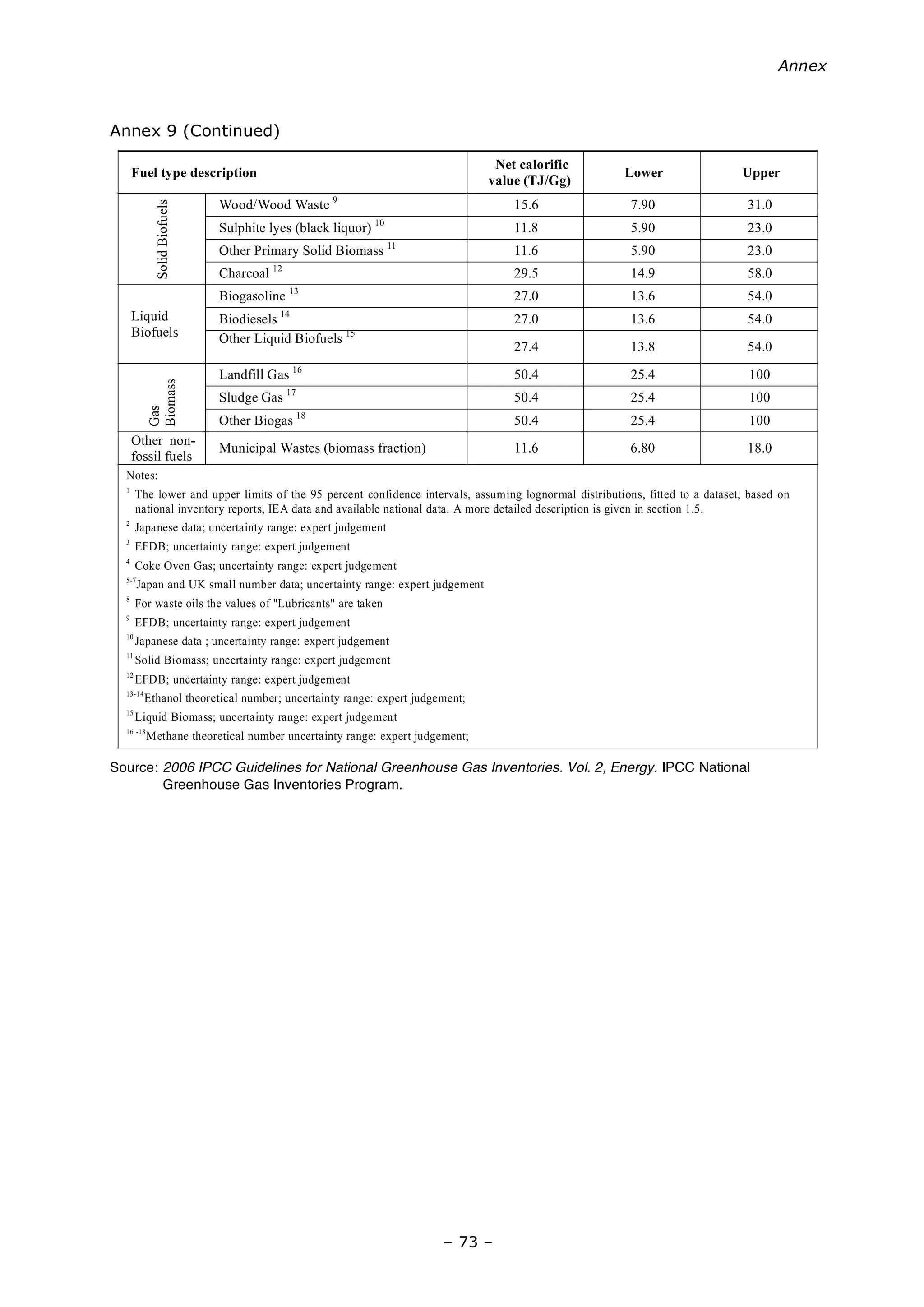
Annex 9. Default Net Calorific Values (NCVs) and Lower and Upper Limits
of the 95% Confidence Intervals...................................................... 72
Annex 10. Default Values of Carbon Content..................................................... 74
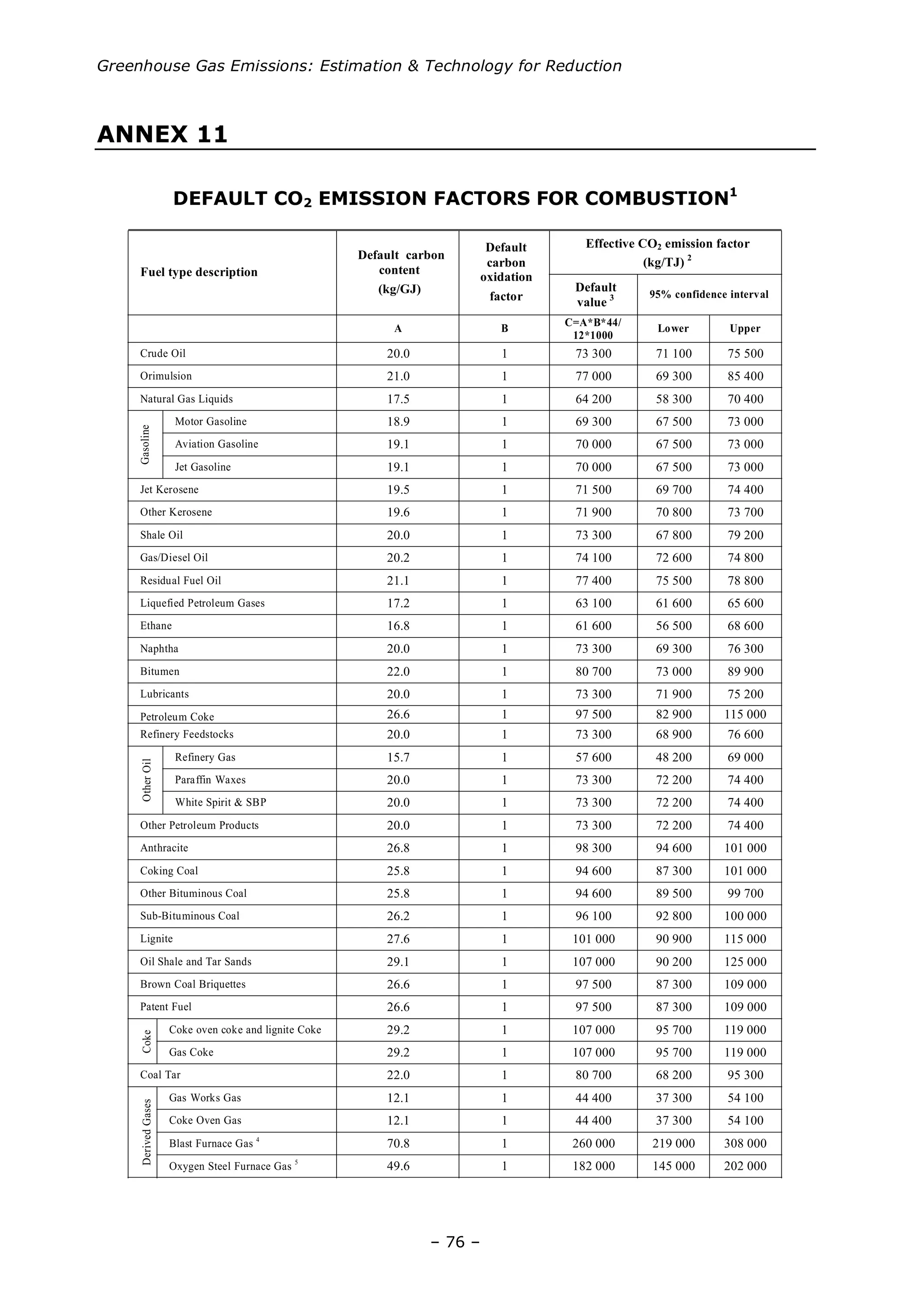
Annex 11. Default CO2 Emission Factors for Combustion................................... 76
Annex 12. IP Table Conversion.......................................................................... 78
Table A12-1. Roof U-factor Requirements (U-factor in Btu/h-ft2
-°F)...........................................78
Table A12-2. Wall U-factor Requirements (U-factor in Btu/h-ft2
)................................................78
Table A12-3. Fenestration U-factor Requirements (U-factor in Btu/h-ft2
)....................................78
Annex 13. Guidelines for Greenhouse Gas Inventories...................................... 79
– v –
ABBREVIATIONS AND ACRONYMS
AGO – Australia Greenhouse Office
APO – Asian Productivity Organization
BEE – Bureau of Energy Efficiency (India)
CDM – Clean Development Mechanism
EC – Energy Conservation
EE – Energy Efficiency
EU – European Union
GHG – Greenhouse Gas
GTZ – Deutsche Gesellschaft für Technische Zusammenarbeit (German Technical
Cooperation)
GWP – Global Warming Potential
IEA – International Energy Association
IPCC – Intergovernmental Panel on Climate Change
LPG – Liquefied Petroleum Gas
NPC – National Productivity Council of India
NCPC – National Cleaner Production Centre of India
R&D – Research & Development
RE – Renewable Energy
SAR – Staff Appraisal Report
SME – Small and Medium Enterprise
SMME – Small, Medium, and Micro Enterprise
UNEP – United Nations Environment Program
UNFCCC – United Nations Framework on Climate Change Convention
WEC – World Energy Council
WRI – World Resource Institute
– vi –
– vii –
FOREWORD
Global warming is now universally accepted as being the greatest environmental
threat to mankind in the current century. The impacts are staggering. Antarctic ice is
thinning at increasingly rapid rates, with correspondingly massive influxes of fresh
water into the world’s oceans. Siberia has warmed 3°C as compared to 1960.
All these changes are due mostly to human activities, particularly in raising the levels
of CO2, a major greenhouse gas (GHG). Atmospheric concentrations of CO2 have risen
35% since the Industrial Revolution. This increase is primarily due to anthropogenic
activities such as the burning of fossil fuels and deforestation. Reducing the rate of
GHG emissions will be an enormous challenge for everyone throughout the world
which must be fought on many fronts.
To create awareness among APO member countries, a workshop was organized in
November 2008 in the Republic of China on Reduction of Greenhouse Gas Emissions.
During the workshop, the participants expressed the need for comprehensive
guidelines for the estimation and reduction of GHG emissions. This manual has been
prepared to help APO member countries estimate their GHG emissions from business
establishments; residential, commercial, and institutional buildings; and transport
sectors, which are the major GHG contributors, and develop appropriate action plans
for their mitigation.
Dr. Thomas Fuller, an 18-century British physician, said: “Get the facts, or the facts
will get you. And when you get them, get them right, or they will get you wrong.” The
APO hopes that this manual will help in striking a balance between development and
the environment in APO member countries and elsewhere.
Shigeo Takenaka
Secretary-General
Tokyo
December, 2009
– viii –
ACKNOWLEDGMENTS
The author and the APO would like to express their sincere thanks to the organizations
and agencies that have helped in compiling this manual through the use of their
enormously valuable information and data for the larger interests of society in
combating climate change brought about by worldwide greenhouse gas emissions.
Our special thanks go to UNEP, UNFCCC, IPCC, World Resources Institute, World
Energy Council, International Energy Agency, European Commission, Australian
Greenhouse Office, National Productivity Council of India, Bureau of Energy Efficiency
(Ministry of Power, Government of India), GERIAP, GTZ, USEPA, and many other
organizations and individual experts in the field of climate change science, whose
valuable input has made this manual useful not only for APO member countries, but
also for society in general.
Last but not least, we would like to thank all those who have been involved directly
or indirectly in preparing this manual.
– 1 –
CHAPTER 1:
ESTIMATING AND REDUCING GHG EMISSIONS
BACKGROUND
Climate change is one of the most critical global environmental, social, and economic
challenges of the century that the entire world is facing. The Earth’s average surface
temperature has risen by three-quarters of a degree Celsius since 1850. The latest
events have clearly demonstrated our growing vulnerability to climate change. Climate
change is not only an environmental problem but also a developmental problem. Its
adverse impacts will disproportionately affect developing countries with their most
vulnerable populations and their least adaptive capacity. In other words, those who
have contributed the least so far to this problem and also do not have the financial
and technological resources to deal with it will be the most affected. Within developing
countries, as well, the poorest citizens living on marginal land and who are most
reliant on their direct natural environment will be the ones most at the receiving end
of climate change impacts such as droughts and floods.
According to the United Nations Framework Convention on Climate Change,
“without further action to reduce greenhouse gas (GHG) emissions, the global average
surface temperature is likely to increase by a further 1.8–4.0 deg C this century.” 1
This report further projects that at least the lower end of this range would be almost a
certainty since pre-industrial times it has risen above 2 deg C, the threshold beyond
which is irreversible and possibly catastrophic changes become far more likely.
Unmitigated climate change beyond 2 deg C will lead to accelerated, irreversible, and
largely unpredictable climate changes. 2
Most of the changes in our climate have been brought about by anthropogenic
activities; that is, they have been caused by human influences. The activities of people
that contribute to climate change include, in particular, the burning of fossil fuels,
agricultural practices, and land use modifications such as deforestation brought about
by the spread of ever-increasing populations. These activities result in the emission of
carbon dioxide (CO2), a major greenhouse gas and the main gas responsible for
climate change, as well as other “greenhouse” gases (i.e., gases that trap heat in the
atmosphere). In order to bring climate change to a halt and save our planet, it is
imperative to reduce greenhouse gas emissions significantly.
In 2005, the European emissions trading scheme commenced while in 2006 the
Kyoto Protocol came into effect, with Russia joining. At the same time, rising oil prices
due to the impending “oil peak” provided financial incentives for alternative fuels.
1
United Nations Framework Convention on Climate Change, 4th
Assessment Report of the
Intergovernmental Panel on Climate Change, 2 February, 2007.
2
Report on “Climate Change and International Security,” Council of the European Union,
Brussels, 3 March, 2008.
Greenhouse Gas Emissions: Estimation & Technology for Reduction
– 2 –
WORLD SCENARIO ON GHG EMISSIONS
GHG emissions have risen steadily since pre-industrial times – by 70% between 1970
and 2004 (IPCC, 2007). The largest growth has been observed in the energy supply
sector (an increase of 145%) followed by the transport sector at 120% within this
period.
Many analyses of GHG emissions trends and projections focus solely on CO2, as
CO2 is the largest source of GHG, accounting for 77% of all such emissions. The next
most important GHG directly emitted through anthropogenic processes are methane
and nitrous oxide. Further, future projections and trends are based on CO2 emissions
in view of the accuracy of data on CO2 emissions from the use of fossil fuels. According
to the IPCC, carbon dioxide concentration has achieved unprecedented levels in the
atmosphere greater than any time in the last 650,000 years. Thus it has become a
major and the fastest-growing factor in climate change (IPCC, 2007).
According to the Energy Information Administration of the U.S. Department of
Energy (EIA, 2007), global carbon dioxide emissions have been projected to rise from
26.9 billion tons in 2004 to 33.9 billion tons in 2015, and 42.9 billion tons in 2030,
at an average growth rate of 1.8% per year.
CARBON DIOXIDE AND THE GLOBAL GHG EMISSIONS SCENARIO
Current Emissions by Country
A relatively small number of countries produce a large majority of global GHG
emissions. Many also rank among the most populous countries and have the largest
economies. The major emitters include almost an equal number of developed and
developing countries, as well as some transition economies of the former Soviet Union.
For implementation of adequate GHG mitigation measures, the international climate
regime has to establish incentives and/or obligations within its political framework.
These measures can be achieved through domestic initiatives, international
agreements, or both. In the absence of such initiatives, any mitigation measures will
fail environmentally.
Emission Projections by Country
Emission projections at the national level are highly uncertain. Uncertainties are
especially acute in developing country economies, which tend to be more volatile and
vulnerable to external shocks. Furthermore, past projections are also questionable in
respect to their accuracy. This has made it difficult to develop policies that are based
on such projections. For instance, fixed emission caps (such as Kyoto Protocol-style
targets) are less likely to be viable in developing countries than in industrialized
countries.
Per Capita Emissions
Only a handful of countries with the largest total emissions rank among those with the
highest per capita emissions. For some, per capita emissions vary significantly when
CO2 from land use and non-CO2 gases are taken into account. Although per capita
emissions are generally higher in wealthier countries, there are notable and diverse
exceptions. Some developing countries with a rising middle class, for instance, have
per capita emission levels similar to those of richer industrialized economies.
Accordingly, international agreements predicated on equal per capita emission
entitlements will face difficulty in arriving at a consensus because of the diverse
Chapter 1: Estimating and Reducing GHG Emissions
– 3 –
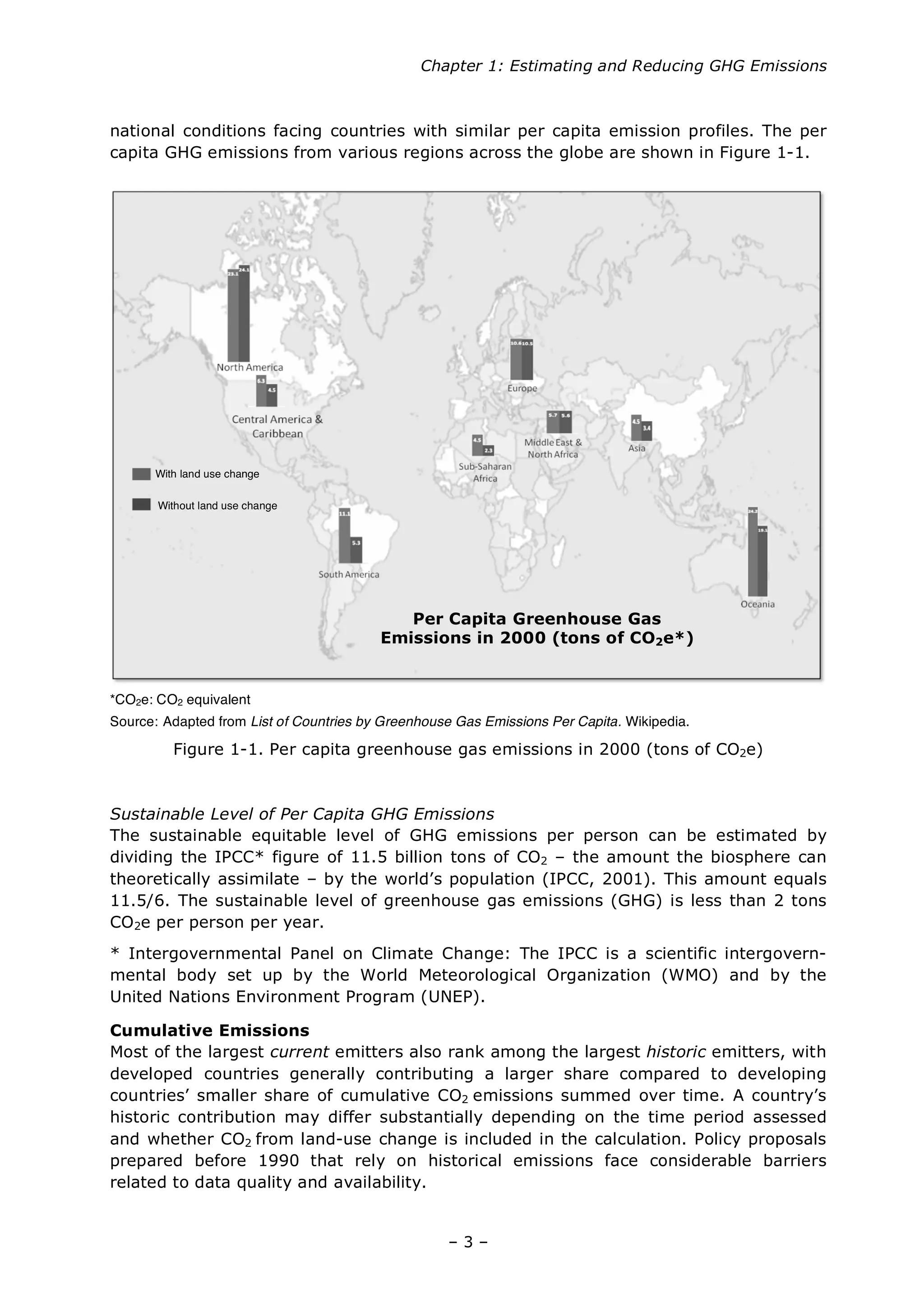
national conditions facing countries with similar per capita emission profiles. The per
capita GHG emissions from various regions across the globe are shown in Figure 1-1.
*CO2e: CO2 equivalent
Source: Adapted from List of Countries by Greenhouse Gas Emissions Per Capita. Wikipedia.
Figure 1-1. Per capita greenhouse gas emissions in 2000 (tons of CO2e)
Sustainable Level of Per Capita GHG Emissions
The sustainable equitable level of GHG emissions per person can be estimated by
dividing the IPCC* figure of 11.5 billion tons of CO2 – the amount the biosphere can
theoretically assimilate – by the world’s population (IPCC, 2001). This amount equals
11.5/6. The sustainable level of greenhouse gas emissions (GHG) is less than 2 tons
CO2e per person per year.
* Intergovernmental Panel on Climate Change: The IPCC is a scientific intergovern-
mental body set up by the World Meteorological Organization (WMO) and by the
United Nations Environment Program (UNEP).
Cumulative Emissions
Most of the largest current emitters also rank among the largest historic emitters, with
developed countries generally contributing a larger share compared to developing
countries’ smaller share of cumulative CO2 emissions summed over time. A country’s
historic contribution may differ substantially depending on the time period assessed
and whether CO2 from land-use change is included in the calculation. Policy proposals
prepared before 1990 that rely on historical emissions face considerable barriers
related to data quality and availability.
Per Capita Greenhouse Gas
Emissions in 2000 (tons of CO2e*)
With land use change
Without land use change
Greenhouse Gas Emissions: Estimation & Technology for Reduction
– 4 –
As can be seen from Figure 1-1, cumulative emissions are higher from the Oceanic
and North American regions compared to Europe and South America. We can also see
that the emissions are almost on par in Asia, the Middle East, North Africa, Sub-
Saharan Africa, and Central America and the Caribbean countries.
Emissions from APO Member Countries
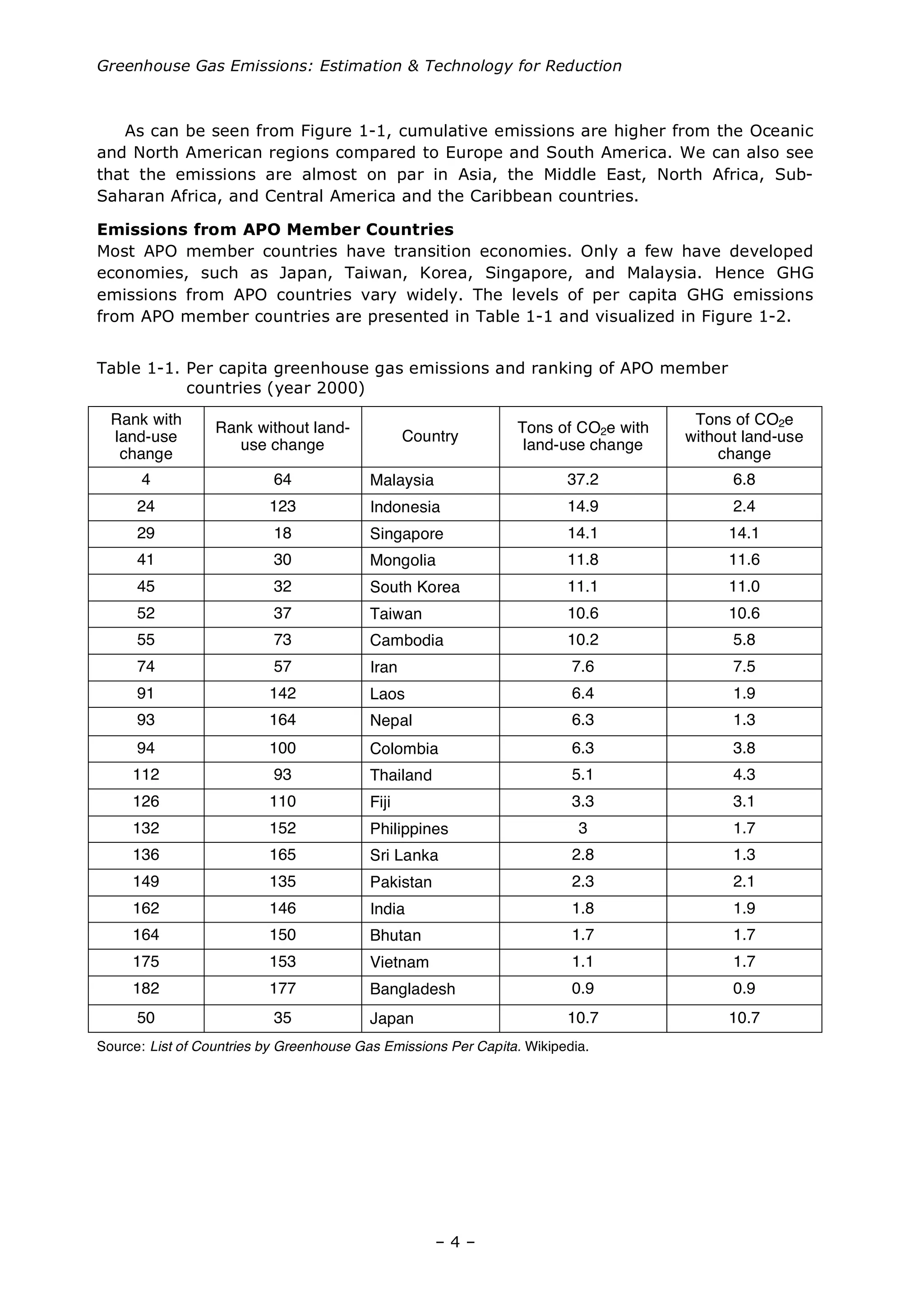
Most APO member countries have transition economies. Only a few have developed
economies, such as Japan, Taiwan, Korea, Singapore, and Malaysia. Hence GHG
emissions from APO countries vary widely. The levels of per capita GHG emissions
from APO member countries are presented in Table 1-1 and visualized in Figure 1-2.
Table 1-1. Per capita greenhouse gas emissions and ranking of APO member
countries (year 2000)
Rank with
land-use
change
Rank without land-
use change
Country
Tons of CO2e with
land-use change
Tons of CO2e
without land-use
change
4 64 Malaysia 37.2 6.8
24 123 Indonesia 14.9 2.4
29 18 Singapore 14.1 14.1
41 30 Mongolia 11.8 11.6
45 32 South Korea 11.1 11.0
52 37 Taiwan 10.6 10.6
55 73 Cambodia 10.2 5.8
74 57 Iran 7.6 7.5
91 142 Laos 6.4 1.9
93 164 Nepal 6.3 1.3
94 100 Colombia 6.3 3.8
112 93 Thailand 5.1 4.3
126 110 Fiji 3.3 3.1
132 152 Philippines 3 1.7
136 165 Sri Lanka 2.8 1.3
149 135 Pakistan 2.3 2.1
162 146 India 1.8 1.9
164 150 Bhutan 1.7 1.7
175 153 Vietnam 1.1 1.7
182 177 Bangladesh 0.9 0.9
50 35 Japan 10.7 10.7
Source: List of Countries by Greenhouse Gas Emissions Per Capita. Wikipedia.
Chapter 1: Estimating and Reducing GHG Emissions
– 5 –
As can be seen from the table, per capita CO2e emissions by Malaysia increased
from 6.8 to 37.2 tons after land-use change, which is the most emissions among all
APO member countries, while Bangladesh had the least at 0.9 tons. However, there is
virtually no difference from “without” to “with” land-use change in per capita GHG
emissions by developed APO member countries such as Singapore, South Korea,
Taiwan, and Japan.
Some Facts About GHG Emissions:
• GHG emissions have risen by 70% between 1970–2004 since the pre-industrial
era.
• CO2 emissions are projected to be 42.9 billion tons in 2030.
• Earth’s average surface temperatures has increased by 0.76°
C since 1850.
• Global average surface temperature is likely to increase by a further 1.8 to 4.0°
C
this century.
• CO2 is the largest source of GHG accounting for 77% of total emissions.
• Sustainable level of GHG emissions is less than 2 tons CO2e per capita per year.
• Per capita GHG emissions were the lowest from Bangladesh at 0.9 tons of CO2e in
2000 among APO member countries.
• Energy sector is the major contributor of GHG emissions accounting for 90% of
the total CO2 emissions globally, resulting from fossil fuel combustion.
• Power plants (electricity generation) without heat recovery account for over 70%
of GHG emissions globally.
Source: Adapted from List of Countries by Greenhouse Gas Emissions Per Capita. Wikipedia.
Figure 1-2. Greenhouse gas emissions in APO member countries in 2000 (per capita)
Greenhouse Gas Emissions: Estimation & Technology for Reduction
– 6 –
GLOBAL GHG EMISSIONS FLOW BY SECTOR AND ACTIVITY
We have seen that fossil fuel use in the energy sector is the main cause of CO2
emissions, with a smaller contribution stemming from changes in land use patterns.
Narrowing this still further, industry, residential and commercial buildings, and
transportation are the major sectors of the economy that use the most energy, and
that use varies widely in different parts of the world. The contributions from different
sectors to global GHG emissions are summarized in Figure 1-3.
The chart illustrates the use of fossil fuel as the primary source of energy (coal, oil,
and gas) and how it differs between sectors using primary energy, i.e., mainly
transportation, the manufacturing and construction sectors, and the production of
electricity and heat, and secondary consumers (end use/activity), i.e., mainly
electricity and heat generation. At the end use/activity level, energy use can be
divided as:
• Transport sector – road, air, rail, shipping, and other;
• Industry – different industrial end users (among which are energy-intensive
sectors including iron and steel, cement, and chemicals); and,
• Others – mainly residential and commercial sectors.
Land Use Change
Agriculture
Waste
18.2%
13.5%
3.6%
Industrial Processes 3.4%
Transportation 13.5%
Electricity & Heat 24.6%
Industry
Fugitive Emissions
Other Fuel
Combustion
10.4%
3.9%
9.0%
YGRENE
Carbon Dioxide
(CO2) 77%
Methane
(CH4) 14%
Nitrous Oxide
(N2O) 8%
HFCs, PFCs,
SF6 1%
Agriculture Soils
Livestock & Manure
Rice Cultivation
Other Agriculture
Landfills
Wastewater, Other Waste
Agricultural Energy Use
6.0%
5.1%
1.5%
0.9%
2.0%
1.6%
1.4%
T&D Losses
Coal Mining
Oil/Gas Extraction, Refining
& Processing
Deforestation
Afforestation
Reforestation
Harvest/Management
Other
Cement
Other Industry
1.9%
1.4%
6.3%
18.3%
-1.5%
-0.5%
2.5%
-0.6%
3.8%
5.0%
Chemicals
Aluminum/Non-Ferrous Metals
Food & Tobacco
Pulp, Paper & Printing
Machinery
4.8%
1.4%
1.0%
1.0%
1.0%
Road
Air
Rail, Ship, & Other Transport
Unallocated Fuel Combustion
Commercial Buildings
Residential Buildings
Iron & Steel
9.9%
1.6%
2.3%
3.5%
5.4%
9.9%
3.2%
World GHG Emissions Flowchart
Sector End Use/Activity Gas
Sources & Notes: All data is for 2000. All calculations are based on CO2 equivalents, using 100-year global warming potentials from the IPCC (1996), based on a total global estimate of
41,755 MtCO2 equivalent. Land use change includes both emissions and absorptions; see Chapter 16. See Appendix 2 for detailed description of sector and end use/activity definitions, as well as data sources.
Dotted lines represent flows of less than 0.1% percent of total GHG emissions.
Source: Navigating the Numbers: Greenhouse Gas Data and International Climate Policy – Part II. World
Resources Institute, 2005.
Figure 1-3. World emissions flowchart of fossil fuel use (World Resources Institute)
Chapter 1: Estimating and Reducing GHG Emissions
– 7 –
The guide allows visualizing where electricity and heat produced by the electric and
cogeneration industry are used as secondary energy by end users, therefore producing
indirect emissions, thus making a distinction between direct emissions (emissions from
the use of primary energy) and indirect emissions (emissions from the use of
secondary energy). Such distinction is important in order to avoid the double counting
of emissions. The figure also includes other sectors such as agriculture and waste,
which contribute mostly to non-CO2 emissions not covered over the last 250 years
(IPCC, 2007).
It is important to note that the release of carbon dioxide is directly proportional to
the efficiency of fossil fuel conversion into energy. At present, the best available coal
and natural gas technologies have efficiencies of 45% and 52%, respectively.
Assuming typical efficiency of a new coal-fired thermal power plant, equipped with a
scrubbing system for sulfur and nitrogen oxide, a 1% increase in efficiency would
result in a 2.5% reduction in carbon dioxide emissions.
KEY DRIVERS OF EMISSIONS FROM ENERGY USE
The key drivers of emissions from energy use are:
• activities such as total population growth, urbanization, building and vehicle
stock, commodity production;
• economic factors such as total GDP, income, and price elasticity;
• energy intensity trends, e.g., energy intensity of energy-using equipment,
appliances, and vehicles; and,
• carbon intensity trends; i.e., the amount of carbon released per unit of energy
use. (This indicator depends on fuel mix and emission reductions derived from
fuel switching.)
These factors are, in turn, driven by changes in consumer preferences, energy and
technology costs, demand for goods, settlement and infrastructure patterns, technical
development, and the overall economic scenario of the nation (IPCC, 2000).
Energy use produces emissions depending on how assumptions relating to the
four main factors vary, that is, activity level, structure, energy intensity, and fuel
mix. Altering any of these factors, alone or in combination, can influence emission
levels. A simple model can be used for representing the interactions between these
four factors and their impact on CO2 emissions: the farther one drives a car
(activity), the more CO2 emissions will result. However, fewer emissions will result if
the car is more energy efficient (energy intensity), and emissions might be avoided
entirely if the car is operating on a zero-carbon fuel such as hydrogen (fuel mix).
Alternatively, one might choose to ride the bus instead of driving (changing the
structure of the activity), which would also alter the CO2 emissions (Pew Center,
2004). The relationship between various key drivers and emissions is presented in
Figure 1-4.
Greenhouse Gas Emissions: Estimation & Technology for Reduction
– 8 –
CO = × ×Population
Energy
Energy
intensity
Fuel
mixActivity
GDP
×
CO
2
2
GDPPer person Energy
Source: An Overview of Global Greenhouse Gas Emissions and Emission Reduction Scenarios for the Future.
Institute for European Environmental Policy (IEEP), Brussels. February, 2008
Figure 1-4. Emissions projections — simple model representing key factors driving CO2
emissions from energy use (Pew Center, 2004)
CO2 EMISSIONS FROM SELECTED SECTORS
We have understood that GHGs are emitted through natural and anthropogenic
sources, and carbon dioxide is the major greenhouse gas contributing to global
warming. Most CO2 emissions derive from fossil fuels used in the energy sector and a
smaller portion from change in land-use patterns. Key sectors of the economy that
use energy are industry, residential and commercial buildings, and transportation.
Contributions from these sectors vary widely between areas of the world depending
upon the developmental activities.
As can be seen from Figure 1-3, the major source of CO2 emissions is the
combustion of fossil fuels, which accounts for more than 90% of the total contribution
of these emissions globally. Within the energy sector, electricity and heat is the
main category, and accounts for over 70% globally from electricity generation without
heat recovery, followed by the transport, manufacturing, and construction sub-sectors.
In transportation, road transport accounts for nearly three-quarters of all
transportation emissions while aviation and marine transport account for most of the
remainder (rail and other modes are themselves relatively insignificant). The trends
and projections of CO2 emissions from the various sectors are presented in Table 1-2.
Among the largest-emitting regions (Asia, Europe, and North America) some
differences can be seen from Figure 1-5. Heat and electricity in each of these three
regions have a very large share ranging from 42.5% (Europe) and 45.4% (Asia).
Manufacturing and construction is the next-largest sub-sector for Asia accounting for
nearly a quarter, but much less for Europe, and less still for North America.
However, in the case of the transportation sector, this pattern is reversed, with
North America producing over 30% of its emissions from all forms of transport,
contrasted to under 13% for Asia, with Europe falling in between the two. Industrial
process emissions are a fairly small share in both Europe and North America, but
more prominent in Asia. Sector-wise CO2 emissions from the use of energy in various
regions are shown in Figure 1-5.
Table 1-2. Trends and projections for CO2 emissions from various sectors of
the economy
No. Sector 1990 2010 2020 2050
1. Industrial 2.8 Gt C 3.2 – 4.9 Gt C 3.5 – 6.2 Gt C 3.7 – 8.8 Gt C
2. Transport 1.3 Gt C 1.3 – 2.1 Gt C 1.4 – 2.7 Gt C 1.8 – 5.7 Gt C
3. Infrastructure 1.9 Gt C/yr 2.9 Gt C/yr 3.3 Gt C/yr 5.3 Gt C/yr
Source: IPCC Technical Paper – 1, 1996.
Chapter 1: Estimating and Reducing GHG Emissions
– 9 –
According to the IPCC, the carbon dioxide emissions from Annex I countries are
projected to remain either constant, rather than decline by 33%, or increase 76% by
2050.
In view of fast-changing production technology and incorporated energy
conservation measures coupled with virtual saturation in demand of developed
nations, it is further projected that the share of Annex I countries would decrease to
about 60–70% by 2020. Also, it is expected that road and air transportation would
increase its share of emissions in most scenarios.
It is estimated that 75% of 1990 emissions are attributable to energy use in Annex
I countries while by 2050 only 50% of buildings-related emissions globally are
expected to be from Annex I countries.
North America
Europe
Asia
World
93.2%
92.8%
90.8%
45.4%
24.3%
11.4%
6.9%
10.6%
42.5%
18.8%
15.7%
2.4%
15.6%
43.9%
29.7%
11.8% 11.9%
0.9%
43.9%
18.2% 18.5%
12.2%
3.6%
97.1%
Energy
Electricity & Heat
Manufacturing & Construction
Transportation
Other Fuel Combustion
Industrial Processes
Sector-wise Global CO2 Emissions in 2004
Source: Navigating the Numbers: Greenhouse Gas Data & International Climate Policy – Part II. World Resources
Institute, 2005.
Figure 1-5. Sector-wise global CO2 emissions in 2004
Another important sector that is assuming importance particularly in developing
countries is solid waste and wastewater disposal. In most of these countries, solid
waste and wastewater management systems are not adequate thus result in release of
GHG emissions in the form of methane gas. According to the World Resources
Institute (WRI), it is estimated that about 50–80 Mt of methane gas (290–460 MtC)
was emitted in 1990 by solid waste disposal facilities (landfills and open dumps) and
wastewater treatment facilities in developing countries.
Greenhouse Gas Emissions: Estimation & Technology for Reduction
– 10 –
ENERGY SUPPLY SECTOR
It is evident from the above that energy is the primary source of GHG
emissions that are being generated during the combustion of fossil fuel.
Hence, the energy sector is one of the most important of all sectors as far
as GHG emissions are concerned. It has been estimated that in 1990
about 6 GtC was released from energy consumption. Out of this, about
72% was delivered to end users, accounting for 3.7 GtC while the
remaining 28%, amounting to 2.3 GtC, was used in energy conversion
and distribution.
In order to focus on major GHG emission sources, this manual pays particular
attention on the estimation of GHG emissions from the industrial, infrastructure, and
transport sectors. The energy sector is common in all, as energy is an essential
component of every activity.
Since small and medium enterprises (SMEs) in Southeast Asian countries
contribute the most to GHG emissions, focus has also been laid to discussing the
technologies for GHG emission reduction particularly in the SME sector. This manual
therefore presents examples of GHG emissions estimation and case studies on GHG
emission reduction technologies.
SMEs AND GHG EMISSIONS
SMEs are an important sector serving as the engine of growth in virtually all
developing nations. They are the main driver for industrialization and a key channel
for absorbing most of the country’s labor. SME expansion boosts employment more
than large firms as they are more labor intensive. SMEs enhance competition and
entrepreneurship and thus have external benefits to economy-wide efficiency,
innovation, and aggregate productivity growth. They contribute, in general, to around
30–60% of East Asian region GDP and up to 70% of the region’s total employment. In
India, the MSME (micro, small, and medium enterprises) sector accounts for 40% of
exports, 45% of industrial production, and 8% of total GDP (SME Times, May, 2008).
At the same time, Indian SMEs are more responsible for causing global warming or
pollution due to a lack of basic infrastructure, accessibility, and affordability of high
tech production technologies and hampered by inefficient mechanisms to safely
discharge effluents. Of course, SMEs are important in providing a flexible skilled
production base that attracts foreign direct investment (FDI) to boost the economy of
the nation.
Despite their positive aspects, SMEs consume more resources per unit of product
and generate more pollution compared to large industries, thus contribute to
environmental pollution to a great extent. Generally, SMEs put about 65% of the total
pollution load on the environment. This has been attributed to low skill levels,
technological status that is typically just conventional, financial constraints, weak
entrepreneurship, etc. Though the quantity of waste generation from a single SME
may be less compared to large enterprises, the cumulative environmental impact of a
number of SMEs is very high in view of their presence in clusters in a given region.
This clearly indicates that SMEs consume more resources as compared to large
enterprises, but they also have great potential for resource optimization and
Chapter 1: Estimating and Reducing GHG Emissions
– 11 –
conservation. In order to assist SMEs in developing countries, a mechanism has been
developed to reduce GHG emissions called “emission trading” under the Kyoto
Protocol. Using this mechanism, Annex 1 countries are permitted to purchase
allowances for carbon produced by their industries through technological
improvements.
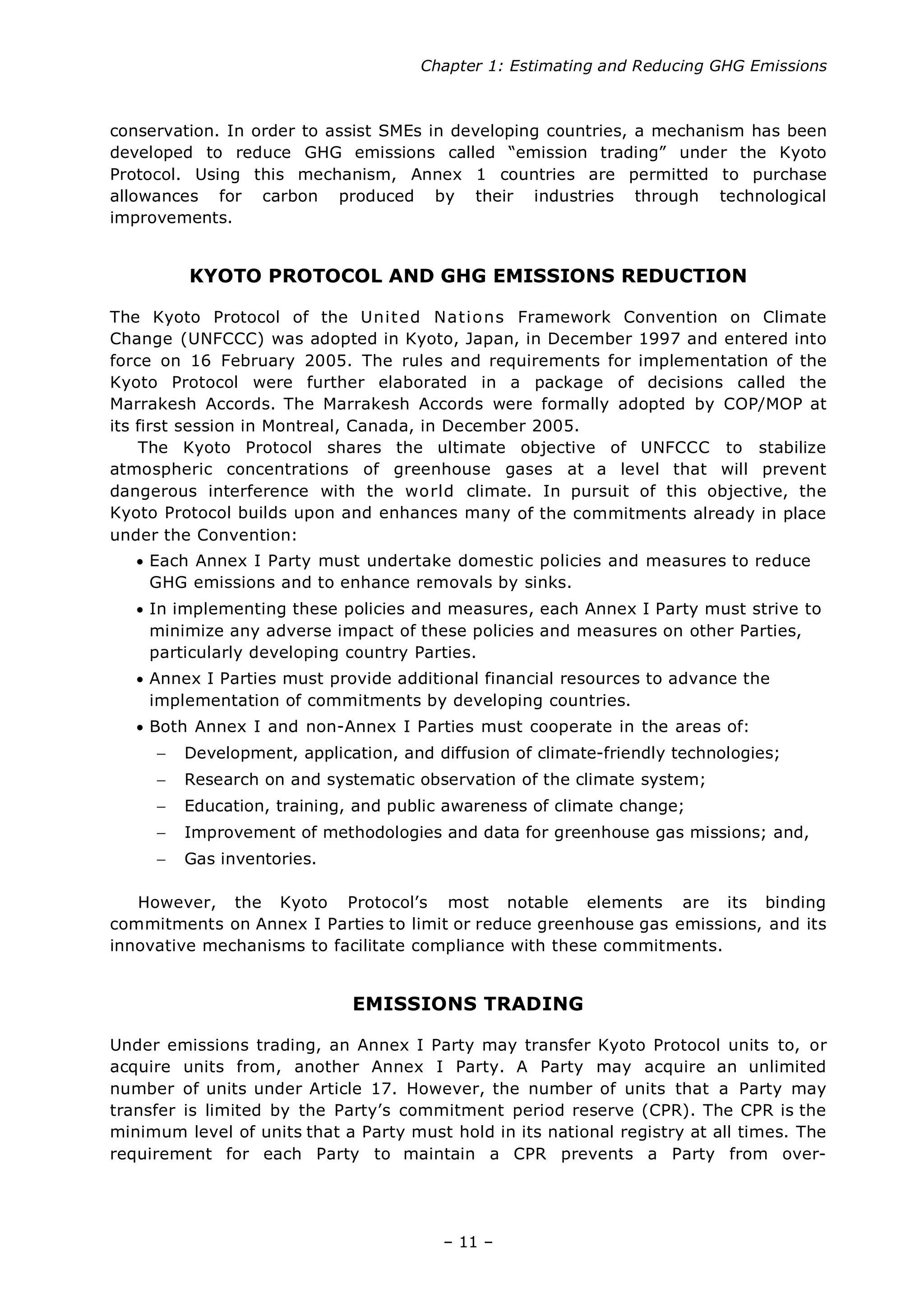
KYOTO PROTOCOL AND GHG EMISSIONS REDUCTION
The Kyoto Protocol of the United Nations Framework Convention on Climate
Change (UNFCCC) was adopted in Kyoto, Japan, in December 1997 and entered into
force on 16 February 2005. The rules and requirements for implementation of the
Kyoto Protocol were further elaborated in a package of decisions called the
Marrakesh Accords. The Marrakesh Accords were formally adopted by COP/MOP at
its first session in Montreal, Canada, in December 2005.
The Kyoto Protocol shares the ultimate objective of UNFCCC to stabilize
atmospheric concentrations of greenhouse gases at a level that will prevent
dangerous interference with the world climate. In pursuit of this objective, the
Kyoto Protocol builds upon and enhances many of the commitments already in place
under the Convention:
• Each Annex I Party must undertake domestic policies and measures to reduce
GHG emissions and to enhance removals by sinks.
• In implementing these policies and measures, each Annex I Party must strive to
minimize any adverse impact of these policies and measures on other Parties,
particularly developing country Parties.
• Annex I Parties must provide additional financial resources to advance the
implementation of commitments by developing countries.
• Both Annex I and non-Annex I Parties must cooperate in the areas of:
− Development, application, and diffusion of climate-friendly technologies;
− Research on and systematic observation of the climate system;
− Education, training, and public awareness of climate change;
− Improvement of methodologies and data for greenhouse gas missions; and,
− Gas inventories.
However, the Kyoto Protocol’s most notable elements are its binding
commitments on Annex I Parties to limit or reduce greenhouse gas emissions, and its
innovative mechanisms to facilitate compliance with these commitments.
EMISSIONS TRADING
Under emissions trading, an Annex I Party may transfer Kyoto Protocol units to, or
acquire units from, another Annex I Party. A Party may acquire an unlimited
number of units under Article 17. However, the number of units that a Party may
transfer is limited by the Party’s commitment period reserve (CPR). The CPR is the
minimum level of units that a Party must hold in its national registry at all times. The
requirement for each Party to maintain a CPR prevents a Party from over-
Greenhouse Gas Emissions: Estimation & Technology for Reduction
– 12 –
transferring units, and thus impairing its ability to meet its Article 3, paragraph 1,
commitment.
Annex I Parties may choose to implement domestic or regional (e.g., with a
group of Parties) systems for entity-level emissions trading, under their authority
and responsibility. Although the Kyoto Protocol does not address domestic or
regional emissions trading, Kyoto emissions trading forms an umbrella under which
national and regional trading systems operate, in that the entity-level trading uses
Kyoto Protocol units and needs to be reflected in the Kyoto Protocol accounting.
Any transfer of units between entities in different Parties under domestic or
regional trading systems is also subject to Kyoto Protocol rules. The emissions
trading scheme (ETS) of the European Union is one example of a regional trading
system, operating under the Kyoto Protocol umbrella.
This manual can help the industries, community, and local bodies estimate their
GHG emissions and obtain the carbon credits from Annex 1 countries through CDM
under the Kyoto Protocol.
– 13 –
CHAPTER 2:
ESTIMATING GHG EMISSIONS
GHG EMISSIONS ESTIMATION AND INVENTORY
It is important to estimate the greenhouse gas emissions from any source in order to
develop policies on mitigation measures. The GHG emission inventory identifies the
most significant emission sources and trends, helping enterprises, local bodies, and
nations develop action plans to mitigate them. The action plans are generally
developed in order to reduce GHG emissions without disrupting economic growth and
development. The inventory also helps to prioritize the sectors and take corrective
measures.
GHG INVENTORY CONCEPTS AND OBJECTIVES
The preparation of inventories relies on a few key concepts with a common
understanding. This helps to ensure comparable inventories, avoid double counting or
omissions, and to confirm the time series reflects actual changes in emissions. In
order to have a uniform and undisputed inventory, one should have understanding
about greenhouse gases, their emissions, and global warming potential (GWP). The
global warming potential of major gases is presented in the following table.
Table 2-1. Global warming potential of major GHGs
GWP (100-year time horizon)
No. GHGs
SAR* TAR*
1 Carbon dioxide (CO2) 1 1
2 Methane (CH4) 21 23
3 Nitrous oxide (N2O) 31 296
4 HFCs 140–11,700 120–12,000
5 CFCs 6,500–9,200 5,700–11,900
6 SF 23,900 22,200
*SAR, TAR: Second Assessment Report, Third Assessment Report
Source: Report on Climate Change and International Security. Council of European Union, Brussels, 3 March,
2008.
The objectives of making a GHG inventory are two-fold. The first objective is to
estimate the GHG emissions from various sources and develop a national database for
reporting at the national and international level. The second is for assessing GHG
emission reductions for emission trading under CDM. In both cases, one has to
develop and upgrade the GHG emissions sources and potentials on a regular basis.
Such an inventory creates a database of the principal sources of emissions to prioritize
mitigation measures to curtail emissions.
Any baseline emission inventory requires inputs including, but not limited to,
energy consumption in the industrial, commercial, residential, and transport sectors.
Greenhouse Gas Emissions: Estimation & Technology for Reduction
– 14 –
In transportation, the usual inputs pertain to the type of vehicle, average miles
traveled per vehicle, and the type and amount of fuel used. The baseline emission
calculators apply emission coefficients/factors to energy consumption to compute
greenhouse gas emissions. Methane generation potential from wastes, etc. is also
estimated.
The important sectors and sub-sectors that contribute to GHG emissions are
energy, industrial processes and product use, infrastructure, transport, waste, etc.
IPCC has set out methodologies to estimate GHG emissions and total emissions are
calculated by summing up all the sources. A national total is calculated by summing up
the emissions and removals for each gas. The emissions resulting from use of fuel in
ships and aircrafts are not included in the national total but are reported separately.
In order to calculate a national inventory, it is necessary to select an approach to
include harvested wood products (HWP).
PREPARATION OF NATIONAL INVENTORY
Before starting a national inventory, one should first determine whether it will meet
IPCC standards. A decision tree is presented in the following diagram for preparing a
national inventory as per the IPCC Guidelines. This diagram explains the stages
needed to make sure it complies with the IPCC standards. The flow diagram illustrates
how the different types of users (working at different levels of inventory detail) can
utilize the various volumes of the IPCC Guidelines for preparing an inventory. One
should recognize that reality is more complex than this simple explanatory chart.
Some countries may have portions of the inventory complete at a high level of detail
but may only be getting started on other parts. It is quite likely that some users will
need to do several iterations of the thinking process reflected in the diagram with
regard to different aspects of their inventory.
The stages outlined in the flow diagram are:
Question 1
Do you already have a detailed national inventory?
Answer: Yes
If your country already has a complete national inventory, you should convert the data
it contains into a form suitable for use by IPCC. This means converting it into a stan-
dardized format. In order to do this, refer to Volume 1 of the IPCC Guidelines,
Reporting Instructions. This explains how the data should be documented and re-
ported.
Answer: No
You should start to plan your inventory and assemble the data you will need to
complete the worksheets of the IPCC Guidelines. Refer to the “Getting Started” section
of the workbook.
Question 2
Do you want to use the inventory software available from IPCC?
Answer: Yes
Chapter 2: Estimating GHG Emissions
– 15 –
If you want to use the IPCC software, you will still need to follow the instructions in-
cluded in the workbook to prepare and assemble the data you have collected. To enter
data you will use the software instead of the printed worksheets.
Answer: No
If you do not use the IPCC software, use the workbook and the worksheets it contains
to assemble your collected data into an inventory.
Finally...
Inventory data should be returned to IPCC in the form recommended in the Reporting
Instructions. It is important that, when you have used a methodology other than the
IPCC default methodology, it is properly documented. This will ensure that national
inventories can be aggregated and compared in a systematic way in order to produce
a coherent regional and global picture.
Do you have
a detailed
National
Inventory?
Do you want to use
IPCC computer
software?
Use manual
worksheets in
workbook
Use software
and
workbook
– Plan inventory
– Assemble data
Yes
YesNo
No
Final National Inventory
AVAILABILITY / USE OF COMPUTER SOFTWARE
IPCC computer software is available with the IPCC Guidelines. The software includes the same simple default
methods as presented in the Workbook and the Sectoral and Summary Tables for reporting inventories, as
presented in the Reporting Instructions. It is available in English only. This version of the software is being
produced in Excel 5.0.
If you would like to receive a copy of the software, send a letter or fax to:
IPCC UNIT FOR GHG INVENTORIES
Pollution Prevention and Control Division
OECD, Environment Directorate
2, Rue André-Pascal
75775 PARIS CEDEX 16, FRANCE
FAX: (33-1) 45 24 78 76
Aggregate/transform
data and put into
standard format as
outlined in the ”Reporting
Instructions.”
• Reporting recommendations
– Documentation
– Verification
– Uncertainties
• Use “Reporting Instructions”
Source: Revised 1996 IPCC Guidelines for National Greenhouse Gas Inventories. Task Force on National
Greenhouse Gas Inventories, IPCC.
Figure 2-1. Decision tree for preparation of GHG emission inventory
Greenhouse Gas Emissions: Estimation & Technology for Reduction
– 16 –
In order to simplify this manual, special attention is paid to methods for estimating
GHG emissions from major sectors such as industrial processes and products, and the
residential, commercial/institutional, and transport sectors.
Methodology for Inventorizing GHG
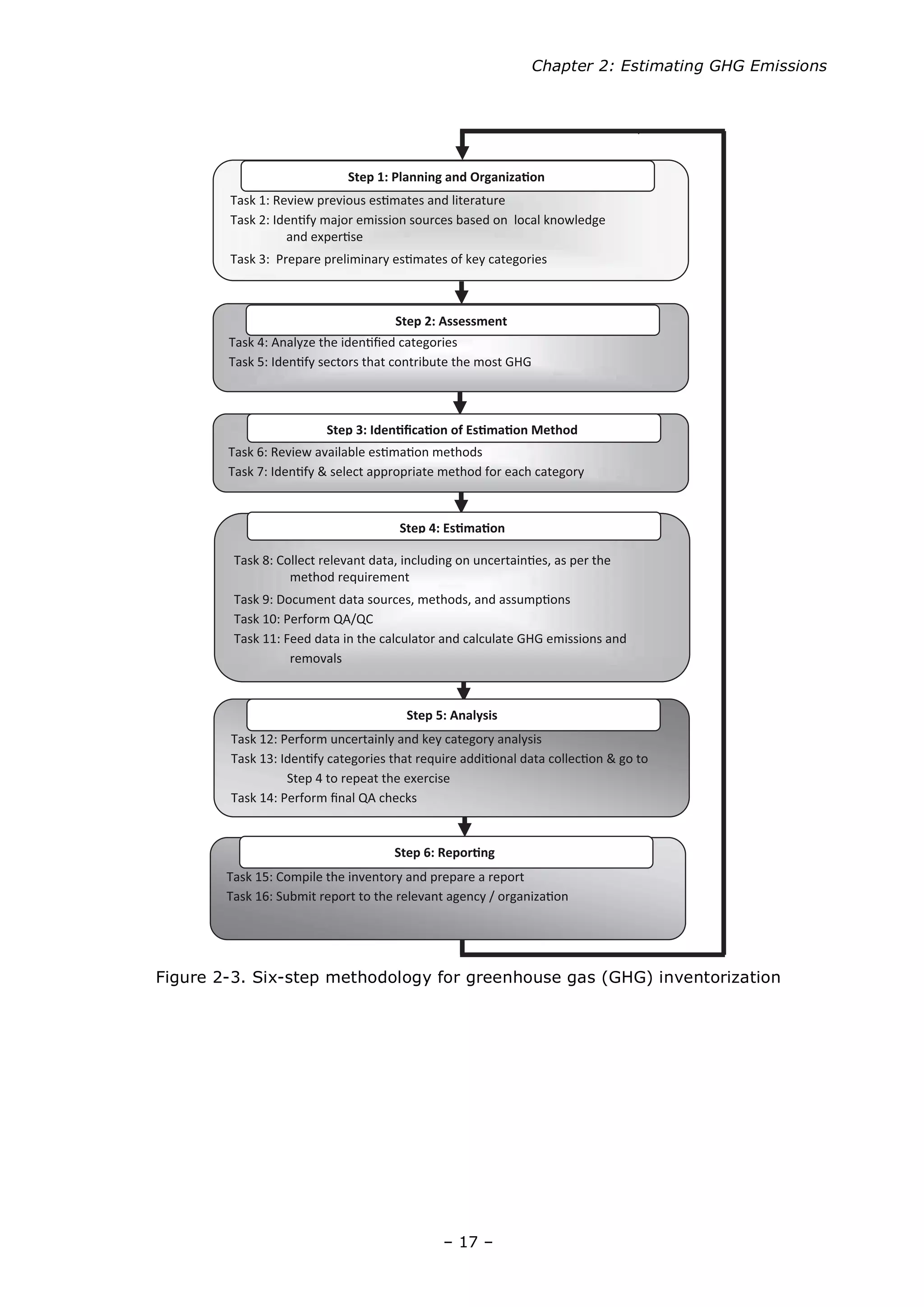
Making an inventory of greenhouse gases is a systematic step-by-step process. Before
undertaking estimates of emissions and removals from specific categories, an
inventory compiler should become familiar with the material. A six-step, 16-task
methodology has been developed based on the IPCC Guidelines on GHG Emissions and
is presented below.
STEP 2
Assessment
STEP 3
IdenƟficaƟon of
EsƟmaƟon Method
STEP 4
EsƟmaƟon
STEP 5
Analysis
STEP 6
ReporƟng
STEP 1
Planning & OrganizaƟon
Figure 2-2. Methodology for GHG inventorization
Chapter 2: Estimating GHG Emissions
– 17 –
Task 1: Review previous esƟmates and literature
Task 2: IdenƟfy major emission sources based on local knowledge
and experƟse
Task 3: Prepare preliminary esƟmates of key categories
Step 1: Planning and OrganizaƟon
Task 15: Compile the inventory and prepare a report
Task 16: Submit report to the relevant agency / organizaƟon
Step 6: ReporƟng
Task 4: Analyze the idenƟfied categories
Task 5: IdenƟfy sectors that contribute the most GHG
Step 2: Assessment
Task 6: Review available esƟmaƟon methods
Task 7: IdenƟfy & select appropriate method for each category
Step 3: IdenƟficaƟon of EsƟmaƟon Method
Step 4: EsƟmaƟon
Task 9: Document data sources, methods, and assumpƟons
Task 10: Perform QA/QC
Task 11: Feed data in the calculator and calculate GHG emissions and
removals
Task 8: Collect relevant data, including on uncertainƟes, as per the
method requirement
Task 14: Perform final QA checks
Task 13: IdenƟfy categories that require addiƟonal data collecƟon & go to
Step 4 to repeat the exercise
Task 12: Perform uncertainly and key category analysis
Step 5: Analysis
Figure 2-3. Six-step methodology for greenhouse gas (GHG) inventorization
Greenhouse Gas Emissions: Estimation & Technology for Reduction
– 18 –
Start
Are
emissions
measurements
available with
satisfactory
QC?
Are all
single sources in
the source category
measured?
Are
country-
specific EFs
available for the
unmeasured part
of the key
category?
Is
specific
fuel use
available for the
category?
Yes
Does
the unmeasured
part belong to a key
category?
No
Can the fuel
consumption estimated
by the model be reconciled with
national fuel statistics or be
verified by independent
sources?
No
Is a detailed
estimation model
available?
Yes
Are
country-specific EFs
available?
Yes
Is this
a key category?
No
Use default EFs
and suitable AD
Tier 1 approach.
Yes
Get country-
specific data.
No
Use country-
specific EFs and
suitable AD Tier
2 approach.
No Use model
Tier 3 approach.
No
Yes
Use
measurements
Tier 3 approach
and combine with
AD and default
EFs Tier 1
approach.
Yes
Get country-
specific data
No
No
Yes
Use
measurements
Tier 3 approach
and combine with
AD and country-
specific EFs
Tier 2 approach.
No
YesYes
Use
measurements
Tier 3 approach.
Source: 2006 IPCC Guidelines for National Greenhouse Gas Inventories. Task Force on National Greenhouse Gas
Inventories, IPCC.
Figure 2-4. Generalized decision tree for estimating emissions from fuel combustion
Chapter 2: Estimating GHG Emissions
– 19 –
The inventory should be based on previous inventories, if available, and should be
revised as per the requirements. When a revised inventory is compiled, all estimates
by year should be reviewed for consistency and updated integrating any feasible
improvements wherever necessary. Thus an iterative process builds on and improves
the inventory each time a new inventory is compiled as illustrated in Figure 2-4. A tier
or level approach has been followed to inventorize GHG emission estimations. The tier
approach is explained below.
Tier 1
The Tier 1 inventory method is fuel-based, since emissions from all sources of
combustion can be estimated on the basis of the quantities of fuel combusted (usually
from national energy statistics) and average emission factors. Tier 1 emission factors
are available for all relevant direct greenhouse gases.
Tier 2
In the Tier 2 inventory method for energy, emissions from combustion are estimated
based on country-specific emission factors in place of the Tier 1 defaults. Since
available country-specific emission factors might differ for different specific fuels,
combustion technologies or even individual industrial plants, activity data could be
further disaggregated to properly reflect such disaggregated sources.
If an inventory compiler has well documented measurements of the amount of
carbon emitted in non-CO2 gases or otherwise not oxidized, it can be taken into
account in this tier in the country-specific emission factors.
Tier 3
In the Tier 3 inventory method for energy, either detailed emission models or
measurements and data at the individual plant level are used where appropriate.
Properly applied, these models and measurements should provide better estimates
primarily for non-CO2 greenhouse gases, though at the cost of more detailed
information and effort.
ESTIMATION OF GHG EMISSIONS FROM
INDUSTRIAL PROCESSES AND PRODUCT USE
GHG emissions are produced from a wide variety of industrial activities. The main
emission sources are releases from industrial processes that chemically or physically
transform materials (for example, a blast furnace in the iron and steel industry,
ammonia and other chemical products manufactured from fossil fuels used as
chemical feedstock, and the cement industry are notable examples of industrial
processes that release significant amounts of CO2). During these processes, many
different greenhouse gases, including carbon dioxide (CO2), methane (CH4), nitrous
oxide (N2O), hydrofluorocarbons (HFCs), and perfluorocarbons (PFCs), can be
produced.
In addition, chemical compounds that may escape as greenhouse gases often are
used in products such as refrigerators, foams, and aerosol cans. For example, HFCs
are used as alternatives to ozone-depleting substances (ODS) in various types of
product applications. Similarly, sulfur hexafluoride (SF6) and N2O are utilized in a
number of products with industrial applications (e.g., SF6 used in electrical equipment
and N2O used as a propellant in aerosol products primarily in the food industry) or by
end-consumers (e.g., SF6 used in running shoes and N2O used for surgical or dental
Greenhouse Gas Emissions: Estimation & Technology for Reduction
– 20 –
anesthesia). A notable feature of these product uses is that, in almost all cases,
significant time can elapse between the manufacture of the product and the ultimate
release of the damaging greenhouse gas. The delay can vary from a few weeks (e.g.,
aerosol sprays) to several decades as in the case of rigid foams. In some applications
(e.g., refrigeration) a portion of the greenhouse gases used in the products can be
recovered at the end of the product life and either recycled, sequestered, or
destroyed. In addition, several other fluorinated greenhouse gases may be used in
special processes, for example in semiconductor manufacture, such as:
• nitrogen trifluoride (NF3)
• trifluoromethyl sulphur pentafluoride (SF5CF3)
• halogenated ethers (C4F9OC2H5, CHF2OCF2OC2F4OCHF2, CHF2OCF2OCHF2)
and other halocarbons not covered by the Montreal Protocol including CF3I, CH2Br2,
CHCl3, CH3Cl, and CH2Cl2. IPCC Guidelines for National Greenhouse Gas Inventories
(2006 IPCC Guidelines, Volume 3) also provides estimation methods for halogenated
greenhouse gases that are not covered by the Montreal Protocol.
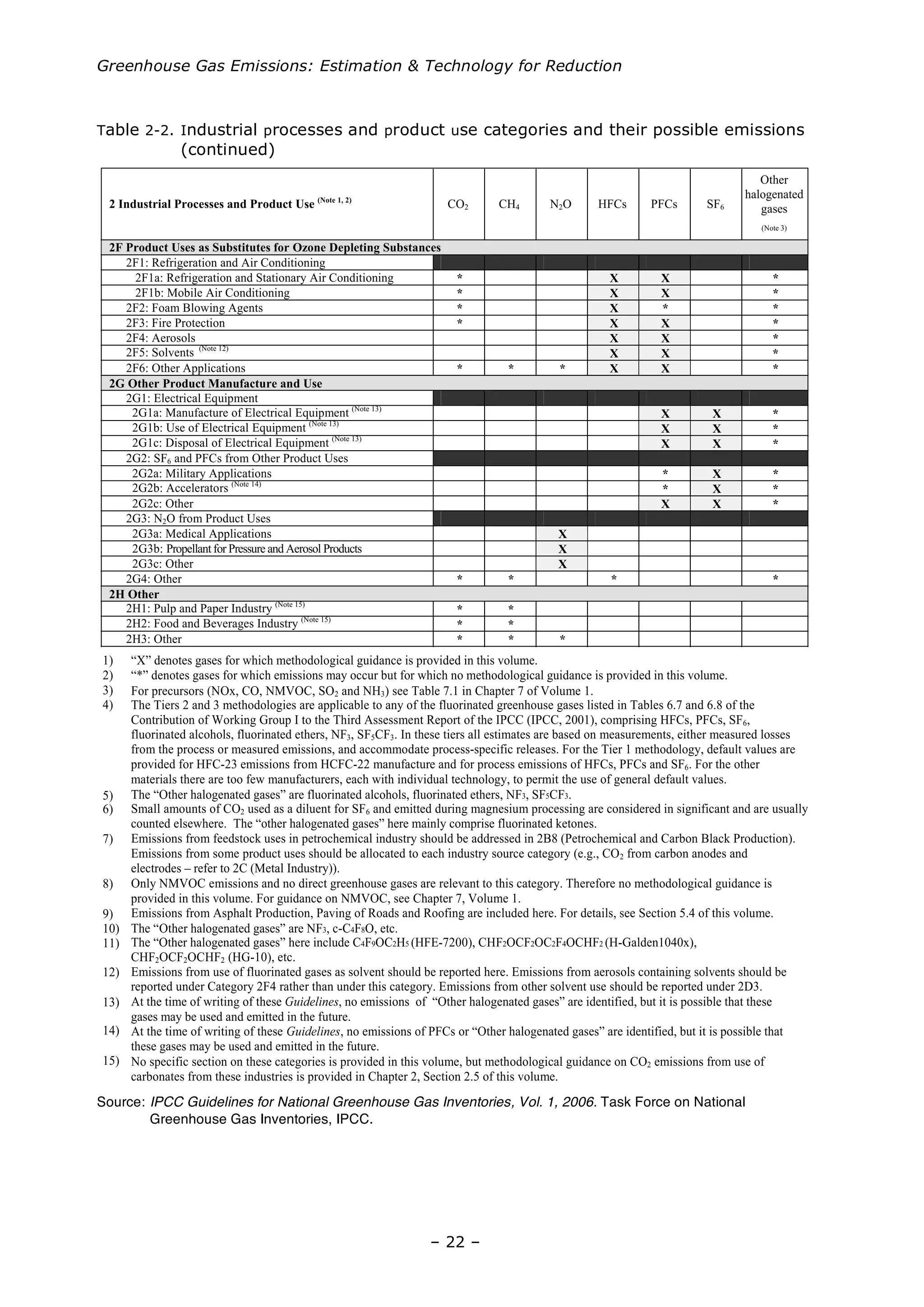
The following Table 2-2 provides possible greenhouse gases from various industrial
processes, which can be used as a reference and can serve as a guide to identify
emission sources.
Although the climate changes naturally on its own, humans contribute heavily to
pollution of the environment. More and more people are wondering how they can do
their part to help reduce greenhouse gas emission into the atmosphere. While change
won't happen overnight, here are steps that you can take against global warming in
your own place of business.
Chapter 2: Estimating GHG Emissions
– 21 –
Table 2-2. Industrial processes and product use categories and their possible emissions
Other
halogenated
gases
(Note 3)
2 In ustrial Processes and Product Use (Note 1, 2)
CO2 CH4 N2O HFCs PFCs SF6d
X2C6: Zinc Production
2A Mineral Industry
2A1: Cement Production X *
2C7: Other * * *
2A2: Lime Production
*
X
*
*
2D Non-Energy Products from Fuels and Solvent Use (Note 7)
2A3: Glass Production X *
* *
2A4: Other Process Uses of Carbonates
2A4a: Ceramics X *
* *
2A4b: Other Uses of Soda Ash X *
* *
2A4c: Non Metallurgical Magnesia Production
X
X
X
*
X
2A4d: Other
X
X
X
*
X
2A5: Other
X
X
X
*
X
*
X
2B Chemical Industry
2B1: Ammonia Production X *
X
*
2E5: Other * * *
2B2: Nitric Acid Production
*
*
*
*
*
X
2B3: Adipic Acid Production * * X
2B4: Caprolactam,Glyoxal, and Glyoxylic Acid Production * * X
2B5: Carbide Production X X *
2B6: Titanium Dioxide Production X * *
2B7: Soda Ash Production X * *
2B8: Petrochemical and Carbon Black Production
2B8a: Methanol X X *
2B8b: Ethylene X X *
2B8c: Ethylene Dichloride and Vinyl Chloride Monomer X X *
2B8d: Ethylene Oxide X X *
2B8e: Acrylonitrile X X *
2B8f: Carbon Black X X *
2B9: Fluorochemical Production (Note 4)
2B9a: By-product Emissions (Note 5)
X X X X
2B9b: Fugitive Emissions (Note 5)
X X X X
2B10: Other * * * * * * *
2C Metal Industry
2C1: Iron and Steel Production X X *
2C2: Ferroalloys Production X X *
2C3: Aluminium Production X * X
2C4: Magnesium Production (Note 6)
X X X X X
2C5: Lead Production X
* *
2D1: Lubricant Use X
2D2: Paraffin Wax Use X
2D3: Solvent Use (Note 8)
2D4: Other (Note 9)
*
2E Electronics Industry
2E1: Integrated Circuit or Semiconductor (Note 10)
X
2E2: TFT Flat Panel Display (Note 10)
X
2E3: Photovoltaics (Note 10)
2E4: Heat Transfer Fluid (Note 11)
*
Greenhouse Gas Emissions: Estimation & Technology for Reduction
– 22 –
Table 2-2. Industrial processes and product use categories and their possible emissions
(continued)
1)
2)
3)
4)
“X” denotes gases for which methodological guidance is provided in this volume.
*
*
2F Product Uses as Substitutes for Ozone Depleting Substances
2F1: Refrigeration and Air Conditioning
2F1a: Refrigeration and Stationary Air Conditioning * X X *
2F1b: Mobile Air Conditioning * X X *
2F2: Foam Blowing Agents * X * *
2F3: Fire Protection * X X *
2F4: Aerosols X X *
2F5: Solvents (Note 12)
X X *
2F6: Other Applications * * * X X *
2G Other Product Manufacture and Use
2G1: Electrical Equipment
2G1a: Manufacture of Electrical Equipment (Note 13)
X X *
2G1b: Use of Electrical Equipment (Note 13)
X X *
2G1c: Disposal of Electrical Equipment (Note 13)
X X *
2G2: SF6 and PFCs from Other Product Uses
2G2a: Military Applications * X *
2G2b: Accelerators (Note 14)
* X *
2G2c: Other X X *
2G3: N2O from Product Uses
2G3a: Medical Applications X
2G3b: Propellant for Pressure and Aerosol Products X
2G3c: Other X
2G4: Other * * *
2H Other
2H1: Pulp and Paper Industry (Note 15)
* *
2H2: Food and Beverages Industry (Note 15)
* *
2H3: Other * *
Other
halogenated
gases
(Note 3)
2 Industrial Processes and Product Use (Note 1, 2)
CO2 CH4 N2O HFCs PFCs SF6
“*” denotes gases for which emissions may occur but for which no methodological guidance is provided in this volume.
For precursors (NOx, CO, NMVOC, SO2 and NH3) see Table 7.1 in Chapter 7 of Volume 1.
The Tiers 2 and 3 methodologies are applicable to any of the fluorinated greenhouse gases listed in Tables 6.7 and 6.8 of the
Contribution of Working Group I to the Third Assessment Report of the IPCC (IPCC, 2001), comprising HFCs, PFCs, SF6,
fluorinated alcohols, fluorinated ethers, NF3, SF5CF3. In these tiers all estimates are based on measurements, either measured losses
from the process or measured emissions, and accommodate process-specific releases. For the Tier 1 methodology, default values are
provided for HFC-23 emissions from HCFC-22 manufacture and for process emissions of HFCs, PFCs and SF6. For the other
materials there are too few manufacturers, each with individual technology, to permit the use of general default values.
The “Other halogenated gases” are fluorinated alcohols, fluorinated ethers, NF3, SF5CF3.
Small amounts of CO2 used as a diluent for SF6 and emitted during magnesium processing are considered in significant and are usually
counted elsewhere. The “other halogenated gases” here mainly comprise fluorinated ketones.
Emissions from feedstock uses in petrochemical industry should be addressed in 2B8 (Petrochemical and Carbon Black Production).
Emissions from some product uses should be allocated to each industry source category (e.g., CO2 from carbon anodes and
electrodes – refer to 2C (Metal Industry)).
Only NMVOC emissions and no direct greenhouse gases are relevant to this category. Therefore no methodological guidance is
provided in this volume. For guidance on NMVOC, see Chapter 7, Volume 1.
Emissions from Asphalt Production, Paving of Roads and Roofing are included here. For details, see Section 5.4 of this volume.
The “Other halogenated gases” are NF3, c-C4F8O, etc.
The “Other halogenated gases” here include C4F9OC2H5 (HFE-7200), CHF2OCF2OC2F4OCHF2 (H-Galden1040x),
CHF2OCF2OCHF2 (HG-10), etc.
Emissions from use of fluorinated gases as solvent should be reported here. Emissions from aerosols containing solvents should be
reported under Category 2F4 rather than under this category. Emissions from other solvent use should be reported under 2D3.
At the time of writing of these Guidelines, no emissions of “Other halogenated gases” are identified, but it is possible that these
gases may be used and emitted in the future.
At the time of writing of these Guidelines, no emissions of PFCs or “Other halogenated gases” are identified, but it is possible that
these gases may be used and emitted in the future.
No specific section on these categories is provided in this volume, but methodological guidance on CO2 emissions from use of
carbonates from these industries is provided in Chapter 2, Section 2.5 of this volume.
5)
6)
7)
8)
9)
10)
11)
12)
13)
14)
15)
Source: IPCC Guidelines for National Greenhouse Gas Inventories, Vol. 1, 2006. Task Force on National
Greenhouse Gas Inventories, IPCC.
Chapter 2: Estimating GHG Emissions
– 23 –
GHG ESTIMATION METHODS
The first step is to recognize how much your firm or organization may be contributing
to the problem of greenhouse gas emissions.
A number of methods are available to calculate GHG emissions. You can choose the
one that is most appropriate for your industry or application. However, calculation
methods that are in accordance with IPCC guidelines for the preparation of national
inventories are encouraged.
Emission Estimation for Facilities
The various methods used to estimate GHG emissions for facilities are presented
below.
• Monitoring and Direct Measurement – This method is helpful in estimating
GHG emissions from continuous sources such as smoke from stacks. This may
involve Continuous Emission Monitoring Systems (CEMS) where emissions are
recorded continuously over a longer and uninterrupted period. This method can
be applied to the industrial establishments that have a fixed emission source as
stacks.
• Mass Balance – In this method, emissions are determined based on the
difference in the input and output of a unit operation where accumulation and
depletion of a substance are included in the calculations.
• Engineering Estimates – This method may involve estimating emissions from
engineering principles and judgment by using knowledge of the chemical and
physical processes involved.
Emission Factors
GHG emissions are estimated based on developed emission factors (EFs). An emission
factor is the rate at which a pollutant is released into the atmosphere as a result of
some process activity or unit throughput. EFs used may be average or general or
technology-specific.
In order to estimate GHG emissions from industrial processes, generally two
approaches, known as mass-balance and emission factor approach, have been
adopted. Both the approaches have specific advantages and disadvantages. The
emission factor approach provides an instant solution while the mass-balance
approach relies on measurements and monitoring. A comparison of both approaches is
presented in the following table.
According to IPCC Good Practice Guidance Guidelines, 1996, the most common
simple methodological approach to calculate GHG emissions is to combine information
on the extent to which a human activity takes place (called activity data or AD) with
coefficients that quantify the emissions or removals per unit activity. These are called
emission factors (EF). The basic equation is therefore:
Emissions = AD x EF
For example, in the energy sector fuel consumption would constitute activity
data, and the mass of carbon dioxide emitted per unit of fuel consumed would be an
emission factor, as per the requirement. The basic equation can, in some
circumstances, be modified to include estimation parameters other than emission
factors.
Greenhouse Gas Emissions: Estimation & Technology for Reduction
– 24 –
Example of Electricity Emission Factors
Low-level GHG power projects that supply clean energy to the electricity grid generally
estimate reductions from assumptions about the energy source that they are
offsetting. While the estimation method of:
a MWh * b tCO2e/MWh = c tCO2e
is straightforward for the project proponent, the justification for the number at b is
more complex. There are several options for considering EFs for calculating emission
reductions from clean or low-emission energy supply to an electricity grid supply that
should be understood when making process decisions.
There is no perfect factor that works in every situation and there are a number of
factors that can guide the selection of a type of emission factor. While choosing EFs,
one should consider the following:
• Are there similar projects / programs already operating with a level of methods
consistency?
• Is there a regulatory framework that restricts the choice?
• What are the levels of accuracy / assurance required for the emissions
calculation? For example, a project planning to take part in emissions trading will
need a more rigorous methodology and calculation than one funded simply as a
demonstration of possible technologies.
• How regionally specific is the program? Is equity across the country a concern?
• Are available data to do the calculations sufficient and if not, is there enough
capacity within the program or proponents to do this work?
Estimation of GHG from the Energy Sector
The energy sector is one of the main contributors to GHG
emissions. In most of the economies of the world, energy
systems are largely driven by the combustion of fossil fuels.
During the combustion process, carbon dioxide and water are
produced from the carbon and hydrogen present in the fossil
fuel. Thus the chemical energy present in the fuel is released in the form of heat that
is generally used either directly or with some conversion losses to produce mechanical
energy for the generation of electricity or for transportation.
Categorization of Sources
The energy sector mainly comprises of:
• exploration and exploitation of primary energy sources;
• conversion of primary energy sources into more usable energy forms in refineries
and power plants;
• transmission and distribution of fuels; and,
• use of fuels in stationary and mobile applications
Emissions arise from these activities by combustion and as fugitive emissions, or
the escape of gases without combustion. For inventory purposes, fuel combustion may
be defined as “the intentional oxidation of materials within an apparatus that is
designed to provide heat or mechanical work to a process, or for use away from the
apparatus.”
Chapter 2: Estimating GHG Emissions
– 25 –
Stationary combustion is usually responsible for about 70% of the greenhouse gas
emissions from the energy sector. About half of these emissions are associated with
combustion in energy industries, mainly power plants and refineries. Mobile
combustion (road and other traffic) causes about one-quarter of the emissions in the
energy sector. Typically, only a few percent of the emissions in the energy sector arise
as fugitive emissions from extraction, transformation, and transportation of primary
energy carriers. Examples are leakage of natural gas and the emissions of methane
gas during coal mining and flaring as part of oil/gas extraction and refining. In some
cases where countries produce or transport significant quantities of fossil fuels,
fugitive emissions can make a much larger contribution to the national total.
GHG CALCULATORS
A number of calculators are available for the estimation of greenhouse gases. Many
countries such as Canada, the U.S., Australia, and Europe have developed their own
calculators based on the IPCC guidelines. The most popular calculator is the one
developed by UNEP. The calculator developed by the Australian Greenhouse Office is
also simple and easy to use. This can also be easily utilized by APO member countries
for estimation of their GHG emissions. Both of these calculators are discussed in this
manual and the member countries can adopt whichever is most suitable for them.
Other calculators have also been developed by private companies to help calculate
GHG emissions for CDM (clean development mechanism) purpose. One such calculator
is presented below.
Table 2-3. GHG emission calculator developed by A1 Future Technologies (India)
Baseline
Emissions
GHG
CDM
Project
Emissions
Net
Reduction
GWPa
C02eb
0 - C02
0 = x 1 =
0 - CH4
0 = x 21 =
0 - N20 0 = x 310 =
0 -
HFC-
23
0 = x 11700 =
0 -
HFC-
125
0 = x 2800 =
0 -
HFC-
134a
0 = x 1300 =
0 -
HFC-
152a
0 = x 140 =
0 - CF4
0 = x 6500 =
0 - C2F6
0 = x 9200 =
0 - SF6
0 = x 23900 =
0 Totals 0
Grand
Total
1. Global Warming Potential as related to CO2.
2. Carbon dioxide equivalent.
Note: All units should be converted to metric tons before being keyed into the calculator. You only need to
provide values for the Baseline Emissions and CDM Project Emissions columns (green-colored cells). Indicate
0 (zero) for empty fields. To avoid errors, make sure to hit all the Calculate buttons before hitting Total.
Source: www.carbonmcgroup.com/ghgcalculator.html
Greenhouse Gas Emissions: Estimation & Technology for Reduction
– 26 –
UNEP GHG Emissions Calculator
A simplified GHG emissions calculator has been developed by UNEP and given below.
This calculator can help make estimations of the reduction in GHG emissions through
adopted measures. The spreadsheet used for calculating GHG emissions is shown
below. The details can be obtained from GHG calculation tools available at
www.ghgprotocol.org/standard/tools.htm.
Table 2-4. Spreadsheet for calculating GHG emissions based on UNEP GHG calculator
SNOITCURTSNI
detaluclacyllacitamotuaeblliwsnoissimeGHGdna,neergderuolocsllecehtnilliF.1
iavafisrotcafnoissimecificepsynapmochtiwesehtecalpernacuoY.sllecwolleynidedivorperasrotcafnoissimedradnatS.2 elbal
trevnocot)teehsetarapes(srotcafnoisrevnocesU!!detacidnisatinutcerrocehtniatadedivorpuoytahterusekamesaelP.3 sennotot3mgemorf
tnalphcaerofemantnereffidarednutnemucodehtevasuoytahterusekamesaelP.4
LARENEG
:noitasinagrofoemaN
:tcudorpniaM
:snoissimeGHGforaeyesaB
2002rofetaluclacesaelp)tey(elbaliavatoneraatadfi3002rofdetaluclacebotsnoissimeGHGreferpdluowew:etoN
SNOISSIMEGHGFOYRAMMUS
tinUytitnauQecruosnoissimeGHG
)3002ro(20024002)3002ro(2002
2OCennoT00noitsubmocleuF.1
2OCennoT00tropsnartrofleuF.2
2OCennoT00noitpmusnocyticirtcelE.3
2OCennoT00detalerssecorP.4
00)4+3,2,1(latotdnarG 2OCennoT
noitcudorP tcudorpennoT
snoissime2OCdesilamroN tcudorpT/2OCT
)noitcudorpainomma.g.erofdeefsaleufgnidulcxetub,noitarenegyticirtceleetisnodnanoitcudorprof(NOITSUBMOCLEUF.1
)ennot(snoissime2OCrotcafnoissimEtinUytitnauQepyTleuF
4002)3002ro(20024002)3002ro(2002
laoC 0015.2ennoT
saGlarutaN 0039.2ennoT
lioleseiD 0086.2)sertil0001(sretiloliK
……:leufrehtO 00
1latotbuS 00
aCGHGPENUehtmorfsrotcafnoissimeehtesudnaesehttresniesaelp,ssecorpnoitcudorpehtrofdesuerasleufrehtofi:etoN )rotalucl
TROPSNARTROFLEUF.2
)ennot(snoissime2OCrotcafnoissimEtinUytitnauQepyTleuF
4002)3002ro(20024002)3002ro(2002
lorteP 0022.2)sertil0001(sretiloliK
leseiD 0086.2)sertil0001(sretiloliK
GPL 0056.1)sertil0001(sretiloliK
2latotbuS 00
yrtnuocybsrotcafnoissimE
)noitarenegetisnognidulcxE(NOITPMUSNOCYTICIRTCELE.3
45.0hsedalgnaB
)ennot(snoissime2OCrotcafnoissimEtinUytitnauQyticirtcelE
277.0anihC
4002)3002ro(2002 )srotcafyrtnuocrofthgirees( 4002)3002ro(2002
98.0aidnI
427.0aisenodnI
00hWMdirgmorfdesahcrupyticirtcelE
427.0ailognoM
00hWMdetropxeyticirtcelE
3latotbuS 00
427.0senippilihP
rehtnodetacidniyrtnuocruoyrofrotcafnoissimetluafedehtesiwrehtorosrotcafnoissimecificepsynapmocesuesaelp:etoN thgi
502.0aknaLirS
:etoN snoissime f mor ticirtcele y xe p detro era detcartbus f mor ticirtcele py desahcru f mor eht g dir
816.0dnaliahT
427.0manteiV
DETALERSSECORP.4
)ennot(2OCrotcafnoissimEtinUytitnauQssecorPssecorP
4002)3002ro(20024002)3002ro(2002
00525.0decudorpreknilcsennoTnoitcudorpreknilCnoitcudorptnemeC
0068.0decudorpemilsennoTnoitcudorpemiLnoitcudorpemiL
reyrDnoitcudorpkcoretahpsohP 00340.0desuetahpsohpsennoT
00511.0desuetahpsohpsennoTrebburcshtiwreniclaC
00593.1ONHsennoTtnalperusserpcirehpsomtA)3ONH(noitcudorpdicacirtiN
71.2ONHsennoT)rab6<(erusserpmuideM
97.2ONHsennoT)rab7>(tnalperusserphgiH
0054.1decudorpainommasennoTnoitcudorpainommacitehtnySnoitcudorpaerU/ainommA
006.1deefsennoTsaglarutanmorf.dorpaerU
0084.2decudorpleetssennoT)yramirp(leets&norInoitcudorpleets&norI
0044.0decudorpleetssennoT)yradnoces(leets&norI
004400.0decudorpleetssennoTecanrufcracirtcelE
003.4decudorpyollaorrefsennoTnoitcudorpyollaorreF
0044.03OCaCsennoT3OCaCpuekamllimpluPnoitcudorppluP
00514.03OC2aNsennoT3OC2aNpuekamllimpluP
4latotbuS 00
mth.sloot/dradnats/gro.locotorpghg.www//:ptth:noelbaliavaeraslootnoitaluclacGHGcificepsssecorP:etoN
Household Greenhouse Gas Emissions Calculator
To better understand your own contribution of greenhouse gas emissions to the
atmosphere, you can use the following calculator. This calculator was developed by
Chapter 2: Estimating GHG Emissions
– 27 –
the Australian government to help that nation’s residents calculate and reduce their
GHG emissions. This calculator can be used as a reference.
Use this calculator to estimate your household's greenhouse gas emissions from
everyday activities. Don’t worry if you can’t work out the exact numbers – a rough
indication is better than nothing. In Australia, an average-size household generates
around 14 tons of greenhouse gases each year, but a bigger household will be more.
Table 2-5. Calculator for estimating GHG emissions released by households
Activity Unit Factor GHG emissions
Household energy Enter whole numbers only
Natural gas or LPG
Megajoules only Kilograms
Or for LPG if you buy
it by the liter Liters Kilograms
Or natural gas
(units in 3.6
megajoules)
Units Kilograms
Electricity
Kilowatt-hours Kilograms
Oil or kerosene
Liters Kilograms
Wood (used in slow
combustion heater) Kilograms Kilograms
Wood (used in open
fireplace) Kilograms Kilograms
TOTAL GREENHOUSE GAS EMISSIONS FROM HOUSEHOLD
ENERGY
Kilograms
TRANSPORT
x 0.07 = 0
x 1.7 = 0
x 0.24 = 0
x 1 = 0
x 3 = 0
x 0.23 = 0
x 5 = 0
0
For gasoline/petrol
Liters Kilograms
For LPG
Liters Kilograms
For diesel fuel
Liters Kilograms
Air travel (domestic)
Km Kilograms
TOTAL GREENHOUSE GAS EMISSIONS FROM TRANSPORT Kilograms
HOUSEHOLD WASTE
Food and garden
waste Kilograms Kilograms
TOTAL GREENHOUSE GAS EMISSIONS Kilograms
x 2.6 = 0
x 1.8 = 0
x 3.0 = 0
x 0.129 = 0
0
x 1 = 0
0
Special note: This calculator is based on indicators and factors developed for Australian households, and can also
serve as a guide for APO member countries.
Household Energy:
• For each energy source, you need to find out how many units of energy you used in the past year.
• For electricity and gas, many suppliers include a bar graph on each bill showing how much energy per day you
used for each billing period over the past year.
• Calculate the amount of energy used in each billing period by multiplying your daily use by the number of days in
the billing period (usually 60 or 90 days).
• You should also be able to get this information by ringing your energy supplier and quoting your details.
Greenhouse Gas Emissions: Estimation & Technology for Reduction
– 28 –
Transportation:
• Many people don't know how much fuel they use each year, so you may have to make an estimate.
• Several approaches can be used to calculate how many liters of fuel you use. If you know your average weekly
amount of money spent on fuel, and the cost per liter, calculate annual liters using: (weekly $) / (cost per liter) x 52
for a few weeks, record how much fuel you buy each week (in liters) and then estimate annual liters using (number
of liters bought) / number of weeks x 52.
• Look up www.greenvehicle guide.gov.au to find out your car's fuel consumption. Remember most cars use more
than the standard test results, but this gives an indication. Then calculate annual liters: number of kilometers / 100
x fuel consumption (liters / 100 km)
Source: Global Warming Cool It: A Home Guide to Reducing Energy Costs and Greenhouse Gases. Australian
Greenhouse Office, Department of Environment and Water Resources, 2007.
GHG-Energy Calculator Developed by Australian Greenhouse Office
A comprehensive and simple GHG calculator has been developed in Australia known as
“GHG-Energy Calc” which is a stand-alone calculator that can be accessed from
www.wacollaboration.org.au or www.carbonneutral.com.au and used without
additional supporting software. The current version is written in the Delphi program.
Users only have to fill in their data once to see both energy and emissions results. It
takes only a minute or two to download and gives instant results for any audit or
“what if” scenario figures entered by the user.
The calculator has been designed to run simple audits and budgets of greenhouse
gas emissions for the infrastructure sector (households, commercial, and institutional)
and small businesses, from the direct consumption of fuel, electricity, food, and goods
but not services. It may be noted that GHG-Energy Calc is not intended to provide the
accurate and detailed audit outputs that may be required, for example, by local bodies
or industry groups. However it is useful for the purpose of domestic energy and
emissions budgeting, or as indicative estimates preliminary to more detailed audits.
GHG emissions estimation, through this calculator, can provide a good indication of
potential areas for emissions reduction.
The calculator has been designed based on normal fuel-based (coal and/or oil)
technology used to generate electricity. However this calculator has to be modified to
reflect the change of technology and shift of energy sources away from predominantly
coal to gas and “renewable,” as this will have a direct impact on the emission factors.
The calculator has been designed to encourage self-auditing of energy use and
emissions by households and small businesses. It estimates all energy and emissions
resulting from the consumption of energy and goods:
• Direct energy and emissions from fuel and electricity used.
• Upstream energy and emissions from the extraction / refining of the fuels and
generation of the electricity that is used (1+2 = full cycle energy and emissions)
• Embodied energy and emissions from the production and manufacture of:
− Food, groceries, and water that we consume and municipal solid waste
− Vehicles and other transport modes, housing, and other possessions
The following Table 2-6 gives an example of GHG emission calculation for a family of
three in Australia. The details of this calculator can be seen at www.wacollaboration.
org.au or www.carbonneutral.com.au.
Chapter 2: Estimating GHG Emissions
– 29 –
Table 2-6. GHG-Energy Calc 4, showing emissions for a typical Australian family
of three
Source: www.carbonneutral.com.au
EMBODIED ENERGY AND EMISSIONS FACTORS
Meaning of Embodied Energy
For the purposes of this manual and GHG-Energy Calculator:
• Embodied energy is defined as the energy used in the production, manufacturing,
packaging, and transport of foods and consumer goods. In Australia, over 95% of
this energy comes from fossil fuels. The same is true for APO member countries
where energy is primarily derived from fossil fuels such as coal and oil.
• Embodied emissions is defined as the sum of the greenhouse gases emitted in the
combustion of fossil fuels as part of all aspects of production, including electricity,
upstream fuel emissions, and machinery depreciation, together with other GHGs
such as methane and nitrous oxide that may be emitted as a result of production
processes.
In the GHG-Energy Calculator only primary emission sources, i.e., direct energy
use and the consumption of goods and transport, have been included over which the
consumer can exercise direct choice.
Greenhouse Gas Emissions: Estimation & Technology for Reduction
– 30 –
It must be noted that in the GHG-Energy Calculator, embodied energy and
emissions provide estimates that are only indicative, rather than precise, because a
single, estimated emission factor is used for each of the goods categories. As well,
these estimates may vary widely depending upon the types of material used and the
categories into which they fall. The embodied energy for various items is presented in
Annex 4.
Emission Factor: CO2 Emission Factors
(From 2006 IPCC Guidelines for National Greenhouse Gas Inventories)
Carbon dioxide is released from the combustion of fuel. In order to reduce the
emission of CO2 and maximize the amount of energy per unit of fuel consumed, one
has to optimize the combustion process. Efficient combustion of fuel ensures oxidation
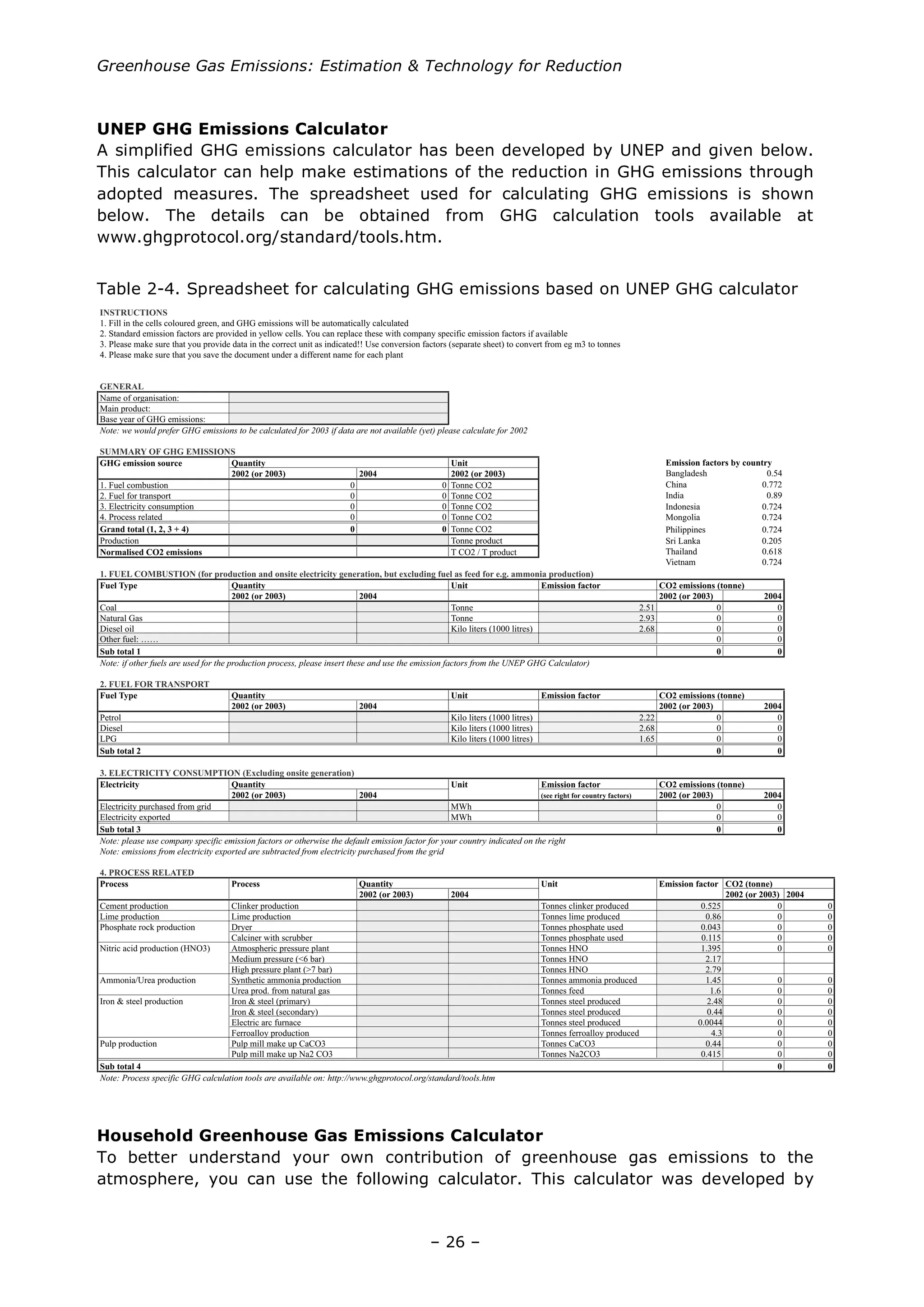
of the maximum amount of carbon present in the fuel. CO2 emission factors for fuel
combustion are therefore relatively insensitive to the combustion process itself;
rather, they are primarily dependent on the carbon content of the fuel only. The
carbon content of various fuels is presented in Annex 5, Table A5-4, and Annex 10.
The carbon content may vary considerably both among and within primary fuel types
on a per mass or per volume basis, as follows:
• The carbon content for natural gas depends on the composition of the gas which,
in its delivered state, is primarily methane, but can include small quantities of
ethane, propane, butane, and heavier hydrocarbons. Natural gas flared at the
production site will usually contain far larger amounts of non-methane
hydrocarbons. The carbon content will be correspondingly different.
• Light refined petroleum products such as gasoline usually have less carbon
content per unit of energy than heavier products such as residual fuel oil.
• The carbon emissions per ton vary considerably for coal deposits, depending on
the composition of carbon, hydrogen, sulfur, ash, oxygen, and nitrogen.
Such variability can be reduced by converting to energy units.
Generally, a small portion of the carbon from fuel escapes oxidation during the
combustion process. This fraction is usually small (up to 1% of carbon). The default
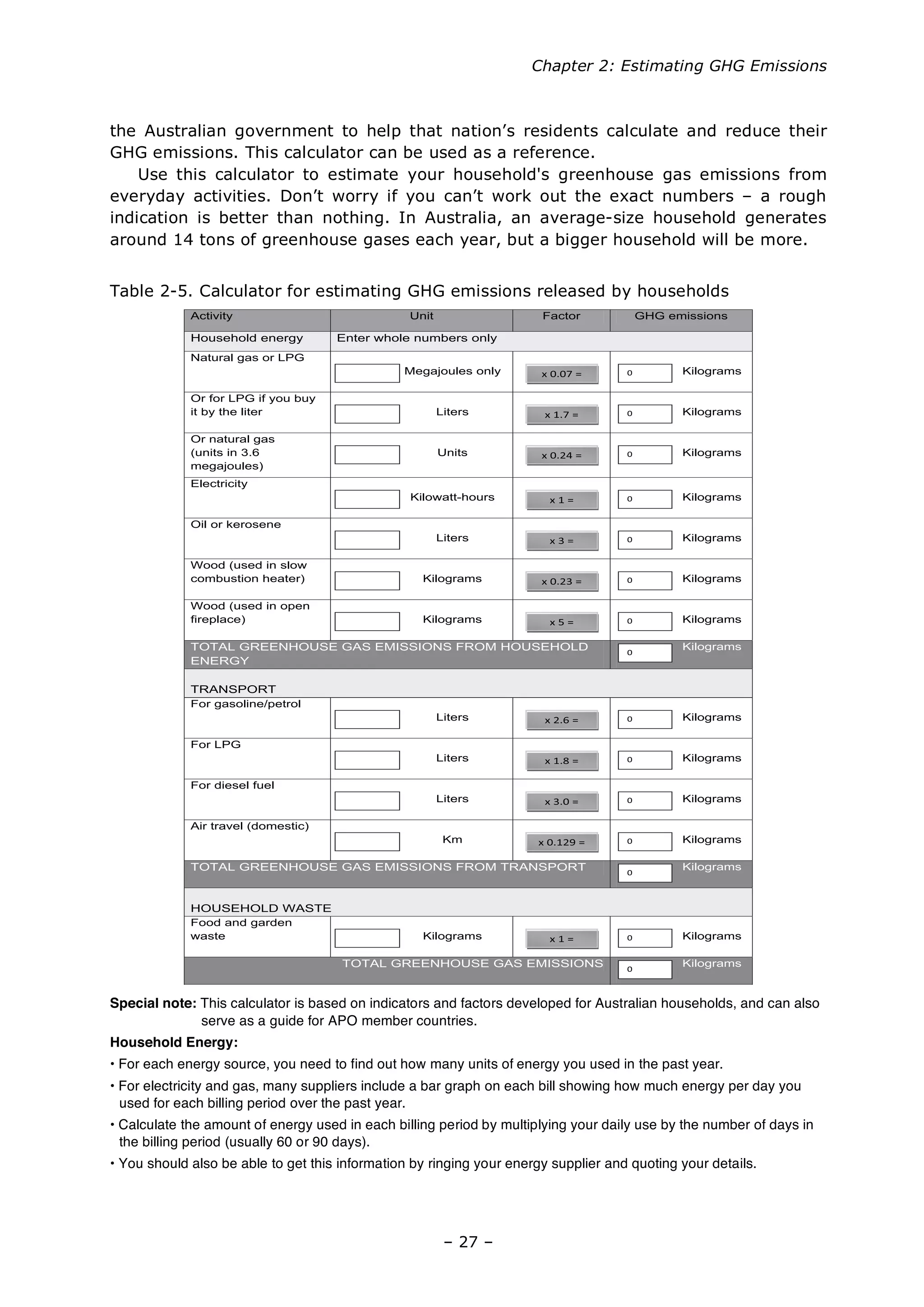
emission factors presented in Annex 11 are derived assuming the fraction of carbon
oxidized is “1” in deriving the default CO2 emission factors.
The carbon content of fuels from which emission factors on a full molecular weight
basis can be calculated (Annex 11) is presented in Annex 10. These emission factors
are default values that may be used only if country-specific factors are not available.
More detailed and up-to-date emission factors may be available at the IPCC EFDB
(Emission Factor Database).
Other Greenhouse Gases
Emission factors for non-CO2 gases from fuel combustion are strongly dependent on
the technology used. Since the set of technologies applied in each sector varies
considerably, so do the emission factors. Therefore it is not particularly useful to
provide default emission factors for these gases on the basis of fuels only. Tier 1
default emission factors are therefore provided in the subsequent chapters for each
sub-sector separately.
Table 2-7 shows the emission factors for various sectors and sub-sectors as
developed by the Australian Greenhouse Office to be used in GHG Energy Calculator.
In view of similar regional conditions in most APO member countries, these factors
may be considered for GHG emissions calculations.
Chapter 2: Estimating GHG Emissions
– 31 –
Table 2-7. Emission factors for GHG calculation developed by the Australian
Greenhouse Office
No. Sector Emission factor
1 Automobiles manufactured and
serviced in Australia
0.158 g CO2e/MJ
2 Food 0.095 kg CO2e/ MJ
3 Residential buildings /MJ
4 Transport
a Long-haul aircraft 0.245 + 0.01+ 0.0 = 0.264 kg/ passenger km, economy
b Short-haul aircraft 0.38 + 0.01 + 0.01 = 0.407 kg/ passenger km, economy
c Long-haul aircraft 1.28 + 0.03 + 0.04 = 1.35 MJ/ passenger km, economy
d Short-haul aircraft 2.0 + 0.03 + 0.07 = 2.1 MJ/ passenger km, economy
5 Marine
a 0.39 kg CO2e/ passenger km
b
Ocean liner transport, economy class
4.99 MJ/passenger km
6 Surface
a Manufacture and servicing of motor
vehicle
1.2 tons CO2e / ton vehicle weight / year
b Bicycle 0.02 kg per passenger km
c Bus 0.06 kgCO2e/ passenger km
d Diesel train 0.03 kgCO2e/ passenger km
e Electric train 0.03 kgCO2e/ passenger km
f Taxi (carrying two passengers) 0.26 kgCO2e/ passenger km
7 Wood heater 0.034 kgCO2e/MJ
8 Food / groceries 0.095 g CO2e /MJ
9 Municipal solid waste 2.7 kg CO2e/ kg MSW
10 Renewable energy 0.03 kgCO2e/MJ
NOTES: • For business class, economy passenger emissions are multiplied by 2.
• For premium economy, economy passenger emissions are multiplied by 1.2.
• For first class, economy passenger emissions are multiplied by 3.
• Emissions from wood heating used in GHG-Energy Calc were derived from Houck, et al.
= 0.55 kg CO2e/ kg fuel = 0.034 kgCO2e/MJ
Source: Global Warming Cool It: A Home Guide to Reducing Energy Costs and Greenhouse Gases. Australian
Greenhouse Office, Department of Environment and Water Resources, 2007 (www.carbonneutral.com.au).
Emissions per passenger km for premium economy, business, and first class seats
were estimated proportionally to typical seat area (www.seatguru.com).
Embodied emissions (EE) of an aircraft are less than one-tenth the EE per
passenger km of a driver-only car, due mainly to the huge distances – over 30 million
km – flown by jet aircraft in their lifetime. This is about 120 times the 250,000 km
traveled by a typical car in its lifetime.
Depending on the situation and conditions, the APO member countries may select
any of the emission factors presented in this manual.
Emission Factor Estimation from Municipal Solid Waste (MSW)
Domestic solid waste comprises a variety of wastes that have greenhouse gas
emission potential such as paper and its byproducts, food products, and garden
wastes. Such wastes generate methane upon degradation which has higher GWP
(global warming potential) compared to CO2. However, in terms of reporting, it is
calculated in relation to carbon dioxide equivalent. The U.S. Environmental Protection
Greenhouse Gas Emissions: Estimation & Technology for Reduction
– 32 –
Agency has estimated CO2e of various domestic waste products, presented below, that
can be used for calculation of GHG emissions.
Table 2-8. Methane yield from selected landfill solid waste components
Material
Selected methane yield – tons of carbon
equivalent (CO2e) / wet ton
Newspaper 0.285
Office paper 1.328
Corrugated cardboard 0.591
Coated paper 0.323
Food scraps 0.369
Grass 0.235
Leaves 0.183
Branches 0.187
Methane emissions from landfill = 0.24 kg CO2e/kg MSW
Source: U.S. Environmental Protection Agency, 1998.
• Total embodied emissions factor for MSW was estimated by adding embodied energy
emissions and methane emissions = 2.45 + 0.24 = 2.7
• Estimated embodied emissions of MSW = 2.7 kg CO2e/kg
UNCERTAINTIES OVER INVENTORY ESTIMATES
A general treatment of uncertainties in emission inventories is provided in Chapter 3 of
Volume 1 of the 2006 IPCC Guidelines. A quantitative analysis of the uncertainties in
the inventory requires quantitative input values for both activity data and emission
factors. The following table presents uncertainties for activity data and emission
factors that will be useful in GHG emission estimation.
Chapter 2: Estimating GHG Emissions
– 33 –
Table 2-9. Uncertainties due to emission factors and activity data
100%Biomass BurningN2O
2 orders of magnitude
CH4 Animals 25% 10% 25%
CH4 Animal Waste 20% 10% 20%
N2O
Agricultural SoilsN2O
50%35%35%Industrial
Processes
11/3
2/3WasteCH4
11/4
3/4Rice CultivationCH4
60%20%55%Coal Mining and
Handling Activities
CH4
60%20%55%Oil and Natural
Gas Activities
CH4
100%50%50%Biomass BurningCH4
60%50%33%Land Use Change
and Forestry
CO2
10%7%7%Industrial
Processes
CO2
10%7%7%EnergyCO2
UT
Overall uncertainty
UA
Activity data
UE
Emission factorSource categoryGas
542 31
Note: Individual uncertainties that appear to be greater than ±60% are not shown. Instead, judgment as to the
relative importance of emission factor and activity data uncertainties are shown as fractions which sum to
one.
Source: IPCC Guidelines on National Inventory, 2006. Task Force on National Greenhouse Gas Inventories, IPCC.
– 34 –
CHAPTER 3:
GHG EMISSION REDUCTION TECHNOLOGIES
INTRODUCTION
As we have seen, GHG emissions are mainly the result of the use of fossil fuels to
generate energy. The main greenhouse gas is carbon dioxide emitted when fossil fuels
are burned. It is directly proportional to both energy consumption and economic
development. Alarmingly, GHG emissions globally have reached such a critical
situation that warrants immediate attention by everyone to adopt mitigation measures
to contain the ever-increasing carbon dioxide levels in the atmosphere. The major
sectors that contribute to GHG emissions are industry, transportation, and residential,
institutional, and commercial buildings.
Most countries have made efforts to improve the energy efficiency of their systems
and reduce energy consumption. However, in the absence of widespread, determined,
and effective steps to curtail demand growth – by dramatic efficiency improvements
and technological developments – primary energy demand is likely to expand two to
two-and-a-half fold by 2050 (World Energy Council).
GHG REDUCTION TECHNOLOGIES
The technologies to reduce GHG emissions revolve around reducing or eliminating
carbon dioxide emissions and these may be achieved through the following techniques
and technologies:
• Use of renewable energies such as solar, wind, biomass, etc.
• Small, mini- and micro-hydro power plants
• Waste-to-energy (WTE)
• Alternative fuels technology
• Fuel substitution
• Fuel cells (transportation and stationary)
• Methane capture from landfill sites
• Green productivity tools and techniques
Above all, however, is the energy efficiency that plays such an important role
cutting across all existing technologies. Selection of technological options is highly
important for mitigating GHG emissions. Before selecting any mitigation technology
one has to carry out a detailed needs assessment, with the selection based on the
following factors:
• GHG reduction potential
• Assessment of investments required
• Specific cost of GHG reduction, $/t CO2
• Correspondence to national and sectoral development goals
Chapter 3: GHG Emission Reduction Technologies
– 35 –
How Energy Efficiency Can Lead to CO2 Reduction
Energy efficiency is the most important factor in mitigating GHG emissions. About
35% in GHG emissions reduction in the energy sector can be brought about by energy
efficiency alone and the balance can be achieved by a number of emerging
technologies, as listed below.
• Energy efficiency
• Scrubbing CO2 at power stations
• Afforestation
• Utilization of waste
• New transport fuels
• Renewable energy
• Nuclear power
• Fuel substitution, coal-to-gas combined cycle
9th
8%
8th
10%
7th
7%
6th
7%
5th
7%
4th
6% 3rd
6%
2nd
14%
1st
35%
Source: Climate Change. Ed. Brooks, Cole Publishing, 2001.
Figure 3-1. GHG reduction potential of various technologies
Barrier Analysis
One of the important aspects one should look
into is the barriers faced in adopting and/or
implementing any technologies. Barrier
analysis is highly important particularly in
developing economies. Depending upon local
conditions, these barriers will vary from
country to country; however, generalized
obstacles have been listed below to provide a
guide to analyzing barriers in specific
situations.
Barriers to Energy Efficiency:
• The availability of efficient
appliances and production
devices;
• The availability of good
information for consumers
about such equipment and
devices; and,
• The availability of technical,
commercial, and financial
services when necessary.
Greenhouse Gas Emissions: Estimation & Technology for Reduction
– 36 –
• Legal
• Organizational, institutional
• Technological
• Financial
• Informational
• Personal/human – attitudinal
After conducting barrier analysis, one should identify enabling measures to
overcome these barriers for successful implementation of mitigation programs.
Energy Efficiency
Energy efficiency is an important tool to
overcome climate change problems.
The Kyoto Protocol objectives, and more
recently concerns about energy security,
have enhanced the importance of
energy efficiency policies. The emissions
of carbon dioxide are directly linked with
the energy efficiency of the system. As
per the World Energy Council
(http://www.worldenergy.org/wec-
geis), energy efficiency (EE)
encompasses all changes that result in a
reduction in the energy used for a given
energy service such as lighting, heating,
etc., or in the level of activity. This
reduction in energy consumption is not
necessarily associated with technical
changes, since it can also result from
better organization and management as
well as improved economic efficiency in
the sector.
According to economists, energy
efficiency is defined as encompassing all
changes that result in decreased
amounts of energy used to produce one
unit of economic activity (e.g., the
energy used per unit of GDP or value
added). Energy efficiency is associated
with economic efficiency and includes
technological, behavioral, and economic
changes (World Energy Council, 2008).
In developing economies as well as
developed nations, energy efficiency is
also an important issue, however,
normally with different driving forces
depending upon socio-economic and
political considerations. In developing
Some Facts:
• About 20% of end-use efficiency
improvements are offset by higher
conversion losses.
• The electricity produced is converted
to energy units (toe) on the basis of
their average efficiency, which varies
from 33% for nuclear power plants to
100% for hydro plants, and to 30% to
40% for thermal power plants.
• Energy efficiency of thermal power
generation has improved by only 2%
since 1990 at the world level from
32% in 1990 to 34% in 2005.
• At the world level, households and
industry account for two-thirds of the
reduction of the energy intensity (35
and 30%, respectively).
• Changes in economic structure also
influence final energy intensities:
services require six times less energy
inputs per unit of value added than
industry.
• Estimated mitigation potential during
Kyoto Period
− Renewable energy
technologies (23 MT)
− Energy efficiency (77 MT)
− Electricity T&D (18 MT)
− Methane mitigation
technologies (20 MT)
Chapter 3: GHG Emission Reduction Technologies
– 37 –
countries, the need to reduce GHG emissions and local pollution has relatively less
priority. However, other related issues such as reducing the financial burden of oil
imports, reducing investment on energy infrastructure, and making the best use of
existing supply capacities in order to improve access to energy are among the more
important driving forces. Further, the problem has been accentuated following the
steep increase in oil prices since 2003, which has increased the cost of oil imports
drastically, with severe consequences for economic growth especially in the poorest
countries. In this regard, any efficiency improvement in oil-consuming sectors will not
only result in direct economic benefits to oil importing countries but also will serve
more consumers.
Improvement in EE in energy-intensive sectors, by reducing the amount of energy
input without changing the quality or quantity of end-use services rendered, makes
the path for economic development less expensive and more sustainable. EE
improvements yield direct benefits, such as reduced burdens on investment for energy
infrastructure projects, lowered levels of crude oil imports, greater affordability,
improved access to modern energy sources through more-affordable energy services,
reduced local air pollution, and the global benefits of reduced greenhouse gas
emissions.
Improved EE also yields economic and social benefits, including enhanced energy
security, reduced impact on consumers from energy price increases, and employment
generation through development of domestic EE industries. Although the role of EE in
mitigating climate change is well understood, large gaps remain between industrialized
and developing countries in terms of EE potential and investments. According to the
International Energy Agency (IEA), more than 65% of GHG reductions through 2030
could come from EE measures in developing and transition countries.
Improved EE in buildings, industry, and transport alone could lead to a one-third
reduction in energy use by 2050. Figures 3-1 and 3-2 illustrate that existing and
emerging energy conservation alternatives and improved end-use efficiency are the
most important contributors to reduced GHG emissions. Improving EE – by obtaining
more light, heat, mobility, or other services from less primary energy input – is also
one of the least expensive means of GHG emission reductions. As with other climate
change mitigation projects, if investment on EE is cost-effective, then the GHG
emissions savings will essentially be free.
Coal to gas
Nuclear
End-use
efficiency Fossil fuel generation
efficiency
CCS
Power
generation
Hydropower
Biomass
Biofuels in transport
CCS in fuel
transformation
Other renewables
Fuel mix in buildings
and industry CCS in industry
Source: An Analytical Compendium of Institutional Frame Works for Energy Efficiency Implementation. Energy
Sector Management Assistance Program. Formal Report 331/08. ESMAP, The International Bank for
Reconstruction & Development/The World Bank Group, October 2008.
Figure 3-2. GHG emissions reductions through 2050, by consuming sector
Greenhouse Gas Emissions: Estimation & Technology for Reduction
– 38 –
Table 3-1. Opportunities for EE improvements by consuming sector
Buildings Building design and measures such as better insulation, advanced
windows, EE lighting, space conditioning, water heating, and refrig-
eration technologies
Industrial processes, cogeneration, waste heat recovery, preheating,
efficient drives
District heating systems, combined heat and power, efficient street
lighting, efficient water supply, pumping, and sewage removal sys-
tems
Efficient irrigation pumping and efficient water use, such as drip
irrigation
New thermal power plants: Combined cycle, supercritical boilers,
integrated gasification combined cycle (IGCC), etc.
Existing generation facilities: Refurbishment and repowering,
improved O&M practices, and better resource utilization (higher plant
load factors and availability)
Reduced transmission and distribution losses: High voltage lines,
insulated conductors, capacitors, low-loss transformers, and im-
proved metering systems
Efficient vehicles, urban mass transport systems, modal shifts to
inter- and intra-city rail and water transport, CNG vehicles, traffic
demand management
Lighting, appliance efficiency, improved cook stoves
Industry
Cities and municipalities
Agriculture
Power systems
Transport
Households
EE Improvement OpportunitiesSector
Source: An Analytical Compendium of Institutional Frame Works for Energy Efficiency Implementation. Energy
Sector Management Assistance Program. Formal Report 331/08. ESMAP, The International Bank for
Reconstruction & Development/The World Bank Group, October 2008.
Energy efficiency is, in fact, a
matter of individual behavior and also
reflects the natural behavior of energy
consumers. Avoiding unnecessary
consumption of energy or choosing
the most appropriate equipment to
reduce the cost of the energy helps
not only to decrease individual energy
consumption without decreasing
individual welfare but also gives
economic gains.
Energy efficient technologies
normally represent upgradation in
service through improved
performance. A wide range of energy
efficient technologies have ancillary
benefits from improved quality of life
such as advanced windows that not
only save on heating and cooling
expense, but also make the home or
workplace more comfortable. Similarly, more efficient vehicles not only save on fuel
costs, but also emit less pollutants. Thus, improving the general environment
Benefits of Energy Efficiency:
• Energy saved is energy produced.
• Supply more consumers with the same
electricity production capacity, which is
often the main constraint in many
countries of Southeast Asia.
• Reduced electricity demand, and
reduced investment needed for
expansion of the electricity sector.
• Reduced GHG and other emissions.
• Maintains a sustainable environment.
• Improved energy security.
• Increased profits.
• Reduced energy bills.
• Reduced energy imports.
Chapter 3: GHG Emission Reduction Technologies
– 39 –
improves health directly and saves on health costs both to the individual and to
society indirectly. However, adoption of energy efficient technologies and energy
management practices varies widely with nations as per their respective policies.
Energy efficiency provides a tremendous cost-effective opportunity to reduce the need
for new power generation and GHG emissions. The EE opportunities in energy-
intensive sectors are presented in Table 3-1.
The following figure shows the relationship between the U.S. economy and lifestyle
with respect to energy use. If we look into this critically, about 43% of expended
energy is wasted unnecessarily while only 9% is useful energy.
Energy Inputs System Outputs
Nonrenewable fossil fuels
Hydropower, geothermal,
wind, solar
Biomass
© 2001 Brooks / Cole Publishing / ITP
Useful energy
PetrochemicalsNonrenewablenuclear
Unavoidable energy
waste
Unnecessary energy
waste
U.S.
economy
and
lifestyles
84%
7%
5%
4%
41%
43%
9%
7%
Source: Climate Change. Ed. Brooks, Cole Publishing, 2001.
Figure 3-3. Showing relationship between economy & lifestyle for energy use
GHG REDUCTION TECHNOLOGIES FOR INDUSTRIES
Among the industrial sectors, energy-intensive sectors such as iron and steel, pulp and
paper, oil and gas extraction, and thermal power plants are the main GHG
contributors. Large industries, however, can improve energy efficiency in their
production processes and thus reduce overall energy demand. The bulk of GHG
reduction technology expenditures are made in these energy-intensive sectors.
In addition to energy-related GHG emissions, the industrial sector also emits GHGs
from various processes. These include:
• CO2 from the calcination process in lime and cement production; steel (production
of coke and pig iron); production of aluminum and ammonia
• Refrigerants, aerosols, CFCs, HCFCs, HFCs, etc.
Greenhouse Gas Emissions: Estimation & Technology for Reduction
– 40 –
• Methane from miscellaneous industrial processes such as oil refining, coal mining,
etc.
• N2O from nitric acid and nylon production, perfluorocarbons such as carbon
tetrafluoride, and hexafluroethylene from aluminum production through
electrolysis
The total energy share of the
industrial sector for OECD Annex I
countries in 1988 was typically 25–30%
of total energy used; however, the
amount for non-Annex I countries
averaged 35–45%, and was as high as
60% in China. It is evident that different
countries have followed different fossil
fuel trajectories to arrive at their present
economic status. This variation in
industry energy share among different
countries not only indicates differences in
energy intensity but also the more rapid
industrial growth of non-Annex I
countries (IPCC Technical Paper 1, 1996).
During the early 1990s, carbon
emissions from industrial sectors in the
European Union and U.S. remained below
their peak levels of 10–15 years earlier,
while Japan’s emissions remained relatively constant. However, the CO2 emissions
from the industrial sectors of non-Annex I countries continue to grow with rapid
industrialization.
The past two decades have seen huge improvement in the efficiency of industrial
processes due to introduction of cleaner technologies. However, energy efficiency
remains the major area for reducing CO2 emissions.
There is a direct correlation between energy use and levels of GHG emissions, so
activities related to GHG emission reduction are closely tied to energy conservation
and energy efficiency strategies.
Industries invest in various GHG reduction technologies including applications on
solar energy, cogeneration, alternative fuels, and waste-to-energy. Currently, the
major expenditure on GHG reduction is related to operating, repairing, and
maintaining cogeneration facilities, waste-to-energy, and fuel substitution
technologies. The investment on GHG reduction technologies may not have substantial
impact on the reduction of energy consumption in the short term but instead may be
spread over several years.
Case Studies on Energy Efficiency in SMEs
In the face of increasing fuel prices and limited resources, the industrial sector,
particularly small and medium industries in countries with transition economies, has
undertaken a number of initiatives to improve the energy efficiency of industrial
processes. Some examples of energy efficiency approaches adopted by Indian
industries are highlighted below. In view of the similar conditions in most APO member
countries, the examples presented here may be considered to be widely applicable.
International Barriers in GHG
Reduction Technologies:
• Disagreements over intellectual
property rights
• Lack of available finances
• Lack of capacity and basic
environmental legislations and
institutional factors in host
countries
• Legal and treaty impediments to
implement cooperative actions
among firms to reduce GHGs
• Within WTO, there is concern
about environmental protection as
a potential restraint on free trade
Chapter 3: GHG Emission Reduction Technologies
– 41 –
Iron and Steel Sector – Small Steel Re-rolling Mill (NPC, India 2005)
Baseline data
• Re-rolling mill furnace capacity 10 tons/hr
• Mill operation per day 10 hrs
• Operating days per year 250
• Production during 2004 14,721 tons
• Specific oil consumption
• (Heat-up time + production) 115 liters/ton
• Cost of oil 60 USD/kL
• Specific power consumption 111.65 kWh/ton
• Cost of power 0.13 USD/kWh
• Total cost of energy
− Oil 101,575 USD
− Electricity 213,668 USD
-----------------------------------------------------------------
Total 315,243 USD
-----------------------------------------------------------------
Energy efficiency measures
In order to reduce energy cost, the combustion efficiency of the furnace was improved
by providing the appropriate quantity of oxygen along with the adoption of a heat
recovery system from the flue gas. These measures resulted not only in economic
gains but also a reduction in GHG emissions, as given below.
I. Oil savings
• Specific oil consumption before implementation 115 liters/ton
• Specific oil consumption after implementation 77.8 liters/ton
• Reduction in oil consumption 37.2 liters/ton
(32.3% down)
• Annual reduction in oil consumption 37.2 x 14,721
= 547.6 kL
• Annual monetary savings 547.6 x 60 USD
= 19,714 USD
• Annual reduction in GHG emissions 16,42.8 tons
II. Power savings
• Specific power consumption
before implementation 111.65 kWh/ton
• Specific power consumption
after implementation 76.17 kWh/ton
• Reduction in power consumption 111.65 – 76.17
= 35.48 kWh/ton
• Annual power savings 35.48 x 14721
= 0.522 million kWh
• Annual monetary savings 67,860 USD
Greenhouse Gas Emissions: Estimation & Technology for Reduction
– 42 –
III. Annual savings due to increased yield
• Average yield before 91.986%
• Average yield after 95.039%
• Increase in yield percentage 3.053%
• Average production during 2004 14,721 tons
• Extra production from improved yield 449.4 tons
• Cost of finished product 600 USD/ton
• Monetary benefit 449.4 x 600
269,640 USD
Total annual monetary gain after implementing GP-EE measures:
19,714 + 67,860 + 269,640 = 355,214 USD
Case Studies on GHG Reduction Through Energy Efficiency in
Indian Industries (Table 3-2)
Indian industries have taken a number of initiatives to improve their energy efficiency
not only on their own but also through regulatory approaches. The Bureau of Energy
Efficiency, under the Indian Ministry of Power, has taken several initiatives to help
SMEs by providing technical assistance.
Chapter 3: GHG Emission Reduction Technologies
– 43 –
Table 3-2. Case studies of GHG reduction through energy efficiency in
Indian industries
No.
Industry/
Sector
Implemented
Measures adopted
1
st
year energy
savings (USD)
1
st
yearelectricity
/fuelsavings
1
st
yearCO2
mitigated(tons)
Assumed
sustainability(years)
Expected
CO2
emissions
mitigated
across entire
life cycle
(tons)
1 Hindalco Ind.
Ltd., Renukoot,
UP (Aluminum)
2003–4 • Use of slotted
anode in pot
smelter
• Optimization of
anode dimensions
and metal pad
4,161,325
2,670,000
146,725
MWh
77,265
MWh
146,725
77,265
10
10
1,467,250
772,650
2 Tata Motors,
Jamshedpur
(Automobile)
2004 Intermediate
controllers for
compressed air
system
27,720 1005
MWh
1005 10 10,050
3 Technical
Stampings
Automotive
Ltd., TN
(Automobile)
2004–5 Installation of energy
savor coil (energy
efficient transformer)
14,730 128
MWh
128 10 1280
4 Birla Super
Cement,
Sholapur,
Maharashtra
(Cement)
2003–4 • Reduction of
power by process
modification
• Process modifica-
tion in ball mill
58,925
60,450
673
MWh
722
MWh
673
722
10
10
6,730
7,230
5 Shree Cement
Ltd., Beawar,
Rajasthan
(Cement)
2005 Closed circuiting of
cement mill
207,500 10,661
MWh
10,661 10 106,610
6 Dalmia
Cement,
Dalmiapuram,
TN (Cement)
2005 Dry fly ash storage
and handling system
410,000 100
MWh
5,780 10 57,800
7 Tuticorin Alkali
Chemicals and
Fertilizers Ltd.,
TN (Chemical)
2005 Installation of gasifier 187,500 604
MWh
9,681 10 96,810
8 Gharda
Chemicals Ltd.
(Chemical)
2003–4 Installation of high
efficiency impellers in
batch reactors
125,000 1,200
MWh
1,200 10 12,100
9 Polyplex Corp.
Ltd.,
Uttaranchal
(Chemical)
2005 Replacing steam jet
ejectors with vacuum
pumps
297,500 660 kL
oil
1,986 10 19,860
10 Rashtriya
Chemicals and
Fertilizers Ltd.,
Trombey,
Maharashtra
(Chemical)
2005 Flare gas utilization 10,750 1,479,09
0 cu.m
gas
4,120 10 41,200
Greenhouse Gas Emissions: Estimation & Technology for Reduction
– 44 –
Table 3-2. Case studies of GHG reduction through energy efficiency in
Indian industries (continued)
No.
Industry/
Sector
Implemented
Measures adopted
1
st
year energy
savings (USD)
1
st
yearelectricity
/fuelsavings
1
st
yearCO2
mitigated(tons)
Assumed
sustainability(years)
Expected
CO2
emissions
mitigated
across entire
life cycle
(tons)
11 Siel Chemical
Complex,
Rajpura,
Punjab
(Chemical)
2005–6 Membrane cells
refurbishment to
reduce voltage drop
and power
consumption
829,775 7,951
MWh
7,951 10 79,510
12 Mahanand
Dairy,
Maharashtra
(Dairy)
1990 Use of solar water
heater for boiler feed
water pre-heating,
etc.
6,400 70 kL oil 211 10 2,110
13 Hindustan
Lates Ltd.,
Karnataka
(Pharmaceuti-
cal)
2005 Replacement of
steam traps and heat
recovery from steam
condensate
82,450 11,162
kL oil
33,665 10 330,650
14 IPCA
Laboratories,
Ratlam, MP
2006 Installation of energy
savers
61,875 1,734
MWh
1,734 10 17,734
15 National
Fertilizers Ltd.,
Vijaipur
(Chemical)
2003–4 Heat recovery from
pre-concentrator by
installing DM water
pre-heater in
ammonia plant
1,705,000 6,060 kL
naptha
13,298 10 132,980
16 Brakes India
Ltd., Vellore,
Tamilnadu
(Foundry)
2005 Redesigning of
furnace coil
144,000 1440
MWh
1440 10 14,400
17 Rashtriya Ispat
Nigam Ltd.,
Vizag Steel
(Iron & Steel)
2006–7 Optimization of
combustion
parameters in coke
oven batteries
960,000 951
million
cu.m gas
122,854 10 1,225,840
18 Tata Steel Ltd.,
Jamshedupur,
Jharkhand
(Iron & Steel)
2006–7 Substitution of coal
with by product gas in
boilers of power
house
1,625,000 201,464
tons coal
286,079 10 2,860,790
19 Nagaon Paper
Mill, Assam
(Pulp & Paper)
2004 Improvement of
power factor by
installation of
capacitor bank and
filter in HT and LT
lines
231,325 8,750
tons coal
12,425 10 124,250
20 Sirpur Paper
Mills, Andhra
Pradesh
(Pulp & Paper)
2003–4 Replacing the boiler
feed pump motor
26,031 833
MWh
833 10 8,330
Chapter 3: GHG Emission Reduction Technologies
– 45 –
Table 3-2. Case studies of GHG reduction through energy efficiency in
Indian industries (continued)
No.
Industry/
Sector
Implemented
Measures adopted
1
st
year energy
savings (USD)
1
st
yearelectricity
/fuelsavings
1
st
yearCO2
mitigated(tons)
Assumed
sustainability(years)
Expected
CO2
emissions
mitigated
across entire
life cycle
(tons)
21 Ballarpur
Industries Ltd,
Chandarpur,
Maharashtra
(Pulp & Paper)
2003–4 Use of activizer “G”
with coal in coal fired
boiler
267,500 7,259
tons coal
10,307 10 103,070
22 Neyveli Lignite
Corporation
Ltd., Tamilnadu
(Thermal
Power)
2004–5,
2005–6
• Replacement of
old efficiency
water circulating
pumps
• Replacement of
wooden fills with
un-bounded PVC
fills in cooling
tower
• Replacement of
dyno-drives with
variable frequency
drives
159,500
512,900
118,925
3,504
MWh
25,472
tons coal
416
MWh
3,504
36,170
10
10
35,040
361,700
23 Manglore
Refinery and
Petrochemicals
Ltd., Karnataka
(Refinery)
2006–7 Utilization of waste
heat for pre-heating
crude
2,047,500 5,623
liters oil
16,960 10 169,600
24 Century Rayon,
Maharashtra
(Textiles)
2005–6 Energy conservation
in compressed air
systems
93,750 960 tons
coal
1,363 10 13,630
25 Indian Rayon,
Veraval
(Textiles)
2004–5 Control of water
supply by installation
of variable frequency
drive on cooling water
pumps
25,700 187
MWh
187 10 1,870
26 Apollo Tyres
Ltd., Pirambra,
Kerala (Tires)
2004 Plant lighting 147,500 1,700
MWh
1,700 3 5100
27 J.K. Tyre and
Industry Ltd.,
Rajasthan
(Tires)
2006–7 Optimization of
energy on cooling
towers
162,910 1,512
MWh
1,512 10 15,120
28 Rama
Phosphate
Ltd., Indore,
M.P. (Edible
Oil)
2000–2 Waste heat recovery
in boiler and
installation of FBC
boiler
337,500 1,350
tons coal
2,025 10 20,250
Source: Greenhouse Gas Mitigation through Energy Efficiency by Indian Industry 2007 – Compendium Vol. 1;
Bureau of Energy Efficiency and Indo-German Energy Program.
Greenhouse Gas Emissions: Estimation & Technology for Reduction
– 46 –
Tips for Energy Efficiency in Industries
Based on a study carried out by the National Cleaner Production Center (NCPC) of
India during 2002–4 under the GERIAP* project in various industrial sectors of
Southeast Asian countries, some important tips were suggested to improve the energy
efficiency of various equipment and activities. These EE measures have had great
impact on the emission of GHGs.
*Greenhouse Gas Emission Reduction from Industry in Asia and the Pacific
The project was funded by the Swedish International Development Cooperation
Agency and coordinated by United Nations Environment Program and implemented
together with national focal points in nine countries: Bangladesh, China, India,
Indonesia, Mongolia, the Philippines, Sri Lanka, Thailand, and Vietnam.
Key suggestions included:
• Use variable-speed drives on large boiler combustion air fans with variable flows
• Use boiler blow down to help warm back-up boilers
• Maintain lowest acceptable process steam pressures
• Use waste steam for water heating
• Monitor O2/CO2/CO and control excess air to the optimum level in furnaces
• Retrofit furnaces with heat recovery device
• Recover heat from incinerator off-gas
• Use waste heat for fuel oil heating, boiler feedwater heating, outside air heating,
etc.
• Use chiller waste heat to preheat hot water
• For compressed air, replace standard v-belts with high-efficiency flat belts as the
old v-belts wear out
• Use water-cooled rather than air-cooled chiller condensers
• Shut down spare, idling, or unneeded equipment
• Make sure that all utilities to redundant areas are turned off, including utilities
such as compressed air and cooling water
EE “DOs and DON’Ts”
For efficient energy utilization, the following is recommended:
DOs
• Clean burners, nozzles, strainers, etc.
• Inspect oil heaters for proper oil temperature
• Inspect for buildup of soot, fly ash, and slag on the fire side of boiler
• Maintain lowest acceptable process steam pressure
• Preheat boiler feed-water
• Insulate all flanges, valves, and couplings
• Check alignment of motors
• Correct power factor to at least 0.90 under rated load conditions in electric
utilities
• Check belt tension regularly and use flat belts as an alternative to v-belts in
drives
Chapter 3: GHG Emission Reduction Technologies
– 47 –
• Change oil filters regularly in compressors
• Use evaporative cooling in dry climates for heating/ventilation/air conditioning
(HVAC)
• Seal leaky HVAC ducts and around coils
• Use water-cooled condensers rather air-cooled condensers in refrigeration
systems
• Conduct regular energy audits
• Change exit signs from incandescent to LED illumination
• Turn off all utilities when not needed
• Replace old spray-type nozzles with new square spray ABS virtually non-clogging
nozzles
DON’Ts
• Don’t waste hot water by disposing in drain
• Don’t continue using wet insulation, better to replace it
• Don’t run fans when not needed
• Don’t overcharge oil in chillers
• Avoid over-sizing refrigeration systems – match the connected load
• Don’t assume that the old way is still the best – particularly for energy-intensive
low temperature systems for refrigeration
Some EE Facts
Boilers
• A 5% reduction in excess air increases boiler efficiency by 1%, and a 1%
reduction of residual oxygen in stack gas increases boiler efficiency by 1% (Limit
excess air to less than 10% with clean fuels.)
• A 1 mm-thick scale (deposit) on the water side of a boiler can increase fuel
consumption by 5 to 8%.
• A 3 mm-thick soot deposition on the heat transfer surface of a boiler can cause
an increase in fuel consumption by 2.5%.
Steam systems
• A 3 mm-dia. hole in a pipeline carrying 7 kg/cm2
steam wastes 33 kiloliters of fuel
oil in one year.
• A 6º C rise in feed water temperature through economizer/condensate recovery
in a boiler realizes a 1% savings in fuel consumption.
• A 0.25 mm-thick air film offers the same resistance to heat transfer as a 330
mm-thick copper wall.
Insulation
• A bare steam pipe 150 mm in diameter and 100 m in length, carrying saturated
steam at 8 kg/cm2
, would waste 25,000 liters of furnace oil in a single year.
• A 70% reduction in heat loss can be achieved by floating a layer of 45 mm-
diameter polypropylene (plastic) balls on the surface of 90ºC hot
liquid/condensate.
Greenhouse Gas Emissions: Estimation & Technology for Reduction
– 48 –
Motors
• High efficiency motors offer 4–5% higher efficiency compared to standard motors.
• For every 10º C increase in motor operating temperature over the recommended
peak, the life of the motor is estimated to cut in half.
• A voltage imbalance can reduce motor input power by 3–5%.
• If rewinding is not properly done, motor efficiency can be reduced by 5–8%.
Compressed air
• Reduction of 1 kg/cm2
air pressure (8 kg/cm2
to 7 kg/cm2
) would result in 9%
input power savings. This also reduces compressed air leakage rates by 10%.
• A compressed air leak from 1 mm-size hole at 7 kg/cm2
pressure causes a power
loss equivalent to 0.5 kW.
• Each 5°C reduction in intake air temperature results in a 1% reduction in
compressor power consumption.
Chillers
• Reducing condensing temperature by 5.5°C results in a 20–25% decrease in
compressor power consumption.
• A 1°C increase in evaporator temperature reduces compressor power
consumption by 20–25%.
Source: Energy Efficiency Guide for Industries in Asia. UNEP, 2002.
RESIDENTIAL, INSTITUTIONAL, AND COMMERCIAL BUILDINGS
(INFRASTRUCTURE SECTOR)
Climate change is caused by an increase in
greenhouse gases in the Earth’s atmosphere.
These gases absorb heat leaving the earth and
return some of it, making the earth warmer
overall. Before the industrial revolution, carbon
dioxide levels in the atmosphere were consistently
between 260 and 280 parts per million (ppm). In
recent times human activities have increased the
concentration to 380 ppm — that’s an increase of
more than a third! The following activities from
residential buildings generate greenhouse gases:
• burning fossil fuels – coal, oil, or gas
• using electricity generated by burning fossil
fuels
Some Important Tips:
• Add insulation, especially to
the roof.
• Change your window glass to
double glazing and add
outside shades to use in
summer.
• Buy an electric bike and use
carpool for long trips.
• Consolidate your trips.
• Buy energy-efficient
appliances with “Energy
Labels.”
Some Facts:
• One liter of petrol, diesel and
gas emits 0.00222, 0.00268
and 0.00165 kg CO2
• An 18-Watt CFL emits
20 gm/hr CO2 as compared
to 110 gm/hr from a 100-
Watt incandescent lamp.
Chapter 3: GHG Emission Reduction Technologies
– 49 –
• several aspects of farming: raising cattle and sheep, using fertilizers, and some
crops
• clearing land
• breakdown of food and plant wastes and sewage
The following figure illustrates a generalized percentage contribution of GHG
emissions from various sources originating from typical households. It can be
observed that maximum GHG emission is contributed by travel activities followed by
water heating and electronic and other appliances used inside the home. In view of
this, more emphasis should be given to reduce GHG emissions from these major
sources.
15%
Electronics and
other appliances
9%
Refrigerator/
freezer
11%
Home heating
& cooking
15%
Water heating
5%
Wastes
5%
Lights
3%
Cooking
2%
Clothes washing & drying
and dishwashing
11%
Travel to work
23%
Travel for shopping, personal business,
recreation (67.8% private cars used)
GHG Emissions
Source: Global Warming Cool It: A Home Guide to Reducing Energy Costs and Greenhouse Gases. Australian
Greenhouse Office, Department of Environment and Water Resources, 2007.
Figure 3-4. Showing energy consumption in various areas of a household
Although the climate changes naturally on its own, humans contribute heavily to
pollution of the environment. More and more people are wondering how they can do
their part to help reduce greenhouse gases emissions into the atmosphere. While
change won’t happen overnight, here are actions you can take against global warming.
In order to reduce energy consumption and improve the energy efficiency of
residential, commercial, and institutional buildings, the Bureau of Energy Efficiency,
Ministry of Power, India, has issued guidelines specifying a “U-factor” for roof
assembly and an “R-factor” for wall insulation. Examples of these factors are given in
the following tables. Calculations using the U- and R-factors are presented in
Annex 12.
Greenhouse Gas Emissions: Estimation & Technology for Reduction
– 50 –
Table 3-3. Roof assembly U-factor and wall insulation R-factor requirements
24-hour-use buildings Daytime-use buildings
Climate zone Hospitals, hotels, call centers, etc. Other building types
Maximum U-factor
of the overall
assembly
Minimum R-value of
insulation alone
Maximum U-factor of the
overall assembly
Minimum R-value
of insulation alone
(W/m
2
(m
2
(W/m
2
(m
2
U-0.261 R-3.5 U-0.409 R-2.1Composite
U-0.261 R-3.5 U-0.409 R-2.1Hot and dry
R-3.5 U-0.409 R-2.1U-0.261Warm and humid
U-0.409
U-0.261
R-2.1
R-3.5
U-0.409
U-0.409
R-2.1Moderate
R-2.1Cold
Source: Energy Conservation Building Code (ECBC) 2006. Bureau of Energy Efficiency, Ministry of Power, India.
Water Heating
Water heating for domestic use produces about 16% of all household-generated GHG
emissions. The various sources of hot water requirements are shown in the following
Figure 3-5. As can be seen, about 30% of related GHG emissions are caused by heat
loss from water heater tanks and pipes, which is the second-highest consumer of
energy in the home after bathing (45%).
Figure 3-5. Greenhouse gas emissions from electric hot water system
(140 liters usage daily)
Some Important GHG Mitigation Tips for Your Home:
• Showers squander the greatest amount of hot water in most homes, hence take
shorter showers. By the act of turning off the shower, you can prevent the
release of up to half a kilogram of GHGs every minute that the shower is
needlessly kept on.
• Avoid rinsing dishes in running hot water. Avoid using even small amounts of hot
water if cold water can do instead.
• Switch off your hot water system in case you are going away for a few days.
Chapter 3: GHG Emission Reduction Technologies
– 51 –
Some Important Tips:
• Install energy-efficient
compact fluorescent
lamps.
• Switch off your second
fridge except when it's
really needed.
• Use solar power – dry
your clothes on the
clothes line outside, not
in a dryer.
• Select only energy-
efficient devices.
Some Facts:
• An average household using electricity for
water heating generates about 4 tons of
greenhouse gas (GHG) each year while using
natural gas generates about 1.5 tons.
• Every 15 liters of hot water from an electric
heater generates about 1 kg of greenhouse
gas.
• About 5 minutes less hot water rinsing every
day can save a ton of GHG each year. Water-
efficient taps can also save hot water and
GHG: save up to a kilogram of GHG for every
five minutes of tap use.
• Fix dripping hot taps: save up to 100 kg of
GHG each year for each tap.
• Reduce heat loss from an
electric- or gas-heated
storage tank by wrapping
the tank with extra
insulation to cut energy bills
and save up to half a ton of
GHGs each year. An
insulated outdoor unit will
need to be protected from
the weather.
• If the overflow pipe from a
hot water service releases
more than a bucket of water
each day, call a plumber and
prevent the release of
hundreds of kilograms in
GHG emissions each year.
• If you have gas-heated water, you save about one-third of the
amount of GHGs quoted above, which apply to electric hot water
heaters. Solar water heating, of course, generates even lower
greenhouse gas emissions.
• When installing a hot water system, position it so that pipes to
outlets used the most are as short as possible. Long pipes can
waste thousands of liters of hot water and half a ton of
greenhouse gases each year.
• Avoid installing a continuously circulating hot water pipe loop. Such loops waste
large amounts of heat and are expensive to use.
• Ensure that exposed hot water pipes are well insulated, with insulation at least
10 millimeters thick.
Source: Global Warming Cool It: A Home Guide To Reducing Energy Costs and Greenhouse Gases. Australian
Greenhouse Office, Department of Environment and Water Resources, 2007.
Energy-Saving Tips
• Switch off all lights, appliances, and equipment
when they're not needed.
• Divert garden and food wastes from landfill
disposal to composting (either at home or
through a local government scheme).
Greenhouse Gas Emissions: Estimation & Technology for Reduction
– 52 –
• Make your home more comfortable by insulating, draft-sealing, and shading
windows in summer.
• Manage home heating and cooling by setting the thermostat appropriately, i.e.,
turn it up a couple of degrees in summer and down a couple of degrees in winter.
• Cut hot water usage by installing a water-efficient showerhead, taking shorter
showers, and using cold water to wash household laundry.
• Switch to low greenhouse impact transport options such as a bicycle or public
transport – or use the phone or email.
• Minimize waste of packaging and materials: Always remember the “Four R’s”:
refuse, reduce, re-use, and recycle.
Many countries have introduced energy conservation bills to improve energy
efficiency in facilities, public buildings, and residences. In India, for example, the
government is promoting energy-efficient lighting not only in households but also for
streetlights. In order to encourage local bodies, demonstration projects have been
undertaken in various parts of the country by the Bureau of Energy Efficiency, Ministry
of Power, India.
Refrigerators and Freezers
MORE STARS
MORE EFFICIENCY
POWER SAVINGS
GUIDE
700
ELECTRICITY CONSUMPTION
UNITS PER YEAR
Appliance
Brand
Model / Year : XX /
YYYY Type : XX
: Refrigerator
: XX
Gross Volume : XX Liters
Storage Volume : XX Liters
Source: Bureau of Energy Efficiency, Ministry
of Power, Government of India.
Figure 3-6. Energy label
developed in India
Some Important Tips & Facts:
• Use energy labels to choose your energy-
efficient, greenhouse-friendly new
fridge/freezer. Don’t buy bigger than you
need.
• Locate refrigerators and freezers in cool
spots, out of the sun: save up to 100 kg of
greenhouse gas each year.
• Small fridges and wine coolers without
energy labels are very inefficient, and can
generate up to 6 times as much GHG.
• Save up to 150 kg of greenhouse gas each
year with good air circulation around the
coils at the back of the refrigerator.
• To keep food safe and save energy, set the
fridge temperature at 3–5°C. Setting it 1°C
lower than necessary releases 15 to 50 kg
more greenhouse gas each year.
• Continuous running of fridge or freezer
motor will waste 20 kg of GHG every week.
• Switch off second fridge, if not used, and
save up to one ton of GHG per year.
• Cooling a 2-liter drink from room
temperature generates 10 times as much
GHG as opening the refrigerator door.
Chapter 3: GHG Emission Reduction Technologies
– 53 –
Some Facts:
• Over its life, a typical compact
fluorescent lamp saves around a
third of a ton of greenhouse gas.
• Fluorescent lamps cut greenhouse
gas emissions and running costs by
75% while producing as much light.
They come as circular or linear
tubes, or as plug-in compact
fluorescent lamps (CFLs).
• Low voltage halogen lamps are not
low energy lamps: each one
generates a kilogram of greenhouse
gas every 15 hours—about the
same as an ordinary 60 watt lamp,
although it does produce a little
more light. Halogens are not easily
replaced by more efficient
alternatives, so installing them
locks you in to high lighting bills.
Good Ideas About Lighting
Some Important Tips:
• Don’t connect more than three lights to
a single light switch – then you can
leave lights switched off that you don’t
really need.
• Select light fittings with reflectors that
direct light where you want it and do
not absorb too much light – colored
glass can halve light output, creating a
need for higher wattage lamps.
• LED (light-emitting diode) lamps are
beginning to appear for outdoor use
and specialized applications like night-
lights. These lamps are very long-
lasting and efficient. We’ll see a lot
more of them in coming years. The
Bureau of Energy Efficiency in India is
promoting the use of LED lighting
systems for street lighting.
• Traditional CFLs (compact fluorescent
lights) deliver most of their light to the
sides: an effective reflector may be
needed to better direct the light.
Corkscrew-shaped CFLs and CFLs
enclosed in frosted plastic spheres distribute light in a pattern more like that of
incandescent lamps.
• Just a few outdoor lights left on every evening can double a household’s
greenhouse gas emissions and lighting costs; switch them off if they are not
needed.
• Install daylight and movement sensors so outdoor lights switch on only when they
are needed, and don’t waste electricity.
• Use natural light in commercial buildings by providing light wells to access
sunlight as much as possible.
• Use daylight sensors that dim hallway lighting when sufficient daylight is present,
and occupancy sensors to turn office lights off when rooms become vacant.
Greenhouse Gas Emissions: Estimation & Technology for Reduction
– 54 –
Some Important Facts:
• A large screen TV, used 6 hours a
day, can generate around half a ton
of greenhouse gas each year—more
than a family fridge.
• Just turn it off if you aren’t
watching it!
• The most efficient conventional TVs
around 76 cm generate a third as
much greenhouse gas as big screen
plasma and LCD TVs.
• DVDs, VCRs, TVs, packaged sound
systems, computers and monitors,
scanners, printers, and fax
machines may carry an Energy Star
label. This shows the product has
much lower standby energy
consumption than standard
products.
• Many appliances use electricity
even when they are not in use and
kept on standby mode.
• When appliances are switched off at
the power point, they don’t use
energy.
• Over the whole year, some
microwave ovens generate more
GHG running the digital clock than
cooking food.
• Use low-emissivity (low-E) glass for windows and cover roofs with light-colored
material that reflect the sun’s heat.
• Install solar-powered garden lights and street lights within
housing complexes.
• Turn off all unnecessary lights, including fluorescent lamps.
• Use natural light instead of artificial light – but don’t
overdo it: large windows and skylights add to summer
heat and winter cold.
• Paint or wallpaper the walls of rooms with light colors. Dark colors absorb light,
increasing the amount of lighting needed.
• Use desk lamps or standard lamps (with CFLs) where stronger light is needed, so
less lighting is required in the rest of the room.
• Modern dimmer controls reduce greenhouse gas emissions as they reduce light
output. They also extend lamp life. Dimmer controls can now also be used with
some CFLs, but check the label first.
• Clean lamps and fittings regularly; over time, dirt build-up reduces light output.
Electronics
Important Tips to Save Electricity
• When appliances are switched off at
the device, but left on at the wall
switch, they may use some energy
for standby power. Typically this is
between 1 and 20 watts, with most
appliances using less than 5 watts.
This amount converts to about 45 kg
of greenhouse gas each year for each
item.
• Switch appliances off at the power
point, not just at the device itself.
• When some appliances, such as
VCRs, DVDs, and CD players are left
on after use, they remain in active
standby mode, often using more than
twice as much energy as they do
when switched off at the appliance
Chapter 3: GHG Emission Reduction Technologies
– 55 –
and in normal standby mode. Switch them off at the appliance to save some
energy and switch them off at the power point to save even more!
Computers and laptops
• A laptop computer used 5 hours each day generates around 40 kg of greenhouse
gas in one year. A desktop computer uses more power and can generate between
200 and 500 kg of GHG in a year. More than half of this is from the monitor.
• An LCD computer monitor generates around half as much greenhouse gas as
older CRT monitors. Lowering display brightness on LCG screens can cut
emissions to a quarter of the usual amount.
• Switch computers and equipment off when they’re not in use. This cuts
greenhouse gases, extends product life, and reduces fire hazards.
GHG REDUCTION TECHNOLOGIES FOR THE TRANSPORT SECTOR
If we look into the growth in GHG emissions and the use of energy, China leads with
6% annual growth in GHG emissions from the transport sector followed by India with
5% as compared to 1–2% a year in the developed world. Of this, about 96% of
transport energy comes from oil with road vehicles contributing three-quarters of the
total. If this trend continues, GHG emissions from transport will grow by 80% by 2030
compared to 2002. Freight transport is often ignored in analyses, but it constitutes
35% of transport emissions and is growing fast. Freight trucks now dominate energy
use and GHG emissions; air freight is still small but growing quickly.
According to estimates by the World Resource Institute, the transport sector
contributes about 14% to total global GHG emissions. Within this sector, road
transport comprises about 72%, air transport 11%, and marine transport 8% (WRI,
2005). In view of this, it is especially important to concentrate on road travel. The CO2
contribution according to type of fuel is presented in the following table.
Table 3-4. CO2 emissions according to fuel type
Fuel Emission/fuel type (CO2/liter)
1. Petrol 0.00222
2. Diesel 0.00268
3. LPG 0.00165
Source: CP-EE Tool Kit. National Cleaner Production Centre /
National Productivity Council (www.energyefficiencyasia.org).
With growing oil prices, alternative fuels will be promoted that will have great impact
on GHG emissions. The alternative fuels will come from unconventional oil, coal, and
natural gas. Bio-fuels newly introduced in the market can play a major role, with
positive GHG emissions effects; however, it may have negative impacts on the
environment and on food supplies. Further, some of the bio-fuels currently used are
neither cost-effective nor especially climate-friendly. Development and rising income
will bring motorization however, and to sustain development governments have to
look into alternative transport sources. Reducing dependence on automobiles requires
attention on expanded public transport, increased use of bicycles, improved public
Greenhouse Gas Emissions: Estimation & Technology for Reduction
– 56 –
safety and infrastructure, and encouraging people to walk for short distances to
conduct their daily activities, which ultimately requires careful urban planning.
Several low-cost or no-cost measures are listed in the following. Some of these
measures involve related design or equipment changes. Most of the manufacturers are
already continuously modifying engine technologies to improve fuel efficiency. The
measures categorized by impact are:
• The engine compression ratio is increased from 9.0 to 10.5, as enabled by
improved cooling. Fuel-air intake ports are cooled by an “air liner” invented by
Chrysler engineers that insulates the ports from the rest of the cylinder head in a
way that cools the charge at wide-open throttle. (The device also warms the
charge at low power, improving cold start performance.) Furthermore, uniform
cooling of cylinder walls enables lower average temperature and simultaneously
enables more uniform dimensions and thus reduced friction.
• The efficiency of an IC engine is low at low engine speed and load, in part
because of poor mixing of the fuel-air charge. This has been corrected in many
engines by using two intake valves per cylinder and almost closing one of them to
enhance swirl. Chrysler engineers invented a less costly approach by installing a
baffle valve before each intake port to create turbulence. The baffle valve is kept
out of the way at wide open throttle.
• In cold start, the cold engine and transmission are warmed up quickly using
sophisticated coolant controls including electronic thermostat, electric water
pump, transmission temperature management and a multi-mode temperature
strategy. In addition, the warm engine is turned off when vehicle is stopped, and
then restarted with windings acting both as a relatively efficient generator and a
motor powerful enough to quickly restart the engine. This is more modest and
lower cost than integrated starter-generators being adopted in many hybrids.
• Friction by moving parts is reduced by as much as 8%. More uniform cylinder wall
temperatures are achieved in part by a short “coolant jacket” that enables
reduced tension in the oil ring. An improved air/oil separator in the positive
crankcase ventilation system permits lower-viscosity oil. An off-set crankshaft, as
already adopted in some small Honda and Toyota engines, reduces the normal
force in the power stroke, with a net reduction in the friction of cylinder walls.
• Electrification of accessories, or electrical control, means that accessory load can
be sharply reduced when the function isn't needed. Reduction of the air drag
coefficient by somewhat over 10% results in a 1% added fuel savings by
redesigning the oil pump.
Table 3-5. Measures and their impact in reducing fuel consumption
Impacts
Measures Increase CR
w/o knock
Increase
low-speed
efficiency
Decrease
cold start &
idling
penalties
Lower
engine
friction
Decrease
accessory &
air drag
loads
Air liner at intake port X X
Precision cooling X X
On-demand piston oil
squirters
X
Chapter 3: GHG Emission Reduction Technologies
– 57 –
Table 3-5. Measures and their impact in reducing fuel consumption (continued)
Impacts
Measures Increase CR
w/o knock
Increase
low-speed
efficiency
Decrease
cold start &
idling
penalties
Lower
engine
friction
Decrease
accessory &
air drag
loads
Intake port
baffle/valve
X
Low oil (piston) ring
tension
X
Lower-viscosity oil X
Off-set crankshaft X
Advanced cooling
system controls &
water pump
X X
12-V
alternator/restarter
X X
Electrically controlled
power steering
X
Redesigned oil pump X
Belly pan & automatic
grille shutters
X
Fuel consumption
reduction
3 to 4% 4% 5 to 6% 3 to 4% 4%
Source: Low-Cost and Near-Term Greenhouse Gas Emission Reduction. Marc Ross, Physics Dept, University of
Michigan, USA, 2003.
Conventional Technologies to Reduce Vehicle-Caused Greenhouse Gases
Public and private vehicles are a major cause of global warming due to release of
carbon dioxide from incomplete and improper combustion. Most of the carbon dioxide
(CO2) emissions in vehicles derive from the combustion of gasoline or diesel. These
vehicles are also responsible for emissions of other potent greenhouse gases such as
nitrous oxide (N2O) and methane (CH4). In addition, vehicle air conditioners can leak
hydrofluorocarbon-134a (HFC-134a), a greenhouse gas that is 1,300 times more
potent than CO2.
Greenhouse Gas Emissions: Estimation & Technology for Reduction
– 58 –
Table 3-6. Technologies for engine modifications to reduce GHG emissions
Source: http://www.ucsusa.org/
Some Facts:
• Automatic shift manual transmissions can reduce GHG emission by reducing the
mechanical losses associated with transmission operation.
• Variable Valve Timing (VVT) or Variable Valve Lift and Timing (VVLT): By providing a
better fuel/air mix and improved combustion.
• Improvements in catalyst technology can reduce N2O and CH4 emissions.
• Engine modifications can reduce GHG emissions through reduction in engine friction
and/or improved combustion.
• Aerodynamic drag can be reduced through sleeker design.
• Leaks of refrigerant accounts for approx. 2% of the CO2-equivalent GHG emissions
released each mile.
• The use of low rolling resistance tires reduces friction between the vehicle and the
road, and can result in a 3% reduction in greenhouse gas emissions.
• The use of a 42-volt electrical system can reduce the engine load created by vehicle
systems or accessories such as power-steering pumps, air conditioners, or
lubrication systems.
• Integrated starter generators or belt-driven starter generators allow a vehicle to turn
off at idle and then quickly restart, thereby eliminating emissions while stopped.
Many vehicle technologies are now commercially available to reduce GHG
emissions. Most of these technologies are already in use in some mass-market
vehicles, or are proven technologies ready to be utilized in new car models, often at
little or no additional cost. With the growing concern about the global warming
potential of transport vehicles, manufacturers are continuously modifying their engines
to improve the fuel efficiency to reduce the GHG emissions. Some of the technologies
used are presented below.
Engine technologies Vehicle models
VTEC Most Honda vehicles
Variable valve timing Most Toyota vehicles, Ford F-150
(5.4 L Triton)
Cylinder deactivation Honda Accord (V6),
GM Vortec V8 engine family
Throttleless engine BMW 3 series
Continuously variable transmission Nissan Murano, Mini Cooper, Saturn Ion,
Saturn Vue, Toyota Prius,
Honda Civic hybrid, Honda Civic CNG
Six-speed automatic transmission Jaguar S-Type and XK Series
Transmission
technologies
Dual-clutch transmission Audi TT 3.2 quattro
Hybrid Electric Vehicles Honda Civic, Honda Insight,
Toyota Prius,
Ford Escape,
Toyota Camry
Chapter 3: GHG Emission Reduction Technologies
– 59 –
Promising Technologies to Reduce GHG Emissions from Transport Sector
Short-term Measures
The following can be adopted as short-term
measures to help reduce GHG emissions.
• Registration and annual fees based on
efficiency, power, engine size, etc.
• Fuel taxes to restrain demand, account
for externalities
• Fee rebate systems to reward fuel-
efficient vehicles, penalize inefficient
vehicles
• Parking “cash back” and
taxes/restrictions
• Road pricing and central city access
fees
• Other transport demand management
strategies
• Encouragement of eco-driving
In order to discourage the use of private
vehicles, government has to strengthen
public transport, and carry out
infrastructure planning for walking and
biking. Some successful examples with
encouraging results are given below:
• Bus rapid transit in Curitiba, Bogota,
Quito, Seoul, etc.
• Chinese cities combining pedestrian
areas, restricted bus lanes, bikeways
• London’s pricing experiment, which has
been replicated many cities
• Car pooling that has been organized in many metro areas of India
Long-term Measures
In the long run, hydrogen fuel cells, plug-in hybrids, and advanced bio-fuels are
promising. Their benefits will depend on details of the full fuel cycle and how the
hydrogen is produced and how the electricity is generated. If we talk about GHG
Some Important Tips:
• Instead of driving, ride a bike, use
public transport or walk – get fit,
reduced driving stress and save
money.
• Organize car-pooling and car-sharing
programs to reduce fuel consumption
and money, as well.
• Buy a fuel-efficient car which may
save up to 20 tons of GHG in its life-
time.
• Use your car efficiently by driving
smoothly which can save GHG up to
30% and fuel cost as well. Also,
maintaining recommended maximum
tire pressure can save up to 100 kg of
GHG each year.
• Remove unnecessary weight for your
car: It may be noted that 50 kg
weight cuts almost 2% of GHG.
• Switch fuels: Diesel can cut GHG by
up to 20% relative to petrol.
• Use car air conditioner appropriately
as it can increase fuel consumption
and GHG emissions, as well.
• Every liter of fuel saved cuts GHG
emissions by 2.8 kg.
Electric car Bio-fuel
Greenhouse Gas Emissions: Estimation & Technology for Reduction
– 60 –
emissions potential from bio-fuels, ethanol from sugar cane provides the strongest
emission reduction while ethanol from corn has more modest reductions. However,
one has to look carefully into the conflict between food and fuel.
Another area that is emerging is bio-fuels from cellulosic materials such as plastics
that appear most promising. In developed countries like Australia and Europe, the
technologies have been developed to produce diesel from plastic; however, it will
require substantial R&D in developing nations.
Technology improvement is crucial in the transport sector for the reduction of GHG
emissions. There is need for hybridization of urban delivery vehicles, improved diesel
engines, better aerodynamics for long-haul trucks, etc. Advanced technologies are
used in many transport vehicles with reduced energy loads from 0.22 aero drag
coefficient, 0.006 rolling resistance coefficient (RRC), 20% weight reduction, and
super-efficient accessories. High-efficiency drive trains with direct injection (DI)
gasoline or diesel, hybridization, advanced transmissions, etc. have been introduced to
improve the energy efficiency of vehicles.
Electric cars for short distances are being used in India and are becoming quite
popular among the general public.
For air transport, blended-wing bodies, laminar flow control, advanced turbofan
engines and advanced traffic control systems are the future. While in marine shipping,
sails and solar panels, advanced hydrodynamic hulls, and bio-fuels may be considered
as alternatives to conventional technologies.
GHG reduction strategies for the transport sector are complex and will depend
upon local conditions. A host of technological solutions are available to all nations,
however it depends greatly how we shape our cities and provide transport services to
all citizens. Careful planning can provide solutions on the issue of GHG emissions to
bring about its reduction in most of the South Asian countries with their growing
populations.
– 61 –
ANNEX 1
CONVERSION TABLES
To:
TJ Gcal Mtoe MBtu GWh
From: multiply by:
TJ 1 238.8 2.388 10-5
947.8 0.2778
Gcal 4.1868 10-3
1 10-7
3.968 1.163 10-3
Mtoe 4.1868 104
107
1 3.968 107
11630
MBtu 1.0551 10-3
0.252 2.52 10-8
1 2.931 10-4
GWh 3.6 860 8.6 10-5
3412 1
To:
gal U.S. gal U.K bbl ft3
l m3
From: multiply by
U.S. Gallon (gal) 1 0.8327 0.02381 0.1337 3.785 0.0038
U.K. Gallon (gal) 1.201 1 0.02859 0.1605 4.546 0.0045
Barrel (bbl) 42.0 34.97 1 5.615 159.0 0.159
Cubic foot (ft3
) 7.48 6.229 0.1781 1 28.3 0.0283
Liter (l) 0.2642 0.220 0.0063 0.0353 1 0.001
Cubic meter (m3
) 264.2 220.0 6.289 35.3147 1000.0 1
Source: CP-EE Tool Kit. National Cleaner Production Centre / National Productivity Council.
(www.energyefficiencyasia.org)
Greenhouse Gas Emissions: Estimation & Technology for Reduction
– 62 –
ANNEX 2
COUNTRY-SPECIFIC ENERGY FACTORS
COUNTRY NCV T J/kiloton
CO2EF (tons
of CO2/ton of
coal used)
COUNTRY NCV T J/kiloton
CO2EF (tons
of CO2/ton of
coal used)
Albania 18.284 1.70 Kuwait 17.710 1.65
Algeria 19.176 1.78 Kyrgyzstan 18.673 1.73
Argentina 17.585 1.63 Latvia 20.306 1.89
Armenia 18.673 1.73 Lebanon 18.003 1.67
Australia 21.227 1.97 Libya 17.710 1.65
Austria 22.944 2.13 Lithuania 17.208 1.60
Azerbaijan 18.673 1.73 Luxembourg 24.493 2.28
Bahrain 17.710 1.65 Malaysia 19.427 1.80
Bangladesh 16.329 1.52 Mexico 21.353 1.98
Belarus 18.945 1.76 Moldova 18.573 1.73
Belgium 24.995 2.32 Morocco 18.631 1.73
Bolivia 17.710 1.65 Nepal 17.543 1.63
Bosnia and
Herzegovina
20.334 1.89 Netherlands 24.702 2.29
Brazil 25.874 2.40 New Zealand 23.781 2.21
Brunei 17.710 1.65 Norway 28.303 2.63
Bulgaria 18.663 1.73 Pakistan 15.701 1.46
Canada 22.944 2.13 Paraguay 17.710 1.65
Chile 21.143 1.96 Peru 23.572 2.19
China 16.370 1.52 Poland 0.000 0.00
Colombia 17.124 1.59 Portugal 25.581 2.38
Croatia 20.464 1.90 Romania 13.188 1.23
Cuba 17.710 1.65 Russia 18.573 1.73
Czech Republic 20.222 1.88 Singapore 13.105 1.22
Denmark 24.283 2.26 Slovak Republic 20.071 1.86
Ecuador 19.176 1.78 South Africa 19.739 1.83
Egypt 17.710 1.65 South Korea 19.176 1.78
Estonia 15.910 1.48 Spain 20.934 1.94
Finland 23.069 2.14 Sri Lanka 17.710 1.65
France 26.544 2.47 Sweden 23.404 2.17
FYROM 20.334 1.89 Switzerland 26.084 2.42
Georgia 18.673 1.73 Syria 17.710 1.65
Germany 23.739 2.21 Tajikistan 18.673 1.73
Greece 19.301 1.79 Thailand 19.887 1.85
Hungary 19.301 1.79 Tunisia 17.710 1.65
Iceland 27.591 2.56 Turkey 22.232 2.07
India 16.454 1.53 Turkmenistan 18.673 1.73
Iran 17.710 1.65 U K 27.005 2.51
Iraq 17.710 1.65 Ukraine 19.427 1.80
Ireland 24.367 2.26 United Arab
Emirates
17.710 1.65
Israel 17.250 1.60 Uruguay 17.710 1.65
Italy 24.283 2.26 USA 23.530 2.19
Japan 27.758 2.58 Uzbekistan 18.673 1.73
Jordan 17.710 1.65 Venezuela 17.710 1.65
Kazakhstan 18.673 1.73 Default 19.841 1.84
Source: CP-EE Tool Kit. National Cleaner Production Centre / National Productivity Council.
(www.energyefficiencyasia.org)
Annex
– 63 –
ANNEX 3
FUEL-SPECIFIC EMISSION FACTORS
Fuels Carbon Emission Factor (tC/TJ) CO2EF (tons of CO2/ton used)
Gasoline 18.9 3.07
Natural gas 15.3 2.93
Gas/diesel oil 20.2 3.19
Residual fuel oil 21.1 3.08
LPG 17.2 2.95
Jet kerosene 19.5 3.17
Ethane 16.8 2.90
Naphtha 20.0 3.27
Bitumen 22.0 3.21
Lubricants 20.0 2.92
Petroleum coke 27.5 3.09
Refinery feedstock 20.0 3.25
Shale oil 20.0 2.61
Refinery gas 18.2 2.92
Other oil products 20.0 2.92
Source: CP-EE Tool Kit. National Cleaner Production Centre / National Productivity Council
(www.energyefficiencyasia.org).
EMISSION FACTORS FOR TRANSPORT VEHICLES
CO2 Emission Factor
Transport
t CO2 / kilometer t CO2 / mile
Average petrol car 5
0.000185 0.000299
Average diesel car 0.000156 0.000251
HGV 0.000782 0.00126
Source: CP-EE Tool Kit. National Cleaner Production Centre / National Productivity Council
(www.energyefficiencyasia.org).
Greenhouse Gas Emissions: Estimation & Technology for Reduction
– 64 –
ANNEX 4
EMBODIED ENERGY AND EMISSIONS OF GOODS
Estimated embodied energy and emissions of goods, annualized over an assumed
lifetime
Bicycle 1 1 133 21 15
Fridge, freezer; 1 1 280 44 20
Washing machine 1 1 347 55 15
Dish washer, clothes drier; air condit 1 1 267 42 15
Toaster, iron, camera, small applianc 1 1 27 4 15
TV (15" or smaller), video camera 1 1 240 38 15
VCR, sound system, microwave 1 1 133 21 15
Computer system - CPU + screen+ p 3 1 1733 274 6
Stove 1 1 160 25 30
Sewing machine or large power tool 1 1 120 19 20
Bed plus mattress 1 1 240 38 20
Jacket 1 1 88 14 10
Trouser 1 1 64 10 5
Sweater 1 1 80 13 5
Shirt, blouse, hat 1 1 48 8 5
Underwear (10 pieces) 1 1 80 13 4
Sets of bedding (doona+blanket) 1 1 80 13 10
Sheets set (2 sheets + pillow case) 1 1 50 8 8
Lawnmower/ edger (petrol) 1 1 132 21 20
KG
WEIGHT
Boat, trailer, caravan (per kg) 4 300 1220 193 30
Sporting equipment (kg) 1 6 528 83 10
Wood furniture (kg) 1 100 133 21 30
Metal furniture (kg) 4 100 400 63 30
Metal/ plastic small items, tools (kg) 1 1 12 2 10
Electronic appliances (kg) 1 30 480 76 15
Books (kg) 1 50 280 44 20
SQ.
METERS
Vinyl/ lino floor covering (sq m) 1 50 200 32 20
Carpet - synthetic light- med weight 5 50 200 32 20
High quality wool carpet (squ m) 1 50 500 79 30
Annual embodied
energy
(MJ per item)
Annual embodied
emissions
(kg CO2e per item)
Expected
lifetime
(years)
Number of
itemsRefItem
Dish washer, clothes drier, air conditioner
Toaster, iron, camera, small appliance
Computer system (CPU + screen+ keyboard)
Lawnmower / edger (petrol)
Metal / plastic small items, tools (kg)
Vinyl / lino floor covering (sq. m)
High quality wool carpet (sq. m)
TV (15" or smaller), video camera
Source: Carbon Neutral. Australian Greenhouse Office, www.carbonneutral.com.au.
PER CAPITA EMISSION FACTORS OF AIRCRAFT AND TRAINS
Transport mode Basis Emission factor for carbon dioxide (1CO2/P.km)
Air- short haul7
Person, kilometer 0.00018
Air- long haul8
Person, kilometer 0.00011
Train9
Person, kilometer 0.000034
Source: CP-EE Tool Kit. National Cleaner Production Centre / National Productivity Council.
(www.energyefficiencyasia.org)
Annex
– 65 –
ANNEX 5
Some Facts and Figures on Fuel, Its Consumption Pattern, and GHG Emissions
Source: The data presented in the following Tables (A5-1 to A5-11) are compiled from Navigating the Numbers:
Greenhouse Gas Data and International Climate Policy. World Resources Institute, 2005.
Table A5-1. Data on GHG emissions according to economic status (with world average)
No. Item
Developed
nations
Developing
nations
World average
1
GHG emissions
– MECO2e
– Percent of world GHG
17,355
52%
16,310
48%
–
–
2
Per capita emissions, 2000
– GHG (tons CO2e)
– CO2 only
14.1
3.3
11.4
2.1
5.6
4.0
3
Emission intensity levels and trends
– GHG intensity, 2000 (tons CO2e /
$ mil GDP PPP)
– Percent change, 1999–2002
(Intensity CO2 only)
633
–23
888
–12
715
–15
4
Cumulative CO2 emissions, 1850–
2002
– Percent of world levels
76% 24% –
5
Income per capita
– 2002 $ PPP
– Percent growth, 1980–2002
(annual average)
22,254
0.9%
3,806
1.9%
6,980
1.3%
Table A5-2. World primary energy consumption and GHG emissions (by fuel type)
No. Parameter Fuel
Consumption level
(%)
1
– Coal
– Biomass
– Oil
– Natural gas
– Nuclear
– Hydro
– Other RE
24
11
35
21
7
2
1
2 GHG emissions
– Coal
– Oil
– Natural gas
– Fugitive*
37
37
20
6
* Fugitive includes GHG emissions from oil and gas (CO2, CH4) drilling / refining and coal mining (CHG).
Greenhouse Gas Emissions: Estimation & Technology for Reduction
– 66 –
Table A5-3. Absolute emissions in this sector in 2000 were 5,743 mt CO2 share
by fuel type
No. Fuel Consumption CO2 emission
1 Oil 96 97
2 Gas 3.2 2.7
3 Coal 0.3 0.4
4 Biomass 0.5 –
Table A5-4. Carbon content of fossil fuels
No. Fossil fuels Tons of carbon per TJ energy
1 Coal 26.8
2 Oil 20.0
3 Gas 15.3
Table A5-5. Selected data on fossil fuels
No.
Type of
fuel
Carbon
content (per
ton J energy)
Parameters
Reserve to
Production
(R/P) ratio,
2004
Consumer
2004 (incl T
of oil equ.)
Projected
growth of
energy
demand 2002–
2030 (%)
Shares of
fuel graded
(%)
1 Coal 26.8 164 2,778 51 17
2 Oil 20.0 41 3,767 57 60
3 Gas 15.3 67 2,422 89 25
Table A5-6. Fossil fuel consumption by sector, 2002
Consumption by fuel type (%)
No. Sector
Coal Oil Gas
1 Electricity 68 9 38
2 Industry 13 18 27
3 Transport – 52 3
4 Residential and Commercial – 15 27
5 Others 18 7 5
Annex
– 67 –
Table A5-7. Electricity and heat (share by fuel type)
No. Fuel
Electricity
generation (%)
Heat output (%) CO2 emissions (%)
1 Coal 38 36 73
2 Oil 7 8 10
3 Gas 20 53 16
4 Nuclear 17 – –
5 Hydro 16 – –
6 Biomass 1 3 –
7 Other RE 1 3 –
Table A5-8. Transport sector – 14% of total global GHG
No. Sector Emissions share (%)
1 Road 72
2 Domestic Air 5
3 Industrial Air 6
4 Industrial Marine 8
5 Other 8
Table A5-9. Building use, 15% of total global of GHG emissions
CO2 contribution (%)
No. Energy source Residential
65
Commercial
35
1 Public electricity 43 65
2 Dist. heat 12 4
3 Direct fuel combustion 45 31
4 All sources 65 35
Table A5-10. Industrial sector, 21% of total global GHG emissions
No. Fuel type GHG contribution (%)
1 Fossil fuel combustion (CO2) 49
2 Electricity and heat (CO2) 35
3 Process emissions (CO2) 10
4 High GWP gases 6
Greenhouse Gas Emissions: Estimation & Technology for Reduction
– 68 –
Table A5-11. GHG emissions from industrial sector according to process
No. Major sub-sector GHG contribution (%)
Chemicals & Petrochemicals 23
– Fuel combustion 51
– Electricity and heat 29
– Adipic and nitric acid (N2O) 8
– OD5 substitute (HFCs) 7
1
– HCFC 22 production 5
Cement 18
– Process emissions 52
– Fuel combustion 43
2
– Electricity and heat 5
Iron & Steel 15
– Direct fuel combustion 70
3
– Electricity and heat 30
Aluminum 4
– CO2 electricity 61
– PTCs 20
– CO2 process emissions 12
4
– CO2 from fossil fuels 7
Source: Adapted from Navigating the Numbers: Greenhouse Gas Data and International Climate
Policy – Part II. World Resource Institute, 2005.
Annex
– 69 –
ANNEX 6
GLOBAL WARMING POTENTIAL (GWP) FACTORS
Trace gas GWP Trace gas GWP
Carbon dioxide (CO2) 1 HFC-143a 3800
CCl 4 1300 HFC-152a 140
CFC-11 3400 HFC-227ea 2900
CFC-113 4500 HFC-23 9800
CFC-116 >6200 HFC-236fa 6300
CFC-12 7100 HFC-245ca 560
CFC-l 14 7000 HFC-32 650
CFC-l 15 7000 HFC-41 150
Chloroform 4 HFC-43-lOmee 1,300
HCFC-123 90 Methane 21
HCFC-124 430 Methylenechloride 9
HCFC-141b 580 Nitrous Oxide 310
HCFC-142b 1600 Perfluorobutane 7000
HCFC-22 1600 Perfluorocyclobutane 8700
HFC-125 2800 Perfluoroethane 9200
HFC-134 1,000 Sulfur hexafluoride 23900
HFC-134a 1300 Trifluoroiodomethane <1
HFC-143 300
Source: • IPCC 1990 and 1996.
• The GHG Indicator. UNEP (http://www.uneptie.org/energy/act/ef/GHGin/).
Greenhouse Gas Emissions: Estimation & Technology for Reduction
– 70 –
ANNEX 7
CONVERSION FACTORS
To convert from To Multiply by
grams (g) metric tons (t) 1 x 10⁻⁶
kilograms (kg) metric tons (t) 1 x 10⁻³
megagrams metric tons (t) 1
gigagrams metric tons (t) 1 x 10³
pounds (lb) metric tons (t) 4.5359 x 10⁻⁴
tons (long) metric tons (t) 1.016
tons (short) metric tons (t) 0.9072
barrels (petroleum, U.S.) cubic meters (m3
) 0.15898
cubic feet (ft3
) cubic meters (m3
) 0.028317
liters cubic meters (m3
) 1 x 10⁻³
cubic yards cubic meters (m3
) 0.76455
gallons (liquid, U.S.) cubic meters (m3
) 3.7854 x 10⁻³
Imperial gallon cubic meters (m3
) 4.54626 x 10⁻³
joule gigajoules (GJ) 1 x 10⁻⁹
kilojoule gigajoules (GJ) 1 x 10⁻⁶
megajoule gigajoules (GJ) 1 x 10⁻³
terajoule (TJ) gigajoules (GJ) 1 x 10³
Btu gigajoules (GJ) 1.05506 x 10⁻⁶
calories, kg (mean) gigajoules (GJ) 4.187 x 10⁻⁶
ton oil equivalent (toe) gigajoules (GJ) 4.22887 x 10⁻³
kWh gigajoules (GJ) 3.6 x 10⁻³
Btu/ft3
GJ/m3
3.72589 x 10⁻⁵
Btu/lb GJ/metric tons 2.326 x 10⁻³
lb/ft3
metric tons/m3
1.60185 x 10⁻²
Psi bar 0.0689476
kgf/cm3
(tech atm) bar 0.980665
atm bar 1.01325
mile (statute) kilometer 1.6093
ton CH4 ton CO2 equivalent 21
ton N2O ton CO2 equivalent 310
ton carbon ton CO2 3.664
Source: http://www.ghgprotocol.org/standard/tools.htm
Annex
– 71 –
ANNEX 8
CONVERSION BETWEEN GROSS AND NET CALORIFIC VALUES
Units:
• MJ/kg: megajoules per kilogram
• 1 MJ/kg = 1 gigajoule/ton (GJ/ton)
Gross CV (GCV) or “higher heating value” (HHV) is the calorific value under laboratory
conditions.
Net CV (NCV) or “lower heating value” (LHV) is the useful calorific value in boiler
plants. The difference is essentially the latent heat of the water vapor produced.
Conversions:
• Gross/net (per ISO, for as received figures) in MJ/kg:
Net CV Gross CV 0.212H 0.0245M 0.008Y
where M is percent moisture, H is percent hydrogen, Y is percent oxygen (from
ultimate analysis that determines the amount of carbon, hydrogen, oxygen,
nitrogen, and sulfur) as received (i.e., includes total moisture (TM)).
Source: World Coal Institute.
More details at: http://www.worldcoal.org/pages/content/index.asp?PageID=190
Greenhouse Gas Emissions: Estimation & Technology for Reduction
– 72 –
ANNEX 9
DEFAULT NET CALORIFIC VALUES (NCVS) AND LOWER AND UPPER
LIMITS OF THE 95% CONFIDENCE INTERVALS1
Fuel type description
Net calorific
value (TJ/Gg)
Lower Upper
Crude Oil 42.3 40.1 44.8
Orimulsion 27.5 27.5 28.3
Natural Gas Liquids 44.2 40.9 46.9
enilosaG
Motor Gasoline 44.3 42.5 44.8
Aviation Gasoline 44.3 42.5 44.8
Jet Gasoline 44.3 42.5 44.8
Jet Kerosene 44.1 42.0 45.0
Other Kerosene 43.8 42.4 45.2
Shale Oil 38.1 32.1 45.2
Gas/Diesel Oil 43.0 41.4 43.3
Residual Fuel Oil 40.4 39.8 41.7
Liquefied Petroleum Gases 47.3 44.8 52.2
Ethane 46.4 44.9 48.8
Naphtha 44.5 41.8 46.5
Bitumen 40.2 33.5 41.2
Lubricants 40.2 33.5 42.3
Petroleum Coke 32.5 29.7 41.9
Refinery Feedstocks 43.0 36.3 46.4
liOrehtO
Refinery Gas 2
49.5 47.5 50.6
Paraffin Waxes 40.2 33.7 48.2
White Spirit and SBP 40.2 33.7 48.2
Other Petroleum Products 40.2 33.7 48.2
Anthracite 26.7 21.6 32.2
Coking Coal 28.2 24.0 31.0
Other Bituminous Coal 25.8 19.9 30.5
Sub-Bituminous Coal 18.9 11.5 26.0
Lignite 11.9 5.50 21.6
Oil Shale and Tar Sands 8.9 7.1 11.1
Brown Coal Briquettes 20.7 15.1 32.0
Patent Fuel 20.7 15.1 32.0
ekoC
Coke Oven Coke and Lignite Coke 28.2 25.1 30.2
Gas Coke 28.2 25.1 30.2
Coal Tar 3
28.0 14.1 55.0
Derived
Gases
Gas Works Gas 4
38.7 19.6 77.0
Coke Oven Gas 5
38.7 19.6 77.0
Blast Furnace Gas 6
2.47 1.20 5.00
Oxygen Steel Furnace Gas 7
7.06 3.80 15.0
Natural Gas 48.0 46.5 50.4
Municipal Wastes (non-biomass fraction) 10 7 18
Industrial Wastes NA NA NA
Waste Oil 40.2 20.3 80.0
Peat 9.76 7.80 12.5
Annex
– 73 –
Annex 9 (Continued)
ssamoiBFuel type description
Net calorific
value (TJ/Gg)
Lower Upper
sleufoiBdiloS
Wood/Wood Waste 9
15.6 7.90 31.0
Sulphite lyes (black liquor) 10
11.8 5.90 23.0
Other Primary Solid Biomass 11
11.6 5.90 23.0
Charcoal 12
29.5 14.9 58.0
Liquid
Biofuels
Biogasoline 13
27.0 13.6 54.0
Biodiesels 14
27.0 13.6 54.0
Other Liquid Biofuels 15
27.4 13.8 54.0
saG
Landfill Gas 16
50.4 25.4 100
Sludge Gas 17
50.4 25.4 100
Other Biogas 18
50.4 25.4 100
Other non-
fossil fuels
Municipal Wastes (biomass fraction) 11.6 6.80 18.0
Notes:
1
The lower and upper limits of the 95 percent confidence intervals, assuming lognormal distributions, fitted to a dataset, based on
national inventory reports, IEA data and available national data. A more detailed description is given in section 1.5.
2
Japanese data; uncertainty range: expert judgement
3
EFDB; uncertainty range: expert judgement
4
Coke Oven Gas; uncertainty range: expert judgement
5-7
Japan and UK small number data; uncertainty range: expert judgement
8
For waste oils the values of "Lubricants" are taken
9
EFDB; uncertainty range: expert judgement
10
Japanese data ; uncertainty range: expert judgement
11
Solid Biomass; uncertainty range: expert judgement
12
EFDB; uncertainty range: expert judgement
13-14
Ethanol theoretical number; uncertainty range: expert judgement;
15
Liquid Biomass; uncertainty range: expert judgement
16 -18
Methane theoretical number uncertainty range: expert judgement;
Source: 2006 IPCC Guidelines for National Greenhouse Gas Inventories. Vol. 2, Energy. IPCC National
Greenhouse Gas Inventories Program.
Greenhouse Gas Emissions: Estimation & Technology for Reduction
– 74 –
ANNEX 10
DEFAULT VALUES OF CARBON CONTENT
Fuel type description
Default carbon
content 1
(kg/GJ)
Lower Upper
Crude Oil 20.0 19.4 20.6
Orimulsion 21.0 18.9 23.3
Natural Gas Liquids 17.5 15.9 19.2
Motor Gasoline 18.9 18.4 19.9
Aviation Gasoline 19.1 18.4 19.9
Jet Gasoline 19.1 18.4 19.9
Jet Kerosene 19.5 19 20.3
Other Kerosene 19.6 19.3 20.1
Shale Oil 20.0 18.5 21.6
Gas/Diesel Oil 20.2 19.8 20.4
Residual Fuel Oil 21.1 20.6 21.5
Liquefied Petroleum Gases 17.2 16.8 17.9
Ethane 16.8 15.4 18.7
Naphtha 20.0 18.9 20.8
Bitumen 22.0 19.9 24.5
Lubricants 20.0 19.6 20.5
Petroleum Coke 26.6 22.6 31.3
Refinery Feedstocks 20.0 18.8 20.9
Refinery Gas 2
15.7 13.3 19.0
Paraffin Waxes 20.0 19.7 20.3
White Spirit & SBP 20.0 19.7 20.3
Other Petroleum Products 20.0 19.7 20.3
Anthracite 26.8 25.8 27.5
Coking Coal 25.8 23.8 27.6
Other Bituminous Coal 25.8 24.4 27.2
Sub-Bituminous Coal 26.2 25.3 27.3
Lignite 27.6 24.8 31.3
Oil Shale and Tar Sands 29.1 24.6 34
Brown Coal Briquettes 26.6 23.8 29.6
Patent Fuel 26.6 23.8 29.6
Coke Oven Coke and Lignite Coke 29.2 26.1 32.4
Gas Coke 29.2 26.1 32.4
Coal Tar 3
22.0 18.6 26.0
Gas Works Gas 4
12.1 10.3 15.0
Coke Oven Gas 5
12.1 10.3 15.0
Blast Furnace Gas 6
70.8 59.7 84.0
Oxygen Steel Furnace Gas 7
49.6 39.5 55.0
Natural Gas 15.3 14.8 15.9
Annex
– 75 –
Annex 10 (Continued)
Fuel type description
Default carbon
content 1
(kg/GJ)
Lower Upper
Municipal Wastes (non-biomass fraction)8 25.0 20.0 33.0
Industrial Wastes 39.0 30.0 50.0
Waste Oils 9 20.0 19.7 20.3
Peat 28.9 28.4 29.5
Wood/Wood Waste 10 30.5 25.9 36.0
Sulphite lyes (black liquor) 11 26.0 22.0 30.0
Other Primary Solid Biomass 12 27.3 23.1 32.0
Charcoal 13 30.5 25.9 36.0
Biogasoline 14 19.3 16.3 23.0
Biodiesels 15 19.3 16.3 23.0
Other Liquid Biofuels 16 21.7 18.3 26.0
Landfill Gas 17 14.9 12.6 18.0
Sludge Gas 18 14.9 12.6 18.0
Other Biogas 19 14.9 12.6 18.0
Municipal Wastes (biomass fraction) 20 27.3 23.1 32.0
Notes:
1
The lower and upper limits of the 95 percent confidence intervals, assuming lognormal distributions, fitted to a dataset, based on
national inventory reports, IEA data and available national data. A more detailed description is given in section 1.5
2
Japanese data; uncertainty range: expert judgement;
3
EFDB; uncertainty range: expert judgement
4
Coke Oven Gas; uncertainty range: expert judgement
5
Japan & UK small number data; uncertainty range: expert judgement
6
7. Japan & UK small number data; uncertainty range: expert judgement
8
Solid Biomass; uncertainty range: expert judgement
9
Lubricants ; uncertainty range: expert judgement
10
EFDB; uncertainty range: expert judgement
11
Japanese data; uncertainty range: expert judgement
12
Solid Biomass; uncertainty range: expert judgement
13
EFDB; uncertainty range: expert judgement
14
Ethanol theoretical number; uncertainty range: expert judgement
15
Ethanol theoretical number; uncertainty range: expert judgement
16
Liquid Biomass; uncertainty range: expert judgement
17-19
Methane theoretical number; uncertainty range: expert judgement
20
Solid Biomass; uncertainty range: expert judgement
Greenhouse Gas Emissions: Estimation & Technology for Reduction
– 76 –
ANNEX 11
DEFAULT CO2 EMISSION FACTORS FOR COMBUSTION1
(kg/TJ) 2
oxidation
value 3
Fuel type description
Default carbon
content
(kg/GJ)
Default
carbon
factor
Effective CO2 emission factor
Default
95% confidence interval
A B
C=A*B*44/
12*1000
Lower Upper
Crude Oil 20.0 1 73 300 71 100 75 500
Orimulsion 21.0 1 77 000 69 300 85 400
Natural Gas Liquids 17.5 1 64 200 58 300 70 400
enilosaG
Motor Gasoline 18.9 1 69 300 67 500 73 000
Aviation Gasoline 19.1 1 70 000 67 500 73 000
Jet Gasoline 19.1 1 70 000 67 500 73 000
Jet Kerosene 19.5 1 71 500 69 700 74 400
Other Kerosene 19.6 1 71 900 70 800 73 700
Shale Oil 20.0 1 73 300 67 800 79 200
Gas/Diesel Oil 20.2 1 74 100 72 600 74 800
Residual Fuel Oil 21.1 1 77 400 75 500 78 800
Liquefied Petroleum Gases 17.2 1 63 100 61 600 65 600
Ethane 16.8 1 61 600 56 500 68 600
Naphtha 20.0 1 73 300 69 300 76 300
Bitumen 22.0 1 80 700 73 000 89 900
Lubricants 20.0 1 73 300 71 900 75 200
Petroleum Coke 26.6 1 97 500 82 900 115 000
Refinery Feedstocks 20.0 1 73 300 68 900 76 600
rehtOliO
Refinery Gas 15.7 1 57 600 48 200 69 000
Paraffin Waxes 20.0 1 73 300 72 200 74 400
White Spirit & SBP 20.0 1 73 300 72 200 74 400
Other Petroleum Products 20.0 1 73 300 72 200 74 400
Anthracite 26.8 1 98 300 94 600 101 000
Coking Coal 25.8 1 94 600 87 300 101 000
Other Bituminous Coal 25.8 1 94 600 89 500 99 700
Sub-Bituminous Coal 26.2 1 96 100 92 800 100 000
Lignite 27.6 1 101 000 90 900 115 000
Oil Shale and Tar Sands 29.1 1 107 000 90 200 125 000
Brown Coal Briquettes 26.6 1 97 500 87 300 109 000
Patent Fuel 26.6 1 97 500 87 300 109 000
ekoC
Coke oven coke and lignite Coke 29.2 1 107 000 95 700 119 000
Gas Coke 29.2 1 107 000 95 700 119 000
Coal Tar 22.0 1 80 700 68 200 95 300
reDidevsesaG
Gas Works Gas 12.1 1 44 400 37 300 54 100
Coke Oven Gas 12.1 1 44 400 37 300 54 100
Blast Furnace Gas 4
70.8 1 260 000 219 000 308 000
Oxygen Steel Furnace Gas 5
49.6 1 182 000 145 000 202 000
Annex
– 77 –
Annex 11 (Continued)
(kg/TJ) 2
oxidation
value
Fuel type description
Default carbon
content
(kg/GJ)
Default
carbon
Factor
Effective CO2 emission factor
Default
95% confidence interval
A B C=A*B*44/
12*1000
Lower Upper
Natural Gas 15.3 1 56 100 54 300 58 300
Municipal Wastes (non-biomass
fraction)
25.0 1 91 700 73 300 121 000
Industrial Wastes 39.0 1 143 000 110 000 183 000
Waste Oil 20.0 1 73 300 72 200 74 400
Peat 28.9 1 106 000 100 000 108 000
diloSsleufoiB
Wood/Wood Waste 30.5 1 112 000 95 000 132 000
Sulphite lyes (black liquor)5
26.0 1 95 300 80 700 110 000
Other Primary Solid Biomass 27.3 1 100 000 84 700 117 000
Charcoal 30.5 1 112 000 95 000 132 000
Lidiuq
sleufoiB
Biogasoline 19.3 1 70 800 59 800 84 300
Biodiesels 19.3 1 70 800 59 800 84 300
Other Liquid Biofuels 21.7 1 79 600 67 100 95 300
saGssamoib
Landfill Gas 14.9 1 54 600 46 200 66 000
Sludge Gas 14.9 1 54 600 46 200 66 000
Other Biogas 14.9 1 54 600 46 200 66 000
rehtO-non
lissofsleuf
Municipal Wastes (biomass
fraction)
27.3 1 100 000 84 700 117 000
Notes:
1
The lower and upper limits of the 95 percent confidence intervals, assuming lognormal distributions, fitted to a dataset, based on national
inventory reports, IEA data and available national data. A more detailed description is given in section 1.5
2
TJ = 1000GJ
3
The emission factor values for BFG includes carbon dioxide originally contained in this gas as well as that formed due to combustion
of this gas.
4
The emission factor values for OSF includes carbon dioxide originally contained in this gas as well as that formed due to combustion
of this gas
5
Includes the biomass-derived CO2 emitted from the black liquor combustion unit and the biomass-derived CO2 emitted from the kraft mill lime
kiln.
Source: 2006 IPCC Guidelines for National Greenhouse Gas Inventories. Vol. 2 Energy. IPCC National
Greenhouse Gas Inventories Programme.
Greenhouse Gas Emissions: Estimation & Technology for Reduction
– 78 –
ANNEX 12
IP TABLE CONVERSION
Table A12-1: Roof U-factor Requirements (U-factor in Btu/h-ft2
-°F)
Composite
Hot and dry
Warm and humid
Moderate
Cold
0.046
0.046
0.046
0.072
0.046
0.072
0.072
0.072
0.072
0.072
Table A12-2: Wall U-factor Requirements (U-factor in Btu/h-ft2)
Composite
Hot and dry
Warm and humid
Moderate
Cold
0.062
0.065
0.062
0.076
0.065
0.062
0.062
0.062
0.070
0.062
Table A12-3: Fenestration U-factor Requirements (U-factor in Btu/h-ft2
)
Composite
Hot and dry
Warm and humid
Moderate
Cold
0.56
0.56
0.56
1.22
0.72
0.25
0.25
0.25
0.40
0.51
Climate U-factor SHGC
Climate Zone 24-Hour Daytime
Source: Energy Conservation Building Code (ECBC) 2006. Bureau of Energy Efficiency of India.
Source: 2006 IPCC Guidelines for National Greenhouse Gas Inventories. Vol. 2 Energy. IPCC National Greenhouse
Gas Inventories Program.
Annex
– 79 –
ANNEX 13
GUIDELINES FOR GREENHOUSE GAS INVENTORIES
Sector Energy
Category Reference Approach (Auxiliary Worksheet 1-1: Estimating Excluded Carbon)
Category Code 1A
Sheet 1 of 1 Auxiliary Worksheet 1-1: Estimating Excluded Carbon
A
Estimated Fuel
Quantities
B
Conversion
Factor
(TJ/Unit)
C
Estimated Fuel
Quantities
(TJ)
D
Carbon
content
(t C/TJ)
E
Excluded
Carbon
(Gg C)
Fuel Types C=A*B E=C*D/1000
LPG(a)
Ethane(a)
Naphtha(a)
Refinery Gas(a) (b)
Gas/Diesel Oil(a)
Other Kerosene(a)
Bitumen(c)
Lubricants(c)
Paraffin Waxes(b)
White Spirit(b) (c)
Petroleum Coke(c)
Coke Oven Coke(d)
Coal Tar (light oils
Coal Tar (coal)
Natural Gas(g)
Other fuels(h)
Other fuels(h)
Other fuels(h)
Notes: Deliveries refers to the total amount of fuel delivered and is not the same thing as apparent consumption
(where the production of secondary fuels is excluded).
• Enter the amount of fuel delivered to petrochemical feedstocks.
• Refinery gas, paraffin waxes and while spirit are included in “other oil”.
• Total deliveries.
• Deliveries to the iron and steel and non-ferrous metals industries.
• Deliveries to chemical industry.
• Deliveries to chemical industry and construction.
• Deliveries to petrochemical feedstocks and blast furnaces.
• Use the Other fuels rows to enter any other products in which carbon may be stored.
These should correspond to the products shown in Table 1-1.
Source: 2006 IPCC Guidelines for National Greenhouse Gas Inventories. Vol. 2 Energy. IPCC National
Greenhouse Gas Inventories Program.
– 80 –
GHG GLOSSARY
Activity data
Data on the magnitude of human activity resulting in emissions or removals taking
place during a given period of time. In the energy sector, for example, the annual
activity data for fuel combustion sources are the total amounts of fuel burned. Annual
activity data for methane emissions from enteric fermentation are the total number of
animals being raised, by species.
Anthropogenic
Man-made, resulting from human activities. In the Guidelines, anthropogenic
emissions are distinguished from natural emissions. Many of the greenhouse gases are
emitted naturally. It is only the man-made increments over natural emissions which
may be perturbing natural balances.
Base year
The year for which a GHG inventory is to be taken. This is currently 1990. In some
cases (such as estimating CH4 from rice production) the base year is simply the middle
of a three-year period over which an average must be taken.
Calorific value
The calorific value of a fuel is a measure of its value for heating purposes. It is
expressed in terms of the heat released from a specified unit quantity under defined
conditions of complete combustion. The calorific value is sometimes referred to as the
heating value of the fuel.
Two measures of calorific value are possible and are referred to as the net (NCV)
and gross (GCV) calorific values. Also termed the lower (LHV) and higher (HHV)
heating values.
The GCV is the total quantity of heat released during combustion when all water
formed by the combustion reaction is returned to the liquid state.
The NCV is the total quantity of heat released during combustion when all water
formed by the combustion reaction remains in the vapor state.
The NCV is therefore less than the GCV. For natural gas this difference is
approximately 9–10% while for oils and coals the difference is approximately 5%.
Net calorific values are used and expressed in SI units, for example TJ/kt. The term
conversion factor has two uses. First, as net calorific value, to convert quantities
expressed in natural units to energy units and, secondly as a scaling factor to convert
one form of energy unit to another (e.g., Btu to GJ).
Carbon dioxide equivalent
This is a metric measure used to compare the emissions from various GHGs based
upon their global warming potential (GWP). Carbon dioxide equivalents are commonly
expressed as “million metric tons of carbon dioxide equivalents (MMTCO2E).” The
carbon dioxide equivalent for a gas is derived by multiplying the tons of gas by the
associated GWP.
MMTCO2e = (million metric ton of gas) x (GWP of the gas)
CFCs
See Chlorofluorocarbons.
Glossary
– 81 –
Chlorofluorocarbons (CFCs)
Hydrocarbon derivatives consist of carbon, chlorine, and fluorine, in which chlorine and
fluorine partly or completely replace the hydrogen. Chlorofluorocarbons are chemical
substances that have been used in refrigeration, foam blowing, etc. CFCs contribute to
the depletion of the earth’s ozone layer in the upper atmosphere. Although they are
greenhouse gases, they are not included in the Guidelines because they are already
being regulated under the Montreal Protocol.
Conversion factor
See Calorific value.
Emission factor
This is a coefficient that relates activity data to the amount of the chemical compound
that is the source of later GHG emissions. Emission factors are often based on a
sample of measurement data that is averaged to develop a representative rate of
emission for a given activity level under a given set of operating conditions.
Fossil fuels
Fossil fuels comprise combustible fuels formed from organic matter within the Earth’s
crust over geological time scales and products manufactured from them. The fuels
extracted from the Earth and prepared for market are termed “primary fuels” (e.g.,
coal, natural gas, crude oil, lignite) and fuel products manufactured from them are
termed “secondary fuels” (e.g., coke, blast furnace gas, gas/diesel oil).
Fugitive emissions
Fugitive emissions are intentional or unintentional releases of gases from
anthropogenic activities. In particular, they may arise from the production, processing,
transmission, storage and use of fuels, and include emissions from combustion only
where it does not support a productive activity (e.g., flaring of natural gases at oil and
gas production facilities).
Gas/diesel oil
Gas/diesel oil is a medium distillate oil primarily distilling between 180° and 380°C.
Several grades are available depending on use:
• diesel oil for diesel compression ignition (cars, trucks, marine, etc.);
• light heating oil for industrial and commercial use;
• other gas oil, including heavy gas oils that distil between 380° and 540°C, and
which are used as petrochemical feed stocks.
Gasoline
Gasoline includes the following products:
Aviation gasoline
This is motor spirit prepared especially for aviation piston engines, with an octane
number suited to the engine, a freezing point of –60°C and a distillation range usually
within the limits of 30°C and 180°C.
Jet gasoline (naphtha-type jet fuel or JPA)
A light hydrocarbon oil distilling between 100°C and 250°C for use in aviation turbine
power units. It is obtained by blending kerosenes and gasoline or naphthas in such a
way that the aromatic content does not exceed 25% in volume, and the vapor
pressure is between 13.7 kPa and 20.6 kPa.
Greenhouse Gas Emissions: Estimation & Technology for Reduction
– 82 –
Motor gasoline
Motor gasoline consists of a mixture of light hydrocarbons distilling between 35° and
215°C. It is used as a fuel for land-based spark ignition engines. Motor gasoline may
include additives, oxygenates, and octane enhancers, including lead compounds such
as TEL (tetraethyl lead) and TML (tetramethyl lead).
Global warming potential (GWP)
GWP is defined as the cumulative radiative forcing effects of a gas over a specified
time horizon resulting from the emission of a unit mass of gas relative to a reference
gas. The reference gas is considered as carbon dioxide. The molecular weight of
carbon is 12, and that of oxygen is 16; therefore the molecular weight of carbon
dioxide is 44 (12 + [16 x 2]), as compared to 12 for carbon alone. Thus carbon
comprises 12/44ths of carbon dioxide by weight.
Greenhouse gases
The current IPCC inventory includes six major greenhouse gases.
Three direct greenhouse gases are included: carbon dioxide (CO2), methane (CH4),
nitrous oxide (N2O); and three precursor gases are included: carbon monoxide (CO),
oxides of nitrogen (NOx), and non-methane volatile organic compounds (NMVOCs).
Other gases that also contribute to the greenhouse effect are being considered for
inclusion in future versions of the Guidelines.
HFCs
See Hydrofluorocarbons.
Hydrofluorocarbons (HCFC)
Hyrocarbon derivatives consisting of one or more halogens that partly replace the
hydrogen. The abbreviation HCFC followed by a number designates a chemical product
of the chlorofluorocarbon (CFC) family.
IPCC
The Intergovernmental Panel on Climate Change, which is a special intergovernmental
body established by UNEP and the WMO to provide assessments of the results of
climate change research to policy makers. The Greenhouse Gas Inventory Guidelines
are being developed under the auspices of the IPCC and will be recommended for use
by parties to the Framework Convention on Climate Change (FCCC).
LULUCF
Land use, land-use change, and forestry.
Montreal Protocol
This is the international agreement that requires signatories to control and report
emissions of CFCs and related chemical substances that deplete the Earth’s ozone
layer. The Montreal Protocol was signed in 1987 in accordance with the broad
principles for protection of the ozone layer agreed in the Vienna Convention (1985).
The Protocol came into force in 1989 and established specific reporting and control
requirements for ozone-depleting substances.
OECD
The Organization for Economic Co-operation and Development, which is a regional
organization of free-market democracies in North America, Europe, and the Pacific.
Glossary
– 83 –
Process emissions
Emissions from industrial processes involving chemical transformations other than
combustion.
UNFCCC
United Nations Framework Convention on Climate Change
U.S. EPA
United States Environmental Protection Agency
FURTHER READING
An Analytical Compendium of Institutional Frameworks for Energy Efficiency
Implementation (October, 2008). Energy Sector Management Assistance Program.
Formal Report 331/08.
Climate Change and International Security (2008). Council of the European Union
(Brussels).
Energy Conservation Building Code (2006). Bureau of Energy Efficiency, Ministry of
Power, Government of India.
Energy Efficiency Labels – Details of Scheme for Energy Efficiency Labeling (2006).
Bureau of Energy Efficiency, Ministry of Power, Government of India.
GHG Data 2006 – Highlights from Greenhouse Gas (GHG) Emissions Data for 1990–
2004 for Annex I Parties. Submitted under the United Nations Framework Convention
on Climate Change (UNFCCC).
Guidelines for National Greenhouse Gas Inventories (2006). Intergovernmental Panel
on Climate Change, UNEP.
Green Rating for Integrated Habitat Assessment (GRIHA). National Rating System for
Green Buildings Ministry of New and Renewable Energy, Government of India.
How to Reduce your Greenhouse Gas Emissions. WikiHow.
Introduction to Clean Energy Project Analysis (2001–2005). RETScreen International,
Canada (www.retscreen.net).
IPCC. Good Practice Guidance and Uncertainty Management in National Greenhouse
Gas Inventories. Intergovernmental Panel on Climate Change, National Greenhouse
Gas Inventories Program. May 2000.
IPCC. Revised 1996 IPCC Guidelines for National Greenhouse Gas Inventories , Vol. 1,
Reporting Instructions, Vol. 2, Workbook; Vol. 3, Reference Manual.
Intergovernmental Panel on Climate Change, Organization for Economic Co-Operation
and Development. Paris, France, 1997.
Anderson D, Ferguson M, and Valsechi C. An Overview of Global Greenhouse Gas
Emissions and Emissions Reduction scenario for the future; the European Parliament’s
Committee on Climate Change. Institute for European Environmental Policy. 2007.
Greenhouse Gas Emissions: Estimation & Technology for Reduction
– 84 –
Kanman DM, Farrel AE, Plevin RJ, Jones AD, Nemet GF, and Delucci MA. Energy and
Greenhouse Impacts of Biofuels: A Framework for Analysis, OECD Roundtable on
Biofuels. Paris, France. 2007.
Plotkin S. Reducing Greenhouse Gas Emissions from Transport; IPCC Fourth
Assessment Report: Argon National Laboratory. Mumbai and Kolkata, India. 2007.
U.S. EPA (U.S. Environmental Protection Agency). Inventory of U.S. Greenhouse Gas
Emissions and Sinks: 1990-2000. Office of Atmospheric Program, EPA, April 15, 2002
EPA 430-R-02-003. Internet url:
http://vosemite.epa.gov/oar/globalwarming.nsf/content/ResourceCentrerPublicationsG
HGEmissionsUSEmissionsInventory2002.html
U.S. EPA. EIIP Volume VIII: Estimating Greenhouse Gas Emissions. Emission
Inventory Improvement Program (EIIP) and U.S. EPA, Washington, DC. 1999.
IMPORTANT WEBSITES
http://www.carbonmcgroup.com/
http://www.ucsusa.org/
http://buildlca.rmit.edu.au/
http://www.worldenergy.org

Greenhouse gas emissions: estimation and reduction

  • 2.
    The opinions expressedin this publication do not necessarily reflect the official view of the APO. For reproduction of the contents in part or in full, the APO’s prior permission is required. Dr. Anil Kumar Saxena, India, served as the author. ©Asian Productivity Organization, 2009 ISBN: 92-833-7086-4
  • 3.
    – i – CONTENTS Listof Tables .........................................................................................................ii List of Figures.......................................................................................................iii List of Annexes .....................................................................................................iv Abbreviations and Acronyms .................................................................................v Foreword… ..........................................................................................................vii Acknowledgments ..............................................................................................viii Chapter 1: Estimating And Reducing GHG Emissions ............................................ 1 Background ............................................................................................................................ 1 World Scenario on GHG Emissions............................................................................................ 2 Carbon Dioxide and the Global GHG Emissions Scenario............................................................. 2 Global GHG Emissions Flow by Sector and Activity..................................................................... 6 Key Drivers of Emissions from Energy Use ................................................................................ 7 CO2 Emissions from Selected Sectors........................................................................................ 8 Energy Supply Sector ............................................................................................................ 10 SMEs and GHG Emissions ...................................................................................................... 10 Kyoto Protocol and GHG Emissions Reduction.......................................................................... 11 Emissions Trading................................................................................................................. 11 Chapter 2: Estimating GHG Emissions..................................................................13 GHG Emissions Estimation and Inventory................................................................................ 13 GHG Inventory Concepts and Objectives................................................................................. 13 Preparation of National Inventory ........................................................................................... 14 Estimation of GHG Emissions from Industrial Processes and Product Use.................................. 19 GHG Estimation Methods ....................................................................................................... 23 GHG Calculators.................................................................................................................... 25 Embodied Energy and Emissions Factors................................................................................. 29 Uncertainties Over Inventory Estimates .................................................................................. 32 Chapter 3: GHG Emission Reduction Technologies...............................................34 Introduction.......................................................................................................................... 34 GHG Reduction Technologies.................................................................................................. 34 GHG Reduction Technologies for Industries ............................................................................. 39 Residential, Institutional, and Commercial Buildings (Infrastructure Sector) .............................. 48 GHG Reduction Technologies for the Transport Sector.............................................................. 55 Annex 1 to 13 ..............................................................................................61 – 79 GHG Glossary.......................................................................................................80 Further Reading .................................................................................................................... 83 Important Websites............................................................................................................... 84
  • 4.
    – ii – LISTOF TABLES Chapter 1: Estimating and Reducing GHG Emissions Table 1-1. Per capita greenhouse gas emissions and ranking of APO member countries (year 2000) ...........................................................................................................4 Table 1-2. Trends and projections for CO2 emissions from various sectors of the economy ..........8 Chapter 2: Estimating GHG Emissions Table 2-1. Global warming potential of major GHGs................................................................13 Table 2-2. Industrial processes and product use categories and their possible emissions ...........21 Table 2-3. GHG emission calculator developed by A1 Future Technologies (India).....................25 Table 2-4. Spreadsheet for calculating GHG emissions based on UNEP GHG calculator ..............26 Table 2-5. Calculator for estimating GHG emissions released by households.............................27 Table 2-6. GHG-Energy Calc 4, showing emissions for a typical Australian family of three .........29 Table 2-7. Emission factors for GHG calculation developed by the Australian Greenhouse Office................................................................................................31 Table 2-8. Methane yield from selected landfill solid waste components ...................................32 Table 2-9. Uncertainties due to emission factors and activity data ...........................................33 Chapter 3: GHG Emission Reduction Technologies Table 3-1. Opportunities for EE improvements by consuming sector .....................................38 Table 3-2. Case studies of GHG reduction through energy efficiency in Indian industries ..........43 Table 3-3. Roof assembly U-factor and wall insulation R-factor requirements ...........................50 Table 3-4. CO2 emissions according to fuel type .....................................................................55 Table 3-5. Measures and their impacts in reducing fuel consumption .......................................56 Table 3-6. Technologies for engine modifications to reduce GHG emissions ..............................58
  • 5.
    – iii – LISTOF FIGURES Chapter 1: Estimating and Reducing GHG Emissions Figure 1-1. Per capita greenhouse gas emissions in 2000 (tons of CO2e) .................................... 3 Figure 1-2. Greenhouse gas emissions in APO member countries in 2000 (per capita) ................. 5 Figure 1-3. World emissions flowchart of fossil fuel use (World Resources Institute) .................... 6 Figure 1-4. Emissions projections — simple model representing key factors driving CO2 emissions from energy use (Pew Center, 2004)................................................. 8 Figure 1-5. Sector-wise global CO2 emissions in 2004 ............................................................... 9 Chapter 2: Estimating GHG Emissions Figure 2-1. Decision tree for preparation of GHG emission inventory ........................................ 15 Figure 2-2. Methodology for GHG inventorization .................................................................... 16 Figure 2-3. Six-step methodology for greenhouse gas (GHG) inventorization ............................ 17 Figure 2-4. Generalized decision tree for estimating emissions from fuel combustion ............. 18 Chapter 3: GHG Emission Reduction Technologies Figure 3-1. GHG reduction potential of various technologies .................................................... 35 Figure 3-2. GHG emissions reductions through 2050, by consuming sector ............................ 37 Figure 3-3. Showing relationship between economy & lifestyle for energy use........................... 39 Figure 3-4. Showing energy consumption in various areas of household ................................... 49 Figure 3-5. Greenhouse gas emissions from electric hot water system (140 liters usage daily) ........................................................................................ 50 Figure 3-6. Energy label developed in India............................................................................ 52
  • 6.
    – iv – LISTOF ANNEXES Annex 1. Conversion Tables ............................................................................ 61 Annex 2. Country-Specific Energy Factors....................................................... 62 Annex 3. Fuel-Specific Emission Factors.......................................................... 63 Emission Factors for Transport Vehicles ........................................... 63 Annex 4. Embodied Energy and Emissions of Goods........................................ 64 Per Capita Emission Factors of Aircraft and Trains ........................... 64 Annex 5. Some Facts and Figures on Fuel, Its Consumption Pattern, and GHG Emissions.................................................................................. 65 Table A5-1. Data on GHG emissions according to economic status (with world average)............65 Table A5-2. World primary energy consumption and GHG emissions (by fuel type) ...................65 Table A5-3. Absolute emissions in this sector in 2000 were 5,743 mt CO2 share by fuel type.....66 Table A5-4. Carbon content of fossil fuels ..............................................................................66 Table A5-5. Selected data on fossil fuels................................................................................66 Table A5-6. Fossil fuel consumption by sector, 2002...............................................................66 Table A5-7. Electricity and heat (share by fuel type)...............................................................67 Table A5-8. Transport sector – 14% of total global GHG .........................................................67 Table A5-9. Building use, 15% of total global of GHG emissions ..............................................67 Table A5-10. Industrial sector, 21% of total global of GHG emissions ........................................67 Table A5-11. GHG emissions from industrial sector according to process....................................68 Annex 6. Global Warming Potential (GWP) Factors ......................................... 69 Annex 7. Conversion Factors ........................................................................... 70 Annex 8. Conversion Between Gross and Net Calorific Values......................... 71 Annex 9. Default Net Calorific Values (NCVs) and Lower and Upper Limits of the 95% Confidence Intervals...................................................... 72 Annex 10. Default Values of Carbon Content..................................................... 74 Annex 11. Default CO2 Emission Factors for Combustion................................... 76 Annex 12. IP Table Conversion.......................................................................... 78 Table A12-1. Roof U-factor Requirements (U-factor in Btu/h-ft2 -°F)...........................................78 Table A12-2. Wall U-factor Requirements (U-factor in Btu/h-ft2 )................................................78 Table A12-3. Fenestration U-factor Requirements (U-factor in Btu/h-ft2 )....................................78 Annex 13. Guidelines for Greenhouse Gas Inventories...................................... 79
  • 7.
    – v – ABBREVIATIONSAND ACRONYMS AGO – Australia Greenhouse Office APO – Asian Productivity Organization BEE – Bureau of Energy Efficiency (India) CDM – Clean Development Mechanism EC – Energy Conservation EE – Energy Efficiency EU – European Union GHG – Greenhouse Gas GTZ – Deutsche Gesellschaft für Technische Zusammenarbeit (German Technical Cooperation) GWP – Global Warming Potential IEA – International Energy Association IPCC – Intergovernmental Panel on Climate Change LPG – Liquefied Petroleum Gas NPC – National Productivity Council of India NCPC – National Cleaner Production Centre of India R&D – Research & Development RE – Renewable Energy SAR – Staff Appraisal Report SME – Small and Medium Enterprise SMME – Small, Medium, and Micro Enterprise UNEP – United Nations Environment Program UNFCCC – United Nations Framework on Climate Change Convention WEC – World Energy Council WRI – World Resource Institute
  • 8.
  • 9.
    – vii – FOREWORD Globalwarming is now universally accepted as being the greatest environmental threat to mankind in the current century. The impacts are staggering. Antarctic ice is thinning at increasingly rapid rates, with correspondingly massive influxes of fresh water into the world’s oceans. Siberia has warmed 3°C as compared to 1960. All these changes are due mostly to human activities, particularly in raising the levels of CO2, a major greenhouse gas (GHG). Atmospheric concentrations of CO2 have risen 35% since the Industrial Revolution. This increase is primarily due to anthropogenic activities such as the burning of fossil fuels and deforestation. Reducing the rate of GHG emissions will be an enormous challenge for everyone throughout the world which must be fought on many fronts. To create awareness among APO member countries, a workshop was organized in November 2008 in the Republic of China on Reduction of Greenhouse Gas Emissions. During the workshop, the participants expressed the need for comprehensive guidelines for the estimation and reduction of GHG emissions. This manual has been prepared to help APO member countries estimate their GHG emissions from business establishments; residential, commercial, and institutional buildings; and transport sectors, which are the major GHG contributors, and develop appropriate action plans for their mitigation. Dr. Thomas Fuller, an 18-century British physician, said: “Get the facts, or the facts will get you. And when you get them, get them right, or they will get you wrong.” The APO hopes that this manual will help in striking a balance between development and the environment in APO member countries and elsewhere. Shigeo Takenaka Secretary-General Tokyo December, 2009
  • 10.
    – viii – ACKNOWLEDGMENTS Theauthor and the APO would like to express their sincere thanks to the organizations and agencies that have helped in compiling this manual through the use of their enormously valuable information and data for the larger interests of society in combating climate change brought about by worldwide greenhouse gas emissions. Our special thanks go to UNEP, UNFCCC, IPCC, World Resources Institute, World Energy Council, International Energy Agency, European Commission, Australian Greenhouse Office, National Productivity Council of India, Bureau of Energy Efficiency (Ministry of Power, Government of India), GERIAP, GTZ, USEPA, and many other organizations and individual experts in the field of climate change science, whose valuable input has made this manual useful not only for APO member countries, but also for society in general. Last but not least, we would like to thank all those who have been involved directly or indirectly in preparing this manual.
  • 11.
    – 1 – CHAPTER1: ESTIMATING AND REDUCING GHG EMISSIONS BACKGROUND Climate change is one of the most critical global environmental, social, and economic challenges of the century that the entire world is facing. The Earth’s average surface temperature has risen by three-quarters of a degree Celsius since 1850. The latest events have clearly demonstrated our growing vulnerability to climate change. Climate change is not only an environmental problem but also a developmental problem. Its adverse impacts will disproportionately affect developing countries with their most vulnerable populations and their least adaptive capacity. In other words, those who have contributed the least so far to this problem and also do not have the financial and technological resources to deal with it will be the most affected. Within developing countries, as well, the poorest citizens living on marginal land and who are most reliant on their direct natural environment will be the ones most at the receiving end of climate change impacts such as droughts and floods. According to the United Nations Framework Convention on Climate Change, “without further action to reduce greenhouse gas (GHG) emissions, the global average surface temperature is likely to increase by a further 1.8–4.0 deg C this century.” 1 This report further projects that at least the lower end of this range would be almost a certainty since pre-industrial times it has risen above 2 deg C, the threshold beyond which is irreversible and possibly catastrophic changes become far more likely. Unmitigated climate change beyond 2 deg C will lead to accelerated, irreversible, and largely unpredictable climate changes. 2 Most of the changes in our climate have been brought about by anthropogenic activities; that is, they have been caused by human influences. The activities of people that contribute to climate change include, in particular, the burning of fossil fuels, agricultural practices, and land use modifications such as deforestation brought about by the spread of ever-increasing populations. These activities result in the emission of carbon dioxide (CO2), a major greenhouse gas and the main gas responsible for climate change, as well as other “greenhouse” gases (i.e., gases that trap heat in the atmosphere). In order to bring climate change to a halt and save our planet, it is imperative to reduce greenhouse gas emissions significantly. In 2005, the European emissions trading scheme commenced while in 2006 the Kyoto Protocol came into effect, with Russia joining. At the same time, rising oil prices due to the impending “oil peak” provided financial incentives for alternative fuels. 1 United Nations Framework Convention on Climate Change, 4th Assessment Report of the Intergovernmental Panel on Climate Change, 2 February, 2007. 2 Report on “Climate Change and International Security,” Council of the European Union, Brussels, 3 March, 2008.
  • 12.
    Greenhouse Gas Emissions:Estimation & Technology for Reduction – 2 – WORLD SCENARIO ON GHG EMISSIONS GHG emissions have risen steadily since pre-industrial times – by 70% between 1970 and 2004 (IPCC, 2007). The largest growth has been observed in the energy supply sector (an increase of 145%) followed by the transport sector at 120% within this period. Many analyses of GHG emissions trends and projections focus solely on CO2, as CO2 is the largest source of GHG, accounting for 77% of all such emissions. The next most important GHG directly emitted through anthropogenic processes are methane and nitrous oxide. Further, future projections and trends are based on CO2 emissions in view of the accuracy of data on CO2 emissions from the use of fossil fuels. According to the IPCC, carbon dioxide concentration has achieved unprecedented levels in the atmosphere greater than any time in the last 650,000 years. Thus it has become a major and the fastest-growing factor in climate change (IPCC, 2007). According to the Energy Information Administration of the U.S. Department of Energy (EIA, 2007), global carbon dioxide emissions have been projected to rise from 26.9 billion tons in 2004 to 33.9 billion tons in 2015, and 42.9 billion tons in 2030, at an average growth rate of 1.8% per year. CARBON DIOXIDE AND THE GLOBAL GHG EMISSIONS SCENARIO Current Emissions by Country A relatively small number of countries produce a large majority of global GHG emissions. Many also rank among the most populous countries and have the largest economies. The major emitters include almost an equal number of developed and developing countries, as well as some transition economies of the former Soviet Union. For implementation of adequate GHG mitigation measures, the international climate regime has to establish incentives and/or obligations within its political framework. These measures can be achieved through domestic initiatives, international agreements, or both. In the absence of such initiatives, any mitigation measures will fail environmentally. Emission Projections by Country Emission projections at the national level are highly uncertain. Uncertainties are especially acute in developing country economies, which tend to be more volatile and vulnerable to external shocks. Furthermore, past projections are also questionable in respect to their accuracy. This has made it difficult to develop policies that are based on such projections. For instance, fixed emission caps (such as Kyoto Protocol-style targets) are less likely to be viable in developing countries than in industrialized countries. Per Capita Emissions Only a handful of countries with the largest total emissions rank among those with the highest per capita emissions. For some, per capita emissions vary significantly when CO2 from land use and non-CO2 gases are taken into account. Although per capita emissions are generally higher in wealthier countries, there are notable and diverse exceptions. Some developing countries with a rising middle class, for instance, have per capita emission levels similar to those of richer industrialized economies. Accordingly, international agreements predicated on equal per capita emission entitlements will face difficulty in arriving at a consensus because of the diverse
  • 13.
    Chapter 1: Estimatingand Reducing GHG Emissions – 3 – national conditions facing countries with similar per capita emission profiles. The per capita GHG emissions from various regions across the globe are shown in Figure 1-1. *CO2e: CO2 equivalent Source: Adapted from List of Countries by Greenhouse Gas Emissions Per Capita. Wikipedia. Figure 1-1. Per capita greenhouse gas emissions in 2000 (tons of CO2e) Sustainable Level of Per Capita GHG Emissions The sustainable equitable level of GHG emissions per person can be estimated by dividing the IPCC* figure of 11.5 billion tons of CO2 – the amount the biosphere can theoretically assimilate – by the world’s population (IPCC, 2001). This amount equals 11.5/6. The sustainable level of greenhouse gas emissions (GHG) is less than 2 tons CO2e per person per year. * Intergovernmental Panel on Climate Change: The IPCC is a scientific intergovern- mental body set up by the World Meteorological Organization (WMO) and by the United Nations Environment Program (UNEP). Cumulative Emissions Most of the largest current emitters also rank among the largest historic emitters, with developed countries generally contributing a larger share compared to developing countries’ smaller share of cumulative CO2 emissions summed over time. A country’s historic contribution may differ substantially depending on the time period assessed and whether CO2 from land-use change is included in the calculation. Policy proposals prepared before 1990 that rely on historical emissions face considerable barriers related to data quality and availability. Per Capita Greenhouse Gas Emissions in 2000 (tons of CO2e*) With land use change Without land use change
  • 14.
    Greenhouse Gas Emissions:Estimation & Technology for Reduction – 4 – As can be seen from Figure 1-1, cumulative emissions are higher from the Oceanic and North American regions compared to Europe and South America. We can also see that the emissions are almost on par in Asia, the Middle East, North Africa, Sub- Saharan Africa, and Central America and the Caribbean countries. Emissions from APO Member Countries Most APO member countries have transition economies. Only a few have developed economies, such as Japan, Taiwan, Korea, Singapore, and Malaysia. Hence GHG emissions from APO countries vary widely. The levels of per capita GHG emissions from APO member countries are presented in Table 1-1 and visualized in Figure 1-2. Table 1-1. Per capita greenhouse gas emissions and ranking of APO member countries (year 2000) Rank with land-use change Rank without land- use change Country Tons of CO2e with land-use change Tons of CO2e without land-use change 4 64 Malaysia 37.2 6.8 24 123 Indonesia 14.9 2.4 29 18 Singapore 14.1 14.1 41 30 Mongolia 11.8 11.6 45 32 South Korea 11.1 11.0 52 37 Taiwan 10.6 10.6 55 73 Cambodia 10.2 5.8 74 57 Iran 7.6 7.5 91 142 Laos 6.4 1.9 93 164 Nepal 6.3 1.3 94 100 Colombia 6.3 3.8 112 93 Thailand 5.1 4.3 126 110 Fiji 3.3 3.1 132 152 Philippines 3 1.7 136 165 Sri Lanka 2.8 1.3 149 135 Pakistan 2.3 2.1 162 146 India 1.8 1.9 164 150 Bhutan 1.7 1.7 175 153 Vietnam 1.1 1.7 182 177 Bangladesh 0.9 0.9 50 35 Japan 10.7 10.7 Source: List of Countries by Greenhouse Gas Emissions Per Capita. Wikipedia.
  • 15.
    Chapter 1: Estimatingand Reducing GHG Emissions – 5 – As can be seen from the table, per capita CO2e emissions by Malaysia increased from 6.8 to 37.2 tons after land-use change, which is the most emissions among all APO member countries, while Bangladesh had the least at 0.9 tons. However, there is virtually no difference from “without” to “with” land-use change in per capita GHG emissions by developed APO member countries such as Singapore, South Korea, Taiwan, and Japan. Some Facts About GHG Emissions: • GHG emissions have risen by 70% between 1970–2004 since the pre-industrial era. • CO2 emissions are projected to be 42.9 billion tons in 2030. • Earth’s average surface temperatures has increased by 0.76° C since 1850. • Global average surface temperature is likely to increase by a further 1.8 to 4.0° C this century. • CO2 is the largest source of GHG accounting for 77% of total emissions. • Sustainable level of GHG emissions is less than 2 tons CO2e per capita per year. • Per capita GHG emissions were the lowest from Bangladesh at 0.9 tons of CO2e in 2000 among APO member countries. • Energy sector is the major contributor of GHG emissions accounting for 90% of the total CO2 emissions globally, resulting from fossil fuel combustion. • Power plants (electricity generation) without heat recovery account for over 70% of GHG emissions globally. Source: Adapted from List of Countries by Greenhouse Gas Emissions Per Capita. Wikipedia. Figure 1-2. Greenhouse gas emissions in APO member countries in 2000 (per capita)
  • 16.
    Greenhouse Gas Emissions:Estimation & Technology for Reduction – 6 – GLOBAL GHG EMISSIONS FLOW BY SECTOR AND ACTIVITY We have seen that fossil fuel use in the energy sector is the main cause of CO2 emissions, with a smaller contribution stemming from changes in land use patterns. Narrowing this still further, industry, residential and commercial buildings, and transportation are the major sectors of the economy that use the most energy, and that use varies widely in different parts of the world. The contributions from different sectors to global GHG emissions are summarized in Figure 1-3. The chart illustrates the use of fossil fuel as the primary source of energy (coal, oil, and gas) and how it differs between sectors using primary energy, i.e., mainly transportation, the manufacturing and construction sectors, and the production of electricity and heat, and secondary consumers (end use/activity), i.e., mainly electricity and heat generation. At the end use/activity level, energy use can be divided as: • Transport sector – road, air, rail, shipping, and other; • Industry – different industrial end users (among which are energy-intensive sectors including iron and steel, cement, and chemicals); and, • Others – mainly residential and commercial sectors. Land Use Change Agriculture Waste 18.2% 13.5% 3.6% Industrial Processes 3.4% Transportation 13.5% Electricity & Heat 24.6% Industry Fugitive Emissions Other Fuel Combustion 10.4% 3.9% 9.0% YGRENE Carbon Dioxide (CO2) 77% Methane (CH4) 14% Nitrous Oxide (N2O) 8% HFCs, PFCs, SF6 1% Agriculture Soils Livestock & Manure Rice Cultivation Other Agriculture Landfills Wastewater, Other Waste Agricultural Energy Use 6.0% 5.1% 1.5% 0.9% 2.0% 1.6% 1.4% T&D Losses Coal Mining Oil/Gas Extraction, Refining & Processing Deforestation Afforestation Reforestation Harvest/Management Other Cement Other Industry 1.9% 1.4% 6.3% 18.3% -1.5% -0.5% 2.5% -0.6% 3.8% 5.0% Chemicals Aluminum/Non-Ferrous Metals Food & Tobacco Pulp, Paper & Printing Machinery 4.8% 1.4% 1.0% 1.0% 1.0% Road Air Rail, Ship, & Other Transport Unallocated Fuel Combustion Commercial Buildings Residential Buildings Iron & Steel 9.9% 1.6% 2.3% 3.5% 5.4% 9.9% 3.2% World GHG Emissions Flowchart Sector End Use/Activity Gas Sources & Notes: All data is for 2000. All calculations are based on CO2 equivalents, using 100-year global warming potentials from the IPCC (1996), based on a total global estimate of 41,755 MtCO2 equivalent. Land use change includes both emissions and absorptions; see Chapter 16. See Appendix 2 for detailed description of sector and end use/activity definitions, as well as data sources. Dotted lines represent flows of less than 0.1% percent of total GHG emissions. Source: Navigating the Numbers: Greenhouse Gas Data and International Climate Policy – Part II. World Resources Institute, 2005. Figure 1-3. World emissions flowchart of fossil fuel use (World Resources Institute)
  • 17.
    Chapter 1: Estimatingand Reducing GHG Emissions – 7 – The guide allows visualizing where electricity and heat produced by the electric and cogeneration industry are used as secondary energy by end users, therefore producing indirect emissions, thus making a distinction between direct emissions (emissions from the use of primary energy) and indirect emissions (emissions from the use of secondary energy). Such distinction is important in order to avoid the double counting of emissions. The figure also includes other sectors such as agriculture and waste, which contribute mostly to non-CO2 emissions not covered over the last 250 years (IPCC, 2007). It is important to note that the release of carbon dioxide is directly proportional to the efficiency of fossil fuel conversion into energy. At present, the best available coal and natural gas technologies have efficiencies of 45% and 52%, respectively. Assuming typical efficiency of a new coal-fired thermal power plant, equipped with a scrubbing system for sulfur and nitrogen oxide, a 1% increase in efficiency would result in a 2.5% reduction in carbon dioxide emissions. KEY DRIVERS OF EMISSIONS FROM ENERGY USE The key drivers of emissions from energy use are: • activities such as total population growth, urbanization, building and vehicle stock, commodity production; • economic factors such as total GDP, income, and price elasticity; • energy intensity trends, e.g., energy intensity of energy-using equipment, appliances, and vehicles; and, • carbon intensity trends; i.e., the amount of carbon released per unit of energy use. (This indicator depends on fuel mix and emission reductions derived from fuel switching.) These factors are, in turn, driven by changes in consumer preferences, energy and technology costs, demand for goods, settlement and infrastructure patterns, technical development, and the overall economic scenario of the nation (IPCC, 2000). Energy use produces emissions depending on how assumptions relating to the four main factors vary, that is, activity level, structure, energy intensity, and fuel mix. Altering any of these factors, alone or in combination, can influence emission levels. A simple model can be used for representing the interactions between these four factors and their impact on CO2 emissions: the farther one drives a car (activity), the more CO2 emissions will result. However, fewer emissions will result if the car is more energy efficient (energy intensity), and emissions might be avoided entirely if the car is operating on a zero-carbon fuel such as hydrogen (fuel mix). Alternatively, one might choose to ride the bus instead of driving (changing the structure of the activity), which would also alter the CO2 emissions (Pew Center, 2004). The relationship between various key drivers and emissions is presented in Figure 1-4.
  • 18.
    Greenhouse Gas Emissions:Estimation & Technology for Reduction – 8 – CO = × ×Population Energy Energy intensity Fuel mixActivity GDP × CO 2 2 GDPPer person Energy Source: An Overview of Global Greenhouse Gas Emissions and Emission Reduction Scenarios for the Future. Institute for European Environmental Policy (IEEP), Brussels. February, 2008 Figure 1-4. Emissions projections — simple model representing key factors driving CO2 emissions from energy use (Pew Center, 2004) CO2 EMISSIONS FROM SELECTED SECTORS We have understood that GHGs are emitted through natural and anthropogenic sources, and carbon dioxide is the major greenhouse gas contributing to global warming. Most CO2 emissions derive from fossil fuels used in the energy sector and a smaller portion from change in land-use patterns. Key sectors of the economy that use energy are industry, residential and commercial buildings, and transportation. Contributions from these sectors vary widely between areas of the world depending upon the developmental activities. As can be seen from Figure 1-3, the major source of CO2 emissions is the combustion of fossil fuels, which accounts for more than 90% of the total contribution of these emissions globally. Within the energy sector, electricity and heat is the main category, and accounts for over 70% globally from electricity generation without heat recovery, followed by the transport, manufacturing, and construction sub-sectors. In transportation, road transport accounts for nearly three-quarters of all transportation emissions while aviation and marine transport account for most of the remainder (rail and other modes are themselves relatively insignificant). The trends and projections of CO2 emissions from the various sectors are presented in Table 1-2. Among the largest-emitting regions (Asia, Europe, and North America) some differences can be seen from Figure 1-5. Heat and electricity in each of these three regions have a very large share ranging from 42.5% (Europe) and 45.4% (Asia). Manufacturing and construction is the next-largest sub-sector for Asia accounting for nearly a quarter, but much less for Europe, and less still for North America. However, in the case of the transportation sector, this pattern is reversed, with North America producing over 30% of its emissions from all forms of transport, contrasted to under 13% for Asia, with Europe falling in between the two. Industrial process emissions are a fairly small share in both Europe and North America, but more prominent in Asia. Sector-wise CO2 emissions from the use of energy in various regions are shown in Figure 1-5. Table 1-2. Trends and projections for CO2 emissions from various sectors of the economy No. Sector 1990 2010 2020 2050 1. Industrial 2.8 Gt C 3.2 – 4.9 Gt C 3.5 – 6.2 Gt C 3.7 – 8.8 Gt C 2. Transport 1.3 Gt C 1.3 – 2.1 Gt C 1.4 – 2.7 Gt C 1.8 – 5.7 Gt C 3. Infrastructure 1.9 Gt C/yr 2.9 Gt C/yr 3.3 Gt C/yr 5.3 Gt C/yr Source: IPCC Technical Paper – 1, 1996.
  • 19.
    Chapter 1: Estimatingand Reducing GHG Emissions – 9 – According to the IPCC, the carbon dioxide emissions from Annex I countries are projected to remain either constant, rather than decline by 33%, or increase 76% by 2050. In view of fast-changing production technology and incorporated energy conservation measures coupled with virtual saturation in demand of developed nations, it is further projected that the share of Annex I countries would decrease to about 60–70% by 2020. Also, it is expected that road and air transportation would increase its share of emissions in most scenarios. It is estimated that 75% of 1990 emissions are attributable to energy use in Annex I countries while by 2050 only 50% of buildings-related emissions globally are expected to be from Annex I countries. North America Europe Asia World 93.2% 92.8% 90.8% 45.4% 24.3% 11.4% 6.9% 10.6% 42.5% 18.8% 15.7% 2.4% 15.6% 43.9% 29.7% 11.8% 11.9% 0.9% 43.9% 18.2% 18.5% 12.2% 3.6% 97.1% Energy Electricity & Heat Manufacturing & Construction Transportation Other Fuel Combustion Industrial Processes Sector-wise Global CO2 Emissions in 2004 Source: Navigating the Numbers: Greenhouse Gas Data & International Climate Policy – Part II. World Resources Institute, 2005. Figure 1-5. Sector-wise global CO2 emissions in 2004 Another important sector that is assuming importance particularly in developing countries is solid waste and wastewater disposal. In most of these countries, solid waste and wastewater management systems are not adequate thus result in release of GHG emissions in the form of methane gas. According to the World Resources Institute (WRI), it is estimated that about 50–80 Mt of methane gas (290–460 MtC) was emitted in 1990 by solid waste disposal facilities (landfills and open dumps) and wastewater treatment facilities in developing countries.
  • 20.
    Greenhouse Gas Emissions:Estimation & Technology for Reduction – 10 – ENERGY SUPPLY SECTOR It is evident from the above that energy is the primary source of GHG emissions that are being generated during the combustion of fossil fuel. Hence, the energy sector is one of the most important of all sectors as far as GHG emissions are concerned. It has been estimated that in 1990 about 6 GtC was released from energy consumption. Out of this, about 72% was delivered to end users, accounting for 3.7 GtC while the remaining 28%, amounting to 2.3 GtC, was used in energy conversion and distribution. In order to focus on major GHG emission sources, this manual pays particular attention on the estimation of GHG emissions from the industrial, infrastructure, and transport sectors. The energy sector is common in all, as energy is an essential component of every activity. Since small and medium enterprises (SMEs) in Southeast Asian countries contribute the most to GHG emissions, focus has also been laid to discussing the technologies for GHG emission reduction particularly in the SME sector. This manual therefore presents examples of GHG emissions estimation and case studies on GHG emission reduction technologies. SMEs AND GHG EMISSIONS SMEs are an important sector serving as the engine of growth in virtually all developing nations. They are the main driver for industrialization and a key channel for absorbing most of the country’s labor. SME expansion boosts employment more than large firms as they are more labor intensive. SMEs enhance competition and entrepreneurship and thus have external benefits to economy-wide efficiency, innovation, and aggregate productivity growth. They contribute, in general, to around 30–60% of East Asian region GDP and up to 70% of the region’s total employment. In India, the MSME (micro, small, and medium enterprises) sector accounts for 40% of exports, 45% of industrial production, and 8% of total GDP (SME Times, May, 2008). At the same time, Indian SMEs are more responsible for causing global warming or pollution due to a lack of basic infrastructure, accessibility, and affordability of high tech production technologies and hampered by inefficient mechanisms to safely discharge effluents. Of course, SMEs are important in providing a flexible skilled production base that attracts foreign direct investment (FDI) to boost the economy of the nation. Despite their positive aspects, SMEs consume more resources per unit of product and generate more pollution compared to large industries, thus contribute to environmental pollution to a great extent. Generally, SMEs put about 65% of the total pollution load on the environment. This has been attributed to low skill levels, technological status that is typically just conventional, financial constraints, weak entrepreneurship, etc. Though the quantity of waste generation from a single SME may be less compared to large enterprises, the cumulative environmental impact of a number of SMEs is very high in view of their presence in clusters in a given region. This clearly indicates that SMEs consume more resources as compared to large enterprises, but they also have great potential for resource optimization and
  • 21.
    Chapter 1: Estimatingand Reducing GHG Emissions – 11 – conservation. In order to assist SMEs in developing countries, a mechanism has been developed to reduce GHG emissions called “emission trading” under the Kyoto Protocol. Using this mechanism, Annex 1 countries are permitted to purchase allowances for carbon produced by their industries through technological improvements. KYOTO PROTOCOL AND GHG EMISSIONS REDUCTION The Kyoto Protocol of the United Nations Framework Convention on Climate Change (UNFCCC) was adopted in Kyoto, Japan, in December 1997 and entered into force on 16 February 2005. The rules and requirements for implementation of the Kyoto Protocol were further elaborated in a package of decisions called the Marrakesh Accords. The Marrakesh Accords were formally adopted by COP/MOP at its first session in Montreal, Canada, in December 2005. The Kyoto Protocol shares the ultimate objective of UNFCCC to stabilize atmospheric concentrations of greenhouse gases at a level that will prevent dangerous interference with the world climate. In pursuit of this objective, the Kyoto Protocol builds upon and enhances many of the commitments already in place under the Convention: • Each Annex I Party must undertake domestic policies and measures to reduce GHG emissions and to enhance removals by sinks. • In implementing these policies and measures, each Annex I Party must strive to minimize any adverse impact of these policies and measures on other Parties, particularly developing country Parties. • Annex I Parties must provide additional financial resources to advance the implementation of commitments by developing countries. • Both Annex I and non-Annex I Parties must cooperate in the areas of: − Development, application, and diffusion of climate-friendly technologies; − Research on and systematic observation of the climate system; − Education, training, and public awareness of climate change; − Improvement of methodologies and data for greenhouse gas missions; and, − Gas inventories. However, the Kyoto Protocol’s most notable elements are its binding commitments on Annex I Parties to limit or reduce greenhouse gas emissions, and its innovative mechanisms to facilitate compliance with these commitments. EMISSIONS TRADING Under emissions trading, an Annex I Party may transfer Kyoto Protocol units to, or acquire units from, another Annex I Party. A Party may acquire an unlimited number of units under Article 17. However, the number of units that a Party may transfer is limited by the Party’s commitment period reserve (CPR). The CPR is the minimum level of units that a Party must hold in its national registry at all times. The requirement for each Party to maintain a CPR prevents a Party from over-
  • 22.
    Greenhouse Gas Emissions:Estimation & Technology for Reduction – 12 – transferring units, and thus impairing its ability to meet its Article 3, paragraph 1, commitment. Annex I Parties may choose to implement domestic or regional (e.g., with a group of Parties) systems for entity-level emissions trading, under their authority and responsibility. Although the Kyoto Protocol does not address domestic or regional emissions trading, Kyoto emissions trading forms an umbrella under which national and regional trading systems operate, in that the entity-level trading uses Kyoto Protocol units and needs to be reflected in the Kyoto Protocol accounting. Any transfer of units between entities in different Parties under domestic or regional trading systems is also subject to Kyoto Protocol rules. The emissions trading scheme (ETS) of the European Union is one example of a regional trading system, operating under the Kyoto Protocol umbrella. This manual can help the industries, community, and local bodies estimate their GHG emissions and obtain the carbon credits from Annex 1 countries through CDM under the Kyoto Protocol.
  • 23.
    – 13 – CHAPTER2: ESTIMATING GHG EMISSIONS GHG EMISSIONS ESTIMATION AND INVENTORY It is important to estimate the greenhouse gas emissions from any source in order to develop policies on mitigation measures. The GHG emission inventory identifies the most significant emission sources and trends, helping enterprises, local bodies, and nations develop action plans to mitigate them. The action plans are generally developed in order to reduce GHG emissions without disrupting economic growth and development. The inventory also helps to prioritize the sectors and take corrective measures. GHG INVENTORY CONCEPTS AND OBJECTIVES The preparation of inventories relies on a few key concepts with a common understanding. This helps to ensure comparable inventories, avoid double counting or omissions, and to confirm the time series reflects actual changes in emissions. In order to have a uniform and undisputed inventory, one should have understanding about greenhouse gases, their emissions, and global warming potential (GWP). The global warming potential of major gases is presented in the following table. Table 2-1. Global warming potential of major GHGs GWP (100-year time horizon) No. GHGs SAR* TAR* 1 Carbon dioxide (CO2) 1 1 2 Methane (CH4) 21 23 3 Nitrous oxide (N2O) 31 296 4 HFCs 140–11,700 120–12,000 5 CFCs 6,500–9,200 5,700–11,900 6 SF 23,900 22,200 *SAR, TAR: Second Assessment Report, Third Assessment Report Source: Report on Climate Change and International Security. Council of European Union, Brussels, 3 March, 2008. The objectives of making a GHG inventory are two-fold. The first objective is to estimate the GHG emissions from various sources and develop a national database for reporting at the national and international level. The second is for assessing GHG emission reductions for emission trading under CDM. In both cases, one has to develop and upgrade the GHG emissions sources and potentials on a regular basis. Such an inventory creates a database of the principal sources of emissions to prioritize mitigation measures to curtail emissions. Any baseline emission inventory requires inputs including, but not limited to, energy consumption in the industrial, commercial, residential, and transport sectors.
  • 24.
    Greenhouse Gas Emissions:Estimation & Technology for Reduction – 14 – In transportation, the usual inputs pertain to the type of vehicle, average miles traveled per vehicle, and the type and amount of fuel used. The baseline emission calculators apply emission coefficients/factors to energy consumption to compute greenhouse gas emissions. Methane generation potential from wastes, etc. is also estimated. The important sectors and sub-sectors that contribute to GHG emissions are energy, industrial processes and product use, infrastructure, transport, waste, etc. IPCC has set out methodologies to estimate GHG emissions and total emissions are calculated by summing up all the sources. A national total is calculated by summing up the emissions and removals for each gas. The emissions resulting from use of fuel in ships and aircrafts are not included in the national total but are reported separately. In order to calculate a national inventory, it is necessary to select an approach to include harvested wood products (HWP). PREPARATION OF NATIONAL INVENTORY Before starting a national inventory, one should first determine whether it will meet IPCC standards. A decision tree is presented in the following diagram for preparing a national inventory as per the IPCC Guidelines. This diagram explains the stages needed to make sure it complies with the IPCC standards. The flow diagram illustrates how the different types of users (working at different levels of inventory detail) can utilize the various volumes of the IPCC Guidelines for preparing an inventory. One should recognize that reality is more complex than this simple explanatory chart. Some countries may have portions of the inventory complete at a high level of detail but may only be getting started on other parts. It is quite likely that some users will need to do several iterations of the thinking process reflected in the diagram with regard to different aspects of their inventory. The stages outlined in the flow diagram are: Question 1 Do you already have a detailed national inventory? Answer: Yes If your country already has a complete national inventory, you should convert the data it contains into a form suitable for use by IPCC. This means converting it into a stan- dardized format. In order to do this, refer to Volume 1 of the IPCC Guidelines, Reporting Instructions. This explains how the data should be documented and re- ported. Answer: No You should start to plan your inventory and assemble the data you will need to complete the worksheets of the IPCC Guidelines. Refer to the “Getting Started” section of the workbook. Question 2 Do you want to use the inventory software available from IPCC? Answer: Yes
  • 25.
    Chapter 2: EstimatingGHG Emissions – 15 – If you want to use the IPCC software, you will still need to follow the instructions in- cluded in the workbook to prepare and assemble the data you have collected. To enter data you will use the software instead of the printed worksheets. Answer: No If you do not use the IPCC software, use the workbook and the worksheets it contains to assemble your collected data into an inventory. Finally... Inventory data should be returned to IPCC in the form recommended in the Reporting Instructions. It is important that, when you have used a methodology other than the IPCC default methodology, it is properly documented. This will ensure that national inventories can be aggregated and compared in a systematic way in order to produce a coherent regional and global picture. Do you have a detailed National Inventory? Do you want to use IPCC computer software? Use manual worksheets in workbook Use software and workbook – Plan inventory – Assemble data Yes YesNo No Final National Inventory AVAILABILITY / USE OF COMPUTER SOFTWARE IPCC computer software is available with the IPCC Guidelines. The software includes the same simple default methods as presented in the Workbook and the Sectoral and Summary Tables for reporting inventories, as presented in the Reporting Instructions. It is available in English only. This version of the software is being produced in Excel 5.0. If you would like to receive a copy of the software, send a letter or fax to: IPCC UNIT FOR GHG INVENTORIES Pollution Prevention and Control Division OECD, Environment Directorate 2, Rue André-Pascal 75775 PARIS CEDEX 16, FRANCE FAX: (33-1) 45 24 78 76 Aggregate/transform data and put into standard format as outlined in the ”Reporting Instructions.” • Reporting recommendations – Documentation – Verification – Uncertainties • Use “Reporting Instructions” Source: Revised 1996 IPCC Guidelines for National Greenhouse Gas Inventories. Task Force on National Greenhouse Gas Inventories, IPCC. Figure 2-1. Decision tree for preparation of GHG emission inventory
  • 26.
    Greenhouse Gas Emissions:Estimation & Technology for Reduction – 16 – In order to simplify this manual, special attention is paid to methods for estimating GHG emissions from major sectors such as industrial processes and products, and the residential, commercial/institutional, and transport sectors. Methodology for Inventorizing GHG Making an inventory of greenhouse gases is a systematic step-by-step process. Before undertaking estimates of emissions and removals from specific categories, an inventory compiler should become familiar with the material. A six-step, 16-task methodology has been developed based on the IPCC Guidelines on GHG Emissions and is presented below. STEP 2 Assessment STEP 3 IdenƟficaƟon of EsƟmaƟon Method STEP 4 EsƟmaƟon STEP 5 Analysis STEP 6 ReporƟng STEP 1 Planning & OrganizaƟon Figure 2-2. Methodology for GHG inventorization
  • 27.
    Chapter 2: EstimatingGHG Emissions – 17 – Task 1: Review previous esƟmates and literature Task 2: IdenƟfy major emission sources based on local knowledge and experƟse Task 3: Prepare preliminary esƟmates of key categories Step 1: Planning and OrganizaƟon Task 15: Compile the inventory and prepare a report Task 16: Submit report to the relevant agency / organizaƟon Step 6: ReporƟng Task 4: Analyze the idenƟfied categories Task 5: IdenƟfy sectors that contribute the most GHG Step 2: Assessment Task 6: Review available esƟmaƟon methods Task 7: IdenƟfy & select appropriate method for each category Step 3: IdenƟficaƟon of EsƟmaƟon Method Step 4: EsƟmaƟon Task 9: Document data sources, methods, and assumpƟons Task 10: Perform QA/QC Task 11: Feed data in the calculator and calculate GHG emissions and removals Task 8: Collect relevant data, including on uncertainƟes, as per the method requirement Task 14: Perform final QA checks Task 13: IdenƟfy categories that require addiƟonal data collecƟon & go to Step 4 to repeat the exercise Task 12: Perform uncertainly and key category analysis Step 5: Analysis Figure 2-3. Six-step methodology for greenhouse gas (GHG) inventorization
  • 28.
    Greenhouse Gas Emissions:Estimation & Technology for Reduction – 18 – Start Are emissions measurements available with satisfactory QC? Are all single sources in the source category measured? Are country- specific EFs available for the unmeasured part of the key category? Is specific fuel use available for the category? Yes Does the unmeasured part belong to a key category? No Can the fuel consumption estimated by the model be reconciled with national fuel statistics or be verified by independent sources? No Is a detailed estimation model available? Yes Are country-specific EFs available? Yes Is this a key category? No Use default EFs and suitable AD Tier 1 approach. Yes Get country- specific data. No Use country- specific EFs and suitable AD Tier 2 approach. No Use model Tier 3 approach. No Yes Use measurements Tier 3 approach and combine with AD and default EFs Tier 1 approach. Yes Get country- specific data No No Yes Use measurements Tier 3 approach and combine with AD and country- specific EFs Tier 2 approach. No YesYes Use measurements Tier 3 approach. Source: 2006 IPCC Guidelines for National Greenhouse Gas Inventories. Task Force on National Greenhouse Gas Inventories, IPCC. Figure 2-4. Generalized decision tree for estimating emissions from fuel combustion
  • 29.
    Chapter 2: EstimatingGHG Emissions – 19 – The inventory should be based on previous inventories, if available, and should be revised as per the requirements. When a revised inventory is compiled, all estimates by year should be reviewed for consistency and updated integrating any feasible improvements wherever necessary. Thus an iterative process builds on and improves the inventory each time a new inventory is compiled as illustrated in Figure 2-4. A tier or level approach has been followed to inventorize GHG emission estimations. The tier approach is explained below. Tier 1 The Tier 1 inventory method is fuel-based, since emissions from all sources of combustion can be estimated on the basis of the quantities of fuel combusted (usually from national energy statistics) and average emission factors. Tier 1 emission factors are available for all relevant direct greenhouse gases. Tier 2 In the Tier 2 inventory method for energy, emissions from combustion are estimated based on country-specific emission factors in place of the Tier 1 defaults. Since available country-specific emission factors might differ for different specific fuels, combustion technologies or even individual industrial plants, activity data could be further disaggregated to properly reflect such disaggregated sources. If an inventory compiler has well documented measurements of the amount of carbon emitted in non-CO2 gases or otherwise not oxidized, it can be taken into account in this tier in the country-specific emission factors. Tier 3 In the Tier 3 inventory method for energy, either detailed emission models or measurements and data at the individual plant level are used where appropriate. Properly applied, these models and measurements should provide better estimates primarily for non-CO2 greenhouse gases, though at the cost of more detailed information and effort. ESTIMATION OF GHG EMISSIONS FROM INDUSTRIAL PROCESSES AND PRODUCT USE GHG emissions are produced from a wide variety of industrial activities. The main emission sources are releases from industrial processes that chemically or physically transform materials (for example, a blast furnace in the iron and steel industry, ammonia and other chemical products manufactured from fossil fuels used as chemical feedstock, and the cement industry are notable examples of industrial processes that release significant amounts of CO2). During these processes, many different greenhouse gases, including carbon dioxide (CO2), methane (CH4), nitrous oxide (N2O), hydrofluorocarbons (HFCs), and perfluorocarbons (PFCs), can be produced. In addition, chemical compounds that may escape as greenhouse gases often are used in products such as refrigerators, foams, and aerosol cans. For example, HFCs are used as alternatives to ozone-depleting substances (ODS) in various types of product applications. Similarly, sulfur hexafluoride (SF6) and N2O are utilized in a number of products with industrial applications (e.g., SF6 used in electrical equipment and N2O used as a propellant in aerosol products primarily in the food industry) or by end-consumers (e.g., SF6 used in running shoes and N2O used for surgical or dental
  • 30.
    Greenhouse Gas Emissions:Estimation & Technology for Reduction – 20 – anesthesia). A notable feature of these product uses is that, in almost all cases, significant time can elapse between the manufacture of the product and the ultimate release of the damaging greenhouse gas. The delay can vary from a few weeks (e.g., aerosol sprays) to several decades as in the case of rigid foams. In some applications (e.g., refrigeration) a portion of the greenhouse gases used in the products can be recovered at the end of the product life and either recycled, sequestered, or destroyed. In addition, several other fluorinated greenhouse gases may be used in special processes, for example in semiconductor manufacture, such as: • nitrogen trifluoride (NF3) • trifluoromethyl sulphur pentafluoride (SF5CF3) • halogenated ethers (C4F9OC2H5, CHF2OCF2OC2F4OCHF2, CHF2OCF2OCHF2) and other halocarbons not covered by the Montreal Protocol including CF3I, CH2Br2, CHCl3, CH3Cl, and CH2Cl2. IPCC Guidelines for National Greenhouse Gas Inventories (2006 IPCC Guidelines, Volume 3) also provides estimation methods for halogenated greenhouse gases that are not covered by the Montreal Protocol. The following Table 2-2 provides possible greenhouse gases from various industrial processes, which can be used as a reference and can serve as a guide to identify emission sources. Although the climate changes naturally on its own, humans contribute heavily to pollution of the environment. More and more people are wondering how they can do their part to help reduce greenhouse gas emission into the atmosphere. While change won't happen overnight, here are steps that you can take against global warming in your own place of business.
  • 31.
    Chapter 2: EstimatingGHG Emissions – 21 – Table 2-2. Industrial processes and product use categories and their possible emissions Other halogenated gases (Note 3) 2 In ustrial Processes and Product Use (Note 1, 2) CO2 CH4 N2O HFCs PFCs SF6d X2C6: Zinc Production 2A Mineral Industry 2A1: Cement Production X * 2C7: Other * * * 2A2: Lime Production * X * * 2D Non-Energy Products from Fuels and Solvent Use (Note 7) 2A3: Glass Production X * * * 2A4: Other Process Uses of Carbonates 2A4a: Ceramics X * * * 2A4b: Other Uses of Soda Ash X * * * 2A4c: Non Metallurgical Magnesia Production X X X * X 2A4d: Other X X X * X 2A5: Other X X X * X * X 2B Chemical Industry 2B1: Ammonia Production X * X * 2E5: Other * * * 2B2: Nitric Acid Production * * * * * X 2B3: Adipic Acid Production * * X 2B4: Caprolactam,Glyoxal, and Glyoxylic Acid Production * * X 2B5: Carbide Production X X * 2B6: Titanium Dioxide Production X * * 2B7: Soda Ash Production X * * 2B8: Petrochemical and Carbon Black Production 2B8a: Methanol X X * 2B8b: Ethylene X X * 2B8c: Ethylene Dichloride and Vinyl Chloride Monomer X X * 2B8d: Ethylene Oxide X X * 2B8e: Acrylonitrile X X * 2B8f: Carbon Black X X * 2B9: Fluorochemical Production (Note 4) 2B9a: By-product Emissions (Note 5) X X X X 2B9b: Fugitive Emissions (Note 5) X X X X 2B10: Other * * * * * * * 2C Metal Industry 2C1: Iron and Steel Production X X * 2C2: Ferroalloys Production X X * 2C3: Aluminium Production X * X 2C4: Magnesium Production (Note 6) X X X X X 2C5: Lead Production X * * 2D1: Lubricant Use X 2D2: Paraffin Wax Use X 2D3: Solvent Use (Note 8) 2D4: Other (Note 9) * 2E Electronics Industry 2E1: Integrated Circuit or Semiconductor (Note 10) X 2E2: TFT Flat Panel Display (Note 10) X 2E3: Photovoltaics (Note 10) 2E4: Heat Transfer Fluid (Note 11) *
  • 32.
    Greenhouse Gas Emissions:Estimation & Technology for Reduction – 22 – Table 2-2. Industrial processes and product use categories and their possible emissions (continued) 1) 2) 3) 4) “X” denotes gases for which methodological guidance is provided in this volume. * * 2F Product Uses as Substitutes for Ozone Depleting Substances 2F1: Refrigeration and Air Conditioning 2F1a: Refrigeration and Stationary Air Conditioning * X X * 2F1b: Mobile Air Conditioning * X X * 2F2: Foam Blowing Agents * X * * 2F3: Fire Protection * X X * 2F4: Aerosols X X * 2F5: Solvents (Note 12) X X * 2F6: Other Applications * * * X X * 2G Other Product Manufacture and Use 2G1: Electrical Equipment 2G1a: Manufacture of Electrical Equipment (Note 13) X X * 2G1b: Use of Electrical Equipment (Note 13) X X * 2G1c: Disposal of Electrical Equipment (Note 13) X X * 2G2: SF6 and PFCs from Other Product Uses 2G2a: Military Applications * X * 2G2b: Accelerators (Note 14) * X * 2G2c: Other X X * 2G3: N2O from Product Uses 2G3a: Medical Applications X 2G3b: Propellant for Pressure and Aerosol Products X 2G3c: Other X 2G4: Other * * * 2H Other 2H1: Pulp and Paper Industry (Note 15) * * 2H2: Food and Beverages Industry (Note 15) * * 2H3: Other * * Other halogenated gases (Note 3) 2 Industrial Processes and Product Use (Note 1, 2) CO2 CH4 N2O HFCs PFCs SF6 “*” denotes gases for which emissions may occur but for which no methodological guidance is provided in this volume. For precursors (NOx, CO, NMVOC, SO2 and NH3) see Table 7.1 in Chapter 7 of Volume 1. The Tiers 2 and 3 methodologies are applicable to any of the fluorinated greenhouse gases listed in Tables 6.7 and 6.8 of the Contribution of Working Group I to the Third Assessment Report of the IPCC (IPCC, 2001), comprising HFCs, PFCs, SF6, fluorinated alcohols, fluorinated ethers, NF3, SF5CF3. In these tiers all estimates are based on measurements, either measured losses from the process or measured emissions, and accommodate process-specific releases. For the Tier 1 methodology, default values are provided for HFC-23 emissions from HCFC-22 manufacture and for process emissions of HFCs, PFCs and SF6. For the other materials there are too few manufacturers, each with individual technology, to permit the use of general default values. The “Other halogenated gases” are fluorinated alcohols, fluorinated ethers, NF3, SF5CF3. Small amounts of CO2 used as a diluent for SF6 and emitted during magnesium processing are considered in significant and are usually counted elsewhere. The “other halogenated gases” here mainly comprise fluorinated ketones. Emissions from feedstock uses in petrochemical industry should be addressed in 2B8 (Petrochemical and Carbon Black Production). Emissions from some product uses should be allocated to each industry source category (e.g., CO2 from carbon anodes and electrodes – refer to 2C (Metal Industry)). Only NMVOC emissions and no direct greenhouse gases are relevant to this category. Therefore no methodological guidance is provided in this volume. For guidance on NMVOC, see Chapter 7, Volume 1. Emissions from Asphalt Production, Paving of Roads and Roofing are included here. For details, see Section 5.4 of this volume. The “Other halogenated gases” are NF3, c-C4F8O, etc. The “Other halogenated gases” here include C4F9OC2H5 (HFE-7200), CHF2OCF2OC2F4OCHF2 (H-Galden1040x), CHF2OCF2OCHF2 (HG-10), etc. Emissions from use of fluorinated gases as solvent should be reported here. Emissions from aerosols containing solvents should be reported under Category 2F4 rather than under this category. Emissions from other solvent use should be reported under 2D3. At the time of writing of these Guidelines, no emissions of “Other halogenated gases” are identified, but it is possible that these gases may be used and emitted in the future. At the time of writing of these Guidelines, no emissions of PFCs or “Other halogenated gases” are identified, but it is possible that these gases may be used and emitted in the future. No specific section on these categories is provided in this volume, but methodological guidance on CO2 emissions from use of carbonates from these industries is provided in Chapter 2, Section 2.5 of this volume. 5) 6) 7) 8) 9) 10) 11) 12) 13) 14) 15) Source: IPCC Guidelines for National Greenhouse Gas Inventories, Vol. 1, 2006. Task Force on National Greenhouse Gas Inventories, IPCC.
  • 33.
    Chapter 2: EstimatingGHG Emissions – 23 – GHG ESTIMATION METHODS The first step is to recognize how much your firm or organization may be contributing to the problem of greenhouse gas emissions. A number of methods are available to calculate GHG emissions. You can choose the one that is most appropriate for your industry or application. However, calculation methods that are in accordance with IPCC guidelines for the preparation of national inventories are encouraged. Emission Estimation for Facilities The various methods used to estimate GHG emissions for facilities are presented below. • Monitoring and Direct Measurement – This method is helpful in estimating GHG emissions from continuous sources such as smoke from stacks. This may involve Continuous Emission Monitoring Systems (CEMS) where emissions are recorded continuously over a longer and uninterrupted period. This method can be applied to the industrial establishments that have a fixed emission source as stacks. • Mass Balance – In this method, emissions are determined based on the difference in the input and output of a unit operation where accumulation and depletion of a substance are included in the calculations. • Engineering Estimates – This method may involve estimating emissions from engineering principles and judgment by using knowledge of the chemical and physical processes involved. Emission Factors GHG emissions are estimated based on developed emission factors (EFs). An emission factor is the rate at which a pollutant is released into the atmosphere as a result of some process activity or unit throughput. EFs used may be average or general or technology-specific. In order to estimate GHG emissions from industrial processes, generally two approaches, known as mass-balance and emission factor approach, have been adopted. Both the approaches have specific advantages and disadvantages. The emission factor approach provides an instant solution while the mass-balance approach relies on measurements and monitoring. A comparison of both approaches is presented in the following table. According to IPCC Good Practice Guidance Guidelines, 1996, the most common simple methodological approach to calculate GHG emissions is to combine information on the extent to which a human activity takes place (called activity data or AD) with coefficients that quantify the emissions or removals per unit activity. These are called emission factors (EF). The basic equation is therefore: Emissions = AD x EF For example, in the energy sector fuel consumption would constitute activity data, and the mass of carbon dioxide emitted per unit of fuel consumed would be an emission factor, as per the requirement. The basic equation can, in some circumstances, be modified to include estimation parameters other than emission factors.
  • 34.
    Greenhouse Gas Emissions:Estimation & Technology for Reduction – 24 – Example of Electricity Emission Factors Low-level GHG power projects that supply clean energy to the electricity grid generally estimate reductions from assumptions about the energy source that they are offsetting. While the estimation method of: a MWh * b tCO2e/MWh = c tCO2e is straightforward for the project proponent, the justification for the number at b is more complex. There are several options for considering EFs for calculating emission reductions from clean or low-emission energy supply to an electricity grid supply that should be understood when making process decisions. There is no perfect factor that works in every situation and there are a number of factors that can guide the selection of a type of emission factor. While choosing EFs, one should consider the following: • Are there similar projects / programs already operating with a level of methods consistency? • Is there a regulatory framework that restricts the choice? • What are the levels of accuracy / assurance required for the emissions calculation? For example, a project planning to take part in emissions trading will need a more rigorous methodology and calculation than one funded simply as a demonstration of possible technologies. • How regionally specific is the program? Is equity across the country a concern? • Are available data to do the calculations sufficient and if not, is there enough capacity within the program or proponents to do this work? Estimation of GHG from the Energy Sector The energy sector is one of the main contributors to GHG emissions. In most of the economies of the world, energy systems are largely driven by the combustion of fossil fuels. During the combustion process, carbon dioxide and water are produced from the carbon and hydrogen present in the fossil fuel. Thus the chemical energy present in the fuel is released in the form of heat that is generally used either directly or with some conversion losses to produce mechanical energy for the generation of electricity or for transportation. Categorization of Sources The energy sector mainly comprises of: • exploration and exploitation of primary energy sources; • conversion of primary energy sources into more usable energy forms in refineries and power plants; • transmission and distribution of fuels; and, • use of fuels in stationary and mobile applications Emissions arise from these activities by combustion and as fugitive emissions, or the escape of gases without combustion. For inventory purposes, fuel combustion may be defined as “the intentional oxidation of materials within an apparatus that is designed to provide heat or mechanical work to a process, or for use away from the apparatus.”
  • 35.
    Chapter 2: EstimatingGHG Emissions – 25 – Stationary combustion is usually responsible for about 70% of the greenhouse gas emissions from the energy sector. About half of these emissions are associated with combustion in energy industries, mainly power plants and refineries. Mobile combustion (road and other traffic) causes about one-quarter of the emissions in the energy sector. Typically, only a few percent of the emissions in the energy sector arise as fugitive emissions from extraction, transformation, and transportation of primary energy carriers. Examples are leakage of natural gas and the emissions of methane gas during coal mining and flaring as part of oil/gas extraction and refining. In some cases where countries produce or transport significant quantities of fossil fuels, fugitive emissions can make a much larger contribution to the national total. GHG CALCULATORS A number of calculators are available for the estimation of greenhouse gases. Many countries such as Canada, the U.S., Australia, and Europe have developed their own calculators based on the IPCC guidelines. The most popular calculator is the one developed by UNEP. The calculator developed by the Australian Greenhouse Office is also simple and easy to use. This can also be easily utilized by APO member countries for estimation of their GHG emissions. Both of these calculators are discussed in this manual and the member countries can adopt whichever is most suitable for them. Other calculators have also been developed by private companies to help calculate GHG emissions for CDM (clean development mechanism) purpose. One such calculator is presented below. Table 2-3. GHG emission calculator developed by A1 Future Technologies (India) Baseline Emissions GHG CDM Project Emissions Net Reduction GWPa C02eb 0 - C02 0 = x 1 = 0 - CH4 0 = x 21 = 0 - N20 0 = x 310 = 0 - HFC- 23 0 = x 11700 = 0 - HFC- 125 0 = x 2800 = 0 - HFC- 134a 0 = x 1300 = 0 - HFC- 152a 0 = x 140 = 0 - CF4 0 = x 6500 = 0 - C2F6 0 = x 9200 = 0 - SF6 0 = x 23900 = 0 Totals 0 Grand Total 1. Global Warming Potential as related to CO2. 2. Carbon dioxide equivalent. Note: All units should be converted to metric tons before being keyed into the calculator. You only need to provide values for the Baseline Emissions and CDM Project Emissions columns (green-colored cells). Indicate 0 (zero) for empty fields. To avoid errors, make sure to hit all the Calculate buttons before hitting Total. Source: www.carbonmcgroup.com/ghgcalculator.html
  • 36.
    Greenhouse Gas Emissions:Estimation & Technology for Reduction – 26 – UNEP GHG Emissions Calculator A simplified GHG emissions calculator has been developed by UNEP and given below. This calculator can help make estimations of the reduction in GHG emissions through adopted measures. The spreadsheet used for calculating GHG emissions is shown below. The details can be obtained from GHG calculation tools available at www.ghgprotocol.org/standard/tools.htm. Table 2-4. Spreadsheet for calculating GHG emissions based on UNEP GHG calculator SNOITCURTSNI detaluclacyllacitamotuaeblliwsnoissimeGHGdna,neergderuolocsllecehtnilliF.1 iavafisrotcafnoissimecificepsynapmochtiwesehtecalpernacuoY.sllecwolleynidedivorperasrotcafnoissimedradnatS.2 elbal trevnocot)teehsetarapes(srotcafnoisrevnocesU!!detacidnisatinutcerrocehtniatadedivorpuoytahterusekamesaelP.3 sennotot3mgemorf tnalphcaerofemantnereffidarednutnemucodehtevasuoytahterusekamesaelP.4 LARENEG :noitasinagrofoemaN :tcudorpniaM :snoissimeGHGforaeyesaB 2002rofetaluclacesaelp)tey(elbaliavatoneraatadfi3002rofdetaluclacebotsnoissimeGHGreferpdluowew:etoN SNOISSIMEGHGFOYRAMMUS tinUytitnauQecruosnoissimeGHG )3002ro(20024002)3002ro(2002 2OCennoT00noitsubmocleuF.1 2OCennoT00tropsnartrofleuF.2 2OCennoT00noitpmusnocyticirtcelE.3 2OCennoT00detalerssecorP.4 00)4+3,2,1(latotdnarG 2OCennoT noitcudorP tcudorpennoT snoissime2OCdesilamroN tcudorpT/2OCT )noitcudorpainomma.g.erofdeefsaleufgnidulcxetub,noitarenegyticirtceleetisnodnanoitcudorprof(NOITSUBMOCLEUF.1 )ennot(snoissime2OCrotcafnoissimEtinUytitnauQepyTleuF 4002)3002ro(20024002)3002ro(2002 laoC 0015.2ennoT saGlarutaN 0039.2ennoT lioleseiD 0086.2)sertil0001(sretiloliK ……:leufrehtO 00 1latotbuS 00 aCGHGPENUehtmorfsrotcafnoissimeehtesudnaesehttresniesaelp,ssecorpnoitcudorpehtrofdesuerasleufrehtofi:etoN )rotalucl TROPSNARTROFLEUF.2 )ennot(snoissime2OCrotcafnoissimEtinUytitnauQepyTleuF 4002)3002ro(20024002)3002ro(2002 lorteP 0022.2)sertil0001(sretiloliK leseiD 0086.2)sertil0001(sretiloliK GPL 0056.1)sertil0001(sretiloliK 2latotbuS 00 yrtnuocybsrotcafnoissimE )noitarenegetisnognidulcxE(NOITPMUSNOCYTICIRTCELE.3 45.0hsedalgnaB )ennot(snoissime2OCrotcafnoissimEtinUytitnauQyticirtcelE 277.0anihC 4002)3002ro(2002 )srotcafyrtnuocrofthgirees( 4002)3002ro(2002 98.0aidnI 427.0aisenodnI 00hWMdirgmorfdesahcrupyticirtcelE 427.0ailognoM 00hWMdetropxeyticirtcelE 3latotbuS 00 427.0senippilihP rehtnodetacidniyrtnuocruoyrofrotcafnoissimetluafedehtesiwrehtorosrotcafnoissimecificepsynapmocesuesaelp:etoN thgi 502.0aknaLirS :etoN snoissime f mor ticirtcele y xe p detro era detcartbus f mor ticirtcele py desahcru f mor eht g dir 816.0dnaliahT 427.0manteiV DETALERSSECORP.4 )ennot(2OCrotcafnoissimEtinUytitnauQssecorPssecorP 4002)3002ro(20024002)3002ro(2002 00525.0decudorpreknilcsennoTnoitcudorpreknilCnoitcudorptnemeC 0068.0decudorpemilsennoTnoitcudorpemiLnoitcudorpemiL reyrDnoitcudorpkcoretahpsohP 00340.0desuetahpsohpsennoT 00511.0desuetahpsohpsennoTrebburcshtiwreniclaC 00593.1ONHsennoTtnalperusserpcirehpsomtA)3ONH(noitcudorpdicacirtiN 71.2ONHsennoT)rab6<(erusserpmuideM 97.2ONHsennoT)rab7>(tnalperusserphgiH 0054.1decudorpainommasennoTnoitcudorpainommacitehtnySnoitcudorpaerU/ainommA 006.1deefsennoTsaglarutanmorf.dorpaerU 0084.2decudorpleetssennoT)yramirp(leets&norInoitcudorpleets&norI 0044.0decudorpleetssennoT)yradnoces(leets&norI 004400.0decudorpleetssennoTecanrufcracirtcelE 003.4decudorpyollaorrefsennoTnoitcudorpyollaorreF 0044.03OCaCsennoT3OCaCpuekamllimpluPnoitcudorppluP 00514.03OC2aNsennoT3OC2aNpuekamllimpluP 4latotbuS 00 mth.sloot/dradnats/gro.locotorpghg.www//:ptth:noelbaliavaeraslootnoitaluclacGHGcificepsssecorP:etoN Household Greenhouse Gas Emissions Calculator To better understand your own contribution of greenhouse gas emissions to the atmosphere, you can use the following calculator. This calculator was developed by
  • 37.
    Chapter 2: EstimatingGHG Emissions – 27 – the Australian government to help that nation’s residents calculate and reduce their GHG emissions. This calculator can be used as a reference. Use this calculator to estimate your household's greenhouse gas emissions from everyday activities. Don’t worry if you can’t work out the exact numbers – a rough indication is better than nothing. In Australia, an average-size household generates around 14 tons of greenhouse gases each year, but a bigger household will be more. Table 2-5. Calculator for estimating GHG emissions released by households Activity Unit Factor GHG emissions Household energy Enter whole numbers only Natural gas or LPG Megajoules only Kilograms Or for LPG if you buy it by the liter Liters Kilograms Or natural gas (units in 3.6 megajoules) Units Kilograms Electricity Kilowatt-hours Kilograms Oil or kerosene Liters Kilograms Wood (used in slow combustion heater) Kilograms Kilograms Wood (used in open fireplace) Kilograms Kilograms TOTAL GREENHOUSE GAS EMISSIONS FROM HOUSEHOLD ENERGY Kilograms TRANSPORT x 0.07 = 0 x 1.7 = 0 x 0.24 = 0 x 1 = 0 x 3 = 0 x 0.23 = 0 x 5 = 0 0 For gasoline/petrol Liters Kilograms For LPG Liters Kilograms For diesel fuel Liters Kilograms Air travel (domestic) Km Kilograms TOTAL GREENHOUSE GAS EMISSIONS FROM TRANSPORT Kilograms HOUSEHOLD WASTE Food and garden waste Kilograms Kilograms TOTAL GREENHOUSE GAS EMISSIONS Kilograms x 2.6 = 0 x 1.8 = 0 x 3.0 = 0 x 0.129 = 0 0 x 1 = 0 0 Special note: This calculator is based on indicators and factors developed for Australian households, and can also serve as a guide for APO member countries. Household Energy: • For each energy source, you need to find out how many units of energy you used in the past year. • For electricity and gas, many suppliers include a bar graph on each bill showing how much energy per day you used for each billing period over the past year. • Calculate the amount of energy used in each billing period by multiplying your daily use by the number of days in the billing period (usually 60 or 90 days). • You should also be able to get this information by ringing your energy supplier and quoting your details.
  • 38.
    Greenhouse Gas Emissions:Estimation & Technology for Reduction – 28 – Transportation: • Many people don't know how much fuel they use each year, so you may have to make an estimate. • Several approaches can be used to calculate how many liters of fuel you use. If you know your average weekly amount of money spent on fuel, and the cost per liter, calculate annual liters using: (weekly $) / (cost per liter) x 52 for a few weeks, record how much fuel you buy each week (in liters) and then estimate annual liters using (number of liters bought) / number of weeks x 52. • Look up www.greenvehicle guide.gov.au to find out your car's fuel consumption. Remember most cars use more than the standard test results, but this gives an indication. Then calculate annual liters: number of kilometers / 100 x fuel consumption (liters / 100 km) Source: Global Warming Cool It: A Home Guide to Reducing Energy Costs and Greenhouse Gases. Australian Greenhouse Office, Department of Environment and Water Resources, 2007. GHG-Energy Calculator Developed by Australian Greenhouse Office A comprehensive and simple GHG calculator has been developed in Australia known as “GHG-Energy Calc” which is a stand-alone calculator that can be accessed from www.wacollaboration.org.au or www.carbonneutral.com.au and used without additional supporting software. The current version is written in the Delphi program. Users only have to fill in their data once to see both energy and emissions results. It takes only a minute or two to download and gives instant results for any audit or “what if” scenario figures entered by the user. The calculator has been designed to run simple audits and budgets of greenhouse gas emissions for the infrastructure sector (households, commercial, and institutional) and small businesses, from the direct consumption of fuel, electricity, food, and goods but not services. It may be noted that GHG-Energy Calc is not intended to provide the accurate and detailed audit outputs that may be required, for example, by local bodies or industry groups. However it is useful for the purpose of domestic energy and emissions budgeting, or as indicative estimates preliminary to more detailed audits. GHG emissions estimation, through this calculator, can provide a good indication of potential areas for emissions reduction. The calculator has been designed based on normal fuel-based (coal and/or oil) technology used to generate electricity. However this calculator has to be modified to reflect the change of technology and shift of energy sources away from predominantly coal to gas and “renewable,” as this will have a direct impact on the emission factors. The calculator has been designed to encourage self-auditing of energy use and emissions by households and small businesses. It estimates all energy and emissions resulting from the consumption of energy and goods: • Direct energy and emissions from fuel and electricity used. • Upstream energy and emissions from the extraction / refining of the fuels and generation of the electricity that is used (1+2 = full cycle energy and emissions) • Embodied energy and emissions from the production and manufacture of: − Food, groceries, and water that we consume and municipal solid waste − Vehicles and other transport modes, housing, and other possessions The following Table 2-6 gives an example of GHG emission calculation for a family of three in Australia. The details of this calculator can be seen at www.wacollaboration. org.au or www.carbonneutral.com.au.
  • 39.
    Chapter 2: EstimatingGHG Emissions – 29 – Table 2-6. GHG-Energy Calc 4, showing emissions for a typical Australian family of three Source: www.carbonneutral.com.au EMBODIED ENERGY AND EMISSIONS FACTORS Meaning of Embodied Energy For the purposes of this manual and GHG-Energy Calculator: • Embodied energy is defined as the energy used in the production, manufacturing, packaging, and transport of foods and consumer goods. In Australia, over 95% of this energy comes from fossil fuels. The same is true for APO member countries where energy is primarily derived from fossil fuels such as coal and oil. • Embodied emissions is defined as the sum of the greenhouse gases emitted in the combustion of fossil fuels as part of all aspects of production, including electricity, upstream fuel emissions, and machinery depreciation, together with other GHGs such as methane and nitrous oxide that may be emitted as a result of production processes. In the GHG-Energy Calculator only primary emission sources, i.e., direct energy use and the consumption of goods and transport, have been included over which the consumer can exercise direct choice.
  • 40.
    Greenhouse Gas Emissions:Estimation & Technology for Reduction – 30 – It must be noted that in the GHG-Energy Calculator, embodied energy and emissions provide estimates that are only indicative, rather than precise, because a single, estimated emission factor is used for each of the goods categories. As well, these estimates may vary widely depending upon the types of material used and the categories into which they fall. The embodied energy for various items is presented in Annex 4. Emission Factor: CO2 Emission Factors (From 2006 IPCC Guidelines for National Greenhouse Gas Inventories) Carbon dioxide is released from the combustion of fuel. In order to reduce the emission of CO2 and maximize the amount of energy per unit of fuel consumed, one has to optimize the combustion process. Efficient combustion of fuel ensures oxidation of the maximum amount of carbon present in the fuel. CO2 emission factors for fuel combustion are therefore relatively insensitive to the combustion process itself; rather, they are primarily dependent on the carbon content of the fuel only. The carbon content of various fuels is presented in Annex 5, Table A5-4, and Annex 10. The carbon content may vary considerably both among and within primary fuel types on a per mass or per volume basis, as follows: • The carbon content for natural gas depends on the composition of the gas which, in its delivered state, is primarily methane, but can include small quantities of ethane, propane, butane, and heavier hydrocarbons. Natural gas flared at the production site will usually contain far larger amounts of non-methane hydrocarbons. The carbon content will be correspondingly different. • Light refined petroleum products such as gasoline usually have less carbon content per unit of energy than heavier products such as residual fuel oil. • The carbon emissions per ton vary considerably for coal deposits, depending on the composition of carbon, hydrogen, sulfur, ash, oxygen, and nitrogen. Such variability can be reduced by converting to energy units. Generally, a small portion of the carbon from fuel escapes oxidation during the combustion process. This fraction is usually small (up to 1% of carbon). The default emission factors presented in Annex 11 are derived assuming the fraction of carbon oxidized is “1” in deriving the default CO2 emission factors. The carbon content of fuels from which emission factors on a full molecular weight basis can be calculated (Annex 11) is presented in Annex 10. These emission factors are default values that may be used only if country-specific factors are not available. More detailed and up-to-date emission factors may be available at the IPCC EFDB (Emission Factor Database). Other Greenhouse Gases Emission factors for non-CO2 gases from fuel combustion are strongly dependent on the technology used. Since the set of technologies applied in each sector varies considerably, so do the emission factors. Therefore it is not particularly useful to provide default emission factors for these gases on the basis of fuels only. Tier 1 default emission factors are therefore provided in the subsequent chapters for each sub-sector separately. Table 2-7 shows the emission factors for various sectors and sub-sectors as developed by the Australian Greenhouse Office to be used in GHG Energy Calculator. In view of similar regional conditions in most APO member countries, these factors may be considered for GHG emissions calculations.
  • 41.
    Chapter 2: EstimatingGHG Emissions – 31 – Table 2-7. Emission factors for GHG calculation developed by the Australian Greenhouse Office No. Sector Emission factor 1 Automobiles manufactured and serviced in Australia 0.158 g CO2e/MJ 2 Food 0.095 kg CO2e/ MJ 3 Residential buildings /MJ 4 Transport a Long-haul aircraft 0.245 + 0.01+ 0.0 = 0.264 kg/ passenger km, economy b Short-haul aircraft 0.38 + 0.01 + 0.01 = 0.407 kg/ passenger km, economy c Long-haul aircraft 1.28 + 0.03 + 0.04 = 1.35 MJ/ passenger km, economy d Short-haul aircraft 2.0 + 0.03 + 0.07 = 2.1 MJ/ passenger km, economy 5 Marine a 0.39 kg CO2e/ passenger km b Ocean liner transport, economy class 4.99 MJ/passenger km 6 Surface a Manufacture and servicing of motor vehicle 1.2 tons CO2e / ton vehicle weight / year b Bicycle 0.02 kg per passenger km c Bus 0.06 kgCO2e/ passenger km d Diesel train 0.03 kgCO2e/ passenger km e Electric train 0.03 kgCO2e/ passenger km f Taxi (carrying two passengers) 0.26 kgCO2e/ passenger km 7 Wood heater 0.034 kgCO2e/MJ 8 Food / groceries 0.095 g CO2e /MJ 9 Municipal solid waste 2.7 kg CO2e/ kg MSW 10 Renewable energy 0.03 kgCO2e/MJ NOTES: • For business class, economy passenger emissions are multiplied by 2. • For premium economy, economy passenger emissions are multiplied by 1.2. • For first class, economy passenger emissions are multiplied by 3. • Emissions from wood heating used in GHG-Energy Calc were derived from Houck, et al. = 0.55 kg CO2e/ kg fuel = 0.034 kgCO2e/MJ Source: Global Warming Cool It: A Home Guide to Reducing Energy Costs and Greenhouse Gases. Australian Greenhouse Office, Department of Environment and Water Resources, 2007 (www.carbonneutral.com.au). Emissions per passenger km for premium economy, business, and first class seats were estimated proportionally to typical seat area (www.seatguru.com). Embodied emissions (EE) of an aircraft are less than one-tenth the EE per passenger km of a driver-only car, due mainly to the huge distances – over 30 million km – flown by jet aircraft in their lifetime. This is about 120 times the 250,000 km traveled by a typical car in its lifetime. Depending on the situation and conditions, the APO member countries may select any of the emission factors presented in this manual. Emission Factor Estimation from Municipal Solid Waste (MSW) Domestic solid waste comprises a variety of wastes that have greenhouse gas emission potential such as paper and its byproducts, food products, and garden wastes. Such wastes generate methane upon degradation which has higher GWP (global warming potential) compared to CO2. However, in terms of reporting, it is calculated in relation to carbon dioxide equivalent. The U.S. Environmental Protection
  • 42.
    Greenhouse Gas Emissions:Estimation & Technology for Reduction – 32 – Agency has estimated CO2e of various domestic waste products, presented below, that can be used for calculation of GHG emissions. Table 2-8. Methane yield from selected landfill solid waste components Material Selected methane yield – tons of carbon equivalent (CO2e) / wet ton Newspaper 0.285 Office paper 1.328 Corrugated cardboard 0.591 Coated paper 0.323 Food scraps 0.369 Grass 0.235 Leaves 0.183 Branches 0.187 Methane emissions from landfill = 0.24 kg CO2e/kg MSW Source: U.S. Environmental Protection Agency, 1998. • Total embodied emissions factor for MSW was estimated by adding embodied energy emissions and methane emissions = 2.45 + 0.24 = 2.7 • Estimated embodied emissions of MSW = 2.7 kg CO2e/kg UNCERTAINTIES OVER INVENTORY ESTIMATES A general treatment of uncertainties in emission inventories is provided in Chapter 3 of Volume 1 of the 2006 IPCC Guidelines. A quantitative analysis of the uncertainties in the inventory requires quantitative input values for both activity data and emission factors. The following table presents uncertainties for activity data and emission factors that will be useful in GHG emission estimation.
  • 43.
    Chapter 2: EstimatingGHG Emissions – 33 – Table 2-9. Uncertainties due to emission factors and activity data 100%Biomass BurningN2O 2 orders of magnitude CH4 Animals 25% 10% 25% CH4 Animal Waste 20% 10% 20% N2O Agricultural SoilsN2O 50%35%35%Industrial Processes 11/3 2/3WasteCH4 11/4 3/4Rice CultivationCH4 60%20%55%Coal Mining and Handling Activities CH4 60%20%55%Oil and Natural Gas Activities CH4 100%50%50%Biomass BurningCH4 60%50%33%Land Use Change and Forestry CO2 10%7%7%Industrial Processes CO2 10%7%7%EnergyCO2 UT Overall uncertainty UA Activity data UE Emission factorSource categoryGas 542 31 Note: Individual uncertainties that appear to be greater than ±60% are not shown. Instead, judgment as to the relative importance of emission factor and activity data uncertainties are shown as fractions which sum to one. Source: IPCC Guidelines on National Inventory, 2006. Task Force on National Greenhouse Gas Inventories, IPCC.
  • 44.
    – 34 – CHAPTER3: GHG EMISSION REDUCTION TECHNOLOGIES INTRODUCTION As we have seen, GHG emissions are mainly the result of the use of fossil fuels to generate energy. The main greenhouse gas is carbon dioxide emitted when fossil fuels are burned. It is directly proportional to both energy consumption and economic development. Alarmingly, GHG emissions globally have reached such a critical situation that warrants immediate attention by everyone to adopt mitigation measures to contain the ever-increasing carbon dioxide levels in the atmosphere. The major sectors that contribute to GHG emissions are industry, transportation, and residential, institutional, and commercial buildings. Most countries have made efforts to improve the energy efficiency of their systems and reduce energy consumption. However, in the absence of widespread, determined, and effective steps to curtail demand growth – by dramatic efficiency improvements and technological developments – primary energy demand is likely to expand two to two-and-a-half fold by 2050 (World Energy Council). GHG REDUCTION TECHNOLOGIES The technologies to reduce GHG emissions revolve around reducing or eliminating carbon dioxide emissions and these may be achieved through the following techniques and technologies: • Use of renewable energies such as solar, wind, biomass, etc. • Small, mini- and micro-hydro power plants • Waste-to-energy (WTE) • Alternative fuels technology • Fuel substitution • Fuel cells (transportation and stationary) • Methane capture from landfill sites • Green productivity tools and techniques Above all, however, is the energy efficiency that plays such an important role cutting across all existing technologies. Selection of technological options is highly important for mitigating GHG emissions. Before selecting any mitigation technology one has to carry out a detailed needs assessment, with the selection based on the following factors: • GHG reduction potential • Assessment of investments required • Specific cost of GHG reduction, $/t CO2 • Correspondence to national and sectoral development goals
  • 45.
    Chapter 3: GHGEmission Reduction Technologies – 35 – How Energy Efficiency Can Lead to CO2 Reduction Energy efficiency is the most important factor in mitigating GHG emissions. About 35% in GHG emissions reduction in the energy sector can be brought about by energy efficiency alone and the balance can be achieved by a number of emerging technologies, as listed below. • Energy efficiency • Scrubbing CO2 at power stations • Afforestation • Utilization of waste • New transport fuels • Renewable energy • Nuclear power • Fuel substitution, coal-to-gas combined cycle 9th 8% 8th 10% 7th 7% 6th 7% 5th 7% 4th 6% 3rd 6% 2nd 14% 1st 35% Source: Climate Change. Ed. Brooks, Cole Publishing, 2001. Figure 3-1. GHG reduction potential of various technologies Barrier Analysis One of the important aspects one should look into is the barriers faced in adopting and/or implementing any technologies. Barrier analysis is highly important particularly in developing economies. Depending upon local conditions, these barriers will vary from country to country; however, generalized obstacles have been listed below to provide a guide to analyzing barriers in specific situations. Barriers to Energy Efficiency: • The availability of efficient appliances and production devices; • The availability of good information for consumers about such equipment and devices; and, • The availability of technical, commercial, and financial services when necessary.
  • 46.
    Greenhouse Gas Emissions:Estimation & Technology for Reduction – 36 – • Legal • Organizational, institutional • Technological • Financial • Informational • Personal/human – attitudinal After conducting barrier analysis, one should identify enabling measures to overcome these barriers for successful implementation of mitigation programs. Energy Efficiency Energy efficiency is an important tool to overcome climate change problems. The Kyoto Protocol objectives, and more recently concerns about energy security, have enhanced the importance of energy efficiency policies. The emissions of carbon dioxide are directly linked with the energy efficiency of the system. As per the World Energy Council (http://www.worldenergy.org/wec- geis), energy efficiency (EE) encompasses all changes that result in a reduction in the energy used for a given energy service such as lighting, heating, etc., or in the level of activity. This reduction in energy consumption is not necessarily associated with technical changes, since it can also result from better organization and management as well as improved economic efficiency in the sector. According to economists, energy efficiency is defined as encompassing all changes that result in decreased amounts of energy used to produce one unit of economic activity (e.g., the energy used per unit of GDP or value added). Energy efficiency is associated with economic efficiency and includes technological, behavioral, and economic changes (World Energy Council, 2008). In developing economies as well as developed nations, energy efficiency is also an important issue, however, normally with different driving forces depending upon socio-economic and political considerations. In developing Some Facts: • About 20% of end-use efficiency improvements are offset by higher conversion losses. • The electricity produced is converted to energy units (toe) on the basis of their average efficiency, which varies from 33% for nuclear power plants to 100% for hydro plants, and to 30% to 40% for thermal power plants. • Energy efficiency of thermal power generation has improved by only 2% since 1990 at the world level from 32% in 1990 to 34% in 2005. • At the world level, households and industry account for two-thirds of the reduction of the energy intensity (35 and 30%, respectively). • Changes in economic structure also influence final energy intensities: services require six times less energy inputs per unit of value added than industry. • Estimated mitigation potential during Kyoto Period − Renewable energy technologies (23 MT) − Energy efficiency (77 MT) − Electricity T&D (18 MT) − Methane mitigation technologies (20 MT)
  • 47.
    Chapter 3: GHGEmission Reduction Technologies – 37 – countries, the need to reduce GHG emissions and local pollution has relatively less priority. However, other related issues such as reducing the financial burden of oil imports, reducing investment on energy infrastructure, and making the best use of existing supply capacities in order to improve access to energy are among the more important driving forces. Further, the problem has been accentuated following the steep increase in oil prices since 2003, which has increased the cost of oil imports drastically, with severe consequences for economic growth especially in the poorest countries. In this regard, any efficiency improvement in oil-consuming sectors will not only result in direct economic benefits to oil importing countries but also will serve more consumers. Improvement in EE in energy-intensive sectors, by reducing the amount of energy input without changing the quality or quantity of end-use services rendered, makes the path for economic development less expensive and more sustainable. EE improvements yield direct benefits, such as reduced burdens on investment for energy infrastructure projects, lowered levels of crude oil imports, greater affordability, improved access to modern energy sources through more-affordable energy services, reduced local air pollution, and the global benefits of reduced greenhouse gas emissions. Improved EE also yields economic and social benefits, including enhanced energy security, reduced impact on consumers from energy price increases, and employment generation through development of domestic EE industries. Although the role of EE in mitigating climate change is well understood, large gaps remain between industrialized and developing countries in terms of EE potential and investments. According to the International Energy Agency (IEA), more than 65% of GHG reductions through 2030 could come from EE measures in developing and transition countries. Improved EE in buildings, industry, and transport alone could lead to a one-third reduction in energy use by 2050. Figures 3-1 and 3-2 illustrate that existing and emerging energy conservation alternatives and improved end-use efficiency are the most important contributors to reduced GHG emissions. Improving EE – by obtaining more light, heat, mobility, or other services from less primary energy input – is also one of the least expensive means of GHG emission reductions. As with other climate change mitigation projects, if investment on EE is cost-effective, then the GHG emissions savings will essentially be free. Coal to gas Nuclear End-use efficiency Fossil fuel generation efficiency CCS Power generation Hydropower Biomass Biofuels in transport CCS in fuel transformation Other renewables Fuel mix in buildings and industry CCS in industry Source: An Analytical Compendium of Institutional Frame Works for Energy Efficiency Implementation. Energy Sector Management Assistance Program. Formal Report 331/08. ESMAP, The International Bank for Reconstruction & Development/The World Bank Group, October 2008. Figure 3-2. GHG emissions reductions through 2050, by consuming sector
  • 48.
    Greenhouse Gas Emissions:Estimation & Technology for Reduction – 38 – Table 3-1. Opportunities for EE improvements by consuming sector Buildings Building design and measures such as better insulation, advanced windows, EE lighting, space conditioning, water heating, and refrig- eration technologies Industrial processes, cogeneration, waste heat recovery, preheating, efficient drives District heating systems, combined heat and power, efficient street lighting, efficient water supply, pumping, and sewage removal sys- tems Efficient irrigation pumping and efficient water use, such as drip irrigation New thermal power plants: Combined cycle, supercritical boilers, integrated gasification combined cycle (IGCC), etc. Existing generation facilities: Refurbishment and repowering, improved O&M practices, and better resource utilization (higher plant load factors and availability) Reduced transmission and distribution losses: High voltage lines, insulated conductors, capacitors, low-loss transformers, and im- proved metering systems Efficient vehicles, urban mass transport systems, modal shifts to inter- and intra-city rail and water transport, CNG vehicles, traffic demand management Lighting, appliance efficiency, improved cook stoves Industry Cities and municipalities Agriculture Power systems Transport Households EE Improvement OpportunitiesSector Source: An Analytical Compendium of Institutional Frame Works for Energy Efficiency Implementation. Energy Sector Management Assistance Program. Formal Report 331/08. ESMAP, The International Bank for Reconstruction & Development/The World Bank Group, October 2008. Energy efficiency is, in fact, a matter of individual behavior and also reflects the natural behavior of energy consumers. Avoiding unnecessary consumption of energy or choosing the most appropriate equipment to reduce the cost of the energy helps not only to decrease individual energy consumption without decreasing individual welfare but also gives economic gains. Energy efficient technologies normally represent upgradation in service through improved performance. A wide range of energy efficient technologies have ancillary benefits from improved quality of life such as advanced windows that not only save on heating and cooling expense, but also make the home or workplace more comfortable. Similarly, more efficient vehicles not only save on fuel costs, but also emit less pollutants. Thus, improving the general environment Benefits of Energy Efficiency: • Energy saved is energy produced. • Supply more consumers with the same electricity production capacity, which is often the main constraint in many countries of Southeast Asia. • Reduced electricity demand, and reduced investment needed for expansion of the electricity sector. • Reduced GHG and other emissions. • Maintains a sustainable environment. • Improved energy security. • Increased profits. • Reduced energy bills. • Reduced energy imports.
  • 49.
    Chapter 3: GHGEmission Reduction Technologies – 39 – improves health directly and saves on health costs both to the individual and to society indirectly. However, adoption of energy efficient technologies and energy management practices varies widely with nations as per their respective policies. Energy efficiency provides a tremendous cost-effective opportunity to reduce the need for new power generation and GHG emissions. The EE opportunities in energy- intensive sectors are presented in Table 3-1. The following figure shows the relationship between the U.S. economy and lifestyle with respect to energy use. If we look into this critically, about 43% of expended energy is wasted unnecessarily while only 9% is useful energy. Energy Inputs System Outputs Nonrenewable fossil fuels Hydropower, geothermal, wind, solar Biomass © 2001 Brooks / Cole Publishing / ITP Useful energy PetrochemicalsNonrenewablenuclear Unavoidable energy waste Unnecessary energy waste U.S. economy and lifestyles 84% 7% 5% 4% 41% 43% 9% 7% Source: Climate Change. Ed. Brooks, Cole Publishing, 2001. Figure 3-3. Showing relationship between economy & lifestyle for energy use GHG REDUCTION TECHNOLOGIES FOR INDUSTRIES Among the industrial sectors, energy-intensive sectors such as iron and steel, pulp and paper, oil and gas extraction, and thermal power plants are the main GHG contributors. Large industries, however, can improve energy efficiency in their production processes and thus reduce overall energy demand. The bulk of GHG reduction technology expenditures are made in these energy-intensive sectors. In addition to energy-related GHG emissions, the industrial sector also emits GHGs from various processes. These include: • CO2 from the calcination process in lime and cement production; steel (production of coke and pig iron); production of aluminum and ammonia • Refrigerants, aerosols, CFCs, HCFCs, HFCs, etc.
  • 50.
    Greenhouse Gas Emissions:Estimation & Technology for Reduction – 40 – • Methane from miscellaneous industrial processes such as oil refining, coal mining, etc. • N2O from nitric acid and nylon production, perfluorocarbons such as carbon tetrafluoride, and hexafluroethylene from aluminum production through electrolysis The total energy share of the industrial sector for OECD Annex I countries in 1988 was typically 25–30% of total energy used; however, the amount for non-Annex I countries averaged 35–45%, and was as high as 60% in China. It is evident that different countries have followed different fossil fuel trajectories to arrive at their present economic status. This variation in industry energy share among different countries not only indicates differences in energy intensity but also the more rapid industrial growth of non-Annex I countries (IPCC Technical Paper 1, 1996). During the early 1990s, carbon emissions from industrial sectors in the European Union and U.S. remained below their peak levels of 10–15 years earlier, while Japan’s emissions remained relatively constant. However, the CO2 emissions from the industrial sectors of non-Annex I countries continue to grow with rapid industrialization. The past two decades have seen huge improvement in the efficiency of industrial processes due to introduction of cleaner technologies. However, energy efficiency remains the major area for reducing CO2 emissions. There is a direct correlation between energy use and levels of GHG emissions, so activities related to GHG emission reduction are closely tied to energy conservation and energy efficiency strategies. Industries invest in various GHG reduction technologies including applications on solar energy, cogeneration, alternative fuels, and waste-to-energy. Currently, the major expenditure on GHG reduction is related to operating, repairing, and maintaining cogeneration facilities, waste-to-energy, and fuel substitution technologies. The investment on GHG reduction technologies may not have substantial impact on the reduction of energy consumption in the short term but instead may be spread over several years. Case Studies on Energy Efficiency in SMEs In the face of increasing fuel prices and limited resources, the industrial sector, particularly small and medium industries in countries with transition economies, has undertaken a number of initiatives to improve the energy efficiency of industrial processes. Some examples of energy efficiency approaches adopted by Indian industries are highlighted below. In view of the similar conditions in most APO member countries, the examples presented here may be considered to be widely applicable. International Barriers in GHG Reduction Technologies: • Disagreements over intellectual property rights • Lack of available finances • Lack of capacity and basic environmental legislations and institutional factors in host countries • Legal and treaty impediments to implement cooperative actions among firms to reduce GHGs • Within WTO, there is concern about environmental protection as a potential restraint on free trade
  • 51.
    Chapter 3: GHGEmission Reduction Technologies – 41 – Iron and Steel Sector – Small Steel Re-rolling Mill (NPC, India 2005) Baseline data • Re-rolling mill furnace capacity 10 tons/hr • Mill operation per day 10 hrs • Operating days per year 250 • Production during 2004 14,721 tons • Specific oil consumption • (Heat-up time + production) 115 liters/ton • Cost of oil 60 USD/kL • Specific power consumption 111.65 kWh/ton • Cost of power 0.13 USD/kWh • Total cost of energy − Oil 101,575 USD − Electricity 213,668 USD ----------------------------------------------------------------- Total 315,243 USD ----------------------------------------------------------------- Energy efficiency measures In order to reduce energy cost, the combustion efficiency of the furnace was improved by providing the appropriate quantity of oxygen along with the adoption of a heat recovery system from the flue gas. These measures resulted not only in economic gains but also a reduction in GHG emissions, as given below. I. Oil savings • Specific oil consumption before implementation 115 liters/ton • Specific oil consumption after implementation 77.8 liters/ton • Reduction in oil consumption 37.2 liters/ton (32.3% down) • Annual reduction in oil consumption 37.2 x 14,721 = 547.6 kL • Annual monetary savings 547.6 x 60 USD = 19,714 USD • Annual reduction in GHG emissions 16,42.8 tons II. Power savings • Specific power consumption before implementation 111.65 kWh/ton • Specific power consumption after implementation 76.17 kWh/ton • Reduction in power consumption 111.65 – 76.17 = 35.48 kWh/ton • Annual power savings 35.48 x 14721 = 0.522 million kWh • Annual monetary savings 67,860 USD
  • 52.
    Greenhouse Gas Emissions:Estimation & Technology for Reduction – 42 – III. Annual savings due to increased yield • Average yield before 91.986% • Average yield after 95.039% • Increase in yield percentage 3.053% • Average production during 2004 14,721 tons • Extra production from improved yield 449.4 tons • Cost of finished product 600 USD/ton • Monetary benefit 449.4 x 600 269,640 USD Total annual monetary gain after implementing GP-EE measures: 19,714 + 67,860 + 269,640 = 355,214 USD Case Studies on GHG Reduction Through Energy Efficiency in Indian Industries (Table 3-2) Indian industries have taken a number of initiatives to improve their energy efficiency not only on their own but also through regulatory approaches. The Bureau of Energy Efficiency, under the Indian Ministry of Power, has taken several initiatives to help SMEs by providing technical assistance.
  • 53.
    Chapter 3: GHGEmission Reduction Technologies – 43 – Table 3-2. Case studies of GHG reduction through energy efficiency in Indian industries No. Industry/ Sector Implemented Measures adopted 1 st year energy savings (USD) 1 st yearelectricity /fuelsavings 1 st yearCO2 mitigated(tons) Assumed sustainability(years) Expected CO2 emissions mitigated across entire life cycle (tons) 1 Hindalco Ind. Ltd., Renukoot, UP (Aluminum) 2003–4 • Use of slotted anode in pot smelter • Optimization of anode dimensions and metal pad 4,161,325 2,670,000 146,725 MWh 77,265 MWh 146,725 77,265 10 10 1,467,250 772,650 2 Tata Motors, Jamshedpur (Automobile) 2004 Intermediate controllers for compressed air system 27,720 1005 MWh 1005 10 10,050 3 Technical Stampings Automotive Ltd., TN (Automobile) 2004–5 Installation of energy savor coil (energy efficient transformer) 14,730 128 MWh 128 10 1280 4 Birla Super Cement, Sholapur, Maharashtra (Cement) 2003–4 • Reduction of power by process modification • Process modifica- tion in ball mill 58,925 60,450 673 MWh 722 MWh 673 722 10 10 6,730 7,230 5 Shree Cement Ltd., Beawar, Rajasthan (Cement) 2005 Closed circuiting of cement mill 207,500 10,661 MWh 10,661 10 106,610 6 Dalmia Cement, Dalmiapuram, TN (Cement) 2005 Dry fly ash storage and handling system 410,000 100 MWh 5,780 10 57,800 7 Tuticorin Alkali Chemicals and Fertilizers Ltd., TN (Chemical) 2005 Installation of gasifier 187,500 604 MWh 9,681 10 96,810 8 Gharda Chemicals Ltd. (Chemical) 2003–4 Installation of high efficiency impellers in batch reactors 125,000 1,200 MWh 1,200 10 12,100 9 Polyplex Corp. Ltd., Uttaranchal (Chemical) 2005 Replacing steam jet ejectors with vacuum pumps 297,500 660 kL oil 1,986 10 19,860 10 Rashtriya Chemicals and Fertilizers Ltd., Trombey, Maharashtra (Chemical) 2005 Flare gas utilization 10,750 1,479,09 0 cu.m gas 4,120 10 41,200
  • 54.
    Greenhouse Gas Emissions:Estimation & Technology for Reduction – 44 – Table 3-2. Case studies of GHG reduction through energy efficiency in Indian industries (continued) No. Industry/ Sector Implemented Measures adopted 1 st year energy savings (USD) 1 st yearelectricity /fuelsavings 1 st yearCO2 mitigated(tons) Assumed sustainability(years) Expected CO2 emissions mitigated across entire life cycle (tons) 11 Siel Chemical Complex, Rajpura, Punjab (Chemical) 2005–6 Membrane cells refurbishment to reduce voltage drop and power consumption 829,775 7,951 MWh 7,951 10 79,510 12 Mahanand Dairy, Maharashtra (Dairy) 1990 Use of solar water heater for boiler feed water pre-heating, etc. 6,400 70 kL oil 211 10 2,110 13 Hindustan Lates Ltd., Karnataka (Pharmaceuti- cal) 2005 Replacement of steam traps and heat recovery from steam condensate 82,450 11,162 kL oil 33,665 10 330,650 14 IPCA Laboratories, Ratlam, MP 2006 Installation of energy savers 61,875 1,734 MWh 1,734 10 17,734 15 National Fertilizers Ltd., Vijaipur (Chemical) 2003–4 Heat recovery from pre-concentrator by installing DM water pre-heater in ammonia plant 1,705,000 6,060 kL naptha 13,298 10 132,980 16 Brakes India Ltd., Vellore, Tamilnadu (Foundry) 2005 Redesigning of furnace coil 144,000 1440 MWh 1440 10 14,400 17 Rashtriya Ispat Nigam Ltd., Vizag Steel (Iron & Steel) 2006–7 Optimization of combustion parameters in coke oven batteries 960,000 951 million cu.m gas 122,854 10 1,225,840 18 Tata Steel Ltd., Jamshedupur, Jharkhand (Iron & Steel) 2006–7 Substitution of coal with by product gas in boilers of power house 1,625,000 201,464 tons coal 286,079 10 2,860,790 19 Nagaon Paper Mill, Assam (Pulp & Paper) 2004 Improvement of power factor by installation of capacitor bank and filter in HT and LT lines 231,325 8,750 tons coal 12,425 10 124,250 20 Sirpur Paper Mills, Andhra Pradesh (Pulp & Paper) 2003–4 Replacing the boiler feed pump motor 26,031 833 MWh 833 10 8,330
  • 55.
    Chapter 3: GHGEmission Reduction Technologies – 45 – Table 3-2. Case studies of GHG reduction through energy efficiency in Indian industries (continued) No. Industry/ Sector Implemented Measures adopted 1 st year energy savings (USD) 1 st yearelectricity /fuelsavings 1 st yearCO2 mitigated(tons) Assumed sustainability(years) Expected CO2 emissions mitigated across entire life cycle (tons) 21 Ballarpur Industries Ltd, Chandarpur, Maharashtra (Pulp & Paper) 2003–4 Use of activizer “G” with coal in coal fired boiler 267,500 7,259 tons coal 10,307 10 103,070 22 Neyveli Lignite Corporation Ltd., Tamilnadu (Thermal Power) 2004–5, 2005–6 • Replacement of old efficiency water circulating pumps • Replacement of wooden fills with un-bounded PVC fills in cooling tower • Replacement of dyno-drives with variable frequency drives 159,500 512,900 118,925 3,504 MWh 25,472 tons coal 416 MWh 3,504 36,170 10 10 35,040 361,700 23 Manglore Refinery and Petrochemicals Ltd., Karnataka (Refinery) 2006–7 Utilization of waste heat for pre-heating crude 2,047,500 5,623 liters oil 16,960 10 169,600 24 Century Rayon, Maharashtra (Textiles) 2005–6 Energy conservation in compressed air systems 93,750 960 tons coal 1,363 10 13,630 25 Indian Rayon, Veraval (Textiles) 2004–5 Control of water supply by installation of variable frequency drive on cooling water pumps 25,700 187 MWh 187 10 1,870 26 Apollo Tyres Ltd., Pirambra, Kerala (Tires) 2004 Plant lighting 147,500 1,700 MWh 1,700 3 5100 27 J.K. Tyre and Industry Ltd., Rajasthan (Tires) 2006–7 Optimization of energy on cooling towers 162,910 1,512 MWh 1,512 10 15,120 28 Rama Phosphate Ltd., Indore, M.P. (Edible Oil) 2000–2 Waste heat recovery in boiler and installation of FBC boiler 337,500 1,350 tons coal 2,025 10 20,250 Source: Greenhouse Gas Mitigation through Energy Efficiency by Indian Industry 2007 – Compendium Vol. 1; Bureau of Energy Efficiency and Indo-German Energy Program.
  • 56.
    Greenhouse Gas Emissions:Estimation & Technology for Reduction – 46 – Tips for Energy Efficiency in Industries Based on a study carried out by the National Cleaner Production Center (NCPC) of India during 2002–4 under the GERIAP* project in various industrial sectors of Southeast Asian countries, some important tips were suggested to improve the energy efficiency of various equipment and activities. These EE measures have had great impact on the emission of GHGs. *Greenhouse Gas Emission Reduction from Industry in Asia and the Pacific The project was funded by the Swedish International Development Cooperation Agency and coordinated by United Nations Environment Program and implemented together with national focal points in nine countries: Bangladesh, China, India, Indonesia, Mongolia, the Philippines, Sri Lanka, Thailand, and Vietnam. Key suggestions included: • Use variable-speed drives on large boiler combustion air fans with variable flows • Use boiler blow down to help warm back-up boilers • Maintain lowest acceptable process steam pressures • Use waste steam for water heating • Monitor O2/CO2/CO and control excess air to the optimum level in furnaces • Retrofit furnaces with heat recovery device • Recover heat from incinerator off-gas • Use waste heat for fuel oil heating, boiler feedwater heating, outside air heating, etc. • Use chiller waste heat to preheat hot water • For compressed air, replace standard v-belts with high-efficiency flat belts as the old v-belts wear out • Use water-cooled rather than air-cooled chiller condensers • Shut down spare, idling, or unneeded equipment • Make sure that all utilities to redundant areas are turned off, including utilities such as compressed air and cooling water EE “DOs and DON’Ts” For efficient energy utilization, the following is recommended: DOs • Clean burners, nozzles, strainers, etc. • Inspect oil heaters for proper oil temperature • Inspect for buildup of soot, fly ash, and slag on the fire side of boiler • Maintain lowest acceptable process steam pressure • Preheat boiler feed-water • Insulate all flanges, valves, and couplings • Check alignment of motors • Correct power factor to at least 0.90 under rated load conditions in electric utilities • Check belt tension regularly and use flat belts as an alternative to v-belts in drives
  • 57.
    Chapter 3: GHGEmission Reduction Technologies – 47 – • Change oil filters regularly in compressors • Use evaporative cooling in dry climates for heating/ventilation/air conditioning (HVAC) • Seal leaky HVAC ducts and around coils • Use water-cooled condensers rather air-cooled condensers in refrigeration systems • Conduct regular energy audits • Change exit signs from incandescent to LED illumination • Turn off all utilities when not needed • Replace old spray-type nozzles with new square spray ABS virtually non-clogging nozzles DON’Ts • Don’t waste hot water by disposing in drain • Don’t continue using wet insulation, better to replace it • Don’t run fans when not needed • Don’t overcharge oil in chillers • Avoid over-sizing refrigeration systems – match the connected load • Don’t assume that the old way is still the best – particularly for energy-intensive low temperature systems for refrigeration Some EE Facts Boilers • A 5% reduction in excess air increases boiler efficiency by 1%, and a 1% reduction of residual oxygen in stack gas increases boiler efficiency by 1% (Limit excess air to less than 10% with clean fuels.) • A 1 mm-thick scale (deposit) on the water side of a boiler can increase fuel consumption by 5 to 8%. • A 3 mm-thick soot deposition on the heat transfer surface of a boiler can cause an increase in fuel consumption by 2.5%. Steam systems • A 3 mm-dia. hole in a pipeline carrying 7 kg/cm2 steam wastes 33 kiloliters of fuel oil in one year. • A 6º C rise in feed water temperature through economizer/condensate recovery in a boiler realizes a 1% savings in fuel consumption. • A 0.25 mm-thick air film offers the same resistance to heat transfer as a 330 mm-thick copper wall. Insulation • A bare steam pipe 150 mm in diameter and 100 m in length, carrying saturated steam at 8 kg/cm2 , would waste 25,000 liters of furnace oil in a single year. • A 70% reduction in heat loss can be achieved by floating a layer of 45 mm- diameter polypropylene (plastic) balls on the surface of 90ºC hot liquid/condensate.
  • 58.
    Greenhouse Gas Emissions:Estimation & Technology for Reduction – 48 – Motors • High efficiency motors offer 4–5% higher efficiency compared to standard motors. • For every 10º C increase in motor operating temperature over the recommended peak, the life of the motor is estimated to cut in half. • A voltage imbalance can reduce motor input power by 3–5%. • If rewinding is not properly done, motor efficiency can be reduced by 5–8%. Compressed air • Reduction of 1 kg/cm2 air pressure (8 kg/cm2 to 7 kg/cm2 ) would result in 9% input power savings. This also reduces compressed air leakage rates by 10%. • A compressed air leak from 1 mm-size hole at 7 kg/cm2 pressure causes a power loss equivalent to 0.5 kW. • Each 5°C reduction in intake air temperature results in a 1% reduction in compressor power consumption. Chillers • Reducing condensing temperature by 5.5°C results in a 20–25% decrease in compressor power consumption. • A 1°C increase in evaporator temperature reduces compressor power consumption by 20–25%. Source: Energy Efficiency Guide for Industries in Asia. UNEP, 2002. RESIDENTIAL, INSTITUTIONAL, AND COMMERCIAL BUILDINGS (INFRASTRUCTURE SECTOR) Climate change is caused by an increase in greenhouse gases in the Earth’s atmosphere. These gases absorb heat leaving the earth and return some of it, making the earth warmer overall. Before the industrial revolution, carbon dioxide levels in the atmosphere were consistently between 260 and 280 parts per million (ppm). In recent times human activities have increased the concentration to 380 ppm — that’s an increase of more than a third! The following activities from residential buildings generate greenhouse gases: • burning fossil fuels – coal, oil, or gas • using electricity generated by burning fossil fuels Some Important Tips: • Add insulation, especially to the roof. • Change your window glass to double glazing and add outside shades to use in summer. • Buy an electric bike and use carpool for long trips. • Consolidate your trips. • Buy energy-efficient appliances with “Energy Labels.” Some Facts: • One liter of petrol, diesel and gas emits 0.00222, 0.00268 and 0.00165 kg CO2 • An 18-Watt CFL emits 20 gm/hr CO2 as compared to 110 gm/hr from a 100- Watt incandescent lamp.
  • 59.
    Chapter 3: GHGEmission Reduction Technologies – 49 – • several aspects of farming: raising cattle and sheep, using fertilizers, and some crops • clearing land • breakdown of food and plant wastes and sewage The following figure illustrates a generalized percentage contribution of GHG emissions from various sources originating from typical households. It can be observed that maximum GHG emission is contributed by travel activities followed by water heating and electronic and other appliances used inside the home. In view of this, more emphasis should be given to reduce GHG emissions from these major sources. 15% Electronics and other appliances 9% Refrigerator/ freezer 11% Home heating & cooking 15% Water heating 5% Wastes 5% Lights 3% Cooking 2% Clothes washing & drying and dishwashing 11% Travel to work 23% Travel for shopping, personal business, recreation (67.8% private cars used) GHG Emissions Source: Global Warming Cool It: A Home Guide to Reducing Energy Costs and Greenhouse Gases. Australian Greenhouse Office, Department of Environment and Water Resources, 2007. Figure 3-4. Showing energy consumption in various areas of a household Although the climate changes naturally on its own, humans contribute heavily to pollution of the environment. More and more people are wondering how they can do their part to help reduce greenhouse gases emissions into the atmosphere. While change won’t happen overnight, here are actions you can take against global warming. In order to reduce energy consumption and improve the energy efficiency of residential, commercial, and institutional buildings, the Bureau of Energy Efficiency, Ministry of Power, India, has issued guidelines specifying a “U-factor” for roof assembly and an “R-factor” for wall insulation. Examples of these factors are given in the following tables. Calculations using the U- and R-factors are presented in Annex 12.
  • 60.
    Greenhouse Gas Emissions:Estimation & Technology for Reduction – 50 – Table 3-3. Roof assembly U-factor and wall insulation R-factor requirements 24-hour-use buildings Daytime-use buildings Climate zone Hospitals, hotels, call centers, etc. Other building types Maximum U-factor of the overall assembly Minimum R-value of insulation alone Maximum U-factor of the overall assembly Minimum R-value of insulation alone (W/m 2 (m 2 (W/m 2 (m 2 U-0.261 R-3.5 U-0.409 R-2.1Composite U-0.261 R-3.5 U-0.409 R-2.1Hot and dry R-3.5 U-0.409 R-2.1U-0.261Warm and humid U-0.409 U-0.261 R-2.1 R-3.5 U-0.409 U-0.409 R-2.1Moderate R-2.1Cold Source: Energy Conservation Building Code (ECBC) 2006. Bureau of Energy Efficiency, Ministry of Power, India. Water Heating Water heating for domestic use produces about 16% of all household-generated GHG emissions. The various sources of hot water requirements are shown in the following Figure 3-5. As can be seen, about 30% of related GHG emissions are caused by heat loss from water heater tanks and pipes, which is the second-highest consumer of energy in the home after bathing (45%). Figure 3-5. Greenhouse gas emissions from electric hot water system (140 liters usage daily) Some Important GHG Mitigation Tips for Your Home: • Showers squander the greatest amount of hot water in most homes, hence take shorter showers. By the act of turning off the shower, you can prevent the release of up to half a kilogram of GHGs every minute that the shower is needlessly kept on. • Avoid rinsing dishes in running hot water. Avoid using even small amounts of hot water if cold water can do instead. • Switch off your hot water system in case you are going away for a few days.
  • 61.
    Chapter 3: GHGEmission Reduction Technologies – 51 – Some Important Tips: • Install energy-efficient compact fluorescent lamps. • Switch off your second fridge except when it's really needed. • Use solar power – dry your clothes on the clothes line outside, not in a dryer. • Select only energy- efficient devices. Some Facts: • An average household using electricity for water heating generates about 4 tons of greenhouse gas (GHG) each year while using natural gas generates about 1.5 tons. • Every 15 liters of hot water from an electric heater generates about 1 kg of greenhouse gas. • About 5 minutes less hot water rinsing every day can save a ton of GHG each year. Water- efficient taps can also save hot water and GHG: save up to a kilogram of GHG for every five minutes of tap use. • Fix dripping hot taps: save up to 100 kg of GHG each year for each tap. • Reduce heat loss from an electric- or gas-heated storage tank by wrapping the tank with extra insulation to cut energy bills and save up to half a ton of GHGs each year. An insulated outdoor unit will need to be protected from the weather. • If the overflow pipe from a hot water service releases more than a bucket of water each day, call a plumber and prevent the release of hundreds of kilograms in GHG emissions each year. • If you have gas-heated water, you save about one-third of the amount of GHGs quoted above, which apply to electric hot water heaters. Solar water heating, of course, generates even lower greenhouse gas emissions. • When installing a hot water system, position it so that pipes to outlets used the most are as short as possible. Long pipes can waste thousands of liters of hot water and half a ton of greenhouse gases each year. • Avoid installing a continuously circulating hot water pipe loop. Such loops waste large amounts of heat and are expensive to use. • Ensure that exposed hot water pipes are well insulated, with insulation at least 10 millimeters thick. Source: Global Warming Cool It: A Home Guide To Reducing Energy Costs and Greenhouse Gases. Australian Greenhouse Office, Department of Environment and Water Resources, 2007. Energy-Saving Tips • Switch off all lights, appliances, and equipment when they're not needed. • Divert garden and food wastes from landfill disposal to composting (either at home or through a local government scheme).
  • 62.
    Greenhouse Gas Emissions:Estimation & Technology for Reduction – 52 – • Make your home more comfortable by insulating, draft-sealing, and shading windows in summer. • Manage home heating and cooling by setting the thermostat appropriately, i.e., turn it up a couple of degrees in summer and down a couple of degrees in winter. • Cut hot water usage by installing a water-efficient showerhead, taking shorter showers, and using cold water to wash household laundry. • Switch to low greenhouse impact transport options such as a bicycle or public transport – or use the phone or email. • Minimize waste of packaging and materials: Always remember the “Four R’s”: refuse, reduce, re-use, and recycle. Many countries have introduced energy conservation bills to improve energy efficiency in facilities, public buildings, and residences. In India, for example, the government is promoting energy-efficient lighting not only in households but also for streetlights. In order to encourage local bodies, demonstration projects have been undertaken in various parts of the country by the Bureau of Energy Efficiency, Ministry of Power, India. Refrigerators and Freezers MORE STARS MORE EFFICIENCY POWER SAVINGS GUIDE 700 ELECTRICITY CONSUMPTION UNITS PER YEAR Appliance Brand Model / Year : XX / YYYY Type : XX : Refrigerator : XX Gross Volume : XX Liters Storage Volume : XX Liters Source: Bureau of Energy Efficiency, Ministry of Power, Government of India. Figure 3-6. Energy label developed in India Some Important Tips & Facts: • Use energy labels to choose your energy- efficient, greenhouse-friendly new fridge/freezer. Don’t buy bigger than you need. • Locate refrigerators and freezers in cool spots, out of the sun: save up to 100 kg of greenhouse gas each year. • Small fridges and wine coolers without energy labels are very inefficient, and can generate up to 6 times as much GHG. • Save up to 150 kg of greenhouse gas each year with good air circulation around the coils at the back of the refrigerator. • To keep food safe and save energy, set the fridge temperature at 3–5°C. Setting it 1°C lower than necessary releases 15 to 50 kg more greenhouse gas each year. • Continuous running of fridge or freezer motor will waste 20 kg of GHG every week. • Switch off second fridge, if not used, and save up to one ton of GHG per year. • Cooling a 2-liter drink from room temperature generates 10 times as much GHG as opening the refrigerator door.
  • 63.
    Chapter 3: GHGEmission Reduction Technologies – 53 – Some Facts: • Over its life, a typical compact fluorescent lamp saves around a third of a ton of greenhouse gas. • Fluorescent lamps cut greenhouse gas emissions and running costs by 75% while producing as much light. They come as circular or linear tubes, or as plug-in compact fluorescent lamps (CFLs). • Low voltage halogen lamps are not low energy lamps: each one generates a kilogram of greenhouse gas every 15 hours—about the same as an ordinary 60 watt lamp, although it does produce a little more light. Halogens are not easily replaced by more efficient alternatives, so installing them locks you in to high lighting bills. Good Ideas About Lighting Some Important Tips: • Don’t connect more than three lights to a single light switch – then you can leave lights switched off that you don’t really need. • Select light fittings with reflectors that direct light where you want it and do not absorb too much light – colored glass can halve light output, creating a need for higher wattage lamps. • LED (light-emitting diode) lamps are beginning to appear for outdoor use and specialized applications like night- lights. These lamps are very long- lasting and efficient. We’ll see a lot more of them in coming years. The Bureau of Energy Efficiency in India is promoting the use of LED lighting systems for street lighting. • Traditional CFLs (compact fluorescent lights) deliver most of their light to the sides: an effective reflector may be needed to better direct the light. Corkscrew-shaped CFLs and CFLs enclosed in frosted plastic spheres distribute light in a pattern more like that of incandescent lamps. • Just a few outdoor lights left on every evening can double a household’s greenhouse gas emissions and lighting costs; switch them off if they are not needed. • Install daylight and movement sensors so outdoor lights switch on only when they are needed, and don’t waste electricity. • Use natural light in commercial buildings by providing light wells to access sunlight as much as possible. • Use daylight sensors that dim hallway lighting when sufficient daylight is present, and occupancy sensors to turn office lights off when rooms become vacant.
  • 64.
    Greenhouse Gas Emissions:Estimation & Technology for Reduction – 54 – Some Important Facts: • A large screen TV, used 6 hours a day, can generate around half a ton of greenhouse gas each year—more than a family fridge. • Just turn it off if you aren’t watching it! • The most efficient conventional TVs around 76 cm generate a third as much greenhouse gas as big screen plasma and LCD TVs. • DVDs, VCRs, TVs, packaged sound systems, computers and monitors, scanners, printers, and fax machines may carry an Energy Star label. This shows the product has much lower standby energy consumption than standard products. • Many appliances use electricity even when they are not in use and kept on standby mode. • When appliances are switched off at the power point, they don’t use energy. • Over the whole year, some microwave ovens generate more GHG running the digital clock than cooking food. • Use low-emissivity (low-E) glass for windows and cover roofs with light-colored material that reflect the sun’s heat. • Install solar-powered garden lights and street lights within housing complexes. • Turn off all unnecessary lights, including fluorescent lamps. • Use natural light instead of artificial light – but don’t overdo it: large windows and skylights add to summer heat and winter cold. • Paint or wallpaper the walls of rooms with light colors. Dark colors absorb light, increasing the amount of lighting needed. • Use desk lamps or standard lamps (with CFLs) where stronger light is needed, so less lighting is required in the rest of the room. • Modern dimmer controls reduce greenhouse gas emissions as they reduce light output. They also extend lamp life. Dimmer controls can now also be used with some CFLs, but check the label first. • Clean lamps and fittings regularly; over time, dirt build-up reduces light output. Electronics Important Tips to Save Electricity • When appliances are switched off at the device, but left on at the wall switch, they may use some energy for standby power. Typically this is between 1 and 20 watts, with most appliances using less than 5 watts. This amount converts to about 45 kg of greenhouse gas each year for each item. • Switch appliances off at the power point, not just at the device itself. • When some appliances, such as VCRs, DVDs, and CD players are left on after use, they remain in active standby mode, often using more than twice as much energy as they do when switched off at the appliance
  • 65.
    Chapter 3: GHGEmission Reduction Technologies – 55 – and in normal standby mode. Switch them off at the appliance to save some energy and switch them off at the power point to save even more! Computers and laptops • A laptop computer used 5 hours each day generates around 40 kg of greenhouse gas in one year. A desktop computer uses more power and can generate between 200 and 500 kg of GHG in a year. More than half of this is from the monitor. • An LCD computer monitor generates around half as much greenhouse gas as older CRT monitors. Lowering display brightness on LCG screens can cut emissions to a quarter of the usual amount. • Switch computers and equipment off when they’re not in use. This cuts greenhouse gases, extends product life, and reduces fire hazards. GHG REDUCTION TECHNOLOGIES FOR THE TRANSPORT SECTOR If we look into the growth in GHG emissions and the use of energy, China leads with 6% annual growth in GHG emissions from the transport sector followed by India with 5% as compared to 1–2% a year in the developed world. Of this, about 96% of transport energy comes from oil with road vehicles contributing three-quarters of the total. If this trend continues, GHG emissions from transport will grow by 80% by 2030 compared to 2002. Freight transport is often ignored in analyses, but it constitutes 35% of transport emissions and is growing fast. Freight trucks now dominate energy use and GHG emissions; air freight is still small but growing quickly. According to estimates by the World Resource Institute, the transport sector contributes about 14% to total global GHG emissions. Within this sector, road transport comprises about 72%, air transport 11%, and marine transport 8% (WRI, 2005). In view of this, it is especially important to concentrate on road travel. The CO2 contribution according to type of fuel is presented in the following table. Table 3-4. CO2 emissions according to fuel type Fuel Emission/fuel type (CO2/liter) 1. Petrol 0.00222 2. Diesel 0.00268 3. LPG 0.00165 Source: CP-EE Tool Kit. National Cleaner Production Centre / National Productivity Council (www.energyefficiencyasia.org). With growing oil prices, alternative fuels will be promoted that will have great impact on GHG emissions. The alternative fuels will come from unconventional oil, coal, and natural gas. Bio-fuels newly introduced in the market can play a major role, with positive GHG emissions effects; however, it may have negative impacts on the environment and on food supplies. Further, some of the bio-fuels currently used are neither cost-effective nor especially climate-friendly. Development and rising income will bring motorization however, and to sustain development governments have to look into alternative transport sources. Reducing dependence on automobiles requires attention on expanded public transport, increased use of bicycles, improved public
  • 66.
    Greenhouse Gas Emissions:Estimation & Technology for Reduction – 56 – safety and infrastructure, and encouraging people to walk for short distances to conduct their daily activities, which ultimately requires careful urban planning. Several low-cost or no-cost measures are listed in the following. Some of these measures involve related design or equipment changes. Most of the manufacturers are already continuously modifying engine technologies to improve fuel efficiency. The measures categorized by impact are: • The engine compression ratio is increased from 9.0 to 10.5, as enabled by improved cooling. Fuel-air intake ports are cooled by an “air liner” invented by Chrysler engineers that insulates the ports from the rest of the cylinder head in a way that cools the charge at wide-open throttle. (The device also warms the charge at low power, improving cold start performance.) Furthermore, uniform cooling of cylinder walls enables lower average temperature and simultaneously enables more uniform dimensions and thus reduced friction. • The efficiency of an IC engine is low at low engine speed and load, in part because of poor mixing of the fuel-air charge. This has been corrected in many engines by using two intake valves per cylinder and almost closing one of them to enhance swirl. Chrysler engineers invented a less costly approach by installing a baffle valve before each intake port to create turbulence. The baffle valve is kept out of the way at wide open throttle. • In cold start, the cold engine and transmission are warmed up quickly using sophisticated coolant controls including electronic thermostat, electric water pump, transmission temperature management and a multi-mode temperature strategy. In addition, the warm engine is turned off when vehicle is stopped, and then restarted with windings acting both as a relatively efficient generator and a motor powerful enough to quickly restart the engine. This is more modest and lower cost than integrated starter-generators being adopted in many hybrids. • Friction by moving parts is reduced by as much as 8%. More uniform cylinder wall temperatures are achieved in part by a short “coolant jacket” that enables reduced tension in the oil ring. An improved air/oil separator in the positive crankcase ventilation system permits lower-viscosity oil. An off-set crankshaft, as already adopted in some small Honda and Toyota engines, reduces the normal force in the power stroke, with a net reduction in the friction of cylinder walls. • Electrification of accessories, or electrical control, means that accessory load can be sharply reduced when the function isn't needed. Reduction of the air drag coefficient by somewhat over 10% results in a 1% added fuel savings by redesigning the oil pump. Table 3-5. Measures and their impact in reducing fuel consumption Impacts Measures Increase CR w/o knock Increase low-speed efficiency Decrease cold start & idling penalties Lower engine friction Decrease accessory & air drag loads Air liner at intake port X X Precision cooling X X On-demand piston oil squirters X
  • 67.
    Chapter 3: GHGEmission Reduction Technologies – 57 – Table 3-5. Measures and their impact in reducing fuel consumption (continued) Impacts Measures Increase CR w/o knock Increase low-speed efficiency Decrease cold start & idling penalties Lower engine friction Decrease accessory & air drag loads Intake port baffle/valve X Low oil (piston) ring tension X Lower-viscosity oil X Off-set crankshaft X Advanced cooling system controls & water pump X X 12-V alternator/restarter X X Electrically controlled power steering X Redesigned oil pump X Belly pan & automatic grille shutters X Fuel consumption reduction 3 to 4% 4% 5 to 6% 3 to 4% 4% Source: Low-Cost and Near-Term Greenhouse Gas Emission Reduction. Marc Ross, Physics Dept, University of Michigan, USA, 2003. Conventional Technologies to Reduce Vehicle-Caused Greenhouse Gases Public and private vehicles are a major cause of global warming due to release of carbon dioxide from incomplete and improper combustion. Most of the carbon dioxide (CO2) emissions in vehicles derive from the combustion of gasoline or diesel. These vehicles are also responsible for emissions of other potent greenhouse gases such as nitrous oxide (N2O) and methane (CH4). In addition, vehicle air conditioners can leak hydrofluorocarbon-134a (HFC-134a), a greenhouse gas that is 1,300 times more potent than CO2.
  • 68.
    Greenhouse Gas Emissions:Estimation & Technology for Reduction – 58 – Table 3-6. Technologies for engine modifications to reduce GHG emissions Source: http://www.ucsusa.org/ Some Facts: • Automatic shift manual transmissions can reduce GHG emission by reducing the mechanical losses associated with transmission operation. • Variable Valve Timing (VVT) or Variable Valve Lift and Timing (VVLT): By providing a better fuel/air mix and improved combustion. • Improvements in catalyst technology can reduce N2O and CH4 emissions. • Engine modifications can reduce GHG emissions through reduction in engine friction and/or improved combustion. • Aerodynamic drag can be reduced through sleeker design. • Leaks of refrigerant accounts for approx. 2% of the CO2-equivalent GHG emissions released each mile. • The use of low rolling resistance tires reduces friction between the vehicle and the road, and can result in a 3% reduction in greenhouse gas emissions. • The use of a 42-volt electrical system can reduce the engine load created by vehicle systems or accessories such as power-steering pumps, air conditioners, or lubrication systems. • Integrated starter generators or belt-driven starter generators allow a vehicle to turn off at idle and then quickly restart, thereby eliminating emissions while stopped. Many vehicle technologies are now commercially available to reduce GHG emissions. Most of these technologies are already in use in some mass-market vehicles, or are proven technologies ready to be utilized in new car models, often at little or no additional cost. With the growing concern about the global warming potential of transport vehicles, manufacturers are continuously modifying their engines to improve the fuel efficiency to reduce the GHG emissions. Some of the technologies used are presented below. Engine technologies Vehicle models VTEC Most Honda vehicles Variable valve timing Most Toyota vehicles, Ford F-150 (5.4 L Triton) Cylinder deactivation Honda Accord (V6), GM Vortec V8 engine family Throttleless engine BMW 3 series Continuously variable transmission Nissan Murano, Mini Cooper, Saturn Ion, Saturn Vue, Toyota Prius, Honda Civic hybrid, Honda Civic CNG Six-speed automatic transmission Jaguar S-Type and XK Series Transmission technologies Dual-clutch transmission Audi TT 3.2 quattro Hybrid Electric Vehicles Honda Civic, Honda Insight, Toyota Prius, Ford Escape, Toyota Camry
  • 69.
    Chapter 3: GHGEmission Reduction Technologies – 59 – Promising Technologies to Reduce GHG Emissions from Transport Sector Short-term Measures The following can be adopted as short-term measures to help reduce GHG emissions. • Registration and annual fees based on efficiency, power, engine size, etc. • Fuel taxes to restrain demand, account for externalities • Fee rebate systems to reward fuel- efficient vehicles, penalize inefficient vehicles • Parking “cash back” and taxes/restrictions • Road pricing and central city access fees • Other transport demand management strategies • Encouragement of eco-driving In order to discourage the use of private vehicles, government has to strengthen public transport, and carry out infrastructure planning for walking and biking. Some successful examples with encouraging results are given below: • Bus rapid transit in Curitiba, Bogota, Quito, Seoul, etc. • Chinese cities combining pedestrian areas, restricted bus lanes, bikeways • London’s pricing experiment, which has been replicated many cities • Car pooling that has been organized in many metro areas of India Long-term Measures In the long run, hydrogen fuel cells, plug-in hybrids, and advanced bio-fuels are promising. Their benefits will depend on details of the full fuel cycle and how the hydrogen is produced and how the electricity is generated. If we talk about GHG Some Important Tips: • Instead of driving, ride a bike, use public transport or walk – get fit, reduced driving stress and save money. • Organize car-pooling and car-sharing programs to reduce fuel consumption and money, as well. • Buy a fuel-efficient car which may save up to 20 tons of GHG in its life- time. • Use your car efficiently by driving smoothly which can save GHG up to 30% and fuel cost as well. Also, maintaining recommended maximum tire pressure can save up to 100 kg of GHG each year. • Remove unnecessary weight for your car: It may be noted that 50 kg weight cuts almost 2% of GHG. • Switch fuels: Diesel can cut GHG by up to 20% relative to petrol. • Use car air conditioner appropriately as it can increase fuel consumption and GHG emissions, as well. • Every liter of fuel saved cuts GHG emissions by 2.8 kg. Electric car Bio-fuel
  • 70.
    Greenhouse Gas Emissions:Estimation & Technology for Reduction – 60 – emissions potential from bio-fuels, ethanol from sugar cane provides the strongest emission reduction while ethanol from corn has more modest reductions. However, one has to look carefully into the conflict between food and fuel. Another area that is emerging is bio-fuels from cellulosic materials such as plastics that appear most promising. In developed countries like Australia and Europe, the technologies have been developed to produce diesel from plastic; however, it will require substantial R&D in developing nations. Technology improvement is crucial in the transport sector for the reduction of GHG emissions. There is need for hybridization of urban delivery vehicles, improved diesel engines, better aerodynamics for long-haul trucks, etc. Advanced technologies are used in many transport vehicles with reduced energy loads from 0.22 aero drag coefficient, 0.006 rolling resistance coefficient (RRC), 20% weight reduction, and super-efficient accessories. High-efficiency drive trains with direct injection (DI) gasoline or diesel, hybridization, advanced transmissions, etc. have been introduced to improve the energy efficiency of vehicles. Electric cars for short distances are being used in India and are becoming quite popular among the general public. For air transport, blended-wing bodies, laminar flow control, advanced turbofan engines and advanced traffic control systems are the future. While in marine shipping, sails and solar panels, advanced hydrodynamic hulls, and bio-fuels may be considered as alternatives to conventional technologies. GHG reduction strategies for the transport sector are complex and will depend upon local conditions. A host of technological solutions are available to all nations, however it depends greatly how we shape our cities and provide transport services to all citizens. Careful planning can provide solutions on the issue of GHG emissions to bring about its reduction in most of the South Asian countries with their growing populations.
  • 71.
    – 61 – ANNEX1 CONVERSION TABLES To: TJ Gcal Mtoe MBtu GWh From: multiply by: TJ 1 238.8 2.388 10-5 947.8 0.2778 Gcal 4.1868 10-3 1 10-7 3.968 1.163 10-3 Mtoe 4.1868 104 107 1 3.968 107 11630 MBtu 1.0551 10-3 0.252 2.52 10-8 1 2.931 10-4 GWh 3.6 860 8.6 10-5 3412 1 To: gal U.S. gal U.K bbl ft3 l m3 From: multiply by U.S. Gallon (gal) 1 0.8327 0.02381 0.1337 3.785 0.0038 U.K. Gallon (gal) 1.201 1 0.02859 0.1605 4.546 0.0045 Barrel (bbl) 42.0 34.97 1 5.615 159.0 0.159 Cubic foot (ft3 ) 7.48 6.229 0.1781 1 28.3 0.0283 Liter (l) 0.2642 0.220 0.0063 0.0353 1 0.001 Cubic meter (m3 ) 264.2 220.0 6.289 35.3147 1000.0 1 Source: CP-EE Tool Kit. National Cleaner Production Centre / National Productivity Council. (www.energyefficiencyasia.org)
  • 72.
    Greenhouse Gas Emissions:Estimation & Technology for Reduction – 62 – ANNEX 2 COUNTRY-SPECIFIC ENERGY FACTORS COUNTRY NCV T J/kiloton CO2EF (tons of CO2/ton of coal used) COUNTRY NCV T J/kiloton CO2EF (tons of CO2/ton of coal used) Albania 18.284 1.70 Kuwait 17.710 1.65 Algeria 19.176 1.78 Kyrgyzstan 18.673 1.73 Argentina 17.585 1.63 Latvia 20.306 1.89 Armenia 18.673 1.73 Lebanon 18.003 1.67 Australia 21.227 1.97 Libya 17.710 1.65 Austria 22.944 2.13 Lithuania 17.208 1.60 Azerbaijan 18.673 1.73 Luxembourg 24.493 2.28 Bahrain 17.710 1.65 Malaysia 19.427 1.80 Bangladesh 16.329 1.52 Mexico 21.353 1.98 Belarus 18.945 1.76 Moldova 18.573 1.73 Belgium 24.995 2.32 Morocco 18.631 1.73 Bolivia 17.710 1.65 Nepal 17.543 1.63 Bosnia and Herzegovina 20.334 1.89 Netherlands 24.702 2.29 Brazil 25.874 2.40 New Zealand 23.781 2.21 Brunei 17.710 1.65 Norway 28.303 2.63 Bulgaria 18.663 1.73 Pakistan 15.701 1.46 Canada 22.944 2.13 Paraguay 17.710 1.65 Chile 21.143 1.96 Peru 23.572 2.19 China 16.370 1.52 Poland 0.000 0.00 Colombia 17.124 1.59 Portugal 25.581 2.38 Croatia 20.464 1.90 Romania 13.188 1.23 Cuba 17.710 1.65 Russia 18.573 1.73 Czech Republic 20.222 1.88 Singapore 13.105 1.22 Denmark 24.283 2.26 Slovak Republic 20.071 1.86 Ecuador 19.176 1.78 South Africa 19.739 1.83 Egypt 17.710 1.65 South Korea 19.176 1.78 Estonia 15.910 1.48 Spain 20.934 1.94 Finland 23.069 2.14 Sri Lanka 17.710 1.65 France 26.544 2.47 Sweden 23.404 2.17 FYROM 20.334 1.89 Switzerland 26.084 2.42 Georgia 18.673 1.73 Syria 17.710 1.65 Germany 23.739 2.21 Tajikistan 18.673 1.73 Greece 19.301 1.79 Thailand 19.887 1.85 Hungary 19.301 1.79 Tunisia 17.710 1.65 Iceland 27.591 2.56 Turkey 22.232 2.07 India 16.454 1.53 Turkmenistan 18.673 1.73 Iran 17.710 1.65 U K 27.005 2.51 Iraq 17.710 1.65 Ukraine 19.427 1.80 Ireland 24.367 2.26 United Arab Emirates 17.710 1.65 Israel 17.250 1.60 Uruguay 17.710 1.65 Italy 24.283 2.26 USA 23.530 2.19 Japan 27.758 2.58 Uzbekistan 18.673 1.73 Jordan 17.710 1.65 Venezuela 17.710 1.65 Kazakhstan 18.673 1.73 Default 19.841 1.84 Source: CP-EE Tool Kit. National Cleaner Production Centre / National Productivity Council. (www.energyefficiencyasia.org)
  • 73.
    Annex – 63 – ANNEX3 FUEL-SPECIFIC EMISSION FACTORS Fuels Carbon Emission Factor (tC/TJ) CO2EF (tons of CO2/ton used) Gasoline 18.9 3.07 Natural gas 15.3 2.93 Gas/diesel oil 20.2 3.19 Residual fuel oil 21.1 3.08 LPG 17.2 2.95 Jet kerosene 19.5 3.17 Ethane 16.8 2.90 Naphtha 20.0 3.27 Bitumen 22.0 3.21 Lubricants 20.0 2.92 Petroleum coke 27.5 3.09 Refinery feedstock 20.0 3.25 Shale oil 20.0 2.61 Refinery gas 18.2 2.92 Other oil products 20.0 2.92 Source: CP-EE Tool Kit. National Cleaner Production Centre / National Productivity Council (www.energyefficiencyasia.org). EMISSION FACTORS FOR TRANSPORT VEHICLES CO2 Emission Factor Transport t CO2 / kilometer t CO2 / mile Average petrol car 5 0.000185 0.000299 Average diesel car 0.000156 0.000251 HGV 0.000782 0.00126 Source: CP-EE Tool Kit. National Cleaner Production Centre / National Productivity Council (www.energyefficiencyasia.org).
  • 74.
    Greenhouse Gas Emissions:Estimation & Technology for Reduction – 64 – ANNEX 4 EMBODIED ENERGY AND EMISSIONS OF GOODS Estimated embodied energy and emissions of goods, annualized over an assumed lifetime Bicycle 1 1 133 21 15 Fridge, freezer; 1 1 280 44 20 Washing machine 1 1 347 55 15 Dish washer, clothes drier; air condit 1 1 267 42 15 Toaster, iron, camera, small applianc 1 1 27 4 15 TV (15" or smaller), video camera 1 1 240 38 15 VCR, sound system, microwave 1 1 133 21 15 Computer system - CPU + screen+ p 3 1 1733 274 6 Stove 1 1 160 25 30 Sewing machine or large power tool 1 1 120 19 20 Bed plus mattress 1 1 240 38 20 Jacket 1 1 88 14 10 Trouser 1 1 64 10 5 Sweater 1 1 80 13 5 Shirt, blouse, hat 1 1 48 8 5 Underwear (10 pieces) 1 1 80 13 4 Sets of bedding (doona+blanket) 1 1 80 13 10 Sheets set (2 sheets + pillow case) 1 1 50 8 8 Lawnmower/ edger (petrol) 1 1 132 21 20 KG WEIGHT Boat, trailer, caravan (per kg) 4 300 1220 193 30 Sporting equipment (kg) 1 6 528 83 10 Wood furniture (kg) 1 100 133 21 30 Metal furniture (kg) 4 100 400 63 30 Metal/ plastic small items, tools (kg) 1 1 12 2 10 Electronic appliances (kg) 1 30 480 76 15 Books (kg) 1 50 280 44 20 SQ. METERS Vinyl/ lino floor covering (sq m) 1 50 200 32 20 Carpet - synthetic light- med weight 5 50 200 32 20 High quality wool carpet (squ m) 1 50 500 79 30 Annual embodied energy (MJ per item) Annual embodied emissions (kg CO2e per item) Expected lifetime (years) Number of itemsRefItem Dish washer, clothes drier, air conditioner Toaster, iron, camera, small appliance Computer system (CPU + screen+ keyboard) Lawnmower / edger (petrol) Metal / plastic small items, tools (kg) Vinyl / lino floor covering (sq. m) High quality wool carpet (sq. m) TV (15" or smaller), video camera Source: Carbon Neutral. Australian Greenhouse Office, www.carbonneutral.com.au. PER CAPITA EMISSION FACTORS OF AIRCRAFT AND TRAINS Transport mode Basis Emission factor for carbon dioxide (1CO2/P.km) Air- short haul7 Person, kilometer 0.00018 Air- long haul8 Person, kilometer 0.00011 Train9 Person, kilometer 0.000034 Source: CP-EE Tool Kit. National Cleaner Production Centre / National Productivity Council. (www.energyefficiencyasia.org)
  • 75.
    Annex – 65 – ANNEX5 Some Facts and Figures on Fuel, Its Consumption Pattern, and GHG Emissions Source: The data presented in the following Tables (A5-1 to A5-11) are compiled from Navigating the Numbers: Greenhouse Gas Data and International Climate Policy. World Resources Institute, 2005. Table A5-1. Data on GHG emissions according to economic status (with world average) No. Item Developed nations Developing nations World average 1 GHG emissions – MECO2e – Percent of world GHG 17,355 52% 16,310 48% – – 2 Per capita emissions, 2000 – GHG (tons CO2e) – CO2 only 14.1 3.3 11.4 2.1 5.6 4.0 3 Emission intensity levels and trends – GHG intensity, 2000 (tons CO2e / $ mil GDP PPP) – Percent change, 1999–2002 (Intensity CO2 only) 633 –23 888 –12 715 –15 4 Cumulative CO2 emissions, 1850– 2002 – Percent of world levels 76% 24% – 5 Income per capita – 2002 $ PPP – Percent growth, 1980–2002 (annual average) 22,254 0.9% 3,806 1.9% 6,980 1.3% Table A5-2. World primary energy consumption and GHG emissions (by fuel type) No. Parameter Fuel Consumption level (%) 1 – Coal – Biomass – Oil – Natural gas – Nuclear – Hydro – Other RE 24 11 35 21 7 2 1 2 GHG emissions – Coal – Oil – Natural gas – Fugitive* 37 37 20 6 * Fugitive includes GHG emissions from oil and gas (CO2, CH4) drilling / refining and coal mining (CHG).
  • 76.
    Greenhouse Gas Emissions:Estimation & Technology for Reduction – 66 – Table A5-3. Absolute emissions in this sector in 2000 were 5,743 mt CO2 share by fuel type No. Fuel Consumption CO2 emission 1 Oil 96 97 2 Gas 3.2 2.7 3 Coal 0.3 0.4 4 Biomass 0.5 – Table A5-4. Carbon content of fossil fuels No. Fossil fuels Tons of carbon per TJ energy 1 Coal 26.8 2 Oil 20.0 3 Gas 15.3 Table A5-5. Selected data on fossil fuels No. Type of fuel Carbon content (per ton J energy) Parameters Reserve to Production (R/P) ratio, 2004 Consumer 2004 (incl T of oil equ.) Projected growth of energy demand 2002– 2030 (%) Shares of fuel graded (%) 1 Coal 26.8 164 2,778 51 17 2 Oil 20.0 41 3,767 57 60 3 Gas 15.3 67 2,422 89 25 Table A5-6. Fossil fuel consumption by sector, 2002 Consumption by fuel type (%) No. Sector Coal Oil Gas 1 Electricity 68 9 38 2 Industry 13 18 27 3 Transport – 52 3 4 Residential and Commercial – 15 27 5 Others 18 7 5
  • 77.
    Annex – 67 – TableA5-7. Electricity and heat (share by fuel type) No. Fuel Electricity generation (%) Heat output (%) CO2 emissions (%) 1 Coal 38 36 73 2 Oil 7 8 10 3 Gas 20 53 16 4 Nuclear 17 – – 5 Hydro 16 – – 6 Biomass 1 3 – 7 Other RE 1 3 – Table A5-8. Transport sector – 14% of total global GHG No. Sector Emissions share (%) 1 Road 72 2 Domestic Air 5 3 Industrial Air 6 4 Industrial Marine 8 5 Other 8 Table A5-9. Building use, 15% of total global of GHG emissions CO2 contribution (%) No. Energy source Residential 65 Commercial 35 1 Public electricity 43 65 2 Dist. heat 12 4 3 Direct fuel combustion 45 31 4 All sources 65 35 Table A5-10. Industrial sector, 21% of total global GHG emissions No. Fuel type GHG contribution (%) 1 Fossil fuel combustion (CO2) 49 2 Electricity and heat (CO2) 35 3 Process emissions (CO2) 10 4 High GWP gases 6
  • 78.
    Greenhouse Gas Emissions:Estimation & Technology for Reduction – 68 – Table A5-11. GHG emissions from industrial sector according to process No. Major sub-sector GHG contribution (%) Chemicals & Petrochemicals 23 – Fuel combustion 51 – Electricity and heat 29 – Adipic and nitric acid (N2O) 8 – OD5 substitute (HFCs) 7 1 – HCFC 22 production 5 Cement 18 – Process emissions 52 – Fuel combustion 43 2 – Electricity and heat 5 Iron & Steel 15 – Direct fuel combustion 70 3 – Electricity and heat 30 Aluminum 4 – CO2 electricity 61 – PTCs 20 – CO2 process emissions 12 4 – CO2 from fossil fuels 7 Source: Adapted from Navigating the Numbers: Greenhouse Gas Data and International Climate Policy – Part II. World Resource Institute, 2005.
  • 79.
    Annex – 69 – ANNEX6 GLOBAL WARMING POTENTIAL (GWP) FACTORS Trace gas GWP Trace gas GWP Carbon dioxide (CO2) 1 HFC-143a 3800 CCl 4 1300 HFC-152a 140 CFC-11 3400 HFC-227ea 2900 CFC-113 4500 HFC-23 9800 CFC-116 >6200 HFC-236fa 6300 CFC-12 7100 HFC-245ca 560 CFC-l 14 7000 HFC-32 650 CFC-l 15 7000 HFC-41 150 Chloroform 4 HFC-43-lOmee 1,300 HCFC-123 90 Methane 21 HCFC-124 430 Methylenechloride 9 HCFC-141b 580 Nitrous Oxide 310 HCFC-142b 1600 Perfluorobutane 7000 HCFC-22 1600 Perfluorocyclobutane 8700 HFC-125 2800 Perfluoroethane 9200 HFC-134 1,000 Sulfur hexafluoride 23900 HFC-134a 1300 Trifluoroiodomethane <1 HFC-143 300 Source: • IPCC 1990 and 1996. • The GHG Indicator. UNEP (http://www.uneptie.org/energy/act/ef/GHGin/).
  • 80.
    Greenhouse Gas Emissions:Estimation & Technology for Reduction – 70 – ANNEX 7 CONVERSION FACTORS To convert from To Multiply by grams (g) metric tons (t) 1 x 10⁻⁶ kilograms (kg) metric tons (t) 1 x 10⁻³ megagrams metric tons (t) 1 gigagrams metric tons (t) 1 x 10³ pounds (lb) metric tons (t) 4.5359 x 10⁻⁴ tons (long) metric tons (t) 1.016 tons (short) metric tons (t) 0.9072 barrels (petroleum, U.S.) cubic meters (m3 ) 0.15898 cubic feet (ft3 ) cubic meters (m3 ) 0.028317 liters cubic meters (m3 ) 1 x 10⁻³ cubic yards cubic meters (m3 ) 0.76455 gallons (liquid, U.S.) cubic meters (m3 ) 3.7854 x 10⁻³ Imperial gallon cubic meters (m3 ) 4.54626 x 10⁻³ joule gigajoules (GJ) 1 x 10⁻⁹ kilojoule gigajoules (GJ) 1 x 10⁻⁶ megajoule gigajoules (GJ) 1 x 10⁻³ terajoule (TJ) gigajoules (GJ) 1 x 10³ Btu gigajoules (GJ) 1.05506 x 10⁻⁶ calories, kg (mean) gigajoules (GJ) 4.187 x 10⁻⁶ ton oil equivalent (toe) gigajoules (GJ) 4.22887 x 10⁻³ kWh gigajoules (GJ) 3.6 x 10⁻³ Btu/ft3 GJ/m3 3.72589 x 10⁻⁵ Btu/lb GJ/metric tons 2.326 x 10⁻³ lb/ft3 metric tons/m3 1.60185 x 10⁻² Psi bar 0.0689476 kgf/cm3 (tech atm) bar 0.980665 atm bar 1.01325 mile (statute) kilometer 1.6093 ton CH4 ton CO2 equivalent 21 ton N2O ton CO2 equivalent 310 ton carbon ton CO2 3.664 Source: http://www.ghgprotocol.org/standard/tools.htm
  • 81.
    Annex – 71 – ANNEX8 CONVERSION BETWEEN GROSS AND NET CALORIFIC VALUES Units: • MJ/kg: megajoules per kilogram • 1 MJ/kg = 1 gigajoule/ton (GJ/ton) Gross CV (GCV) or “higher heating value” (HHV) is the calorific value under laboratory conditions. Net CV (NCV) or “lower heating value” (LHV) is the useful calorific value in boiler plants. The difference is essentially the latent heat of the water vapor produced. Conversions: • Gross/net (per ISO, for as received figures) in MJ/kg: Net CV Gross CV 0.212H 0.0245M 0.008Y where M is percent moisture, H is percent hydrogen, Y is percent oxygen (from ultimate analysis that determines the amount of carbon, hydrogen, oxygen, nitrogen, and sulfur) as received (i.e., includes total moisture (TM)). Source: World Coal Institute. More details at: http://www.worldcoal.org/pages/content/index.asp?PageID=190
  • 82.
    Greenhouse Gas Emissions:Estimation & Technology for Reduction – 72 – ANNEX 9 DEFAULT NET CALORIFIC VALUES (NCVS) AND LOWER AND UPPER LIMITS OF THE 95% CONFIDENCE INTERVALS1 Fuel type description Net calorific value (TJ/Gg) Lower Upper Crude Oil 42.3 40.1 44.8 Orimulsion 27.5 27.5 28.3 Natural Gas Liquids 44.2 40.9 46.9 enilosaG Motor Gasoline 44.3 42.5 44.8 Aviation Gasoline 44.3 42.5 44.8 Jet Gasoline 44.3 42.5 44.8 Jet Kerosene 44.1 42.0 45.0 Other Kerosene 43.8 42.4 45.2 Shale Oil 38.1 32.1 45.2 Gas/Diesel Oil 43.0 41.4 43.3 Residual Fuel Oil 40.4 39.8 41.7 Liquefied Petroleum Gases 47.3 44.8 52.2 Ethane 46.4 44.9 48.8 Naphtha 44.5 41.8 46.5 Bitumen 40.2 33.5 41.2 Lubricants 40.2 33.5 42.3 Petroleum Coke 32.5 29.7 41.9 Refinery Feedstocks 43.0 36.3 46.4 liOrehtO Refinery Gas 2 49.5 47.5 50.6 Paraffin Waxes 40.2 33.7 48.2 White Spirit and SBP 40.2 33.7 48.2 Other Petroleum Products 40.2 33.7 48.2 Anthracite 26.7 21.6 32.2 Coking Coal 28.2 24.0 31.0 Other Bituminous Coal 25.8 19.9 30.5 Sub-Bituminous Coal 18.9 11.5 26.0 Lignite 11.9 5.50 21.6 Oil Shale and Tar Sands 8.9 7.1 11.1 Brown Coal Briquettes 20.7 15.1 32.0 Patent Fuel 20.7 15.1 32.0 ekoC Coke Oven Coke and Lignite Coke 28.2 25.1 30.2 Gas Coke 28.2 25.1 30.2 Coal Tar 3 28.0 14.1 55.0 Derived Gases Gas Works Gas 4 38.7 19.6 77.0 Coke Oven Gas 5 38.7 19.6 77.0 Blast Furnace Gas 6 2.47 1.20 5.00 Oxygen Steel Furnace Gas 7 7.06 3.80 15.0 Natural Gas 48.0 46.5 50.4 Municipal Wastes (non-biomass fraction) 10 7 18 Industrial Wastes NA NA NA Waste Oil 40.2 20.3 80.0 Peat 9.76 7.80 12.5
  • 83.
    Annex – 73 – Annex9 (Continued) ssamoiBFuel type description Net calorific value (TJ/Gg) Lower Upper sleufoiBdiloS Wood/Wood Waste 9 15.6 7.90 31.0 Sulphite lyes (black liquor) 10 11.8 5.90 23.0 Other Primary Solid Biomass 11 11.6 5.90 23.0 Charcoal 12 29.5 14.9 58.0 Liquid Biofuels Biogasoline 13 27.0 13.6 54.0 Biodiesels 14 27.0 13.6 54.0 Other Liquid Biofuels 15 27.4 13.8 54.0 saG Landfill Gas 16 50.4 25.4 100 Sludge Gas 17 50.4 25.4 100 Other Biogas 18 50.4 25.4 100 Other non- fossil fuels Municipal Wastes (biomass fraction) 11.6 6.80 18.0 Notes: 1 The lower and upper limits of the 95 percent confidence intervals, assuming lognormal distributions, fitted to a dataset, based on national inventory reports, IEA data and available national data. A more detailed description is given in section 1.5. 2 Japanese data; uncertainty range: expert judgement 3 EFDB; uncertainty range: expert judgement 4 Coke Oven Gas; uncertainty range: expert judgement 5-7 Japan and UK small number data; uncertainty range: expert judgement 8 For waste oils the values of "Lubricants" are taken 9 EFDB; uncertainty range: expert judgement 10 Japanese data ; uncertainty range: expert judgement 11 Solid Biomass; uncertainty range: expert judgement 12 EFDB; uncertainty range: expert judgement 13-14 Ethanol theoretical number; uncertainty range: expert judgement; 15 Liquid Biomass; uncertainty range: expert judgement 16 -18 Methane theoretical number uncertainty range: expert judgement; Source: 2006 IPCC Guidelines for National Greenhouse Gas Inventories. Vol. 2, Energy. IPCC National Greenhouse Gas Inventories Program.
  • 84.
    Greenhouse Gas Emissions:Estimation & Technology for Reduction – 74 – ANNEX 10 DEFAULT VALUES OF CARBON CONTENT Fuel type description Default carbon content 1 (kg/GJ) Lower Upper Crude Oil 20.0 19.4 20.6 Orimulsion 21.0 18.9 23.3 Natural Gas Liquids 17.5 15.9 19.2 Motor Gasoline 18.9 18.4 19.9 Aviation Gasoline 19.1 18.4 19.9 Jet Gasoline 19.1 18.4 19.9 Jet Kerosene 19.5 19 20.3 Other Kerosene 19.6 19.3 20.1 Shale Oil 20.0 18.5 21.6 Gas/Diesel Oil 20.2 19.8 20.4 Residual Fuel Oil 21.1 20.6 21.5 Liquefied Petroleum Gases 17.2 16.8 17.9 Ethane 16.8 15.4 18.7 Naphtha 20.0 18.9 20.8 Bitumen 22.0 19.9 24.5 Lubricants 20.0 19.6 20.5 Petroleum Coke 26.6 22.6 31.3 Refinery Feedstocks 20.0 18.8 20.9 Refinery Gas 2 15.7 13.3 19.0 Paraffin Waxes 20.0 19.7 20.3 White Spirit & SBP 20.0 19.7 20.3 Other Petroleum Products 20.0 19.7 20.3 Anthracite 26.8 25.8 27.5 Coking Coal 25.8 23.8 27.6 Other Bituminous Coal 25.8 24.4 27.2 Sub-Bituminous Coal 26.2 25.3 27.3 Lignite 27.6 24.8 31.3 Oil Shale and Tar Sands 29.1 24.6 34 Brown Coal Briquettes 26.6 23.8 29.6 Patent Fuel 26.6 23.8 29.6 Coke Oven Coke and Lignite Coke 29.2 26.1 32.4 Gas Coke 29.2 26.1 32.4 Coal Tar 3 22.0 18.6 26.0 Gas Works Gas 4 12.1 10.3 15.0 Coke Oven Gas 5 12.1 10.3 15.0 Blast Furnace Gas 6 70.8 59.7 84.0 Oxygen Steel Furnace Gas 7 49.6 39.5 55.0 Natural Gas 15.3 14.8 15.9
  • 85.
    Annex – 75 – Annex10 (Continued) Fuel type description Default carbon content 1 (kg/GJ) Lower Upper Municipal Wastes (non-biomass fraction)8 25.0 20.0 33.0 Industrial Wastes 39.0 30.0 50.0 Waste Oils 9 20.0 19.7 20.3 Peat 28.9 28.4 29.5 Wood/Wood Waste 10 30.5 25.9 36.0 Sulphite lyes (black liquor) 11 26.0 22.0 30.0 Other Primary Solid Biomass 12 27.3 23.1 32.0 Charcoal 13 30.5 25.9 36.0 Biogasoline 14 19.3 16.3 23.0 Biodiesels 15 19.3 16.3 23.0 Other Liquid Biofuels 16 21.7 18.3 26.0 Landfill Gas 17 14.9 12.6 18.0 Sludge Gas 18 14.9 12.6 18.0 Other Biogas 19 14.9 12.6 18.0 Municipal Wastes (biomass fraction) 20 27.3 23.1 32.0 Notes: 1 The lower and upper limits of the 95 percent confidence intervals, assuming lognormal distributions, fitted to a dataset, based on national inventory reports, IEA data and available national data. A more detailed description is given in section 1.5 2 Japanese data; uncertainty range: expert judgement; 3 EFDB; uncertainty range: expert judgement 4 Coke Oven Gas; uncertainty range: expert judgement 5 Japan & UK small number data; uncertainty range: expert judgement 6 7. Japan & UK small number data; uncertainty range: expert judgement 8 Solid Biomass; uncertainty range: expert judgement 9 Lubricants ; uncertainty range: expert judgement 10 EFDB; uncertainty range: expert judgement 11 Japanese data; uncertainty range: expert judgement 12 Solid Biomass; uncertainty range: expert judgement 13 EFDB; uncertainty range: expert judgement 14 Ethanol theoretical number; uncertainty range: expert judgement 15 Ethanol theoretical number; uncertainty range: expert judgement 16 Liquid Biomass; uncertainty range: expert judgement 17-19 Methane theoretical number; uncertainty range: expert judgement 20 Solid Biomass; uncertainty range: expert judgement
  • 86.
    Greenhouse Gas Emissions:Estimation & Technology for Reduction – 76 – ANNEX 11 DEFAULT CO2 EMISSION FACTORS FOR COMBUSTION1 (kg/TJ) 2 oxidation value 3 Fuel type description Default carbon content (kg/GJ) Default carbon factor Effective CO2 emission factor Default 95% confidence interval A B C=A*B*44/ 12*1000 Lower Upper Crude Oil 20.0 1 73 300 71 100 75 500 Orimulsion 21.0 1 77 000 69 300 85 400 Natural Gas Liquids 17.5 1 64 200 58 300 70 400 enilosaG Motor Gasoline 18.9 1 69 300 67 500 73 000 Aviation Gasoline 19.1 1 70 000 67 500 73 000 Jet Gasoline 19.1 1 70 000 67 500 73 000 Jet Kerosene 19.5 1 71 500 69 700 74 400 Other Kerosene 19.6 1 71 900 70 800 73 700 Shale Oil 20.0 1 73 300 67 800 79 200 Gas/Diesel Oil 20.2 1 74 100 72 600 74 800 Residual Fuel Oil 21.1 1 77 400 75 500 78 800 Liquefied Petroleum Gases 17.2 1 63 100 61 600 65 600 Ethane 16.8 1 61 600 56 500 68 600 Naphtha 20.0 1 73 300 69 300 76 300 Bitumen 22.0 1 80 700 73 000 89 900 Lubricants 20.0 1 73 300 71 900 75 200 Petroleum Coke 26.6 1 97 500 82 900 115 000 Refinery Feedstocks 20.0 1 73 300 68 900 76 600 rehtOliO Refinery Gas 15.7 1 57 600 48 200 69 000 Paraffin Waxes 20.0 1 73 300 72 200 74 400 White Spirit & SBP 20.0 1 73 300 72 200 74 400 Other Petroleum Products 20.0 1 73 300 72 200 74 400 Anthracite 26.8 1 98 300 94 600 101 000 Coking Coal 25.8 1 94 600 87 300 101 000 Other Bituminous Coal 25.8 1 94 600 89 500 99 700 Sub-Bituminous Coal 26.2 1 96 100 92 800 100 000 Lignite 27.6 1 101 000 90 900 115 000 Oil Shale and Tar Sands 29.1 1 107 000 90 200 125 000 Brown Coal Briquettes 26.6 1 97 500 87 300 109 000 Patent Fuel 26.6 1 97 500 87 300 109 000 ekoC Coke oven coke and lignite Coke 29.2 1 107 000 95 700 119 000 Gas Coke 29.2 1 107 000 95 700 119 000 Coal Tar 22.0 1 80 700 68 200 95 300 reDidevsesaG Gas Works Gas 12.1 1 44 400 37 300 54 100 Coke Oven Gas 12.1 1 44 400 37 300 54 100 Blast Furnace Gas 4 70.8 1 260 000 219 000 308 000 Oxygen Steel Furnace Gas 5 49.6 1 182 000 145 000 202 000
  • 87.
    Annex – 77 – Annex11 (Continued) (kg/TJ) 2 oxidation value Fuel type description Default carbon content (kg/GJ) Default carbon Factor Effective CO2 emission factor Default 95% confidence interval A B C=A*B*44/ 12*1000 Lower Upper Natural Gas 15.3 1 56 100 54 300 58 300 Municipal Wastes (non-biomass fraction) 25.0 1 91 700 73 300 121 000 Industrial Wastes 39.0 1 143 000 110 000 183 000 Waste Oil 20.0 1 73 300 72 200 74 400 Peat 28.9 1 106 000 100 000 108 000 diloSsleufoiB Wood/Wood Waste 30.5 1 112 000 95 000 132 000 Sulphite lyes (black liquor)5 26.0 1 95 300 80 700 110 000 Other Primary Solid Biomass 27.3 1 100 000 84 700 117 000 Charcoal 30.5 1 112 000 95 000 132 000 Lidiuq sleufoiB Biogasoline 19.3 1 70 800 59 800 84 300 Biodiesels 19.3 1 70 800 59 800 84 300 Other Liquid Biofuels 21.7 1 79 600 67 100 95 300 saGssamoib Landfill Gas 14.9 1 54 600 46 200 66 000 Sludge Gas 14.9 1 54 600 46 200 66 000 Other Biogas 14.9 1 54 600 46 200 66 000 rehtO-non lissofsleuf Municipal Wastes (biomass fraction) 27.3 1 100 000 84 700 117 000 Notes: 1 The lower and upper limits of the 95 percent confidence intervals, assuming lognormal distributions, fitted to a dataset, based on national inventory reports, IEA data and available national data. A more detailed description is given in section 1.5 2 TJ = 1000GJ 3 The emission factor values for BFG includes carbon dioxide originally contained in this gas as well as that formed due to combustion of this gas. 4 The emission factor values for OSF includes carbon dioxide originally contained in this gas as well as that formed due to combustion of this gas 5 Includes the biomass-derived CO2 emitted from the black liquor combustion unit and the biomass-derived CO2 emitted from the kraft mill lime kiln. Source: 2006 IPCC Guidelines for National Greenhouse Gas Inventories. Vol. 2 Energy. IPCC National Greenhouse Gas Inventories Programme.
  • 88.
    Greenhouse Gas Emissions:Estimation & Technology for Reduction – 78 – ANNEX 12 IP TABLE CONVERSION Table A12-1: Roof U-factor Requirements (U-factor in Btu/h-ft2 -°F) Composite Hot and dry Warm and humid Moderate Cold 0.046 0.046 0.046 0.072 0.046 0.072 0.072 0.072 0.072 0.072 Table A12-2: Wall U-factor Requirements (U-factor in Btu/h-ft2) Composite Hot and dry Warm and humid Moderate Cold 0.062 0.065 0.062 0.076 0.065 0.062 0.062 0.062 0.070 0.062 Table A12-3: Fenestration U-factor Requirements (U-factor in Btu/h-ft2 ) Composite Hot and dry Warm and humid Moderate Cold 0.56 0.56 0.56 1.22 0.72 0.25 0.25 0.25 0.40 0.51 Climate U-factor SHGC Climate Zone 24-Hour Daytime Climate Zone 24-Hour Daytime Source: Energy Conservation Building Code (ECBC) 2006. Bureau of Energy Efficiency of India. Source: 2006 IPCC Guidelines for National Greenhouse Gas Inventories. Vol. 2 Energy. IPCC National Greenhouse Gas Inventories Program.
  • 89.
    Annex – 79 – ANNEX13 GUIDELINES FOR GREENHOUSE GAS INVENTORIES Sector Energy Category Reference Approach (Auxiliary Worksheet 1-1: Estimating Excluded Carbon) Category Code 1A Sheet 1 of 1 Auxiliary Worksheet 1-1: Estimating Excluded Carbon A Estimated Fuel Quantities B Conversion Factor (TJ/Unit) C Estimated Fuel Quantities (TJ) D Carbon content (t C/TJ) E Excluded Carbon (Gg C) Fuel Types C=A*B E=C*D/1000 LPG(a) Ethane(a) Naphtha(a) Refinery Gas(a) (b) Gas/Diesel Oil(a) Other Kerosene(a) Bitumen(c) Lubricants(c) Paraffin Waxes(b) White Spirit(b) (c) Petroleum Coke(c) Coke Oven Coke(d) Coal Tar (light oils Coal Tar (coal) Natural Gas(g) Other fuels(h) Other fuels(h) Other fuels(h) Notes: Deliveries refers to the total amount of fuel delivered and is not the same thing as apparent consumption (where the production of secondary fuels is excluded). • Enter the amount of fuel delivered to petrochemical feedstocks. • Refinery gas, paraffin waxes and while spirit are included in “other oil”. • Total deliveries. • Deliveries to the iron and steel and non-ferrous metals industries. • Deliveries to chemical industry. • Deliveries to chemical industry and construction. • Deliveries to petrochemical feedstocks and blast furnaces. • Use the Other fuels rows to enter any other products in which carbon may be stored. These should correspond to the products shown in Table 1-1. Source: 2006 IPCC Guidelines for National Greenhouse Gas Inventories. Vol. 2 Energy. IPCC National Greenhouse Gas Inventories Program.
  • 90.
    – 80 – GHGGLOSSARY Activity data Data on the magnitude of human activity resulting in emissions or removals taking place during a given period of time. In the energy sector, for example, the annual activity data for fuel combustion sources are the total amounts of fuel burned. Annual activity data for methane emissions from enteric fermentation are the total number of animals being raised, by species. Anthropogenic Man-made, resulting from human activities. In the Guidelines, anthropogenic emissions are distinguished from natural emissions. Many of the greenhouse gases are emitted naturally. It is only the man-made increments over natural emissions which may be perturbing natural balances. Base year The year for which a GHG inventory is to be taken. This is currently 1990. In some cases (such as estimating CH4 from rice production) the base year is simply the middle of a three-year period over which an average must be taken. Calorific value The calorific value of a fuel is a measure of its value for heating purposes. It is expressed in terms of the heat released from a specified unit quantity under defined conditions of complete combustion. The calorific value is sometimes referred to as the heating value of the fuel. Two measures of calorific value are possible and are referred to as the net (NCV) and gross (GCV) calorific values. Also termed the lower (LHV) and higher (HHV) heating values. The GCV is the total quantity of heat released during combustion when all water formed by the combustion reaction is returned to the liquid state. The NCV is the total quantity of heat released during combustion when all water formed by the combustion reaction remains in the vapor state. The NCV is therefore less than the GCV. For natural gas this difference is approximately 9–10% while for oils and coals the difference is approximately 5%. Net calorific values are used and expressed in SI units, for example TJ/kt. The term conversion factor has two uses. First, as net calorific value, to convert quantities expressed in natural units to energy units and, secondly as a scaling factor to convert one form of energy unit to another (e.g., Btu to GJ). Carbon dioxide equivalent This is a metric measure used to compare the emissions from various GHGs based upon their global warming potential (GWP). Carbon dioxide equivalents are commonly expressed as “million metric tons of carbon dioxide equivalents (MMTCO2E).” The carbon dioxide equivalent for a gas is derived by multiplying the tons of gas by the associated GWP. MMTCO2e = (million metric ton of gas) x (GWP of the gas) CFCs See Chlorofluorocarbons.
  • 91.
    Glossary – 81 – Chlorofluorocarbons(CFCs) Hydrocarbon derivatives consist of carbon, chlorine, and fluorine, in which chlorine and fluorine partly or completely replace the hydrogen. Chlorofluorocarbons are chemical substances that have been used in refrigeration, foam blowing, etc. CFCs contribute to the depletion of the earth’s ozone layer in the upper atmosphere. Although they are greenhouse gases, they are not included in the Guidelines because they are already being regulated under the Montreal Protocol. Conversion factor See Calorific value. Emission factor This is a coefficient that relates activity data to the amount of the chemical compound that is the source of later GHG emissions. Emission factors are often based on a sample of measurement data that is averaged to develop a representative rate of emission for a given activity level under a given set of operating conditions. Fossil fuels Fossil fuels comprise combustible fuels formed from organic matter within the Earth’s crust over geological time scales and products manufactured from them. The fuels extracted from the Earth and prepared for market are termed “primary fuels” (e.g., coal, natural gas, crude oil, lignite) and fuel products manufactured from them are termed “secondary fuels” (e.g., coke, blast furnace gas, gas/diesel oil). Fugitive emissions Fugitive emissions are intentional or unintentional releases of gases from anthropogenic activities. In particular, they may arise from the production, processing, transmission, storage and use of fuels, and include emissions from combustion only where it does not support a productive activity (e.g., flaring of natural gases at oil and gas production facilities). Gas/diesel oil Gas/diesel oil is a medium distillate oil primarily distilling between 180° and 380°C. Several grades are available depending on use: • diesel oil for diesel compression ignition (cars, trucks, marine, etc.); • light heating oil for industrial and commercial use; • other gas oil, including heavy gas oils that distil between 380° and 540°C, and which are used as petrochemical feed stocks. Gasoline Gasoline includes the following products: Aviation gasoline This is motor spirit prepared especially for aviation piston engines, with an octane number suited to the engine, a freezing point of –60°C and a distillation range usually within the limits of 30°C and 180°C. Jet gasoline (naphtha-type jet fuel or JPA) A light hydrocarbon oil distilling between 100°C and 250°C for use in aviation turbine power units. It is obtained by blending kerosenes and gasoline or naphthas in such a way that the aromatic content does not exceed 25% in volume, and the vapor pressure is between 13.7 kPa and 20.6 kPa.
  • 92.
    Greenhouse Gas Emissions:Estimation & Technology for Reduction – 82 – Motor gasoline Motor gasoline consists of a mixture of light hydrocarbons distilling between 35° and 215°C. It is used as a fuel for land-based spark ignition engines. Motor gasoline may include additives, oxygenates, and octane enhancers, including lead compounds such as TEL (tetraethyl lead) and TML (tetramethyl lead). Global warming potential (GWP) GWP is defined as the cumulative radiative forcing effects of a gas over a specified time horizon resulting from the emission of a unit mass of gas relative to a reference gas. The reference gas is considered as carbon dioxide. The molecular weight of carbon is 12, and that of oxygen is 16; therefore the molecular weight of carbon dioxide is 44 (12 + [16 x 2]), as compared to 12 for carbon alone. Thus carbon comprises 12/44ths of carbon dioxide by weight. Greenhouse gases The current IPCC inventory includes six major greenhouse gases. Three direct greenhouse gases are included: carbon dioxide (CO2), methane (CH4), nitrous oxide (N2O); and three precursor gases are included: carbon monoxide (CO), oxides of nitrogen (NOx), and non-methane volatile organic compounds (NMVOCs). Other gases that also contribute to the greenhouse effect are being considered for inclusion in future versions of the Guidelines. HFCs See Hydrofluorocarbons. Hydrofluorocarbons (HCFC) Hyrocarbon derivatives consisting of one or more halogens that partly replace the hydrogen. The abbreviation HCFC followed by a number designates a chemical product of the chlorofluorocarbon (CFC) family. IPCC The Intergovernmental Panel on Climate Change, which is a special intergovernmental body established by UNEP and the WMO to provide assessments of the results of climate change research to policy makers. The Greenhouse Gas Inventory Guidelines are being developed under the auspices of the IPCC and will be recommended for use by parties to the Framework Convention on Climate Change (FCCC). LULUCF Land use, land-use change, and forestry. Montreal Protocol This is the international agreement that requires signatories to control and report emissions of CFCs and related chemical substances that deplete the Earth’s ozone layer. The Montreal Protocol was signed in 1987 in accordance with the broad principles for protection of the ozone layer agreed in the Vienna Convention (1985). The Protocol came into force in 1989 and established specific reporting and control requirements for ozone-depleting substances. OECD The Organization for Economic Co-operation and Development, which is a regional organization of free-market democracies in North America, Europe, and the Pacific.
  • 93.
    Glossary – 83 – Processemissions Emissions from industrial processes involving chemical transformations other than combustion. UNFCCC United Nations Framework Convention on Climate Change U.S. EPA United States Environmental Protection Agency FURTHER READING An Analytical Compendium of Institutional Frameworks for Energy Efficiency Implementation (October, 2008). Energy Sector Management Assistance Program. Formal Report 331/08. Climate Change and International Security (2008). Council of the European Union (Brussels). Energy Conservation Building Code (2006). Bureau of Energy Efficiency, Ministry of Power, Government of India. Energy Efficiency Labels – Details of Scheme for Energy Efficiency Labeling (2006). Bureau of Energy Efficiency, Ministry of Power, Government of India. GHG Data 2006 – Highlights from Greenhouse Gas (GHG) Emissions Data for 1990– 2004 for Annex I Parties. Submitted under the United Nations Framework Convention on Climate Change (UNFCCC). Guidelines for National Greenhouse Gas Inventories (2006). Intergovernmental Panel on Climate Change, UNEP. Green Rating for Integrated Habitat Assessment (GRIHA). National Rating System for Green Buildings Ministry of New and Renewable Energy, Government of India. How to Reduce your Greenhouse Gas Emissions. WikiHow. Introduction to Clean Energy Project Analysis (2001–2005). RETScreen International, Canada (www.retscreen.net). IPCC. Good Practice Guidance and Uncertainty Management in National Greenhouse Gas Inventories. Intergovernmental Panel on Climate Change, National Greenhouse Gas Inventories Program. May 2000. IPCC. Revised 1996 IPCC Guidelines for National Greenhouse Gas Inventories , Vol. 1, Reporting Instructions, Vol. 2, Workbook; Vol. 3, Reference Manual. Intergovernmental Panel on Climate Change, Organization for Economic Co-Operation and Development. Paris, France, 1997. Anderson D, Ferguson M, and Valsechi C. An Overview of Global Greenhouse Gas Emissions and Emissions Reduction scenario for the future; the European Parliament’s Committee on Climate Change. Institute for European Environmental Policy. 2007.
  • 94.
    Greenhouse Gas Emissions:Estimation & Technology for Reduction – 84 – Kanman DM, Farrel AE, Plevin RJ, Jones AD, Nemet GF, and Delucci MA. Energy and Greenhouse Impacts of Biofuels: A Framework for Analysis, OECD Roundtable on Biofuels. Paris, France. 2007. Plotkin S. Reducing Greenhouse Gas Emissions from Transport; IPCC Fourth Assessment Report: Argon National Laboratory. Mumbai and Kolkata, India. 2007. U.S. EPA (U.S. Environmental Protection Agency). Inventory of U.S. Greenhouse Gas Emissions and Sinks: 1990-2000. Office of Atmospheric Program, EPA, April 15, 2002 EPA 430-R-02-003. Internet url: http://vosemite.epa.gov/oar/globalwarming.nsf/content/ResourceCentrerPublicationsG HGEmissionsUSEmissionsInventory2002.html U.S. EPA. EIIP Volume VIII: Estimating Greenhouse Gas Emissions. Emission Inventory Improvement Program (EIIP) and U.S. EPA, Washington, DC. 1999. IMPORTANT WEBSITES http://www.carbonmcgroup.com/ http://www.ucsusa.org/ http://buildlca.rmit.edu.au/ http://www.worldenergy.org