HOW TO AVOID
A CLIMATE
DISASTER
VISHAL KIRTI
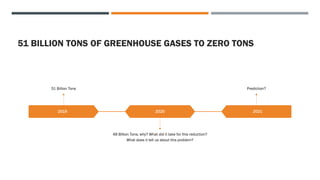
51 BILLION TONS OF GREENHOUSE GASES TO ZERO TONS
2019
51 Billion Tons
2020
48 Billion Tons; why? What did it take for this reduction?
What does it tell us about this problem?
2021
Prediction?
WHY ZERO?
Temperature?
•Why does the sunlight itself not
cause Global Warming?
•Why do we need Greenhouse gases?
•Why other gases like O2 not causing
Greenhouse effect?
•Should we be thankful to Greenhouse
gases for anything?
Effects?
•1.5-3 degrees warmer by mid
century.
•4-8 degrees warmer by end of
century.
•Sea levels will rise.
•When does this become
catastrophic?
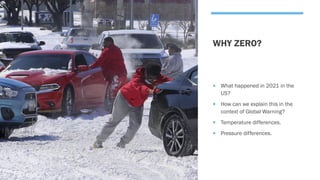
WHY ZERO?
 What happened in 2021 in the
US?
 How can we explain this in the
context of Global Warning?
 Temperature differences.
 Pressure differences.
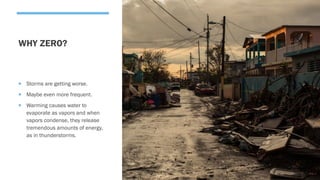
WHY ZERO?
 Storms are getting worse.
 Maybe even more frequent.
 Warming causes water to
evaporate as vapors and when
vapors condense, they release
tremendous amounts of energy,
as in thunderstorms.
WHY ZERO?
Flooding
•Land Loss & Food Loss
Drought
•Food Loss
Extinction
•Biodiversity Loss.
•Maybe natural disasters?
Discussion: Who will all of this hit the hardest? Why?
WHICH IS BETTER? ADAPTATION OR MITIGATION?
Adaptation
What can farmers do to adapt to
climate change?
Mitigation
Whose responsibility is
mitigation? Who consumes more?
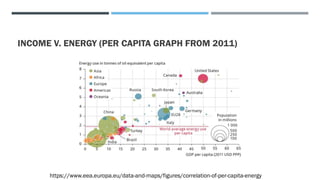
INCOME V. ENERGY (PER CAPITA GRAPH FROM 2011)
https://www.eea.europa.eu/data-and-maps/figures/correlation-of-per-capita-energy
FIVE QUESTIONS
TO ASK IN ALL
CLIMATE
CONVERSATIONS?
How much of the 51 Billion are we talking about?
What’s your plan for cement? Why bring cement up?
How much power are we talking about? 1KW=US home
How much space are we talking about?
How much will this cost?
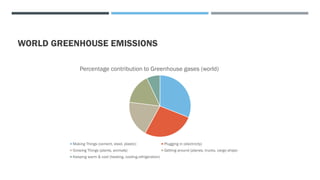
WORLD GREENHOUSE EMISSIONS
Percentage contribution to Greenhouse gases (world)
Making Things (cement, steel, plastic) Plugging in (electricity)
Growing Things (plants, animals) Getting around (planes, trucks, cargo ships)
Keeping warm & cool (heating, cooling,refrigeration)
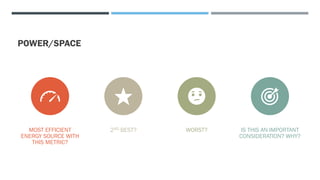
POWER/SPACE
MOST EFFICIENT
ENERGY SOURCE WITH
THIS METRIC?
2ND BEST? WORST? IS THIS AN IMPORTANT
CONSIDERATION? WHY?
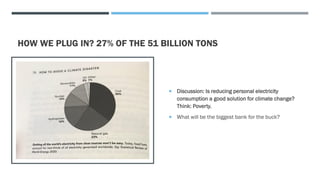
HOW WE PLUG IN? 27% OF THE 51 BILLION TONS
 Discussion: Is reducing personal electricity
consumption a good solution for climate change?
Think: Poverty.
 What will be the biggest bank for the buck?
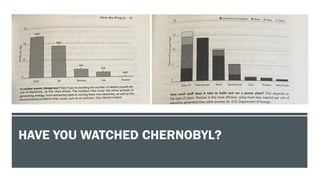
HAVE YOU WATCHED CHERNOBYL?
HOW WE MAKE
THINGS? 31% OF THE
51 BILLION TONS
 Which country is using most of the materials
these days?
 Discussion: Are economic activity and climate
change antithetical in nature?
 Ideas to reduce emissions from
manufacturing?
 Electrify every process possible.
 Get that electricity from a power grid that
has been decarbonized.
 Use carbon capture to absorb the
remaining emissions.
 Use materials more efficiently.
HOW WE GROW THINGS? 19% OF THE 51 BILLION TONS
 Norman Borlaug’s semi dwarf wheat prevented hunger.
 Greenhouse emissions from making fertilizers and applying it.
 Cow farts and poop. Will you eat lab meat? Will you eat vegan meat?
 Discussion: how can we avoid food wastage?
 Discussion: which is a better strategy, planting more trees or preventing deforestation?
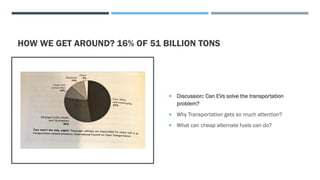
HOW WE GET AROUND? 16% OF 51 BILLION TONS
 Discussion: Can EVs solve the transportation
problem?
 Why Transportation gets so much attention?
 What can cheap alternate fuels can do?
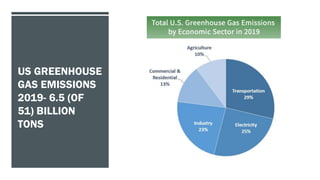
US GREENHOUSE
GAS EMISSIONS
2019- 6.5 (OF
51) BILLION
TONS
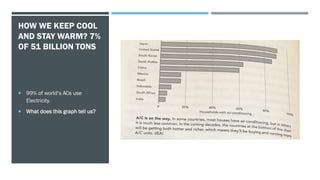
HOW WE KEEP COOL
AND STAY WARM? 7%
OF 51 BILLION TONS
 99% of world’s ACs use
Electricity.
 What does this graph tell us?
HOW WE STAY WARM?
MOSTLY NATURAL GAS FOR HEATING.
WHY?
DISCUSSION- NEGATIVE GREEN PREMIUM
WITH HEAT PUMPS. WHY NOT ADOPTED?
SOLUTIONS FOR HEATING AND COOLING
 Electrify: Get rid of gas-powered furnaces and water heaters, replacing with electric heat pumps.
 Decarbonize: Improving the power grid for generating, storing and transmitting power.
 Efficiency: We need both efficiency and low greenhouse gases.
ADAPTATION
Remember: Adaptation is crucial for poorer countries.
CGIAR:
•Biggest Agricultural Research Group.
•Helps create better plant and animal genetics.
•E.g. drought-tolerant maize in Zimbabwe.
•E.g. drought-tolerant rice in India.
Help farmers manage the risk of chaotic weather. (social security?)
Focus on the most vulnerable people. (women farmers?)
Factor climate change into policy decisions for agriculture.
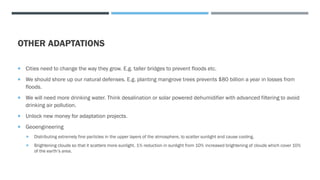
OTHER ADAPTATIONS
 Cities need to change the way they grow. E.g. taller bridges to prevent floods etc.
 We should shore up our natural defenses. E.g. planting mangrove trees prevents $80 billion a year in losses from
floods.
 We will need more drinking water. Think desalination or solar powered dehumidifier with advanced filtering to avoid
drinking air pollution.
 Unlock new money for adaptation projects.
 Geoengineering
 Distributing extremely fine particles in the upper layers of the atmosphere, to scatter sunlight and cause cooling.
 Brightening clouds so that it scatters more sunlight. 1% reduction in sunlight from 10% increased brightening of clouds which cover 10%
of the earth’s area.
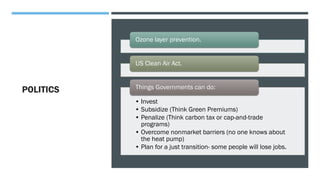
POLITICS
Ozone layer prevention.
US Clean Air Act.
• Invest
• Subsidize (Think Green Premiums)
• Penalize (Think carbon tax or cap-and-trade
programs)
• Overcome nonmarket barriers (no one knows about
the heat pump)
• Plan for a just transition- some people will lose jobs.
Things Governments can do:
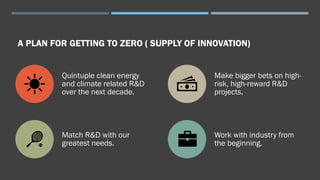
A PLAN FOR GETTING TO ZERO ( SUPPLY OF INNOVATION)
Quintuple clean energy
and climate related R&D
over the next decade.
Make bigger bets on high-
risk, high-reward R&D
projects.
Match R&D with our
greatest needs.
Work with industry from
the beginning.
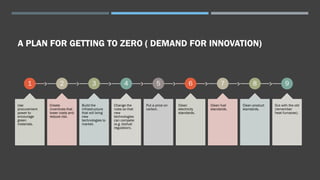
A PLAN FOR GETTING TO ZERO ( DEMAND FOR INNOVATION)
1
Use
procurement
power to
encourage
green
materials.
2
Create
incentives that
lower costs and
reduce risk.
3
Build the
infrastructure
that will bring
new
technologies to
market.
4
Change the
rules so that
new
technologies
can compete
(e.g. biofuel
regulation).
5
Put a price on
carbon.
6
Clean
electricity
standards.
7
Clean fuel
standards.
8
Clean product
standards.
9
Out with the old
(remember
heat furnaces).
PLAN TO ZERO (DIFFERENT LEVELS OF GOVERNMENT)
 Federal Government
 Enormous spending power.
 Can control what crosses our borders. Estimates show that if we include all goods consumed in the US which were produced elsewhere, US
emissions would be 8% higher. Britain’s would be 40% higher.
 Funding for R&D.
 Environmental regulations and standards.
 State Government
 States can have their own carbon emission goals.
 Carbon-pricing systems, clean energy standards.
 Pollution standards, agricultural use.
 Local Government
 Building regulations.
 Zoning laws and charging stations.
DISCUSSION OF
IDEAS
WHAT EACH OF
US CAN DO AS A
CITIZEN?
Make calls, write letters, attend town
halls.
Elect right people.
Run for office.
WHAT EACH OF US CAN DO AS A CONSUMER?
Use your wallet to
show that you
prefer green
products.
01
Sign up for a green
pricing program
with your electric
utility or install a
solar panel.
02
Reduce your
home’s emissions.
03
Buy an EV.
04
Try plant-based
alternatives to beef
or scientific meat if
you are so inclined.
05
WHAT EACH OF US CAN DO AS AN EMPLOYER OR AN EMPLOYEE?
Setup an internal carbon tax.
Be an early adopter. E.g. go for carbon neutral buildings.
Engage in the policy-making process.
Connect with government funded research.
Help early-stage innovators get across the valley of death.

How to avoid a climate disaster

  • 1.
    HOW TO AVOID ACLIMATE DISASTER VISHAL KIRTI
  • 2.
    51 BILLION TONSOF GREENHOUSE GASES TO ZERO TONS 2019 51 Billion Tons 2020 48 Billion Tons; why? What did it take for this reduction? What does it tell us about this problem? 2021 Prediction?
  • 3.
    WHY ZERO? Temperature? •Why doesthe sunlight itself not cause Global Warming? •Why do we need Greenhouse gases? •Why other gases like O2 not causing Greenhouse effect? •Should we be thankful to Greenhouse gases for anything? Effects? •1.5-3 degrees warmer by mid century. •4-8 degrees warmer by end of century. •Sea levels will rise. •When does this become catastrophic?
  • 4.
    WHY ZERO?  Whathappened in 2021 in the US?  How can we explain this in the context of Global Warning?  Temperature differences.  Pressure differences.
  • 5.
    WHY ZERO?  Stormsare getting worse.  Maybe even more frequent.  Warming causes water to evaporate as vapors and when vapors condense, they release tremendous amounts of energy, as in thunderstorms.
  • 6.
    WHY ZERO? Flooding •Land Loss& Food Loss Drought •Food Loss Extinction •Biodiversity Loss. •Maybe natural disasters? Discussion: Who will all of this hit the hardest? Why?
  • 7.
    WHICH IS BETTER?ADAPTATION OR MITIGATION? Adaptation What can farmers do to adapt to climate change? Mitigation Whose responsibility is mitigation? Who consumes more?
  • 8.
    INCOME V. ENERGY(PER CAPITA GRAPH FROM 2011) https://www.eea.europa.eu/data-and-maps/figures/correlation-of-per-capita-energy
  • 9.
    FIVE QUESTIONS TO ASKIN ALL CLIMATE CONVERSATIONS? How much of the 51 Billion are we talking about? What’s your plan for cement? Why bring cement up? How much power are we talking about? 1KW=US home How much space are we talking about? How much will this cost?
  • 10.
    WORLD GREENHOUSE EMISSIONS Percentagecontribution to Greenhouse gases (world) Making Things (cement, steel, plastic) Plugging in (electricity) Growing Things (plants, animals) Getting around (planes, trucks, cargo ships) Keeping warm & cool (heating, cooling,refrigeration)
  • 11.
    POWER/SPACE MOST EFFICIENT ENERGY SOURCEWITH THIS METRIC? 2ND BEST? WORST? IS THIS AN IMPORTANT CONSIDERATION? WHY?
  • 12.
    HOW WE PLUGIN? 27% OF THE 51 BILLION TONS  Discussion: Is reducing personal electricity consumption a good solution for climate change? Think: Poverty.  What will be the biggest bank for the buck?
  • 13.
    HAVE YOU WATCHEDCHERNOBYL?
  • 14.
    HOW WE MAKE THINGS?31% OF THE 51 BILLION TONS  Which country is using most of the materials these days?  Discussion: Are economic activity and climate change antithetical in nature?  Ideas to reduce emissions from manufacturing?  Electrify every process possible.  Get that electricity from a power grid that has been decarbonized.  Use carbon capture to absorb the remaining emissions.  Use materials more efficiently.
  • 15.
    HOW WE GROWTHINGS? 19% OF THE 51 BILLION TONS  Norman Borlaug’s semi dwarf wheat prevented hunger.  Greenhouse emissions from making fertilizers and applying it.  Cow farts and poop. Will you eat lab meat? Will you eat vegan meat?  Discussion: how can we avoid food wastage?  Discussion: which is a better strategy, planting more trees or preventing deforestation?
  • 16.
    HOW WE GETAROUND? 16% OF 51 BILLION TONS  Discussion: Can EVs solve the transportation problem?  Why Transportation gets so much attention?  What can cheap alternate fuels can do?
  • 17.
    US GREENHOUSE GAS EMISSIONS 2019-6.5 (OF 51) BILLION TONS
  • 18.
    HOW WE KEEPCOOL AND STAY WARM? 7% OF 51 BILLION TONS  99% of world’s ACs use Electricity.  What does this graph tell us?
  • 19.
    HOW WE STAYWARM? MOSTLY NATURAL GAS FOR HEATING. WHY? DISCUSSION- NEGATIVE GREEN PREMIUM WITH HEAT PUMPS. WHY NOT ADOPTED?
  • 20.
    SOLUTIONS FOR HEATINGAND COOLING  Electrify: Get rid of gas-powered furnaces and water heaters, replacing with electric heat pumps.  Decarbonize: Improving the power grid for generating, storing and transmitting power.  Efficiency: We need both efficiency and low greenhouse gases.
  • 21.
    ADAPTATION Remember: Adaptation iscrucial for poorer countries. CGIAR: •Biggest Agricultural Research Group. •Helps create better plant and animal genetics. •E.g. drought-tolerant maize in Zimbabwe. •E.g. drought-tolerant rice in India. Help farmers manage the risk of chaotic weather. (social security?) Focus on the most vulnerable people. (women farmers?) Factor climate change into policy decisions for agriculture.
  • 22.
    OTHER ADAPTATIONS  Citiesneed to change the way they grow. E.g. taller bridges to prevent floods etc.  We should shore up our natural defenses. E.g. planting mangrove trees prevents $80 billion a year in losses from floods.  We will need more drinking water. Think desalination or solar powered dehumidifier with advanced filtering to avoid drinking air pollution.  Unlock new money for adaptation projects.  Geoengineering  Distributing extremely fine particles in the upper layers of the atmosphere, to scatter sunlight and cause cooling.  Brightening clouds so that it scatters more sunlight. 1% reduction in sunlight from 10% increased brightening of clouds which cover 10% of the earth’s area.
  • 23.
    POLITICS Ozone layer prevention. USClean Air Act. • Invest • Subsidize (Think Green Premiums) • Penalize (Think carbon tax or cap-and-trade programs) • Overcome nonmarket barriers (no one knows about the heat pump) • Plan for a just transition- some people will lose jobs. Things Governments can do:
  • 24.
    A PLAN FORGETTING TO ZERO ( SUPPLY OF INNOVATION) Quintuple clean energy and climate related R&D over the next decade. Make bigger bets on high- risk, high-reward R&D projects. Match R&D with our greatest needs. Work with industry from the beginning.
  • 25.
    A PLAN FORGETTING TO ZERO ( DEMAND FOR INNOVATION) 1 Use procurement power to encourage green materials. 2 Create incentives that lower costs and reduce risk. 3 Build the infrastructure that will bring new technologies to market. 4 Change the rules so that new technologies can compete (e.g. biofuel regulation). 5 Put a price on carbon. 6 Clean electricity standards. 7 Clean fuel standards. 8 Clean product standards. 9 Out with the old (remember heat furnaces).
  • 26.
    PLAN TO ZERO(DIFFERENT LEVELS OF GOVERNMENT)  Federal Government  Enormous spending power.  Can control what crosses our borders. Estimates show that if we include all goods consumed in the US which were produced elsewhere, US emissions would be 8% higher. Britain’s would be 40% higher.  Funding for R&D.  Environmental regulations and standards.  State Government  States can have their own carbon emission goals.  Carbon-pricing systems, clean energy standards.  Pollution standards, agricultural use.  Local Government  Building regulations.  Zoning laws and charging stations.
  • 27.
  • 28.
    WHAT EACH OF USCAN DO AS A CITIZEN? Make calls, write letters, attend town halls. Elect right people. Run for office.
  • 29.
    WHAT EACH OFUS CAN DO AS A CONSUMER? Use your wallet to show that you prefer green products. 01 Sign up for a green pricing program with your electric utility or install a solar panel. 02 Reduce your home’s emissions. 03 Buy an EV. 04 Try plant-based alternatives to beef or scientific meat if you are so inclined. 05
  • 30.
    WHAT EACH OFUS CAN DO AS AN EMPLOYER OR AN EMPLOYEE? Setup an internal carbon tax. Be an early adopter. E.g. go for carbon neutral buildings. Engage in the policy-making process. Connect with government funded research. Help early-stage innovators get across the valley of death.