Gross Enrolment Ratio (GER)
Definition: Total enrolment in primary education,
regardless of age, expressed as a percentage of
the eligible official primary school-age population
in a given school-year
Purpose: GER is widely used to show the general
level of participation in and capacity of primary
education. Used in place of the net enrolment
ratio (NER) when data on enrolment by single
years of age are not available. Can also be used
together with the NER to measure the extent of
over-aged and under-aged enrolment.
Gross Enrolment Ratio (GER)
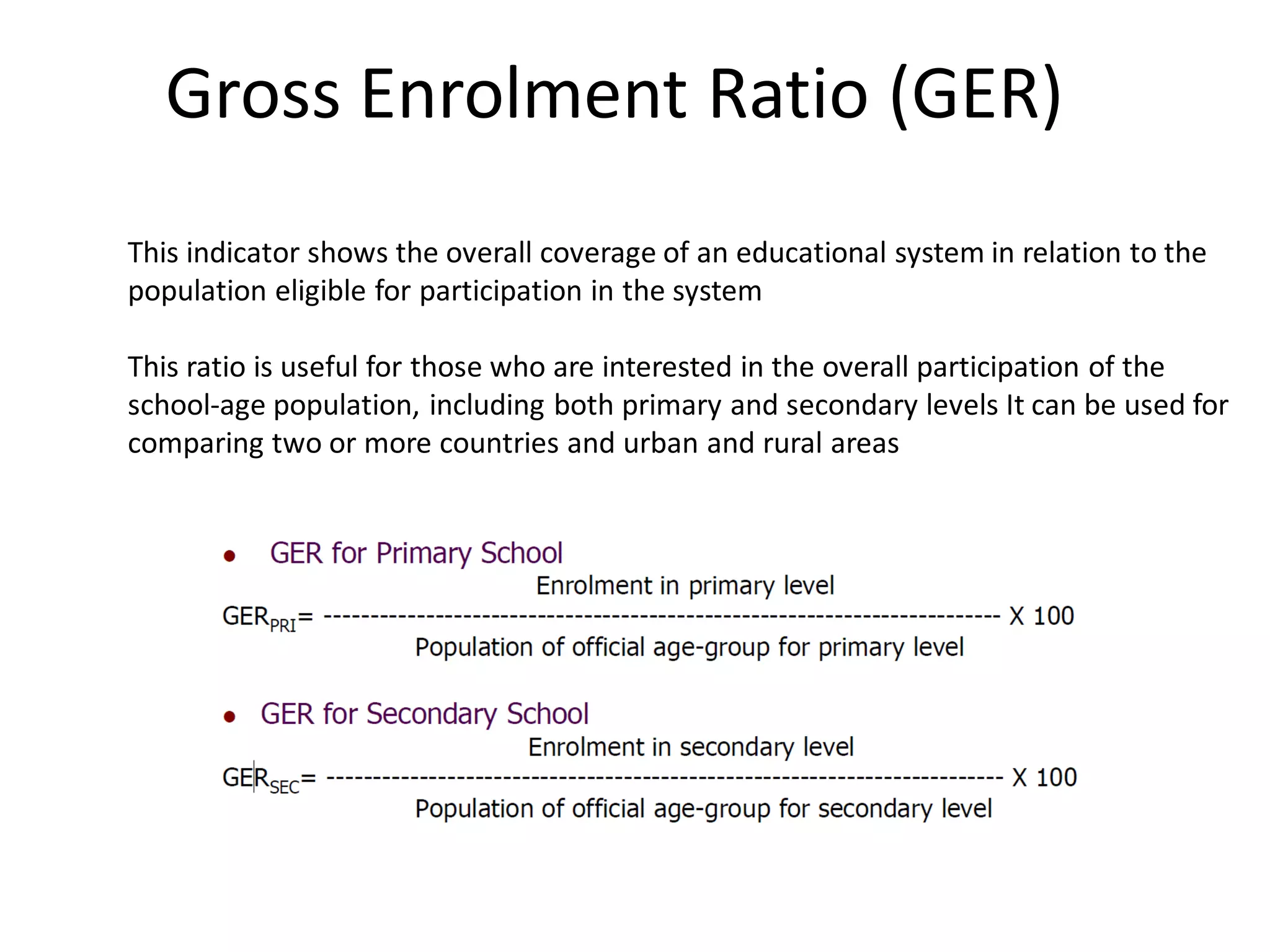
This indicator shows the overall coverage of an educational system in relation to the
population eligible for participation in the system
This ratio is useful for those who are interested in the overall participation of the
school-age population, including both primary and secondary levels It can be used for
comparing two or more countries and urban and rural areas
Gross Enrolment Ratio (GER)
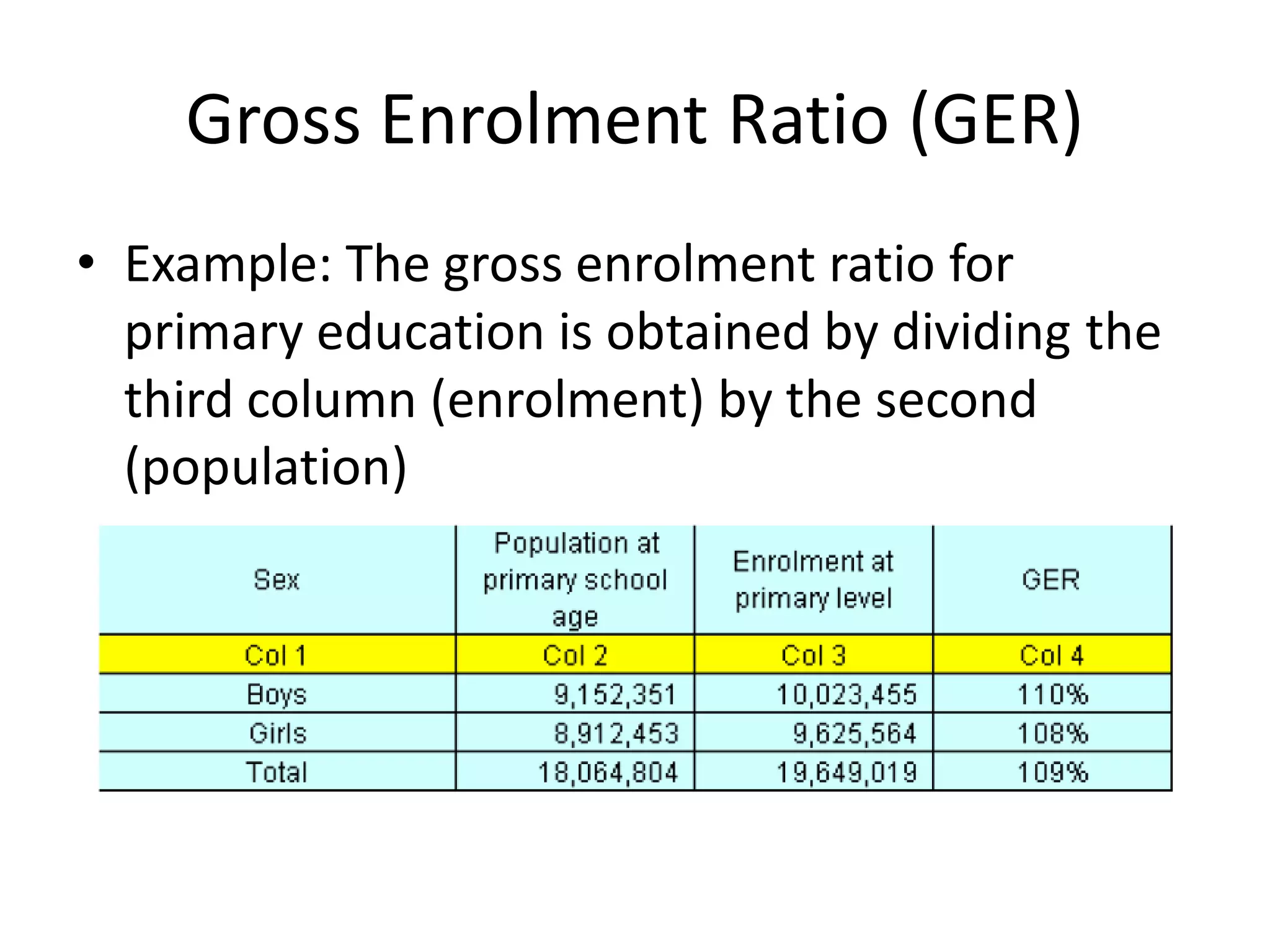
• Example: The gross enrolment ratio for
primary education is obtained by dividing the
third column (enrolment) by the second
(population)
Gross Enrolment Ratio (GER)
Interpretation
High GER indicates high degree of participation,
regardless of age
GER ≥ 100% indicates that a country is, in principle,
able to accommodate all of its primary school-age
population, but does not indicate the proportion of
that population actually enrolled
The achievement of GER of 100% is a necessary but
not sufficient
Gross Enrolment Ratio (GER)
When a country’s GER exceeds 90% for primary
education, the aggregate number of places for
pupils is approaching the number required for full
enrolment of the official age-group population;
In order to achieve universal primary education,
the number of under and over-age pupils would
need to decline in order to free places for pupils in
the official primary school age-group
Gross Enrolment Ratio (GER)
• Limitation
GER can sometimes exceed 100% due to the
inclusion of over-aged and under-aged pupils and
repeaters. In this case, a rigorous interpretation of
GER needs additional information on the extent of
repetition, early and late entrants, etc.
Net Enrolment Ratio (NER)
Definition: Enrolment in primary education of
the official primary school age group expressed
as a percentage of the corresponding population.
Purpose: NER gives a more precise
measurement of the extent of participation in
primary education of children belonging to the
official primary school age.
Net Enrolment Ratio (NER)
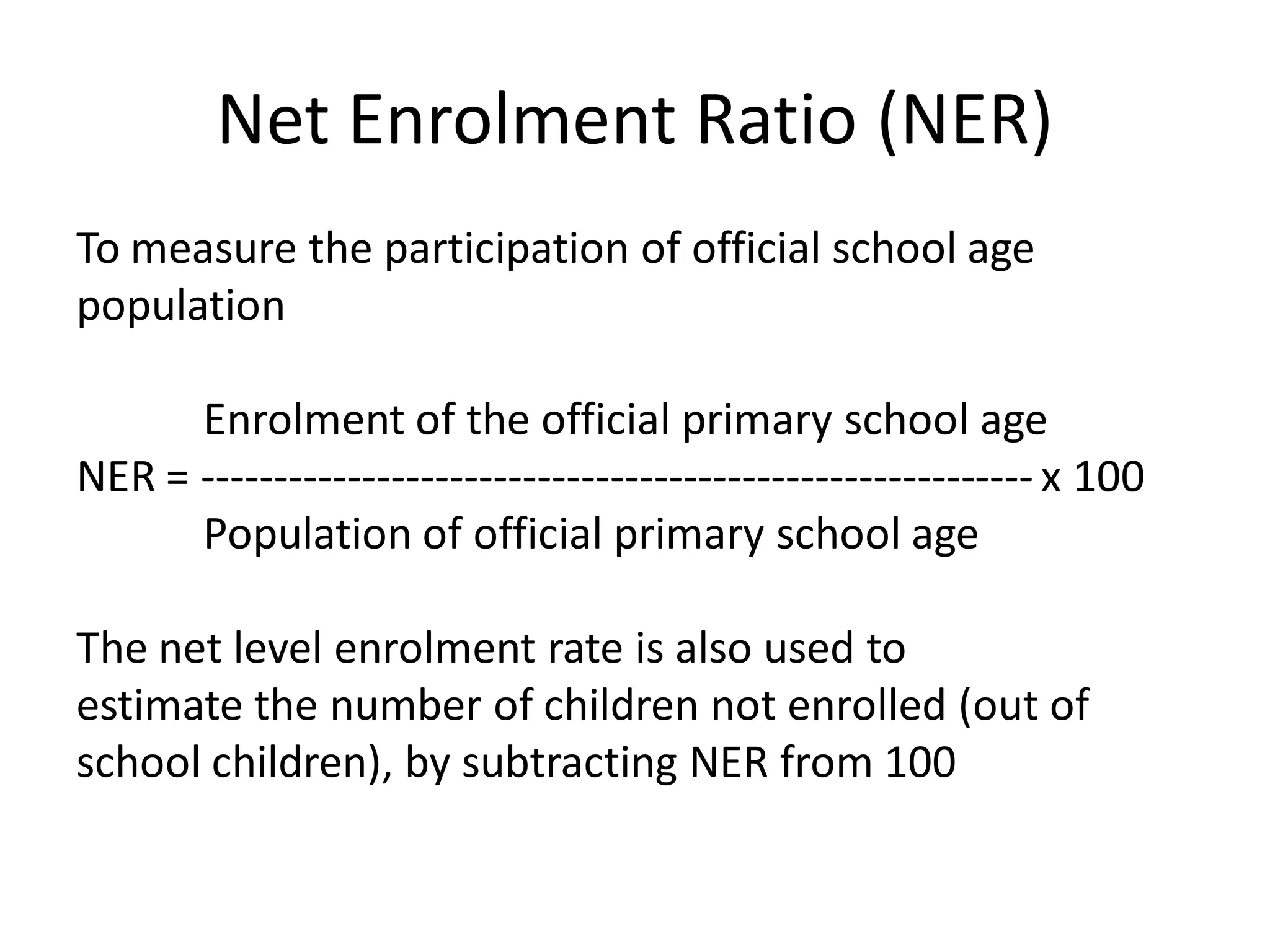
To measure the participation of official school age
population
Enrolment of the official primary school age
NER = --------------------------------------------------------- x 100
Population of official primary school age
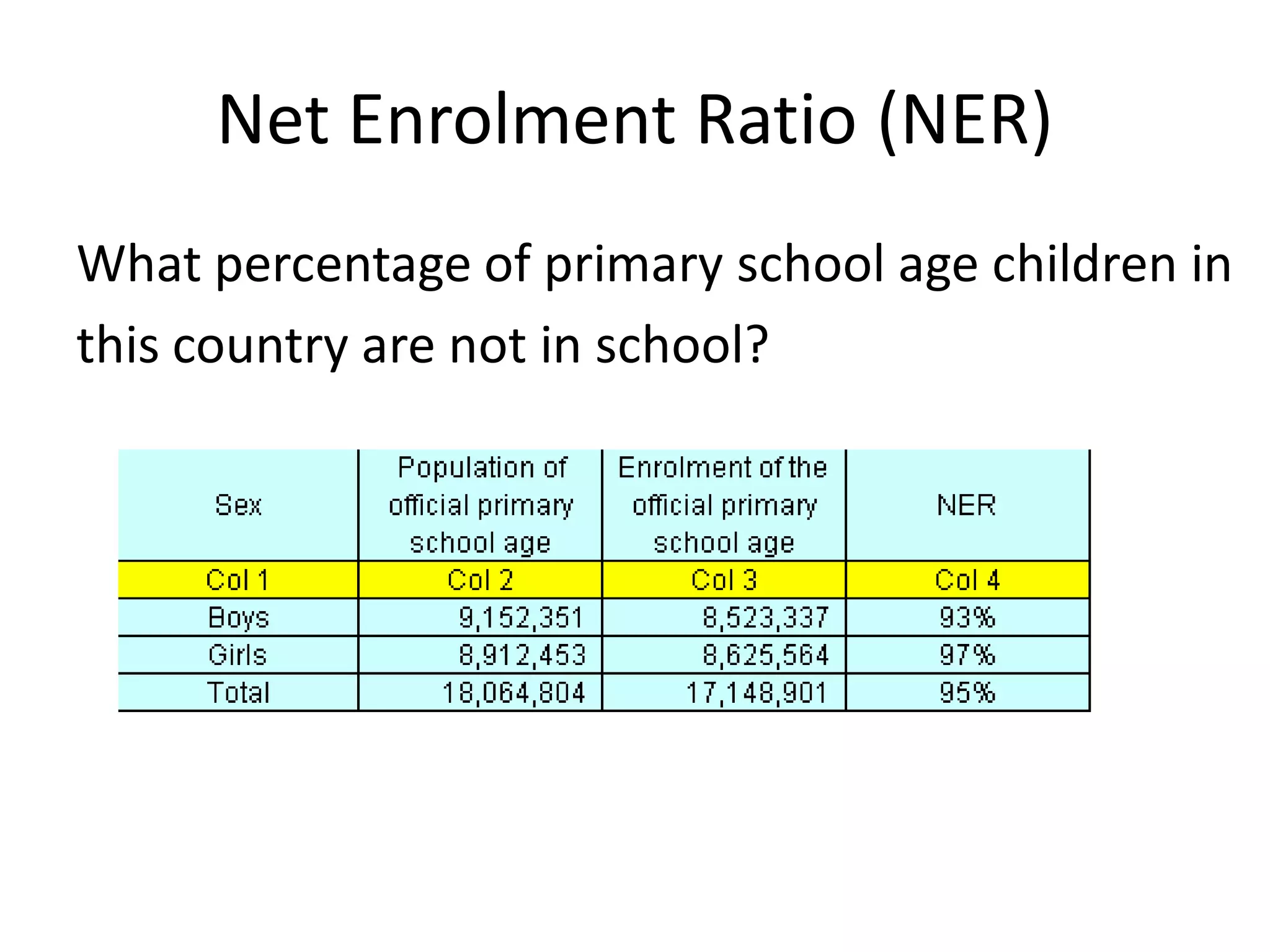
The net level enrolment rate is also used to
estimate the number of children not enrolled (out of
school children), by subtracting NER from 100
Net Enrolment Ratio (NER)
What percentage of primary school age children in
this country are not in school?
NER vs GER
By analyzing GER and NER together, one can see
the participation pattern of the system:
Over and under age pupils
Degree of participation
Geographical disparity
Gender disparity
Theoretically, NER should not be more than 100
while GER can be more than 100
Limitations
Lack of accurate data is a major problem when
calculating enrolment ratios
Population figures are estimated and enrolment
data is subject to tabulation errors and missing data
Inaccurate population estimates and less than 100%
returns of school questionnaires make enrolment
rates unreliable
Issues with enrolment ratios

Net gross enrolment rate guide.pdf

  • 1.
    Gross Enrolment Ratio(GER) Definition: Total enrolment in primary education, regardless of age, expressed as a percentage of the eligible official primary school-age population in a given school-year Purpose: GER is widely used to show the general level of participation in and capacity of primary education. Used in place of the net enrolment ratio (NER) when data on enrolment by single years of age are not available. Can also be used together with the NER to measure the extent of over-aged and under-aged enrolment.
  • 2.
    Gross Enrolment Ratio(GER) This indicator shows the overall coverage of an educational system in relation to the population eligible for participation in the system This ratio is useful for those who are interested in the overall participation of the school-age population, including both primary and secondary levels It can be used for comparing two or more countries and urban and rural areas
  • 3.
    Gross Enrolment Ratio(GER) • Example: The gross enrolment ratio for primary education is obtained by dividing the third column (enrolment) by the second (population)
  • 4.
    Gross Enrolment Ratio(GER) Interpretation High GER indicates high degree of participation, regardless of age GER ≥ 100% indicates that a country is, in principle, able to accommodate all of its primary school-age population, but does not indicate the proportion of that population actually enrolled The achievement of GER of 100% is a necessary but not sufficient
  • 5.
    Gross Enrolment Ratio(GER) When a country’s GER exceeds 90% for primary education, the aggregate number of places for pupils is approaching the number required for full enrolment of the official age-group population; In order to achieve universal primary education, the number of under and over-age pupils would need to decline in order to free places for pupils in the official primary school age-group
  • 6.
    Gross Enrolment Ratio(GER) • Limitation GER can sometimes exceed 100% due to the inclusion of over-aged and under-aged pupils and repeaters. In this case, a rigorous interpretation of GER needs additional information on the extent of repetition, early and late entrants, etc.
  • 7.
    Net Enrolment Ratio(NER) Definition: Enrolment in primary education of the official primary school age group expressed as a percentage of the corresponding population. Purpose: NER gives a more precise measurement of the extent of participation in primary education of children belonging to the official primary school age.
  • 8.
    Net Enrolment Ratio(NER) To measure the participation of official school age population Enrolment of the official primary school age NER = --------------------------------------------------------- x 100 Population of official primary school age The net level enrolment rate is also used to estimate the number of children not enrolled (out of school children), by subtracting NER from 100
  • 9.
    Net Enrolment Ratio(NER) What percentage of primary school age children in this country are not in school?
  • 10.
    NER vs GER Byanalyzing GER and NER together, one can see the participation pattern of the system: Over and under age pupils Degree of participation Geographical disparity Gender disparity Theoretically, NER should not be more than 100 while GER can be more than 100
  • 11.
    Limitations Lack of accuratedata is a major problem when calculating enrolment ratios Population figures are estimated and enrolment data is subject to tabulation errors and missing data Inaccurate population estimates and less than 100% returns of school questionnaires make enrolment rates unreliable Issues with enrolment ratios