What is anindicator?
• A tool used to evaluate the
performance of the
education system.
• A tool used to report the
status of the education
system to the community, to
the whole country and to
the global community.
3.
What are thefunctions of an indicator?
• Measures how far or how
close one is from an
objective
• Identifies problematic or
unacceptable situation
• Meets policy concern
• Compares its value to a
reference value, to a
standard or to itself
4.
PERFORMANCE INDICATORS
1. GrossEnrolment Ratio in Early
Childhood Development
Programs (GER-ECD)
- measures the general level of
participation in early
childhood development
programs
- indicates the capacity of the
education system to prepare
young children for elementary
education
5.
Gross Enrolment Ratioin ECD
Kindergarten Enrolment
-------------------------------- x 100
Population Ages 5
6.
Cont.
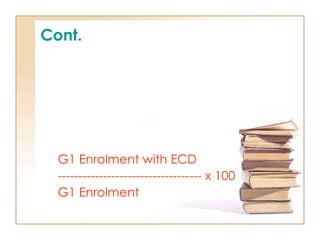
2. Percentage ofGrade 1 Pupils
with Early Childhood
Development Programs (%G1-
ECD Exp.)
- measures the level of grade 1
pupils in ECD programs
G1 Enrolment with ECD
----------------------------------- x 100
G1 Enrolment
7.
Cont.
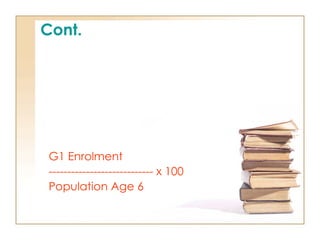
3. Apparent/Gross IntakeRate (AIR/GIR)
- reflects the general level of access
to primary education
- indicates the capacity of the
education system to provide access
to grade 1 for the official school-
entrance age population
G1 Enrolment
---------------------------- x 100
Population Age 6
8.
Cont.
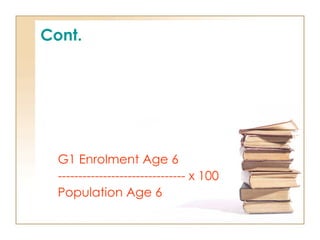
4. Net IntakeRate (NIR)
- gives a more precise
measurement of access to
primary education of the eligible,
primary school-entrance age
population than the AIR/GIR
G1 Enrolment Age 6
------------------------------- x 100
Population Age 6
9.
Cont.
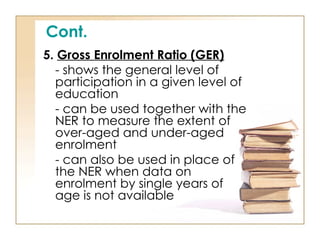
5. Gross EnrolmentRatio (GER)
- shows the general level of
participation in a given level of
education
- can be used together with the
NER to measure the extent of
over-aged and under-aged
enrolment
- can also be used in place of
the NER when data on
enrolment by single years of
age is not available
10.
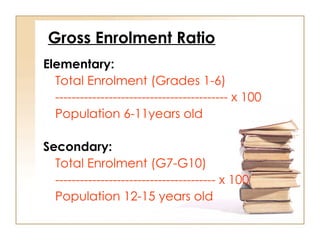
Gross Enrolment Ratio
Elementary:
TotalEnrolment (Grades 1-6)
------------------------------------------ x 100
Population 6-11years old
Secondary:
Total Enrolment (G7-G10)
--------------------------------------- x 100
Population 12-15 years old
11.
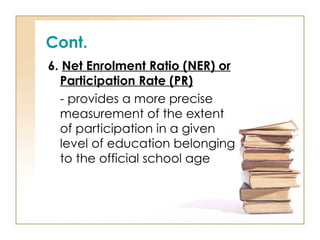
Cont.
6. Net EnrolmentRatio (NER) or
Participation Rate (PR)
- provides a more precise
measurement of the extent
of participation in a given
level of education belonging
to the official school age
12.
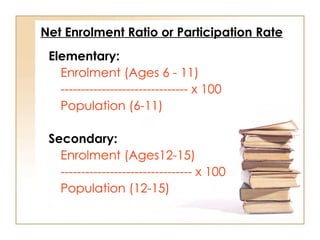
Net Enrolment Ratioor Participation Rate
Elementary:
Enrolment (Ages 6 - 11)
------------------------------- x 100
Population (6-11)
Secondary:
Enrolment (Ages12-15)
-------------------------------- x 100
Population (12-15)
13.
Cont.
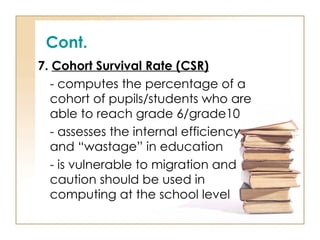
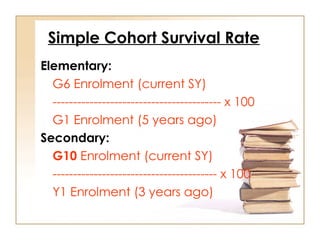
7. Cohort SurvivalRate (CSR)
- computes the percentage of a
cohort of pupils/students who are
able to reach grade 6/grade10
- assesses the internal efficiency
and “wastage” in education
- is vulnerable to migration and
caution should be used in
computing at the school level
14.
Simple Cohort SurvivalRate
Elementary:
G6 Enrolment (current SY)
----------------------------------------- x 100
G1 Enrolment (5 years ago)
Secondary:
G10 Enrolment (current SY)
---------------------------------------- x 100
Y1 Enrolment (3 years ago)
15.
Cont.
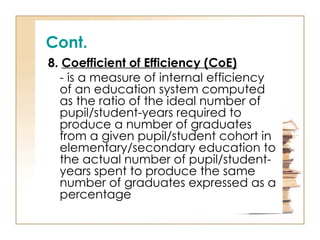
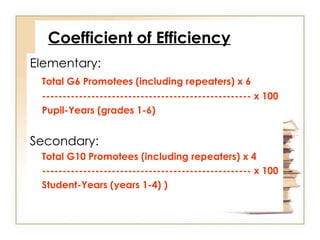
8. Coefficient ofEfficiency (CoE)
- is a measure of internal efficiency
of an education system computed
as the ratio of the ideal number of
pupil/student-years required to
produce a number of graduates
from a given pupil/student cohort in
elementary/secondary education to
the actual number of pupil/student-
years spent to produce the same
number of graduates expressed as a
percentage
16.
Coefficient of Efficiency
Elementary:
TotalG6 Promotees (including repeaters) x 6
--------------------------------------------------- x 100
Pupil-Years (grades 1-6)
Secondary:
Total G10 Promotees (including repeaters) x 4
--------------------------------------------------- x 100
Student-Years (years 1-4) )
17.
Cont.
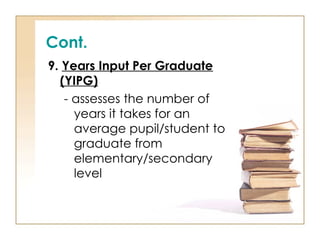
9. Years InputPer Graduate
(YIPG)
- assesses the number of
years it takes for an
average pupil/student to
graduate from
elementary/secondary
level
18.
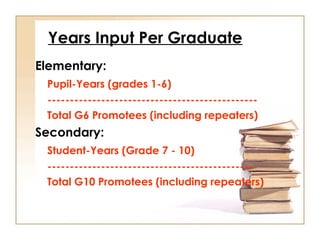
Years Input PerGraduate
Elementary:
Pupil-Years (grades 1-6)
-----------------------------------------------
Total G6 Promotees (including repeaters)
Secondary:
Student-Years (Grade 7 - 10)
----------------------------------------------
Total G10 Promotees (including repeaters)
19.
Cont.
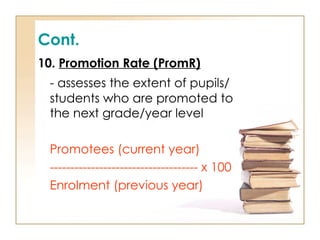
10. Promotion Rate(PromR)
- assesses the extent of pupils/
students who are promoted to
the next grade/year level
Promotees (current year)
------------------------------------ x 100
Enrolment (previous year)
20.
Cont.
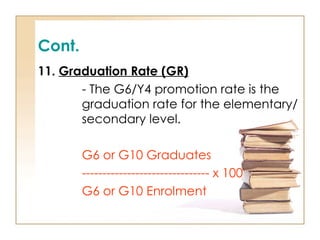
11. Graduation Rate(GR)
- The G6/Y4 promotion rate is the
graduation rate for the elementary/
secondary level.
G6 or G10 Graduates
------------------------------- x 100
G6 or G10 Enrolment
21.
Cont.
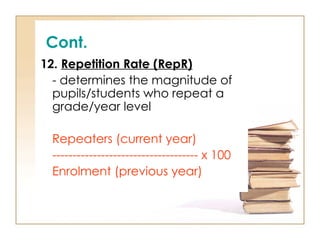
12. Repetition Rate(RepR)
- determines the magnitude of
pupils/students who repeat a
grade/year level
Repeaters (current year)
------------------------------------ x 100
Enrolment (previous year)
22.
Cont.
13. School LeaverRate (SLR)
- covers both pupils/students
who do not finish a particular
grade/year level as well as
those who finish but fail to
enroll in the next grade/year
level the following school year
- should be computed for
every grade/year except for
G1 of the elementary level and
Y1 of the secondary level
Cont.
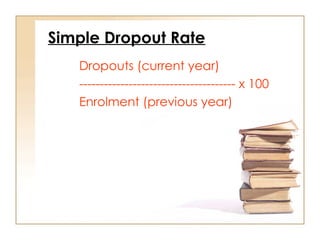
14. Simple DropoutRate (SDR)
- calculates the percentage of
pupils/students who do not finish
a particular grade/year level
- does not capture
pupils/students who finish a
grade/year but do not enroll in
the next grade/year of the
following school year
Cont.
15. Transition Rate(TR)
- assesses the extent by
which pupils are able to
move to the next higher
level of education (i.e.
primary to intermediate
and elementary to
secondary)
27.
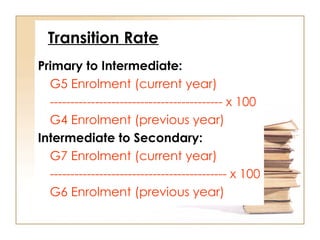
Transition Rate
Primary toIntermediate:
G5 Enrolment (current year)
------------------------------------------ x 100
G4 Enrolment (previous year)
Intermediate to Secondary:
G7 Enrolment (current year)
------------------------------------------- x 100
G6 Enrolment (previous year)
28.
Cont.
16. Completion Rate(CR)
- measures the percentage
of grade 1/year 1entrants
who graduate in
elementary/ secondary
education
- can be used
interchangeably with survival
rate and retention rate
29.
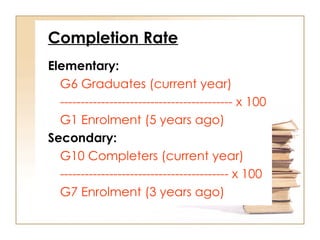
Completion Rate
Elementary:
G6 Graduates(current year)
------------------------------------------ x 100
G1 Enrolment (5 years ago)
Secondary:
G10 Completers (current year)
----------------------------------------- x 100
G7 Enrolment (3 years ago)
30.
Cont.
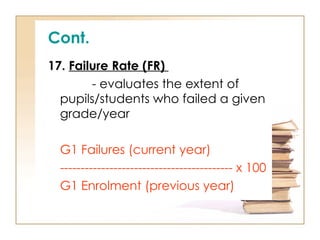
17. Failure Rate(FR)
- evaluates the extent of
pupils/students who failed a given
grade/year
G1 Failures (current year)
------------------------------------------ x 100
G1 Enrolment (previous year)
31.
Cont.
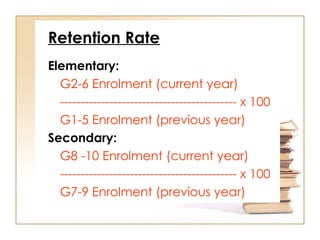
18. Retention Rate(RR)
- determines the
degree of pupils/students
in a particular school year
who continue to be in
school in succeeding year
- is also vulnerable to
migration and is not
advisable to compute at
the school level
Cont.
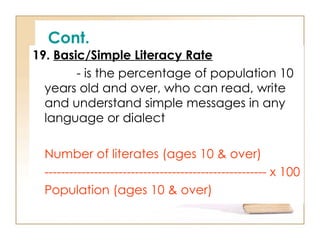
19. Basic/Simple LiteracyRate
- is the percentage of population 10
years old and over, who can read, write
and understand simple messages in any
language or dialect
Number of literates (ages 10 & over)
------------------------------------------------------ x 100
Population (ages 10 & over)
34.
Cont.
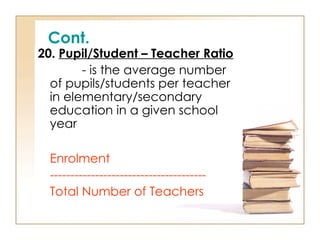
20. Pupil/Student –Teacher Ratio
- is the average number
of pupils/students per teacher
in elementary/secondary
education in a given school
year
Enrolment
--------------------------------------
Total Number of Teachers
35.
Cont.
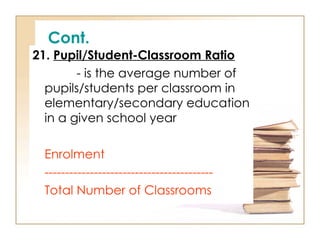
21. Pupil/Student-Classroom Ratio
-is the average number of
pupils/students per classroom in
elementary/secondary education
in a given school year
Enrolment
-----------------------------------------
Total Number of Classrooms
36.
Cont.
22. Pupil/Student-Armchair Ratio
-is the average number of
pupils/students per armchair in
elementary/secondary education
in a given school year
Enrolment
----------------------------------------
Total Number of Armchairs
37.
Cont.
23. Textbook-Pupil/Student Ratio
-is the average number of
usable textbooks per pupil/student
in elementary/secondary level in a
given subject in a given school year
Number of Usable Textbooks
-------------------------------------------
Enrolment
38.
Cont.
24. Per Pupil/StudentCost
- is the ratio of the total education
expenditures to the total enrolment in a
given year
Total Expenditures (PS + MOOE)
----------------------------------------------
Total Enrolment
39.
Cont.
25. National AchievementRate (NAT)
- is being measured by Mean Point
Score (MPS) by subject area
> Mathematics
> English
> Science
> Filipino
> Hekasi/Araling Panlipunan


![School Leaver Rate
SLR = 1 - Promotion Rate - Repetition Rate
or
Elementary:
G1 Enrolment (previous SY)-[G2 Enrolment-G2 Repeaters (current year)]
G2 SLR = ----------------------------------------------------------------------------------- x 100
Grade 1 Enrolment (previous SY)
Secondary:
G7 Enrolment (previous SY)-[G8 Enrolment-G2 Repeaters (current year)]
Y2 SLR = ----------------------------------------------------------------------------------- x 100
Grade 7 Enrolment (previous SY)](https://image.slidesharecdn.com/performanceindicatorsformula-250302121849-ccad48a9/85/performance_indicators_formula-for-DepEd-23-320.jpg)