NEONATAL JAUNDICE
Introduction
Jaundice isyellow discolorationof skinandsclera.Neonataljaundiceisacommonproblemwhichoften
doesnotrequire intervention. However,jaundice inthe newbornsometimesmightsignal aserious,
but potentiallytreatable illnesswhichmaycause neurological damage (bilirubinencephalopathywith
subsequentkernicterus),if the bilirubin level issignificantlyelevated.
Physiological and pathological jaundice
Jaundice canbe seenin60% of term infantsand80% of preterm infants.Itismostlyphysiological.
Featuresof physiological jaundice (allof the following)
• Jaundice thatfirstappearsbetween24-72 hoursof age
• Maximumintensityisseenon4-5thday interm and7th
day inpretermneonates
• Doesnotexceed15 mg/dl (255μmol/l)
• Clinicallyundetectable after14 days
Physiological jaundice isadiagnosisbyexclusion.Notreatmentis requiredbutbabyshouldbe observed
closelyforsignsof worsening jaundice.
Featuresof pathological jaundice (any of the following)
• Clinical jaundice within24hoursof birth.
• Total serumbilirubin >15mg/dl (255μmol/l) after24 hoursof life
• Total serumbilirubin(TSB) increasingby> 5mg/dl/day (85 μmol/l/day) or0.5 mg/dl/hr(8.5μmol/l/hr)
4 National GuidelinesforNewbornCare - Volume II
• Conjugatedserumbilirubin>20%of total serumbilirubin level
• Clinical jaundice persistingfor> 2 week*infull term and>3 weeksinpreterm neonates(prolonged
jaundice). (*NB:exceptinthe casesof breast milkjaundice)
Causes ofjaundice
Hyperbilirubinaemiainthe first weekof life isusuallyof the unconjugated(indirect) variety.Although
conjugated hyperbilirubinemia(direct) occurslesscommonly,itisalways pathological.
Causesof jaundice are usuallyclassifiedbasedonthe time of onsetof jaundice.
Appearingwithin 24 hours of age
• Haemolyticdisease of newborn:Rh,ABOandminor bloodgroupincompatibility
• Infections:Intrauterine infectionsandperinatalsepsis
• Hereditary haemolyticanaemias:congenital spherocytosis,G6PDdeficiency
Appearingafter 24 hours of life
• All of the above
• Physiological
• Polycythaemia
• Concealedhaemorrhages:cephalhaematoma,subaponeurotic/subarachnoid/intraventricular
haemorrhage.
• Neonatal hepatitiseg.TORCHinfection
• Metabolicdisorderseg.Galactosaemia,CriglerNajjarSyndrome
Prolongedjaundice
Prolongedunconjugatedhyperbilirubinaemia
 New/persistingsepsiseg.urinarytractinfection
 Metabolic- Hypothyroidism, galactosaemia
 Persistinghaemolysis
 Breastmilkjaundice
Prolongedconjugatedhyperbilirubinaemia
 Neonatal hepatitis:–Congenital infections,α1- Antitrypsin
 deficiency
 Extra hepaticbiliaryatresia
 Choledochal cyst
Approach to a jaundicedbaby
The followingquestionsneedtobe addressed
• What isthe gestation?
• What isthe birthweightandcurrent weight?
• What isthe postnatal age in hours?
• Isthe babyclinicallyillorwell?
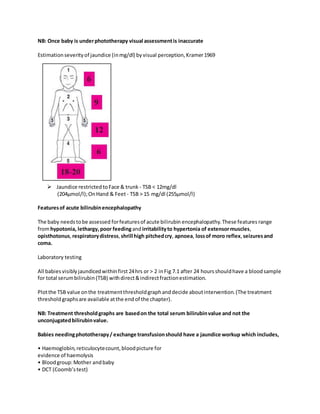
• What isthe severityof jaundice?(clinical visualperception;(below figure)
Afterthe initial evaluationdecide whether;
• The baby needsinvestigationforjaundice?
• The baby needsphototherapy/exchange transfusion?
• The baby hasfeaturesof encephalopathy?
Assessmentofa jaundicedneonate
In the assessmentof ajaundicedneonate,the historyandexaminationare directedtowardsassessing
the severity,complicationsand determiningthe aetiologyof jaundice.
Severity of jaundice
Whena neonate isclinicallyjaundiced, the total serumbilirubin(TSB) isusually>5mg/dl (85 μmol/l).
Jaundice inthe newbornprogressesin the cephalo-caudaldirection and thustheextentof yellownessof
the skin is usefulto assessthelevel of bilirubin. Kramer’s criteria areused to clinically estimateseverity.
Howeverthiscanbe unreliable inidentifyingthose babieswhorequirespecificmanagement,especially
once the babyisunderphototherapy orisjaundicedbelow the nipple line.Therefore if facilitiesare
available abilirubinlevel shouldbe checked.
NB: Once baby is underphototherapy visual assessmentis inaccurate
Estimationseverityof jaundice (inmg/dl) byvisual perception,Kramer1969
 Jaundice restrictedtoFace & trunk - TSB < 12mg/dl
(204μmol/l);OnHand & Feet - TSB > 15 mg/dl (255μmol/l)
Featuresof acute bilirubinencephalopathy
The baby needstobe assessed forfeaturesof acute bilirubin encephalopathy.These features range
fromhypotonia, lethargy, poor feedingandirritabilityto hypertonia of extensormuscles,
opisthotonus, respiratorydistress,shrill high pitchedcry, apnoea, lossof moro reflex, seizuresand
coma.
Laboratory testing
All babiesvisiblyjaundicedwithinfirst 24hrs or > 2 inFig 7.1 after 24 hoursshouldhave a bloodsample
for total serumbilirubin(TSB) withdirect&indirectfractionestimation.
Plotthe TSB value onthe treatmentthresholdgraphanddecide aboutintervention.(The treatment
threshold graphsare available atthe end of the chapter).
NB: Treatment thresholdgraphs are basedon the total serum bilirubinvalue and not the
unconjugatedbilirubinvalue.
Babies needingphototherapy/ exchange transfusionshould have a jaundice workup which includes,
• Haemoglobin,reticulocytecount,bloodpicture for
evidence of haemolysis
• Bloodgroup:Mother andbaby
• DCT (Coomb’stest)
• Septicscreenif sepsisissuspected
Save baby’sand mother’sbloodsample forcrossmatching.
The follow-upplanmaybe devisedbasedonindividual assessment.
Management
Managementof jaundice isdirectedtowardsreducingthe level of bilirubinandpreventingCNStoxicity.
1. Reductionof bilirubinis achievedbyphototherapyand/or exchange transfusion.
2. Hyperbilirubinaemiadue to dehydrationmaybe preventedby earlyandfrequentfeeding.The
decisiontotreatdependsonthe severityandthe cause of jaundice.
Phototherapy
Preparationforphototherapy
• Thisinvolvesexposure of the nakedbabytoblue light/ CFL/LED of wave length450-460nm
• Keepbabiesatthe distance recommendedbythe manufacturerforthe phototherapylightstobe
maximally effectiveandsafe (avoidhyperthermia).Incase of fluorescentlightphototherapymachines
babyshouldbe keptabout18 inchesaway from the light.
• Ideal irradiance:Use of intensive phototherapy withirradiance inblue-greenspectrumof atleast20-
30μW/cm2/nm and deliveredto asmuch of the infant’ssurface areaas possible.
• The light wavesconvert the bilirubintowater soluble nontoxicformswhich are then easilyexcreted.
• Advantagesof phototherapy:non-invasive,effective, inexpensiveandeasyto use
• Frequentfeeding,every 2-3hours andchange of posture shouldbe promotedinan infantreceiving
phototherapy.
• Eye shadesshouldbe fixed.
• External genitaliashouldbe coveredto prevent soilingfromurine and stools.The nappy should
cover only a minimumarea ofbody surface of the baby.
Provisionof phototherapy
• Generallysingle phototherapyisinitiated.
• Initiate continuousmultiple phototherapyif anyof the
followingapply:
- TSB level isrising>0.5mg/dl/hr(8.5μmol/l/hr)
- TSB isat a level within3mg/dl (50μmol/l) below the level forwhichexchangetransfusionis indicated
- TSB level failsto respondtosingle phototherapy (i.e.bilirubincontinuestorise,ordoesnot fall, within
6 hoursof startingsingle phototherapy)
- Whenbilirubinlevel fallsduringcontinuous multiple phototherapytoa level ≥3mg/dl (50μmol/l)
belowthe thresholdlevel forwhich exchangetransfusionisindicated,stepdowntosingle
phototherapy.
• Repeatserumbilirubinmeasurement4–6 hours afterinitiatingphototherapy.
• Repeatlevels4-6hourlyif serumbilirubinisrisingoris not fallingwhile underphototherapy.
• Repeatserumbilirubinmeasurementevery12-24 hours whenthe serumbilirubinlevel isstableor
falling.
• Stopphototherapyonce bilirubinlevelsare belowthe phototherapylevelby2 -3 mg/dl (35 - 50μmol/l)
as per postnatal age.
• Incase of haemolyticjaundice,checkbilirubinlevels after12 hoursof stoppingphototherapytocheck
for reboundincrease.
• Babywill appearbleachedwhenunderphototherapy andhence clinical assessmentof jaundice isnot
reliable. Serumbilirubinmustbe monitored.
• Prophylacticphototherapydoesnotofferanyclinical benefitinthe course of hyperbilirubinaemia
• Do notuse sunlightastreatmentforjaundice. Side effectsof phototherapy
• Increasedinsensiblewaterlosswhenproviding phototherapyincots:breastfeedmore frequently/
provide adequate fluidstoavoiddehydration
• Loose greenstools: weighoftenandcompensate with breastmilk.
• Skinrashes:harmless,noneedtodiscontinue phototherapy;
 Bronze baby syndrome:occurs ifbaby has conjugated
hyperbilirubinaemia.Ifso,discontinue phototherapy
• Hypoor hyperthermia:monitortemperaturefrequently.
NB: These side effectsare reversible
Exchange transfusion
It isan effective andreliablemethodtoreduce serumbilirubin.Itshouldbe performedif the TSB
remainsinexchange transfusionrange aspertreatmentthresholdgraphs,despiteeffective
phototherapy.
Immediate exchange transfusionisindicatedif featuresof bilirubin encephalopathyare evident.If
facilitiesforexchange transfusionsare notavailable atyourcentre earlyreferral toa highercentre is
indicated.
Delayintreatmentmayresultinpermanentbraindamage.
Whenreferringababy withjaundice,make sure thateitherthe mother isreferredormother’sblood
sample issent.
• Use a double-volume exchangetransfusion(2x 80 ml /kg)
• Umbilical vesselsare the preferredaccessmethodfor performinganexchange transfusion
• Use acid citrate dextrose (ACD) orcitrate phosphate dextrose (CPD) bloodlessthan2to 5 daysold.
• Electrolytes,blood gasesandvital signsshouldbe monitoredduringexchange transfusion
Type of blood:
In ‘Rh’isoimmunisation,the bestchoice wouldbe Onegative packed cellssuspendedinABpositive
plasma.O negative whole bloodor cross-matchedbaby’sbloodgroup(butRhnegative) mayalsobe
used.
For ‘ABO’isoimmunisation,Ogroup(Rhcompatible)packedcells suspendedinABplasmaorO group
whole blood(Rhcompatiblewith baby) shouldbe used.
In othersituationsbaby’sbloodgroup shouldbe used.All bloodmustbe crossmatchedagainst
maternal plasma.
Followingexchange transfusion:
• Maintaincontinuousmultiplephototherapy
• Measure serumbilirubin level within2hours andmanage according to thresholdgraphs
Role of additional therapiesfor treatmentof jaundice
• IVIG(0.5g/kgover 4 hours),fordecreasingthe needfor exchange transfusion inneonateswithRhesus
or ABO haemolyticdiseasewhenthe serumbilirubincontinues torise >8.5 μmol/l/hr
• Do notuse any of the followingtotreathyperbilirubinaemia
- albumin,barbiturates,cholestyramine,metalloporphyrins.
Care of babieswith prolongedjaundice
In babieswithagestational age of 37 weeksormore withjaundice lastingmore than14 daysand in
babieswithagestational age of less than37 weekswithjaundice lastingmore than21 days:
- lookforpale chalkystoolsand/ordark urine thatstainsthe nappy – seeninconjugated
hyperbilirubinaemia
Followinginvestigationsare indicatedin prolongedjaundice:
• Total bilirubinandconjugatedbilirubin
• Full bloodcount,bloodpicture,reticulocyte count
• Bloodgroupdetermination(motherandbaby) andDAT
(Coombs’test)
• Urine culture
• Routine metabolicscreeningincludingscreeningforcongenitalhypothyroidism(T4,
TSH),galactosaemia(urinereducingsubstances)
If all the above investigationsare notsuggestive of apathological cause the diagnosisof breastmilk
jaundice maybe considered.Baby shouldbe revieweduntil the jaundice disappears.
Followexpertadvice aboutcare of babieswitha conjugatedbilirubin level greaterthan20% of total
bilirubinbecause thismayindicate seriousliverdisease.
Conjugatedhyperbilirubinaemia
Thisis rare inthe newbornperiodandisdefined asadirectbilirubin levelof > 20% of total bilirubin.Itis
importantto identifythe cause asit isneverphysiological Approach
The followingquestionsneedtobe answered
• Are the stoolswhite orclaycoloured?
• Isthe urine darkcoloured?
• Are liverandspleenenlarged?
Baby shouldbe investigatedtofindthe aetiology;
- Serumbilirubinwith directfraction
- US scan abdomen-*Absence of the gall bladderafter4 hoursof fastingis
suggestive of biliaryatresia*Alteredechogenicityof liverparenchymaissuggestive
of congenital hepatitis*Presenceof Choledocal cyst
- Liverfunction tests – enzymes,alkalinephosphatase,PT
/INR
- Urine for reducingsubstance
- Urine culture
- TORCH screen(toxoplasma,rubella,cytomegalovirus, herpes,syphilis)
Rule outor establishthe diagnosisof extrahepaticbiliaryatresiaas earlyaspossible (withineightweeks
of life) whenitisstill surgically correctable.

Neonatal jaundice

  • 1.
    NEONATAL JAUNDICE Introduction Jaundice isyellowdiscolorationof skinandsclera.Neonataljaundiceisacommonproblemwhichoften doesnotrequire intervention. However,jaundice inthe newbornsometimesmightsignal aserious, but potentiallytreatable illnesswhichmaycause neurological damage (bilirubinencephalopathywith subsequentkernicterus),if the bilirubin level issignificantlyelevated. Physiological and pathological jaundice Jaundice canbe seenin60% of term infantsand80% of preterm infants.Itismostlyphysiological. Featuresof physiological jaundice (allof the following) • Jaundice thatfirstappearsbetween24-72 hoursof age • Maximumintensityisseenon4-5thday interm and7th day inpretermneonates • Doesnotexceed15 mg/dl (255μmol/l) • Clinicallyundetectable after14 days Physiological jaundice isadiagnosisbyexclusion.Notreatmentis requiredbutbabyshouldbe observed closelyforsignsof worsening jaundice. Featuresof pathological jaundice (any of the following) • Clinical jaundice within24hoursof birth. • Total serumbilirubin >15mg/dl (255μmol/l) after24 hoursof life • Total serumbilirubin(TSB) increasingby> 5mg/dl/day (85 μmol/l/day) or0.5 mg/dl/hr(8.5μmol/l/hr) 4 National GuidelinesforNewbornCare - Volume II • Conjugatedserumbilirubin>20%of total serumbilirubin level • Clinical jaundice persistingfor> 2 week*infull term and>3 weeksinpreterm neonates(prolonged jaundice). (*NB:exceptinthe casesof breast milkjaundice) Causes ofjaundice Hyperbilirubinaemiainthe first weekof life isusuallyof the unconjugated(indirect) variety.Although conjugated hyperbilirubinemia(direct) occurslesscommonly,itisalways pathological. Causesof jaundice are usuallyclassifiedbasedonthe time of onsetof jaundice. Appearingwithin 24 hours of age • Haemolyticdisease of newborn:Rh,ABOandminor bloodgroupincompatibility • Infections:Intrauterine infectionsandperinatalsepsis • Hereditary haemolyticanaemias:congenital spherocytosis,G6PDdeficiency Appearingafter 24 hours of life • All of the above • Physiological • Polycythaemia
  • 2.
    • Concealedhaemorrhages:cephalhaematoma,subaponeurotic/subarachnoid/intraventricular haemorrhage. • Neonatalhepatitiseg.TORCHinfection • Metabolicdisorderseg.Galactosaemia,CriglerNajjarSyndrome Prolongedjaundice Prolongedunconjugatedhyperbilirubinaemia  New/persistingsepsiseg.urinarytractinfection  Metabolic- Hypothyroidism, galactosaemia  Persistinghaemolysis  Breastmilkjaundice Prolongedconjugatedhyperbilirubinaemia  Neonatal hepatitis:–Congenital infections,α1- Antitrypsin  deficiency  Extra hepaticbiliaryatresia  Choledochal cyst Approach to a jaundicedbaby The followingquestionsneedtobe addressed • What isthe gestation? • What isthe birthweightandcurrent weight? • What isthe postnatal age in hours? • Isthe babyclinicallyillorwell? • What isthe severityof jaundice?(clinical visualperception;(below figure) Afterthe initial evaluationdecide whether; • The baby needsinvestigationforjaundice? • The baby needsphototherapy/exchange transfusion? • The baby hasfeaturesof encephalopathy? Assessmentofa jaundicedneonate In the assessmentof ajaundicedneonate,the historyandexaminationare directedtowardsassessing the severity,complicationsand determiningthe aetiologyof jaundice. Severity of jaundice Whena neonate isclinicallyjaundiced, the total serumbilirubin(TSB) isusually>5mg/dl (85 μmol/l). Jaundice inthe newbornprogressesin the cephalo-caudaldirection and thustheextentof yellownessof the skin is usefulto assessthelevel of bilirubin. Kramer’s criteria areused to clinically estimateseverity. Howeverthiscanbe unreliable inidentifyingthose babieswhorequirespecificmanagement,especially once the babyisunderphototherapy orisjaundicedbelow the nipple line.Therefore if facilitiesare available abilirubinlevel shouldbe checked.
  • 3.
    NB: Once babyis underphototherapy visual assessmentis inaccurate Estimationseverityof jaundice (inmg/dl) byvisual perception,Kramer1969  Jaundice restrictedtoFace & trunk - TSB < 12mg/dl (204μmol/l);OnHand & Feet - TSB > 15 mg/dl (255μmol/l) Featuresof acute bilirubinencephalopathy The baby needstobe assessed forfeaturesof acute bilirubin encephalopathy.These features range fromhypotonia, lethargy, poor feedingandirritabilityto hypertonia of extensormuscles, opisthotonus, respiratorydistress,shrill high pitchedcry, apnoea, lossof moro reflex, seizuresand coma. Laboratory testing All babiesvisiblyjaundicedwithinfirst 24hrs or > 2 inFig 7.1 after 24 hoursshouldhave a bloodsample for total serumbilirubin(TSB) withdirect&indirectfractionestimation. Plotthe TSB value onthe treatmentthresholdgraphanddecide aboutintervention.(The treatment threshold graphsare available atthe end of the chapter). NB: Treatment thresholdgraphs are basedon the total serum bilirubinvalue and not the unconjugatedbilirubinvalue. Babies needingphototherapy/ exchange transfusionshould have a jaundice workup which includes, • Haemoglobin,reticulocytecount,bloodpicture for evidence of haemolysis • Bloodgroup:Mother andbaby • DCT (Coomb’stest)
  • 4.
    • Septicscreenif sepsisissuspected Savebaby’sand mother’sbloodsample forcrossmatching. The follow-upplanmaybe devisedbasedonindividual assessment. Management Managementof jaundice isdirectedtowardsreducingthe level of bilirubinandpreventingCNStoxicity. 1. Reductionof bilirubinis achievedbyphototherapyand/or exchange transfusion. 2. Hyperbilirubinaemiadue to dehydrationmaybe preventedby earlyandfrequentfeeding.The decisiontotreatdependsonthe severityandthe cause of jaundice. Phototherapy Preparationforphototherapy • Thisinvolvesexposure of the nakedbabytoblue light/ CFL/LED of wave length450-460nm • Keepbabiesatthe distance recommendedbythe manufacturerforthe phototherapylightstobe maximally effectiveandsafe (avoidhyperthermia).Incase of fluorescentlightphototherapymachines babyshouldbe keptabout18 inchesaway from the light. • Ideal irradiance:Use of intensive phototherapy withirradiance inblue-greenspectrumof atleast20- 30μW/cm2/nm and deliveredto asmuch of the infant’ssurface areaas possible. • The light wavesconvert the bilirubintowater soluble nontoxicformswhich are then easilyexcreted. • Advantagesof phototherapy:non-invasive,effective, inexpensiveandeasyto use • Frequentfeeding,every 2-3hours andchange of posture shouldbe promotedinan infantreceiving phototherapy. • Eye shadesshouldbe fixed. • External genitaliashouldbe coveredto prevent soilingfromurine and stools.The nappy should cover only a minimumarea ofbody surface of the baby. Provisionof phototherapy • Generallysingle phototherapyisinitiated. • Initiate continuousmultiple phototherapyif anyof the followingapply: - TSB level isrising>0.5mg/dl/hr(8.5μmol/l/hr) - TSB isat a level within3mg/dl (50μmol/l) below the level forwhichexchangetransfusionis indicated - TSB level failsto respondtosingle phototherapy (i.e.bilirubincontinuestorise,ordoesnot fall, within 6 hoursof startingsingle phototherapy) - Whenbilirubinlevel fallsduringcontinuous multiple phototherapytoa level ≥3mg/dl (50μmol/l) belowthe thresholdlevel forwhich exchangetransfusionisindicated,stepdowntosingle phototherapy.
  • 5.
    • Repeatserumbilirubinmeasurement4–6 hoursafterinitiatingphototherapy. • Repeatlevels4-6hourlyif serumbilirubinisrisingoris not fallingwhile underphototherapy. • Repeatserumbilirubinmeasurementevery12-24 hours whenthe serumbilirubinlevel isstableor falling. • Stopphototherapyonce bilirubinlevelsare belowthe phototherapylevelby2 -3 mg/dl (35 - 50μmol/l) as per postnatal age. • Incase of haemolyticjaundice,checkbilirubinlevels after12 hoursof stoppingphototherapytocheck for reboundincrease. • Babywill appearbleachedwhenunderphototherapy andhence clinical assessmentof jaundice isnot reliable. Serumbilirubinmustbe monitored. • Prophylacticphototherapydoesnotofferanyclinical benefitinthe course of hyperbilirubinaemia • Do notuse sunlightastreatmentforjaundice. Side effectsof phototherapy • Increasedinsensiblewaterlosswhenproviding phototherapyincots:breastfeedmore frequently/ provide adequate fluidstoavoiddehydration • Loose greenstools: weighoftenandcompensate with breastmilk. • Skinrashes:harmless,noneedtodiscontinue phototherapy;  Bronze baby syndrome:occurs ifbaby has conjugated hyperbilirubinaemia.Ifso,discontinue phototherapy • Hypoor hyperthermia:monitortemperaturefrequently. NB: These side effectsare reversible Exchange transfusion It isan effective andreliablemethodtoreduce serumbilirubin.Itshouldbe performedif the TSB remainsinexchange transfusionrange aspertreatmentthresholdgraphs,despiteeffective phototherapy. Immediate exchange transfusionisindicatedif featuresof bilirubin encephalopathyare evident.If facilitiesforexchange transfusionsare notavailable atyourcentre earlyreferral toa highercentre is indicated. Delayintreatmentmayresultinpermanentbraindamage. Whenreferringababy withjaundice,make sure thateitherthe mother isreferredormother’sblood sample issent. • Use a double-volume exchangetransfusion(2x 80 ml /kg) • Umbilical vesselsare the preferredaccessmethodfor performinganexchange transfusion • Use acid citrate dextrose (ACD) orcitrate phosphate dextrose (CPD) bloodlessthan2to 5 daysold. • Electrolytes,blood gasesandvital signsshouldbe monitoredduringexchange transfusion Type of blood: In ‘Rh’isoimmunisation,the bestchoice wouldbe Onegative packed cellssuspendedinABpositive plasma.O negative whole bloodor cross-matchedbaby’sbloodgroup(butRhnegative) mayalsobe used. For ‘ABO’isoimmunisation,Ogroup(Rhcompatible)packedcells suspendedinABplasmaorO group whole blood(Rhcompatiblewith baby) shouldbe used.
  • 6.
    In othersituationsbaby’sbloodgroup shouldbeused.All bloodmustbe crossmatchedagainst maternal plasma. Followingexchange transfusion: • Maintaincontinuousmultiplephototherapy • Measure serumbilirubin level within2hours andmanage according to thresholdgraphs Role of additional therapiesfor treatmentof jaundice • IVIG(0.5g/kgover 4 hours),fordecreasingthe needfor exchange transfusion inneonateswithRhesus or ABO haemolyticdiseasewhenthe serumbilirubincontinues torise >8.5 μmol/l/hr • Do notuse any of the followingtotreathyperbilirubinaemia - albumin,barbiturates,cholestyramine,metalloporphyrins. Care of babieswith prolongedjaundice In babieswithagestational age of 37 weeksormore withjaundice lastingmore than14 daysand in babieswithagestational age of less than37 weekswithjaundice lastingmore than21 days: - lookforpale chalkystoolsand/ordark urine thatstainsthe nappy – seeninconjugated hyperbilirubinaemia Followinginvestigationsare indicatedin prolongedjaundice: • Total bilirubinandconjugatedbilirubin • Full bloodcount,bloodpicture,reticulocyte count • Bloodgroupdetermination(motherandbaby) andDAT (Coombs’test) • Urine culture • Routine metabolicscreeningincludingscreeningforcongenitalhypothyroidism(T4, TSH),galactosaemia(urinereducingsubstances) If all the above investigationsare notsuggestive of apathological cause the diagnosisof breastmilk jaundice maybe considered.Baby shouldbe revieweduntil the jaundice disappears. Followexpertadvice aboutcare of babieswitha conjugatedbilirubin level greaterthan20% of total bilirubinbecause thismayindicate seriousliverdisease. Conjugatedhyperbilirubinaemia Thisis rare inthe newbornperiodandisdefined asadirectbilirubin levelof > 20% of total bilirubin.Itis importantto identifythe cause asit isneverphysiological Approach The followingquestionsneedtobe answered • Are the stoolswhite orclaycoloured? • Isthe urine darkcoloured? • Are liverandspleenenlarged?
  • 7.
    Baby shouldbe investigatedtofindtheaetiology; - Serumbilirubinwith directfraction - US scan abdomen-*Absence of the gall bladderafter4 hoursof fastingis suggestive of biliaryatresia*Alteredechogenicityof liverparenchymaissuggestive of congenital hepatitis*Presenceof Choledocal cyst - Liverfunction tests – enzymes,alkalinephosphatase,PT /INR - Urine for reducingsubstance - Urine culture - TORCH screen(toxoplasma,rubella,cytomegalovirus, herpes,syphilis) Rule outor establishthe diagnosisof extrahepaticbiliaryatresiaas earlyaspossible (withineightweeks of life) whenitisstill surgically correctable.