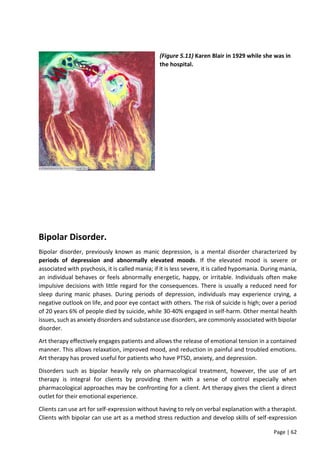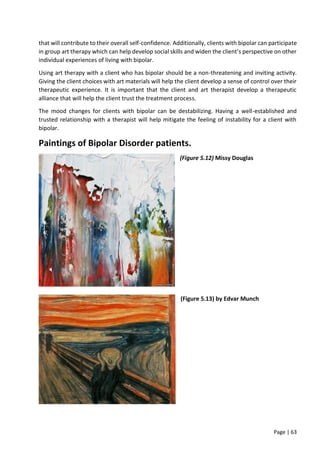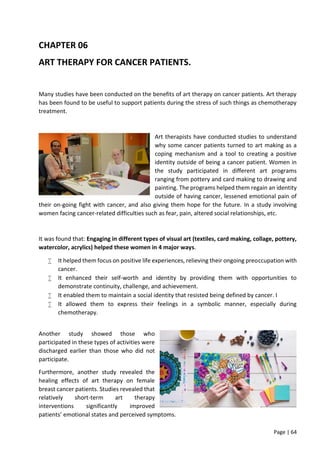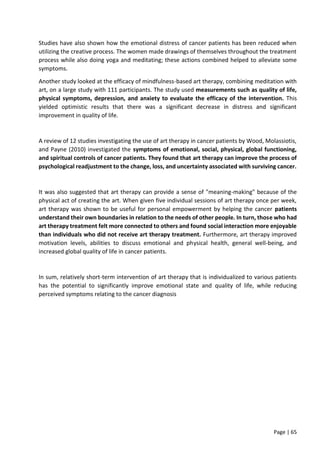
Gayani Neranjana Liyanage.
Faculty of Medicine University of KDU.
Batch 33 /B.
D/MBBS/15A/0043.
Page | 1
ACKNOWLEDGEMENT.
Art therapy is a form of psychotherapy that promotes creative self-expression on a symbolic level,
through the creative use of art media that leads to the safe expression of emotions and internal
conflicts. Art is used as a medium of communication between the client and the therapist in order
to improve physical, mental, and emotional well-being.
In this report am doing self-study regarding art therapy and present my report. As a medical student
and art lover I choose this topic and I hope this knowledge will help me in my future carrier in many
ways. In my report I studied basically about fundamental basic of arts therapy, family therapy use
of arts therapy in healing psychiatric disorder in adult and children.
I would like to express my sincere thanks to Dr (Mrs) K.D Welikanda, Retired registrar in Psychiatric,
based hospital Homagama for her generous and relentless, fervent support and also give
appreciation to my parents and husband for their endless support.
Page | 2
CONTENT
CHAPTER 01……………………………………………………..Page 03
Basic of Art Therapy.
 What is Art Therapy?
 Use of Art Therapy.
 History of Art Therapy.
 Role of Art Therapist.
 A Typical Art Therapy Session.
 Art Therapy Room.
 Art Therapy Assessments.
CHAPTER 02……………………………………………………. Page 20
Art Therapy with Children.
 Drawing conclusion from children’s Art.
 History.
 Art Therapy Activities for Children.
 Art Therapy for Children with Autism.
CHAPTER 03…………………………………………….……….Page 35
Art Therapy with adolescent.
 Adolescent Depression.
 Abuse and Secret.
 Art Therapy Activates for Adolescent.
CHAPTER 04…………………………….…………..…………..Page 46
Family Art Therapy
CHAPTER 05……………………………………………………..Page 54
Art Therapy and Mental Disorders.
 Schizophrenia.
 Bipolar disorder.
CHAPTER 06 …………………………………………………….Page 64
Art therapy for cancer Patients
Page | 3
CHAPTER 01
BASIC OF ART THERAPY.
What Is Art Therapy?
A Definition
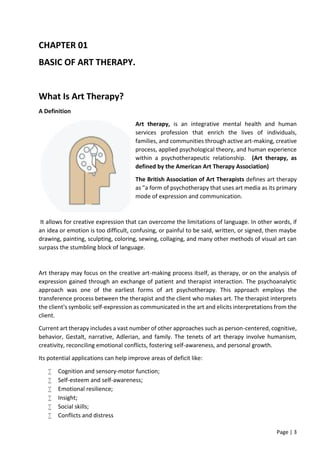
Art therapy, is an integrative mental health and human
services profession that enrich the lives of individuals,
families, and communities through active art-making, creative
process, applied psychological theory, and human experience
within a psychotherapeutic relationship. (Art therapy, as
defined by the American Art Therapy Association)
The British Association of Art Therapists defines art therapy
as "a form of psychotherapy that uses art media as its primary
mode of expression and communication.
It allows for creative expression that can overcome the limitations of language. In other words, if
an idea or emotion is too difficult, confusing, or painful to be said, written, or signed, then maybe
drawing, painting, sculpting, coloring, sewing, collaging, and many other methods of visual art can
surpass the stumbling block of language.
Art therapy may focus on the creative art-making process itself, as therapy, or on the analysis of
expression gained through an exchange of patient and therapist interaction. The psychoanalytic
approach was one of the earliest forms of art psychotherapy. This approach employs the
transference process between the therapist and the client who makes art. The therapist interprets
the client's symbolic self-expression as communicated in the art and elicits interpretations from the
client.
Current art therapy includes a vast number of other approaches such as person-centered, cognitive,
behavior, Gestalt, narrative, Adlerian, and family. The tenets of art therapy involve humanism,
creativity, reconciling emotional conflicts, fostering self-awareness, and personal growth.
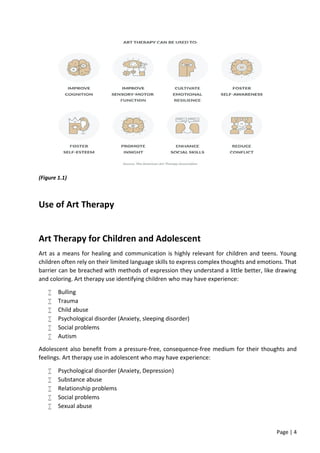
Its potential applications can help improve areas of deficit like:
 Cognition and sensory-motor function;
 Self-esteem and self-awareness;
 Emotional resilience;
 Insight;
 Social skills;
 Conflicts and distress
Page | 4
(Figure 1.1)
Use of Art Therapy
Art Therapy for Children and Adolescent
Art as a means for healing and communication is highly relevant for children and teens. Young
children often rely on their limited language skills to express complex thoughts and emotions. That
barrier can be breached with methods of expression they understand a little better, like drawing
and coloring. Art therapy use identifying children who may have experience:
 Bulling
 Trauma
 Child abuse
 Psychological disorder (Anxiety, sleeping disorder)
 Social problems
 Autism
Adolescent also benefit from a pressure-free, consequence-free medium for their thoughts and
feelings. Art therapy use in adolescent who may have experience:
 Psychological disorder (Anxiety, Depression)
 Substance abuse
 Relationship problems
 Social problems
 Sexual abuse
Page | 5
Family Art Psychotherapy
Denial of impulses and suppression of feeling are the root of family problems. Dysfunctional families
have:
 fearful of conflict
 Cling to routines
 Lack of warmth
 Parents find children to be annoying/children don’t respect themselves or parents
The use of art and creativity may lead to greater self-knowledge. Accessing creativity may be helpful
in identifying emotional issues and can help in the healing process. Art therapy is a serious
technique that uses the creative process to help improve the mental health of family member. Art
therapy can be used on children and adults to treat a wide range of emotional issues.
Art Therapy in Mental Disorders.
Art therapy is a therapeutic technique rooted in the idea that creative expression can foster healing
and mental well-being. Art, either the process of creating it or viewing others' artworks, is used to
help people explore their emotions, develop self-awareness, cope with stress, boost self-esteem,
and work on social skills. Art can be an effective tool in mental health treatment. Some conditions
that art therapy may be used to treat include:
 Anxiety
 Depression
 Emotional difficulties
 Eating disorders
 Substance use
 Schizophrenia, Bipolar disease like psychiatric disorders
 Stress
 Post-Traumatic stress Disorder
Art Therapy in Chronic Medical Conditions.
Art therapy is a powerful tool involving the use of artistic ways of expression for physical and mental
healing as well as the improvement of perception and cognitive functions. Art therapies are used
to face the existence of life and death in serious diseases such as cancer and other chronic medical
disease, and visually express certain deeply-hidden feelings, such as fear and hope, by stimulating
the memory. Through art therapy, cancer patients can express themselves with no need for talent,
when they fall short of words. The primary goal is to reveal the feelings of cancer patients and help
them be happy.
Page | 6
History of Art Therapy
Art therapy as a profession began in the mid-20th century, arising independently in English-speaking
and European countries. The early art therapists who published accounts of their work
acknowledged the influence of aesthetics, psychiatry, psychoanalysis, rehabilitation, early
childhood education, and art education, to varying degrees, on their practices.
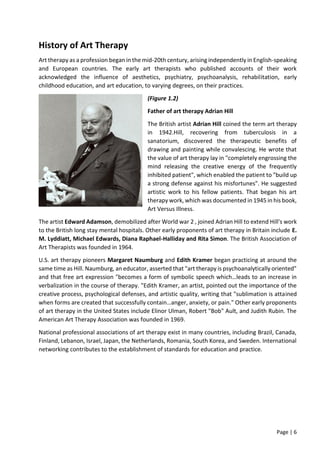
(Figure 1.2)
Father of art therapy Adrian Hill
The British artist Adrian Hill coined the term art therapy
in 1942.Hill, recovering from tuberculosis in a
sanatorium, discovered the therapeutic benefits of
drawing and painting while convalescing. He wrote that
the value of art therapy lay in "completely engrossing the
mind releasing the creative energy of the frequently
inhibited patient", which enabled the patient to "build up
a strong defense against his misfortunes". He suggested
artistic work to his fellow patients. That began his art
therapy work, which was documented in 1945 in his book,
Art Versus Illness.
The artist Edward Adamson, demobilized after World war 2 , joined Adrian Hill to extend Hill's work
to the British long stay mental hospitals. Other early proponents of art therapy in Britain include E.
M. Lyddiatt, Michael Edwards, Diana Raphael-Halliday and Rita Simon. The British Association of
Art Therapists was founded in 1964.
U.S. art therapy pioneers Margaret Naumburg and Edith Kramer began practicing at around the
same time as Hill. Naumburg, an educator, asserted that "art therapy is psychoanalytically oriented"
and that free art expression "becomes a form of symbolic speech which…leads to an increase in
verbalization in the course of therapy. "Edith Kramer, an artist, pointed out the importance of the
creative process, psychological defenses, and artistic quality, writing that "sublimation is attained
when forms are created that successfully contain…anger, anxiety, or pain." Other early proponents
of art therapy in the United States include Elinor Ulman, Robert "Bob" Ault, and Judith Rubin. The
American Art Therapy Association was founded in 1969.
National professional associations of art therapy exist in many countries, including Brazil, Canada,
Finland, Lebanon, Israel, Japan, the Netherlands, Romania, South Korea, and Sweden. International
networking contributes to the establishment of standards for education and practice.
Page | 7
Role of Art Therapist
Art therapist are trained in both therapy and art, and have studied and mastered both psychology
and human development, having received a Master’s Degree. There are various requirements for
becoming an art therapist as well as certifications which means they are masters when it comes to
using art as a springboard for everything from a general assessment of another person’s state to
treatment for aiding serious illness. Art therapists can work with people of all ages, sex, creed, et
al. They can help an individual, a couple, a family, or groups of people and depending on the
situation, there may be numerous therapists working together as a clinical team.
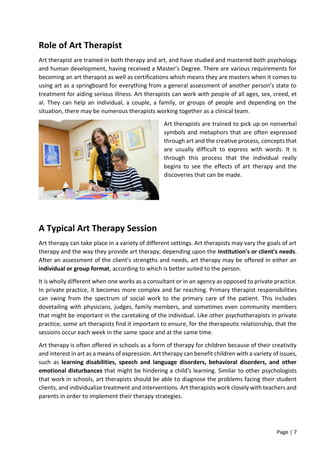
Art therapists are trained to pick up on nonverbal
symbols and metaphors that are often expressed
through art and the creative process, concepts that
are usually difficult to express with words. It is
through this process that the individual really
begins to see the effects of art therapy and the
discoveries that can be made.
A Typical Art Therapy Session
Art therapy can take place in a variety of different settings. Art therapists may vary the goals of art
therapy and the way they provide art therapy, depending upon the institution's or client's needs.
After an assessment of the client's strengths and needs, art therapy may be offered in either an
individual or group format, according to which is better suited to the person.
It is wholly different when one works as a consultant or in an agency as opposed to private practice.
In private practice, it becomes more complex and far reaching. Primary therapist responsibilities
can swing from the spectrum of social work to the primary care of the patient. This includes
dovetailing with physicians, judges, family members, and sometimes even community members
that might be important in the caretaking of the individual. Like other psychotherapists in private
practice, some art therapists find it important to ensure, for the therapeutic relationship, that the
sessions occur each week in the same space and at the same time.
Art therapy is often offered in schools as a form of therapy for children because of their creativity
and interest in art as a means of expression. Art therapy can benefit children with a variety of issues,
such as learning disabilities, speech and language disorders, behavioral disorders, and other
emotional disturbances that might be hindering a child's learning. Similar to other psychologists
that work in schools, art therapists should be able to diagnose the problems facing their student
clients, and individualize treatment and interventions. Art therapists work closely with teachers and
parents in order to implement their therapy strategies.
Page | 8
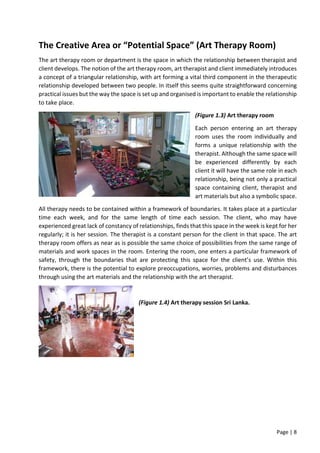
The Creative Area or “Potential Space” (Art Therapy Room)
The art therapy room or department is the space in which the relationship between therapist and
client develops. The notion of the art therapy room, art therapist and client immediately introduces
a concept of a triangular relationship, with art forming a vital third component in the therapeutic
relationship developed between two people. In itself this seems quite straightforward concerning
practical issues but the way the space is set up and organised is important to enable the relationship
to take place.
(Figure 1.3) Art therapy room
Each person entering an art therapy
room uses the room individually and
forms a unique relationship with the
therapist. Although the same space will
be experienced differently by each
client it will have the same role in each
relationship, being not only a practical
space containing client, therapist and
art materials but also a symbolic space.
All therapy needs to be contained within a framework of boundaries. It takes place at a particular
time each week, and for the same length of time each session. The client, who may have
experienced great lack of constancy of relationships, finds that this space in the week is kept for her
regularly; it is her session. The therapist is a constant person for the client in that space. The art
therapy room offers as near as is possible the same choice of possibilities from the same range of
materials and work spaces in the room. Entering the room, one enters a particular framework of
safety, through the boundaries that are protecting this space for the client’s use. Within this
framework, there is the potential to explore preoccupations, worries, problems and disturbances
through using the art materials and the relationship with the art therapist.
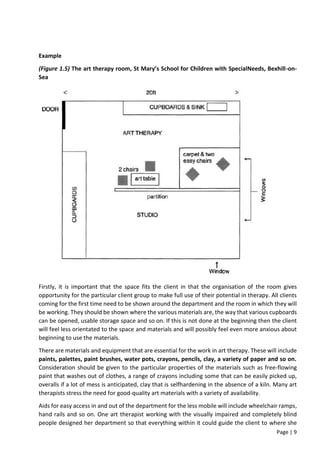
(Figure 1.4) Art therapy session Sri Lanka.
Page | 9
Example
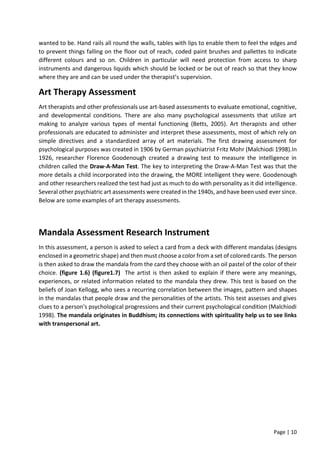
(Figure 1.5) The art therapy room, St Mary’s School for Children with SpecialNeeds, Bexhill-on-
Sea
Firstly, it is important that the space fits the client in that the organisation of the room gives
opportunity for the particular client group to make full use of their potential in therapy. All clients
coming for the first time need to be shown around the department and the room in which they will
be working. They should be shown where the various materials are, the way that various cupboards
can be opened, usable storage space and so on. If this is not done at the beginning then the client
will feel less orientated to the space and materials and will possibly feel even more anxious about
beginning to use the materials.
There are materials and equipment that are essential for the work in art therapy. These will include
paints, palettes, paint brushes, water pots, crayons, pencils, clay, a variety of paper and so on.
Consideration should be given to the particular properties of the materials such as free-flowing
paint that washes out of clothes, a range of crayons including some that can be easily picked up,
overalls if a lot of mess is anticipated, clay that is selfhardening in the absence of a kiln. Many art
therapists stress the need for good-quality art materials with a variety of availability.
Aids for easy access in and out of the department for the less mobile will include wheelchair ramps,
hand rails and so on. One art therapist working with the visually impaired and completely blind
people designed her department so that everything within it could guide the client to where she
Page | 10
wanted to be. Hand rails all round the walls, tables with lips to enable them to feel the edges and
to prevent things falling on the floor out of reach, coded paint brushes and pallettes to indicate
different colours and so on. Children in particular will need protection from access to sharp
instruments and dangerous liquids which should be locked or be out of reach so that they know
where they are and can be used under the therapist’s supervision.
Art Therapy Assessment
Art therapists and other professionals use art-based assessments to evaluate emotional, cognitive,
and developmental conditions. There are also many psychological assessments that utilize art
making to analyze various types of mental functioning (Betts, 2005). Art therapists and other
professionals are educated to administer and interpret these assessments, most of which rely on
simple directives and a standardized array of art materials. The first drawing assessment for
psychological purposes was created in 1906 by German psychiatrist Fritz Mohr (Malchiodi 1998).In
1926, researcher Florence Goodenough created a drawing test to measure the intelligence in
children called the Draw-A-Man Test. The key to interpreting the Draw-A-Man Test was that the
more details a child incorporated into the drawing, the MORE intelligent they were. Goodenough
and other researchers realized the test had just as much to do with personality as it did intelligence.
Several other psychiatric art assessments were created in the 1940s, and have been used ever since.
Below are some examples of art therapy assessments.
Mandala Assessment Research Instrument
In this assessment, a person is asked to select a card from a deck with different mandalas (designs
enclosed in a geometric shape) and then must choose a color from a set of colored cards. The person
is then asked to draw the mandala from the card they choose with an oil pastel of the color of their
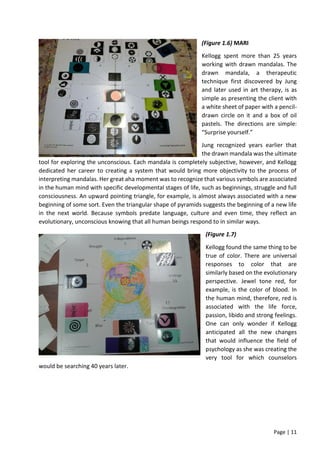
choice. (figure 1.6) (figure1.7) The artist is then asked to explain if there were any meanings,
experiences, or related information related to the mandala they drew. This test is based on the
beliefs of Joan Kellogg, who sees a recurring correlation between the images, pattern and shapes
in the mandalas that people draw and the personalities of the artists. This test assesses and gives
clues to a person's psychological progressions and their current psychological condition (Malchiodi
1998). The mandala originates in Buddhism; its connections with spirituality help us to see links
with transpersonal art.
Page | 11
(Figure 1.6) MARI
Kellogg spent more than 25 years
working with drawn mandalas. The
drawn mandala, a therapeutic
technique first discovered by Jung
and later used in art therapy, is as
simple as presenting the client with
a white sheet of paper with a pencil-
drawn circle on it and a box of oil
pastels. The directions are simple:
“Surprise yourself.”
Jung recognized years earlier that
the drawn mandala was the ultimate
tool for exploring the unconscious. Each mandala is completely subjective, however, and Kellogg
dedicated her career to creating a system that would bring more objectivity to the process of
interpreting mandalas. Her great aha moment was to recognize that various symbols are associated
in the human mind with specific developmental stages of life, such as beginnings, struggle and full
consciousness. An upward pointing triangle, for example, is almost always associated with a new
beginning of some sort. Even the triangular shape of pyramids suggests the beginning of a new life
in the next world. Because symbols predate language, culture and even time, they reflect an
evolutionary, unconscious knowing that all human beings respond to in similar ways.
(Figure 1.7)
Kellogg found the same thing to be
true of color. There are universal
responses to color that are
similarly based on the evolutionary
perspective. Jewel tone red, for
example, is the color of blood. In
the human mind, therefore, red is
associated with the life force,
passion, libido and strong feelings.
One can only wonder if Kellogg
anticipated all the new changes
that would influence the field of
psychology as she was creating the
very tool for which counselors
would be searching 40 years later.
Page | 12
House–Tree–Person Test
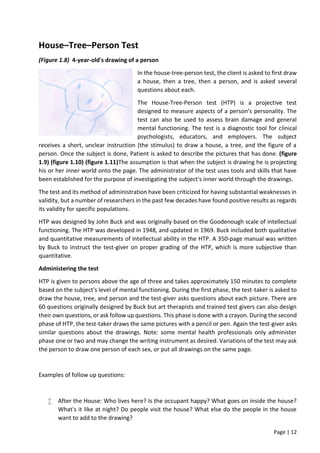
(Figure 1.8) 4-year-old's drawing of a person
In the house-tree-person test, the client is asked to first draw
a house, then a tree, then a person, and is asked several
questions about each.
The House-Tree-Person test (HTP) is a projective test
designed to measure aspects of a person’s personality. The
test can also be used to assess brain damage and general
mental functioning. The test is a diagnostic tool for clinical
psychologists, educators, and employers. The subject
receives a short, unclear instruction (the stimulus) to draw a house, a tree, and the figure of a
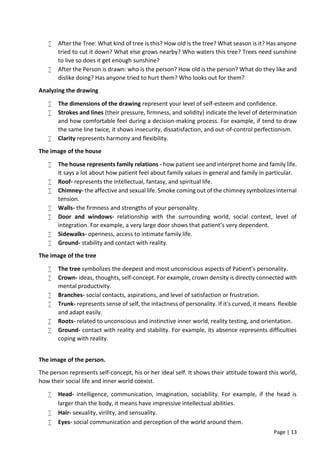
person. Once the subject is done, Patient is asked to describe the pictures that has done. (figure
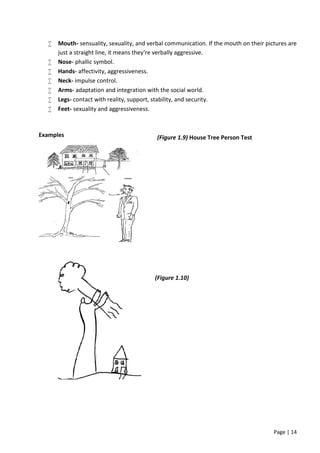
1.9) (figure 1.10) (figure 1.11)The assumption is that when the subject is drawing he is projecting
his or her inner world onto the page. The administrator of the test uses tools and skills that have
been established for the purpose of investigating the subject's inner world through the drawings.
The test and its method of administration have been criticized for having substantial weaknesses in
validity, but a number of researchers in the past few decades have found positive results as regards
its validity for specific populations.
HTP was designed by John Buck and was originally based on the Goodenough scale of intellectual
functioning. The HTP was developed in 1948, and updated in 1969. Buck included both qualitative
and quantitative measurements of intellectual ability in the HTP. A 350-page manual was written
by Buck to instruct the test-giver on proper grading of the HTP, which is more subjective than
quantitative.
Administering the test
HTP is given to persons above the age of three and takes approximately 150 minutes to complete
based on the subject's level of mental functioning. During the first phase, the test-taker is asked to
draw the house, tree, and person and the test-giver asks questions about each picture. There are
60 questions originally designed by Buck but art therapists and trained test givers can also design
their own questions, or ask follow up questions. This phase is done with a crayon. During the second
phase of HTP, the test-taker draws the same pictures with a pencil or pen. Again the test-giver asks
similar questions about the drawings. Note: some mental health professionals only administer
phase one or two and may change the writing instrument as desired. Variations of the test may ask
the person to draw one person of each sex, or put all drawings on the same page.
Examples of follow up questions:
 After the House: Who lives here? Is the occupant happy? What goes on inside the house?
What's it like at night? Do people visit the house? What else do the people in the house
want to add to the drawing?
Page | 13
 After the Tree: What kind of tree is this? How old is the tree? What season is it? Has anyone
tried to cut it down? What else grows nearby? Who waters this tree? Trees need sunshine
to live so does it get enough sunshine?
 After the Person is drawn: who is the person? How old is the person? What do they like and
dislike doing? Has anyone tried to hurt them? Who looks out for them?
Analyzing the drawing
 The dimensions of the drawing represent your level of self-esteem and confidence.
 Strokes and lines (their pressure, firmness, and solidity) indicate the level of determination
and how comfortable feel during a decision-making process. For example, if tend to draw
the same line twice, it shows insecurity, dissatisfaction, and out-of-control perfectionism.
 Clarity represents harmony and flexibility.
The image of the house
 The house represents family relations - how patient see and interpret home and family life.
It says a lot about how patient feel about family values in general and family in particular.
 Roof- represents the intellectual, fantasy, and spiritual life.
 Chimney- the affective and sexual life. Smoke coming out of the chimney symbolizes internal
tension.
 Walls- the firmness and strengths of your personality.
 Door and windows- relationship with the surrounding world, social context, level of
integration. For example, a very large door shows that patient’s very dependent.
 Sidewalks- openness, access to intimate family life.
 Ground- stability and contact with reality.
The image of the tree
 The tree symbolizes the deepest and most unconscious aspects of Patient’s personality.
 Crown- ideas, thoughts, self-concept. For example, crown density is directly connected with
mental productivity.
 Branches- social contacts, aspirations, and level of satisfaction or frustration.
 Trunk- represents sense of self, the intactness of personality. If it's curved, it means flexible
and adapt easily.
 Roots- related to unconscious and instinctive inner world, reality testing, and orientation.
 Ground- contact with reality and stability. For example, its absence represents difficulties
coping with reality.
The image of the person.
The person represents self-concept, his or her ideal self. It shows their attitude toward this world,
how their social life and inner world coexist.
 Head- intelligence, communication, imagination, sociability. For example, if the head is
larger than the body, it means have impressive intellectual abilities.
 Hair- sexuality, virility, and sensuality.
 Eyes- social communication and perception of the world around them.
Page | 14
 Mouth- sensuality, sexuality, and verbal communication. If the mouth on their pictures are
just a straight line, it means they're verbally aggressive.
 Nose- phallic symbol.
 Hands- affectivity, aggressiveness.
 Neck- impulse control.
 Arms- adaptation and integration with the social world.
 Legs- contact with reality, support, stability, and security.
 Feet- sexuality and aggressiveness.
Examples (Figure 1.9) House Tree Person Test
(Figure 1.10)
Page | 15
Outsider art
Outsider art is art by self-taught or naïve art makers. Typically, those labeled as outsider artists have
little or no contact with the mainstream art world or art institutions. In many cases, their work is
discovered only after their deaths. Often, outsider art illustrates extreme mental states,
unconventional ideas, or elaborate fantasy worlds.
The term outsider art was coined by art critic Roger Cardinal in 1972 as an English synonym for art
brut "raw art" or "rough art", a label created by French artist Jean Dubuffet to describe art created
outside the boundaries of official culture; Dubuffet focused particularly on art by those on the
outside of the established art scene, using as examples psychiatric hospital patients and children.
The work of Dr Morganthaler documented his patient Adolf Wolfli, a genius who produced
countless thousands of works from a small cell in his Swiss asylum. Dr Hans Prinzhorn collected
thousands of works by psychiatric patients and his book “Bildernerei der Geisteskranken” (Artistry
of the Mentally Ill), published in 1922 became an influential work amongst Surrealist and other
artists of the time.
Examples
(Figure 1.12) by Jean Dubuffet 1947
The art of children, psychiatric patients and prisoners who create
art outwith the conventional structures of art training and art
production is often categorised as outsider art. In 1964 the French
artist Jean Dubuffet started to collect artworks he considered to
be free from societal constraints. This was termed art brut (raw
art) – another term for outsider art – and in 1948 he founded the
Compagnie de L’Art Brut with André Breton.
(Figure 1.11)
Page | 16
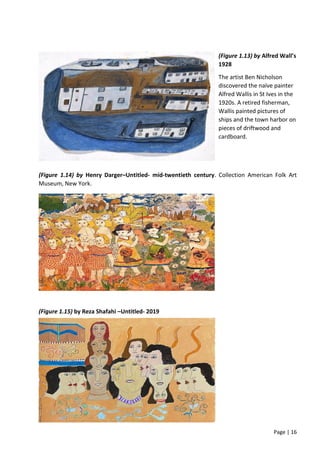
(Figure 1.13) by Alfred Wall’s
1928
The artist Ben Nicholson
discovered the naïve painter
Alfred Wallis in St Ives in the
1920s. A retired fisherman,
Wallis painted pictures of
ships and the town harbor on
pieces of driftwood and
cardboard.
(Figure 1.14) by Henry Darger–Untitled- mid-twentieth century. Collection American Folk Art
Museum, New York.
(Figure 1.15) by Reza Shafahi –Untitled- 2019
Page | 17
Diagnostic Drawing Series
The Diagnostic Drawing Series (DDS) is one of the four major art therapy assessments and is a
standardized art therapy evaluation tool. It relies on the use of art materials to express emotion,
combining a deep understanding of the creative process and how it works, with other
psychotherapeutic techniques to help increase insight and awareness of the issues, help improve
the patient’s judgment, cope with stress, work through events that have been traumatic, and
embrace creativity to become familiar with the art of self-expression. This is one of the most
commonly used art therapy assessments and is the most concentrated area of research in the field
of art therapy.
The DDS was developed in 1982 by two art therapists: Barry M. Cohen and Barbara Lesowitz. It was
first presented at the annual American Art Therapy Association conference in 1983 as a pilot study
but was granted the Research Award by the association the same year for its multicenter
collaborative design.
Method
This is a three-part assessment where patients use pastel-colored chalk and a piece of 18”x24”
paper. Each part of the assessment has a fifteen-minute time limit.
 In the first part of the assessment, patients are free to draw whatever comes to mind to let
them become comfortable in the setting and in drawing.
 The second part of the assessment involves the patient drawing a tree.
 The third part of the assessment, the patient is asked to draw how they feel by using color,
lines and shapes.
Each of the three pictures in the Series can be rated using the DDS Rating Guide for the presence of
a total of 23 criteria. These descriptive, primarily structural, criteria, defined in the Rating Guide
(Cohen, 1986/1994), lead the rater toward an empirical (rather than intuitive) graphic profile of the
art.
DDSs can be collected individually and in groups, and can be administered to a client repeatedly
over time. The varied task structure of a DDS elicits valuable content, structural, and process
information that—together—can inform clinicians as to the strengths and psychopathology of the
subject. It also provides a rich source of material for treatment planning.
The DDS was designed by art therapists for use by art therapists. However, the DDS may be
administered by any mental health professional or trainee who has read the Handbook and is
prepared to follow its protocol. It is possible for individuals to train themselves to rate and render
interpretations accurately by painstaking study of the Rating Guide and the existing research on the
DDS. However, participation in a two-day training on the DDS taught by an approved DDS trainer is
highly recommended due to the practical difficulties posed by self-study.
Page | 18
Examples
 Drawing one - "Make a picture using these materials" (figure 1.16)
May gauge what and how much info client will share, and is a representation of client's defense
mechanisms, i.e. stereotypic imagery, coping mechanisms in response to stress.
(Figure 1.16)
 Drawing two - "Draw a picture of a tree" (figure 1.17)
Welcomed because prompt is more directive, defenses may lower. The tree may "be viewed as
a symbolic self-portrait, displaying one's vegetative and/or psychic state," or a representation
of the self-according to Carl Jung. Structure of this task may reveal strengths in some clients
while revealing weaknesses in others.
(Figure 1.17)
Page | 19
 Drawing three - "Make a picture of how you are feeling using lines, shapes, and colors" (figure
1.18)
Task allows for great latitude of expression despite specificity of wording of the directive. May
produce images ranging from abstract to representational, highly personal to stereotypic or
mundane. Requires more thoughtfulness and control than second drawing but also provides
outlet for emotional release and closure.
(Figure 1.18)
What to look for in DDS drawings
According to Mills, Cohen, and Meneses, (1993) the DDS has:
o very good inter-rater reliability for the diagnostic rating tool
o good procedural validity compared to existing diagnostic tools
o Behaviors and appearance
o Use of art material
o Formal elements
o Use of space
o Line quality
o Color
o Abstract or representational
o Drawings examined progressively and as a complete series
Designed by art therapists in 1983, the Diagnostic Drawing Series (DDS) is a three-picture art
interview that focuses on the structure of drawings not content.
Page | 20
CHAPTER 02
ART THERAPY WITH CHILDREN.
Children can often benefit from Art therapy, especially if they have mental health problems or
disabilities, they may find it scary or difficult to properly express themselves in a clinical setting.
This is particularly true for young children who generally have limited vocabularies and those that
don’t speak the primary language in the country where they live. In addition to or standard therapy
methods, kids can use art to communicating their thoughts and feelings to the adults who want
to help them deal with their life challenges.
Children are naturally creative, and it is usually easier for them to draw a picture as opposed to
answering questions directly. They may be reluctant or even hostile about discussing certain topics.
Creating artwork is a non-threatening venue that allows kids to tackle tough issues in a creative
way. Talking to the children about their drawings or paintings and helping them interpret the art
can provide therapists with the opening they need to get at the heart of the problems affecting
their young patients.
Art therapy can be used to assist children with a number of issues including:
 Death of a family member or friend.
 Childhood trauma involving physical, mental, or sexual abuse.
 Learning disabilities.
 Emotional issues like fear of abandonment or phobias.
 Improve cognitive abilities.
 Deal with the challenges of serious diseases like cancer.
 Treating mental disorders such as schizophrenia or depression.
 Help children understand and deal with physical disabilities.
 Understand and treat behavioral problems.
In addition to these challenges, art therapy can
help children relieve stress, increase awareness
of self, and develop healthy and effective coping
skills. Children of all ages, nationalities, races
and cultures can benefit from art therapy.
Programs are developed around a child’s
strengths and abilities, so the kid can use the
medium even if he or she has never picked up a
crayon before.
Page | 21
Drawing conclusions from children’s art.
When we look at a child’s drawing we may see a collection of scribbles, or a clear representation of
reality. We may simply enjoy the range of shapes and colors before us, or we may look for personal
meaning to the child artist or to ourselves.
And meaning may or may not be there: children’s drawings fulfil a variety of purposes (Thomas
& Silk, 1990).
Children draw to decorate a wall or simply to bring pleasure to themselves and the viewer; but they
also draw to express feelings, to show others how they feel about people and objects in their lives.
At least by the late 1930s, as seen in the work of Lowenfeld (1939, 1947)1, some researchers were
coming round to the idea that children’s drawings were not just representations from life that
varied in realism or served as measures of intelligence (Goodenough,1926)2. The drawing of a
human figure, in particular, began to be regarded as a way in which children expressed something
about themselves. This ‘body-image’ assumption laid the base of formal tests of the child’s
personality (The Machover Draw-a-Person Test: Machover, 1951) and current emotional state
(Koppitz, 1968). Other tests, such as the Kinetic Family Drawing Test and the House-Tree-Person
test, claimed to measure how children felt about the topics in the drawing and their wider
environment. Unfortunately, research studies assessing the reliability and validity of these tests fell
short of what was needed for them to be trusted (Swenson, 1968; Thomas & Jolley, 1998)3.
However, recent research is beginning to provide evidence that children’s feelings do come out in
their drawings. Children may not display their feelings in consistent and reliable ways in their
drawings (a possibility that diagnostic tests rely on), but this doesn’t mean that they don’t draw
their feelings at all. However, by focusing on particular drawing properties, such as drawing size
and color, research is beginning to show that children’s feelings about drawing figures can be
investigated systematically. But there are also factors that need to be borne in mind before jumping
to a conclusion about the emotional meaning of children’s drawings.
Page | 22
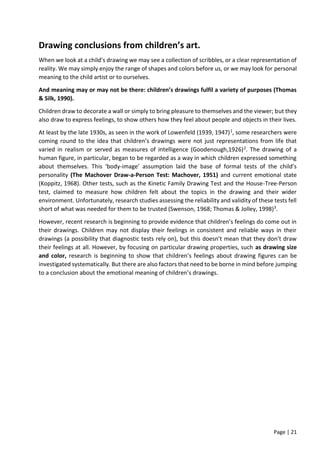
Figure size
(Figure 2.1)
There is a long research tradition on whether
children show how they feel about the topics they
draw through alterations in the size of significant
figures. However, some of the research has
neglected to find out how the children feel about
the topics independently from the drawings
themselves, and studies in the area have used
varying methodologies that cannot be easily
compared. There has been some confusion about
exactly what aspect of emotion children convey
when they draw a large figure or a small figure, and
what mechanisms influence these changes in scale.
Recent research is beginning to show that “ if a
child regards a figure as happy and feels positively
towards that figure, or indeed regards the figure as socially important, they will generally increase
the size relative to a figure towards which they hold neutral or negative affect, or which they
regard as less socially salient” (Aronsson & Andersson, 1996; Burkitt et al., 2003b, 2004).
This may be because children have learnt to depict positive topics in a large scale or because they
are trying to increase the pleasantness of the drawn topic. However, we do know this trend is not
dependent on children simply increasing the size of their drawings to include more details (Burkitt
et al., 2004). Children do not show negative feelings towards topics in quite as reliable a way.
“There is mixed evidence to suggest that an unpleasant or sad figure will be reduced in size “
(Burkitt et al., 2003a, 2003b; Fox & Thomas, 1990; Jolley, 1995; Jolley & Vulic-Prtoric, 2001;
Thomas et al., 1989).
Color
Color–emotion associations have been well documented, but very little has been done to assess
the personal meaning of colors in relation to drawing production. Children’s drawings are often
viewed as cheerful and positive when figures are depicted in bright, bold primary and secondary
colors. Conversely, when a child draws in black or dark purples and browns, it is tempting to
conclude that the child may be personally distressed about the scenes they are drawing. Such
premises still guide the use of chromatic and nonchromatic assessments of personality and
emotional states (Hammer, 1997).
Whilst these notions may be true for some children, we know that when children are asked to depict
figures they feel positively or negatively towards, they select colors in relation not only to the
emotional valence of the drawing topics, but to how they feel about the colors themselves.
For example, a child who draws a person using dark purple is not necessarily revealing a negative
attitude towards them; if that child favours dark purple they could be showing how much they like
the figure and the color they have used.
Page | 23
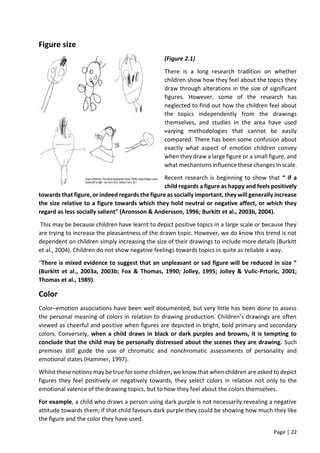
(Figure 2.2) shows drawings of 6 years old child.
Figure 1 shows drawings of a nicely, neutrally and a nastily described man drawn by the same six-
year-old child. The child’s color preferences, which were taken into account in a counterbalanced
testing session, revealed that the child liked the color used for the nice man more than the color
used for the baseline and nasty man.
The use of some colors for the depiction of liked or disliked topics seems to occur across cultures,
whereas other colors are used very differently between educational and cultural groups. This is
hardly surprising if we take the view that children learn conventional color–affect rules from
important cultural influences:
For example, that the baddies wear black. In fact, the use of darker colors to depict topics that the
child artist feels negatively about seems to be fairly consistent across varying educational and
cultural groups.
The Draw-a-Man Test
It is a psychological personality and cognitive test used to evaluate children and adolescents for a
variety of purposes (measuring nonverbal intelligence, screening emotional and behavioral
disorders). It is a test where the subject is asked to draw a picture of a man, a woman, and
themselves. No further instructions are given and the pictures are analyzed on a number of
dimensions.
Page | 24
History
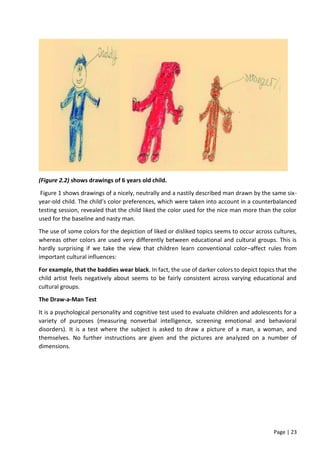
(Figure 2.3)
Developed by Florence Goodenough (1926). Goodenough first
became interested in figure drawing when she wanted to find a
way to supplement the (Stanford- Binet intelligence test) with a
non- verbal measure.
She concluded that the amount of detail involved in a child’s
drawing could be used as an effective tool which led to the
development of the first official assessment using figure drawing,
the draw- a- man test.
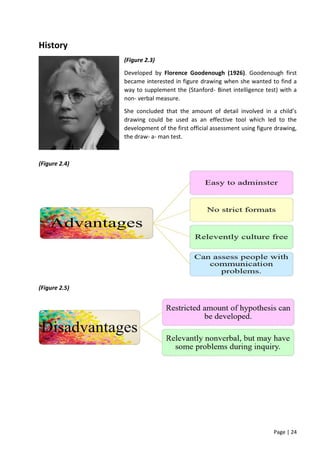
(Figure 2.4)
(Figure 2.5)
Page | 25
Administration
Directions:
“I want you to make a picture of a person. Make the very best picture that you can. Take your time
and work very carefully. Try very hard and see what a good picture you can make.” (The
administrator may ask the children to include the name, age, feelings or what is his/ her drawing is
doing at the moment).
Time:
No time limits. Usually 10 minutes will suffice with young children.
Note:
The drawings of bright children more than 10 years old or those who have had drawing lessons will
result in an invalid evaluation of the child’s intellectual potential.
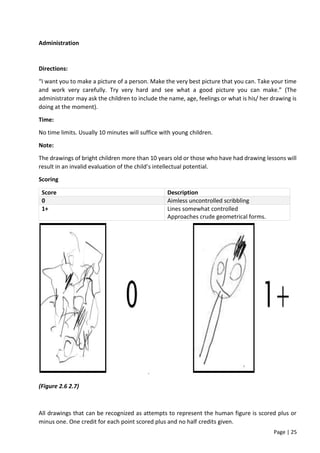
Scoring
Score Description
0 Aimless uncontrolled scribbling
1+ Lines somewhat controlled
Approaches crude geometrical forms.
(Figure 2.6 2.7)
All drawings that can be recognized as attempts to represent the human figure is scored plus or
minus one. One credit for each point scored plus and no half credits given.
Page | 26
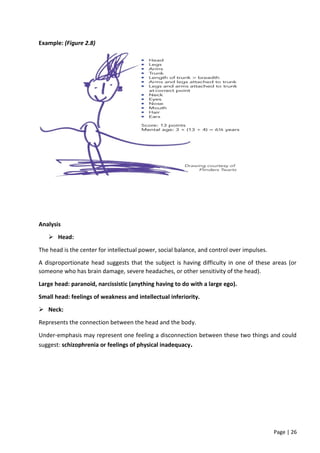
Example: (Figure 2.8)
Analysis
 Head:
The head is the center for intellectual power, social balance, and control over impulses.
A disproportionate head suggests that the subject is having difficulty in one of these areas (or
someone who has brain damage, severe headaches, or other sensitivity of the head).
Large head: paranoid, narcissistic (anything having to do with a large ego).
Small head: feelings of weakness and intellectual inferiority.
 Neck:
Represents the connection between the head and the body.
Under-emphasis may represent one feeling a disconnection between these two things and could
suggest: schizophrenia or feelings of physical inadequacy.
Page | 27
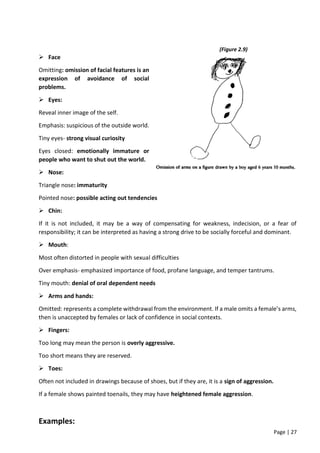
 Face
Omitting: omission of facial features is an
expression of avoidance of social
problems.
 Eyes:
Reveal inner image of the self.
Emphasis: suspicious of the outside world.
Tiny eyes- strong visual curiosity
Eyes closed: emotionally immature or
people who want to shut out the world.
 Nose:
Triangle nose: immaturity
Pointed nose: possible acting out tendencies
 Chin:
If it is not included, it may be a way of compensating for weakness, indecision, or a fear of
responsibility; it can be interpreted as having a strong drive to be socially forceful and dominant.
 Mouth:
Most often distorted in people with sexual difficulties
Over emphasis- emphasized importance of food, profane language, and temper tantrums.
Tiny mouth: denial of oral dependent needs
 Arms and hands:
Omitted: represents a complete withdrawal from the environment. If a male omits a female’s arms,
then is unaccepted by females or lack of confidence in social contexts.
 Fingers:
Too long may mean the person is overly aggressive.
Too short means they are reserved.
 Toes:
Often not included in drawings because of shoes, but if they are, it is a sign of aggression.
If a female shows painted toenails, they may have heightened female aggression.
Examples:
(Figure 2.9)
Page | 28
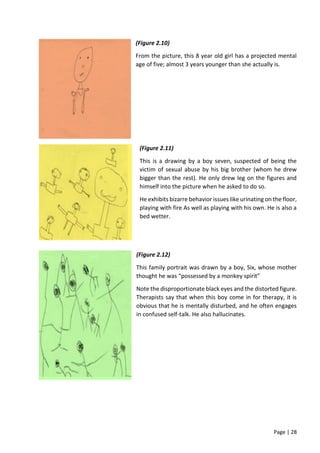
(Figure 2.10)
From the picture, this 8 year old girl has a projected mental
age of five; almost 3 years younger than she actually is.
(Figure 2.11)
This is a drawing by a boy seven, suspected of being the
victim of sexual abuse by his big brother (whom he drew
bigger than the rest). He only drew leg on the figures and
himself into the picture when he asked to do so.
He exhibits bizarre behavior issues like urinating on the floor,
playing with fire As well as playing with his own. He is also a
bed wetter.
(Figure 2.12)
This family portrait was drawn by a boy, Six, whose mother
thought he was “possessed by a monkey spirit”
Note the disproportionate black eyes and the distorted figure.
Therapists say that when this boy come in for therapy, it is
obvious that he is mentally disturbed, and he often engages
in confused self-talk. He also hallucinates.
Page | 29
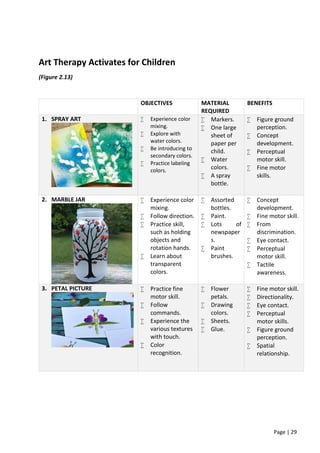
Art Therapy Activates for Children
(Figure 2.13)
OBJECTIVES MATERIAL
REQUIRED
BENEFITS
1. SPRAY ART  Experience color
mixing.
 Explore with
water colors.
 Be introducing to
secondary colors.
 Practice labeling
colors.
 Markers.
 One large
sheet of
paper per
child.
 Water
colors.
 A spray
bottle.
 Figure ground
perception.
 Concept
development.
 Perceptual
motor skill.
 Fine motor
skills.
2. MARBLE JAR  Experience color
mixing.
 Follow direction.
 Practice skill,
such as holding
objects and
rotation hands.
 Learn about
transparent
colors.
 Assorted
bottles.
 Paint.
 Lots of
newspaper
s.
 Paint
brushes.
 Concept
development.
 Fine motor skill.
 From
discrimination.
 Eye contact.
 Perceptual
motor skill.
 Tactile
awareness.
3. PETAL PICTURE  Practice fine
motor skill.
 Follow
commands.
 Experience the
various textures
with touch.
 Color
recognition.
 Flower
petals.
 Drawing
colors.
 Sheets.
 Glue.
 Fine motor skill.
 Directionality.
 Eye contact.
 Perceptual
motor skills.
 Figure ground
perception.
 Spatial
relationship.
Page | 30
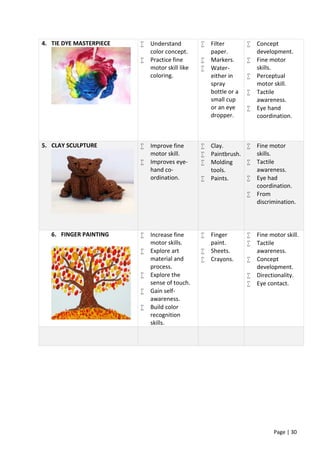
4. TIE DYE MASTERPIECE  Understand
color concept.
 Practice fine
motor skill like
coloring.
 Filter
paper.
 Markers.
 Water-
either in
spray
bottle or a
small cup
or an eye
dropper.
 Concept
development.
 Fine motor
skills.
 Perceptual
motor skill.
 Tactile
awareness.
 Eye hand
coordination.
5. CLAY SCULPTURE  Improve fine
motor skill.
 Improves eye-
hand co-
ordination.
 Clay.
 Paintbrush.
 Molding
tools.
 Paints.
 Fine motor
skills.
 Tactile
awareness.
 Eye had
coordination.
 From
discrimination.
6. FINGER PAINTING  Increase fine
motor skills.
 Explore art
material and
process.
 Explore the
sense of touch.
 Gain self-
awareness.
 Build color
recognition
skills.
 Finger
paint.
 Sheets.
 Crayons.
 Fine motor skill.
 Tactile
awareness.
 Concept
development.
 Directionality.
 Eye contact.
Page | 31
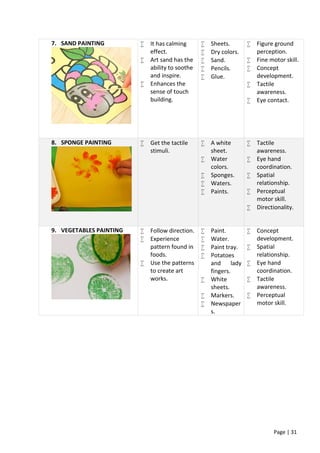
7. SAND PAINTING  It has calming
effect.
 Art sand has the
ability to soothe
and inspire.
 Enhances the
sense of touch
building.
 Sheets.
 Dry colors.
 Sand.
 Pencils.
 Glue.
 Figure ground
perception.
 Fine motor skill.
 Concept
development.
 Tactile
awareness.
 Eye contact.
8. SPONGE PAINTING  Get the tactile
stimuli.
 A white
sheet.
 Water
colors.
 Sponges.
 Waters.
 Paints.
 Tactile
awareness.
 Eye hand
coordination.
 Spatial
relationship.
 Perceptual
motor skill.
 Directionality.
9. VEGETABLES PAINTING  Follow direction.
 Experience
pattern found in
foods.
 Use the patterns
to create art
works.
 Paint.
 Water.
 Paint tray.
 Potatoes
and lady
fingers.
 White
sheets.
 Markers.
 Newspaper
s.
 Concept
development.
 Spatial
relationship.
 Eye hand
coordination.
 Tactile
awareness.
 Perceptual
motor skill.
Page | 32
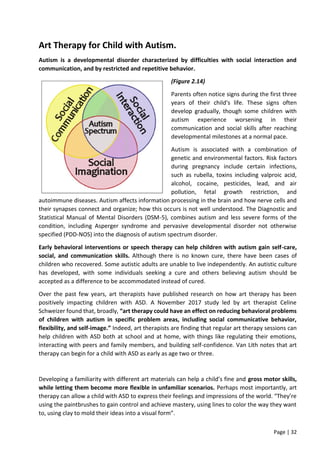
Art Therapy for Child with Autism.
Autism is a developmental disorder characterized by difficulties with social interaction and
communication, and by restricted and repetitive behavior.
(Figure 2.14)
Parents often notice signs during the first three
years of their child's life. These signs often
develop gradually, though some children with
autism experience worsening in their
communication and social skills after reaching
developmental milestones at a normal pace.
Autism is associated with a combination of
genetic and environmental factors. Risk factors
during pregnancy include certain infections,
such as rubella, toxins including valproic acid,
alcohol, cocaine, pesticides, lead, and air
pollution, fetal growth restriction, and
autoimmune diseases. Autism affects information processing in the brain and how nerve cells and
their synapses connect and organize; how this occurs is not well understood. The Diagnostic and
Statistical Manual of Mental Disorders (DSM-5), combines autism and less severe forms of the
condition, including Asperger syndrome and pervasive developmental disorder not otherwise
specified (PDD-NOS) into the diagnosis of autism spectrum disorder.
Early behavioral interventions or speech therapy can help children with autism gain self-care,
social, and communication skills. Although there is no known cure, there have been cases of
children who recovered. Some autistic adults are unable to live independently. An autistic culture
has developed, with some individuals seeking a cure and others believing autism should be
accepted as a difference to be accommodated instead of cured.
Over the past few years, art therapists have published research on how art therapy has been
positively impacting children with ASD. A November 2017 study led by art therapist Celine
Schweizer found that, broadly, “art therapy could have an effect on reducing behavioral problems
of children with autism in specific problem areas, including social communicative behavior,
flexibility, and self-image.” Indeed, art therapists are finding that regular art therapy sessions can
help children with ASD both at school and at home, with things like regulating their emotions,
interacting with peers and family members, and building self-confidence. Van Lith notes that art
therapy can begin for a child with ASD as early as age two or three.
Developing a familiarity with different art materials can help a child’s fine and gross motor skills,
while letting them become more flexible in unfamiliar scenarios. Perhaps most importantly, art
therapy can allow a child with ASD to express their feelings and impressions of the world. “They’re
using the paintbrushes to gain control and achieve mastery, using lines to color the way they want
to, using clay to mold their ideas into a visual form”.
Page | 33
In art therapy treatment of autistic children mainly focus on below components,
 Behavioral issues.
 Crisis or trauma.
 Loss and bereavement.
 Emotional difficulties.
 Illness or medical issues.
 Special needs- Sensory integration, adaptive art and play, developmental delay.
Objectives for art therapy interventions.
 To focus on communication, imagination and socialization.
 To address behaviors without pressure.
 Strength and ability of child.
 Adapt to child’s functioning level.
 Allow choice for child.
 Design groups to develop social skills and friendships.
 Most important –Creative expression

Individual art therapy with child with autism.
Via individual therapy can build up good relationship
with child can assess behavior and sensory issues.
Sessions are create in structural manner and
incorporate with behavior plan and use strategies
for transitions.
Benefits of this therapy are attention allows for
more in-depth work and can easily establishes trust.
And also can help with individual needs and skill.
This therapy is very useful in creating and enforcing
behavioral plan.
Group art therapy with children with autism.
Group of children participate at same time and this challenges child abilities and allows for
socialization. Important do build up good coping skill allow for flexibility to go with the group. And
also reinforce good behavior and model for others.
Group session example
o Theme – friendship
o Directive- Creat images related to friendship, friend and children. Group project will be
included “working together” will be encouraged.
Page | 34
o Tables – have children sit at table and introduce project. Show pictures related to friendship
and see verbal and nonverbal reactions to photos. Have children create their own friendship
collage using cut out image people.
o Mural – help children trace each other’s hands on to colored construction paper, describe
how their hands will be the leaves of the friendship tree. Allow children to also use crayons
and other mixed media to help fill in areas of the tree.
o Free art time – offer children paper dolls, markers and or model magic to play with back at
the table, emphasizing the friendship themes and encouraging them to “work with a
friends.”
From group therapy children will continue to learn about “working together”, and they will learn
about social skill group awareness. Children experience the sensory aspect of collage and texture
and will have choices and be able to express creatively through the mediums offered.
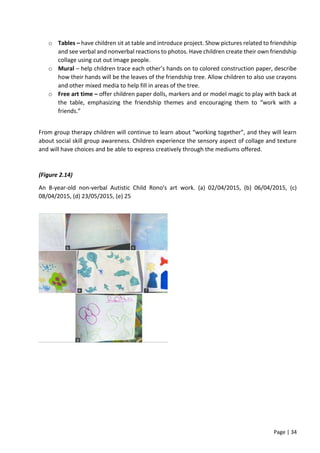
(Figure 2.14)
An 8-year-old non-verbal Autistic Child Rono's art work. (a) 02/04/2015, (b) 06/04/2015, (c)
08/04/2015, (d) 23/05/2015, (e) 25
Page | 35
CHAPTER 03
ART THERAPY WITH ADOLESENTS.
Understanding adolescents is a challenge at best, and the adolescent who is ill or suffering from
psychological stress is an even greater conundrum. The physician treats the physical problem but
often puzzles over where to find therapeutic treatment for this age group. Teenagers are sensitive
about their image, particularly with their peers, and often put themselves at emotional risk rather
than confess that they need help from a “shrink.” Furthermore, their view of the “talking”
psychotherapies has been shaped by the movies, and they often think that these therapies are only
for serious “mental” cases. In contrast, they come to art therapy without such preconceived ideas,
and this form of therapy has proved effective with adolescents.
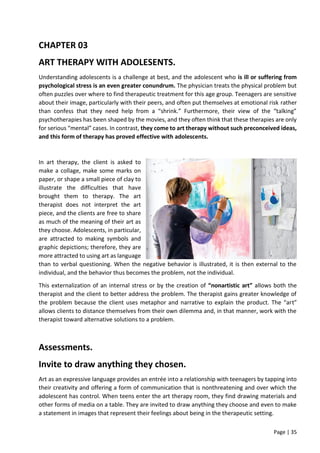
In art therapy, the client is asked to
make a collage, make some marks on
paper, or shape a small piece of clay to
illustrate the difficulties that have
brought them to therapy. The art
therapist does not interpret the art
piece, and the clients are free to share
as much of the meaning of their art as
they choose. Adolescents, in particular,
are attracted to making symbols and
graphic depictions; therefore, they are
more attracted to using art as language
than to verbal questioning. When the negative behavior is illustrated, it is then external to the
individual, and the behavior thus becomes the problem, not the individual.
This externalization of an internal stress or by the creation of “nonartistic art” allows both the
therapist and the client to better address the problem. The therapist gains greater knowledge of
the problem because the client uses metaphor and narrative to explain the product. The “art”
allows clients to distance themselves from their own dilemma and, in that manner, work with the
therapist toward alternative solutions to a problem.
Assessments.
Invite to draw anything they chosen.
Art as an expressive language provides an entrée into a relationship with teenagers by tapping into
their creativity and offering a form of communication that is nonthreatening and over which the
adolescent has control. When teens enter the art therapy room, they find drawing materials and
other forms of media on a table. They are invited to draw anything they choose and even to make
a statement in images that represent their feelings about being in the therapeutic setting.
Page | 36
Nonjudgmental Assessment.
Attention to the art that the adolescent produces in the session helps the therapist gain some idea
of the youth's concerns and life circumstances.
Imagery, such as a collage picture, can provide a broad range of information. If therapists
understand adolescent concerns, they will not attempt to interpret or assess the psychological
state of the youth by imagining what the image means. Adolescents are often suspicious of the
art therapist's skill at interpretation, and they have every right to be cautious. It is only respectful
to clients to reserve personal projections and to allow the teens to reveal what they will about their
artwork.
The therapist's stance of neutrality can lead to trust, which is the basis of any form of therapeutic
relationship. This principle of neutrality must be established from the beginning of the art therapy
relationship. The art therapist has no magic to see meaning in the art; the “magic” comes from the
creativity of the teen. Assessment comes about by comparing the art product from session to
session and marking the variations that occur both in the art's content and the clients' verbal
explanations of its meaning.
Developmental Fit.
Using art in therapy provides a pleasure factor that is not what teens expect to encounter, and it
stimulates their desire to be expressive. Drawing, or making marks, is in tune with adolescents'
development, as evidenced by the tagging and graffiti that is abundant in many cities. It is hard to
restrain an adolescent's urge to “make their mark.” Channeling this drive into productive
communication can neutralize the battle over what to reveal or keep hidden.
The emergence of an image is an extension of the processes of memory and conceptualization.
Imagery introduces metaphorical language and personalized communication. If adolescents are
asked to show the therapist what needs to be corrected at home, or even in society as a whole,
they can do so through the creation of an image.
Examples
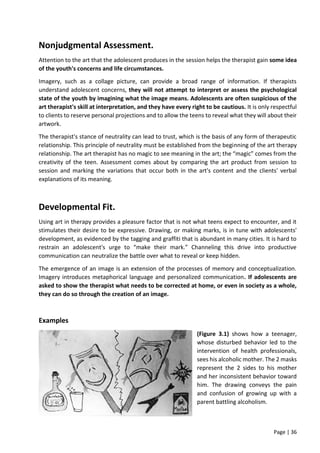
(Figure 3.1) shows how a teenager,
whose disturbed behavior led to the
intervention of health professionals,
sees his alcoholic mother. The 2 masks
represent the 2 sides to his mother
and her inconsistent behavior toward
him. The drawing conveys the pain
and confusion of growing up with a
parent battling alcoholism.
Page | 37
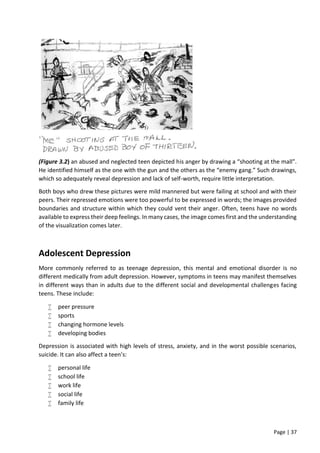
(Figure 3.2) an abused and neglected teen depicted his anger by drawing a “shooting at the mall”.
He identified himself as the one with the gun and the others as the “enemy gang.” Such drawings,
which so adequately reveal depression and lack of self-worth, require little interpretation.
Both boys who drew these pictures were mild mannered but were failing at school and with their
peers. Their repressed emotions were too powerful to be expressed in words; the images provided
boundaries and structure within which they could vent their anger. Often, teens have no words
available to express their deep feelings. In many cases, the image comes first and the understanding
of the visualization comes later.
Adolescent Depression
More commonly referred to as teenage depression, this mental and emotional disorder is no
different medically from adult depression. However, symptoms in teens may manifest themselves
in different ways than in adults due to the different social and developmental challenges facing
teens. These include:
 peer pressure
 sports
 changing hormone levels
 developing bodies
Depression is associated with high levels of stress, anxiety, and in the worst possible scenarios,
suicide. It can also affect a teen’s:
 personal life
 school life
 work life
 social life
 family life
Page | 38
In the developmental cycle of
adolescents, depression slows the
move toward independence and a
secure identity. Therefore, it is helpful
to provide a safe outlet for the
distress that has engendered the
depression. Adolescents with
depression that is motivated by
situations in the family environment,
or in the external world of peers and
society, appear to get better when
they express their anxieties through art therapy.
This improvement has been observed in clinical situations, and art is used as an assessment of
depression by Silver in her extensive work through a protocol she developed, called Draw a Story.
The method of treating depression through art therapy is complex and goes beyond the scope of
this article.
Examples
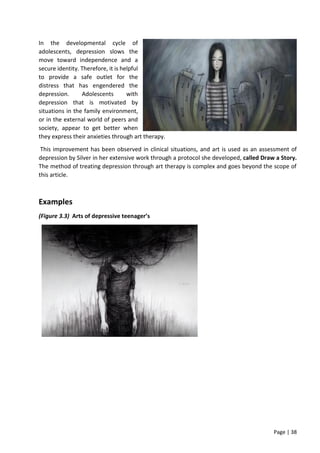
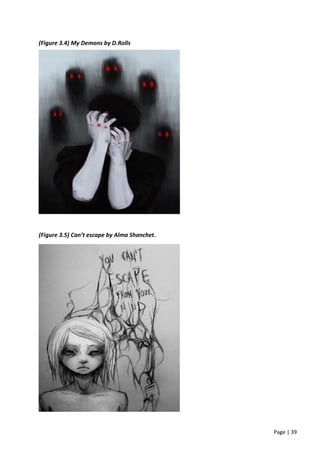
(Figure 3.3) Arts of depressive teenager’s
Page | 39
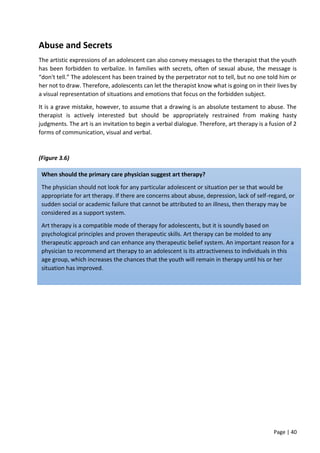
(Figure 3.4) My Demons by D.Rolls
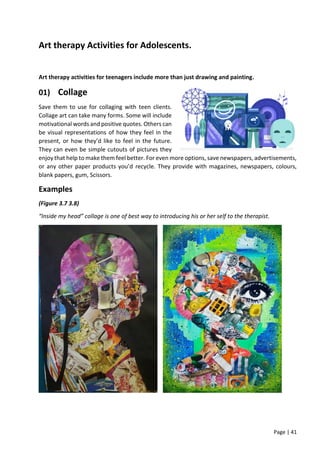
(Figure 3.5) Can’t escape by Alma Shanchet.
Page | 40
Abuse and Secrets
The artistic expressions of an adolescent can also convey messages to the therapist that the youth
has been forbidden to verbalize. In families with secrets, often of sexual abuse, the message is
“don't tell.” The adolescent has been trained by the perpetrator not to tell, but no one told him or
her not to draw. Therefore, adolescents can let the therapist know what is going on in their lives by
a visual representation of situations and emotions that focus on the forbidden subject.
It is a grave mistake, however, to assume that a drawing is an absolute testament to abuse. The
therapist is actively interested but should be appropriately restrained from making hasty
judgments. The art is an invitation to begin a verbal dialogue. Therefore, art therapy is a fusion of 2
forms of communication, visual and verbal.
(Figure 3.6)
When should the primary care physician suggest art therapy?
The physician should not look for any particular adolescent or situation per se that would be
appropriate for art therapy. If there are concerns about abuse, depression, lack of self-regard, or
sudden social or academic failure that cannot be attributed to an illness, then therapy may be
considered as a support system.
Art therapy is a compatible mode of therapy for adolescents, but it is soundly based on
psychological principles and proven therapeutic skills. Art therapy can be molded to any
therapeutic approach and can enhance any therapeutic belief system. An important reason for a
physician to recommend art therapy to an adolescent is its attractiveness to individuals in this
age group, which increases the chances that the youth will remain in therapy until his or her
situation has improved.
Page | 41
Art therapy Activities for Adolescents.
Art therapy activities for teenagers include more than just drawing and painting.
01) Collage
Save them to use for collaging with teen clients.
Collage art can take many forms. Some will include
motivational words and positive quotes. Others can
be visual representations of how they feel in the
present, or how they’d like to feel in the future.
They can even be simple cutouts of pictures they
enjoy that help to make them feel better. For even more options, save newspapers, advertisements,
or any other paper products you’d recycle. They provide with magazines, newspapers, colours,
blank papers, gum, Scissors.
Examples
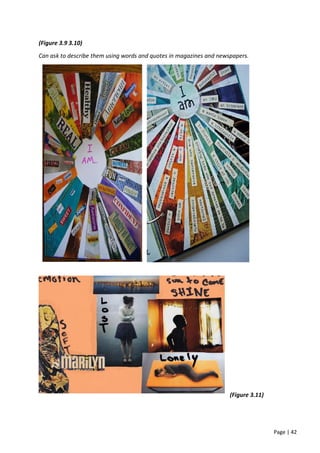
(Figure 3.7 3.8)
“Inside my head” collage is one of best way to introducing his or her self to the therapist.
Page | 42
(Figure 3.9 3.10)
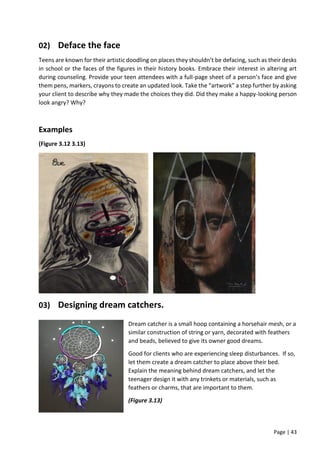
Can ask to describe them using words and quotes in magazines and newspapers.
(Figure 3.11)
Page | 43
02) Deface the face
Teens are known for their artistic doodling on places they shouldn’t be defacing, such as their desks
in school or the faces of the figures in their history books. Embrace their interest in altering art
during counseling. Provide your teen attendees with a full-page sheet of a person’s face and give
them pens, markers, crayons to create an updated look. Take the “artwork” a step further by asking
your client to describe why they made the choices they did. Did they make a happy-looking person
look angry? Why?
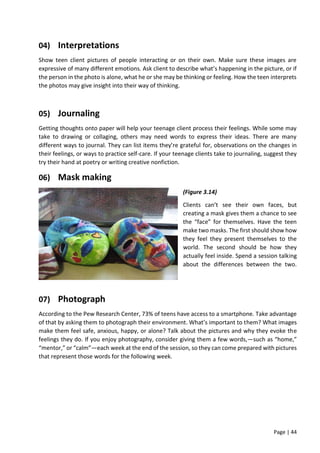
Examples
(Figure 3.12 3.13)
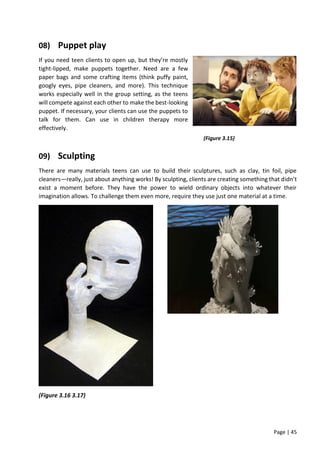
03) Designing dream catchers.
Dream catcher is a small hoop containing a horsehair mesh, or a
similar construction of string or yarn, decorated with feathers
and beads, believed to give its owner good dreams.
Good for clients who are experiencing sleep disturbances. If so,
let them create a dream catcher to place above their bed.
Explain the meaning behind dream catchers, and let the
teenager design it with any trinkets or materials, such as
feathers or charms, that are important to them.
(Figure 3.13)
Page | 44
04) Interpretations
Show teen client pictures of people interacting or on their own. Make sure these images are
expressive of many different emotions. Ask client to describe what’s happening in the picture, or if
the person in the photo is alone, what he or she may be thinking or feeling. How the teen interprets
the photos may give insight into their way of thinking.
05) Journaling
Getting thoughts onto paper will help your teenage client process their feelings. While some may
take to drawing or collaging, others may need words to express their ideas. There are many
different ways to journal. They can list items they’re grateful for, observations on the changes in
their feelings, or ways to practice self-care. If your teenage clients take to journaling, suggest they
try their hand at poetry or writing creative nonfiction.
06) Mask making
(Figure 3.14)
Clients can’t see their own faces, but
creating a mask gives them a chance to see
the “face” for themselves. Have the teen
make two masks. The first should show how
they feel they present themselves to the
world. The second should be how they
actually feel inside. Spend a session talking
about the differences between the two.
07) Photograph
According to the Pew Research Center, 73% of teens have access to a smartphone. Take advantage
of that by asking them to photograph their environment. What’s important to them? What images
make them feel safe, anxious, happy, or alone? Talk about the pictures and why they evoke the
feelings they do. If you enjoy photography, consider giving them a few words‚—such as “home,”
“mentor,” or “calm”—each week at the end of the session, so they can come prepared with pictures
that represent those words for the following week.
Page | 45
08) Puppet play
If you need teen clients to open up, but they’re mostly
tight-lipped, make puppets together. Need are a few
paper bags and some crafting items (think puffy paint,
googly eyes, pipe cleaners, and more). This technique
works especially well in the group setting, as the teens
will compete against each other to make the best-looking
puppet. If necessary, your clients can use the puppets to
talk for them. Can use in children therapy more
effectively.
09) Sculpting
There are many materials teens can use to build their sculptures, such as clay, tin foil, pipe
cleaners—really, just about anything works! By sculpting, clients are creating something that didn’t
exist a moment before. They have the power to wield ordinary objects into whatever their
imagination allows. To challenge them even more, require they use just one material at a time.
(Figure 3.16 3.17)
(Figure 3.15)
Page | 46
CHAPTER 04
FAMILY ART THERAPY
Family Art Therapy helps families to bond together and improve mental health care through
creativity and art workshop. By using creativity family art therapy, family will be enjoying the
therapeutic process of art and gain a new insight about themselves and respective family
members. Family bonding and teamwork are reinforced to build a resilient, productive, optimistic
and strong family. Family Art Therapy is a mental health and wellness for families.
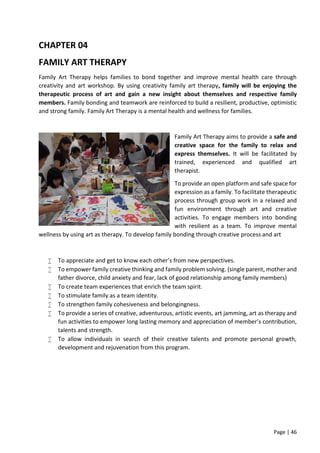
Family Art Therapy aims to provide a safe and
creative space for the family to relax and
express themselves. It will be facilitated by
trained, experienced and qualified art
therapist.
To provide an open platform and safe space for
expression as a family. To facilitate therapeutic
process through group work in a relaxed and
fun environment through art and creative
activities. To engage members into bonding
with resilient as a team. To improve mental
wellness by using art as therapy. To develop family bonding through creative process and art
 To appreciate and get to know each other’s from new perspectives.
 To empower family creative thinking and family problem solving. (single parent, mother and
father divorce, child anxiety and fear, lack of good relationship among family members)
 To create team experiences that enrich the team spirit.
 To stimulate family as a team identity.
 To strengthen family cohesiveness and belongingness.
 To provide a series of creative, adventurous, artistic events, art jamming, art as therapy and
fun activities to empower long lasting memory and appreciation of member’s contribution,
talents and strength.
 To allow individuals in search of their creative talents and promote personal growth,
development and rejuvenation from this program.
Page | 47
Family Art Therapy Assessments.
Kinetic Family Drawing.
The Kinetic Family Drawing (KFD) was developed by Burns and Kauffman in 1970 as a “children’s
assessment to gather information on self-concept and interpersonal relationships”. It was initially
designed to be an individual assessment, but it can provide information about the individual’s
perceptions of their family dynamics.
Method
The drawing is completed on an 8.5x11 inch white piece of paper using a number two pencil.
The instructions are as follows: “draw a picture of everyone in your family, including you, doing
something. Try to draw whole people, not cartoons or stick people. Remember, make everyone
doing something—some kind of action.”
KFD is especially useful in showing possible discrepancies between how individuals view themselves
within their family system and in the larger society. This assessment can bring up important insights
and revelations from family members such as “we don’t do anything together” and the facial
expressions drawn on each family member in may reveal how the individual views their various
family members, and can possibly uncover their unexpressed feelings towards family members. The
KFD is sometimes interpreted as part of an evaluation of child abuse.
Examples
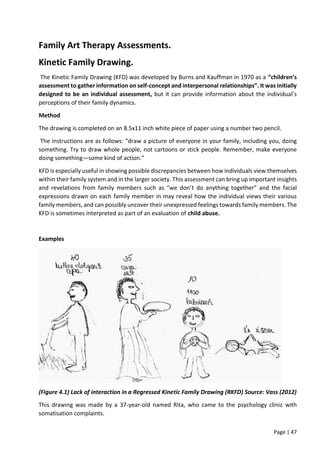
(Figure 4.1) Lack of interaction in a Regressed Kinetic Family Drawing (RKFD) Source: Vass (2012)
This drawing was made by a 37-year-old named Rita, who came to the psychology clinic with
somatisation complaints.
Page | 48
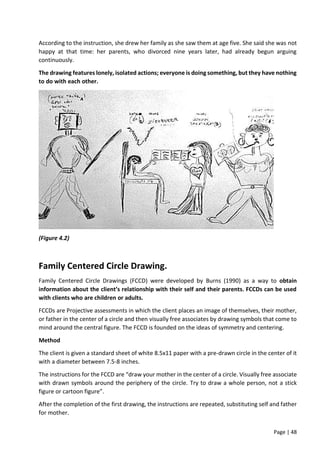
According to the instruction, she drew her family as she saw them at age five. She said she was not
happy at that time: her parents, who divorced nine years later, had already begun arguing
continuously.
The drawing features lonely, isolated actions; everyone is doing something, but they have nothing
to do with each other.
(Figure 4.2)
Family Centered Circle Drawing.
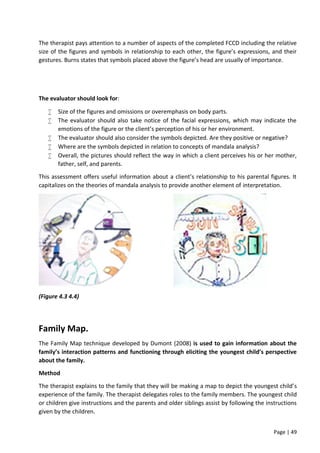
Family Centered Circle Drawings (FCCD) were developed by Burns (1990) as a way to obtain
information about the client’s relationship with their self and their parents. FCCDs can be used
with clients who are children or adults.
FCCDs are Projective assessments in which the client places an image of themselves, their mother,
or father in the center of a circle and then visually free associates by drawing symbols that come to
mind around the central figure. The FCCD is founded on the ideas of symmetry and centering.
Method
The client is given a standard sheet of white 8.5x11 paper with a pre-drawn circle in the center of it
with a diameter between 7.5-8 inches.
The instructions for the FCCD are “draw your mother in the center of a circle. Visually free associate
with drawn symbols around the periphery of the circle. Try to draw a whole person, not a stick
figure or cartoon figure”.
After the completion of the first drawing, the instructions are repeated, substituting self and father
for mother.
Page | 49
The therapist pays attention to a number of aspects of the completed FCCD including the relative
size of the figures and symbols in relationship to each other, the figure’s expressions, and their
gestures. Burns states that symbols placed above the figure’s head are usually of importance.
The evaluator should look for:
 Size of the figures and omissions or overemphasis on body parts.
 The evaluator should also take notice of the facial expressions, which may indicate the
emotions of the figure or the client’s perception of his or her environment.
 The evaluator should also consider the symbols depicted. Are they positive or negative?
 Where are the symbols depicted in relation to concepts of mandala analysis?
 Overall, the pictures should reflect the way in which a client perceives his or her mother,
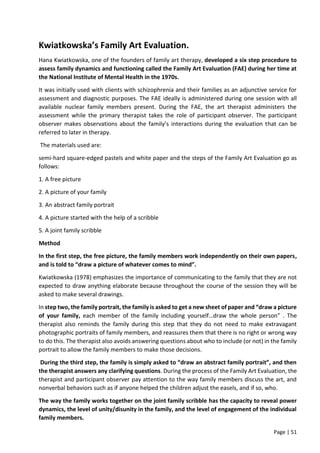
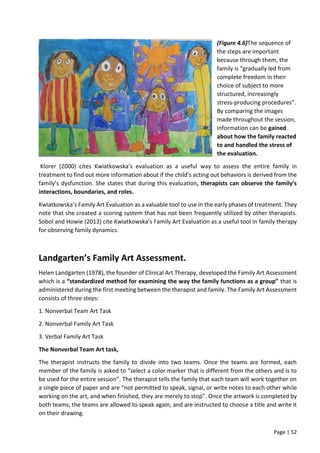
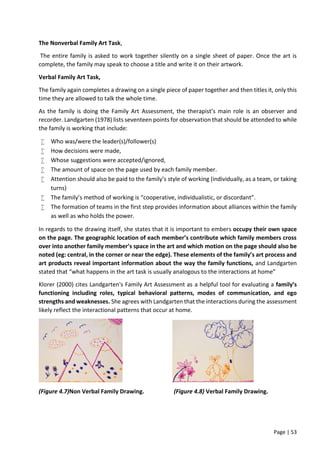
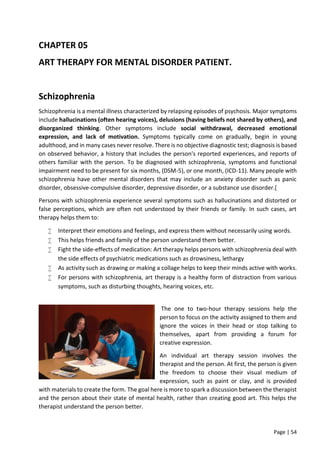
father, self, and parents.
This assessment offers useful information about a client’s relationship to his parental figures. It
capitalizes on the theories of mandala analysis to provide another element of interpretation.
(Figure 4.3 4.4)
Family Map.
The Family Map technique developed by Dumont (2008) is used to gain information about the
family’s interaction patterns and functioning through eliciting the youngest child’s perspective
about the family.
Method
The therapist explains to the family that they will be making a map to depict the youngest child’s
experience of the family. The therapist delegates roles to the family members. The youngest child
or children give instructions and the parents and older siblings assist by following the instructions
given by the children.
Page | 50
When there are multiple children in the family, the procedure can be adapted so they can work
together and make joint decisions, or if needed, each child can make their own family map.
Next, the therapist makes a large circle on oversized paper and indicates that there will be room in
this space for each family member. This can also be modified to two circles to represent two
households if the parents are separated.
(Figure 4.5)
The context of the family is included outside of the circle, including school, their neighborhood, or
work. The children then select a color for themselves and for each person in the household. Each
person is given the marker that represents him or herself, and the therapist stands in for those not
present by holding their marker. The child is asked to represent someone in the family with a circle,
considering the size and placement of their circle. The largest circle would be used to “represent
someone who ‘takes up the most space’.”.
Next, the children direct the others to create lines between family members representing the
nature of their relationships: double lines to represent close relationships and zigzag lines to
indicate conflict.
At the end of session, children are given the opportunity to modify the map if they wish. They are
also asked to draw a new map about their wishes for the future. This process can help in the
construction of goals for treatment. The therapist notes the sequence of the relational lines, size
and proximity of the circles to each other as well as alliances, and roles of family members including
if they are peripheral or overpowering.
In addition to providing the clinician with information about the children’s perceptions of the
dynamics and relationships in the family, Dumont (2008) states that it can reveal to parents that
children are aware of and effected by what is going on in the family, especially conflict.
Overall, family assessments developed by psychologists that utilize art are used to assess family
dynamics and family member’s perceptions of the relationships between family members.
Information is gained during these assessments primarily through the art product, rather than the
family or individual’s process of creating the art.
Page | 51
Kwiatkowska’s Family Art Evaluation.
Hana Kwiatkowska, one of the founders of family art therapy, developed a six step procedure to
assess family dynamics and functioning called the Family Art Evaluation (FAE) during her time at
the National Institute of Mental Health in the 1970s.
It was initially used with clients with schizophrenia and their families as an adjunctive service for
assessment and diagnostic purposes. The FAE ideally is administered during one session with all
available nuclear family members present. During the FAE, the art therapist administers the
assessment while the primary therapist takes the role of participant observer. The participant
observer makes observations about the family’s interactions during the evaluation that can be
referred to later in therapy.
The materials used are:
semi-hard square-edged pastels and white paper and the steps of the Family Art Evaluation go as
follows:
1. A free picture
2. A picture of your family
3. An abstract family portrait
4. A picture started with the help of a scribble
5. A joint family scribble
Method
In the first step, the free picture, the family members work independently on their own papers,
and is told to “draw a picture of whatever comes to mind”.
Kwiatkowska (1978) emphasizes the importance of communicating to the family that they are not
expected to draw anything elaborate because throughout the course of the session they will be
asked to make several drawings.
In step two, the family portrait, the family is asked to get a new sheet of paper and “draw a picture
of your family, each member of the family including yourself…draw the whole person” . The
therapist also reminds the family during this step that they do not need to make extravagant
photographic portraits of family members, and reassures them that there is no right or wrong way
to do this. The therapist also avoids answering questions about who to include (or not) in the family
portrait to allow the family members to make those decisions.
During the third step, the family is simply asked to “draw an abstract family portrait”, and then
the therapist answers any clarifying questions. During the process of the Family Art Evaluation, the
therapist and participant observer pay attention to the way family members discuss the art, and
nonverbal behaviors such as if anyone helped the children adjust the easels, and if so, who.
The way the family works together on the joint family scribble has the capacity to reveal power
dynamics, the level of unity/disunity in the family, and the level of engagement of the individual
family members.
Page | 52
(Figure 4.6)The sequence of
the steps are important
because through them, the
family is “gradually led from
complete freedom in their
choice of subject to more
structured, increasingly
stress-producing procedures”.
By comparing the images
made throughout the session,
information can be gained
about how the family reacted
to and handled the stress of
the evaluation.
Klorer (2000) cites Kwiatkowska’s evaluation as a useful way to assess the entire family in
treatment to find out more information about if the child’s acting out behaviors is derived from the
family’s dysfunction. She states that during this evaluation, therapists can observe the family’s
interactions, boundaries, and roles.
Kwiatkowska’s Family Art Evaluation as a valuable tool to use in the early phases of treatment. They
note that she created a scoring system that has not been frequently utilized by other therapists.
Sobol and Howie (2013) cite Kwiatkowska’s Family Art Evaluation as a useful tool in family therapy
for observing family dynamics.
Landgarten’s Family Art Assessment.
Helen Landgarten (1978), the founder of Clinical Art Therapy, developed the Family Art Assessment
which is a “standardized method for examining the way the family functions as a group” that is
administered during the first meeting between the therapist and family. The Family Art Assessment
consists of three steps:
1. Nonverbal Team Art Task
2. Nonverbal Family Art Task
3. Verbal Family Art Task
The Nonverbal Team Art task,
The therapist instructs the family to divide into two teams. Once the teams are formed, each
member of the family is asked to “select a color marker that is different from the others and is to
be used for the entire session”. The therapist tells the family that each team will work together on
a single piece of paper and are “not permitted to speak, signal, or write notes to each other while
working on the art, and when finished, they are merely to stop”. Once the artwork is completed by
both teams, the teams are allowed to speak again, and are instructed to choose a title and write it
on their drawing.
Page | 53
The Nonverbal Family Art Task,
The entire family is asked to work together silently on a single sheet of paper. Once the art is
complete, the family may speak to choose a title and write it on their artwork.
Verbal Family Art Task,
The family again completes a drawing on a single piece of paper together and then titles it, only this
time they are allowed to talk the whole time.
As the family is doing the Family Art Assessment, the therapist’s main role is an observer and
recorder. Landgarten (1978) lists seventeen points for observation that should be attended to while
the family is working that include:
 Who was/were the leader(s)/follower(s)
 How decisions were made,
 Whose suggestions were accepted/ignored,
 The amount of space on the page used by each family member.
 Attention should also be paid to the family’s style of working (individually, as a team, or taking
turns)
 The family’s method of working is “cooperative, individualistic, or discordant”.
 The formation of teams in the first step provides information about alliances within the family
as well as who holds the power.
In regards to the drawing itself, she states that it is important to embers occupy their own space
on the page. The geographic location of each member’s contribute which family members cross
over into another family member’s space in the art and which motion on the page should also be
noted (eg: central, in the corner or near the edge). These elements of the family’s art process and
art products reveal important information about the way the family functions, and Landgarten
stated that “what happens in the art task is usually analogous to the interactions at home”
Klorer (2000) cites Landgarten's Family Art Assessment as a helpful tool for evaluating a family’s
functioning including roles, typical behavioral patterns, modes of communication, and ego
strengths and weaknesses. She agrees with Landgarten that the interactions during the assessment
likely reflect the interactional patterns that occur at home.
(Figure 4.7)Non Verbal Family Drawing. (Figure 4.8) Verbal Family Drawing.
Page | 54
CHAPTER 05
ART THERAPY FOR MENTAL DISORDER PATIENT.
Schizophrenia
Schizophrenia is a mental illness characterized by relapsing episodes of psychosis. Major symptoms
include hallucinations (often hearing voices), delusions (having beliefs not shared by others), and
disorganized thinking. Other symptoms include social withdrawal, decreased emotional
expression, and lack of motivation. Symptoms typically come on gradually, begin in young
adulthood, and in many cases never resolve. There is no objective diagnostic test; diagnosis is based
on observed behavior, a history that includes the person's reported experiences, and reports of
others familiar with the person. To be diagnosed with schizophrenia, symptoms and functional
impairment need to be present for six months, (DSM-5), or one month, (ICD-11). Many people with
schizophrenia have other mental disorders that may include an anxiety disorder such as panic
disorder, obsessive-compulsive disorder, depressive disorder, or a substance use disorder.[
Persons with schizophrenia experience several symptoms such as hallucinations and distorted or
false perceptions, which are often not understood by their friends or family. In such cases, art
therapy helps them to:
 Interpret their emotions and feelings, and express them without necessarily using words.
 This helps friends and family of the person understand them better.
 Fight the side-effects of medication: Art therapy helps persons with schizophrenia deal with
the side effects of psychiatric medications such as drowsiness, lethargy
 As activity such as drawing or making a collage helps to keep their minds active with works.
 For persons with schizophrenia, art therapy is a healthy form of distraction from various
symptoms, such as disturbing thoughts, hearing voices, etc.
The one to two-hour therapy sessions help the
person to focus on the activity assigned to them and
ignore the voices in their head or stop talking to
themselves, apart from providing a forum for
creative expression.
An individual art therapy session involves the
therapist and the person. At first, the person is given
the freedom to choose their visual medium of
expression, such as paint or clay, and is provided
with materials to create the form. The goal here is more to spark a discussion between the therapist
and the person about their state of mental health, rather than creating good art. This helps the
therapist understand the person better.
Page | 55
The person then creates the art form, after which the therapist and the person discuss and reflect
upon the therapeutic relief through the art form. For persons with serious mental illnesses like
schizophrenia, creating the art form could be something that they would like to share and express
or something that they want to describe – an incident or an experience that they have not been
comfortable sharing earlier.
Working with Art in a Case of Schizophrenia
Konrad J. Noronha
Schizophrenia often requires a lifetime of treatment. This study used art as a therapeutic tool in
therapy with a client diagnosed with schizophrenia, along with medical management. The purpose
of using art was to enable the non-communicative client to communicate. The clients’ drawings
were used as a process medium. Progress was seen in changes in social behaviors and
communication evidenced by him speaking more, expressing feelings and gaining better insight.
The therapist used art as a process medium while working with a non-communicative client. The
client felt comfortable drawing and the drawings were then used in therapy. Art was a safe
intervention in this diagnosed case of schizophrenia.
History
 Personal details
The client was a 45-year-old, US born man of Asian ethnicity, born and raised in the mid-west, never
married, recently employed, and living with non-related persons in an independent living facility.
 Presenting complain
Irritable behavior and complaining hearing voices inside his head
 History of presenting complain
The present therapist saw him after he was in mobile treatment for about 3 months after discharge
from an inpatient facility. He had a history of emergency room visits a minimum of 3 times a day
because he heard voices in his head. There was history of suicidal thoughts, cutting, screaming and
cursing when upset. He liked to be reminded that his behavior was due to mental illness and he
liked “calming words.” At the start of therapy, he would only repeat what was said by the therapist.
He had a fear of “big” things, was afraid of hearing his name called, and felt there was a “bear”
hovering around him.
 Family history
The client has three estranged children. His sister was involved in treatment. He did not talk much
about his family, but mentioned that he wanted to connect with his children and their mother. He
did not know where they lived.
 Personal history
The client was a high school dropout, with minimal work experience.
 Forensic and substance history
Page | 56
The client did not evidence any history of substance abuse or imprisonment.
 Past psychiatric history
He stayed away from others clients at the mobile clinic, and did not communicate much at his board
and care. He got upset with foul language. He had a very basic knowledge of reading and writing.
While in therapy he was on Risperadol, Chlorpromazine, Benytriptine, Risperadol Consta, Benedryl,
and Deprovate ER.
 Past medical history
He had a history of hepatitis and chronic mental illness. No allergic history.
 Past surgical history
Not significant
 Premorbid personality
The client did not have a faith or spiritual affiliation. He did not attend any church, but considered
himself to be Christian.
Leisure and recreation history
His leisure time was spent in listening to CD's on his earphones.
Dreams
No dreams or nightmares were reported, but he reported “flashbacks.” He could not say whether
the same flashbacks were present in his dreams. The “bear” is one of his flashbacks.
Mental state examination
 Appearance and behavior
Client was disheveled with uncut, dirty nails. His face had an oily, unwashed appearance. Clothes
were dirty in most sessions. Client was approximately 5’ 7" in height and weighs 150 pounds.
Hygiene improved with therapy.
 Speech
Deliberate tone, pauses, irregular rhythm of speech, which at times it appeared to be pressured.
No testing for speech disabilities was done.
 Mood
Mood was angry and affect was congruent to mood.
 Thought
In the first session he was unable to respond to the therapist, and would just repeat what was said.
He began to respond to the questions, and show insight and judgment, from session three. He was
co-operative for three sessions after which he began to attend sessions irregularly and became
resistant.
Page | 57
 Perception
No current hallucinations either visual or auditory. He had paranoid thoughts. No obsessions,
compulsions, and phobias presently.
 Cognition
Client was oriented to person, place, time and situation. He was alert and fully oriented presently.
 Insight
Poor
Diagnosis - Schizophrenia, undifferentiated type, unspecified pattern
Treatment
In the 1st session patient was just parroting what was said.
In the 2nd session therapist keep some blank papers, coloring pens and crayons on the table and
asked him to draw what he want to express.
In every session, he was asked to draw what was on his mind at that time. He began to become
more communicative through art. It was in the session, where he first identified figures in his
drawings as being that of his father and mother that the first resistances were set up. His pictures
included his “fears” [Figure 1] and the “bear” which was always hovering about him. This was the
symbol in his life that he had amplified to such a limit that it was controlling his functioning.
Consequently, it had to be controlled. Through therapy an attempt was made to “unfreeze (melt)”
the statue [Figure 2] that he tended to become, and help the screaming child emerge [Figure 1]. He
had to deal with the constant “running away” [Figure 3] from his fears [Figure 4], his abuse, society
[Figures 5 and 6] and learn to face what life had to offer, knowing it is possible [Figure 7].
(Figure 5.1)
Bear hovering over him
Page | 58
(Figure 5.2)
Allowing the screaming child to emerge.
(Figure 5.3)
To work on running away from issues
(Figure 5.4)
Attempt to melt the statue he had
become
Page | 59
(Figure 5.5)
Cause of trauma
(Figure 5.6)
Dealing with society
(Figure 5.7)
Possibility of developing a
sense of self
Page | 60
The strengths, which he brought to the treatment were his developing insight. His weaknesses were
his forgetfulness, confusions and poor language skills. From the team, the therapist, the social
worker and the staff psychiatrist, were directly responsible for the client. Together with the social
worker and therapist, the client decided on the following goals.
Problem 1
Auditory hallucinations, basically hearing his name being called, and the other voices in his head.
Long-term goals
The client would report that he is more comfortable with his name and the voices in his head, every
3 months.
Interventions
1. Through art, make him understand how to make something larger and smaller
2. Utilizing the “bear” and his “name,” in art and trying to make him articulate how he would
gain control of the bear and learn to love his name
3. To do progressive desensitization of his fear of the bear, his father and others he feared, by
using soft toys or pictures of bears.
Short-term goals
The client will report that he has attempted to control the voices in his head, weekly
Interventions
1. Thought stopping and thought insertion
2. Relaxation exercises
3. Role-play to talk to the “friend” and “to talk to the feeling.”
Problem 2
Fear of people, tendency to stay alone, and not communicate
Long-term goals
The client will report that he has made progress at his place of residence and work, in
communicating with people. He will attend a linguistics class to improve his vocabulary and diction.
Short-term goals
1. Client will work on communication skills:
2. The client will converse with other clients at the mobile facility and at his place of residence
and be more sociable
3. Client will continue to work on speech improvement. The client will join a linguistic class.
Page | 61
Painting of Schizophrenic Patients.
(Figure 5.8) A painting by Bryan Charnley; trying to
communicate his depressions.
(Figure 5.9) A drawing by a patient in mental
hospital suffering from paranoid schizophrenia.
(Figure 5.10) A drawing of
hallucinations by another patient.
Page | 62
(Figure 5.11) Karen Blair in 1929 while she was in
the hospital.
Bipolar Disorder.
Bipolar disorder, previously known as manic depression, is a mental disorder characterized by
periods of depression and abnormally elevated moods. If the elevated mood is severe or
associated with psychosis, it is called mania; if it is less severe, it is called hypomania. During mania,
an individual behaves or feels abnormally energetic, happy, or irritable. Individuals often make
impulsive decisions with little regard for the consequences. There is usually a reduced need for
sleep during manic phases. During periods of depression, individuals may experience crying, a
negative outlook on life, and poor eye contact with others. The risk of suicide is high; over a period
of 20 years 6% of people died by suicide, while 30-40% engaged in self-harm. Other mental health
issues, such as anxiety disorders and substance use disorders, are commonly associated with bipolar
disorder.
Art therapy effectively engages patients and allows the release of emotional tension in a contained
manner. This allows relaxation, improved mood, and reduction in painful and troubled emotions.
Art therapy has proved useful for patients who have PTSD, anxiety, and depression.
Disorders such as bipolar heavily rely on pharmacological treatment, however, the use of art
therapy is integral for clients by providing them with a sense of control especially when
pharmacological approaches may be confronting for a client. Art therapy gives the client a direct
outlet for their emotional experience.
Clients can use art for self-expression without having to rely on verbal explanation with a therapist.
Clients with bipolar can use art as a method stress reduction and develop skills of self-expression
Page | 63
that will contribute to their overall self-confidence. Additionally, clients with bipolar can participate
in group art therapy which can help develop social skills and widen the client’s perspective on other
individual experiences of living with bipolar.
Using art therapy with a client who has bipolar should be a non-threatening and inviting activity.
Giving the client choices with art materials will help the client develop a sense of control over their
therapeutic experience. It is important that the client and art therapist develop a therapeutic
alliance that will help the client trust the treatment process.
The mood changes for clients with bipolar can be destabilizing. Having a well-established and
trusted relationship with a therapist will help mitigate the feeling of instability for a client with
bipolar.
Paintings of Bipolar Disorder patients.
(Figure 5.12) Missy Douglas
(Figure 5.13) by Edvar Munch
Page | 64
CHAPTER 06
ART THERAPY FOR CANCER PATIENTS.
Many studies have been conducted on the benefits of art therapy on cancer patients. Art therapy
has been found to be useful to support patients during the stress of such things as chemotherapy
treatment.
Art therapists have conducted studies to understand
why some cancer patients turned to art making as a
coping mechanism and a tool to creating a positive
identity outside of being a cancer patient. Women in
the study participated in different art programs
ranging from pottery and card making to drawing and
painting. The programs helped them regain an identity
outside of having cancer, lessened emotional pain of
their on-going fight with cancer, and also giving them hope for the future. In a study involving
women facing cancer-related difficulties such as fear, pain, altered social relationships, etc.
It was found that: Engaging in different types of visual art (textiles, card making, collage, pottery,
watercolor, acrylics) helped these women in 4 major ways.
 It helped them focus on positive life experiences, relieving their ongoing preoccupation with
cancer.
 It enhanced their self-worth and identity by providing them with opportunities to
demonstrate continuity, challenge, and achievement.
 It enabled them to maintain a social identity that resisted being defined by cancer. I
 It allowed them to express their feelings in a symbolic manner, especially during
chemotherapy.
Another study showed those who
participated in these types of activities were
discharged earlier than those who did not
participate.
Furthermore, another study revealed the
healing effects of art therapy on female
breast cancer patients. Studies revealed that
relatively short-term art therapy
interventions significantly improved
patients’ emotional states and perceived symptoms.
Page | 65
Studies have also shown how the emotional distress of cancer patients has been reduced when
utilizing the creative process. The women made drawings of themselves throughout the treatment
process while also doing yoga and meditating; these actions combined helped to alleviate some
symptoms.
Another study looked at the efficacy of mindfulness-based art therapy, combining meditation with
art, on a large study with 111 participants. The study used measurements such as quality of life,
physical symptoms, depression, and anxiety to evaluate the efficacy of the intervention. This
yielded optimistic results that there was a significant decrease in distress and significant
improvement in quality of life.
A review of 12 studies investigating the use of art therapy in cancer patients by Wood, Molassiotis,
and Payne (2010) investigated the symptoms of emotional, social, physical, global functioning,
and spiritual controls of cancer patients. They found that art therapy can improve the process of
psychological readjustment to the change, loss, and uncertainty associated with surviving cancer.
It was also suggested that art therapy can provide a sense of "meaning-making" because of the
physical act of creating the art. When given five individual sessions of art therapy once per week,
art therapy was shown to be useful for personal empowerment by helping the cancer patients
understand their own boundaries in relation to the needs of other people. In turn, those who had
art therapy treatment felt more connected to others and found social interaction more enjoyable
than individuals who did not receive art therapy treatment. Furthermore, art therapy improved
motivation levels, abilities to discuss emotional and physical health, general well-being, and
increased global quality of life in cancer patients.
In sum, relatively short-term intervention of art therapy that is individualized to various patients
has the potential to significantly improve emotional state and quality of life, while reducing
perceived symptoms relating to the cancer diagnosis

Art Therapy- Electives Report.pdf

  • 1.
    Gayani Neranjana Liyanage. Facultyof Medicine University of KDU. Batch 33 /B. D/MBBS/15A/0043.
  • 2.
    Page | 1 ACKNOWLEDGEMENT. Arttherapy is a form of psychotherapy that promotes creative self-expression on a symbolic level, through the creative use of art media that leads to the safe expression of emotions and internal conflicts. Art is used as a medium of communication between the client and the therapist in order to improve physical, mental, and emotional well-being. In this report am doing self-study regarding art therapy and present my report. As a medical student and art lover I choose this topic and I hope this knowledge will help me in my future carrier in many ways. In my report I studied basically about fundamental basic of arts therapy, family therapy use of arts therapy in healing psychiatric disorder in adult and children. I would like to express my sincere thanks to Dr (Mrs) K.D Welikanda, Retired registrar in Psychiatric, based hospital Homagama for her generous and relentless, fervent support and also give appreciation to my parents and husband for their endless support.
  • 3.
    Page | 2 CONTENT CHAPTER01……………………………………………………..Page 03 Basic of Art Therapy.  What is Art Therapy?  Use of Art Therapy.  History of Art Therapy.  Role of Art Therapist.  A Typical Art Therapy Session.  Art Therapy Room.  Art Therapy Assessments. CHAPTER 02……………………………………………………. Page 20 Art Therapy with Children.  Drawing conclusion from children’s Art.  History.  Art Therapy Activities for Children.  Art Therapy for Children with Autism. CHAPTER 03…………………………………………….……….Page 35 Art Therapy with adolescent.  Adolescent Depression.  Abuse and Secret.  Art Therapy Activates for Adolescent. CHAPTER 04…………………………….…………..…………..Page 46 Family Art Therapy CHAPTER 05……………………………………………………..Page 54 Art Therapy and Mental Disorders.  Schizophrenia.  Bipolar disorder. CHAPTER 06 …………………………………………………….Page 64 Art therapy for cancer Patients
  • 4.
    Page | 3 CHAPTER01 BASIC OF ART THERAPY. What Is Art Therapy? A Definition Art therapy, is an integrative mental health and human services profession that enrich the lives of individuals, families, and communities through active art-making, creative process, applied psychological theory, and human experience within a psychotherapeutic relationship. (Art therapy, as defined by the American Art Therapy Association) The British Association of Art Therapists defines art therapy as "a form of psychotherapy that uses art media as its primary mode of expression and communication. It allows for creative expression that can overcome the limitations of language. In other words, if an idea or emotion is too difficult, confusing, or painful to be said, written, or signed, then maybe drawing, painting, sculpting, coloring, sewing, collaging, and many other methods of visual art can surpass the stumbling block of language. Art therapy may focus on the creative art-making process itself, as therapy, or on the analysis of expression gained through an exchange of patient and therapist interaction. The psychoanalytic approach was one of the earliest forms of art psychotherapy. This approach employs the transference process between the therapist and the client who makes art. The therapist interprets the client's symbolic self-expression as communicated in the art and elicits interpretations from the client. Current art therapy includes a vast number of other approaches such as person-centered, cognitive, behavior, Gestalt, narrative, Adlerian, and family. The tenets of art therapy involve humanism, creativity, reconciling emotional conflicts, fostering self-awareness, and personal growth. Its potential applications can help improve areas of deficit like:  Cognition and sensory-motor function;  Self-esteem and self-awareness;  Emotional resilience;  Insight;  Social skills;  Conflicts and distress
  • 5.
    Page | 4 (Figure1.1) Use of Art Therapy Art Therapy for Children and Adolescent Art as a means for healing and communication is highly relevant for children and teens. Young children often rely on their limited language skills to express complex thoughts and emotions. That barrier can be breached with methods of expression they understand a little better, like drawing and coloring. Art therapy use identifying children who may have experience:  Bulling  Trauma  Child abuse  Psychological disorder (Anxiety, sleeping disorder)  Social problems  Autism Adolescent also benefit from a pressure-free, consequence-free medium for their thoughts and feelings. Art therapy use in adolescent who may have experience:  Psychological disorder (Anxiety, Depression)  Substance abuse  Relationship problems  Social problems  Sexual abuse
  • 6.
    Page | 5 FamilyArt Psychotherapy Denial of impulses and suppression of feeling are the root of family problems. Dysfunctional families have:  fearful of conflict  Cling to routines  Lack of warmth  Parents find children to be annoying/children don’t respect themselves or parents The use of art and creativity may lead to greater self-knowledge. Accessing creativity may be helpful in identifying emotional issues and can help in the healing process. Art therapy is a serious technique that uses the creative process to help improve the mental health of family member. Art therapy can be used on children and adults to treat a wide range of emotional issues. Art Therapy in Mental Disorders. Art therapy is a therapeutic technique rooted in the idea that creative expression can foster healing and mental well-being. Art, either the process of creating it or viewing others' artworks, is used to help people explore their emotions, develop self-awareness, cope with stress, boost self-esteem, and work on social skills. Art can be an effective tool in mental health treatment. Some conditions that art therapy may be used to treat include:  Anxiety  Depression  Emotional difficulties  Eating disorders  Substance use  Schizophrenia, Bipolar disease like psychiatric disorders  Stress  Post-Traumatic stress Disorder Art Therapy in Chronic Medical Conditions. Art therapy is a powerful tool involving the use of artistic ways of expression for physical and mental healing as well as the improvement of perception and cognitive functions. Art therapies are used to face the existence of life and death in serious diseases such as cancer and other chronic medical disease, and visually express certain deeply-hidden feelings, such as fear and hope, by stimulating the memory. Through art therapy, cancer patients can express themselves with no need for talent, when they fall short of words. The primary goal is to reveal the feelings of cancer patients and help them be happy.
  • 7.
    Page | 6 Historyof Art Therapy Art therapy as a profession began in the mid-20th century, arising independently in English-speaking and European countries. The early art therapists who published accounts of their work acknowledged the influence of aesthetics, psychiatry, psychoanalysis, rehabilitation, early childhood education, and art education, to varying degrees, on their practices. (Figure 1.2) Father of art therapy Adrian Hill The British artist Adrian Hill coined the term art therapy in 1942.Hill, recovering from tuberculosis in a sanatorium, discovered the therapeutic benefits of drawing and painting while convalescing. He wrote that the value of art therapy lay in "completely engrossing the mind releasing the creative energy of the frequently inhibited patient", which enabled the patient to "build up a strong defense against his misfortunes". He suggested artistic work to his fellow patients. That began his art therapy work, which was documented in 1945 in his book, Art Versus Illness. The artist Edward Adamson, demobilized after World war 2 , joined Adrian Hill to extend Hill's work to the British long stay mental hospitals. Other early proponents of art therapy in Britain include E. M. Lyddiatt, Michael Edwards, Diana Raphael-Halliday and Rita Simon. The British Association of Art Therapists was founded in 1964. U.S. art therapy pioneers Margaret Naumburg and Edith Kramer began practicing at around the same time as Hill. Naumburg, an educator, asserted that "art therapy is psychoanalytically oriented" and that free art expression "becomes a form of symbolic speech which…leads to an increase in verbalization in the course of therapy. "Edith Kramer, an artist, pointed out the importance of the creative process, psychological defenses, and artistic quality, writing that "sublimation is attained when forms are created that successfully contain…anger, anxiety, or pain." Other early proponents of art therapy in the United States include Elinor Ulman, Robert "Bob" Ault, and Judith Rubin. The American Art Therapy Association was founded in 1969. National professional associations of art therapy exist in many countries, including Brazil, Canada, Finland, Lebanon, Israel, Japan, the Netherlands, Romania, South Korea, and Sweden. International networking contributes to the establishment of standards for education and practice.
  • 8.
    Page | 7 Roleof Art Therapist Art therapist are trained in both therapy and art, and have studied and mastered both psychology and human development, having received a Master’s Degree. There are various requirements for becoming an art therapist as well as certifications which means they are masters when it comes to using art as a springboard for everything from a general assessment of another person’s state to treatment for aiding serious illness. Art therapists can work with people of all ages, sex, creed, et al. They can help an individual, a couple, a family, or groups of people and depending on the situation, there may be numerous therapists working together as a clinical team. Art therapists are trained to pick up on nonverbal symbols and metaphors that are often expressed through art and the creative process, concepts that are usually difficult to express with words. It is through this process that the individual really begins to see the effects of art therapy and the discoveries that can be made. A Typical Art Therapy Session Art therapy can take place in a variety of different settings. Art therapists may vary the goals of art therapy and the way they provide art therapy, depending upon the institution's or client's needs. After an assessment of the client's strengths and needs, art therapy may be offered in either an individual or group format, according to which is better suited to the person. It is wholly different when one works as a consultant or in an agency as opposed to private practice. In private practice, it becomes more complex and far reaching. Primary therapist responsibilities can swing from the spectrum of social work to the primary care of the patient. This includes dovetailing with physicians, judges, family members, and sometimes even community members that might be important in the caretaking of the individual. Like other psychotherapists in private practice, some art therapists find it important to ensure, for the therapeutic relationship, that the sessions occur each week in the same space and at the same time. Art therapy is often offered in schools as a form of therapy for children because of their creativity and interest in art as a means of expression. Art therapy can benefit children with a variety of issues, such as learning disabilities, speech and language disorders, behavioral disorders, and other emotional disturbances that might be hindering a child's learning. Similar to other psychologists that work in schools, art therapists should be able to diagnose the problems facing their student clients, and individualize treatment and interventions. Art therapists work closely with teachers and parents in order to implement their therapy strategies.
  • 9.
    Page | 8 TheCreative Area or “Potential Space” (Art Therapy Room) The art therapy room or department is the space in which the relationship between therapist and client develops. The notion of the art therapy room, art therapist and client immediately introduces a concept of a triangular relationship, with art forming a vital third component in the therapeutic relationship developed between two people. In itself this seems quite straightforward concerning practical issues but the way the space is set up and organised is important to enable the relationship to take place. (Figure 1.3) Art therapy room Each person entering an art therapy room uses the room individually and forms a unique relationship with the therapist. Although the same space will be experienced differently by each client it will have the same role in each relationship, being not only a practical space containing client, therapist and art materials but also a symbolic space. All therapy needs to be contained within a framework of boundaries. It takes place at a particular time each week, and for the same length of time each session. The client, who may have experienced great lack of constancy of relationships, finds that this space in the week is kept for her regularly; it is her session. The therapist is a constant person for the client in that space. The art therapy room offers as near as is possible the same choice of possibilities from the same range of materials and work spaces in the room. Entering the room, one enters a particular framework of safety, through the boundaries that are protecting this space for the client’s use. Within this framework, there is the potential to explore preoccupations, worries, problems and disturbances through using the art materials and the relationship with the art therapist. (Figure 1.4) Art therapy session Sri Lanka.
  • 10.
    Page | 9 Example (Figure1.5) The art therapy room, St Mary’s School for Children with SpecialNeeds, Bexhill-on- Sea Firstly, it is important that the space fits the client in that the organisation of the room gives opportunity for the particular client group to make full use of their potential in therapy. All clients coming for the first time need to be shown around the department and the room in which they will be working. They should be shown where the various materials are, the way that various cupboards can be opened, usable storage space and so on. If this is not done at the beginning then the client will feel less orientated to the space and materials and will possibly feel even more anxious about beginning to use the materials. There are materials and equipment that are essential for the work in art therapy. These will include paints, palettes, paint brushes, water pots, crayons, pencils, clay, a variety of paper and so on. Consideration should be given to the particular properties of the materials such as free-flowing paint that washes out of clothes, a range of crayons including some that can be easily picked up, overalls if a lot of mess is anticipated, clay that is selfhardening in the absence of a kiln. Many art therapists stress the need for good-quality art materials with a variety of availability. Aids for easy access in and out of the department for the less mobile will include wheelchair ramps, hand rails and so on. One art therapist working with the visually impaired and completely blind people designed her department so that everything within it could guide the client to where she
  • 11.
    Page | 10 wantedto be. Hand rails all round the walls, tables with lips to enable them to feel the edges and to prevent things falling on the floor out of reach, coded paint brushes and pallettes to indicate different colours and so on. Children in particular will need protection from access to sharp instruments and dangerous liquids which should be locked or be out of reach so that they know where they are and can be used under the therapist’s supervision. Art Therapy Assessment Art therapists and other professionals use art-based assessments to evaluate emotional, cognitive, and developmental conditions. There are also many psychological assessments that utilize art making to analyze various types of mental functioning (Betts, 2005). Art therapists and other professionals are educated to administer and interpret these assessments, most of which rely on simple directives and a standardized array of art materials. The first drawing assessment for psychological purposes was created in 1906 by German psychiatrist Fritz Mohr (Malchiodi 1998).In 1926, researcher Florence Goodenough created a drawing test to measure the intelligence in children called the Draw-A-Man Test. The key to interpreting the Draw-A-Man Test was that the more details a child incorporated into the drawing, the MORE intelligent they were. Goodenough and other researchers realized the test had just as much to do with personality as it did intelligence. Several other psychiatric art assessments were created in the 1940s, and have been used ever since. Below are some examples of art therapy assessments. Mandala Assessment Research Instrument In this assessment, a person is asked to select a card from a deck with different mandalas (designs enclosed in a geometric shape) and then must choose a color from a set of colored cards. The person is then asked to draw the mandala from the card they choose with an oil pastel of the color of their choice. (figure 1.6) (figure1.7) The artist is then asked to explain if there were any meanings, experiences, or related information related to the mandala they drew. This test is based on the beliefs of Joan Kellogg, who sees a recurring correlation between the images, pattern and shapes in the mandalas that people draw and the personalities of the artists. This test assesses and gives clues to a person's psychological progressions and their current psychological condition (Malchiodi 1998). The mandala originates in Buddhism; its connections with spirituality help us to see links with transpersonal art.
  • 12.
    Page | 11 (Figure1.6) MARI Kellogg spent more than 25 years working with drawn mandalas. The drawn mandala, a therapeutic technique first discovered by Jung and later used in art therapy, is as simple as presenting the client with a white sheet of paper with a pencil- drawn circle on it and a box of oil pastels. The directions are simple: “Surprise yourself.” Jung recognized years earlier that the drawn mandala was the ultimate tool for exploring the unconscious. Each mandala is completely subjective, however, and Kellogg dedicated her career to creating a system that would bring more objectivity to the process of interpreting mandalas. Her great aha moment was to recognize that various symbols are associated in the human mind with specific developmental stages of life, such as beginnings, struggle and full consciousness. An upward pointing triangle, for example, is almost always associated with a new beginning of some sort. Even the triangular shape of pyramids suggests the beginning of a new life in the next world. Because symbols predate language, culture and even time, they reflect an evolutionary, unconscious knowing that all human beings respond to in similar ways. (Figure 1.7) Kellogg found the same thing to be true of color. There are universal responses to color that are similarly based on the evolutionary perspective. Jewel tone red, for example, is the color of blood. In the human mind, therefore, red is associated with the life force, passion, libido and strong feelings. One can only wonder if Kellogg anticipated all the new changes that would influence the field of psychology as she was creating the very tool for which counselors would be searching 40 years later.
  • 13.
    Page | 12 House–Tree–PersonTest (Figure 1.8) 4-year-old's drawing of a person In the house-tree-person test, the client is asked to first draw a house, then a tree, then a person, and is asked several questions about each. The House-Tree-Person test (HTP) is a projective test designed to measure aspects of a person’s personality. The test can also be used to assess brain damage and general mental functioning. The test is a diagnostic tool for clinical psychologists, educators, and employers. The subject receives a short, unclear instruction (the stimulus) to draw a house, a tree, and the figure of a person. Once the subject is done, Patient is asked to describe the pictures that has done. (figure 1.9) (figure 1.10) (figure 1.11)The assumption is that when the subject is drawing he is projecting his or her inner world onto the page. The administrator of the test uses tools and skills that have been established for the purpose of investigating the subject's inner world through the drawings. The test and its method of administration have been criticized for having substantial weaknesses in validity, but a number of researchers in the past few decades have found positive results as regards its validity for specific populations. HTP was designed by John Buck and was originally based on the Goodenough scale of intellectual functioning. The HTP was developed in 1948, and updated in 1969. Buck included both qualitative and quantitative measurements of intellectual ability in the HTP. A 350-page manual was written by Buck to instruct the test-giver on proper grading of the HTP, which is more subjective than quantitative. Administering the test HTP is given to persons above the age of three and takes approximately 150 minutes to complete based on the subject's level of mental functioning. During the first phase, the test-taker is asked to draw the house, tree, and person and the test-giver asks questions about each picture. There are 60 questions originally designed by Buck but art therapists and trained test givers can also design their own questions, or ask follow up questions. This phase is done with a crayon. During the second phase of HTP, the test-taker draws the same pictures with a pencil or pen. Again the test-giver asks similar questions about the drawings. Note: some mental health professionals only administer phase one or two and may change the writing instrument as desired. Variations of the test may ask the person to draw one person of each sex, or put all drawings on the same page. Examples of follow up questions:  After the House: Who lives here? Is the occupant happy? What goes on inside the house? What's it like at night? Do people visit the house? What else do the people in the house want to add to the drawing?
  • 14.
    Page | 13 After the Tree: What kind of tree is this? How old is the tree? What season is it? Has anyone tried to cut it down? What else grows nearby? Who waters this tree? Trees need sunshine to live so does it get enough sunshine?  After the Person is drawn: who is the person? How old is the person? What do they like and dislike doing? Has anyone tried to hurt them? Who looks out for them? Analyzing the drawing  The dimensions of the drawing represent your level of self-esteem and confidence.  Strokes and lines (their pressure, firmness, and solidity) indicate the level of determination and how comfortable feel during a decision-making process. For example, if tend to draw the same line twice, it shows insecurity, dissatisfaction, and out-of-control perfectionism.  Clarity represents harmony and flexibility. The image of the house  The house represents family relations - how patient see and interpret home and family life. It says a lot about how patient feel about family values in general and family in particular.  Roof- represents the intellectual, fantasy, and spiritual life.  Chimney- the affective and sexual life. Smoke coming out of the chimney symbolizes internal tension.  Walls- the firmness and strengths of your personality.  Door and windows- relationship with the surrounding world, social context, level of integration. For example, a very large door shows that patient’s very dependent.  Sidewalks- openness, access to intimate family life.  Ground- stability and contact with reality. The image of the tree  The tree symbolizes the deepest and most unconscious aspects of Patient’s personality.  Crown- ideas, thoughts, self-concept. For example, crown density is directly connected with mental productivity.  Branches- social contacts, aspirations, and level of satisfaction or frustration.  Trunk- represents sense of self, the intactness of personality. If it's curved, it means flexible and adapt easily.  Roots- related to unconscious and instinctive inner world, reality testing, and orientation.  Ground- contact with reality and stability. For example, its absence represents difficulties coping with reality. The image of the person. The person represents self-concept, his or her ideal self. It shows their attitude toward this world, how their social life and inner world coexist.  Head- intelligence, communication, imagination, sociability. For example, if the head is larger than the body, it means have impressive intellectual abilities.  Hair- sexuality, virility, and sensuality.  Eyes- social communication and perception of the world around them.
  • 15.
    Page | 14 Mouth- sensuality, sexuality, and verbal communication. If the mouth on their pictures are just a straight line, it means they're verbally aggressive.  Nose- phallic symbol.  Hands- affectivity, aggressiveness.  Neck- impulse control.  Arms- adaptation and integration with the social world.  Legs- contact with reality, support, stability, and security.  Feet- sexuality and aggressiveness. Examples (Figure 1.9) House Tree Person Test (Figure 1.10)
  • 16.
    Page | 15 Outsiderart Outsider art is art by self-taught or naïve art makers. Typically, those labeled as outsider artists have little or no contact with the mainstream art world or art institutions. In many cases, their work is discovered only after their deaths. Often, outsider art illustrates extreme mental states, unconventional ideas, or elaborate fantasy worlds. The term outsider art was coined by art critic Roger Cardinal in 1972 as an English synonym for art brut "raw art" or "rough art", a label created by French artist Jean Dubuffet to describe art created outside the boundaries of official culture; Dubuffet focused particularly on art by those on the outside of the established art scene, using as examples psychiatric hospital patients and children. The work of Dr Morganthaler documented his patient Adolf Wolfli, a genius who produced countless thousands of works from a small cell in his Swiss asylum. Dr Hans Prinzhorn collected thousands of works by psychiatric patients and his book “Bildernerei der Geisteskranken” (Artistry of the Mentally Ill), published in 1922 became an influential work amongst Surrealist and other artists of the time. Examples (Figure 1.12) by Jean Dubuffet 1947 The art of children, psychiatric patients and prisoners who create art outwith the conventional structures of art training and art production is often categorised as outsider art. In 1964 the French artist Jean Dubuffet started to collect artworks he considered to be free from societal constraints. This was termed art brut (raw art) – another term for outsider art – and in 1948 he founded the Compagnie de L’Art Brut with André Breton. (Figure 1.11)
  • 17.
    Page | 16 (Figure1.13) by Alfred Wall’s 1928 The artist Ben Nicholson discovered the naïve painter Alfred Wallis in St Ives in the 1920s. A retired fisherman, Wallis painted pictures of ships and the town harbor on pieces of driftwood and cardboard. (Figure 1.14) by Henry Darger–Untitled- mid-twentieth century. Collection American Folk Art Museum, New York. (Figure 1.15) by Reza Shafahi –Untitled- 2019
  • 18.
    Page | 17 DiagnosticDrawing Series The Diagnostic Drawing Series (DDS) is one of the four major art therapy assessments and is a standardized art therapy evaluation tool. It relies on the use of art materials to express emotion, combining a deep understanding of the creative process and how it works, with other psychotherapeutic techniques to help increase insight and awareness of the issues, help improve the patient’s judgment, cope with stress, work through events that have been traumatic, and embrace creativity to become familiar with the art of self-expression. This is one of the most commonly used art therapy assessments and is the most concentrated area of research in the field of art therapy. The DDS was developed in 1982 by two art therapists: Barry M. Cohen and Barbara Lesowitz. It was first presented at the annual American Art Therapy Association conference in 1983 as a pilot study but was granted the Research Award by the association the same year for its multicenter collaborative design. Method This is a three-part assessment where patients use pastel-colored chalk and a piece of 18”x24” paper. Each part of the assessment has a fifteen-minute time limit.  In the first part of the assessment, patients are free to draw whatever comes to mind to let them become comfortable in the setting and in drawing.  The second part of the assessment involves the patient drawing a tree.  The third part of the assessment, the patient is asked to draw how they feel by using color, lines and shapes. Each of the three pictures in the Series can be rated using the DDS Rating Guide for the presence of a total of 23 criteria. These descriptive, primarily structural, criteria, defined in the Rating Guide (Cohen, 1986/1994), lead the rater toward an empirical (rather than intuitive) graphic profile of the art. DDSs can be collected individually and in groups, and can be administered to a client repeatedly over time. The varied task structure of a DDS elicits valuable content, structural, and process information that—together—can inform clinicians as to the strengths and psychopathology of the subject. It also provides a rich source of material for treatment planning. The DDS was designed by art therapists for use by art therapists. However, the DDS may be administered by any mental health professional or trainee who has read the Handbook and is prepared to follow its protocol. It is possible for individuals to train themselves to rate and render interpretations accurately by painstaking study of the Rating Guide and the existing research on the DDS. However, participation in a two-day training on the DDS taught by an approved DDS trainer is highly recommended due to the practical difficulties posed by self-study.
  • 19.
    Page | 18 Examples Drawing one - "Make a picture using these materials" (figure 1.16) May gauge what and how much info client will share, and is a representation of client's defense mechanisms, i.e. stereotypic imagery, coping mechanisms in response to stress. (Figure 1.16)  Drawing two - "Draw a picture of a tree" (figure 1.17) Welcomed because prompt is more directive, defenses may lower. The tree may "be viewed as a symbolic self-portrait, displaying one's vegetative and/or psychic state," or a representation of the self-according to Carl Jung. Structure of this task may reveal strengths in some clients while revealing weaknesses in others. (Figure 1.17)
  • 20.
    Page | 19 Drawing three - "Make a picture of how you are feeling using lines, shapes, and colors" (figure 1.18) Task allows for great latitude of expression despite specificity of wording of the directive. May produce images ranging from abstract to representational, highly personal to stereotypic or mundane. Requires more thoughtfulness and control than second drawing but also provides outlet for emotional release and closure. (Figure 1.18) What to look for in DDS drawings According to Mills, Cohen, and Meneses, (1993) the DDS has: o very good inter-rater reliability for the diagnostic rating tool o good procedural validity compared to existing diagnostic tools o Behaviors and appearance o Use of art material o Formal elements o Use of space o Line quality o Color o Abstract or representational o Drawings examined progressively and as a complete series Designed by art therapists in 1983, the Diagnostic Drawing Series (DDS) is a three-picture art interview that focuses on the structure of drawings not content.
  • 21.
    Page | 20 CHAPTER02 ART THERAPY WITH CHILDREN. Children can often benefit from Art therapy, especially if they have mental health problems or disabilities, they may find it scary or difficult to properly express themselves in a clinical setting. This is particularly true for young children who generally have limited vocabularies and those that don’t speak the primary language in the country where they live. In addition to or standard therapy methods, kids can use art to communicating their thoughts and feelings to the adults who want to help them deal with their life challenges. Children are naturally creative, and it is usually easier for them to draw a picture as opposed to answering questions directly. They may be reluctant or even hostile about discussing certain topics. Creating artwork is a non-threatening venue that allows kids to tackle tough issues in a creative way. Talking to the children about their drawings or paintings and helping them interpret the art can provide therapists with the opening they need to get at the heart of the problems affecting their young patients. Art therapy can be used to assist children with a number of issues including:  Death of a family member or friend.  Childhood trauma involving physical, mental, or sexual abuse.  Learning disabilities.  Emotional issues like fear of abandonment or phobias.  Improve cognitive abilities.  Deal with the challenges of serious diseases like cancer.  Treating mental disorders such as schizophrenia or depression.  Help children understand and deal with physical disabilities.  Understand and treat behavioral problems. In addition to these challenges, art therapy can help children relieve stress, increase awareness of self, and develop healthy and effective coping skills. Children of all ages, nationalities, races and cultures can benefit from art therapy. Programs are developed around a child’s strengths and abilities, so the kid can use the medium even if he or she has never picked up a crayon before.
  • 22.
    Page | 21 Drawingconclusions from children’s art. When we look at a child’s drawing we may see a collection of scribbles, or a clear representation of reality. We may simply enjoy the range of shapes and colors before us, or we may look for personal meaning to the child artist or to ourselves. And meaning may or may not be there: children’s drawings fulfil a variety of purposes (Thomas & Silk, 1990). Children draw to decorate a wall or simply to bring pleasure to themselves and the viewer; but they also draw to express feelings, to show others how they feel about people and objects in their lives. At least by the late 1930s, as seen in the work of Lowenfeld (1939, 1947)1, some researchers were coming round to the idea that children’s drawings were not just representations from life that varied in realism or served as measures of intelligence (Goodenough,1926)2. The drawing of a human figure, in particular, began to be regarded as a way in which children expressed something about themselves. This ‘body-image’ assumption laid the base of formal tests of the child’s personality (The Machover Draw-a-Person Test: Machover, 1951) and current emotional state (Koppitz, 1968). Other tests, such as the Kinetic Family Drawing Test and the House-Tree-Person test, claimed to measure how children felt about the topics in the drawing and their wider environment. Unfortunately, research studies assessing the reliability and validity of these tests fell short of what was needed for them to be trusted (Swenson, 1968; Thomas & Jolley, 1998)3. However, recent research is beginning to provide evidence that children’s feelings do come out in their drawings. Children may not display their feelings in consistent and reliable ways in their drawings (a possibility that diagnostic tests rely on), but this doesn’t mean that they don’t draw their feelings at all. However, by focusing on particular drawing properties, such as drawing size and color, research is beginning to show that children’s feelings about drawing figures can be investigated systematically. But there are also factors that need to be borne in mind before jumping to a conclusion about the emotional meaning of children’s drawings.
  • 23.
    Page | 22 Figuresize (Figure 2.1) There is a long research tradition on whether children show how they feel about the topics they draw through alterations in the size of significant figures. However, some of the research has neglected to find out how the children feel about the topics independently from the drawings themselves, and studies in the area have used varying methodologies that cannot be easily compared. There has been some confusion about exactly what aspect of emotion children convey when they draw a large figure or a small figure, and what mechanisms influence these changes in scale. Recent research is beginning to show that “ if a child regards a figure as happy and feels positively towards that figure, or indeed regards the figure as socially important, they will generally increase the size relative to a figure towards which they hold neutral or negative affect, or which they regard as less socially salient” (Aronsson & Andersson, 1996; Burkitt et al., 2003b, 2004). This may be because children have learnt to depict positive topics in a large scale or because they are trying to increase the pleasantness of the drawn topic. However, we do know this trend is not dependent on children simply increasing the size of their drawings to include more details (Burkitt et al., 2004). Children do not show negative feelings towards topics in quite as reliable a way. “There is mixed evidence to suggest that an unpleasant or sad figure will be reduced in size “ (Burkitt et al., 2003a, 2003b; Fox & Thomas, 1990; Jolley, 1995; Jolley & Vulic-Prtoric, 2001; Thomas et al., 1989). Color Color–emotion associations have been well documented, but very little has been done to assess the personal meaning of colors in relation to drawing production. Children’s drawings are often viewed as cheerful and positive when figures are depicted in bright, bold primary and secondary colors. Conversely, when a child draws in black or dark purples and browns, it is tempting to conclude that the child may be personally distressed about the scenes they are drawing. Such premises still guide the use of chromatic and nonchromatic assessments of personality and emotional states (Hammer, 1997). Whilst these notions may be true for some children, we know that when children are asked to depict figures they feel positively or negatively towards, they select colors in relation not only to the emotional valence of the drawing topics, but to how they feel about the colors themselves. For example, a child who draws a person using dark purple is not necessarily revealing a negative attitude towards them; if that child favours dark purple they could be showing how much they like the figure and the color they have used.
  • 24.
    Page | 23 (Figure2.2) shows drawings of 6 years old child. Figure 1 shows drawings of a nicely, neutrally and a nastily described man drawn by the same six- year-old child. The child’s color preferences, which were taken into account in a counterbalanced testing session, revealed that the child liked the color used for the nice man more than the color used for the baseline and nasty man. The use of some colors for the depiction of liked or disliked topics seems to occur across cultures, whereas other colors are used very differently between educational and cultural groups. This is hardly surprising if we take the view that children learn conventional color–affect rules from important cultural influences: For example, that the baddies wear black. In fact, the use of darker colors to depict topics that the child artist feels negatively about seems to be fairly consistent across varying educational and cultural groups. The Draw-a-Man Test It is a psychological personality and cognitive test used to evaluate children and adolescents for a variety of purposes (measuring nonverbal intelligence, screening emotional and behavioral disorders). It is a test where the subject is asked to draw a picture of a man, a woman, and themselves. No further instructions are given and the pictures are analyzed on a number of dimensions.
  • 25.
    Page | 24 History (Figure2.3) Developed by Florence Goodenough (1926). Goodenough first became interested in figure drawing when she wanted to find a way to supplement the (Stanford- Binet intelligence test) with a non- verbal measure. She concluded that the amount of detail involved in a child’s drawing could be used as an effective tool which led to the development of the first official assessment using figure drawing, the draw- a- man test. (Figure 2.4) (Figure 2.5)
  • 26.
    Page | 25 Administration Directions: “Iwant you to make a picture of a person. Make the very best picture that you can. Take your time and work very carefully. Try very hard and see what a good picture you can make.” (The administrator may ask the children to include the name, age, feelings or what is his/ her drawing is doing at the moment). Time: No time limits. Usually 10 minutes will suffice with young children. Note: The drawings of bright children more than 10 years old or those who have had drawing lessons will result in an invalid evaluation of the child’s intellectual potential. Scoring Score Description 0 Aimless uncontrolled scribbling 1+ Lines somewhat controlled Approaches crude geometrical forms. (Figure 2.6 2.7) All drawings that can be recognized as attempts to represent the human figure is scored plus or minus one. One credit for each point scored plus and no half credits given.
  • 27.
    Page | 26 Example:(Figure 2.8) Analysis  Head: The head is the center for intellectual power, social balance, and control over impulses. A disproportionate head suggests that the subject is having difficulty in one of these areas (or someone who has brain damage, severe headaches, or other sensitivity of the head). Large head: paranoid, narcissistic (anything having to do with a large ego). Small head: feelings of weakness and intellectual inferiority.  Neck: Represents the connection between the head and the body. Under-emphasis may represent one feeling a disconnection between these two things and could suggest: schizophrenia or feelings of physical inadequacy.
  • 28.
    Page | 27 Face Omitting: omission of facial features is an expression of avoidance of social problems.  Eyes: Reveal inner image of the self. Emphasis: suspicious of the outside world. Tiny eyes- strong visual curiosity Eyes closed: emotionally immature or people who want to shut out the world.  Nose: Triangle nose: immaturity Pointed nose: possible acting out tendencies  Chin: If it is not included, it may be a way of compensating for weakness, indecision, or a fear of responsibility; it can be interpreted as having a strong drive to be socially forceful and dominant.  Mouth: Most often distorted in people with sexual difficulties Over emphasis- emphasized importance of food, profane language, and temper tantrums. Tiny mouth: denial of oral dependent needs  Arms and hands: Omitted: represents a complete withdrawal from the environment. If a male omits a female’s arms, then is unaccepted by females or lack of confidence in social contexts.  Fingers: Too long may mean the person is overly aggressive. Too short means they are reserved.  Toes: Often not included in drawings because of shoes, but if they are, it is a sign of aggression. If a female shows painted toenails, they may have heightened female aggression. Examples: (Figure 2.9)
  • 29.
    Page | 28 (Figure2.10) From the picture, this 8 year old girl has a projected mental age of five; almost 3 years younger than she actually is. (Figure 2.11) This is a drawing by a boy seven, suspected of being the victim of sexual abuse by his big brother (whom he drew bigger than the rest). He only drew leg on the figures and himself into the picture when he asked to do so. He exhibits bizarre behavior issues like urinating on the floor, playing with fire As well as playing with his own. He is also a bed wetter. (Figure 2.12) This family portrait was drawn by a boy, Six, whose mother thought he was “possessed by a monkey spirit” Note the disproportionate black eyes and the distorted figure. Therapists say that when this boy come in for therapy, it is obvious that he is mentally disturbed, and he often engages in confused self-talk. He also hallucinates.
  • 30.
    Page | 29 ArtTherapy Activates for Children (Figure 2.13) OBJECTIVES MATERIAL REQUIRED BENEFITS 1. SPRAY ART  Experience color mixing.  Explore with water colors.  Be introducing to secondary colors.  Practice labeling colors.  Markers.  One large sheet of paper per child.  Water colors.  A spray bottle.  Figure ground perception.  Concept development.  Perceptual motor skill.  Fine motor skills. 2. MARBLE JAR  Experience color mixing.  Follow direction.  Practice skill, such as holding objects and rotation hands.  Learn about transparent colors.  Assorted bottles.  Paint.  Lots of newspaper s.  Paint brushes.  Concept development.  Fine motor skill.  From discrimination.  Eye contact.  Perceptual motor skill.  Tactile awareness. 3. PETAL PICTURE  Practice fine motor skill.  Follow commands.  Experience the various textures with touch.  Color recognition.  Flower petals.  Drawing colors.  Sheets.  Glue.  Fine motor skill.  Directionality.  Eye contact.  Perceptual motor skills.  Figure ground perception.  Spatial relationship.
  • 31.
    Page | 30 4.TIE DYE MASTERPIECE  Understand color concept.  Practice fine motor skill like coloring.  Filter paper.  Markers.  Water- either in spray bottle or a small cup or an eye dropper.  Concept development.  Fine motor skills.  Perceptual motor skill.  Tactile awareness.  Eye hand coordination. 5. CLAY SCULPTURE  Improve fine motor skill.  Improves eye- hand co- ordination.  Clay.  Paintbrush.  Molding tools.  Paints.  Fine motor skills.  Tactile awareness.  Eye had coordination.  From discrimination. 6. FINGER PAINTING  Increase fine motor skills.  Explore art material and process.  Explore the sense of touch.  Gain self- awareness.  Build color recognition skills.  Finger paint.  Sheets.  Crayons.  Fine motor skill.  Tactile awareness.  Concept development.  Directionality.  Eye contact.
  • 32.
    Page | 31 7.SAND PAINTING  It has calming effect.  Art sand has the ability to soothe and inspire.  Enhances the sense of touch building.  Sheets.  Dry colors.  Sand.  Pencils.  Glue.  Figure ground perception.  Fine motor skill.  Concept development.  Tactile awareness.  Eye contact. 8. SPONGE PAINTING  Get the tactile stimuli.  A white sheet.  Water colors.  Sponges.  Waters.  Paints.  Tactile awareness.  Eye hand coordination.  Spatial relationship.  Perceptual motor skill.  Directionality. 9. VEGETABLES PAINTING  Follow direction.  Experience pattern found in foods.  Use the patterns to create art works.  Paint.  Water.  Paint tray.  Potatoes and lady fingers.  White sheets.  Markers.  Newspaper s.  Concept development.  Spatial relationship.  Eye hand coordination.  Tactile awareness.  Perceptual motor skill.
  • 33.
    Page | 32 ArtTherapy for Child with Autism. Autism is a developmental disorder characterized by difficulties with social interaction and communication, and by restricted and repetitive behavior. (Figure 2.14) Parents often notice signs during the first three years of their child's life. These signs often develop gradually, though some children with autism experience worsening in their communication and social skills after reaching developmental milestones at a normal pace. Autism is associated with a combination of genetic and environmental factors. Risk factors during pregnancy include certain infections, such as rubella, toxins including valproic acid, alcohol, cocaine, pesticides, lead, and air pollution, fetal growth restriction, and autoimmune diseases. Autism affects information processing in the brain and how nerve cells and their synapses connect and organize; how this occurs is not well understood. The Diagnostic and Statistical Manual of Mental Disorders (DSM-5), combines autism and less severe forms of the condition, including Asperger syndrome and pervasive developmental disorder not otherwise specified (PDD-NOS) into the diagnosis of autism spectrum disorder. Early behavioral interventions or speech therapy can help children with autism gain self-care, social, and communication skills. Although there is no known cure, there have been cases of children who recovered. Some autistic adults are unable to live independently. An autistic culture has developed, with some individuals seeking a cure and others believing autism should be accepted as a difference to be accommodated instead of cured. Over the past few years, art therapists have published research on how art therapy has been positively impacting children with ASD. A November 2017 study led by art therapist Celine Schweizer found that, broadly, “art therapy could have an effect on reducing behavioral problems of children with autism in specific problem areas, including social communicative behavior, flexibility, and self-image.” Indeed, art therapists are finding that regular art therapy sessions can help children with ASD both at school and at home, with things like regulating their emotions, interacting with peers and family members, and building self-confidence. Van Lith notes that art therapy can begin for a child with ASD as early as age two or three. Developing a familiarity with different art materials can help a child’s fine and gross motor skills, while letting them become more flexible in unfamiliar scenarios. Perhaps most importantly, art therapy can allow a child with ASD to express their feelings and impressions of the world. “They’re using the paintbrushes to gain control and achieve mastery, using lines to color the way they want to, using clay to mold their ideas into a visual form”.
  • 34.
    Page | 33 Inart therapy treatment of autistic children mainly focus on below components,  Behavioral issues.  Crisis or trauma.  Loss and bereavement.  Emotional difficulties.  Illness or medical issues.  Special needs- Sensory integration, adaptive art and play, developmental delay. Objectives for art therapy interventions.  To focus on communication, imagination and socialization.  To address behaviors without pressure.  Strength and ability of child.  Adapt to child’s functioning level.  Allow choice for child.  Design groups to develop social skills and friendships.  Most important –Creative expression  Individual art therapy with child with autism. Via individual therapy can build up good relationship with child can assess behavior and sensory issues. Sessions are create in structural manner and incorporate with behavior plan and use strategies for transitions. Benefits of this therapy are attention allows for more in-depth work and can easily establishes trust. And also can help with individual needs and skill. This therapy is very useful in creating and enforcing behavioral plan. Group art therapy with children with autism. Group of children participate at same time and this challenges child abilities and allows for socialization. Important do build up good coping skill allow for flexibility to go with the group. And also reinforce good behavior and model for others. Group session example o Theme – friendship o Directive- Creat images related to friendship, friend and children. Group project will be included “working together” will be encouraged.
  • 35.
    Page | 34 oTables – have children sit at table and introduce project. Show pictures related to friendship and see verbal and nonverbal reactions to photos. Have children create their own friendship collage using cut out image people. o Mural – help children trace each other’s hands on to colored construction paper, describe how their hands will be the leaves of the friendship tree. Allow children to also use crayons and other mixed media to help fill in areas of the tree. o Free art time – offer children paper dolls, markers and or model magic to play with back at the table, emphasizing the friendship themes and encouraging them to “work with a friends.” From group therapy children will continue to learn about “working together”, and they will learn about social skill group awareness. Children experience the sensory aspect of collage and texture and will have choices and be able to express creatively through the mediums offered. (Figure 2.14) An 8-year-old non-verbal Autistic Child Rono's art work. (a) 02/04/2015, (b) 06/04/2015, (c) 08/04/2015, (d) 23/05/2015, (e) 25
  • 36.
    Page | 35 CHAPTER03 ART THERAPY WITH ADOLESENTS. Understanding adolescents is a challenge at best, and the adolescent who is ill or suffering from psychological stress is an even greater conundrum. The physician treats the physical problem but often puzzles over where to find therapeutic treatment for this age group. Teenagers are sensitive about their image, particularly with their peers, and often put themselves at emotional risk rather than confess that they need help from a “shrink.” Furthermore, their view of the “talking” psychotherapies has been shaped by the movies, and they often think that these therapies are only for serious “mental” cases. In contrast, they come to art therapy without such preconceived ideas, and this form of therapy has proved effective with adolescents. In art therapy, the client is asked to make a collage, make some marks on paper, or shape a small piece of clay to illustrate the difficulties that have brought them to therapy. The art therapist does not interpret the art piece, and the clients are free to share as much of the meaning of their art as they choose. Adolescents, in particular, are attracted to making symbols and graphic depictions; therefore, they are more attracted to using art as language than to verbal questioning. When the negative behavior is illustrated, it is then external to the individual, and the behavior thus becomes the problem, not the individual. This externalization of an internal stress or by the creation of “nonartistic art” allows both the therapist and the client to better address the problem. The therapist gains greater knowledge of the problem because the client uses metaphor and narrative to explain the product. The “art” allows clients to distance themselves from their own dilemma and, in that manner, work with the therapist toward alternative solutions to a problem. Assessments. Invite to draw anything they chosen. Art as an expressive language provides an entrée into a relationship with teenagers by tapping into their creativity and offering a form of communication that is nonthreatening and over which the adolescent has control. When teens enter the art therapy room, they find drawing materials and other forms of media on a table. They are invited to draw anything they choose and even to make a statement in images that represent their feelings about being in the therapeutic setting.
  • 37.
    Page | 36 NonjudgmentalAssessment. Attention to the art that the adolescent produces in the session helps the therapist gain some idea of the youth's concerns and life circumstances. Imagery, such as a collage picture, can provide a broad range of information. If therapists understand adolescent concerns, they will not attempt to interpret or assess the psychological state of the youth by imagining what the image means. Adolescents are often suspicious of the art therapist's skill at interpretation, and they have every right to be cautious. It is only respectful to clients to reserve personal projections and to allow the teens to reveal what they will about their artwork. The therapist's stance of neutrality can lead to trust, which is the basis of any form of therapeutic relationship. This principle of neutrality must be established from the beginning of the art therapy relationship. The art therapist has no magic to see meaning in the art; the “magic” comes from the creativity of the teen. Assessment comes about by comparing the art product from session to session and marking the variations that occur both in the art's content and the clients' verbal explanations of its meaning. Developmental Fit. Using art in therapy provides a pleasure factor that is not what teens expect to encounter, and it stimulates their desire to be expressive. Drawing, or making marks, is in tune with adolescents' development, as evidenced by the tagging and graffiti that is abundant in many cities. It is hard to restrain an adolescent's urge to “make their mark.” Channeling this drive into productive communication can neutralize the battle over what to reveal or keep hidden. The emergence of an image is an extension of the processes of memory and conceptualization. Imagery introduces metaphorical language and personalized communication. If adolescents are asked to show the therapist what needs to be corrected at home, or even in society as a whole, they can do so through the creation of an image. Examples (Figure 3.1) shows how a teenager, whose disturbed behavior led to the intervention of health professionals, sees his alcoholic mother. The 2 masks represent the 2 sides to his mother and her inconsistent behavior toward him. The drawing conveys the pain and confusion of growing up with a parent battling alcoholism.
  • 38.
    Page | 37 (Figure3.2) an abused and neglected teen depicted his anger by drawing a “shooting at the mall”. He identified himself as the one with the gun and the others as the “enemy gang.” Such drawings, which so adequately reveal depression and lack of self-worth, require little interpretation. Both boys who drew these pictures were mild mannered but were failing at school and with their peers. Their repressed emotions were too powerful to be expressed in words; the images provided boundaries and structure within which they could vent their anger. Often, teens have no words available to express their deep feelings. In many cases, the image comes first and the understanding of the visualization comes later. Adolescent Depression More commonly referred to as teenage depression, this mental and emotional disorder is no different medically from adult depression. However, symptoms in teens may manifest themselves in different ways than in adults due to the different social and developmental challenges facing teens. These include:  peer pressure  sports  changing hormone levels  developing bodies Depression is associated with high levels of stress, anxiety, and in the worst possible scenarios, suicide. It can also affect a teen’s:  personal life  school life  work life  social life  family life
  • 39.
    Page | 38 Inthe developmental cycle of adolescents, depression slows the move toward independence and a secure identity. Therefore, it is helpful to provide a safe outlet for the distress that has engendered the depression. Adolescents with depression that is motivated by situations in the family environment, or in the external world of peers and society, appear to get better when they express their anxieties through art therapy. This improvement has been observed in clinical situations, and art is used as an assessment of depression by Silver in her extensive work through a protocol she developed, called Draw a Story. The method of treating depression through art therapy is complex and goes beyond the scope of this article. Examples (Figure 3.3) Arts of depressive teenager’s
  • 40.
    Page | 39 (Figure3.4) My Demons by D.Rolls (Figure 3.5) Can’t escape by Alma Shanchet.
  • 41.
    Page | 40 Abuseand Secrets The artistic expressions of an adolescent can also convey messages to the therapist that the youth has been forbidden to verbalize. In families with secrets, often of sexual abuse, the message is “don't tell.” The adolescent has been trained by the perpetrator not to tell, but no one told him or her not to draw. Therefore, adolescents can let the therapist know what is going on in their lives by a visual representation of situations and emotions that focus on the forbidden subject. It is a grave mistake, however, to assume that a drawing is an absolute testament to abuse. The therapist is actively interested but should be appropriately restrained from making hasty judgments. The art is an invitation to begin a verbal dialogue. Therefore, art therapy is a fusion of 2 forms of communication, visual and verbal. (Figure 3.6) When should the primary care physician suggest art therapy? The physician should not look for any particular adolescent or situation per se that would be appropriate for art therapy. If there are concerns about abuse, depression, lack of self-regard, or sudden social or academic failure that cannot be attributed to an illness, then therapy may be considered as a support system. Art therapy is a compatible mode of therapy for adolescents, but it is soundly based on psychological principles and proven therapeutic skills. Art therapy can be molded to any therapeutic approach and can enhance any therapeutic belief system. An important reason for a physician to recommend art therapy to an adolescent is its attractiveness to individuals in this age group, which increases the chances that the youth will remain in therapy until his or her situation has improved.
  • 42.
    Page | 41 Arttherapy Activities for Adolescents. Art therapy activities for teenagers include more than just drawing and painting. 01) Collage Save them to use for collaging with teen clients. Collage art can take many forms. Some will include motivational words and positive quotes. Others can be visual representations of how they feel in the present, or how they’d like to feel in the future. They can even be simple cutouts of pictures they enjoy that help to make them feel better. For even more options, save newspapers, advertisements, or any other paper products you’d recycle. They provide with magazines, newspapers, colours, blank papers, gum, Scissors. Examples (Figure 3.7 3.8) “Inside my head” collage is one of best way to introducing his or her self to the therapist.
  • 43.
    Page | 42 (Figure3.9 3.10) Can ask to describe them using words and quotes in magazines and newspapers. (Figure 3.11)
  • 44.
    Page | 43 02)Deface the face Teens are known for their artistic doodling on places they shouldn’t be defacing, such as their desks in school or the faces of the figures in their history books. Embrace their interest in altering art during counseling. Provide your teen attendees with a full-page sheet of a person’s face and give them pens, markers, crayons to create an updated look. Take the “artwork” a step further by asking your client to describe why they made the choices they did. Did they make a happy-looking person look angry? Why? Examples (Figure 3.12 3.13) 03) Designing dream catchers. Dream catcher is a small hoop containing a horsehair mesh, or a similar construction of string or yarn, decorated with feathers and beads, believed to give its owner good dreams. Good for clients who are experiencing sleep disturbances. If so, let them create a dream catcher to place above their bed. Explain the meaning behind dream catchers, and let the teenager design it with any trinkets or materials, such as feathers or charms, that are important to them. (Figure 3.13)
  • 45.
    Page | 44 04)Interpretations Show teen client pictures of people interacting or on their own. Make sure these images are expressive of many different emotions. Ask client to describe what’s happening in the picture, or if the person in the photo is alone, what he or she may be thinking or feeling. How the teen interprets the photos may give insight into their way of thinking. 05) Journaling Getting thoughts onto paper will help your teenage client process their feelings. While some may take to drawing or collaging, others may need words to express their ideas. There are many different ways to journal. They can list items they’re grateful for, observations on the changes in their feelings, or ways to practice self-care. If your teenage clients take to journaling, suggest they try their hand at poetry or writing creative nonfiction. 06) Mask making (Figure 3.14) Clients can’t see their own faces, but creating a mask gives them a chance to see the “face” for themselves. Have the teen make two masks. The first should show how they feel they present themselves to the world. The second should be how they actually feel inside. Spend a session talking about the differences between the two. 07) Photograph According to the Pew Research Center, 73% of teens have access to a smartphone. Take advantage of that by asking them to photograph their environment. What’s important to them? What images make them feel safe, anxious, happy, or alone? Talk about the pictures and why they evoke the feelings they do. If you enjoy photography, consider giving them a few words‚—such as “home,” “mentor,” or “calm”—each week at the end of the session, so they can come prepared with pictures that represent those words for the following week.
  • 46.
    Page | 45 08)Puppet play If you need teen clients to open up, but they’re mostly tight-lipped, make puppets together. Need are a few paper bags and some crafting items (think puffy paint, googly eyes, pipe cleaners, and more). This technique works especially well in the group setting, as the teens will compete against each other to make the best-looking puppet. If necessary, your clients can use the puppets to talk for them. Can use in children therapy more effectively. 09) Sculpting There are many materials teens can use to build their sculptures, such as clay, tin foil, pipe cleaners—really, just about anything works! By sculpting, clients are creating something that didn’t exist a moment before. They have the power to wield ordinary objects into whatever their imagination allows. To challenge them even more, require they use just one material at a time. (Figure 3.16 3.17) (Figure 3.15)
  • 47.
    Page | 46 CHAPTER04 FAMILY ART THERAPY Family Art Therapy helps families to bond together and improve mental health care through creativity and art workshop. By using creativity family art therapy, family will be enjoying the therapeutic process of art and gain a new insight about themselves and respective family members. Family bonding and teamwork are reinforced to build a resilient, productive, optimistic and strong family. Family Art Therapy is a mental health and wellness for families. Family Art Therapy aims to provide a safe and creative space for the family to relax and express themselves. It will be facilitated by trained, experienced and qualified art therapist. To provide an open platform and safe space for expression as a family. To facilitate therapeutic process through group work in a relaxed and fun environment through art and creative activities. To engage members into bonding with resilient as a team. To improve mental wellness by using art as therapy. To develop family bonding through creative process and art  To appreciate and get to know each other’s from new perspectives.  To empower family creative thinking and family problem solving. (single parent, mother and father divorce, child anxiety and fear, lack of good relationship among family members)  To create team experiences that enrich the team spirit.  To stimulate family as a team identity.  To strengthen family cohesiveness and belongingness.  To provide a series of creative, adventurous, artistic events, art jamming, art as therapy and fun activities to empower long lasting memory and appreciation of member’s contribution, talents and strength.  To allow individuals in search of their creative talents and promote personal growth, development and rejuvenation from this program.
  • 48.
    Page | 47 FamilyArt Therapy Assessments. Kinetic Family Drawing. The Kinetic Family Drawing (KFD) was developed by Burns and Kauffman in 1970 as a “children’s assessment to gather information on self-concept and interpersonal relationships”. It was initially designed to be an individual assessment, but it can provide information about the individual’s perceptions of their family dynamics. Method The drawing is completed on an 8.5x11 inch white piece of paper using a number two pencil. The instructions are as follows: “draw a picture of everyone in your family, including you, doing something. Try to draw whole people, not cartoons or stick people. Remember, make everyone doing something—some kind of action.” KFD is especially useful in showing possible discrepancies between how individuals view themselves within their family system and in the larger society. This assessment can bring up important insights and revelations from family members such as “we don’t do anything together” and the facial expressions drawn on each family member in may reveal how the individual views their various family members, and can possibly uncover their unexpressed feelings towards family members. The KFD is sometimes interpreted as part of an evaluation of child abuse. Examples (Figure 4.1) Lack of interaction in a Regressed Kinetic Family Drawing (RKFD) Source: Vass (2012) This drawing was made by a 37-year-old named Rita, who came to the psychology clinic with somatisation complaints.
  • 49.
    Page | 48 Accordingto the instruction, she drew her family as she saw them at age five. She said she was not happy at that time: her parents, who divorced nine years later, had already begun arguing continuously. The drawing features lonely, isolated actions; everyone is doing something, but they have nothing to do with each other. (Figure 4.2) Family Centered Circle Drawing. Family Centered Circle Drawings (FCCD) were developed by Burns (1990) as a way to obtain information about the client’s relationship with their self and their parents. FCCDs can be used with clients who are children or adults. FCCDs are Projective assessments in which the client places an image of themselves, their mother, or father in the center of a circle and then visually free associates by drawing symbols that come to mind around the central figure. The FCCD is founded on the ideas of symmetry and centering. Method The client is given a standard sheet of white 8.5x11 paper with a pre-drawn circle in the center of it with a diameter between 7.5-8 inches. The instructions for the FCCD are “draw your mother in the center of a circle. Visually free associate with drawn symbols around the periphery of the circle. Try to draw a whole person, not a stick figure or cartoon figure”. After the completion of the first drawing, the instructions are repeated, substituting self and father for mother.
  • 50.
    Page | 49 Thetherapist pays attention to a number of aspects of the completed FCCD including the relative size of the figures and symbols in relationship to each other, the figure’s expressions, and their gestures. Burns states that symbols placed above the figure’s head are usually of importance. The evaluator should look for:  Size of the figures and omissions or overemphasis on body parts.  The evaluator should also take notice of the facial expressions, which may indicate the emotions of the figure or the client’s perception of his or her environment.  The evaluator should also consider the symbols depicted. Are they positive or negative?  Where are the symbols depicted in relation to concepts of mandala analysis?  Overall, the pictures should reflect the way in which a client perceives his or her mother, father, self, and parents. This assessment offers useful information about a client’s relationship to his parental figures. It capitalizes on the theories of mandala analysis to provide another element of interpretation. (Figure 4.3 4.4) Family Map. The Family Map technique developed by Dumont (2008) is used to gain information about the family’s interaction patterns and functioning through eliciting the youngest child’s perspective about the family. Method The therapist explains to the family that they will be making a map to depict the youngest child’s experience of the family. The therapist delegates roles to the family members. The youngest child or children give instructions and the parents and older siblings assist by following the instructions given by the children.
  • 51.
    Page | 50 Whenthere are multiple children in the family, the procedure can be adapted so they can work together and make joint decisions, or if needed, each child can make their own family map. Next, the therapist makes a large circle on oversized paper and indicates that there will be room in this space for each family member. This can also be modified to two circles to represent two households if the parents are separated. (Figure 4.5) The context of the family is included outside of the circle, including school, their neighborhood, or work. The children then select a color for themselves and for each person in the household. Each person is given the marker that represents him or herself, and the therapist stands in for those not present by holding their marker. The child is asked to represent someone in the family with a circle, considering the size and placement of their circle. The largest circle would be used to “represent someone who ‘takes up the most space’.”. Next, the children direct the others to create lines between family members representing the nature of their relationships: double lines to represent close relationships and zigzag lines to indicate conflict. At the end of session, children are given the opportunity to modify the map if they wish. They are also asked to draw a new map about their wishes for the future. This process can help in the construction of goals for treatment. The therapist notes the sequence of the relational lines, size and proximity of the circles to each other as well as alliances, and roles of family members including if they are peripheral or overpowering. In addition to providing the clinician with information about the children’s perceptions of the dynamics and relationships in the family, Dumont (2008) states that it can reveal to parents that children are aware of and effected by what is going on in the family, especially conflict. Overall, family assessments developed by psychologists that utilize art are used to assess family dynamics and family member’s perceptions of the relationships between family members. Information is gained during these assessments primarily through the art product, rather than the family or individual’s process of creating the art.
  • 52.
    Page | 51 Kwiatkowska’sFamily Art Evaluation. Hana Kwiatkowska, one of the founders of family art therapy, developed a six step procedure to assess family dynamics and functioning called the Family Art Evaluation (FAE) during her time at the National Institute of Mental Health in the 1970s. It was initially used with clients with schizophrenia and their families as an adjunctive service for assessment and diagnostic purposes. The FAE ideally is administered during one session with all available nuclear family members present. During the FAE, the art therapist administers the assessment while the primary therapist takes the role of participant observer. The participant observer makes observations about the family’s interactions during the evaluation that can be referred to later in therapy. The materials used are: semi-hard square-edged pastels and white paper and the steps of the Family Art Evaluation go as follows: 1. A free picture 2. A picture of your family 3. An abstract family portrait 4. A picture started with the help of a scribble 5. A joint family scribble Method In the first step, the free picture, the family members work independently on their own papers, and is told to “draw a picture of whatever comes to mind”. Kwiatkowska (1978) emphasizes the importance of communicating to the family that they are not expected to draw anything elaborate because throughout the course of the session they will be asked to make several drawings. In step two, the family portrait, the family is asked to get a new sheet of paper and “draw a picture of your family, each member of the family including yourself…draw the whole person” . The therapist also reminds the family during this step that they do not need to make extravagant photographic portraits of family members, and reassures them that there is no right or wrong way to do this. The therapist also avoids answering questions about who to include (or not) in the family portrait to allow the family members to make those decisions. During the third step, the family is simply asked to “draw an abstract family portrait”, and then the therapist answers any clarifying questions. During the process of the Family Art Evaluation, the therapist and participant observer pay attention to the way family members discuss the art, and nonverbal behaviors such as if anyone helped the children adjust the easels, and if so, who. The way the family works together on the joint family scribble has the capacity to reveal power dynamics, the level of unity/disunity in the family, and the level of engagement of the individual family members.
  • 53.
    Page | 52 (Figure4.6)The sequence of the steps are important because through them, the family is “gradually led from complete freedom in their choice of subject to more structured, increasingly stress-producing procedures”. By comparing the images made throughout the session, information can be gained about how the family reacted to and handled the stress of the evaluation. Klorer (2000) cites Kwiatkowska’s evaluation as a useful way to assess the entire family in treatment to find out more information about if the child’s acting out behaviors is derived from the family’s dysfunction. She states that during this evaluation, therapists can observe the family’s interactions, boundaries, and roles. Kwiatkowska’s Family Art Evaluation as a valuable tool to use in the early phases of treatment. They note that she created a scoring system that has not been frequently utilized by other therapists. Sobol and Howie (2013) cite Kwiatkowska’s Family Art Evaluation as a useful tool in family therapy for observing family dynamics. Landgarten’s Family Art Assessment. Helen Landgarten (1978), the founder of Clinical Art Therapy, developed the Family Art Assessment which is a “standardized method for examining the way the family functions as a group” that is administered during the first meeting between the therapist and family. The Family Art Assessment consists of three steps: 1. Nonverbal Team Art Task 2. Nonverbal Family Art Task 3. Verbal Family Art Task The Nonverbal Team Art task, The therapist instructs the family to divide into two teams. Once the teams are formed, each member of the family is asked to “select a color marker that is different from the others and is to be used for the entire session”. The therapist tells the family that each team will work together on a single piece of paper and are “not permitted to speak, signal, or write notes to each other while working on the art, and when finished, they are merely to stop”. Once the artwork is completed by both teams, the teams are allowed to speak again, and are instructed to choose a title and write it on their drawing.
  • 54.
    Page | 53 TheNonverbal Family Art Task, The entire family is asked to work together silently on a single sheet of paper. Once the art is complete, the family may speak to choose a title and write it on their artwork. Verbal Family Art Task, The family again completes a drawing on a single piece of paper together and then titles it, only this time they are allowed to talk the whole time. As the family is doing the Family Art Assessment, the therapist’s main role is an observer and recorder. Landgarten (1978) lists seventeen points for observation that should be attended to while the family is working that include:  Who was/were the leader(s)/follower(s)  How decisions were made,  Whose suggestions were accepted/ignored,  The amount of space on the page used by each family member.  Attention should also be paid to the family’s style of working (individually, as a team, or taking turns)  The family’s method of working is “cooperative, individualistic, or discordant”.  The formation of teams in the first step provides information about alliances within the family as well as who holds the power. In regards to the drawing itself, she states that it is important to embers occupy their own space on the page. The geographic location of each member’s contribute which family members cross over into another family member’s space in the art and which motion on the page should also be noted (eg: central, in the corner or near the edge). These elements of the family’s art process and art products reveal important information about the way the family functions, and Landgarten stated that “what happens in the art task is usually analogous to the interactions at home” Klorer (2000) cites Landgarten's Family Art Assessment as a helpful tool for evaluating a family’s functioning including roles, typical behavioral patterns, modes of communication, and ego strengths and weaknesses. She agrees with Landgarten that the interactions during the assessment likely reflect the interactional patterns that occur at home. (Figure 4.7)Non Verbal Family Drawing. (Figure 4.8) Verbal Family Drawing.
  • 55.
    Page | 54 CHAPTER05 ART THERAPY FOR MENTAL DISORDER PATIENT. Schizophrenia Schizophrenia is a mental illness characterized by relapsing episodes of psychosis. Major symptoms include hallucinations (often hearing voices), delusions (having beliefs not shared by others), and disorganized thinking. Other symptoms include social withdrawal, decreased emotional expression, and lack of motivation. Symptoms typically come on gradually, begin in young adulthood, and in many cases never resolve. There is no objective diagnostic test; diagnosis is based on observed behavior, a history that includes the person's reported experiences, and reports of others familiar with the person. To be diagnosed with schizophrenia, symptoms and functional impairment need to be present for six months, (DSM-5), or one month, (ICD-11). Many people with schizophrenia have other mental disorders that may include an anxiety disorder such as panic disorder, obsessive-compulsive disorder, depressive disorder, or a substance use disorder.[ Persons with schizophrenia experience several symptoms such as hallucinations and distorted or false perceptions, which are often not understood by their friends or family. In such cases, art therapy helps them to:  Interpret their emotions and feelings, and express them without necessarily using words.  This helps friends and family of the person understand them better.  Fight the side-effects of medication: Art therapy helps persons with schizophrenia deal with the side effects of psychiatric medications such as drowsiness, lethargy  As activity such as drawing or making a collage helps to keep their minds active with works.  For persons with schizophrenia, art therapy is a healthy form of distraction from various symptoms, such as disturbing thoughts, hearing voices, etc. The one to two-hour therapy sessions help the person to focus on the activity assigned to them and ignore the voices in their head or stop talking to themselves, apart from providing a forum for creative expression. An individual art therapy session involves the therapist and the person. At first, the person is given the freedom to choose their visual medium of expression, such as paint or clay, and is provided with materials to create the form. The goal here is more to spark a discussion between the therapist and the person about their state of mental health, rather than creating good art. This helps the therapist understand the person better.
  • 56.
    Page | 55 Theperson then creates the art form, after which the therapist and the person discuss and reflect upon the therapeutic relief through the art form. For persons with serious mental illnesses like schizophrenia, creating the art form could be something that they would like to share and express or something that they want to describe – an incident or an experience that they have not been comfortable sharing earlier. Working with Art in a Case of Schizophrenia Konrad J. Noronha Schizophrenia often requires a lifetime of treatment. This study used art as a therapeutic tool in therapy with a client diagnosed with schizophrenia, along with medical management. The purpose of using art was to enable the non-communicative client to communicate. The clients’ drawings were used as a process medium. Progress was seen in changes in social behaviors and communication evidenced by him speaking more, expressing feelings and gaining better insight. The therapist used art as a process medium while working with a non-communicative client. The client felt comfortable drawing and the drawings were then used in therapy. Art was a safe intervention in this diagnosed case of schizophrenia. History  Personal details The client was a 45-year-old, US born man of Asian ethnicity, born and raised in the mid-west, never married, recently employed, and living with non-related persons in an independent living facility.  Presenting complain Irritable behavior and complaining hearing voices inside his head  History of presenting complain The present therapist saw him after he was in mobile treatment for about 3 months after discharge from an inpatient facility. He had a history of emergency room visits a minimum of 3 times a day because he heard voices in his head. There was history of suicidal thoughts, cutting, screaming and cursing when upset. He liked to be reminded that his behavior was due to mental illness and he liked “calming words.” At the start of therapy, he would only repeat what was said by the therapist. He had a fear of “big” things, was afraid of hearing his name called, and felt there was a “bear” hovering around him.  Family history The client has three estranged children. His sister was involved in treatment. He did not talk much about his family, but mentioned that he wanted to connect with his children and their mother. He did not know where they lived.  Personal history The client was a high school dropout, with minimal work experience.  Forensic and substance history
  • 57.
    Page | 56 Theclient did not evidence any history of substance abuse or imprisonment.  Past psychiatric history He stayed away from others clients at the mobile clinic, and did not communicate much at his board and care. He got upset with foul language. He had a very basic knowledge of reading and writing. While in therapy he was on Risperadol, Chlorpromazine, Benytriptine, Risperadol Consta, Benedryl, and Deprovate ER.  Past medical history He had a history of hepatitis and chronic mental illness. No allergic history.  Past surgical history Not significant  Premorbid personality The client did not have a faith or spiritual affiliation. He did not attend any church, but considered himself to be Christian. Leisure and recreation history His leisure time was spent in listening to CD's on his earphones. Dreams No dreams or nightmares were reported, but he reported “flashbacks.” He could not say whether the same flashbacks were present in his dreams. The “bear” is one of his flashbacks. Mental state examination  Appearance and behavior Client was disheveled with uncut, dirty nails. His face had an oily, unwashed appearance. Clothes were dirty in most sessions. Client was approximately 5’ 7" in height and weighs 150 pounds. Hygiene improved with therapy.  Speech Deliberate tone, pauses, irregular rhythm of speech, which at times it appeared to be pressured. No testing for speech disabilities was done.  Mood Mood was angry and affect was congruent to mood.  Thought In the first session he was unable to respond to the therapist, and would just repeat what was said. He began to respond to the questions, and show insight and judgment, from session three. He was co-operative for three sessions after which he began to attend sessions irregularly and became resistant.
  • 58.
    Page | 57 Perception No current hallucinations either visual or auditory. He had paranoid thoughts. No obsessions, compulsions, and phobias presently.  Cognition Client was oriented to person, place, time and situation. He was alert and fully oriented presently.  Insight Poor Diagnosis - Schizophrenia, undifferentiated type, unspecified pattern Treatment In the 1st session patient was just parroting what was said. In the 2nd session therapist keep some blank papers, coloring pens and crayons on the table and asked him to draw what he want to express. In every session, he was asked to draw what was on his mind at that time. He began to become more communicative through art. It was in the session, where he first identified figures in his drawings as being that of his father and mother that the first resistances were set up. His pictures included his “fears” [Figure 1] and the “bear” which was always hovering about him. This was the symbol in his life that he had amplified to such a limit that it was controlling his functioning. Consequently, it had to be controlled. Through therapy an attempt was made to “unfreeze (melt)” the statue [Figure 2] that he tended to become, and help the screaming child emerge [Figure 1]. He had to deal with the constant “running away” [Figure 3] from his fears [Figure 4], his abuse, society [Figures 5 and 6] and learn to face what life had to offer, knowing it is possible [Figure 7]. (Figure 5.1) Bear hovering over him
  • 59.
    Page | 58 (Figure5.2) Allowing the screaming child to emerge. (Figure 5.3) To work on running away from issues (Figure 5.4) Attempt to melt the statue he had become
  • 60.
    Page | 59 (Figure5.5) Cause of trauma (Figure 5.6) Dealing with society (Figure 5.7) Possibility of developing a sense of self
  • 61.
    Page | 60 Thestrengths, which he brought to the treatment were his developing insight. His weaknesses were his forgetfulness, confusions and poor language skills. From the team, the therapist, the social worker and the staff psychiatrist, were directly responsible for the client. Together with the social worker and therapist, the client decided on the following goals. Problem 1 Auditory hallucinations, basically hearing his name being called, and the other voices in his head. Long-term goals The client would report that he is more comfortable with his name and the voices in his head, every 3 months. Interventions 1. Through art, make him understand how to make something larger and smaller 2. Utilizing the “bear” and his “name,” in art and trying to make him articulate how he would gain control of the bear and learn to love his name 3. To do progressive desensitization of his fear of the bear, his father and others he feared, by using soft toys or pictures of bears. Short-term goals The client will report that he has attempted to control the voices in his head, weekly Interventions 1. Thought stopping and thought insertion 2. Relaxation exercises 3. Role-play to talk to the “friend” and “to talk to the feeling.” Problem 2 Fear of people, tendency to stay alone, and not communicate Long-term goals The client will report that he has made progress at his place of residence and work, in communicating with people. He will attend a linguistics class to improve his vocabulary and diction. Short-term goals 1. Client will work on communication skills: 2. The client will converse with other clients at the mobile facility and at his place of residence and be more sociable 3. Client will continue to work on speech improvement. The client will join a linguistic class.
  • 62.
    Page | 61 Paintingof Schizophrenic Patients. (Figure 5.8) A painting by Bryan Charnley; trying to communicate his depressions. (Figure 5.9) A drawing by a patient in mental hospital suffering from paranoid schizophrenia. (Figure 5.10) A drawing of hallucinations by another patient.
  • 63.
    Page | 62 (Figure5.11) Karen Blair in 1929 while she was in the hospital. Bipolar Disorder. Bipolar disorder, previously known as manic depression, is a mental disorder characterized by periods of depression and abnormally elevated moods. If the elevated mood is severe or associated with psychosis, it is called mania; if it is less severe, it is called hypomania. During mania, an individual behaves or feels abnormally energetic, happy, or irritable. Individuals often make impulsive decisions with little regard for the consequences. There is usually a reduced need for sleep during manic phases. During periods of depression, individuals may experience crying, a negative outlook on life, and poor eye contact with others. The risk of suicide is high; over a period of 20 years 6% of people died by suicide, while 30-40% engaged in self-harm. Other mental health issues, such as anxiety disorders and substance use disorders, are commonly associated with bipolar disorder. Art therapy effectively engages patients and allows the release of emotional tension in a contained manner. This allows relaxation, improved mood, and reduction in painful and troubled emotions. Art therapy has proved useful for patients who have PTSD, anxiety, and depression. Disorders such as bipolar heavily rely on pharmacological treatment, however, the use of art therapy is integral for clients by providing them with a sense of control especially when pharmacological approaches may be confronting for a client. Art therapy gives the client a direct outlet for their emotional experience. Clients can use art for self-expression without having to rely on verbal explanation with a therapist. Clients with bipolar can use art as a method stress reduction and develop skills of self-expression
  • 64.
    Page | 63 thatwill contribute to their overall self-confidence. Additionally, clients with bipolar can participate in group art therapy which can help develop social skills and widen the client’s perspective on other individual experiences of living with bipolar. Using art therapy with a client who has bipolar should be a non-threatening and inviting activity. Giving the client choices with art materials will help the client develop a sense of control over their therapeutic experience. It is important that the client and art therapist develop a therapeutic alliance that will help the client trust the treatment process. The mood changes for clients with bipolar can be destabilizing. Having a well-established and trusted relationship with a therapist will help mitigate the feeling of instability for a client with bipolar. Paintings of Bipolar Disorder patients. (Figure 5.12) Missy Douglas (Figure 5.13) by Edvar Munch
  • 65.
    Page | 64 CHAPTER06 ART THERAPY FOR CANCER PATIENTS. Many studies have been conducted on the benefits of art therapy on cancer patients. Art therapy has been found to be useful to support patients during the stress of such things as chemotherapy treatment. Art therapists have conducted studies to understand why some cancer patients turned to art making as a coping mechanism and a tool to creating a positive identity outside of being a cancer patient. Women in the study participated in different art programs ranging from pottery and card making to drawing and painting. The programs helped them regain an identity outside of having cancer, lessened emotional pain of their on-going fight with cancer, and also giving them hope for the future. In a study involving women facing cancer-related difficulties such as fear, pain, altered social relationships, etc. It was found that: Engaging in different types of visual art (textiles, card making, collage, pottery, watercolor, acrylics) helped these women in 4 major ways.  It helped them focus on positive life experiences, relieving their ongoing preoccupation with cancer.  It enhanced their self-worth and identity by providing them with opportunities to demonstrate continuity, challenge, and achievement.  It enabled them to maintain a social identity that resisted being defined by cancer. I  It allowed them to express their feelings in a symbolic manner, especially during chemotherapy. Another study showed those who participated in these types of activities were discharged earlier than those who did not participate. Furthermore, another study revealed the healing effects of art therapy on female breast cancer patients. Studies revealed that relatively short-term art therapy interventions significantly improved patients’ emotional states and perceived symptoms.
  • 66.
    Page | 65 Studieshave also shown how the emotional distress of cancer patients has been reduced when utilizing the creative process. The women made drawings of themselves throughout the treatment process while also doing yoga and meditating; these actions combined helped to alleviate some symptoms. Another study looked at the efficacy of mindfulness-based art therapy, combining meditation with art, on a large study with 111 participants. The study used measurements such as quality of life, physical symptoms, depression, and anxiety to evaluate the efficacy of the intervention. This yielded optimistic results that there was a significant decrease in distress and significant improvement in quality of life. A review of 12 studies investigating the use of art therapy in cancer patients by Wood, Molassiotis, and Payne (2010) investigated the symptoms of emotional, social, physical, global functioning, and spiritual controls of cancer patients. They found that art therapy can improve the process of psychological readjustment to the change, loss, and uncertainty associated with surviving cancer. It was also suggested that art therapy can provide a sense of "meaning-making" because of the physical act of creating the art. When given five individual sessions of art therapy once per week, art therapy was shown to be useful for personal empowerment by helping the cancer patients understand their own boundaries in relation to the needs of other people. In turn, those who had art therapy treatment felt more connected to others and found social interaction more enjoyable than individuals who did not receive art therapy treatment. Furthermore, art therapy improved motivation levels, abilities to discuss emotional and physical health, general well-being, and increased global quality of life in cancer patients. In sum, relatively short-term intervention of art therapy that is individualized to various patients has the potential to significantly improve emotional state and quality of life, while reducing perceived symptoms relating to the cancer diagnosis