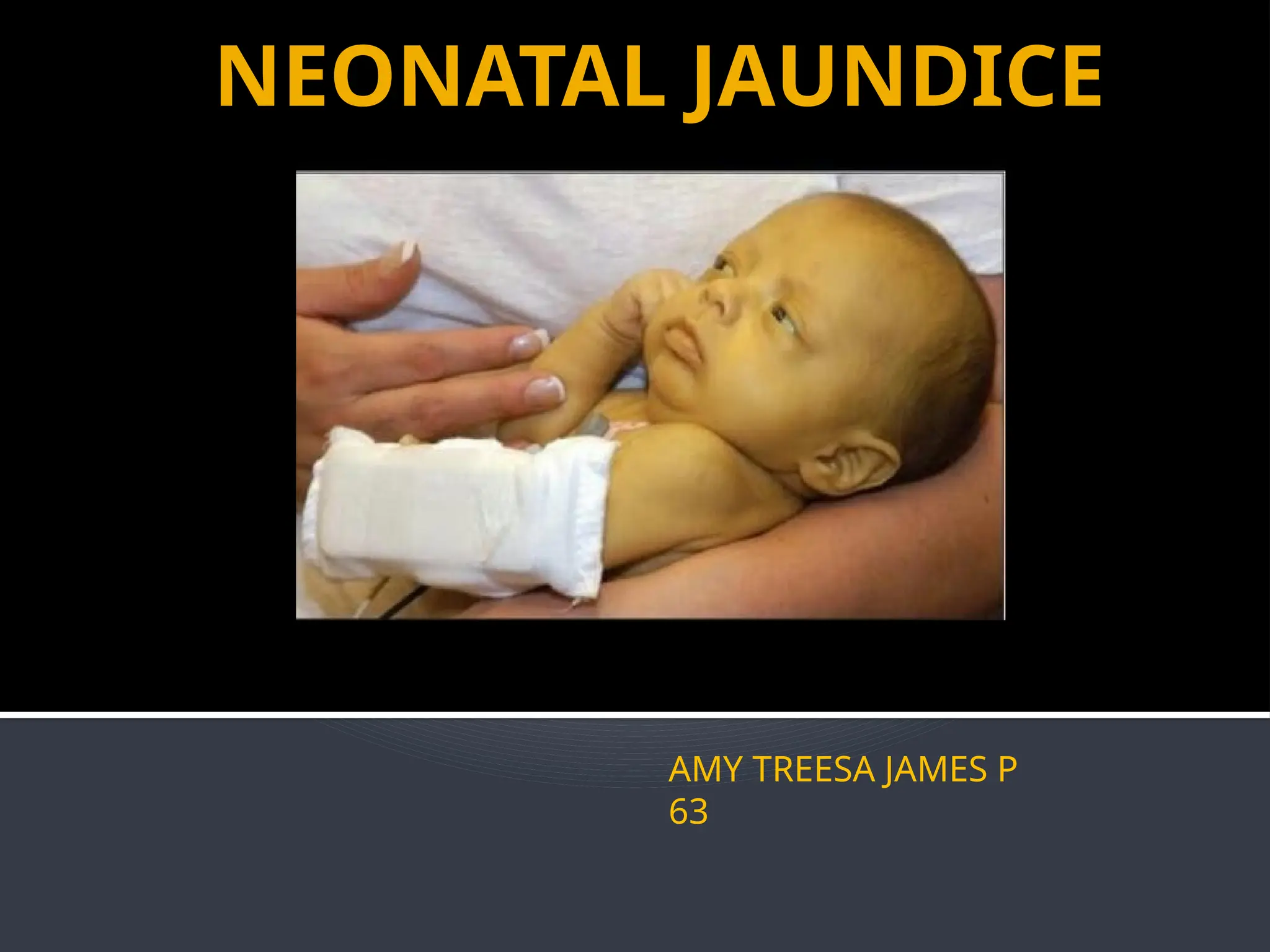
NEONATAL JAUNDICE
AMY TREESA JAMES P
63
INTRODUCTION
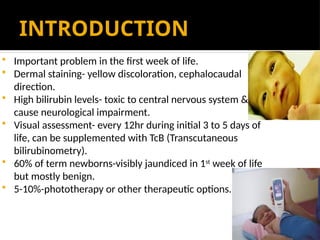
 Important problem in the first week of life.
 Dermal staining- yellow discoloration, cephalocaudal
direction.
 High bilirubin levels- toxic to central nervous system &
cause neurological impairment.
 Visual assessment- every 12hr during initial 3 to 5 days of
life, can be supplemented with TcB (Transcutaneous
bilirubinometry).
 60% of term newborns-visibly jaundiced in 1st
week of life
but mostly benign.
 5-10%-phototherapy or other therapeutic options.
PHYSIOLOGICAL VS
PATHOLOGICAL JAUNDICE
 Physiological Jaundice:
 Physiological immaturity to handle increased bilirubin
production.
 Visible jaundice-appears between 24-72 hrs.
 TSB peaks in 3 days, then falls in term neonates.
 Pathological Jaundice:
 Appears within first 24 hrs of life.
 Elevation of TSB level, exceeds 5mg/dL on first day, 10 mg/dL
in second day, 15 mg/dL thereafter.
 Clinical jaundice-beyond 3 weeks.
 Conjugated bilirubin.
CAUSES
 Hemolytic:
• Rh/ABO incompatibility
• G6PD deficiency
• Thalassemia
• Hereditary spherocytosis
 Non-Hemolytic:
• Prematurity
• Extravasated blood
• Inadequate feeding
• Polycythemia
• Idiopathic
• Breast milk jaundice
CAUSES
 <24 hrs: Pathological
• Hemolytic disease
• Infections
 24-72 hrs
• Physiological
• Sepsis
• Polycythemia
• Concealed hemorrhages
• Increased enterohepatic
circulation
 >72 hrs
• Sepsis
• Neonatal hepatitis
• Extrahepatic biliary atresia
• Breastmilk jaundice
• Metabolic disorders
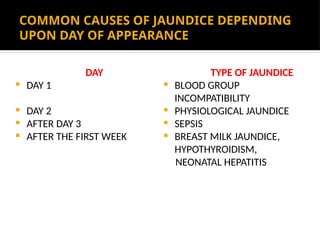
COMMON CAUSES OF JAUNDICE DEPENDING
UPON DAY OF APPEARANCE
DAY
 DAY 1
 DAY 2
 AFTER DAY 3
 AFTER THE FIRST WEEK
TYPE OF JAUNDICE
 BLOOD GROUP
INCOMPATIBILITY
 PHYSIOLOGICAL JAUNDICE
 SEPSIS
 BREAST MILK JAUNDICE,
HYPOTHYROIDISM,
NEONATAL HEPATITIS
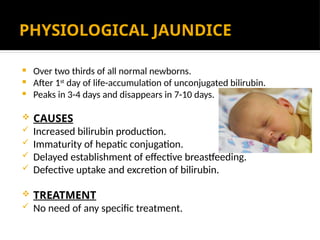
PHYSIOLOGICAL JAUNDICE
 Over two thirds of all normal newborns.
 After 1st
day of life-accumulation of unconjugated bilirubin.
 Peaks in 3-4 days and disappears in 7-10 days.
 CAUSES
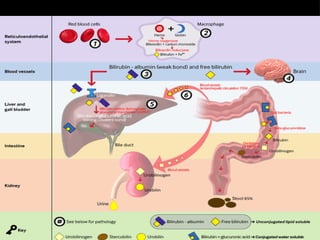
 Increased bilirubin production.
 Immaturity of hepatic conjugation.
 Delayed establishment of effective breastfeeding.
 Defective uptake and excretion of bilirubin.
 TREATMENT
 No need of any specific treatment.
PRESENCE OF ANY OF FOLLOWING
SIGNS-PATHOLOGICAL JAUNDICE
 Clinical jaundice- before 24 hrs of age
 Serum bilirubin rise->5mg/dL/day
 Serum bilirubin rise->15mg/dL
 Clinical jaundice beyond 14 days of life
 Clay-/white colored stool and/or dark urine staining the clothes
yellow
 Direct bilirubin >2mg/dL at any time
BREASTFEEDING JAUNDICE
• Exclusively breastfed- different
pattern of physiological
jaundice than artificially fed
babies.
• Inadequate breastfeeding.
• Appears: 24-72 hrs.
• Peaks: 5-15 days.
• Disappears: third week of life.
• 1/3rd
cases: mild jaundice in 3rd
week- persists into 2nd/3rd
month of life.
• Ensure optimum breastfeeding.
BREASTMILK JAUNDICE
• 2-4% cases-jaundice in excess
of 10 mg/dL beyond 3rd
/4th
week of life.
• Milk contain inhibitors of
conjugation(Pregnanediol, non
esterified long chain fatty acids)
• Diagnosis, if this is
unconjugated(mild
unconjugated
hyperbilirubinemia).
• Rule out other causes.
• Continue breastfeeding.
• Needs no treatment rarely
phototherapy.
RISK FACTORS FOR SEVERE HYPERBILIRUBINEMIA
 Jaundice observed-first 24hrs
 Blood group incompatibility
 Gestational age 35-36 weeks
 Previous sibling received phototherapy
 Cephalohematoma
 Inadequate breastfeeding
 East Asian race
DANGERS OF HYPERBILIRUBINEMIA
 KERNICTERUS
 Unconjugated bilirubin can cross the immature Blood Brain Barrier
[BBB].
 SYMPTOMS
• Lethargy
• Loss of Moro reflex
• Poor feeding
Intracranial involvement
• High pitched cry
• Bulging fontanel
• Seizures
• Opisthotonos
If Infant survives
• Choreoathetoid cerebral palsy
• Mental retardation
• Paralysis of upward gaze
• High-frequency hearing impairment
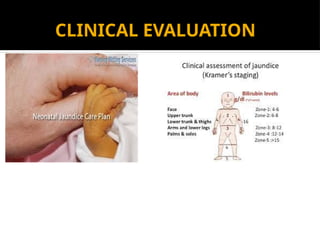
CLINICAL EVALUATION
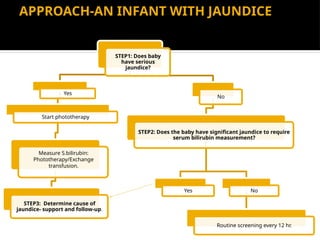
APPROACH-AN INFANT WITH JAUNDICE
visual assessment every 12 hrs, first 3-5 days ; TRANSCUTANEOUS IF AVAILABLE.
STEP1: Does baby
have serious
jaundice?
Yes
Start phototherapy
Measure S.bilirubin:
Phototherapy/Exchange
transfusion.
STEP3: Determine cause of
jaundice- support and follow-up.
No
STEP2: Does the baby have significant jaundice to require
serum bilirubin measurement?
Yes No
Routine screening every 12 hr.
INVESTIGATIONS
 FIRST LINE
• Total serum bilirubin.
• Blood groups of mother and baby.
• Peripheral smear: Evidence of hemolysis.
 SECOND LINE
• Direct Coombs test: Antibody coating on fetal RBC.
• Hematocrit: Decreased in hemolysis.
• Reticulocyte count: Increased in hemolysis
• G6PD levels.
• Others: Sepsis screen, thyroid function test, rule out
other genetic enzyme deficiencies.
CLINICAL ESTIMATION
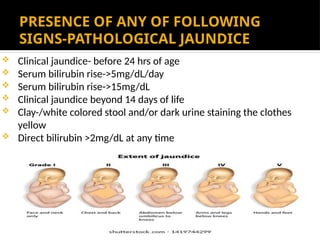
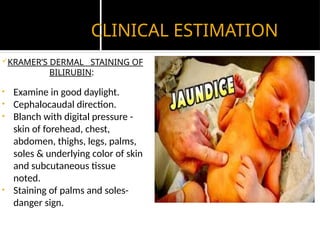
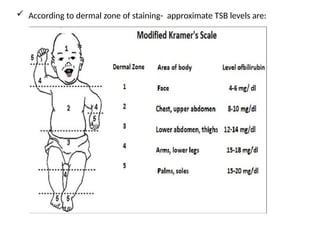
KRAMER’S DERMAL STAINING OF
BILIRUBIN:
• Examine in good daylight.
• Cephalocaudal direction.
• Blanch with digital pressure -
skin of forehead, chest,
abdomen, thighs, legs, palms,
soles & underlying color of skin
and subcutaneous tissue
noted.
• Staining of palms and soles-
danger sign.
 According to dermal zone of staining- approximate TSB levels are:
CUT-OFFS FOR TREATMENT IN PRETERMS:
GESTATION
(COMPLETED WEEKS)
PHOTOTHERAPY
[TSB-mg/dL]
EXCHANGE
TRANSFUSION
[TSB-mg/dL]
<28 weeks 5-6 11-14
28-29 weeks 6-8 12-14
30-31 weeks 8-10 13-16
32-33 weeks 10-12 15-18
34 weeks 12-14 17-19
CLINICAL HISTORY
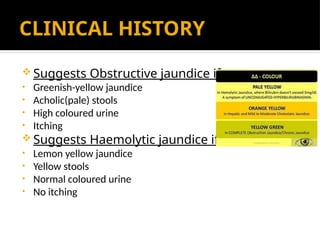
 Suggests Obstructive jaundice if
• Greenish-yellow jaundice
• Acholic(pale) stools
• High coloured urine
• Itching
 Suggests Haemolytic jaundice if
• Lemon yellow jaundice
• Yellow stools
• Normal coloured urine
• No itching
PROLONGED JAUNDICE
 Beyond 3 weeks(10mg/dL).
 COMMON CAUSES:
 Inadequate feeding
 Breast milk jaundice
 Extravasated blood
 Hemolytic disease
 G6PD deficiency
 Hypothyroidism
 IF THE BABY HAS DARK URINE OR SIGNIFICANT JAUNDICE, RULE OUT:
 Cholestasis
 Hemolysis, G6PD screen
 Hypothyroidism
 Urinary tract infection
MANAGEMENT
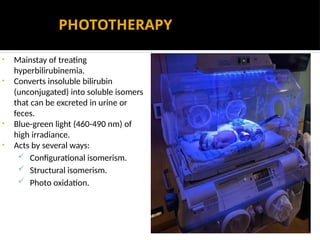
PHOTOTHERAPY
• Mainstay of treating
hyperbilirubinemia.
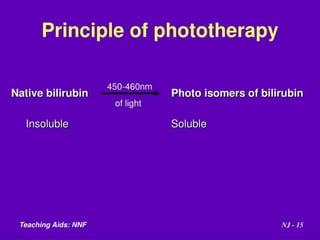
• Converts insoluble bilirubin
(unconjugated) into soluble isomers
that can be excreted in urine or
feces.
• Blue-green light (460-490 nm) of
high irradiance.
• Acts by several ways:
 Configurational isomerism.
 Structural isomerism.
 Photo oxidation.
TYPES OF PHOTOTHERAPY LIGHTS
 Fluorescent lamps of different colors and shapes(CFLs)
 Halogen bulbs
 High intensity LEDs (blue)-long life, high irradiance
 Fibro-optic light sources
PROCEDURE
 Ensure optimum room temperature: 25-28 degree Celsius.
 Keep the baby in a cot/ bassinet/ incubator/ radiant warmer.
 Remove all clothes of baby except diaper. Expose maximal surface
area of body. Avoid blocking of light by any equipment.
 Cover baby’s eyes with an eye patch.
 Keep the distance between baby and light 30-45 cms.
 Ensure optimum breastfeeding. Minimize interruption of
phototherapy during feeding sessions or procedures.
 Monitor temperature of baby every 2-4 hours.
 Measure TSB levels every 12-24 hrs.
 Discontinue once two TSB values 12 hours apart fall below current
age-specific cut offs.
 Monitor for rebound rise within 24 hrs after stopping
phototherapy.
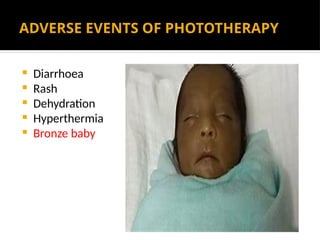
ADVERSE EVENTS OF PHOTOTHERAPY
 Diarrhoea
 Rash
 Dehydration
 Hyperthermia
 Bronze baby
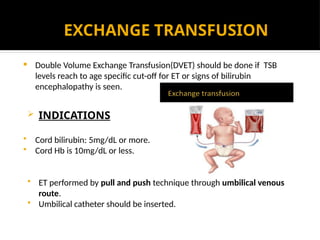
EXCHANGE TRANSFUSION
 Double Volume Exchange Transfusion(DVET) should be done if TSB
levels reach to age specific cut-off for ET or signs of bilirubin
encephalopathy is seen.
 INDICATIONS
 Cord bilirubin: 5mg/dL or more.
 Cord Hb is 10mg/dL or less.
 ET performed by pull and push technique through umbilical venous
route.
 Umbilical catheter should be inserted.
MEDICATIONS
 IV immunoglobulin-protecting sensitized red cells
from getting hemolysed.
FOLLOW-UP
 Serum bilirubin>20mg/dL
 Require ET
 BERA done at 3 months of age
PREVENTION
• Antenatal maternal blood grouping.
• Ensure adequate breast feeding.
• Parent education regarding danger signs.
• High-risk babies.
THANK YOU

Neonatal Jaundice.pptx pediatrics presentation

  • 1.
  • 2.
    INTRODUCTION  Important problemin the first week of life.  Dermal staining- yellow discoloration, cephalocaudal direction.  High bilirubin levels- toxic to central nervous system & cause neurological impairment.  Visual assessment- every 12hr during initial 3 to 5 days of life, can be supplemented with TcB (Transcutaneous bilirubinometry).  60% of term newborns-visibly jaundiced in 1st week of life but mostly benign.  5-10%-phototherapy or other therapeutic options.
  • 3.
    PHYSIOLOGICAL VS PATHOLOGICAL JAUNDICE Physiological Jaundice:  Physiological immaturity to handle increased bilirubin production.  Visible jaundice-appears between 24-72 hrs.  TSB peaks in 3 days, then falls in term neonates.  Pathological Jaundice:  Appears within first 24 hrs of life.  Elevation of TSB level, exceeds 5mg/dL on first day, 10 mg/dL in second day, 15 mg/dL thereafter.  Clinical jaundice-beyond 3 weeks.  Conjugated bilirubin.
  • 4.
    CAUSES  Hemolytic: • Rh/ABOincompatibility • G6PD deficiency • Thalassemia • Hereditary spherocytosis  Non-Hemolytic: • Prematurity • Extravasated blood • Inadequate feeding • Polycythemia • Idiopathic • Breast milk jaundice
  • 5.
    CAUSES  <24 hrs:Pathological • Hemolytic disease • Infections  24-72 hrs • Physiological • Sepsis • Polycythemia • Concealed hemorrhages • Increased enterohepatic circulation  >72 hrs • Sepsis • Neonatal hepatitis • Extrahepatic biliary atresia • Breastmilk jaundice • Metabolic disorders
  • 6.
    COMMON CAUSES OFJAUNDICE DEPENDING UPON DAY OF APPEARANCE DAY  DAY 1  DAY 2  AFTER DAY 3  AFTER THE FIRST WEEK TYPE OF JAUNDICE  BLOOD GROUP INCOMPATIBILITY  PHYSIOLOGICAL JAUNDICE  SEPSIS  BREAST MILK JAUNDICE, HYPOTHYROIDISM, NEONATAL HEPATITIS
  • 7.
    PHYSIOLOGICAL JAUNDICE  Overtwo thirds of all normal newborns.  After 1st day of life-accumulation of unconjugated bilirubin.  Peaks in 3-4 days and disappears in 7-10 days.  CAUSES  Increased bilirubin production.  Immaturity of hepatic conjugation.  Delayed establishment of effective breastfeeding.  Defective uptake and excretion of bilirubin.  TREATMENT  No need of any specific treatment.
  • 9.
    PRESENCE OF ANYOF FOLLOWING SIGNS-PATHOLOGICAL JAUNDICE  Clinical jaundice- before 24 hrs of age  Serum bilirubin rise->5mg/dL/day  Serum bilirubin rise->15mg/dL  Clinical jaundice beyond 14 days of life  Clay-/white colored stool and/or dark urine staining the clothes yellow  Direct bilirubin >2mg/dL at any time
  • 10.
    BREASTFEEDING JAUNDICE • Exclusivelybreastfed- different pattern of physiological jaundice than artificially fed babies. • Inadequate breastfeeding. • Appears: 24-72 hrs. • Peaks: 5-15 days. • Disappears: third week of life. • 1/3rd cases: mild jaundice in 3rd week- persists into 2nd/3rd month of life. • Ensure optimum breastfeeding. BREASTMILK JAUNDICE • 2-4% cases-jaundice in excess of 10 mg/dL beyond 3rd /4th week of life. • Milk contain inhibitors of conjugation(Pregnanediol, non esterified long chain fatty acids) • Diagnosis, if this is unconjugated(mild unconjugated hyperbilirubinemia). • Rule out other causes. • Continue breastfeeding. • Needs no treatment rarely phototherapy.
  • 11.
    RISK FACTORS FORSEVERE HYPERBILIRUBINEMIA  Jaundice observed-first 24hrs  Blood group incompatibility  Gestational age 35-36 weeks  Previous sibling received phototherapy  Cephalohematoma  Inadequate breastfeeding  East Asian race
  • 12.
    DANGERS OF HYPERBILIRUBINEMIA KERNICTERUS  Unconjugated bilirubin can cross the immature Blood Brain Barrier [BBB].  SYMPTOMS • Lethargy • Loss of Moro reflex • Poor feeding Intracranial involvement • High pitched cry • Bulging fontanel • Seizures • Opisthotonos If Infant survives • Choreoathetoid cerebral palsy • Mental retardation • Paralysis of upward gaze • High-frequency hearing impairment
  • 13.
  • 14.
    APPROACH-AN INFANT WITHJAUNDICE visual assessment every 12 hrs, first 3-5 days ; TRANSCUTANEOUS IF AVAILABLE. STEP1: Does baby have serious jaundice? Yes Start phototherapy Measure S.bilirubin: Phototherapy/Exchange transfusion. STEP3: Determine cause of jaundice- support and follow-up. No STEP2: Does the baby have significant jaundice to require serum bilirubin measurement? Yes No Routine screening every 12 hr.
  • 15.
    INVESTIGATIONS  FIRST LINE •Total serum bilirubin. • Blood groups of mother and baby. • Peripheral smear: Evidence of hemolysis.  SECOND LINE • Direct Coombs test: Antibody coating on fetal RBC. • Hematocrit: Decreased in hemolysis. • Reticulocyte count: Increased in hemolysis • G6PD levels. • Others: Sepsis screen, thyroid function test, rule out other genetic enzyme deficiencies.
  • 16.
    CLINICAL ESTIMATION KRAMER’S DERMALSTAINING OF BILIRUBIN: • Examine in good daylight. • Cephalocaudal direction. • Blanch with digital pressure - skin of forehead, chest, abdomen, thighs, legs, palms, soles & underlying color of skin and subcutaneous tissue noted. • Staining of palms and soles- danger sign.
  • 17.
     According todermal zone of staining- approximate TSB levels are:
  • 18.
    CUT-OFFS FOR TREATMENTIN PRETERMS: GESTATION (COMPLETED WEEKS) PHOTOTHERAPY [TSB-mg/dL] EXCHANGE TRANSFUSION [TSB-mg/dL] <28 weeks 5-6 11-14 28-29 weeks 6-8 12-14 30-31 weeks 8-10 13-16 32-33 weeks 10-12 15-18 34 weeks 12-14 17-19
  • 19.
    CLINICAL HISTORY  SuggestsObstructive jaundice if • Greenish-yellow jaundice • Acholic(pale) stools • High coloured urine • Itching  Suggests Haemolytic jaundice if • Lemon yellow jaundice • Yellow stools • Normal coloured urine • No itching
  • 20.
    PROLONGED JAUNDICE  Beyond3 weeks(10mg/dL).  COMMON CAUSES:  Inadequate feeding  Breast milk jaundice  Extravasated blood  Hemolytic disease  G6PD deficiency  Hypothyroidism  IF THE BABY HAS DARK URINE OR SIGNIFICANT JAUNDICE, RULE OUT:  Cholestasis  Hemolysis, G6PD screen  Hypothyroidism  Urinary tract infection
  • 21.
  • 22.
    PHOTOTHERAPY • Mainstay oftreating hyperbilirubinemia. • Converts insoluble bilirubin (unconjugated) into soluble isomers that can be excreted in urine or feces. • Blue-green light (460-490 nm) of high irradiance. • Acts by several ways:  Configurational isomerism.  Structural isomerism.  Photo oxidation.
  • 24.
    TYPES OF PHOTOTHERAPYLIGHTS  Fluorescent lamps of different colors and shapes(CFLs)  Halogen bulbs  High intensity LEDs (blue)-long life, high irradiance  Fibro-optic light sources
  • 25.
    PROCEDURE  Ensure optimumroom temperature: 25-28 degree Celsius.  Keep the baby in a cot/ bassinet/ incubator/ radiant warmer.  Remove all clothes of baby except diaper. Expose maximal surface area of body. Avoid blocking of light by any equipment.  Cover baby’s eyes with an eye patch.  Keep the distance between baby and light 30-45 cms.  Ensure optimum breastfeeding. Minimize interruption of phototherapy during feeding sessions or procedures.  Monitor temperature of baby every 2-4 hours.  Measure TSB levels every 12-24 hrs.  Discontinue once two TSB values 12 hours apart fall below current age-specific cut offs.  Monitor for rebound rise within 24 hrs after stopping phototherapy.
  • 26.
    ADVERSE EVENTS OFPHOTOTHERAPY  Diarrhoea  Rash  Dehydration  Hyperthermia  Bronze baby
  • 27.
    EXCHANGE TRANSFUSION  DoubleVolume Exchange Transfusion(DVET) should be done if TSB levels reach to age specific cut-off for ET or signs of bilirubin encephalopathy is seen.  INDICATIONS  Cord bilirubin: 5mg/dL or more.  Cord Hb is 10mg/dL or less.  ET performed by pull and push technique through umbilical venous route.  Umbilical catheter should be inserted.
  • 28.
    MEDICATIONS  IV immunoglobulin-protectingsensitized red cells from getting hemolysed.
  • 29.
    FOLLOW-UP  Serum bilirubin>20mg/dL Require ET  BERA done at 3 months of age
  • 30.
    PREVENTION • Antenatal maternalblood grouping. • Ensure adequate breast feeding. • Parent education regarding danger signs. • High-risk babies.
  • 31.