Neonatal Hypoglycemia
Mohd Zaim
Definition
• Hypoglycaemia is defined as < 2.6 mmol/L
after first 4 hours of life
• There is no specific plasma glucose
concentration or duration of hypoglycemia
that predicts permanent neurologic injury in
high-risk infants.
• From birth to 4 hours, glucose level of above
25 mg/dL (1.5 mmol/L) is acceptable if the
infant is asymptomatic.
High Risk Infant
• Infants of Diabetic Mothers
• Small for Gestational Age infants
• Preterm infants including late preterm infants.
• Macrosomic infants / Large for gestational age infants
> 4.0kg.
• Ill infants including those with:
• • Hypoxic-ischemic encephalopathy.
• • Rhesus disease.
• • Polycythaemia.
• • Sepsis.
• • Hypothermia.
Clinical Features
• Jitteriness and irritability.
• Apnoea and cyanosis.
• Hypotonia and poor feeding.
• Convulsions.
• Note: Hypoglycaemia may be asymptomatic
therefore monitoring is important for high
risk cases.
Management
• Prevention and Early Detection – at birth.
• • Identify at risk infants.
• • Well infants who are at risk:
• • Immediate feeding – first feed can be given in Labour
Room.
• • Supplement feeding until breastfeeding established.
• • Unwell infants:
• • Set up dextrose 10% drip.
• • Regular glucometer monitoring:
• • On admission and at 1, 2 and 4 hours after admission.
• • 3 -6 hourly just prior to feeding once stable for 24-48
hours.
If Hypoglycemic What To Do?
• Repeat the capillary blood sugar sampling and
send RBS stat.
• Examine and document any symptoms.
• Note when the last feeding was given.
• If on IV drip, check that IV infusion of glucose
is adequate and running well.
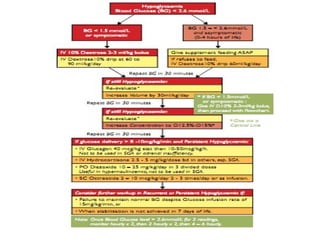
Blood Sugar Level <1.5mmol/l or
symptomatic
• GIve IV bolus Dextrose 10% at 2-3 ml/kg.
• Followed by dextrose 10% drip at 60-
90ml/kg/day (for day 1 of life) to maintain
normal blood glucose.
• If baby is already on dextrose 10% drip
consider increasing the rate or the glucose
concentration (usually require 6-8 mg/kg/min
of glucose delivery).
If blood sugar level (BSL) 1.5 – 2.5
mmol/l and asymptomatic
• Give supplementary feed (EBM or formula) as
soon as possible.
• If BSL remains < 2.6 mmol/l and baby refuses
feeds, give dextrose 10% drip.
• If baby is on dextrose 10% drip, consider
stepwise increment of glucose infusion rate by
2 mg/kg/min until blood sugar is > 2.6
mmol/L.
Next step to monitor glucose
• • If blood sugar is < 2.6 mmol/l, re-check
glucometer half hourly.
• • If blood sugar > 2.6 mmol/l for 2 readings:
Monitor hourly x 2, Then 2 hourly X 2, Then to
4-6 hourly if blood sugar remains normal.
Persistent Hypoglycaemia
• Re-evaluate the infant
• Confirm hypoglycaemia with RBS but treat as such while awaiting
RBS result.
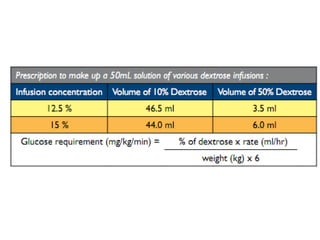
• Increase volume by 30ml/kg/day and/or increase dextrose
concentration to 12.5% or 15% . Concentrations >12.5% must be
infused through a central line.
• If hypoglycaemia still persists despite glucose delivery >8-10
mg/kg/min, consider glucagon 40 mcg/kg stat then 10-50mcg/kg/h.
Glucagon is only useful where there is sufficient liver stores, thus
should not be used for SGA babies or in adrenal insufficiency.
• In others especially SGA, give IV Hydrocortisone 2.5 -5 mg/kg /dose
bd.
• There may be hyperinsulinaemia in growth retarded babies as well.
Recurrent or resistant hypoglycaemia
• Consider this if failure to maintain normal
blood sugar levels despite a glucose infusion
of 15 mg/kg/min, or
• When stabilization is not achieved by 7 days
of life. High levels of glucose infusion may be
needed in the infants to achieve euglycemia.
Differential diagnoses of Recurrent or
resistant hypoglycemia
• Hyperinsulinaemic states (e.g.Beckwith-
Wiedemann syndr, Nesidioblastosis)
• Adrenal insufficiency.
• Galactosaemia.
• Metabolic (e.g. fatty acid oxidation disorders)
and mitochondrial disorders.
Investigations For Recurrent or
resistant hypoglycaemia
• Insulin , cortisol, growth hormone levels
• Serum ketones
• Urine for organic acids
Medical treatment
• As per protocol for Management of Persistent
Hypoglycaemia.
• PO Diazoxide 10-25mg/kg/day in threedivided
doses
- Reduces insulin secretion, therefore useful in
hyperinsulinaemia.
- Not to be used in SGA infants.
• SC Octreotide (synthetic somatostatin) 2-10
μg/kg/day bd/tds or as infusion
Pearls and Pitfalls in Management
• Maintain some oral feeds. Breastfeeding is
encouraged
• Feed baby with much milk as tolerated and
maintain glucose infusion
• Avoid multiple boluses of 10 percent glucose
• Bolus given must followed by infusion of glucose
• Consider problems like cardiac failure, cerebral
edema and renal failure. Ensure appropriate fluid
restriction.
• RBS should be taken
Neonatal hypoglycemia

Neonatal hypoglycemia

  • 1.
  • 2.
    Definition • Hypoglycaemia isdefined as < 2.6 mmol/L after first 4 hours of life • There is no specific plasma glucose concentration or duration of hypoglycemia that predicts permanent neurologic injury in high-risk infants. • From birth to 4 hours, glucose level of above 25 mg/dL (1.5 mmol/L) is acceptable if the infant is asymptomatic.
  • 3.
    High Risk Infant •Infants of Diabetic Mothers • Small for Gestational Age infants • Preterm infants including late preterm infants. • Macrosomic infants / Large for gestational age infants > 4.0kg. • Ill infants including those with: • • Hypoxic-ischemic encephalopathy. • • Rhesus disease. • • Polycythaemia. • • Sepsis. • • Hypothermia.
  • 4.
    Clinical Features • Jitterinessand irritability. • Apnoea and cyanosis. • Hypotonia and poor feeding. • Convulsions. • Note: Hypoglycaemia may be asymptomatic therefore monitoring is important for high risk cases.
  • 5.
    Management • Prevention andEarly Detection – at birth. • • Identify at risk infants. • • Well infants who are at risk: • • Immediate feeding – first feed can be given in Labour Room. • • Supplement feeding until breastfeeding established. • • Unwell infants: • • Set up dextrose 10% drip. • • Regular glucometer monitoring: • • On admission and at 1, 2 and 4 hours after admission. • • 3 -6 hourly just prior to feeding once stable for 24-48 hours.
  • 6.
    If Hypoglycemic WhatTo Do? • Repeat the capillary blood sugar sampling and send RBS stat. • Examine and document any symptoms. • Note when the last feeding was given. • If on IV drip, check that IV infusion of glucose is adequate and running well.
  • 7.
    Blood Sugar Level<1.5mmol/l or symptomatic • GIve IV bolus Dextrose 10% at 2-3 ml/kg. • Followed by dextrose 10% drip at 60- 90ml/kg/day (for day 1 of life) to maintain normal blood glucose. • If baby is already on dextrose 10% drip consider increasing the rate or the glucose concentration (usually require 6-8 mg/kg/min of glucose delivery).
  • 8.
    If blood sugarlevel (BSL) 1.5 – 2.5 mmol/l and asymptomatic • Give supplementary feed (EBM or formula) as soon as possible. • If BSL remains < 2.6 mmol/l and baby refuses feeds, give dextrose 10% drip. • If baby is on dextrose 10% drip, consider stepwise increment of glucose infusion rate by 2 mg/kg/min until blood sugar is > 2.6 mmol/L.
  • 9.
    Next step tomonitor glucose • • If blood sugar is < 2.6 mmol/l, re-check glucometer half hourly. • • If blood sugar > 2.6 mmol/l for 2 readings: Monitor hourly x 2, Then 2 hourly X 2, Then to 4-6 hourly if blood sugar remains normal.
  • 10.
    Persistent Hypoglycaemia • Re-evaluatethe infant • Confirm hypoglycaemia with RBS but treat as such while awaiting RBS result. • Increase volume by 30ml/kg/day and/or increase dextrose concentration to 12.5% or 15% . Concentrations >12.5% must be infused through a central line. • If hypoglycaemia still persists despite glucose delivery >8-10 mg/kg/min, consider glucagon 40 mcg/kg stat then 10-50mcg/kg/h. Glucagon is only useful where there is sufficient liver stores, thus should not be used for SGA babies or in adrenal insufficiency. • In others especially SGA, give IV Hydrocortisone 2.5 -5 mg/kg /dose bd. • There may be hyperinsulinaemia in growth retarded babies as well.
  • 12.
    Recurrent or resistanthypoglycaemia • Consider this if failure to maintain normal blood sugar levels despite a glucose infusion of 15 mg/kg/min, or • When stabilization is not achieved by 7 days of life. High levels of glucose infusion may be needed in the infants to achieve euglycemia.
  • 13.
    Differential diagnoses ofRecurrent or resistant hypoglycemia • Hyperinsulinaemic states (e.g.Beckwith- Wiedemann syndr, Nesidioblastosis) • Adrenal insufficiency. • Galactosaemia. • Metabolic (e.g. fatty acid oxidation disorders) and mitochondrial disorders.
  • 14.
    Investigations For Recurrentor resistant hypoglycaemia • Insulin , cortisol, growth hormone levels • Serum ketones • Urine for organic acids
  • 15.
    Medical treatment • Asper protocol for Management of Persistent Hypoglycaemia. • PO Diazoxide 10-25mg/kg/day in threedivided doses - Reduces insulin secretion, therefore useful in hyperinsulinaemia. - Not to be used in SGA infants. • SC Octreotide (synthetic somatostatin) 2-10 μg/kg/day bd/tds or as infusion
  • 16.
    Pearls and Pitfallsin Management • Maintain some oral feeds. Breastfeeding is encouraged • Feed baby with much milk as tolerated and maintain glucose infusion • Avoid multiple boluses of 10 percent glucose • Bolus given must followed by infusion of glucose • Consider problems like cardiac failure, cerebral edema and renal failure. Ensure appropriate fluid restriction. • RBS should be taken