Neonatal
hypoglycemia
Definition
 Blood glucose level <40mg/dl
 Plasma glucose level <45mg/dl
Causes of hypoglycemia
1. Inadequate substrate:
 Small for gestational age (<3rd percentile)
 Gestational age <35 weeks
 Birth weight <2000g
 Delayed onset feeding
2. Relative hyperinsulinemia:
 Infants of diabetic mother
 Large for date babies (>97th percentile)
 Rh isoimmunisation
3. Sickness
 Hypothermia
 Sepsis
 Asphysia
Clinical features
 May be asymptomatic
 Some may present with:
 Stupor
 Tremor
 Jitteriness
 Seizures
 coma
 Lethargy
 apathy
 Poor or difficult feeding
 Abnormal cry
 Eye rolling
 Hypothermia
 Sweating
 Tachypnea
 Grunting
 Cyanosis
 Sudden pallor
 Hypotonia
 Irritability
Screening
 High risk babies should be screened for hypoglycemia at
2,6,12,24,48 and 72 hours after birth with reagent strips (dextrostix)
 If the blood sugar value is <40mg/dl on reagent strip , should be
treated after confirmation by lab test.
Operational threshold
 In 2000, Cornblath recommended the use of
“operational threshold”for blood sugar management in
newborn infants. It is indication for action and is not
diagnostic of disease or abnormality.
Operational threshold as
suggested by Cornblath et al.
1. Healthy term infant
 <24 hrs of age – 30-35mg/dl may be acceptable at
one time but threshold is raised to 45mg/dl if it
persists after feeding or reoccur in 1st 24 hrs
 After 24 hrs , threshold should be increased to 45-
50mg/dl
2. Infant with abnormal sign and symptoms – 45mg/dl
3. Asymptomatic infants with risk factors -36mg/dl
4. For any baby, if the glucose level is <20-25mg/dl ; I.V
glucose is needed to raise the plasma glucose level to
>45mg/dl
Management
 Prevention
 Asymptomatic babies
 Symptomatic babies
 Medical management
 Surgical management
Prevention
 All high risk baby should require proper breast feeding
counselling and support
 Adequacy of breast feeding should be accessed
 Babies not able to suck effectively on breast should
receive expressed breast milk by alternative methods
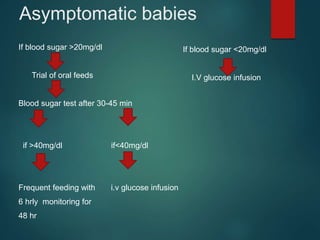
Asymptomatic babies
If blood sugar >20mg/dl
Trial of oral feeds
Blood sugar test after 30-45 min
if >40mg/dl if<40mg/dl
Frequent feeding with i.v glucose infusion
6 hrly monitoring for
48 hr
If blood sugar <20mg/dl
I.V glucose infusion
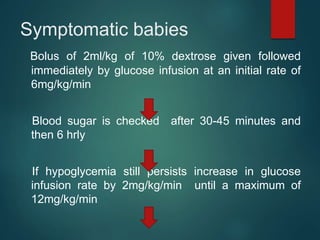
Symptomatic babies
Bolus of 2ml/kg of 10% dextrose given followed
immediately by glucose infusion at an initial rate of
6mg/kg/min
Blood sugar is checked after 30-45 minutes and
then 6 hrly
If hypoglycemia still persists increase in glucose
infusion rate by 2mg/kg/min until a maximum of
12mg/kg/min
If 2 or more consecutive values are > 50mg/dl after 24 hr of
parenteral therapy
Infusion is taperd off at the rate of 2mg/kg/min every 6 hr with
glucose monitoring
Tapering should be combined with increase in oral feed
Medical management
 Hydrocortisone 5mg/kg/day in 2 divided doses
 Diazoxide 5-8mg/kg/day
 Octreotide 5-20mcg/kg/day
 Glucagon 0.025-0.2mg/kg
Surgical management
 Subtotal pancreatectomy
If hypoglycemia is persistent or needs prolonged treatment, one should
consider the rarer causes and following tests must be carried out to
determine the cause:
 Critical lab sample-
 Glucose
 Insulin
 Cortisol
 Beta-hydroxybutyrate and free fatty acid levels
 Other additional tests-
 Growth hormone
 ACTH
 Thyroxine and TSH
 Glucagon
 Plasma and urine amino acids
 Urine ketones
 Urine reducing substance
 Other special tests to diagnose inborn errors of metabolism
Follow up and outcomes
 1 month – eye evaluation
 3,6,9,12 and 18 months – growth, neurodevelopment
and vision and hearing loss
Differential Diagnosis
i. Sepsis
ii. CNS disease
iii. Toxic exposure
iv. Metabolic abnormalities : hypocalcemia,
hypomagnesemia, hyponatremia or hypernatremia
v. Adrenal insufficiency
vi. Heart failure
vii. Renal failure
viii. Liver failure
References:
 Ghai Essential pediatrics
 Manual of neonatal care
THANK YOU!!!

Neonatal hypoglycemia

  • 1.
  • 2.
    Definition  Blood glucoselevel <40mg/dl  Plasma glucose level <45mg/dl
  • 3.
    Causes of hypoglycemia 1.Inadequate substrate:  Small for gestational age (<3rd percentile)  Gestational age <35 weeks  Birth weight <2000g  Delayed onset feeding 2. Relative hyperinsulinemia:  Infants of diabetic mother  Large for date babies (>97th percentile)  Rh isoimmunisation
  • 4.
  • 5.
    Clinical features  Maybe asymptomatic  Some may present with:  Stupor  Tremor  Jitteriness  Seizures  coma  Lethargy  apathy  Poor or difficult feeding  Abnormal cry  Eye rolling  Hypothermia  Sweating  Tachypnea  Grunting  Cyanosis  Sudden pallor  Hypotonia  Irritability
  • 6.
    Screening  High riskbabies should be screened for hypoglycemia at 2,6,12,24,48 and 72 hours after birth with reagent strips (dextrostix)  If the blood sugar value is <40mg/dl on reagent strip , should be treated after confirmation by lab test.
  • 7.
    Operational threshold  In2000, Cornblath recommended the use of “operational threshold”for blood sugar management in newborn infants. It is indication for action and is not diagnostic of disease or abnormality.
  • 8.
    Operational threshold as suggestedby Cornblath et al. 1. Healthy term infant  <24 hrs of age – 30-35mg/dl may be acceptable at one time but threshold is raised to 45mg/dl if it persists after feeding or reoccur in 1st 24 hrs  After 24 hrs , threshold should be increased to 45- 50mg/dl 2. Infant with abnormal sign and symptoms – 45mg/dl
  • 9.
    3. Asymptomatic infantswith risk factors -36mg/dl 4. For any baby, if the glucose level is <20-25mg/dl ; I.V glucose is needed to raise the plasma glucose level to >45mg/dl
  • 10.
    Management  Prevention  Asymptomaticbabies  Symptomatic babies  Medical management  Surgical management
  • 11.
    Prevention  All highrisk baby should require proper breast feeding counselling and support  Adequacy of breast feeding should be accessed  Babies not able to suck effectively on breast should receive expressed breast milk by alternative methods
  • 12.
    Asymptomatic babies If bloodsugar >20mg/dl Trial of oral feeds Blood sugar test after 30-45 min if >40mg/dl if<40mg/dl Frequent feeding with i.v glucose infusion 6 hrly monitoring for 48 hr If blood sugar <20mg/dl I.V glucose infusion
  • 13.
    Symptomatic babies Bolus of2ml/kg of 10% dextrose given followed immediately by glucose infusion at an initial rate of 6mg/kg/min Blood sugar is checked after 30-45 minutes and then 6 hrly If hypoglycemia still persists increase in glucose infusion rate by 2mg/kg/min until a maximum of 12mg/kg/min
  • 14.
    If 2 ormore consecutive values are > 50mg/dl after 24 hr of parenteral therapy Infusion is taperd off at the rate of 2mg/kg/min every 6 hr with glucose monitoring Tapering should be combined with increase in oral feed
  • 15.
    Medical management  Hydrocortisone5mg/kg/day in 2 divided doses  Diazoxide 5-8mg/kg/day  Octreotide 5-20mcg/kg/day  Glucagon 0.025-0.2mg/kg Surgical management  Subtotal pancreatectomy
  • 16.
    If hypoglycemia ispersistent or needs prolonged treatment, one should consider the rarer causes and following tests must be carried out to determine the cause:  Critical lab sample-  Glucose  Insulin  Cortisol  Beta-hydroxybutyrate and free fatty acid levels
  • 17.
     Other additionaltests-  Growth hormone  ACTH  Thyroxine and TSH  Glucagon  Plasma and urine amino acids  Urine ketones  Urine reducing substance  Other special tests to diagnose inborn errors of metabolism
  • 18.
    Follow up andoutcomes  1 month – eye evaluation  3,6,9,12 and 18 months – growth, neurodevelopment and vision and hearing loss
  • 19.
    Differential Diagnosis i. Sepsis ii.CNS disease iii. Toxic exposure iv. Metabolic abnormalities : hypocalcemia, hypomagnesemia, hyponatremia or hypernatremia v. Adrenal insufficiency vi. Heart failure vii. Renal failure viii. Liver failure
  • 20.
    References:  Ghai Essentialpediatrics  Manual of neonatal care
  • 21.