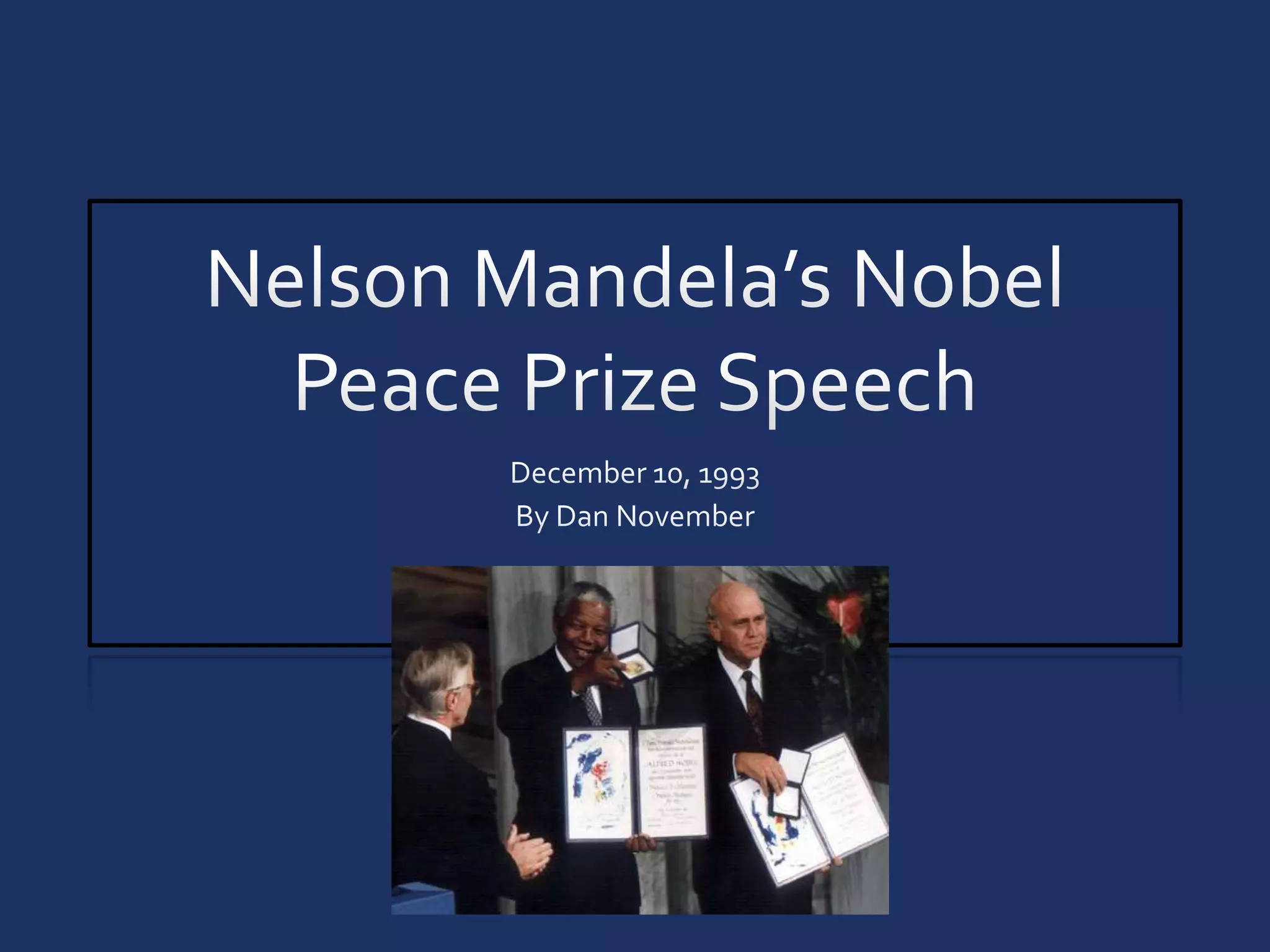
Nelson Mandela’s Nobel Peace Prize SpeechDecember 10, 1993By Dan November
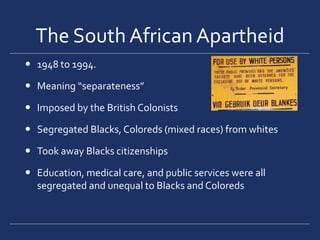
The South African Apartheid1948 to 1994.Meaning “separateness”Imposed by the British ColonistsSegregated Blacks, Coloreds (mixed races) from whitesTook away Blacks citizenshipsEducation, medical care, and public services were all segregated and unequal to Blacks and Coloreds
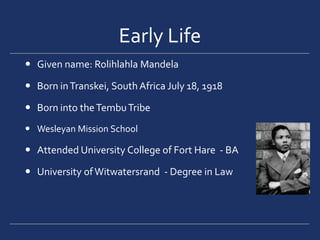
Early LifeGiven name: Rolihlahla MandelaBorn in Transkei, South Africa July 18, 1918Born into the Tembu TribeWesleyan Mission School Attended University College of Fort Hare  - BAUniversity of Witwatersrand  - Degree in Law
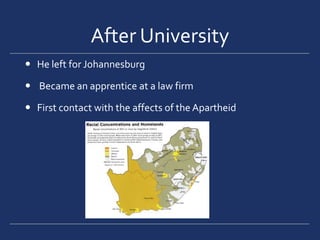
After UniversityHe left for Johannesburg  Became an apprentice at a law firmFirst contact with the affects of the Apartheid
African National CongressFounded 1912Democratic PartyIncrease the rights of BlacksMandela joined “Youth League” in 1944Military Section: Umkhontowe Sizwe (Spear of the Nation) was formed by Mandela in 1961Inspired by Gandhi
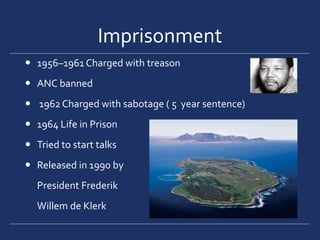
Imprisonment 1956–1961 Charged with treasonANC banned 1962 Charged with sabotage ( 5  year sentence)1964 Life in PrisonTried to start talks Released in 1990 by	President Frederik	Willem de Klerk
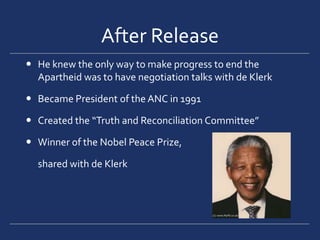
After ReleaseHe knew the only way to make progress to end the Apartheid was to have negotiation talks with de KlerkBecame President of the ANC in 1991 Created the “Truth and Reconciliation Committee”Winner of the Nobel Peace Prize, 	shared with de Klerk
Nobel Peace PrizeFirst awarded in 1901 90 LaureatesGiven to those who exemplify:”The person who shall have done the most or the best work for fraternity between nations, for the abolition or reduction of standing armies and for the holding and promotion of peace congresses"
The Speech		Began by thanking everyone who was involved with helping to end the ApartheidPays respects to Martin Luther King jr.“It will and must be measured by the happiness and welfare of the children, at once the most vulnerable citizens in any society and the greatest of our treasures. “Says it can never happen againAcknowledges there are those who do not believe in the change
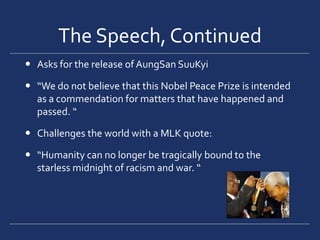
The Speech, ContinuedAsks for the release of AungSan SuuKyi“We do not believe that this Nobel Peace Prize is intended as a commendation for matters that have happened and passed. “Challenges the world with a MLK quote:“Humanity can no longer be tragically bound to the starless midnight of racism and war. “
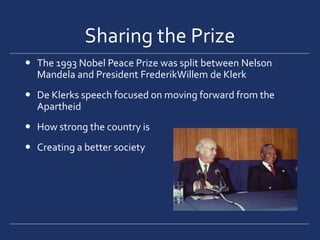
Sharing the PrizeThe 1993 Nobel Peace Prize was split between Nelson Mandela and President FrederikWillem de KlerkDe Klerks speech focused on moving forward from the ApartheidHow strong the country isCreating a better society
Bibliography1.Adam, Anthony. "The Common People View of Nelson Mandela." Telephone interview. 5 Nov. 2009. 2.BRINK, ANDRE. "Time 100: Nelson Mandela." Time 100: Nelson Mandela. Web. <http://www.time.com/time/time100/leaders/profile/mandela.html>. 3."Nelson Mandela." Nelson Mandela Biography. Nobel Prize. Web. 7 Nov. 2009. <http://nobelprize.org/nobel_prizes/peace/>. 4."The Nobel Peace Prize 1991." The Nobel Peace Prize 1991. Web. <http://nobelprize.org/nobel_prizes/peace/laureates/1991/press.html>.

Nelson Mandela Nobel Peace Speach

  • 1.
    Nelson Mandela’s NobelPeace Prize SpeechDecember 10, 1993By Dan November
  • 2.
    The South AfricanApartheid1948 to 1994.Meaning “separateness”Imposed by the British ColonistsSegregated Blacks, Coloreds (mixed races) from whitesTook away Blacks citizenshipsEducation, medical care, and public services were all segregated and unequal to Blacks and Coloreds
  • 3.
    Early LifeGiven name:Rolihlahla MandelaBorn in Transkei, South Africa July 18, 1918Born into the Tembu TribeWesleyan Mission School Attended University College of Fort Hare - BAUniversity of Witwatersrand - Degree in Law
  • 4.
    After UniversityHe leftfor Johannesburg Became an apprentice at a law firmFirst contact with the affects of the Apartheid
  • 5.
    African National CongressFounded1912Democratic PartyIncrease the rights of BlacksMandela joined “Youth League” in 1944Military Section: Umkhontowe Sizwe (Spear of the Nation) was formed by Mandela in 1961Inspired by Gandhi
  • 6.
    Imprisonment 1956–1961 Chargedwith treasonANC banned 1962 Charged with sabotage ( 5 year sentence)1964 Life in PrisonTried to start talks Released in 1990 by President Frederik Willem de Klerk
  • 7.
    After ReleaseHe knewthe only way to make progress to end the Apartheid was to have negotiation talks with de KlerkBecame President of the ANC in 1991 Created the “Truth and Reconciliation Committee”Winner of the Nobel Peace Prize, shared with de Klerk
  • 8.
    Nobel Peace PrizeFirstawarded in 1901 90 LaureatesGiven to those who exemplify:”The person who shall have done the most or the best work for fraternity between nations, for the abolition or reduction of standing armies and for the holding and promotion of peace congresses"
  • 9.
    The Speech Began bythanking everyone who was involved with helping to end the ApartheidPays respects to Martin Luther King jr.“It will and must be measured by the happiness and welfare of the children, at once the most vulnerable citizens in any society and the greatest of our treasures. “Says it can never happen againAcknowledges there are those who do not believe in the change
  • 10.
    The Speech, ContinuedAsksfor the release of AungSan SuuKyi“We do not believe that this Nobel Peace Prize is intended as a commendation for matters that have happened and passed. “Challenges the world with a MLK quote:“Humanity can no longer be tragically bound to the starless midnight of racism and war. “
  • 11.
    Sharing the PrizeThe1993 Nobel Peace Prize was split between Nelson Mandela and President FrederikWillem de KlerkDe Klerks speech focused on moving forward from the ApartheidHow strong the country isCreating a better society
  • 12.
    Bibliography1.Adam, Anthony. "TheCommon People View of Nelson Mandela." Telephone interview. 5 Nov. 2009. 2.BRINK, ANDRE. "Time 100: Nelson Mandela." Time 100: Nelson Mandela. Web. <http://www.time.com/time/time100/leaders/profile/mandela.html>. 3."Nelson Mandela." Nelson Mandela Biography. Nobel Prize. Web. 7 Nov. 2009. <http://nobelprize.org/nobel_prizes/peace/>. 4."The Nobel Peace Prize 1991." The Nobel Peace Prize 1991. Web. <http://nobelprize.org/nobel_prizes/peace/laureates/1991/press.html>.