Presented By,
Md. Abubaker Siddicq
ID No: EV-17015063
 Life of Nelson Mandela
 As a Political Leader
 Achievement
 Famous Quotation
 What we have learnt
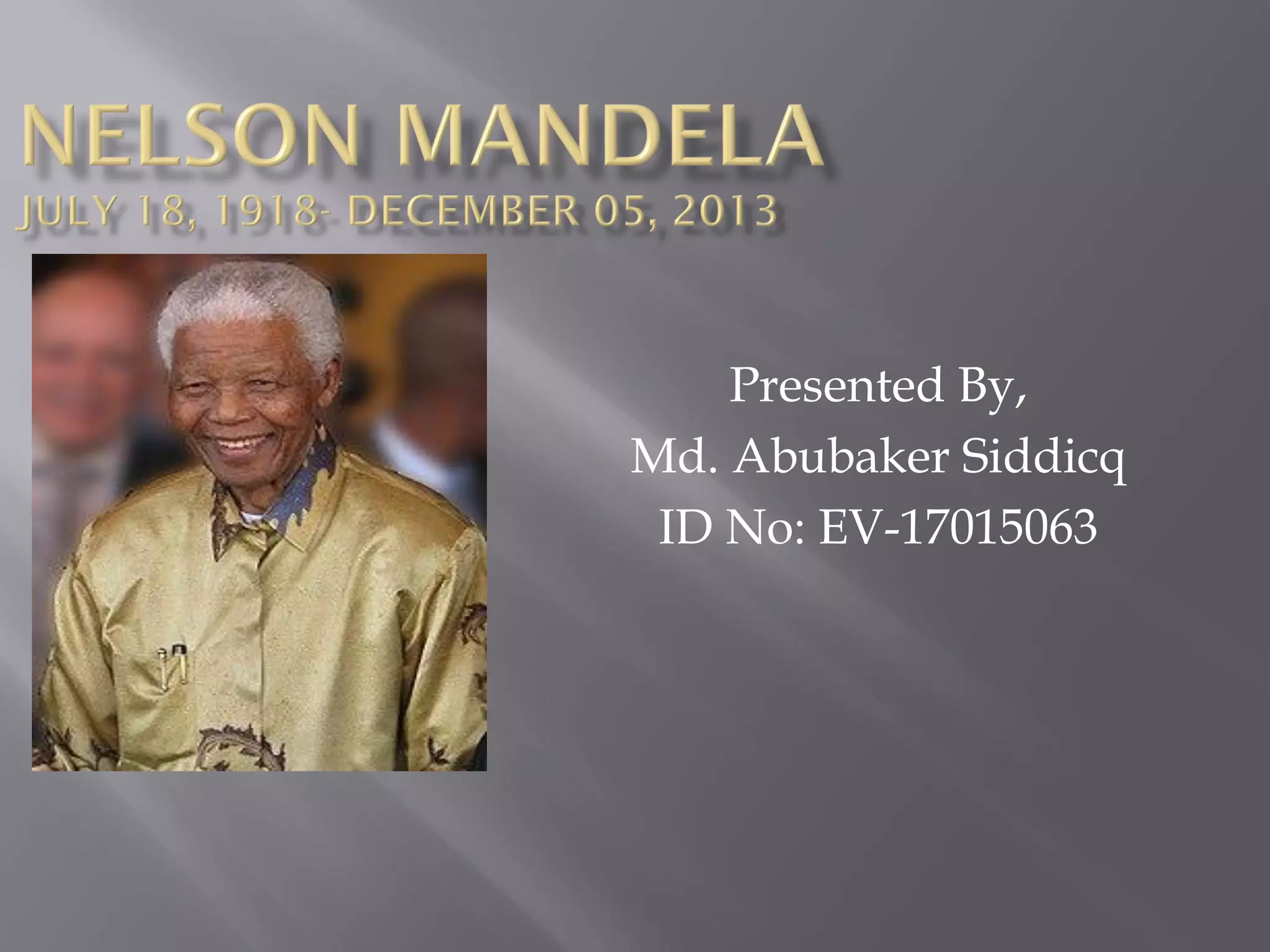
 Nelson Mandela was born into the Madiba
clan in the village of Mvezo , on 18 July 1918.
 when he was 12 years old, his father died and
the young Rolihlahla became a ward of
Jongintaba at the Great Place in
Mqhekezweni.
 Mandela began his studies for a Bachelor of
Arts degree at the University College of Fort
Hare but did not complete the degree there as
he was expelled for joining in a student
protest.
 He completed his BA through the
University of South Africa and went back
to Fort Hare for his graduation in 1943.
 In 1989, while in the last months of his
imprisonment, he obtained an LLB
through the University of South Africa.
He graduated in absentia at a ceremony
in Cape Town.
 In 1993 Nobel Peace Prize for his dedication to
the fight against racial oppression in South
Africa and establishing democracy.
 He play an important role in the African
National Congress (ANC), a civil right group.
 He also helped form the ANC youth league in
the 1950’s.
 From 1960-1962 Mandela led the NAC’s para
military wing known as Umkhonto which
translate to “Spear of the Nation.”
 He was arrested in 1962, sentenced to 5 years in
prison & while incarcerated was again
convicted of sabotage& treason & was
sentenced to life imprisonment.
 During 27 years in prison, Mandela became a
symbol of resistance to the white-dominated
country of South Africa throughout the world.
 After complex negotiation, Mandela was
finally released from prison by President F.W.
deKlerk in February, 1990, after lifting the long
ban on the ANC.
 Nelson Mandela was the first black
President of South Africa. He spent 27 years
in prison for trying to overthrow the pro-
apartheid government. After he left prison,
he worked to achieve human rights and
a better future for everyone in South Africa.
 He got Nobel Peace Prize in 1993.
 Congressional Gold Medal in 1998.
 Presidential Medal of Freedom in 2002 etc.
 Education is the most powerful weapon
which you can use to change the world.
 It always seems impossible until it's
done.
 To deny people their human rights is to
challenge their very humanity.
 After climbing a great hill, one only finds
that there are many more hills to climb
etc.
 Change can be met with resistance from
people who fear it. Or who don't
understand it. There are few things more
effective as an impetus for change than
knowledge — people can't fight for
something if they don't understand what
they are fighting for.
Allah Hafez

Nelson Mandela

  • 1.
    Presented By, Md. AbubakerSiddicq ID No: EV-17015063
  • 2.
     Life ofNelson Mandela  As a Political Leader  Achievement  Famous Quotation  What we have learnt
  • 3.
     Nelson Mandelawas born into the Madiba clan in the village of Mvezo , on 18 July 1918.  when he was 12 years old, his father died and the young Rolihlahla became a ward of Jongintaba at the Great Place in Mqhekezweni.  Mandela began his studies for a Bachelor of Arts degree at the University College of Fort Hare but did not complete the degree there as he was expelled for joining in a student protest.
  • 4.
     He completedhis BA through the University of South Africa and went back to Fort Hare for his graduation in 1943.  In 1989, while in the last months of his imprisonment, he obtained an LLB through the University of South Africa. He graduated in absentia at a ceremony in Cape Town.
  • 5.
     In 1993Nobel Peace Prize for his dedication to the fight against racial oppression in South Africa and establishing democracy.  He play an important role in the African National Congress (ANC), a civil right group.  He also helped form the ANC youth league in the 1950’s.  From 1960-1962 Mandela led the NAC’s para military wing known as Umkhonto which translate to “Spear of the Nation.”
  • 6.
     He wasarrested in 1962, sentenced to 5 years in prison & while incarcerated was again convicted of sabotage& treason & was sentenced to life imprisonment.  During 27 years in prison, Mandela became a symbol of resistance to the white-dominated country of South Africa throughout the world.  After complex negotiation, Mandela was finally released from prison by President F.W. deKlerk in February, 1990, after lifting the long ban on the ANC.
  • 7.
     Nelson Mandelawas the first black President of South Africa. He spent 27 years in prison for trying to overthrow the pro- apartheid government. After he left prison, he worked to achieve human rights and a better future for everyone in South Africa.  He got Nobel Peace Prize in 1993.  Congressional Gold Medal in 1998.  Presidential Medal of Freedom in 2002 etc.
  • 8.
     Education isthe most powerful weapon which you can use to change the world.  It always seems impossible until it's done.  To deny people their human rights is to challenge their very humanity.  After climbing a great hill, one only finds that there are many more hills to climb etc.
  • 9.
     Change canbe met with resistance from people who fear it. Or who don't understand it. There are few things more effective as an impetus for change than knowledge — people can't fight for something if they don't understand what they are fighting for.
  • 10.