3
According to National Reference Manual, Neighborhood is defined as “The Combination of two or more
mohallas”.
Neighborhood can also be defined as “ A smallest unit which serves the local community and encouraged
them to foster a neighborhood spirit or relationship which seems to have been lost in modern life.
According to National Reference Manual, The characteristics of neighborhood includes; Secondary School,
Jumma Masjid (Ja’ama Masjid), and Population i.e. 25000.
Concept, Purpose, Elements, 5 C’s & Benefits.
5
The concept of Neighborhood planning was given by Clarence Arthur Perry (1872-1944) for a population of 5000-
6000. The concept began as a means of insulating the community from the ill-effects of burgeoning sea of vehicular
traffic.
Neighborhood planning is a new way for communities to decide the future of the places where they live and work.
It gives communities direct power to develop a shared vision for their neighborhood and shape the development
and growth of their local area.
The ‘Neighborhood Unit’ as a planning concept evolved in response to the degenerated environmental and
social conditions fostered as a consequence of industrial revolution in the early 1900s.
Neighborhood planning is effective and provide inspire those creative strategies that can increase the capacity of
residents in charting out their shared future.
It’s a vision of a better future.
6
01
02
03
04
05
06
To make the people socialize
with one and another.
To maintain, enhance, and improve area
for recreational activities.
To support a safe and healthy
environment within the neighborhood.
To provide safety and efficiency to road
users and pedestrians.
To enable the inhabitants to share the
public amenities and recreational
facilities.
To determine community’s prospects for
the future.
7
Facilities
Sector
Size
Street System
Boundaries
Protective Strips
Layout of buildings
Shopping Centre
Community Centres
8
COMPLETE
COMPACT
CONNECTED
COMPLEX
CONVIVIAL
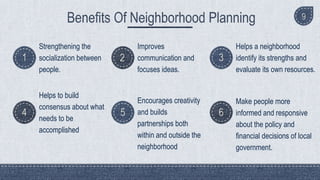
Strengthening the
socialization between
people.
Improves
communication and
focuses ideas.
Helps a neighborhood
identify its strengths and
evaluate its own resources.
Helps to build
consensus about what
needs to be
accomplished
Encourages creativity
and builds
partnerships both
within and outside the
neighborhood
Make people more
informed and responsive
about the policy and
financial decisions of local
government.
1 2 3
4 5 6
9
Any Questions?

Neighborhood planning

  • 3.
    3 According to NationalReference Manual, Neighborhood is defined as “The Combination of two or more mohallas”. Neighborhood can also be defined as “ A smallest unit which serves the local community and encouraged them to foster a neighborhood spirit or relationship which seems to have been lost in modern life. According to National Reference Manual, The characteristics of neighborhood includes; Secondary School, Jumma Masjid (Ja’ama Masjid), and Population i.e. 25000.
  • 4.
    Concept, Purpose, Elements,5 C’s & Benefits.
  • 5.
    5 The concept ofNeighborhood planning was given by Clarence Arthur Perry (1872-1944) for a population of 5000- 6000. The concept began as a means of insulating the community from the ill-effects of burgeoning sea of vehicular traffic. Neighborhood planning is a new way for communities to decide the future of the places where they live and work. It gives communities direct power to develop a shared vision for their neighborhood and shape the development and growth of their local area. The ‘Neighborhood Unit’ as a planning concept evolved in response to the degenerated environmental and social conditions fostered as a consequence of industrial revolution in the early 1900s. Neighborhood planning is effective and provide inspire those creative strategies that can increase the capacity of residents in charting out their shared future. It’s a vision of a better future.
  • 6.
    6 01 02 03 04 05 06 To make thepeople socialize with one and another. To maintain, enhance, and improve area for recreational activities. To support a safe and healthy environment within the neighborhood. To provide safety and efficiency to road users and pedestrians. To enable the inhabitants to share the public amenities and recreational facilities. To determine community’s prospects for the future.
  • 7.
  • 8.
  • 9.
    Strengthening the socialization between people. Improves communicationand focuses ideas. Helps a neighborhood identify its strengths and evaluate its own resources. Helps to build consensus about what needs to be accomplished Encourages creativity and builds partnerships both within and outside the neighborhood Make people more informed and responsive about the policy and financial decisions of local government. 1 2 3 4 5 6 9
  • 11.