Negotiation for Fun and Profit: A Practical Guide  Michael Erdle Managing Partner © 2008, Michael Erdle
Introduction Negotiation Problems  Negotiation Skills Dispute Resolution In theory there is no difference between theory and practice.  In practice, there is.   -- Jan  van de Snepscheut
Why Do We Negotiate? To get things we need or want. To resolve or reduce conflict. To create value. To enhance prestige or reputation.
What is Negotiation? Everything can be negotiated. Business Relationships “ I want to buy your product/service.” “ Let’s be partners.” Personal Relationships “ What movie to you want to see?” “ Can I borrow the car?”
What is Negotiation? Negotiation is  expressly  about specific products, services or actions. Negotiation is also  implicitly  about controlling personal feelings and behaviour. The negotiator must recognize both the visible and hidden elements of negotiation.
How Not to Negotiate Assume things are non-negotiable. Don’t prepare. Make it a “zero-sum” game. Be inflexible.  Insist on certainty and control. Fail to understand, evaluate alternatives. Show impatience. Reveal too much, too soon.
Negotiation Goals Identify Issues  What does each side want and need? Consider Interests Mutual Complementary Conflicting Create Value Opportunistic vs. Problem-solving
Distributive Bargaining “ Win-lose” approach In a zero sum game, the person who makes the first offer is at a disadvantage  sets the outer limits of price, other terms Improve zero-sum negotiation skills by: Understanding your objectives Understanding the other side’s objectives
Negotiation Traps 10 Classic “Hard Bargaining” Ploys Extreme claims, small concessions Early commitment – “my hands are tied” “ Take or leave it.” Unreciprocated offers Increasing demands Personal insults Bluffing and lying Threats and warnings Attacking the alternatives Good cop, bad cop
“ Interest-Based” Negotiation “ Win-win” approach – make the pie bigger. Different people value the same thing differently. Multiple interests and trade-offs. Recognize interdependence. Value the relationship more than the outcome of a single negotiation.
Effective Negotiation Successful relationships are built on communication and trust.  Negotiation can help to create trust – or decide whether trust is justified. Example: “The Prisoner’s Dilemma” –  classic game theory problem
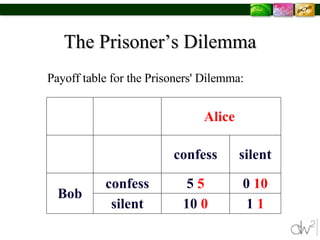
The Prisoner’s Dilemma Bob and Alice are arrested near the scene of a burglary and questioned separately by the police.  Each has to choose whether to confess and implicate the other.  If neither one confesses, both will serve  one year  in jail (carrying burglar tools).  If each confesses and implicates the other, both will go to prison for  5 years .  But, if one confesses and implicates the other, and the other does not confess, the collaborator will go free, and the other will go to prison for  10 years .
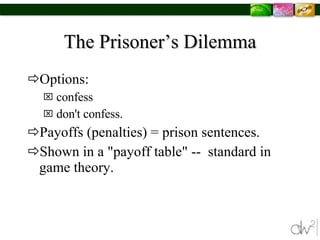
The Prisoner’s Dilemma Options:  confess  don't confess. Payoffs (penalties) = prison sentences.  Shown in a "payoff table" --  standard in game theory.
The Prisoner’s Dilemma Payoff table for the Prisoners' Dilemma: 1  1 10  0 silent 0  10 5  5 confess Bob silent confess Alice
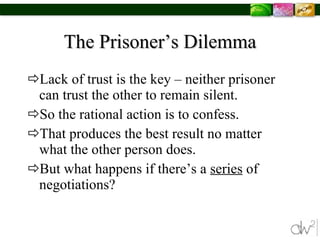
The Prisoner’s Dilemma Lack of trust is the key – neither prisoner can trust the other to remain silent. So the rational action is to confess. That produces the best result no matter what the other person does. But what happens if there’s a  series  of negotiations?
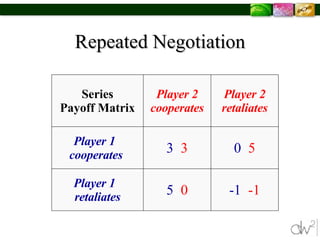
Repeated Negotiation -1 ,  -1 5 ,  0 Player 1  retaliates 0 ,  5 3 ,  3 Player 1  cooperates  Player 2 retaliates Player 2 cooperates Series Payoff Matrix
Repeated Negotiation “Tit-for-Tat” strategy is most successful.  Four key attributes: Cooperation Retaliation Forgiveness Generosity
“Tit-for-tat” Negotiation The player always cooperates, unless provoked. The player retaliates, if provoked.  The player is quick to forgive.  The game must continue long enough for the ‘retaliation and forgiveness’ pattern to affect opponent’s behaviour.
BATNA “ Best Alternative To Negotiated Agreement” Understanding BATNA – yours and the other guy’s – is the most important step in improving your negotiating position. Improve your BATNA and control the negotiations.
Negotiation Skills Communication is the key to effective negotiation. What you say is often less important than how you say it. Tone Body language
Negotiation Skills Understanding and recognition do not mean compromise and concession. Your own emotions and subconscious brain can hinder your ability to negotiate effectively.
Stroop Test
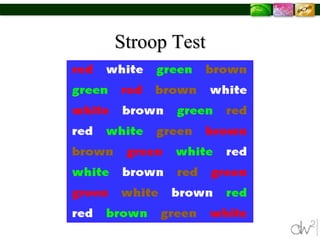
Stroop Test The automatic processing of words interferes with the task of naming the colors.  Selecting an appropriate response involves conflict between the right and left half of the brain.  This conflict is involved in many thought processes and emotional responses.  Source: PBS Online http://www.pbs.org/wgbh/nova/everest/exposure/stroopdesc.html
Negotiation Styles Three common negotiation styles Competitor Accommodator Avoider Assertive vs. Empathetic  Most effective negotiator is both assertive  and  empathetic.
Negotiation Skills Listening Develop “active listening”. Understanding Acknowledge the other person’s perspective. Flexibility Be open to other options. Pragmatism Be ready to accept the best available option.
Effective Negotiation Interests vs. Positions “ Needs” vs. “wants” “ Separate the People from the Problem.” Soft on the person Hard on the problem Consider other Options
Effective Negotiation Use objective alternatives. Look for a “win-win” solution. Find ways to improve BATNA.
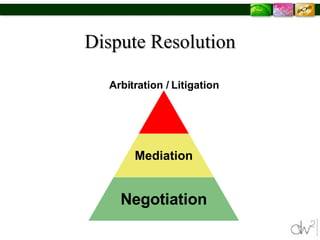
Dispute Resolution Arbitration / Litigation Mediation Negotiation
Mediation Interest-based Mediation Mediator is a facilitator Focus on interests, not legal rights or obligations Options for creative solutions Evaluative Mediation Neutral evaluation Based on legal rights & obligations
Mediation Qualities of a successful mediator: Subject area knowledge Negotiation & mediation process skills Lets parties make key decisions Creative, problem-solving approach. Patience
Resources Cohen:  You Can Negotiate Anything , Bantam, 1980 Fischer, Ury and Patton:  Getting to Yes , Penguin, 1991 Ury:  Getting Past No , Bantam, 1993 Mnookin, Peppet and Tulumello:  Beyond Winning , Harvard University Press, 2000
Questions?

Negotiation for Fun and Profit: A Practical Guide

  • 1.
    Negotiation for Funand Profit: A Practical Guide Michael Erdle Managing Partner © 2008, Michael Erdle
  • 2.
    Introduction Negotiation Problems Negotiation Skills Dispute Resolution In theory there is no difference between theory and practice. In practice, there is. -- Jan van de Snepscheut
  • 3.
    Why Do WeNegotiate? To get things we need or want. To resolve or reduce conflict. To create value. To enhance prestige or reputation.
  • 4.
    What is Negotiation?Everything can be negotiated. Business Relationships “ I want to buy your product/service.” “ Let’s be partners.” Personal Relationships “ What movie to you want to see?” “ Can I borrow the car?”
  • 5.
    What is Negotiation?Negotiation is expressly about specific products, services or actions. Negotiation is also implicitly about controlling personal feelings and behaviour. The negotiator must recognize both the visible and hidden elements of negotiation.
  • 6.
    How Not toNegotiate Assume things are non-negotiable. Don’t prepare. Make it a “zero-sum” game. Be inflexible. Insist on certainty and control. Fail to understand, evaluate alternatives. Show impatience. Reveal too much, too soon.
  • 7.
    Negotiation Goals IdentifyIssues What does each side want and need? Consider Interests Mutual Complementary Conflicting Create Value Opportunistic vs. Problem-solving
  • 8.
    Distributive Bargaining “Win-lose” approach In a zero sum game, the person who makes the first offer is at a disadvantage sets the outer limits of price, other terms Improve zero-sum negotiation skills by: Understanding your objectives Understanding the other side’s objectives
  • 9.
    Negotiation Traps 10Classic “Hard Bargaining” Ploys Extreme claims, small concessions Early commitment – “my hands are tied” “ Take or leave it.” Unreciprocated offers Increasing demands Personal insults Bluffing and lying Threats and warnings Attacking the alternatives Good cop, bad cop
  • 10.
    “ Interest-Based” Negotiation“ Win-win” approach – make the pie bigger. Different people value the same thing differently. Multiple interests and trade-offs. Recognize interdependence. Value the relationship more than the outcome of a single negotiation.
  • 11.
    Effective Negotiation Successfulrelationships are built on communication and trust. Negotiation can help to create trust – or decide whether trust is justified. Example: “The Prisoner’s Dilemma” – classic game theory problem
  • 12.
    The Prisoner’s DilemmaBob and Alice are arrested near the scene of a burglary and questioned separately by the police. Each has to choose whether to confess and implicate the other. If neither one confesses, both will serve one year in jail (carrying burglar tools). If each confesses and implicates the other, both will go to prison for 5 years . But, if one confesses and implicates the other, and the other does not confess, the collaborator will go free, and the other will go to prison for 10 years .
  • 13.
    The Prisoner’s DilemmaOptions: confess don't confess. Payoffs (penalties) = prison sentences. Shown in a "payoff table" -- standard in game theory.
  • 14.
    The Prisoner’s DilemmaPayoff table for the Prisoners' Dilemma: 1 1 10 0 silent 0 10 5 5 confess Bob silent confess Alice
  • 15.
    The Prisoner’s DilemmaLack of trust is the key – neither prisoner can trust the other to remain silent. So the rational action is to confess. That produces the best result no matter what the other person does. But what happens if there’s a series of negotiations?
  • 16.
    Repeated Negotiation -1, -1 5 , 0 Player 1 retaliates 0 , 5 3 , 3 Player 1 cooperates Player 2 retaliates Player 2 cooperates Series Payoff Matrix
  • 17.
    Repeated Negotiation “Tit-for-Tat”strategy is most successful. Four key attributes: Cooperation Retaliation Forgiveness Generosity
  • 18.
    “Tit-for-tat” Negotiation Theplayer always cooperates, unless provoked. The player retaliates, if provoked. The player is quick to forgive. The game must continue long enough for the ‘retaliation and forgiveness’ pattern to affect opponent’s behaviour.
  • 19.
    BATNA “ BestAlternative To Negotiated Agreement” Understanding BATNA – yours and the other guy’s – is the most important step in improving your negotiating position. Improve your BATNA and control the negotiations.
  • 20.
    Negotiation Skills Communicationis the key to effective negotiation. What you say is often less important than how you say it. Tone Body language
  • 21.
    Negotiation Skills Understandingand recognition do not mean compromise and concession. Your own emotions and subconscious brain can hinder your ability to negotiate effectively.
  • 22.
  • 23.
    Stroop Test Theautomatic processing of words interferes with the task of naming the colors. Selecting an appropriate response involves conflict between the right and left half of the brain. This conflict is involved in many thought processes and emotional responses. Source: PBS Online http://www.pbs.org/wgbh/nova/everest/exposure/stroopdesc.html
  • 24.
    Negotiation Styles Threecommon negotiation styles Competitor Accommodator Avoider Assertive vs. Empathetic Most effective negotiator is both assertive and empathetic.
  • 25.
    Negotiation Skills ListeningDevelop “active listening”. Understanding Acknowledge the other person’s perspective. Flexibility Be open to other options. Pragmatism Be ready to accept the best available option.
  • 26.
    Effective Negotiation Interestsvs. Positions “ Needs” vs. “wants” “ Separate the People from the Problem.” Soft on the person Hard on the problem Consider other Options
  • 27.
    Effective Negotiation Useobjective alternatives. Look for a “win-win” solution. Find ways to improve BATNA.
  • 28.
    Dispute Resolution Arbitration/ Litigation Mediation Negotiation
  • 29.
    Mediation Interest-based MediationMediator is a facilitator Focus on interests, not legal rights or obligations Options for creative solutions Evaluative Mediation Neutral evaluation Based on legal rights & obligations
  • 30.
    Mediation Qualities ofa successful mediator: Subject area knowledge Negotiation & mediation process skills Lets parties make key decisions Creative, problem-solving approach. Patience
  • 31.
    Resources Cohen: You Can Negotiate Anything , Bantam, 1980 Fischer, Ury and Patton: Getting to Yes , Penguin, 1991 Ury: Getting Past No , Bantam, 1993 Mnookin, Peppet and Tulumello: Beyond Winning , Harvard University Press, 2000
  • 32.