NEGOTIATION

http://in.linkedin.com/in/gurpindersingh
What is Negotiation?
Negotiation is a method by which people settle differences.
It is a process by which compromise or agreement is reached
while avoiding argument
Why Negotiate?
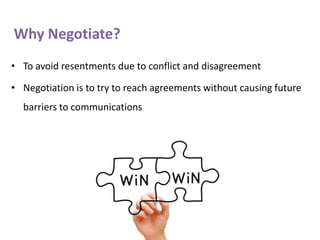
• To avoid resentments due to conflict and disagreement

• Negotiation is to try to reach agreements without causing future
barriers to communications
Stages of Negotiation
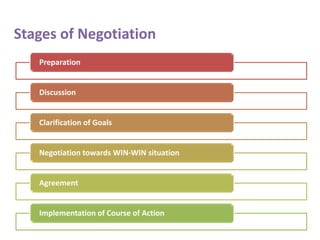
Preparation

Discussion

Clarification of Goals

Negotiation towards WIN-WIN situation

Agreement

Implementation of Course of Action
1. Preparation
• Venue to discuss the problem and who will attend

• Setting a limited timescale can prevent the continuation of
disagreement

• Ensure that you have knowledge of all the pertinent facts of the
situation are known in order to clarify your own position
• This would include knowing the ‘rules’ of your organization
2. Discussion
• During this stage, individuals or members of each side put forward
the case as they see it, that is their understanding of the situation.
• Key skills are questioning, listening and clarifying.
• Take notes during the discussion stage to record all points put
forward in case there is need for further clarification.
• It is extremely important to listen,

• Each side should have an equal opportunity to present their case
3. Clarifying Goals
• From the discussion, the goals, interests and viewpoints of both
sides of the disagreement need to be clarified.
• List these in order of priority.
• Through clarification it is often possible to identify or establish

common ground.
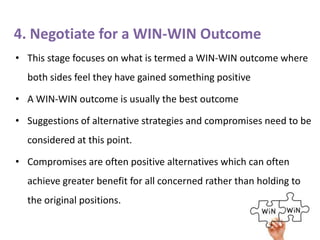
4. Negotiate for a WIN-WIN Outcome
• This stage focuses on what is termed a WIN-WIN outcome where
both sides feel they have gained something positive
• A WIN-WIN outcome is usually the best outcome
• Suggestions of alternative strategies and compromises need to be

considered at this point.
• Compromises are often positive alternatives which can often
achieve greater benefit for all concerned rather than holding to
the original positions.
5. Agreement
• Agreement can be achieved once understanding of both sides’
viewpoints and interests have been considered.

• It is essential to keep an open mind in order to achieve a solution.
• Any agreement needs to be made perfectly clear so that both sides
know what has been decided.
6. Implementing a Course of Action
• From the agreement, a course of action has to be implemented, to
carry through the decision.
• Failure to Agree: process of negotiation breaks down and

agreement cannot be reached, then re-scheduling a further
meeting is called for.
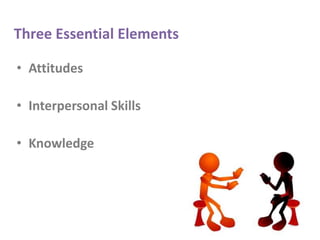
Three Essential Elements
• Attitudes
• Interpersonal Skills
• Knowledge
Attitudes
• All negotiation is strongly influenced by underlying attitudes to

the process itself
• Negotiation is not an arena for the realization of individual
achievements.

• Certain features of negotiation may influence a person’s behavior,
for example some people may become defensive.
Interpersonal Skills
Skills You Need:
• Communication
• Listening
• Reflecting, Clarifying and Summarising

• Problem Solving
• Decision Making
• Assertiveness

• Stress Management
• Dealing with Aggression
Knowledge
• Good preparation is essential.
• The way issues are negotiated must be understood as negotiating
will require different methods in different situations
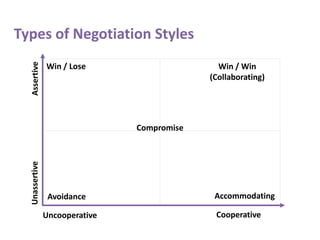
Assertive

Types of Negotiation Styles
Win / Lose

Win / Win
(Collaborating)

Unassertive

Compromise

Avoidance
Uncooperative

Accommodating
Cooperative
Win - Lose Style
• The win-lose is the most common style of negotiation wherein a
person pursues his or her own interests at the expense of other
party.
• Under this style negotiation is viewed as a game to be won. Losing

may be taken as failure, weakness, and a loss of status.
• When engaged in this style, the parties may use different tactics to
win like: persuasion, argument, power, or even threats.
Avoidance Style
• Avoiding the conflict in certain situations – not negotiating at all –
is also negotiation.
• People may physically withdraw by simply leaving the scene of
conflict or they can refuse to get involved by using silence, or

changing the topic of conversation.
• Psychologically, avoiders can also deny the existence of conflict.
• During formal negotiation, avoidance style is exercised by turning
a deaf ear and / or a blind eye to the conflicting points or issues.
Accommodating Style
• Accommodating style of negotiation entails giving in to the wishes

of the opponent party.
• Like avoidance, accommodating the other party almost in a onesided way, is also a negotiation.

• Unlike avoiders, the accommodators enter into negotiation and give
in a way that strengthens the relationships.
• During negotiation, giving in totally / partially may be part of
negotiating game plan.
Compromising Style
• Compromising, the most common style of conflict resolution,
entails splitting the differences and reaching an acceptable middle
ground solution through give-and-take whereby each party should
gain something and may have to lose something.
• Parties under this style of negotiation, generally use techniques
like trading, bargaining, smoothing over differences, & voting etc.
• While most negotiations start with win-lose style, they may end up

with a compromise.
Collaborating (Win-Win) Style
• Collaborating is based on a willingness to accept other party’s
needs while asserting your own needs as well.
• It assumes that there is some reasonable chance that a solution

can be found to satisfy both parties in conflict without losing much.
• Solutions which satisfy all parties , are generally not possible, but a
collaborator believes that it is worth trying to find that.
Key Points
• Focus on maintaining good relationships
• Focus on the interest not position
• Generate a variety of options that offer gains to both sides
before making decisions

• Avoid misunderstanding
– clarify the goal, problem, viewpoints, meanings
Negotiations

Negotiations

  • 1.
  • 2.
    What is Negotiation? Negotiationis a method by which people settle differences. It is a process by which compromise or agreement is reached while avoiding argument
  • 3.
    Why Negotiate? • Toavoid resentments due to conflict and disagreement • Negotiation is to try to reach agreements without causing future barriers to communications
  • 4.
    Stages of Negotiation Preparation Discussion Clarificationof Goals Negotiation towards WIN-WIN situation Agreement Implementation of Course of Action
  • 5.
    1. Preparation • Venueto discuss the problem and who will attend • Setting a limited timescale can prevent the continuation of disagreement • Ensure that you have knowledge of all the pertinent facts of the situation are known in order to clarify your own position • This would include knowing the ‘rules’ of your organization
  • 6.
    2. Discussion • Duringthis stage, individuals or members of each side put forward the case as they see it, that is their understanding of the situation. • Key skills are questioning, listening and clarifying. • Take notes during the discussion stage to record all points put forward in case there is need for further clarification. • It is extremely important to listen, • Each side should have an equal opportunity to present their case
  • 7.
    3. Clarifying Goals •From the discussion, the goals, interests and viewpoints of both sides of the disagreement need to be clarified. • List these in order of priority. • Through clarification it is often possible to identify or establish common ground.
  • 8.
    4. Negotiate fora WIN-WIN Outcome • This stage focuses on what is termed a WIN-WIN outcome where both sides feel they have gained something positive • A WIN-WIN outcome is usually the best outcome • Suggestions of alternative strategies and compromises need to be considered at this point. • Compromises are often positive alternatives which can often achieve greater benefit for all concerned rather than holding to the original positions.
  • 9.
    5. Agreement • Agreementcan be achieved once understanding of both sides’ viewpoints and interests have been considered. • It is essential to keep an open mind in order to achieve a solution. • Any agreement needs to be made perfectly clear so that both sides know what has been decided.
  • 10.
    6. Implementing aCourse of Action • From the agreement, a course of action has to be implemented, to carry through the decision. • Failure to Agree: process of negotiation breaks down and agreement cannot be reached, then re-scheduling a further meeting is called for.
  • 11.
    Three Essential Elements •Attitudes • Interpersonal Skills • Knowledge
  • 12.
    Attitudes • All negotiationis strongly influenced by underlying attitudes to the process itself • Negotiation is not an arena for the realization of individual achievements. • Certain features of negotiation may influence a person’s behavior, for example some people may become defensive.
  • 13.
    Interpersonal Skills Skills YouNeed: • Communication • Listening • Reflecting, Clarifying and Summarising • Problem Solving • Decision Making • Assertiveness • Stress Management • Dealing with Aggression
  • 14.
    Knowledge • Good preparationis essential. • The way issues are negotiated must be understood as negotiating will require different methods in different situations
  • 15.
    Assertive Types of NegotiationStyles Win / Lose Win / Win (Collaborating) Unassertive Compromise Avoidance Uncooperative Accommodating Cooperative
  • 16.
    Win - LoseStyle • The win-lose is the most common style of negotiation wherein a person pursues his or her own interests at the expense of other party. • Under this style negotiation is viewed as a game to be won. Losing may be taken as failure, weakness, and a loss of status. • When engaged in this style, the parties may use different tactics to win like: persuasion, argument, power, or even threats.
  • 17.
    Avoidance Style • Avoidingthe conflict in certain situations – not negotiating at all – is also negotiation. • People may physically withdraw by simply leaving the scene of conflict or they can refuse to get involved by using silence, or changing the topic of conversation. • Psychologically, avoiders can also deny the existence of conflict. • During formal negotiation, avoidance style is exercised by turning a deaf ear and / or a blind eye to the conflicting points or issues.
  • 18.
    Accommodating Style • Accommodatingstyle of negotiation entails giving in to the wishes of the opponent party. • Like avoidance, accommodating the other party almost in a onesided way, is also a negotiation. • Unlike avoiders, the accommodators enter into negotiation and give in a way that strengthens the relationships. • During negotiation, giving in totally / partially may be part of negotiating game plan.
  • 19.
    Compromising Style • Compromising,the most common style of conflict resolution, entails splitting the differences and reaching an acceptable middle ground solution through give-and-take whereby each party should gain something and may have to lose something. • Parties under this style of negotiation, generally use techniques like trading, bargaining, smoothing over differences, & voting etc. • While most negotiations start with win-lose style, they may end up with a compromise.
  • 20.
    Collaborating (Win-Win) Style •Collaborating is based on a willingness to accept other party’s needs while asserting your own needs as well. • It assumes that there is some reasonable chance that a solution can be found to satisfy both parties in conflict without losing much. • Solutions which satisfy all parties , are generally not possible, but a collaborator believes that it is worth trying to find that.
  • 21.
    Key Points • Focuson maintaining good relationships • Focus on the interest not position • Generate a variety of options that offer gains to both sides before making decisions • Avoid misunderstanding – clarify the goal, problem, viewpoints, meanings