DISSERTATION
PRESENTATION
PRESENTED BY
Ms. KRUPA PATEL
RESEARCH GUIDE
Mr. HASMUKH H. PATEL
A s s i s t a n t P r o f e s s o r,
H O D O f M e d i c a l S u r g i c a l N u r s i n g
C h i t r i n i N u r s i n g C o l l e g e , P r a n t i j .
RESEARCH STATEMENT
“A STUDY TO ASSESS THE EFFECTIVENESS OF STRUCTURE
TEACHING PROGRAMME ON KNOWLEDGE REGARDING NEEDLE
STICK INJURY AMONG
THE CLASS-IV WORKERS WORKING
AT SELECTED HOSPITALS OF
SABARAKANTHA DISTRICT.”
INTRODUCTION
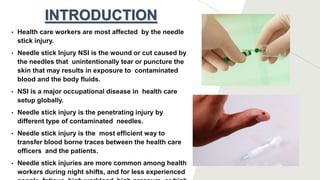
• Health care workers are most affected by the needle
stick injury.
• Needle stick Injury NSI is the wound or cut caused by
the needles that unintentionally tear or puncture the
skin that may results in exposure to contaminated
blood and the body fluids.
• NSI is a major occupational disease in health care
setup globally.
• Needle stick injury is the penetrating injury by
different type of contaminated needles.
• Needle stick injury is the most efficient way to
transfer blood borne traces between the health care
officers and the patients.
• Needle stick injuries are more common among health
workers during night shifts, and for less experienced
NEED OF THE STUDY
• The researchers (Yadara 2017) felt that class-iv workers are most suitable
candidates for training of prevention & management of NSI as they are likely to
come across such situations during handling the bio waste management. This
study aims at assessing knowledge of prevention & management of NSI of class-iv
workers working at hospitals.
• According to International Journal of Applied Research 46% were having moderate
knowledge, and 34% were having adequate knowledge and 20% of health workers
having inadequate knowledge about needle stick injury.
• WHO reports in the World Health Report 2018, that of the 35 million health-care
workersout of them, 2 million workers experience percutaneous exposure to
infectious diseases each year.
• It further notes that 37.6% of Hepatitis B, 39% of Hepatitis C and 4.4% of HIV/AIDS
RESEARCH STATEMENT
“A STUDY TO ASSESS THE EFFECTIVENESS OF
STRUCTURE TEACHING PROGRAMME ON KNOWLEDGE
REGARDING NEEDLE STICK INJURY AMONG
THE CLASS-IV WORKERS WORKING
AT SELECTED HOSPITALS OF
SABARAKANTHA DISTRICT.”
OBJECTIVES OF THE STUDY
• To assess the level of knowledge regarding needle stick injury
among the class-IV workers working at hospitals structure teaching
programme.
• To evaluate the effectiveness of structure teaching programme on
the knowledge regarding needle stick injury among the class-iv
workers working at hospitals.
• To find out the association between pretest level of knowledge with
selected socio demographic variables.
HYPOTHESIS
• H1: The mean post test knowledge scores of class-IV
workers will be significantly higher than the mean
pretest scores on knowledge regarding needle stick
injury as measured by knowledge questionnaire.
• H2: There will be significant association between the
pretest scores of knowledge with the selected
demographic variables
OPERATIONAL DEFINITIONS
 Assess:
• According to oxford dictionary, to make a judgment about the nature or
quality of someone or something
• In this study, assess refers to examine or know the level of knowledge of
students on needle stick injury at selected hospitals of sabarkantha district.
 Knowledge:
• According to oxford dictionary, the information, understanding and skills that
you gain through education or experience
• In this study, knowledge refers to the extent of information, understanding or
awareness of class-IV workers on needle stick injury at selected hospitals of
sabarkantha district.
Effectiveness :
• According to oxford dictionary, the fact of producing the result that is
wanted or intended
• In this study, effectiveness refers to the ability to be successful and
produce the intended result.
Structure Teaching Programe :
• In this study, structure teaching program refers to systematically
developed instructional programe using instructional aids, designed to
provide information on the needle stick injury.
Needle Stick Injury :
• In this study, needle stick injury refers to wounds caused by needles
that accidentally puncture the skin.
Class-IV Workers :
• In this study, class-iv workers are the persons who are working at
hospital for cleaning area of hospital and handling the bio medical
waste management
Hospital :
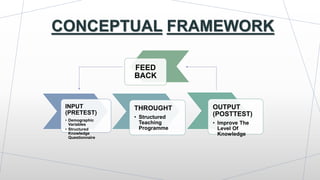
CONCEPTUAL FRAMEWORK
INPUT
(PRETEST)
• Demographic
Variables
• Structured
Knowledge
Questionnaire
THROUGHT
• Structured
Teaching
Programme
OUTPUT
(POSTTEST)
• Improve The
Level Of
Knowledge
FEED
BACK
REVIEW
OF
LITERATURE
Literature related to knowledge
and attitude regarding prevention
of Needle Stick Injuries.
Literature related to structured
teaching program on knowledge
and attitude regarding prevention
of Needle Stick Injuries.
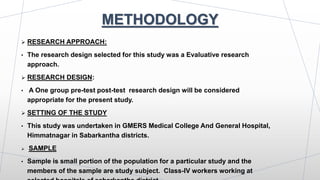
METHODOLOGY
 RESEARCH APPROACH:
• The research design selected for this study was a Evaluative research
approach.
 RESEARCH DESIGN:
• A One group pre-test post-test research design will be considered
appropriate for the present study.
 SETTING OF THE STUDY
• This study was undertaken in GMERS Medical College And General Hospital,
Himmatnagar in Sabarkantha districts.
 SAMPLE
• Sample is small portion of the population for a particular study and the
members of the sample are study subject. Class-IV workers working at
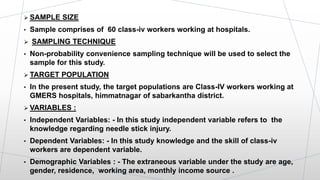
 SAMPLE SIZE
• Sample comprises of 60 class-iv workers working at hospitals.
 SAMPLING TECHNIQUE
• Non-probability convenience sampling technique will be used to select the
sample for this study.
 TARGET POPULATION
• In the present study, the target populations are Class-IV workers working at
GMERS hospitals, himmatnagar of sabarkantha district.
 VARIABLES :
• Independent Variables: - In this study independent variable refers to the
knowledge regarding needle stick injury.
• Dependent Variables: - In this study knowledge and the skill of class-iv
workers are dependent variable.
• Demographic Variables : - The extraneous variable under the study are age,
gender, residence, working area, monthly income source .
RESULT OF STUDY
Section A: demographic variables of study participants
regarding knowledge of needle stick injuries.
Section B: Analysis and interpretation of knowledge regarding
needle stick injuries.
Section C: Effectiveness of the structured teaching program
regarding needle stick injuries
Section D: Association between pretest knowledge score and
their selected demographic variables
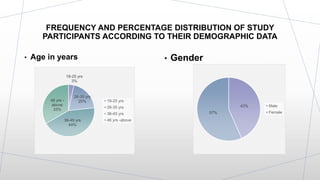
FREQUENCY AND PERCENTAGE DISTRIBUTION OF STUDY
PARTICIPANTS ACCORDING TO THEIR DEMOGRAPHIC DATA
• Age in years • Gender
18-25 yrs
3%
26-35 yrs
20%
36-45 yrs
44%
46 yrs -
above
33%
18-25 yrs
26-35 yrs
36-45 yrs
46 yrs -above
43%
57%
Male
Female
• Religion • Education
FREQUENCY AND PERCENTAGE DISTRIBUTION OF STUDY
PARTICIPANTS ACCORDING TO THEIR DEMOGRAPHIC DATA
90%
0%
0%
10%
Hindu Muslim Christian Others
10th pass
3%
12th pass
87%
graduate
10%
Postgraduat
e
0%
10th pass 12th pass graduate Postgraduate
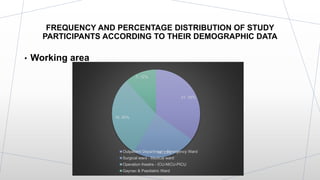
• Working area
FREQUENCY AND PERCENTAGE DISTRIBUTION OF STUDY
PARTICIPANTS ACCORDING TO THEIR DEMOGRAPHIC DATA
21, 35%
14, 23%
18, 30%
7, 12%
Outpatient Department - Emergency Ward
Surgical ward - Medical ward
Operation theatre - ICU-NICU-PICU
Gaynac & Paediatric Ward
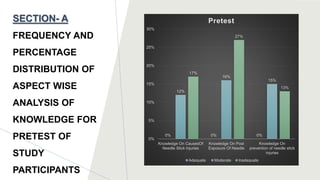
SECTION- A
FREQUENCY AND
PERCENTAGE
DISTRIBUTION OF
ASPECT WISE
ANALYSIS OF
KNOWLEDGE FOR
PRETEST OF
STUDY
PARTICIPANTS
0% 0% 0%
12%
16%
15%
17%
27%
13%
0%
5%
10%
15%
20%
25%
30%
Knowledge On CausesOf
Needle Stick Injuries
Knowledge On Post
Exposure Of Needle
Knowledge On
prevention of needle stick
injuries
Pretest
Adequate Moderate Inadequate
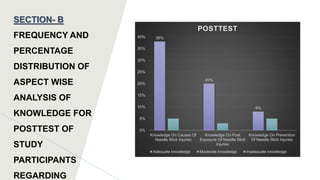
SECTION- B
FREQUENCY AND
PERCENTAGE
DISTRIBUTION OF
ASPECT WISE
ANALYSIS OF
KNOWLEDGE FOR
POSTTEST OF
STUDY
PARTICIPANTS
REGARDING
38%
20%
8%
0%
5%
10%
15%
20%
25%
30%
35%
40%
Knowledge On Causes Of
Needle Stick Injuries
Knowledge On Post
Exposure Of Needle Stick
Injuries
Knowledge On Prevention
Of Needle Stick Injuries
POSTTEST
Adequate knowledge Moderate knowledge Inadequate knowledge
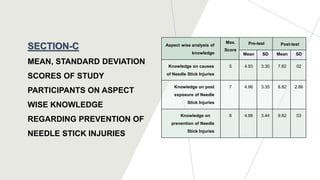
SECTION-C
MEAN, STANDARD DEVIATION
SCORES OF STUDY
PARTICIPANTS ON ASPECT
WISE KNOWLEDGE
REGARDING PREVENTION OF
NEEDLE STICK INJURIES
Aspect wise analysis of
knowledge
Max.
Score
Pre-test Post-test
Mean SD Mean SD
Knowledge on causes
of Needle Stick Injuries
5 4.93 3.30 7.82 02
Knowledge on post
exposure of Needle
Stick Injuries
7 4.96 3.35 8.82 2.86
Knowledge on
prevention of Needle
Stick Injuries
8 4.98 3.44 9.82 03
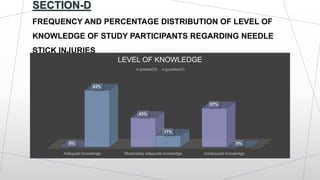
SECTION-D
FREQUENCY AND PERCENTAGE DISTRIBUTION OF LEVEL OF
KNOWLEDGE OF STUDY PARTICIPANTS REGARDING NEEDLE
STICK INJURIES
Adequate knowledge Moderately adequate knowledge Inadequate knowledge
0%
43%
57%
83%
17%
0%
LEVEL OF KNOWLEDGE
(pretest)% (posttest)%
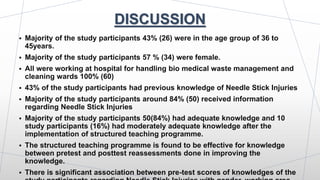
DISCUSSION
 Majority of the study participants 43% (26) were in the age group of 36 to
45years.
 Majority of the study participants 57 % (34) were female.
 All were working at hospital for handling bio medical waste management and
cleaning wards 100% (60)
 43% of the study participants had previous knowledge of Needle Stick Injuries
 Majority of the study participants around 84% (50) received information
regarding Needle Stick Injuries
 Majority of the study participants 50(84%) had adequate knowledge and 10
study participants (16%) had moderately adequate knowledge after the
implementation of structured teaching programme.
 The structured teaching programme is found to be effective for knowledge
between pretest and posttest reassessments done in improving the
knowledge.
 There is significant association between pre-test scores of knowledges of the
CONCLUSION
• The study found that structured teaching program on
knowledge regarding Needle Stick Injuries has helped
to develop additional knowledge about the same.
• It is very effective for the study participants, and they
can use this knowledge in working are.
• The result of the study shows that there is a need to
arrange informative programmes on Needle Stick
Injuries, sharp injury and their prevention.
• Hence, structured teaching programme helps the study
participants to be aware of the prevention of Needle
Stick Injuries thereby protecting themselves as well as
RECOMMENDATIONS FOR
FURTHER STUDY
 A similar study can be replicated on a larger sample size to
generalize the findings.
 A study can be conducted by using other booklets,
flashcards, demonstration, role play, simulation and video.
 Hospital personnel should be provided with periodic training
services regarding Needle Stick Injuries.
 A larger study can be carried out to assess the knowledge
and attitude and practice regarding universal precaution
towards infectious diseases.
Needle stick injury .pptx

Needle stick injury .pptx

  • 1.
    DISSERTATION PRESENTATION PRESENTED BY Ms. KRUPAPATEL RESEARCH GUIDE Mr. HASMUKH H. PATEL A s s i s t a n t P r o f e s s o r, H O D O f M e d i c a l S u r g i c a l N u r s i n g C h i t r i n i N u r s i n g C o l l e g e , P r a n t i j .
  • 2.
    RESEARCH STATEMENT “A STUDYTO ASSESS THE EFFECTIVENESS OF STRUCTURE TEACHING PROGRAMME ON KNOWLEDGE REGARDING NEEDLE STICK INJURY AMONG THE CLASS-IV WORKERS WORKING AT SELECTED HOSPITALS OF SABARAKANTHA DISTRICT.”
  • 3.
    INTRODUCTION • Health careworkers are most affected by the needle stick injury. • Needle stick Injury NSI is the wound or cut caused by the needles that unintentionally tear or puncture the skin that may results in exposure to contaminated blood and the body fluids. • NSI is a major occupational disease in health care setup globally. • Needle stick injury is the penetrating injury by different type of contaminated needles. • Needle stick injury is the most efficient way to transfer blood borne traces between the health care officers and the patients. • Needle stick injuries are more common among health workers during night shifts, and for less experienced
  • 4.
    NEED OF THESTUDY • The researchers (Yadara 2017) felt that class-iv workers are most suitable candidates for training of prevention & management of NSI as they are likely to come across such situations during handling the bio waste management. This study aims at assessing knowledge of prevention & management of NSI of class-iv workers working at hospitals. • According to International Journal of Applied Research 46% were having moderate knowledge, and 34% were having adequate knowledge and 20% of health workers having inadequate knowledge about needle stick injury. • WHO reports in the World Health Report 2018, that of the 35 million health-care workersout of them, 2 million workers experience percutaneous exposure to infectious diseases each year. • It further notes that 37.6% of Hepatitis B, 39% of Hepatitis C and 4.4% of HIV/AIDS
  • 5.
    RESEARCH STATEMENT “A STUDYTO ASSESS THE EFFECTIVENESS OF STRUCTURE TEACHING PROGRAMME ON KNOWLEDGE REGARDING NEEDLE STICK INJURY AMONG THE CLASS-IV WORKERS WORKING AT SELECTED HOSPITALS OF SABARAKANTHA DISTRICT.”
  • 6.
    OBJECTIVES OF THESTUDY • To assess the level of knowledge regarding needle stick injury among the class-IV workers working at hospitals structure teaching programme. • To evaluate the effectiveness of structure teaching programme on the knowledge regarding needle stick injury among the class-iv workers working at hospitals. • To find out the association between pretest level of knowledge with selected socio demographic variables.
  • 7.
    HYPOTHESIS • H1: Themean post test knowledge scores of class-IV workers will be significantly higher than the mean pretest scores on knowledge regarding needle stick injury as measured by knowledge questionnaire. • H2: There will be significant association between the pretest scores of knowledge with the selected demographic variables
  • 8.
    OPERATIONAL DEFINITIONS  Assess: •According to oxford dictionary, to make a judgment about the nature or quality of someone or something • In this study, assess refers to examine or know the level of knowledge of students on needle stick injury at selected hospitals of sabarkantha district.  Knowledge: • According to oxford dictionary, the information, understanding and skills that you gain through education or experience • In this study, knowledge refers to the extent of information, understanding or awareness of class-IV workers on needle stick injury at selected hospitals of sabarkantha district.
  • 9.
    Effectiveness : • Accordingto oxford dictionary, the fact of producing the result that is wanted or intended • In this study, effectiveness refers to the ability to be successful and produce the intended result. Structure Teaching Programe : • In this study, structure teaching program refers to systematically developed instructional programe using instructional aids, designed to provide information on the needle stick injury. Needle Stick Injury : • In this study, needle stick injury refers to wounds caused by needles that accidentally puncture the skin. Class-IV Workers : • In this study, class-iv workers are the persons who are working at hospital for cleaning area of hospital and handling the bio medical waste management Hospital :
  • 10.
    CONCEPTUAL FRAMEWORK INPUT (PRETEST) • Demographic Variables •Structured Knowledge Questionnaire THROUGHT • Structured Teaching Programme OUTPUT (POSTTEST) • Improve The Level Of Knowledge FEED BACK
  • 11.
    REVIEW OF LITERATURE Literature related toknowledge and attitude regarding prevention of Needle Stick Injuries. Literature related to structured teaching program on knowledge and attitude regarding prevention of Needle Stick Injuries.
  • 12.
    METHODOLOGY  RESEARCH APPROACH: •The research design selected for this study was a Evaluative research approach.  RESEARCH DESIGN: • A One group pre-test post-test research design will be considered appropriate for the present study.  SETTING OF THE STUDY • This study was undertaken in GMERS Medical College And General Hospital, Himmatnagar in Sabarkantha districts.  SAMPLE • Sample is small portion of the population for a particular study and the members of the sample are study subject. Class-IV workers working at
  • 13.
     SAMPLE SIZE •Sample comprises of 60 class-iv workers working at hospitals.  SAMPLING TECHNIQUE • Non-probability convenience sampling technique will be used to select the sample for this study.  TARGET POPULATION • In the present study, the target populations are Class-IV workers working at GMERS hospitals, himmatnagar of sabarkantha district.  VARIABLES : • Independent Variables: - In this study independent variable refers to the knowledge regarding needle stick injury. • Dependent Variables: - In this study knowledge and the skill of class-iv workers are dependent variable. • Demographic Variables : - The extraneous variable under the study are age, gender, residence, working area, monthly income source .
  • 14.
    RESULT OF STUDY SectionA: demographic variables of study participants regarding knowledge of needle stick injuries. Section B: Analysis and interpretation of knowledge regarding needle stick injuries. Section C: Effectiveness of the structured teaching program regarding needle stick injuries Section D: Association between pretest knowledge score and their selected demographic variables
  • 15.
    FREQUENCY AND PERCENTAGEDISTRIBUTION OF STUDY PARTICIPANTS ACCORDING TO THEIR DEMOGRAPHIC DATA • Age in years • Gender 18-25 yrs 3% 26-35 yrs 20% 36-45 yrs 44% 46 yrs - above 33% 18-25 yrs 26-35 yrs 36-45 yrs 46 yrs -above 43% 57% Male Female
  • 16.
    • Religion •Education FREQUENCY AND PERCENTAGE DISTRIBUTION OF STUDY PARTICIPANTS ACCORDING TO THEIR DEMOGRAPHIC DATA 90% 0% 0% 10% Hindu Muslim Christian Others 10th pass 3% 12th pass 87% graduate 10% Postgraduat e 0% 10th pass 12th pass graduate Postgraduate
  • 17.
    • Working area FREQUENCYAND PERCENTAGE DISTRIBUTION OF STUDY PARTICIPANTS ACCORDING TO THEIR DEMOGRAPHIC DATA 21, 35% 14, 23% 18, 30% 7, 12% Outpatient Department - Emergency Ward Surgical ward - Medical ward Operation theatre - ICU-NICU-PICU Gaynac & Paediatric Ward
  • 18.
    SECTION- A FREQUENCY AND PERCENTAGE DISTRIBUTIONOF ASPECT WISE ANALYSIS OF KNOWLEDGE FOR PRETEST OF STUDY PARTICIPANTS 0% 0% 0% 12% 16% 15% 17% 27% 13% 0% 5% 10% 15% 20% 25% 30% Knowledge On CausesOf Needle Stick Injuries Knowledge On Post Exposure Of Needle Knowledge On prevention of needle stick injuries Pretest Adequate Moderate Inadequate
  • 19.
    SECTION- B FREQUENCY AND PERCENTAGE DISTRIBUTIONOF ASPECT WISE ANALYSIS OF KNOWLEDGE FOR POSTTEST OF STUDY PARTICIPANTS REGARDING 38% 20% 8% 0% 5% 10% 15% 20% 25% 30% 35% 40% Knowledge On Causes Of Needle Stick Injuries Knowledge On Post Exposure Of Needle Stick Injuries Knowledge On Prevention Of Needle Stick Injuries POSTTEST Adequate knowledge Moderate knowledge Inadequate knowledge
  • 20.
    SECTION-C MEAN, STANDARD DEVIATION SCORESOF STUDY PARTICIPANTS ON ASPECT WISE KNOWLEDGE REGARDING PREVENTION OF NEEDLE STICK INJURIES Aspect wise analysis of knowledge Max. Score Pre-test Post-test Mean SD Mean SD Knowledge on causes of Needle Stick Injuries 5 4.93 3.30 7.82 02 Knowledge on post exposure of Needle Stick Injuries 7 4.96 3.35 8.82 2.86 Knowledge on prevention of Needle Stick Injuries 8 4.98 3.44 9.82 03
  • 21.
    SECTION-D FREQUENCY AND PERCENTAGEDISTRIBUTION OF LEVEL OF KNOWLEDGE OF STUDY PARTICIPANTS REGARDING NEEDLE STICK INJURIES Adequate knowledge Moderately adequate knowledge Inadequate knowledge 0% 43% 57% 83% 17% 0% LEVEL OF KNOWLEDGE (pretest)% (posttest)%
  • 22.
    DISCUSSION  Majority ofthe study participants 43% (26) were in the age group of 36 to 45years.  Majority of the study participants 57 % (34) were female.  All were working at hospital for handling bio medical waste management and cleaning wards 100% (60)  43% of the study participants had previous knowledge of Needle Stick Injuries  Majority of the study participants around 84% (50) received information regarding Needle Stick Injuries  Majority of the study participants 50(84%) had adequate knowledge and 10 study participants (16%) had moderately adequate knowledge after the implementation of structured teaching programme.  The structured teaching programme is found to be effective for knowledge between pretest and posttest reassessments done in improving the knowledge.  There is significant association between pre-test scores of knowledges of the
  • 23.
    CONCLUSION • The studyfound that structured teaching program on knowledge regarding Needle Stick Injuries has helped to develop additional knowledge about the same. • It is very effective for the study participants, and they can use this knowledge in working are. • The result of the study shows that there is a need to arrange informative programmes on Needle Stick Injuries, sharp injury and their prevention. • Hence, structured teaching programme helps the study participants to be aware of the prevention of Needle Stick Injuries thereby protecting themselves as well as
  • 24.
    RECOMMENDATIONS FOR FURTHER STUDY A similar study can be replicated on a larger sample size to generalize the findings.  A study can be conducted by using other booklets, flashcards, demonstration, role play, simulation and video.  Hospital personnel should be provided with periodic training services regarding Needle Stick Injuries.  A larger study can be carried out to assess the knowledge and attitude and practice regarding universal precaution towards infectious diseases.