Definitions
>Morning sickness: isthe nausea felt by about 50% of pregnant
women on getting up in the morning.
> Emesis gravidarum: Actual vomiting in the morning.
> These two conditions usually start between the 4th and 6th
weeks of pregnancy and improves or disappears about the 12
th week.
>Hyperemesis gravidarum: The vomiting is not confined to the
morning but it is repeated throughout the day until it affects
the general condition of the patient.
www.freelivedoctor.com
3.
Aetiology
1. Hormonal: highhuman chorionic gonadotrophin
(hCG) stimulates the chemoreceptor trigger zone
in the brain stem including the vomiting center.
This is the most accepted theory and proved by
the higher frequency in the conditions where the
hCG is high as in:-
a. early in pregnancy,
b. vesicular mole and
c. multiple pregnancy.
www.freelivedoctor.com
4.
Aetiology
2.Allergy: to thecorpus luteum or the released
hormones.
3. Deficiency of:
a. adrenocortical hormone and /or,
b. vitamin B6 and B1
4.Nervous and psychological:
a.due to psychological rejection of an
unwanted pregnancy,
b. fear of pregnancy or labour so it is more
common in primigravidae.
www.freelivedoctor.com
5.
Pathological Changes:
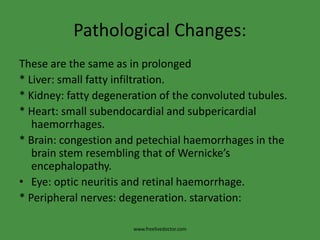
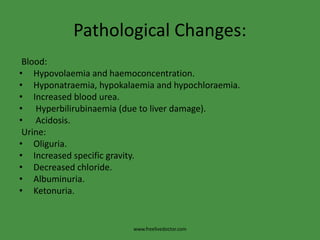
These arethe same as in prolonged
* Liver: small fatty infiltration.
* Kidney: fatty degeneration of the convoluted tubules.
* Heart: small subendocardial and subpericardial
haemorrhages.
* Brain: congestion and petechial haemorrhages in the
brain stem resembling that of Wernicke’s
encephalopathy.
• Eye: optic neuritis and retinal haemorrhage.
* Peripheral nerves: degeneration. starvation:
www.freelivedoctor.com
Diagnosis
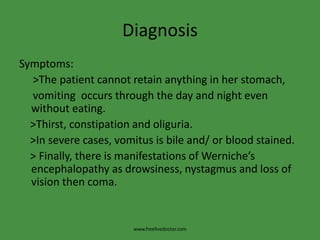
Symptoms:
>The patient cannotretain anything in her stomach,
vomiting occurs through the day and night even
without eating.
>Thirst, constipation and oliguria.
>In severe cases, vomitus is bile and/ or blood stained.
> Finally, there is manifestations of Werniche’s
encephalopathy as drowsiness, nystagmus and loss of
vision then coma.
www.freelivedoctor.com
8.
Diagnosis
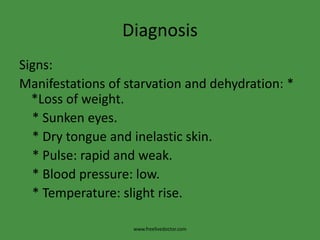
Signs:
Manifestations of starvationand dehydration: *
*Loss of weight.
* Sunken eyes.
* Dry tongue and inelastic skin.
* Pulse: rapid and weak.
* Blood pressure: low.
* Temperature: slight rise.
www.freelivedoctor.com
Management
Intravenous fluids
* Oralfeeding is prevented for 24-48 hours.
* Three litres of glucose 5% is given by rapid
infusion over 2-3 hours.
* Maintain intravenous glucose 5% and saline
therapy.
* When vomiting is controlled frequent gradual
smallcarbohydrate diets are started.
www.freelivedoctor.com
12.
Management
Drugs
* Adrenocortical preparations.
*Vit. B6 and Vit. B1.
* Antihistaminics that have antiemetic effect as
meclozinehydrochloride 25-50 mg twice daily. A
preparation contains both meclozine
hydrochloride + pyridoxine hydrochloride (vit. B6)
is of good benefit.
* Phenothiazine (chlorpromazine=largactil) 5-10 mg
three times daily has a tranquilliser and
antiemetic effect.
www.freelivedoctor.com
13.
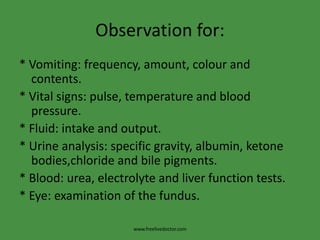
Observation for:
* Vomiting:frequency, amount, colour and
contents.
* Vital signs: pulse, temperature and blood
pressure.
* Fluid: intake and output.
* Urine analysis: specific gravity, albumin, ketone
bodies,chloride and bile pigments.
* Blood: urea, electrolyte and liver function tests.
* Eye: examination of the fundus.
www.freelivedoctor.com