NECK INCISIONS
DR G SRAVAN KUMAR
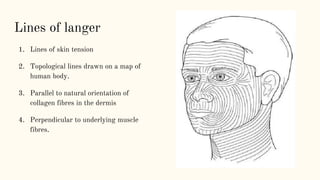
Lines of langer
1. Lines of skin tension
2. Topological lines drawn on a map of
human body.
3. Parallel to natural orientation of
collagen fibres in the dermis
4. Perpendicular to underlying muscle
fibres.
The choice for a specific incision is based on a variety of factors,
including
1. personal preference
2. previous radiotherapy or surgery,
3. the site of the primary tumour and its resection.
The following are the main goals that should be achieved by the skin
incision over neck:
1. assure adequate vascularization of the skin flaps
2. adequate exposure of the surgical field
3. consider the localization of the primary tumour
4. adequate protection of the major vessels
5. consider preoperative factors, such as previous radiotherapy
6. consider as well as facilitate reconstructive surgery, if needed
7. include previous surgical fields (scars, incisions for biopsies, etc.)
8. produce acceptable cosmetic results.
Submandibular gland excision
Transverse neck incision between
2 to 3 centimeters in length along
the inferior aspect of the
submandibular gland and
approximately 1 to 2 centimeters
inferior to the inferior border of
the mandible is made.
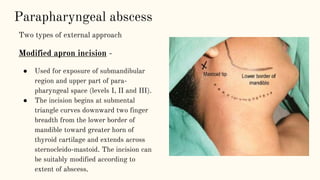
Parapharyngeal abscess
Two types of external approach
Modified apron incision -
● Used for exposure of submandibular
region and upper part of para-
pharyngeal space (levels I, II and III).
● The incision begins at submental
triangle curves downward two finger
breadth from the lower border of
mandible toward greater horn of
thyroid cartilage and extends across
sternocleido-mastoid. The incision can
be suitably modified according to
extent of abscess.
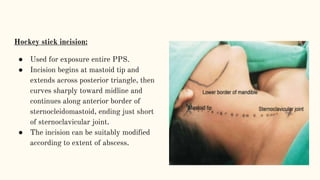
Hockey stick incision:
● Used for exposure entire PPS.
● Incision begins at mastoid tip and
extends across posterior triangle, then
curves sharply toward midline and
continues along anterior border of
sternocleidomastoid, ending just short
of sternoclavicular joint.
● The incision can be suitably modified
according to extent of abscess.
Thyroid incisions
Kocher’s thyroid incision:
Transverse “collar” incision, 2 finger
breadths above the suprasternal notch
from one sternocleidomastoid to another
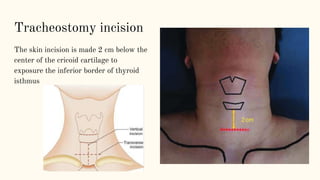
Tracheostomy incision
The skin incision is made 2 cm below the
center of the cricoid cartilage to
exposure the inferior border of thyroid
isthmus
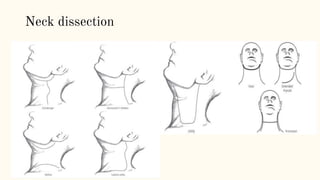
Neck dissection
Modified schobinger incision
- Modified Schobinger's incision is the most common incision used for
neck dissection.
- It has the advantage of adequate exposure and the incision can be
easily extended anteriorly as lip splitting incision in order to expose
the primary oral cavity tumor
Roy S, Shetty V, Sherigar V, Hegde P, Prasad R. Evaluation of Four Incisions Used For Radical Neck Dissection- A
Comparative Study. Asian Pac J Cancer Prev. 2019 Feb 26
Total laryngectomy incisions
● Gluck Sorensen incision
● Vertical incision
● T shaped incision
● Crime Y incision
● Trap door incision
● Double trap door incision
● Apron incision
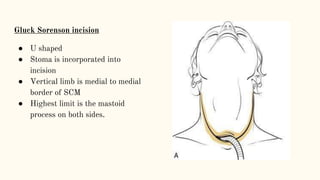
Gluck Sorenson incision
● U shaped
● Stoma is incorporated into
incision
● Vertical limb is medial to medial
border of SCM
● Highest limit is the mastoid
process on both sides.
THANK YOU

Neck incisions.pptx

  • 1.
    NECK INCISIONS DR GSRAVAN KUMAR
  • 2.
    Lines of langer 1.Lines of skin tension 2. Topological lines drawn on a map of human body. 3. Parallel to natural orientation of collagen fibres in the dermis 4. Perpendicular to underlying muscle fibres.
  • 3.
    The choice fora specific incision is based on a variety of factors, including 1. personal preference 2. previous radiotherapy or surgery, 3. the site of the primary tumour and its resection.
  • 4.
    The following arethe main goals that should be achieved by the skin incision over neck: 1. assure adequate vascularization of the skin flaps 2. adequate exposure of the surgical field 3. consider the localization of the primary tumour 4. adequate protection of the major vessels 5. consider preoperative factors, such as previous radiotherapy 6. consider as well as facilitate reconstructive surgery, if needed 7. include previous surgical fields (scars, incisions for biopsies, etc.) 8. produce acceptable cosmetic results.
  • 8.
    Submandibular gland excision Transverseneck incision between 2 to 3 centimeters in length along the inferior aspect of the submandibular gland and approximately 1 to 2 centimeters inferior to the inferior border of the mandible is made.
  • 9.
    Parapharyngeal abscess Two typesof external approach Modified apron incision - ● Used for exposure of submandibular region and upper part of para- pharyngeal space (levels I, II and III). ● The incision begins at submental triangle curves downward two finger breadth from the lower border of mandible toward greater horn of thyroid cartilage and extends across sternocleido-mastoid. The incision can be suitably modified according to extent of abscess.
  • 10.
    Hockey stick incision: ●Used for exposure entire PPS. ● Incision begins at mastoid tip and extends across posterior triangle, then curves sharply toward midline and continues along anterior border of sternocleidomastoid, ending just short of sternoclavicular joint. ● The incision can be suitably modified according to extent of abscess.
  • 11.
    Thyroid incisions Kocher’s thyroidincision: Transverse “collar” incision, 2 finger breadths above the suprasternal notch from one sternocleidomastoid to another
  • 12.
    Tracheostomy incision The skinincision is made 2 cm below the center of the cricoid cartilage to exposure the inferior border of thyroid isthmus
  • 13.
  • 14.
    Modified schobinger incision -Modified Schobinger's incision is the most common incision used for neck dissection. - It has the advantage of adequate exposure and the incision can be easily extended anteriorly as lip splitting incision in order to expose the primary oral cavity tumor
  • 15.
    Roy S, ShettyV, Sherigar V, Hegde P, Prasad R. Evaluation of Four Incisions Used For Radical Neck Dissection- A Comparative Study. Asian Pac J Cancer Prev. 2019 Feb 26
  • 16.
    Total laryngectomy incisions ●Gluck Sorensen incision ● Vertical incision ● T shaped incision ● Crime Y incision ● Trap door incision ● Double trap door incision ● Apron incision
  • 17.
    Gluck Sorenson incision ●U shaped ● Stoma is incorporated into incision ● Vertical limb is medial to medial border of SCM ● Highest limit is the mastoid process on both sides.
  • 19.